Apr 23, 2012
Mar 31, 2014
Sep 21, 2023
Aug 18, 2010
Sep 21, 2023
Nov 23, 2009

Shards of Memory After 9/11

Yesterday most of the world didn’t stop to commemorate the loss of life at the World Trade Center on September 11, 2001.  That’s OK: it’s a big world, and there is suffering enough to go around.  Perhaps that’s why I found many of the images from New York to be somewhat garish: crowded, busy, cluttered with symbolism, and ultimately self-absorbed, they were awkward photos of a scene that already is more about the present than the past.  So let me offer another image in their place.
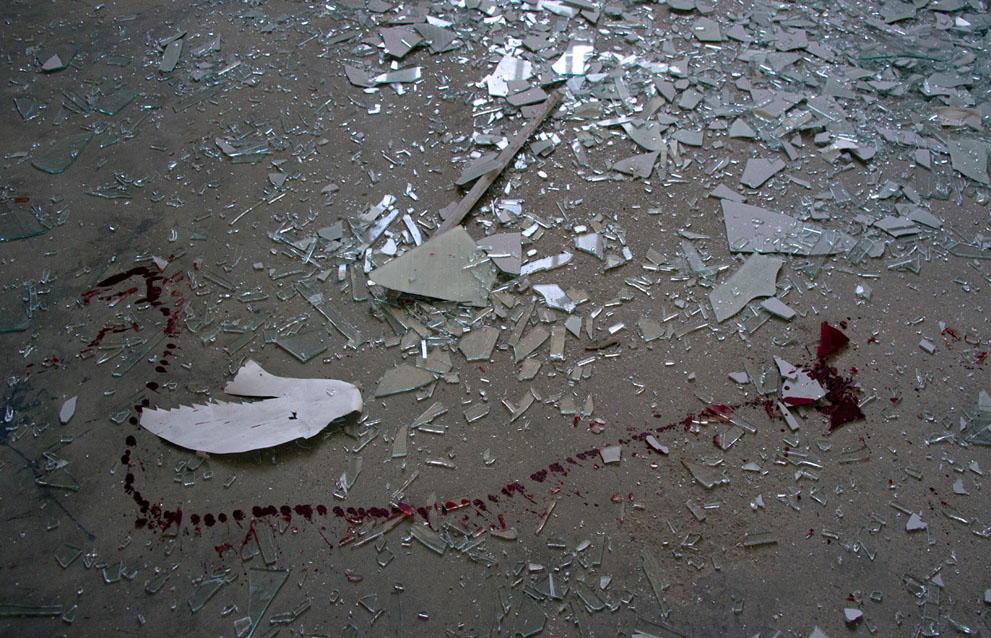
This isn’t New York, but rather a street in Kabul.  That’s one way that 9/11 is still a global event, and one where the loss of American lives and treasure continues.  The splintered glass is from a school that was lacerated by a suicide blast next door. The blood—well, that didn’t come from the masonry.  Those shards will have flown like shrapnel.  Terrorism, like torture, like any war in a civilian environment can traumatize not only with the weapons themselves but also by turning the furniture of everyday life into instruments of horror.

For the same reason, scenes such as this can lead absurdly in the other direction to normalize violence.  Step back (figuratively) just a bit, and the image looks like a plate prepared at some tony restaurant: the small entree, a detritus of smaller pieces strewn casually as if nature’s work, and then the delicate drizzle of sauce to give it that aesthetic touch, framing the composition as a serene moment of transitory elegance in the art of living.  “Lovely presentation, isn’t it?”  (No way that is going to fill me up.)  “One can see the Japanese influence.”  (Perhaps I can grab a burger on the way home.)

The joke is lame, but it points toward something better.  The abstraction in this composition provides important elements for serious remembrance and reflection.  Lives were shattered and can never be put back together again.  Rich, red blood continues to be spilled, many times over the death toll of eleven years ago.  The closely cropped image reminds us that just about everything else is outside the frame, part of a much bigger world where life goes on regardless of what happened to you and yours, or to those who died this past week, month, or year because the root causes of terrorism still haven’t been addressed adequately and the unintended consequences of US military actions still haven’t been remedied.  The image is both elemental in its concentration on the ground-level facts of violence and comprehensive in its suggestion of how much goes unseen, misunderstood, and mishandled.

The abstraction works in another way as well.  Glass is an optical instrument, like the camera taking the photograph. Perhaps the lens supplies a missing wholeness, a restoration of order in the aftermath of its destruction.  One can indeed trace lines, a vector, an organic outline in the array from lower left to rear center, but that is a small consolation.  Better, I think, to see each sliver of glass as a fragment of perception or experience or memory.  Violence attacks not only individuals, but also our collective resources for remembering and empathizing and understanding, that is, for seeing a good life held in common.

Each piece of glass stands for some small part of a larger understanding of the events of that day and of the long decade behind us.  Every time a bomb goes off, more lives are broken.  Every time violence expands, the bonds of community are damaged.  Every day the blood-letting continues, the world’s collective capacity for peace is diminished.

Photograph by Johannes Eisele/AFP-Getty Images.

 0 Comments

Hiding the Cost of War

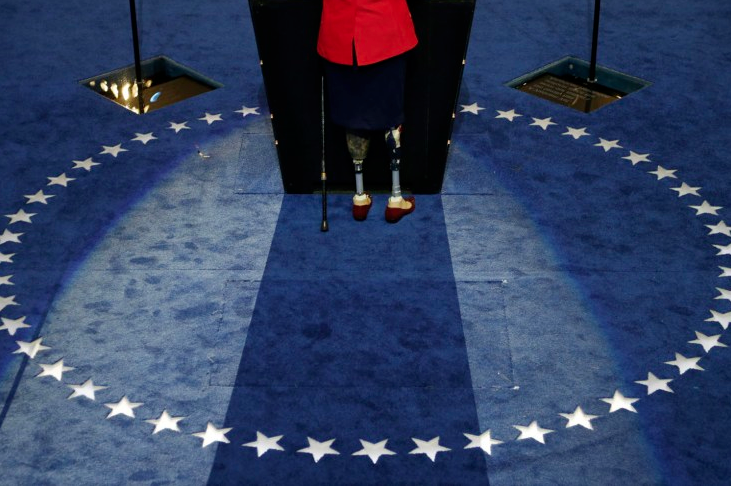
The photograph above is of Tammy Duckworth, a candidate for U.S. Congress in Illinois’ Eighth District, speaking at the Democratic National Convention this past week. She is also a war hero, having been among the first women to fly combat missions in Iraq, losing both of her legs when a grenade landed in her lap while piloting a Blackhawk helicopter north of Baghdad.  Her opponent for Congress, the incumbent Republican Joe Walsh has accused her of not being a “true hero” because she makes a point of discussing her military service in her campaign.  To quote former President Clinton in a different context, “that takes some brass,” especially coming from someone who has never served a day in the military in his life.  But the photograph above is not about Congressman Walsh’s Neanderthal attitudes nor even about Tammy Duckworth’s heroic service and sacrifice to her nation—or at least not explicitly so.

Shot from behind the podium and at a high angle that crops her body at the waist and accents her prosthetic legs, the photograph emphasizes what the viewing audience could not see—at least not while she was speaking. Viewed from the front we see a face, the marker of the liberal individual, a person.  And any person who can make their way onto the national stage to address a live audience of thousands and a mass mediated audience of millions can’t be doing all that bad.

Viewed from the back, however, the photograph invites a different story.  It reminds us of the terrible price that this individual paid—and now note that she is anonymous, faceless, another casualty of war but not one that we have to address directly.  In short, the photograph is an aide memoire to what we desperately don’t want to see, to what we want actively to forget: that we sent her into battle and the price she paid is really our debt, but it is a debt we have no way of paying.

In a sense, the photograph is a comment on the hundreds of images we see of the more than 1,200 veterans who have lost limbs in the Iraq and Afghanistan wars and yet, through the wonders of modern medical technology (ironically made possible because of advances in “war medicine”), survived to live what appear to be so-called “normal” lives.  And indeed, it is the emphasis on appearance that is very much to the point, for in the end we rarely learn very much about the ordinary lives that such people live and pain, trauma, and hardships that they face.

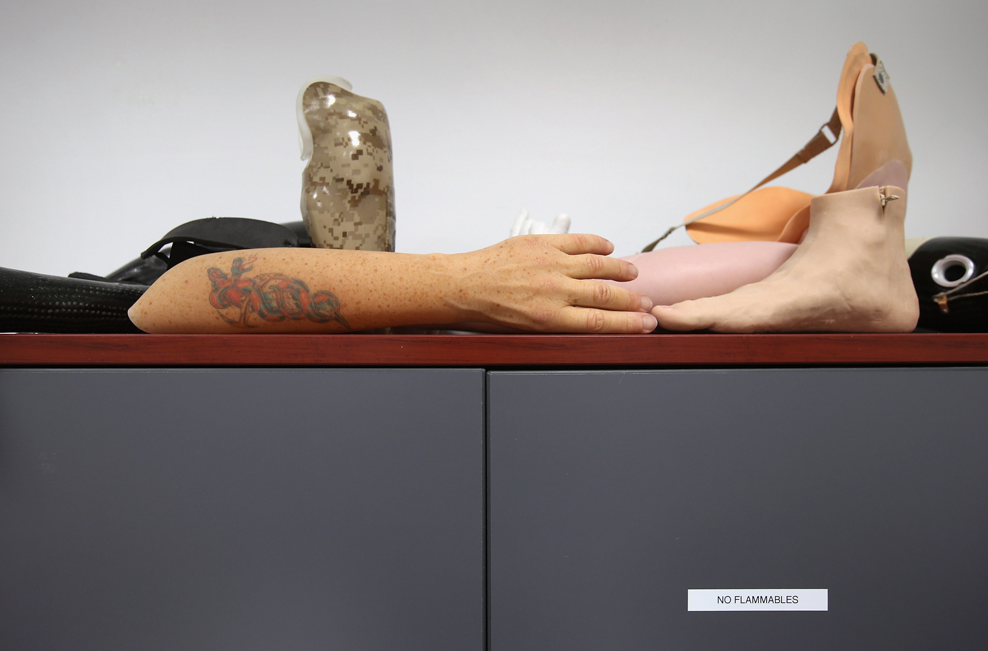
Consider, for example, this photograph that appeared recently in a slide show dedicated to the recovery of war veterans at Brooke Army Medical Center.

What you are looking at here are not real arms and legs, but rather “life-like covers” designed to slip over prosthetic limbs so as to masquerade a disability and to hide it from public view.  Note in particular the customized tattoos on the arm that make it appear to be individual and personal. There is every reason to believe that an amputee would want to be “seen” as normal, to hide his or her stigma, and thus to mask their prosthesis with a “life-like cover.”  Or rather there is every reason to believe that this is how someone who does not share such a disability—a so called “normal” person—might imagine how an amputee would want to cover-up his or her “shame.”  But really, the shame is ours and such “life-like covers” function, at least on par, as a veil that makes it easier for us to forget or to ignore our complicity with the sacrifice such men and women have made and the real debts that have to be paid.

Photo Credit: Charlie Neibergall/AP; John Moore/Getty Images

 1 Comment

SIght Gag: Back to the Future

Credit: Clay Bennett

Sight Gags” is our weekly nod to the ironic, satiric, parodic, and carnivalesque performances that are an important part of a vibrant democratic public culture.  These “gags” may not always be funny or represent a familiar point of view, but they attempt to cut through the lies, hypocrisy, shamelessness, stupidity, complacency, and other vices of democratic life.  Of course, we invite you to comment … and to send us images that you think might deserve a laugh or at least a wry and rueful look by those who are thinking about the character of public life today.

 0 Comments

Petrochemical America: Exhibition and Book

Petrochemical America
Photographs by Richard Misrach
Ecological Atlas by Kate Orff

Exhibition: August 25 – October 6, 2012, Aperture Foundation 547 West 27th Street, 4th floor, New York, N.Y. 10001

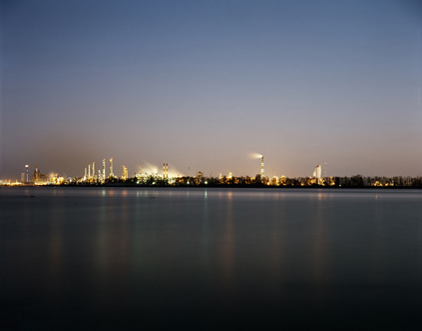
Petrochemical America features Richard Misrach’s haunting photographic record of Louisiana’s Chemical Corridor, accompanied by landscape architect Kate Orff’s Ecological Atlas—a series of “speculative drawings” developed through research and mapping of data from the region. Their joint effort depicts and unpacks the complex cultural, physical, and economic ecologies along 150 miles of the Mississippi River, from Baton Rouge to New Orleans, an area of intense chemical production that first garnered public attention as “Cancer Alley” when unusual occurrences of cancer were discovered in the region.

This collaboration has resulted in an unprecedented, multilayered document presenting a unique narrative of visual information. Petrochemical America offers in-depth analysis of the causes of specific environmental abuses in the region, and expands into an extensively researched study of the way in which petrochemicals have permeated every facet of contemporary life in America.

What is revealed over the course of the book is that Cancer Alley—although complicated by its own regional histories and particularities—may well be an apt metaphor for the global impact of petrochemicals on the human landscape as a whole. Misrach and Orff’s collaborative examination of Cancer Alley points to the past and into the future, implicating neighborhoods and corporate states. It also aims to participate in new thinking about how we can best divest ourselves of our addiction to petrochemicals, and to sketch the outlines of a more hopeful future.

Richard Misrach (born in Los Angeles, 1949) has a long-standing personal connection with New Orleans and the surrounding region. Destroy This Memory, his latest published monograph, shows a record of hurricane-inspired graffiti left on houses and cars in New Orleans in the wake of Katrina, which garnered Aperture a nomination for a 2010 Lucie Award for Book Publisher of the Year, and won the award for Best Photobook of the Year 2011 at PhotoEspaña. Another standout success was his 2007 large-format Aperture book On the Beach, a sublime visual meditation on the relationship between humankind and the environment, which is as spectacular as it is unsettling. Earlier, Aperture published Violent Legacies, which addressed, in part, the contamination of the desert due to nuclear testing. Richard Misrach’s other books include Golden Gate, released by Aperture in spring 2012, on the occasion of the seventy-fifth anniversary of the iconic bridge.

Kate Orff (born in Maryland, 1971) is an assistant professor at Columbia University and founder of SCAPE, a landscape architecture studio in Manhattan. Her work weaves together sustainable development, design for biodiversity, and community-based change. Orff’s recent exhibition at MoMA, Oyster-tecture, imagined the future of the polluted Gowanus Canal as part of a ground-up community process and an ecologically revitalized New York harbor.

The book can be purchased here.

 0 Comments

Real Democracy in Charlotte, North Carolina

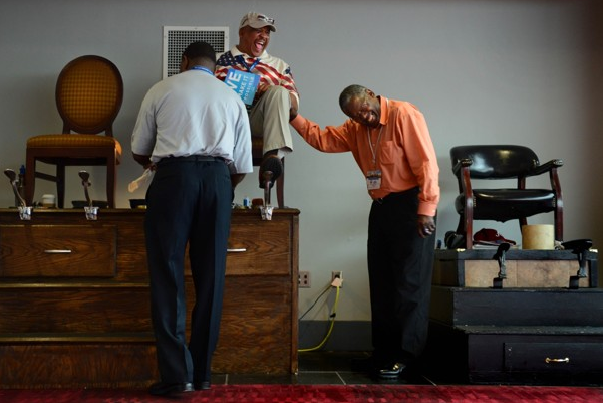
It looks like the Democratic National Convention is going to really push those who like to think that there are no real differences between the two parties.  For one, the Democrats won’t have to make stuff up to make their case.  For another, instead of seeing one, very narrow slice of the American demographic, this week you can see everyone else.  And you also can see this wonderful photograph.


Three men are sharing a laugh at a shoe shine stand.  The one up high is George Davis, who is married to a delegate from Georgia.  George from Georgia probably has got nothing to do this week but have fun, and it looks like he’s making a good start.  His shoes are being shined by William Robinson, while Isaiah Jones is free to wholeheartedly enjoy the joke.

The electrical connection looks a bit shaky, but otherwise the place is in nice shape.  No one is rich, but no one is starving, either.  The guy on top probably makes a fair amount more than the others, but not enough to make anyone uncomfortable.  The three gentlemen have had different lives, but they have a lot in common as well.  And one of the things they have in common is having lived in America as it was transformed from a Jim Crow society to a nation where Barack Obama is president.  No wonder the American flag is proudly displayed across George’s shirt.

This is a beautiful photo, because it captures the beauty of a democratic society: one in which simple association among equals can happen anywhere, because no one has to pretend that they are inferior to those who happen to have more wealth or status or authority.  Preachers of prejudice and exclusion love to say that progressive ideals of equality, social justice, and the general welfare would nullify differences in achievement.  That is nonsense, of course, but it is dangerous nonsense.  The men in the photograph aren’t pretending that they all make the same amount of money or have the same connections to political power.  They don’t have to, as they already share something far more valuable: the joy of civic friendship, which is the capacity to trust one another enough to enjoy life lived in common.  That’s not a uniform way of living directed from above, but very much the opposite: a life of small differences, shared suffering, and the human comedy as it can be seen and enjoyed in everyday life.

And that is why this photograph from outside the convention hall is all about the speeches being delivered inside.  And about other speeches as well, not least the vicious screeds by Hank Williams, Jr. and Chuck Norris, who claim that the “Muslim president” will bring “a 1000 years of darkness.”  (And have you noticed how bad these guys look?  Hatred and vicious idiocy must really wear on a man.)  Against a politics of fear, exclusion, and expropriation, the Democratic party is, for all its problems, at least moving forward toward the full realization of the American dream.  We should not forget that some would destroy that dream, but it is even more important to recognize how it is already here.  Not everywhere, but here and there, North, South, East, and West, down the street and around the corner, whenever two or three people can enjoy a common life secured by freedom and equality.

Photograph by Linda Davidson/Washington Post.

 1 Comment

Happy Labor Day, 1882-

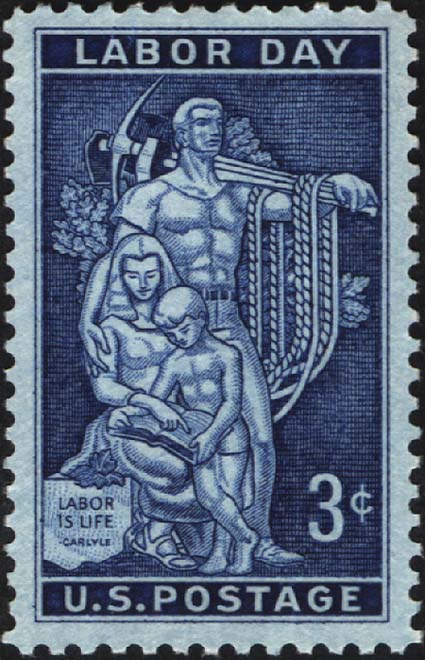
Labor Day was first celebrated by the Central Labor Union on September 5, 1882 in New York City and by 1885 the celebration had spread widely.  The first state to recognize Labor Day was Oregon in 1887, followed swiftly by Colorado, Massachusetts, New York and New Jersey.  Following the violent clash between the U.S. military and marshals and railroad workers during the Pullman Strike which resulted in thirdy deaths in the summer of 1894, the U.S.  Congress designated the first Monday of September as a national holiday to honor labor.  Labor Day was recognized by the release of the Labor Day Stamp in in the White House Rose Garden on September 3, 1955.  The  stamp features a design from the mosaic “Labor of Life” by artist Lumen Winter which can be found at the AFL-CIO headquarters in Washington, D.C.

 0 Comments

Sight Gag: They Built It!

Credit: Unknown

Sight Gags” is our weekly nod to the ironic, satiric, parodic, and carnivalesque performances that are an important part of a vibrant democratic public culture.  These “gags” may not always be funny or represent a familiar point of view, but they attempt to cut through the lies, hypocrisy, shamelessness, stupidity, complacency, and other vices of democratic life.  Of course, we invite you to comment … and to send us images that you think might deserve a laugh or at least a wry and rueful look by those who are thinking about the character of public life today.

 0 Comments