Feb 12, 2012
Dec 21, 2012
Mar 31, 2014
May 24, 2009
Aug 08, 2008
Jan 11, 2008

Not With a Bang, But a Whimper

Natural disasters seem to come and go.  Tsunami’s, earthquakes, tornadoes, and hurricanes wreak unimaginable damage, literally erasing neighborhoods—and even cities—within the blink of an eye.  One minute there is a thriving or peaceful community.  The next, nothing but rubble.  It is hard to fathom, particularly if it is not literally in our own backyard, even as the power of photography manages to reduce the distance between “here” and “there,” and in the process activates the human empathy needed to lend a helping hand across all manner of social, political, economic, and geographical borders.  And yet there is something troubling about such images for even as they give presence to the immediacy of such tragedies there is a sense in which they fragment each event, inviting us to treat them as an isolated and individual events effecting these people—always them, never us—here and now.

I thought about this some this past week as I perused the many photographs of the fury unleashed by Hurricane Sandy on places like the Jersey Shore, New York City’s east side Battery, and  Breezy Point on Long Island.  And in the process I found myself thinking about the natural tragedies that don’t seem to cull such easy images of nature’s fury and destruction.

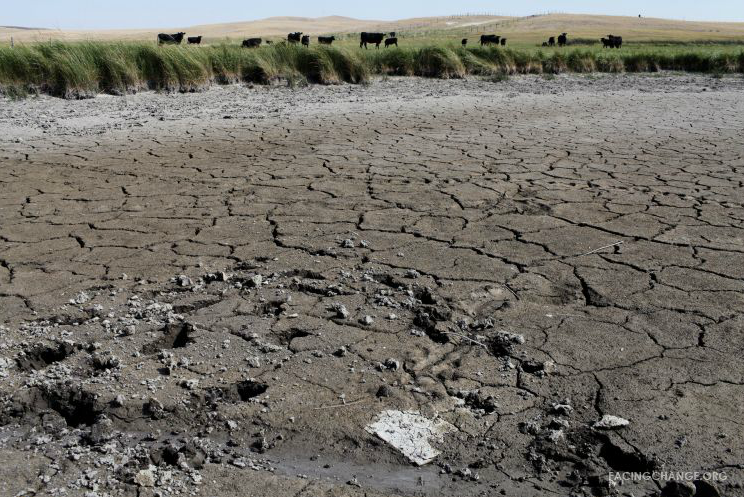
The photograph above is from Hay Springs, Nevada.  It was taken just three months ago and what it shows is one of the many dried up river beds that are becoming more and more prevalent in the plain states and in the upper Midwest as a result of recent and increasingly intense droughts.  The image is hardly as dramatic as the scenes we see in the wake of hurricanes and tornadoes, in large measure because here nature’s violence is slower and more exacting, creeping and gradual, rather than bold and arrogant.  And the damage itself is harder to see, its human effects harder to imagine.  The water has disappeared, and the river bed is cracked, but the grass on the other side, however far away, remains green (for now) and the cattle continue to have space to roam (for the time being).  But if you look closely enough to the horizon—and the point is that you have to look closely to see it—you will notice that the plains are more brown than green and it is not hard to imagine that before long they too will suffer the same fate as the river bed.  And where then will the cattle go?

The point, of course, is not to ignore the dramatic effects of the natural disasters that grab our attention and compassion for a moment in time, only to be forgotten as an isolated event, but to recognize that such events are connected and symptomatic  of a larger problem, one that is gradual and more enduring, and which we can see—but only if we look closely—as unfolding slowly and  in real time.

Photo Credit: Andrew Lichtenstein/Public Sphere: America A Changing Place
 2 Comments

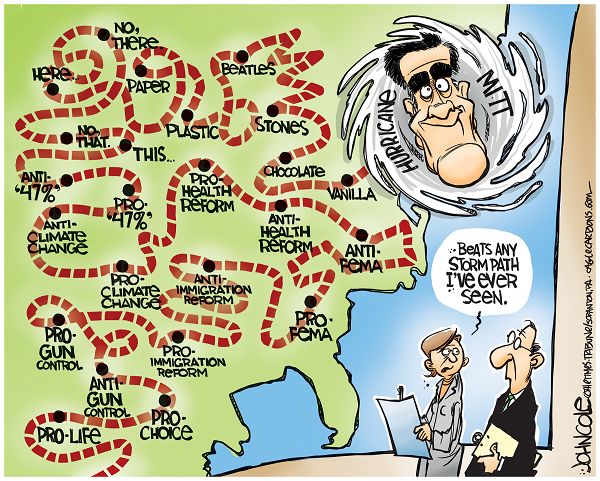
Sight Gag: Follow the Dotted Line

Credit:  John Cole

Sight Gag is our weekly nod to the ironic, satiric, parodic, and carnivalesque performances that are an important part of a vibrant democratic public culture.  These “gags” may not always be funny or represent a familiar point of view, but they attempt to cut through the lies, hypocrisy, shamelessness, stupidity, complacency, and other vices of democratic life.  Of course, we invite you to comment … and to send us images that you think might deserve a laugh or at least a wry and rueful look by those who are thinking about the character of public life today.

 0 Comments

Call For Papers: Domestic Images in the Digital Era

Visual Communication Quarterly

Call for Papers

Visual Portfolio: Domestic Images in the Digital, Online, and Viral Era

Guest Editors: David D. Perlmutter and Lisa Silvestri, The University of Iowa

Today anyone with a cellphone and an Internet connection can create and distribute images without professional training or a governmental or industrial institutional affiliation. Whether funny cat YouTube uploads, vacation videos (from a tsunami site) or pictures of the humiliation of Iraqi prisoners, images that once fell under the genre of “domestic” are now regularly erupting onto world attention, controversy, and influence. Likewise, ordinary citizens are delivering the first visual “draft of history” because they are first on the scene of breaking news-from terror-filled moments in a London subway after a bombing to an airliner landing on the Hudson River.

This special issue of VCQ seeks scholars and practitioners who study or document the blurring between “home” photography and “public,” professional, or commercial photography as it becomes increasingly indistinct in our viral digital/online/social media age.

Among possible questions to ask: What does it mean when the “home mode” goes viral? How does the role of the professional photographer and industry change when “citizen journalists” are creating so much public content? What new genres of photography are emerging in the home-public fusion? How does the domestic origin of an image affect its reception? What are the historical antecedents to this phenomenon (e.g., images of the Holocaust that were originally souvenir snapshots by its perpetrators or domestic scenes of celebrities made famous after their deaths?)

VCQ: Visual Communication Quarterly solicits contributions for an upcoming special issue on the domestic image. VCQ welcomes essays that consider the relationship between “home” and “public” modes of photography, visuality in a viral era, digitization, Photoshopping, cropping, and dissemination. In addition to theoretically grounded, critical essays, we will consider the submission of visual essays and photo pieces. Max. word length for essays: 7500.

Deadline for submissions: February 20, 2013

VCQ: Visual Communication Quarterly publishes scholarship and professional imagery that promotes an inclusive, broad discussion of all things visual, while also encouraging synthesis and theory building across our fascinating field of study. See: http://vcquarterly.org/ for submission style and guidelines. Please email an electronic version of your essay (as an MS Word document), along with a 100 word abstract, to david-perlmutter@uiowa.edu. For portfolios, send inquiry first.

EDITOR
Berkley Hudson, Missouri School of Journalism

 0 Comments