Feb 18, 2011
Mar 16, 2014
Jan 14, 2009
Oct 26, 2009
Aug 01, 2007
Mar 27, 2009

Street Seen, at the Milwaukee Art Museum

Street Seen: The Psychological Gesture in American Photography, 1940–1959

Ted Croner, New York, 1947 Milwaukee

Milwaukee Art Museum

January 30, 2010–April 25, 2010

“See more than 100 photographs in the first major exhibition of street photography from this era in nearly 20 years. Refuting the common claim that photojournalism was the only significant photographic activity at the time, Street Seen: The Psychological Gesture in American Photography, 1940–1959 uncovers a crucial time in American art, when global media was in its adolescence and photography was just beginning to gain recognition in the art world. The exhibition focuses on the work of six photographers (Lisette Model, Louis Faurer, Ted Croner, Saul Leiter, William Klein, and Robert Frank) who broke the rules of conventional photography to create emotionally engaging photographs.”

Information about the exhibition, related programming, and catalog is available here.

Photograph Ted Croner, New York, 1947. Gelatin silver print, 11 x 13 7/8 in. The Museum of Modern Art, New York.

 0 Comments

Myth and Reality in the Iraqi Election

What is it about photo editors’ obsession with inked fingers?  After seeing dozens of the purple digits being offered to the camera, I want to scream “out, damned spot” and do a post on something sane–like fashion week.  It is just when the media are caught up in a new craze, however, that older habits can be revealed.

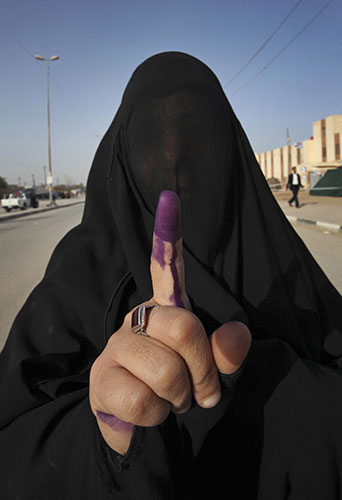
Burqa inked finger Iraq

This might be the paradigmatic inked finger photo.  In the foreground, direct physical evidence of democratic participation; in the background, display of the traditional, nondemocratic society that is being brought into modernity by the electoral process.

The symbolism is comprehensive: the finger signifies an individual voter and perhaps liberal individualism; the ink implies both institutional legitimacy (one person, one vote, via reliably transparent procedures) and the manner in which democratic identity might become a second skin, voluntarily painted onto the flesh.  Likewise, the individual is otherwise wrapped in that society’s depersonalizing and oppressive traditions.  Thus, these highly gendered and Orientalist images of veiled women are particularly useful for maintaining Western mythology about colonial occupation.  The US is (and always was) there to provide democracy and other forms of emancipation, which occur when the client nation adopts Western procedures on their belated march into modernity.

Even if this were true, those in the occupation zones have always been able to see that there is another dimension to the story.  The second side of modernization is revealed in this photo of another inked finger.

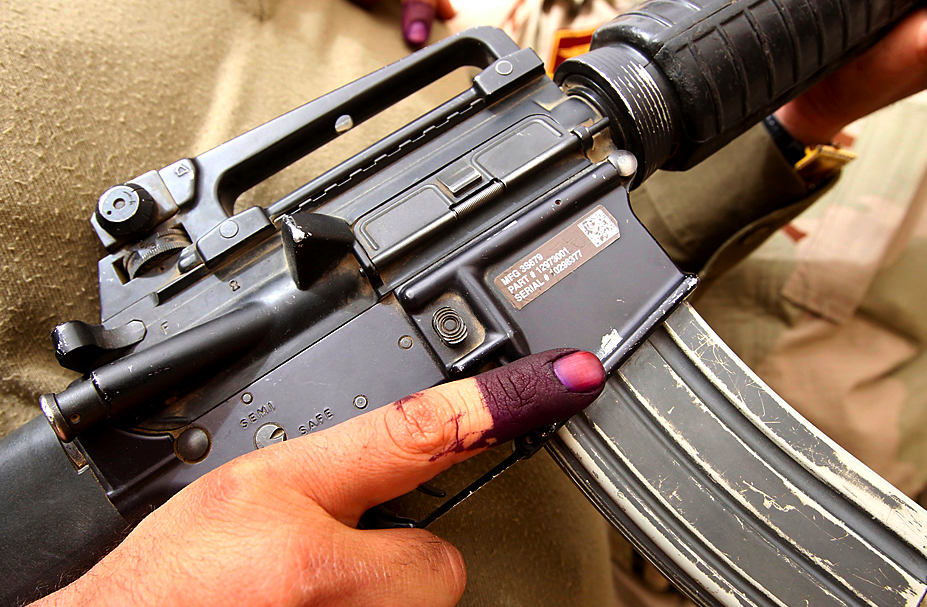
Iraqi security inked finger, gun

“I VOTED” began the caption for this photograph of a member of the “security personnel” in Iraq. Yes, he voted, and he also locked and loaded.  Once again, we have the finger set against a backdrop, but instead of traditional costume we see a machine of the national security state.  Now democracy goes hand in hand with military force.  Of course, elections do need to be protected from disruption, and the state is to have a monopoly on violence, but this image of militant democratization may imply that the election is a temporary ritual while the projection of military power will remain the constant feature of national life long after the dye has washed off.

More telling is the lettering on the gun: all in English, it reminds us that the weapon was bought from-and very likely paid for by–the US.  “I voted,” but the US equipped, and this election cannot escape the fact that it is still being conducted in a country stocked with US troops and on the US payroll.

The first image implies (falsely) that Iraq’s past was one of traditional Islamic repression.  The second image exposes its present condition as a client state.  One might hope that there can be a third alternative for the future.

Photographs by Alaa al-Marjani/Associated Press and Mohammed Ameen/Reuters.

 0 Comments

Canada, Society of the Spectacle?

Some Americans like to think that Canada is a progressive paradise–not to put too fine a point on it, they imagine Canada as being America without the craziness.  You know, a place where you can drive the same car, sans road rage, or have all your favorite TV shows, movies, and music but not have to worry about society amusing itself to death.  Canadians strive and shop just like Americans, but still are the soul of decency, tolerance, prudence, civility, and common sense.

Like this:

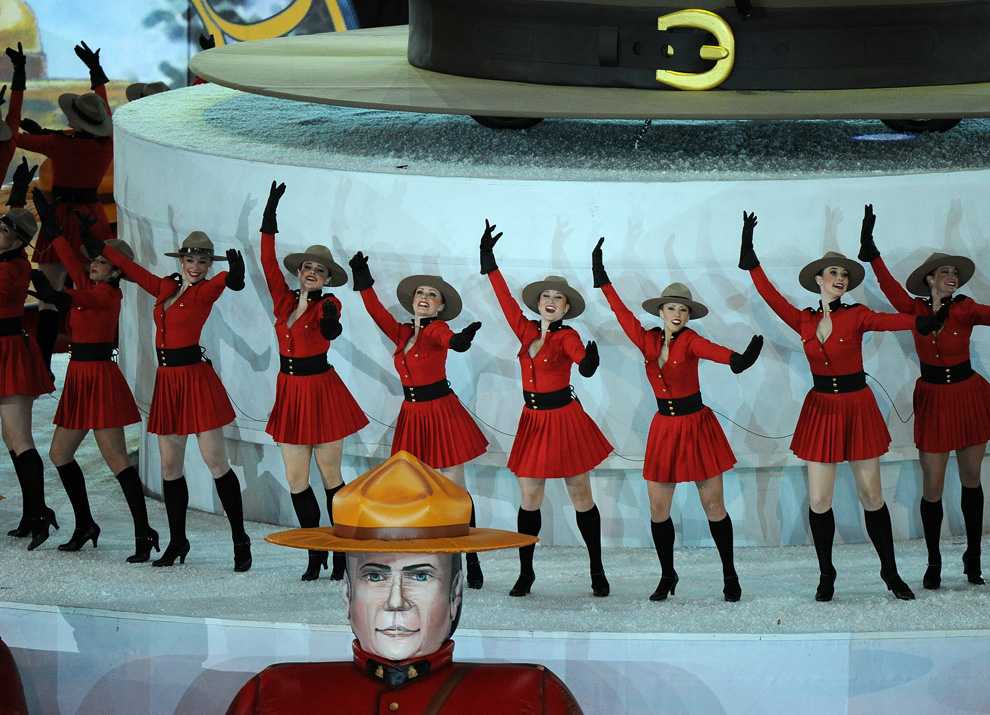
Vancouver Olympics closing ceremony

According to the caption at The Big Picture, “Entertainers dressed as Mounties perform during the closing ceremony of the 2010 Winter Olympics.”  So that’s what they are: entertainers.  And what about the elephant in the living room, by which I mean the giant Mounty cake?  And speaking of Mounties, isn’t that other fine example of the Royal Canadian Mounted Police a Giant Cut-Out?  Not just any nation could have mashed up the Rockettes and a Victorian greeting card, but Canada is not just any nation.

I get a kick out of this photograph, which can be read in either direction on the big question of Canadian exceptionalism (just like American exceptionalism, except nicer).  On the on hand, we see the same ridiculous, over-the-top, mass pop aesthetics that we have come to expect from Olympic closing ceremonies, Super Bowl halftime shows, and the like.  On the other hand, it is still so, well, what you would expect from a nation whose frontier hero was a policeman.  That said, I want to side with the craziness and so cut back the myth of Canada the well-mannered America.  Face it, they’re nuts, too.

I should quit there, but I there is another point to be made for our academic readers.  Guy Debord’s Society of the Spectacle begins with the statement that “The spectacle is not a collection of images; rather, it is a social relation between people that is mediated by images” (paragraph 4).  That important point is too easily overlooked, but it also lets Debord off a very big hook: what if a specific image or collection of images suggests a different social relation, or one intertwined with another?  And what if Canada is doing the good work of providing a spectacle that can be read in either direction: as the epitome of fetishism and false consciousness aligned with the state, or as something that somehow gets close to that but ends up, well, more negotiable and not so threatening?

Look at this image again, and it’s all there: state power, the commodity fetish, the cult of the copy, separation celebrated, and gender ideology materialized.   But more is there as well: in a word, it’s nuts, and obviously so; more important, it is so obviously a theater of duplication that you have to believe irony is in the wings.  Excess may not be more of the same but rather one means for living within the spectacle.  And come to think of it, perhaps Canada knows a thing or two about being regarded as a copy, but with a difference for the better.

Photograph by Robyn Beck/AFP-Getty Images.

 5 Comments

Disasters Natural and Political

Another earthquake, this one 100 times more powerful than the quake that wrecked Haiti.  More photographs, although probably less than before due to some combination of better infrastructure in Chile and compassion fatigue in the American media.  Comparisons between the two disasters will be made–and sure to include both racist asides and warnings about the Last Days, such are the blessings of free speech.  The question remains whether the second quake provides an opportunity to learn something about disasters.  Nor is this a question about tectonic plates.
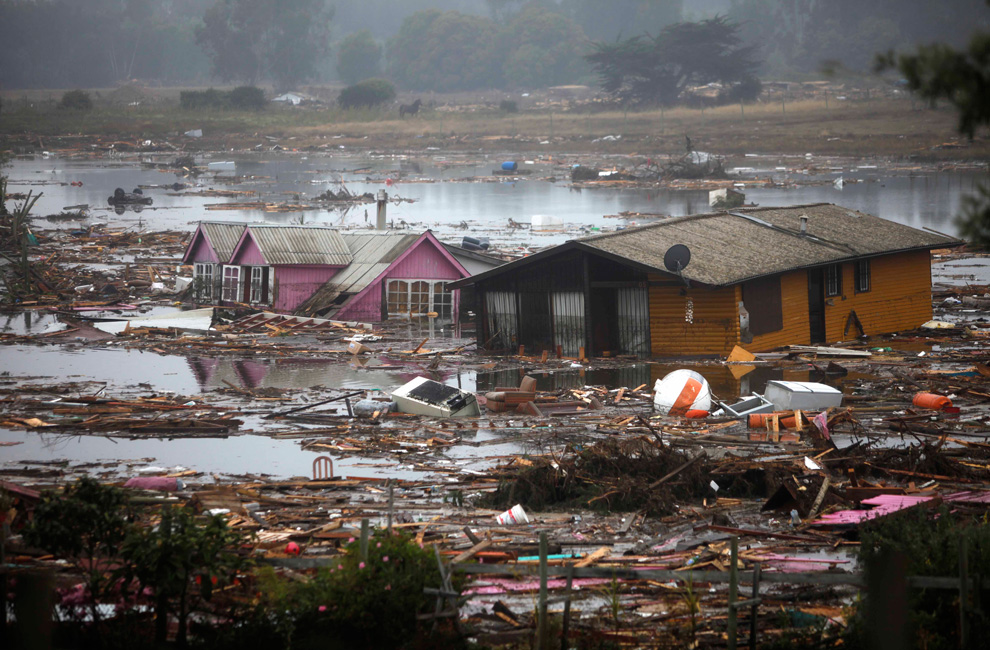
chilean tsunami damage

I think this photograph from Pelluhue, some 200 miles southwest of Santiago, is at once typical of the current disaster coverage and yet somewhat distinctive.  Typical, in that it documents the nature and extent of the destruction; distinctive, in that the wreckage was done by flooding, a secondary effect of the quake.  If nothing else, the photo can prompt one to recognize that this disaster, and every disaster, has more extensive causes and more extensive effects than those seen at the dramatic center of the event.

The photo’s texture may inflect the story further.  Instead of the arid, concrete, public, urban environment typically featured in the initial coverage, this rural setting was more lush to begin with and now is awash with the soggy debris of private life.  (Yes, those are refrigerators stuck on the strand, and perhaps a buoy for the recreational boating in the area.)  It is clear, also, that the disaster has washed up over the land, through no fault of their own, you might say, and that although human domesticity has been disturbed by nature’s excess, a more serene natural world remains, like the horse in the background, awaiting a return to normal activity and dwelling in relative harmony once things are cleaned up and rebuilt.  If there is a moral to the story, it is that disasters can have a greater reach than one might expect, but the advice remains the same: be better prepared next time, but get back to normal first.  One can almost imagine the scene flowing backwards: the refrigerators moving back into houses, the houses back onto their foundations, the buoy back into the bay, the chairs and buckets back onto the dock, and the flimsy walls of the dockside buildings slapping back together.

Something similar actually will happen, flowing forward, as the aid will come and the investments made and everyone knows what should be the result.  Not every disaster zone is so lucky.

Afghan war zone

This photograph was taken from a helicopter over “a rubble-strewn battlefield” in Marjah, Afghanistan.  Note how perfectly, although perhaps inadvertently, the “objective” caption captures the destructiveness so painfully evident in the photo.  The three buildings in the picture have effectively ceased to exist, to have ever existed.  They are not even mentioned, save to be designated as part of the rubble.  (They are another addition to Rubble World, a sector with excellent growth prospects in the 21st century.)  As before, the texture of the image speaks powerfully but now with a very different tone: this is sheer desolation, as if the environment had somehow been transformed into war itself, or at least a simulacrum of war suitable for a dark video game.  Only one dot of blue remains as the last hint of another purpose for this place of devastation, and soon, if anything is to be done, it will be bulldozed underground.

If anything is to be done.  This scene has only the barest trace of a past–shattered concrete without any evident purpose–and virtually no sense of a future.  It is a war zone, likely to be leveled for tactical security, and then what?  If the armies move on, they leave nothing.  If they stay, there is no return to whatever was there before.  Likewise, the relationship to other causes and effects remains obscure.  The scene was seemingly the center of a battle, but there is no sense of where the war started, why is it there, or where it is going.  (This elision of a grand narrative can be a feature of all war photography, as Alan Trachtenberg has noted, but we should add that it may say something about war and have more bite with some wars than others.)  War may be more or less destructive than a natural disaster, but only war destroys the future.

There is a political dimension to every natural disaster, but that is not quite my point today.  Wars are political disasters, and were we to see them much as we do natural disasters, it might be much easier to help those after the battle and perhaps even to be better prepared to maintain the peace next time.  But too often the images of political disasters may, in ways large and small, already be reproducing the damning implication that comes from not being defined as having natural causes.  Thus, instead of seeing how calamity has washed over the land through no fault of their own and that there remains only the hard work of rebuilding, the moral of the story is that for those in the wrong place there can be no return to normal life.  Earthquakes are episodic, but war and occupation, it seems, are endless.

Photographs by Roberto Candia and Brennan Linsley for the Associated Press.

Cross-posted at BAGnewsNotes.

 1 Comment

Diving into Midwinter

The holidays are a distant memory, snow is falling again, and ordinary activity can seem frozen into work and routine.  What else is there to do?  Days are short, there is too little sunlight, depression lurks amidst the layers of heavy clothing, and just getting about can be a series of chores.  One’s options, it seems, are limited.

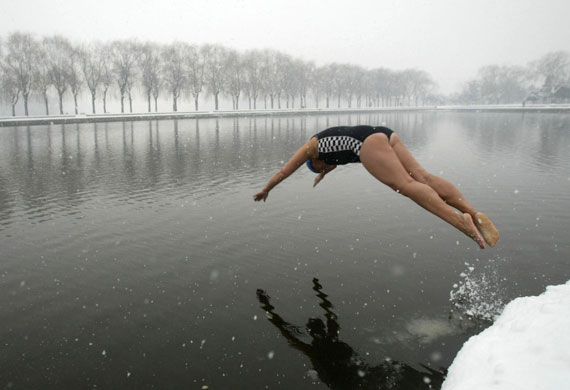
But don’t tell this woman:

A-winter-swimmer-jumps-in-005

The caption read, “Shenyang, China: A swimmer jumps into icy water at a park.”  Really?  You’d think the writer had seasonal affective disorder; doesn’t “jump” suggest suicide?  As it is, however, she is not jumping but diving, and instead of going to her death she is throwing herself into life.

The tension between death and life suffuses the photo. The snow shrouded treeline along the field of whiteness could be the frozen shore of the netherworld, and the cold, dark, glassy water seems a catch basin for dead souls–like the shadow solidifying under its surface.  But suspended against this there is the incredible vitality of her strong, beautiful body, and even the puff of snow testifies to her quick kick up into the air. And all this for one reason: the amazing shock of slicing into the cold water, the sharp gasp, the radiant fire of skin alive.

In 1872 Christina Rossetti penned a beautiful poem that many encounter as a Christmas hymn.  The first verse speaks to anyone regardless of faith–to anyone, that is, who has known winter.

In the bleak midwinter, frosty wind made moan,
Earth stood hard as iron, water like a stone;
Snow had fallen, snow on snow, snow on snow,
In the bleak midwinter, long ago.

There is more than one kind of winter. Too much in American national life at the moment seems locked into bleak patterns of dysfunction and stasis.  Too many people are hoping to settle for what is safest, and too many are resigned to simply making do or getting by.  Who can blame them?  When leaders are abdicating right and left and the future looks bleak, it makes sense to pull the blanket close around yourself and not take any risks.

Stuck in the middle of winter, perhaps one should simply wait for spring.  I’d like to think, however, that somehow each of us could take the plunge into a better life.  This might mean nothing more than doing something unexpected or otherwise out of season.  Who knows how much that could change?

Photograph from Reuters.

 1 Comment

World Press Photo Awards

The 2010 World Press Photo Awards were announced last week.

You can see the photographs here.

settler aggression

You may have seen some of the photographs before, as when we posted on this image and The Practice of Domination in Everyday Life.  There are many others, however, and many that are likely to amaze.  Some also will raise questions about who should be the photographic subject, what should count as an artistic image, and how spectators should respond to eloquent images of suffering.  If photojournalism is to remain a public art, we will need both the photographs and an engaged audience capable of debating these issues and more.

Photograph by Rina Castelnuovo/The New York Times.

 0 Comments

Haiti After the Catastrophe: The Power of Ordinary Life

This week the New York Times ran a story entitled Haiti Emerges From Its Shock, and Tears Roll.  The government had declared a national period of mourning, and the point of the story was that Haitians finally were able to grieve openly and collectively about their devastating losses.  An accompanying slide show featured funerals and memorial services, while the story itself included eloquent testimonials that could have been included in any eulogy.

Whatever the good intentions behind the reportage, I can’t help but think that this and similar stories are themselves ritual events: specifically, memorial services provided precisely so that the American audience can psychologically declare an end to the disaster and move on.  The massive mobilization of charitable giving is slowing down, and the surge of compassion is being replaced by the daunting complexity of managing  the long effort of reconstruction, and, well, it’s been more than a month and the Winter Olympics are on.

Like any story, it seems that catastrophes ought to have a beginning, a middle, and an end.  Likewise, the dramatic rupture of the beginning culminates in the symbolic repair provided by ritual performance at the end.  And so it is that the shock of the initial trauma is soothed by the tears of emotional release during the time to mourn. These are important features of human life, and the press would be remiss in ignoring them.  That said, there is another story to be told that has nothing to do with dramatic gestures.

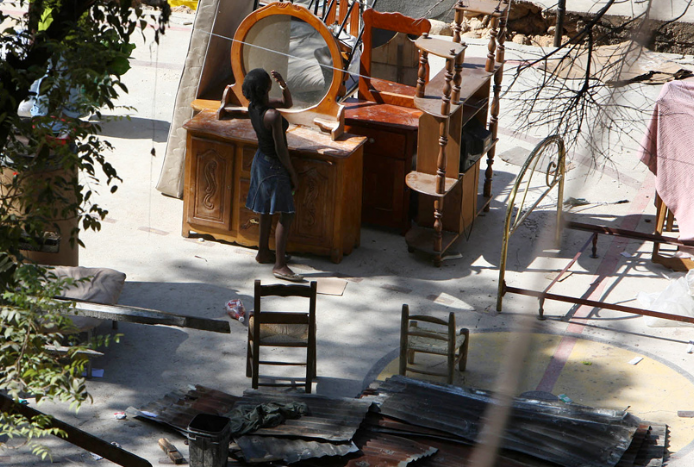
woman looking in mirror, Haiti

This is a photograph from the middle period of the disaster–a time when people already were beginning to get on with their lives.  Furniture from a ruined house has been put out in the street.  A woman is walking by, then stops and checks her reflection in the mirror.  You can see that she is adjusting something–her hair or an eyebrow, perhaps.  The scene is surprisingly intimate, and our gaze is not intrusive as she clearly would be aware that she is in a public setting.  Come to think of it, people often steal a moment of privacy to check their appearance in store windows or other public mirrors, much as she is doing here.

One might be tempted to fault her.  “How vain!  What a princess.  Doesn’t she know her country has been wrecked?”  I don’t see it that way.  Instead, I see an act of triumph over adversity.  A small act, to be sure–we are at the lowest level of the micro-political here–but an assertion that life as she knew it will go on somehow and she has a future in which it matters how she looks.  In short, amidst near complete disruption of the normal state of things (where one’s bedroom now is in the street), there remain practical opportunities to do what you would want to do anyway.

I think this ability to assert the small routines of everyday life is an important political resource.  And just to make sure that we understand how much resilience is at stake, look at this:

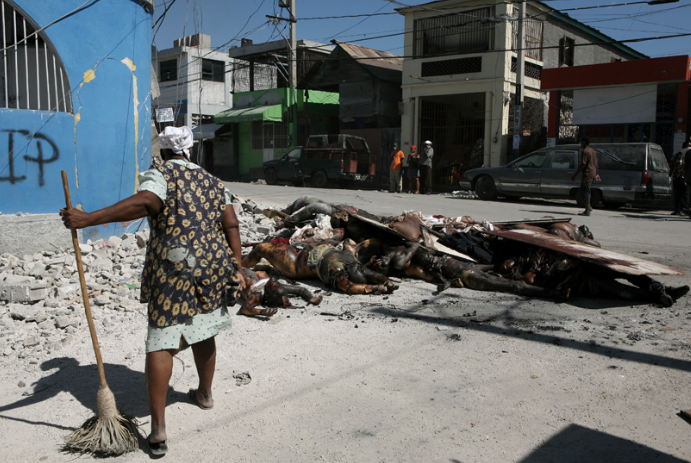
woman sweeping, Haiti

A woman is sweeping up the debris in the street in front of a pile of decomposing bodies.  From her smock and broom, I’d say she’s swept up before.  And why not now?  She can’t move the bodies by herself, but she can sweep, and that has to be done if the place is to get back to normal.  And don’t tell her that the scale of destruction is too great or that recovery will take many years or that there’s nothing she can do.

As in the first photo, we see a lone individual engaging in what is usually a private activity, but now in a public space or a space having unusual public significance.  In each case, I think we are seeing a civic practice, albeit in a peculiar sense.  These are not the practices of state action or global mobilization by state and non-governmental organizations; instead, they are the simple habits of vernacular life.  Habits that have transformative power precisely because they aspire to no more than continuity.

Photographs by Ruth Fremson and Damon Winter for the New York Times.

Cross-posted at BAGnewsNotes.

 5 Comments

Vanishing into Modernism

One of the pleasures of going to an art gallery is to see the other people there as artworks–that is, as if crafted for display, and displayed to reveal something important about who we are as human beings.  Of  course, some people seem better suited to being seen this way than others.

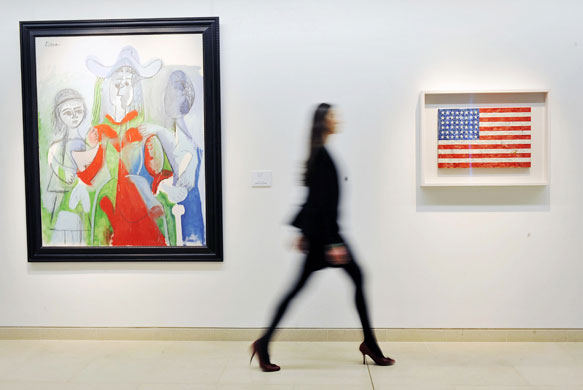
Woman in art gallery

This woman striding through a gallery in London seems obviously stylish—high heels, short skirt, long, sleek hair, ramrod posture, stiletto figure, all in basic black, one can go right down the fashion magazine checklist.  Less is more, however, and her lean minimalism and striking pose suggest that she is not merely stylish but as much a work of art as the two paintings on either side of her, as if she were the middle panel of a triptych.  But for the blurred edges that indicate motion, she could be a sculpture by Alberto Giacometti.

alberto_giacometti

And not just any sculpture, but one that sold this month at a Sotheby’s auction for $103.4 million.  That fact may account for the presence of the first photo above, as the publicity about the sale may have activated the Giacometti neuron in at least one photographer’s brain, and the photo was taken at Christie’s auction house, but the woman had to be there as she was for the photograph to be taken at all.  And so one artist was paying homage to another, but he could do so in part because the artistic influence was so pervasive that life was already following that art.

No one gets up in the morning to put on their Giacometti outfit, but many do spend a lot of money and effort to appear stylish, and the hundreds of his stick figures that populate museums, books, posters, and other media of the art world played a role in defining the aesthetic norms of contemporary cosmopolitan society.  That modernist norms can be traced across art, fashion, and photography as well as interior design, architecture, and other arts is hardly surprising, as a universal economy of representation was the point, but I want to suggest that something more than homology is at stake.

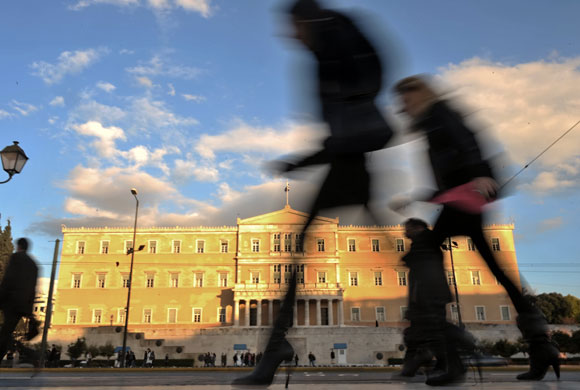
Women walking in Athens

When this photograph turned up as well, I had to wonder what was going on.  One answer is that a second photographer had been cued to Giacometti’s gaze.  But now I began to think that this was not merely a study in influence, but rather that Giacometti had seen something then that was becoming ever more evident now in modernity’s continued development on its own terms.

But what is being shown?  People are transformed into shadows, women are styled into nothingness, mass is consumed by motion, life crafted for the gaze reverts to the vanishing point, all that is solid melts into air. . . . Each of these ideas is a start, but just that, at understanding what is being revealed.  And perhaps it is worth noting that the last photo was taken before the Greek parliament building during a week when the Greek financial meltdown was threatening the EU (and world) economy.  And so, once again, billions of dollars have gone up in smoke across the globe as modern financial systems operate with the radical autonomy and disregard for common sense that may be a key to artistic innovation, but little else.

Modernism is now seen in some circles as a period style, but some have claimed that modernity will not–cannot–ever end.  Even if that were to be true, modernist art and fashion alike might prompt one to ask who, what, and how much caught within modern processes of change will simply vanish.

The first photograph is by Tim Ireland/PA; the third photograph is by Louisa Gouliamaki/AFP-Getty Images.  The sculpture may be L’Homme qui marche I or another like it.

 1 Comment

Decoration and the Distribution of the Sensible

Decoration has been deemed inferior to serious art, philosophy, and political thought since Plato, and especially so within modernity and the aesthetic regime of modernism.  In my lifetime, it has been commonplace among educated people to snub some things by labeling them “decorative,” with the term (or its synonyms) designating superficial or excessive display.  There is some irony–or not, perhaps–in the same slights reinforcing hierarchies of race, class, gender, sexual orientation, and empire, as there is a robust history of representing people of color, lower classes, women, gays, and subaltern peoples as too caught up in adornment.  So it is that one might wonder what is being shown here:

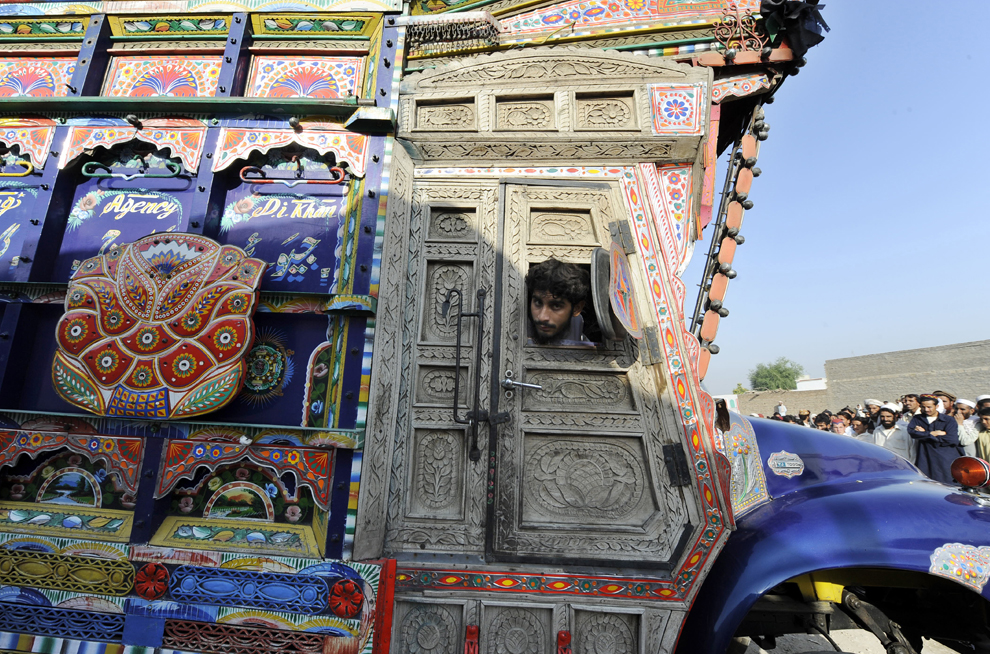
truck Pakistan

I get a real kick out of this photograph, and not only because the truck would stop traffic where I live.  The man’s head sticks out as if the vehicle is a carny show or a clubhouse (though hardly for a secret society), or perhaps the carapace of some kind of exotic social creature that you might find in an art house film.  Closer to reality, you have to admit that someone has a lot of pride in that truck, and justifiably so.  But even so, it may be too easy to let the image activate the old binaries: those people are exotic (of course) and thus devoted to social display rather than rational analysis and organization, and so necessarily less productive than those of us who would keep our trucks completely functional.  To challenge that conclusion, you could point to the care lavished on the chrome pipes and rich paint on many an American 18-wheeler, but we can do better yet by quoting from the photograph’s caption: “A Pakistani truck driver enters a distribution point carrying relief supplies for internally displaced civilians.”  The decoration fits right into a scheme of modern administrative organization, and that gaudy piece of folk art is functional after all.

But surely this curiosity has no real utility:

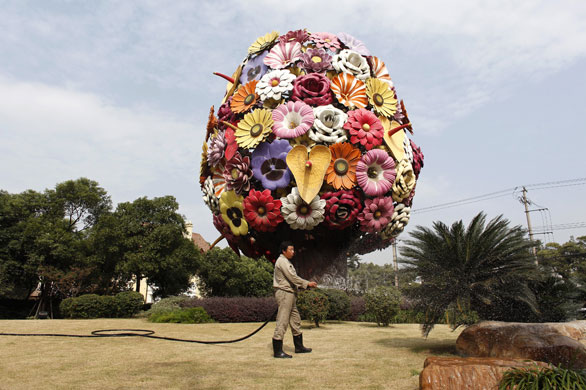
Shanghai sculpture

Again, I love the photo for both its eye-catching quality and its sense of strangeness.  What is that thing?  Well, it’s a giant floral sculpture shaped as if it were itself a flowering plant or perhaps a vase holding flowers, and, for the most part its just too damn big, isn’t it?  And that distortion in one’s sense of scale is a key to the photo’s artistry.  One can’t be sure whether the man is to provide the measure for the artwork, or the artwork for the man.  As in the photo above, the human being is both very much a part of the scene–perfectly at home in it–and yet also dwarfed by the artifice.  And as before, the decoration seems completely out of place and yet obviously is completely intentional–just what is supposed to be there and is being carefully tended.

The second photo is from Shanghai, and the caption verges on comic understatement: “A gardener waters plants near a giant flower-shaped sculpture.”  I imagine adding, “a giant flower-shaped sculpture that will reproduce across the land and become objects of worship for you pitiful creatures, you humans with your pathetic love of pretty things, your fear of the blank surface and the empty space, your need to be ruled by what delights the eye.”  But that would be the modernist talking; ok, a slightly bent modernist, but a modernist.

The philosopher Jacques Rancière distinguishes between two senses of the aesthetic: the traditional idea of it as the modality of the sensible which then is contrasted with rationality, and his definition of the aesthetic as a distribution of the sensible: that is, as both a given arrangement of sensation and reason and an additional disturbance of that relationship that neutralizes the hierarchy and so opens one up to alternative arrangements, including those that seem excessive but are still a part of one’s world.

And that’s why I enjoy the two photographs above.  Although they draw on a given distribution of the sensible that denigrates the human mania for decorating the surfaces of the social world, they also trouble that distribution.  The photos portray popular and public artistry that is at once trivial and superfluous, but they also capture a combination of familiarity and strangeness that merits attention.  Neither the artifacts nor the photos are great works of art, but they suggest that nothing can be merely decorative.

Photographs by Aamir Qureshi/AFP-Getty Images and Nir Elias/Reuters.  For a recent summary of Rancière’s argument, see “The Aesthetic Dimension: Aesthetics, Politics, and Knowledge,” Critical Inquiry 36 (2009), 1-19.

 0 Comments

The Two Faces of Military Occupation

There’s a fine video criticism of Avatar making the rounds, thanks in part to a boost from the Huffington Post.  The author is Jay Bauman at redlettermedia.com, and he absolutely nails an important point: “The Na’vi were a little too perfect and harmonious for a primitive culture, and the military were a little too simplistic and destructive for an advanced culture.”  He’s certainly right on the first point–and “little too” actually means “way too”–and he is correct on the second as well, once you distinguish between the destructive potential and the actual conduct of the U.S. military in the field, and remember that the distinction is meaningless to those who actually get nailed by modern firepower.

In other words, enough of the time the truth about modern warfare is complicated.  When the U.S. military has been successful in Iraq and Afghanistan, it is because they are both highly destructive and regularly engaged in careful interactions with ordinary people caught in the war zone.  Thus, the military has two faces.   Here’s one of them:

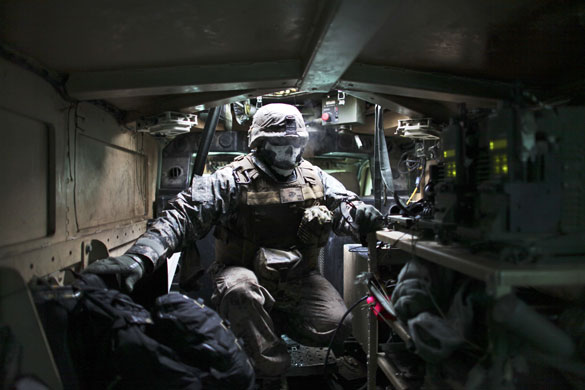
Marine gunner Afghanistan-

The caption for this photograph tells us that a Marine turret gunner is inside an armoured vehicle in the Pech Valley, Afghanistan.  OK, he’s a turret gunner, and he also is War incarnate.  The death’s head, his physical bulk poised for action even within an enclosed space, his uniform that seems like some infernal skin, and his effortless ease and conformity with the metal and machines all around him all communicate one thing: this guy is capable of wreaking total violence on anything that gets in his way.

I am not going to say that the photograph is misleading and that actually the gunner is there to hand out candy to kids.  This is one of the true faces of empire, and one that rightly terrifies those who see it.  But there also is another side of military action:

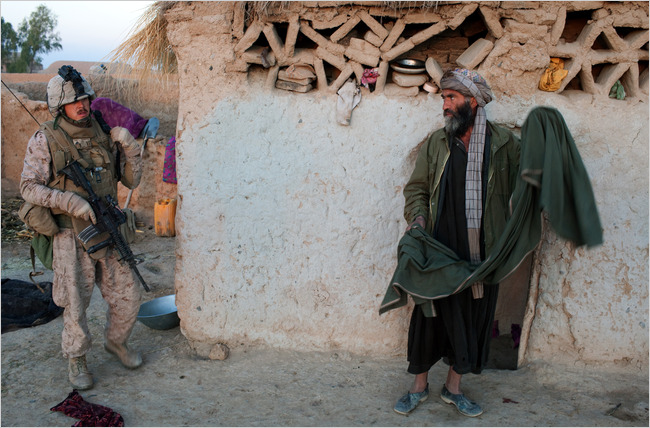
afghan man and marine

This photo was on the front page of the New York Times yesterday, and so one can easily read it as an attempt to help the U.S. put its best face forward.  It is as accurate and as representative as the one above, however.  Here the Marines are on a sweep through Helmand province, which has lead to this interaction between two individuals, each of whom is taking care to show that he is not as dangerous as he might be.  The photo positions the two men as roughly equals, and while it emphasizes the gulf between them, that space does not appear to be a battle space.  The gulf symbolized by the blank wall could include cultural differences, political objectives, or social trust, but in any case it seems clear that the work to be done has to involve communicating rather than firing the Marine’s weapon.  In fact, it becomes easy to see each of them in civilian terms, as if the one on the right were a local businessman (which he may be) and the one on the left were a small town bureaucrat (which, in a way, he is).

Part of the current struggle regarding the imperial project is between these two alternatives of overwhelming, indiscriminate violence and tactical negotiations that can translate “politics by other means” into politics.  Photojournalism is needed to show us the two faces of war–and not either one alone.  It is up to others, however, to decide whether the balance will tip one way or the other.

Photographs by Brennan Linsley/Associated Press and Tyler Hicks/The New York Times. The Times story is here, along with a slide show of photographs by Tyler Hicks.

 4 Comments