Dec 05, 2007
Jan 10, 2008
Mar 10, 2008
Feb 02, 2009
Dec 15, 2012
May 20, 2009

What It Means to Be in the Picture

The war in Iraq and Afghanistan is slowly edging back into US public media, but it’s still easy to miss.  The problem isn’t only that so much attention is being given to the debates about health care (or the lack of it) and financial regulation (or that lack of it) and the continuing problems in each sector (see “lack,” above).  The war coverage itself has a peculiar cast: instead of deployments, patrols, firefights, and other action shots, there have been a stream of images that show wreckage, rubble, and similar scenes of destruction.  Scenes like this:
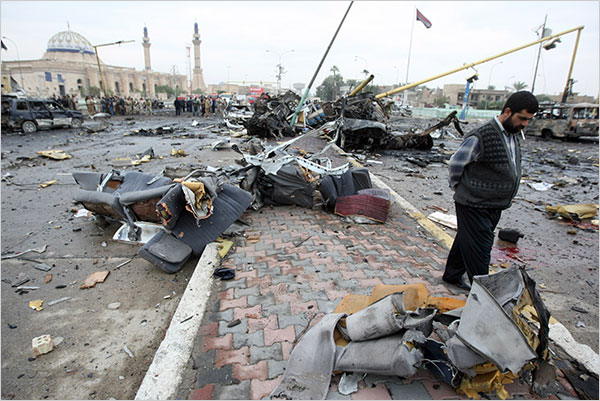
man in Baghdad wreakage

A man walks slowly along Cairo Street in Baghdad in the aftermath of a bombing.  The bomb obviously was huge, leaving a vast swath of mangled metal and broken lives.  What you don’t see is a field of battle; instead, this is a civilian street, complete with a cobblestone median and an institutional building in the background.  The picture might be said to lend plausible deniability to the idea that there still is a real war going on in Iraq.  The lone figure in the foreground suggests as much.  He is every inch a civilian, and his pensive posture suggests that this is a time for reflection, not action.

The flag is still flying, and officials and soldiers far in the rear will oversee the clean-up, but the large space between them and the lone individual in the front is empty of people, as if the society itself had been vaporized in the blast.  The war is there but not there, while the social, ethnic, religious, and political motivations for the bombings are unintelligible.  A bomb detonates, and a man muses. Apparently, there is nothing for him–or anyone else–to do but to walk on into the unknown future that lies outside the frame.   Like this:
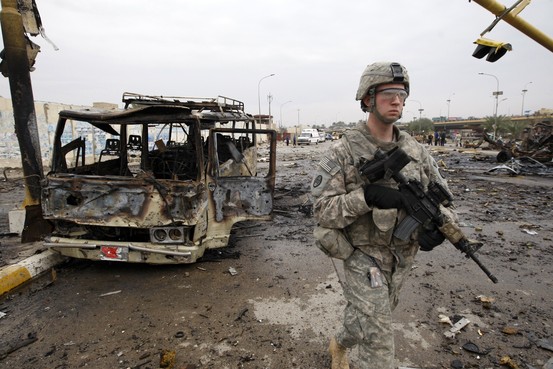
US soldier amidst bomb wreakage

There have been dozens of photographs similar to this one in the past several weeks: photos of US troops standing around or slowly walking through places that are otherwise empty.  Often enough, they are scenes of destruction, but the act is already in the past, something that occurred off camera.  The troops aren’t fighting so much as overseeing an impersonal process of destruction.  And that process seems to involve razing city streets and vehicles more than anything else; again, the people that would normally fill the scene have been ghosted away.

Note the many other similarities with the first photo.  Again, officials hold down the rear of the scene, while a single person walks toward the space to the right of the frame.  His mood is not identical to the man above, but he does seem both turned inward and weighed down, and, again, there is nothing to be done about what has happened.  He is merely going through the motions to “secure the area”: an area already secured by the scythe of the bomb’s blast.

Such photos may reflect that fact that US policy has been in a state of limbo for the past few months, but they also may suggest that the US war effort has become something like a permanent state between war and peace, an intermediate place of suspension and neglect.  Worse, they may suggest that this is acceptable because the US troops are just passing through.  They are there for awhile but not really doing much, and eventually they’ll rotate out and leave the place to its fate as one of the boroughs of rubble world.

And so there is reason to look at the first photograph again, for there may be an important difference between the two after all.  Despite his ability to do much more than walk through the scene, there is little doubt that he lives there.  If that isn’t his street, it’s his city; if not his city, it’s continuous with where he does live.  He thinks, smokes, and walks on, but his future will be in that place.  And to see him there is to see someone who belongs in the photograph, whose presence speaks to something valuable there, and who provides a point of contact for the viewer.  To the extent that we can see him as being in the picture, we are pulled into the frame as well, and asked to witness and reflect on what is there and why.

By contrast, it seems very clear that the soldier is just passing through.  Whatever his presence may provoke, the message is that he really isn’t a part of the scene.  If we walk with him, it’s to appreciate his wish to get through it alive, but not to stay in, understand, and commit to that place.

Each photograph–any photograph–presents the viewer with a choice about how much one might be in the picture.  In both of these two photos, the choice to the US viewer is skewed toward minimal involvement: one figure is a foreign national in his homeland, and the other is a US soldier far from home.  Even so, the first image may also evoke a compassionate response.  With the second image, however, it’s just a matter of time before we can pretend that there is no one there.

Photographs by Ahmad Al-Rubaye/AFP-Getty Images and Reuters (Wall Street Journal).
 0 Comments

Public Images of Private Grief

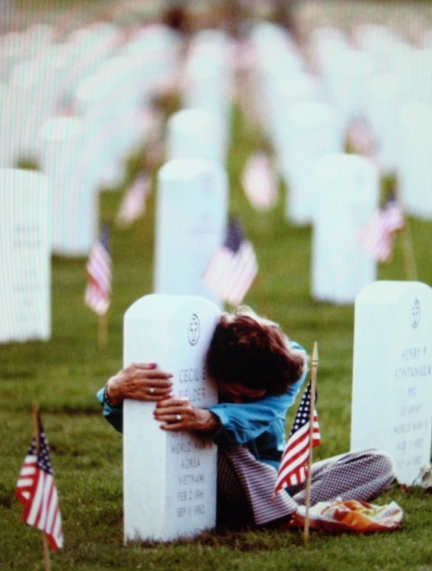
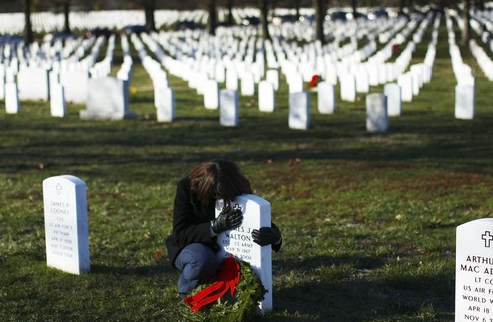
On Saturday 15,000 Christmas wreaths were placed on the graves at Arlington Cemetery.  The annual event is an occasion for both press coverage and personal visitations, as with this photograph of a woman hugging the gravestone of her husband who recently had been killed in Afghanistan.

Arlington grief December 2009

This photo is one of a series of similar shots that together received wide circulation, including the front page of the Sunday New York Times.  Some are close cropped while others show more of the surrounding phalanx of gravestones, but all feature the woman holding on to the lifeless stone.

He was 41 when it happened, a Lt. Colonel on his second deployment to the region (the first had been in Iraq).  He had been training Afghan soldiers until his vehicle hit an IED.  You can read more about him here, but that is not really what the photograph is about.  It’s about her, and her devastating loss, and about having to live with that pain and emptiness.

She wraps her body around the stone, trying to get as close as she can to his memory, his still lingering presence, to what they once had together.  Head bowed in grief, she knows all too well the futility of living flesh finding warmth in the inanimate object, but she holds on anyway.  Who would want to let go?

Her body humanizes the stone, reminding us that there once was a person in place of the block letters of a name, just as her personal act of devotion redeems the rest of the scene, where long rows of bare markers stretch into bone-white desolation.  The stones are but symbols, we realize, of those who were loved and lost, and of how much grief must be locked up in those still living.

Some people believe that such images shouldn’t be shown, but they are.  They carry no direct bias as they can serve arguments both for and against war, and all might agree that they shouldn’t be “politicized,” but it is hard to pretend that Arlington should lie outside of public concern.  Public grieving is an important part of democratic life, and images of individual loss are one of the means by which grief is made intelligible in a liberal society.  Seeing how grief isolates people, leaving them so radically alone, might be an important reminder of how the community needs to help those in need, and to sustain its own bonds of collective support.

That said, photographs marking a relationship between private loss and public life also can prompt questions about the relationship between past, present, and national priorities.  Have we seen this before?  Is the unique moment of individual loss part of a larger pattern?  In spite of sincere ritual observances (such as the laying of the wreaths), are we becoming too accustomed to war and the costs of war?  How well are we caring for the widow and the orphan, and for all citizens?  How much will history have to repeat itself before we notice that, whether in war or peace, the pictures are all the same?

Suau Memorial Day

Photographs by Win McNamee/Getty Images and Anthony Suau/Denver Post.  The second photograph was taken on Memorial Day, 1983 and received the Pulitzer Prize in 1984.

 7 Comments

Visual Culture Graduate Student Conference

Urban Cuts: Appropriation and Resistance in the American City

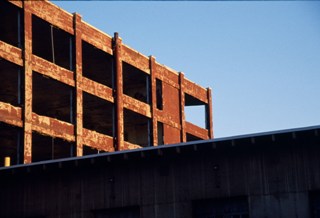
Sky cut-small

The Department of American Studies at Saint Louis University invites papers for its Second Visual Culture Graduate Student Conference, to be held April 16-18, 2010 in St. Louis, Missouri. This year’s conference theme, “Urban Cuts: Appropriation and Resistance in the American City,” coincides with the “Urban Alchemy/Gordon Matta-Clark” exhibition at the Pulitzer Foundation for the Arts, St. Louis.

Proposals are welcome from all disciplines exploring visual representations of conflicting uses and contested meanings of urban space. Taking a cue from Matta-Clark’s “cuts,” we seek contributions addressing the effects of changes in urban geography on people’s daily lives. We are particularly interested in projects that examine the role of photography, film, advertising, fine art, performance, architecture, design, and/or new media. We encourage submissions by graduate students working transnationally and comparatively on urban environments.

Topics may include, but are not limited to, the following themes:
– Representation & Iconography of Urban Space
– Demolition, Destruction & Displacement
– Fractured/Fragmented Space
– Contested Ownership
– Political Activism through Urban Space
– Memory & Subjectivity
– “Anarchitecture” as concept and practice
– Abandonment & Neglect
– Urban Renewal
– Urban Performance as Resistance

Please submit a 250-word abstract and a curriculum vitae by January 15, 2010 to vcc2010@slu.edu.
Additional information is available here. For questions, please contact Elizabeth Wolfson (vcc2010@slu.edu).

 0 Comments

Bit Players in the Ritualization of Violence

Lawrence Olivier once suggested that the key to acting was throwing yourself into your part, no matter that it might be as insignificant as the third spear carrier from the left.  The characters in this scene exemplify that advice.

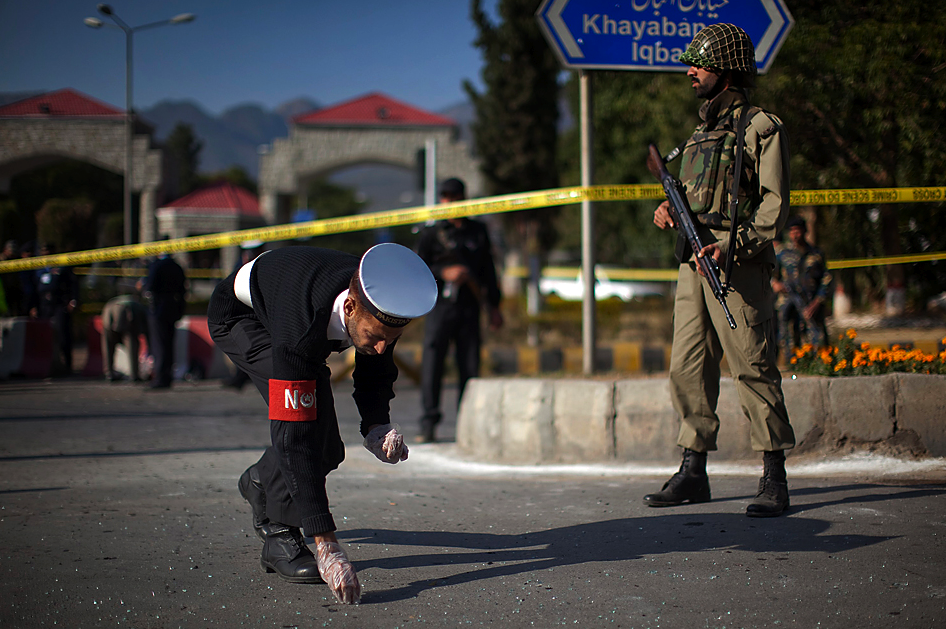
body parts Pakistan

While the figure on the right stands guard, the figure the left picks up body parts in the aftermath of a suicide bombing in Islamabad, Pakistan.  Neither action is likely to be decisive in the war spreading across that country, and each seems incidental even within the small scale of this photograph: the tiny pieces of flesh being retrieved appear to be no bigger than a fingernail, while the soldier is armed and ready in a street that is once again stabilized, even static, and almost empty.  Yet they are playing their parts with complete concentration, as if the play really mattered.

This play does matter, of course, and yet the war there and in Afghanistan is haunted by the sense that a deadly serious game also is being played merely for show.  The full panoply of state action appears, albeit too late to save those who were attacked, and on behalf of the restoration of a normalcy that was already a facade.  Everything in the scene is meticulously modern: sharp uniforms, aluminum signage, yellow plastic crime scene tape (in English), even the flowers in the traffic median and the clear plastic gloves for the body-part detail.  And yet none of these investments in civic order could keep someone from detonating a bomb among innocent people.

Thus, the image is troubling because of how it captures several deep tensions within state responses to insurgencies across the globe: tensions between attentiveness and incapacity, between restoring civic order and refusing to change, between collecting the dead and ignoring the demands of the living.

Because they have played their silent roles so well, these two minor players allow the scene to speak.  The photograph depicts another instance of the normalization of violence in the 21st century.  Nor can that violence be attributed wholly to the absent suicide bomber, for every part of the mise en scene declares that such violent acts are not a primitive residue, but have become fully integrated into a ritualized modernism.  Unfortunately, it seems that too often the modern state is committed only to maintaining whatever imbalances feed its own display of power.  If so, then any show of strength really is a sham.

Photograph by Adrees Latif/Reuters.

 0 Comments

Photographic Exhibition: Act of State

ACT OF STATE

Une histoire photographiée de l’occupation israélienne 1967 — 2007

(A Photographic History of the Israeli Occupation, 1967-2007)

Act of State

Curated by Ariella Azoulay

Centre de la photographie

Geneva, Switzerland

ACT OF STATE is the first photographic history of the occupation of the Palestinian territories. This exhibition documents both a history of facts and a history of representations.  The 700 photographs taken by 50 photographers are printed on A4 sheets from digital files.  The images also are available in an Italian catalogue published by Bruno Mondadori in 2008.

28, re des Bains, Ch-11205, Geneve

t +41 22 329 28 35/F +41 22 320 99 04

epg@centrephotogeneve.ch

www.centrephotogeneve.ch

December 3, 2009-January 17, 2010

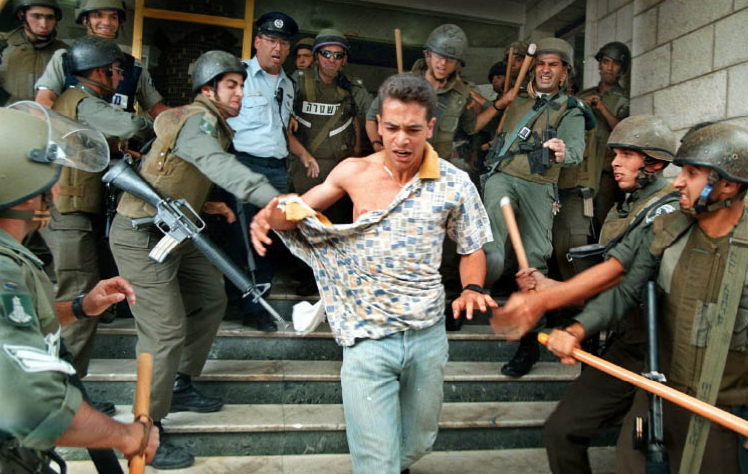
Photograph by Rina Castelnuovo, 1997.  See also Ariella Azoulay, The Civil Contract of Photography.

 1 Comment

Accidental Truths in Images of the Afghan War

Much of the time, photographs provide the ideal pretext for those who would deny the obvious.  The gambit goes like this: someone, often a photographer with intimate knowledge of the setting, takes a photograph that  is circulated by the press and then used as evidence in political argument.  At that point, the defender of the policy being questioned responds by focusing exclusively on the photograph’s evidentiary problems: the image shows only a single event; things might have looked very different a moment before or after; expressions can’t be trusted; much is not being shown; given these problems, the use of the photo is proof of bias.  Such objections rightly carry weight as each is true of photography in general and can provide a reasonable basis for skepticism.  The problem is that they also are used to deflect deliberation about serious problems, including environmental damage, economic and social decline, and tragic mistakes in foreign policy.   Worse yet, these seemingly reasonable caveats can bring one to overlook the facts when they are staring you in the face.

US soldier training Afghan police

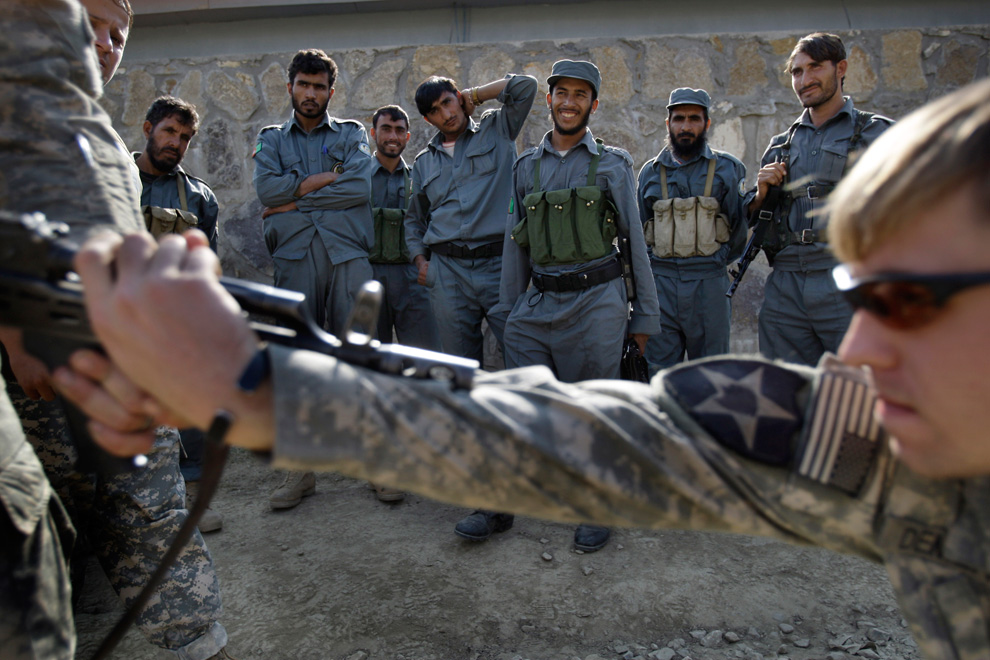
This recent photograph from Afghanistan is a good example of how images can simultaneously both reveal the truth and provide fodder for its denial.  The caption at The Big Picture said, “Afghan National policemen look on as U.S. soldier Cpl. Joseph Dement, right, from the 2nd Battalion, 12th Infantry Regiment, 4th Brigade Combat Team, 4th Infantry Division helps train the police on how to apprehend a gunman at an outpost in the Pech Valley of Afghanistan’s Kunar province Thursday, Nov. 5, 2009.”  The text is chock full of facts, and so we are cued to see the scene as evidence, but of what?

One obvious answer is that Americans are training Afghan security forces, and that the training reflects the same precision and intensity found in our own superbly prepared troops.  But note the verb: the policemen “look on.”  And so they do; they look on rather than study intently as if they were committed to the same mission as the US forces, or as if they really expected to be in a situation where they would enage in close combat rather than melt away.

In fact, the photograph is a troubling picture of contradictory extremes that can’t work together and aren’t likely to prevail on their own.  On the one hand, there is the American who is entirely focused on the technical precision of the military operation, and oblivious to the complex social scene in which he is embedded.  On the other hand, the Afghan policemen represent a social field of diverse personalities and attitudes, not one of which is likely to lead to a well-organized counter-insurgency.  It’s as if the photo was from a casting call for two very different B movies: one with American action figures and the other an Afghan sitcom on the order of Hogan’s Heros.

Thus, some can see the photo as revealing a fundamental problem in the American war in Afghanistan–indeed, a problem those of us of a certain age have seen in another war in a place called Vietnam, when we were subject to many years of denial of the obvious at all levels.  But you don’t have to take that analogy to see the problem now.  For example, Comment #79 at the Big Picture slide show says that this photo “shows pretty well the situation in Afghanistan. The Americans will fail because they can’t stay forever and the moment they leave everything will collapse.”

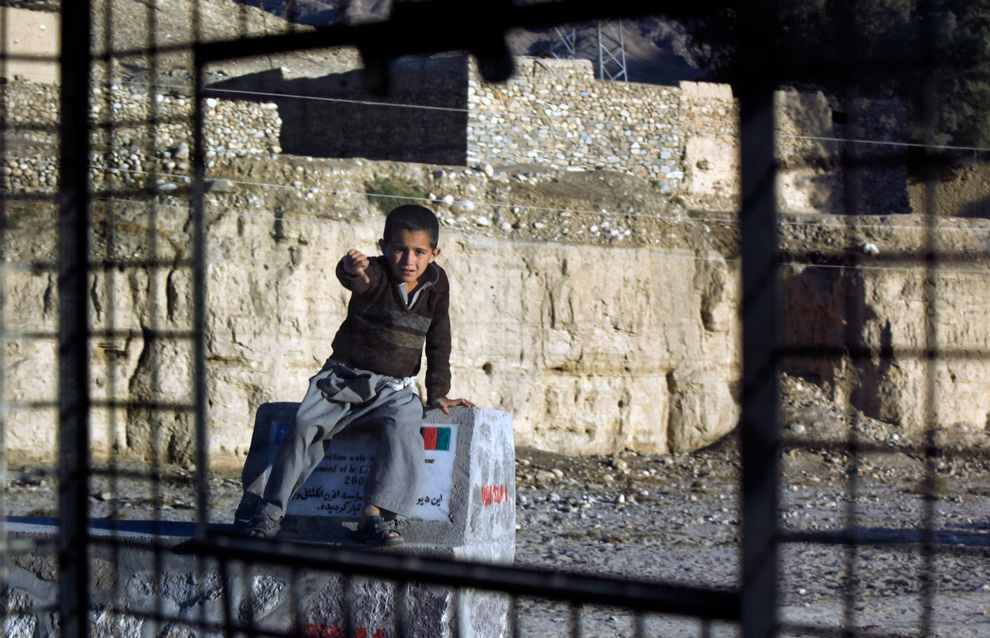
On the other side, of course, photographs depicting momentary facial expressions are tailor made for those who will seize on the single image to deny the broader picture.  Well, there are very few situations where anyone should be persuaded by a single image, and this isn’t one of them.  But it also is not a situation where political dissent should be disregarded because it turns to images to provide evidence (a term that comes from the Latin word for seeing).  When the “hearts and minds” of the people are a crucial factor in the mission, then photographs of ordinary people caught in accidental moments of time can reveal important truths.

Afghan boy thumbs down

“A young Afghan boy gives the thumbs down to a passing NATO French Foreign Legion convoy near Surobi some 50 kms east of Kabul, Afghanistan,Monday, Nov. 9, 2009” (The Big Picture).

Photographs by David Guttenfelder and Jerome Delay for the Associated Press.

 1 Comment

Giving Thanks or Giving Up?

As the Thanksgiving holiday in the US approaches, preachers, public officials, teachers, counselors, and even advertisers will be encouraging everyone to give thanks for what we might otherwise take for granted.  Because this was not likely to have been a bountiful year for most people, the ordinary, unsung features of daily life are being elevated to the status of blessings (which they are).  One might consider what would happen if similar advice were given regarding the way we look at things.  The sentiment need not even be one of gratitude so much as simple curiosity, if we would but look at what we otherwise take for granted.

wild turkey Buffalo-New-York

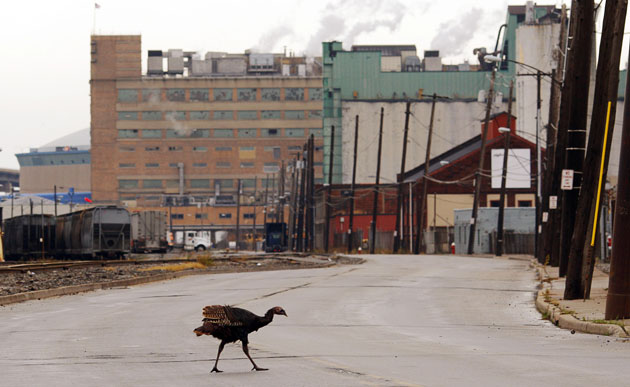
This photograph provides one example of what I have in mind.  It is basically a novelty shot: a wild turkey on the street in Buffalo, New York.  Even at Thanksgiving, one doesn’t see many wild turkeys, and they are not expected to appear in an urban, industrial setting, and what could it be doing there but–I can’t resist–crossing the road to get to the other side.  No more serious response seems called for: the turkey is a small, awkward figure, yet it can dominate a scene that is both dismal and distant.  This is not the time of year for a turkey to be walking into the city, but it seems safe enough, somewhat like an ordinary commuter trudging through urban isolation.  The image might as well be comic, if it is to be noticed at all.

What strikes me about the image, however, is everything other than the turkey.  Almost every part of the photo is focused on some part of what we ordinarily overlook: the electrical poles, lines, guy wires, and signage; the cracks in the pavement, crumbling curbs, and weeds breaking them down; the rusted rail line, the road bed, and rail cars; the industrial back lot of utility buildings, ventilation ducts, smoke stacks, and air conditioners and other rooftop machines; and, increasingly, the emptiness haunting industrial sites that have been abandoned or neglected or put to too little use for too long.

Seeing the world is something that everyone in the US now does through a camera, whether they know it or not, but not the camera that shows all.  Instead, most of the time we see the beautiful vistas and happy people of what might be called the retail side of life.  We habitually edit out the power lines in the tourist photo of a busy street or the weeds lurking in the news coverage, and few stop to consider how they rarely are shown the gritty reality of de-industrialization or the sad dispersions of people, possessions, and opportunities that accompany a declining standard of living.

Were people to really look at what is around them, they would still see much to be thankful for.  But they might see reasons to become alarmed as well.  To be truly thankful involves not only a feeling of gratitude, but also a resolution to preserve the good thing and pass it along to others.  If one looks closely, it may appear that Americans are overlooking a great deal, and that their inattention and lack of care for their cities, factories, and other infrastructure is a sign not of gratitude but rather of giving up.

Photograph by Brian Snyder/Reuters.

 1 Comment

When Poverty Doesn't Catch the Eye

This photograph may be one of the more ordinary images in recent photojournalism, and all the more eloquent for that.

homeless labourer

The caption stated that “A labourer rests near his makeshift tent home in a park” in Charlotte, North Carolina.  Attentive readers will have noticed the British spelling (and usage), and the image did come from an online slide show at The Guardian.  My guess is that American papers weren’t so quick to run the photo, but can you blame them?  There is nothing dramatic or otherwise notable anywhere in the frame.  The focus is diffused from the man in the foreground across the darkened, nondescript scene and then up into the spare stand of trees and the vague sky.  The area on the ground is littered with generic consumer items, while the background vista is a mess of random tree trunks, scrawny branches poking every which way, and brown leaves not yet scattered. The scene is utterly without visual interest, while nothing is happening–or likely to happen.

Attentive viewers may have noticed another dimension to the scene, however.  There are several tensions, subtle yet troubling, that can guide reflection.  First, there is more to the man, if you will look for it.  He is brooding it seems, an attitude that resonates with the long shadows from the late afternoon sun.  And that sunlight gilds his face and his hand: the face is taut with interior life, and the gesture and veins of his hand suggest strength and skill.  Together they may signify the dignity of labor, and so this photograph can channel the realism and progressive sentiments of genre painting.  He is not at work, however, or have enough of a job to afford shelter, and so the worker’s capable hands (and strong back) are immobilized.

Note also the contrast between his personal possessions and the unkept woodland.  His clothes are clean while laundry is draped on a clothesline, there is a symmetrical order to the campsite, and it looks as if a calendar and similar items are tacked to the tree trunk on the right.  What should be natural setting has taken on the look of domesticity, and what should be a temporary site–a campground, as if for a weekend getaway–is becoming the place where he may spend the winter.

So it is that the banality of the photograph is the vehicle for its documentary truth.  What we are seeing is a man settling into a “new normal.”  He is homeless, even if he is working he won’t have any job security, and his ability to cope, adapt, keep his shirt clean, and otherwise be ready to move up may do no more than keep him from slipping lower yet.

Photograph by Carlos Barria/Reuters.

 3 Comments

Sony World Photography Awards

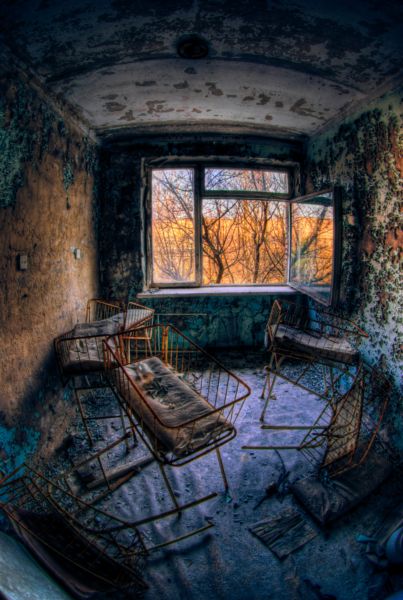
The World Photography Organization manages the Sony World Photography Awards, which offer parallel competitions for professional photographers and for amateurs.  Entry in competitions is free.  This year’s deadline for submission is January 4, 2010.  Information is available at the website, along with images of last year’s winners and amateur submissions.  The winners deserve our attention, but others do as well.  Images like this, for example:

chernobyl-hospital-ruin

Photograph of the department for newborn children, Pripyat’s hospital, Chernobyl alienation Zone, Ukraine, by Sergii Shchelkunov.

 4 Comments

Traces of Torture in the Visual Archive

The persistence of torture is enough to condemn modern civilization, the human race, and any conception of a just God.  Any thinking, feeling human being should be ashamed at what is done, and appalled at the perversion and obscenity and stupidity that it requires, and outraged at those who fabricate lies and evasions to excuse what is always a deliberate act of horror.

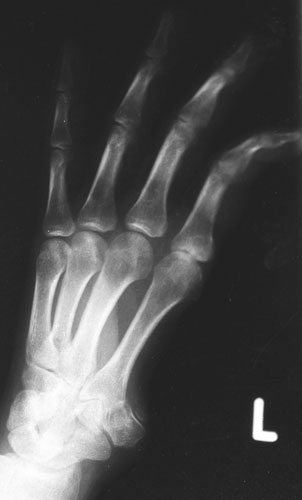
It’s pitiful that there is even need to say so, and because discussion of the topic involves facing evil while risking rationalization, good people might be loathe to consider how torture can be exposed, documented, and brought to public attention and so perhaps to justice.  The problem is compounded by the irony that so much of the damage done need not be visible.  The ratio between harm and evidence of harm may be greater with torture than with any other form of violence, not least because of the cleverness expended in devising techniques for causing pain without leaving physical scars (American citizens might want to to think of waterboarding and sleep deprivation, for example).  This is why the images collected by German radiologist Hermann Vogel provide eloquent testimony to the continuing agony and shame.

torture-x-rays-kurdistan

This is an X-ray of the hand of a victim from Kurdistan; after hanging from his fingers for far too long, the thumb had to be amputated.  (“Clearly the work of amateurs,” a seasoned torturer might say.) I find the image to be at once beautiful and heartbreaking.  The skeletal whiteness against the black void signifies a deep vulnerability, as we are at once creatures of light and yet so easily ghosted away into the void.  The delicately elongated fingers suggest the incredible sensitivity of which a human hand is capable–one can easily imagine these fingers creating gorgeous music at the piano, or making an intricate ornamental pattern on paper, or gently stroking a lover’s face.  All that was turned against the poor soul, however, as the same nerves were made to scream for mercy that never came.  And so the missing thumb speaks to a terrible absence, not only of itself, but also of the whole hand, and the whole body and self intact, and everything else that also had to be missing–and was–for evil to occur.

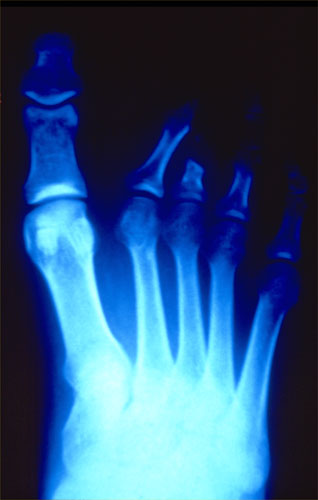
As reported by articles in The Guardian, Vogel has been collected X-ray images of torture and other forms of violence for almost thirty years.  This work is slowly bearing fruit, including the book A Radiologic  Atlas of Abuse, Torture, Terroism, and Afflicted Trauma, and Vogel currently is lobbying the EU to allow X-ray evidence in juridical proceedings such as asylum hearings.  Hearings that might offer some solace to the victims, or better yet, have saved someone from this:

torture-x-rays-iranian-girl

The X-ray reveals the permanent deformity produced when the toes of a 14-year-old girl were clamped by ­revolutionary guards in Iran.  She was being punished for wearing make-up.  Again, there is something touching about the image because it contains both a damaged body and a suggestion of the beauty that was broken.  Perhaps the crooked foot suggests the awkwardness of the teenage years, and certainly the blue and white hue evokes the color of a young woman’s clothes and love of life.  (These images obviously work in tandem with our foreknowledge of the victim’s circumstances, but that is hardly unusual.)  And again, the part less damaged is still suffused with light, while the brokenness blends into the dark beyond.  These images not only provide indexical signs of violence, they capture what is at stake in torture, which is nothing less than a war on all that is beautiful about human life.

It seems that evidence of trauma depends on assumptions about the formal integrity and right proportions of the human body that might be subject to criticism in some academic forums.  That indites no one, but it is a reminder that, on the one hand, ethical judgments can depend on aesthetic perception and visual evidence can extend well beyond factual verification, and, on the other hand, that nothing should be taken for granted and there will be reason to develop many other resources in order to press the case against torture.  In the meantime, however, one might appreciate the irony that these X-ray images, of all things, can evoke an emotional responsiveness essential to acknowledging the inhumanity of torture.  In the final analysis, these photographs may be seen more as art than as evidence, but they could be all the more important for that.

Photographs collected by Hermann Vogel.

 3 Comments