Jan 25, 2008
Nov 03, 2014
Feb 04, 2015
Aug 09, 2007
Mar 20, 2008
Jun 03, 2013

Between a Rock and a Hard Place

The recession has been bad for just about everyone, but it has been much worse for some than others.  And surely among those hurt the hardest have been the homeless who have become both the frequent target of hate crimes as well as the aim of criminalization laws in 273 cities nationwide making it making it illegal to eat, sit, or sleep in public places.  It is difficulty to fathom the fear that animates such violent reactions against those we might imagine are forlorn and hopeless—what is about such fellow citizens that evokes such animus?  what makes them appear to be so undeserving of our charity?— but since it comes from both vigilantes (the rock) and the state (the hard place) we can only assume that it is driven by deeply seeded anxieties.

A photograph featured by the New York Times in a story on efforts to enact hate crime statutes against those who perpetrate violence against the homeless perhaps offers the hint of an answer.
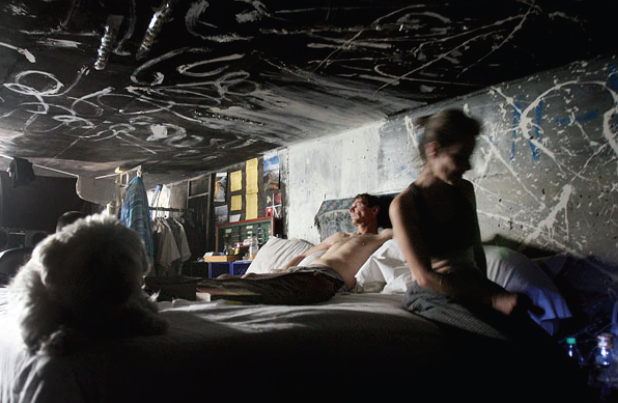
homeless-in-las-vegas

The photograph is of a couple who live in an underground flood channel beneath the Las Vegas strip. The image is shot at eye level, the vertical angle neither high nor low, and thus nullifying any sense of a power differential between the viewer and the subjects even as it suggests some degree of identification; at the same time, however, the horizontal angle is slightly oblique, detaching the viewer from the scene, perhaps even casting him or her as an outside observer. The image is thus framed formally by a tension between identification and dissociation.

The social tension that simultaneously separates and connects viewers and the viewed is marked in other respects as well.  The faces of the people are not recognizable, cast in shadows and blurred by movement, and yet they appear to be a normative heterosexual couple—perhaps even a family—as they share their neatly made bed with one another and their dog.  It is clearly not a normal house or apartment.  Distinguished by its low ceiling it has something of a cellar-like atmosphere, dark and damp.  The unrecognizable graffiti strewn across the wall and ceiling  makes even that an unlikely location however, suggesting something of a public space.  And yet for all of that it does appear to be organized as a private “room” that  bears many of the artifacts of modern living, including what looks to be a bulletin board that features colorful photographs—a reminder of or perhaps a hope for better times—and something like a desk.  And note too the book that sits next to the man’s leg as he apparently has tired of reading in bed.  Maybe he is listening to the boom box that sits behind the dog.

The most telling feature of the photograph is  surely the clothing neatly hanging on a rod in the background.  This sign of orderliness—here, a clear marker of civility—does not fit with our stereotype of the homeless as crazed, drunken or lazy vagabonds.  These are not social outcasts who tote their worldly goods bundled together in a trash bag or orphan grocery cart or who mumble to themselves while walking down the street.  They clearly know what it means to have a home. Indeed, these people could be us, the viewers, you and me.  And therein, no doubt, lies at least part of the answer to the cause of our intense fear and loathing of the homeless, for as much as scenes like this lead us to utter the mantra “there but for the grace of God,” so too do they heighten the need for dissociation.  And as history has shown, time and again, there is no more powerful mode of dissociation than casting about for scapegoats.  But that, of course, has not been history’s only lesson with respect to the practice of scapegoating.

Perhaps we too as viewers are caught between a rock and a hard place.

Photo Credit: Isaac Brekken/New York Times
 2 Comments

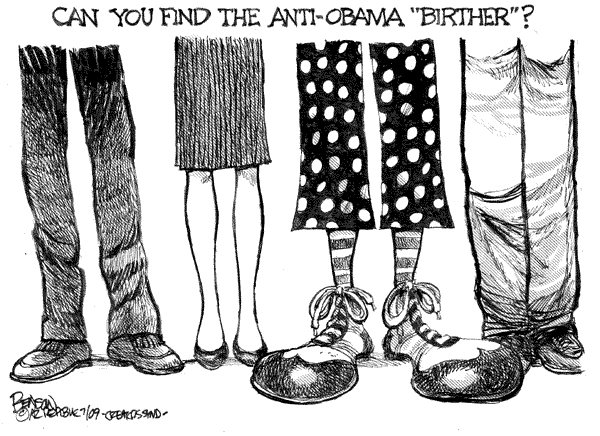
SIght Gag: Can You Find the Obama "Birther"?

benson

Credit: Benson/Arizona Republic

“Sight Gags” is our weekly nod to the ironic and carnivalesque in a vibrant democratic public culture.  We typically will not comment beyond offering an identifying label, leaving the images to “speak” for themselves as much as possible.  Of course, we invite you to comment … and to send us images that you think capture the carnival of contemporary democratic public culture.

 0 Comments

President Obama's Teachable Moment

wh-beer-summit

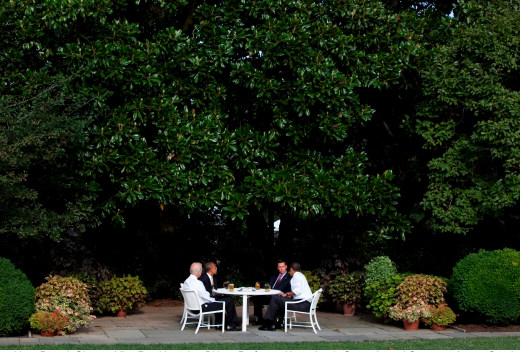
My first impulse on seeing various iterations of this photograph—this is the official White House version—was to take a pass on commenting on it.  After all, I surmised, it is such an obviously orchestrated photo-op that there is very little that needs saying—a point seemingly underscored by the fact that many of the numerous newspapers that showcased the photograph on their front page chose not to include any front page commentary beyond a simple caption (including the New York Times).  And perhaps this was with good cause as most articles written about the event emphasized such key facts as the clothes being worn, the type of glassware being used, and the variety of beer being consumed (it turns out that the president is a “Bud Lite” man).  But then I watched the Colbert Report and was reminded that the point of this meeting had something to do with what President Obama had called “a teachable moment.” And the more I looked at the photograph the more I wondered, what exactly is being taught?

The photograph shows four men sitting at a round table having a beer and engaging in private conversation.  We know it is a private conversation in part because the four men have their attention directed towards one another and seem oblivious of the fact that they are being observed by a row of photographers some fifty feet away.  But note too, that the very setting underscores the sense of privacy as the table is conspicuously set apart from the rest of the yard in what middle class homeowners might recognize as a patio carefully shielded from public view by trees and planters.  The sense that this is a private meeting is further accented by the photograph as it is shot from afar with what appears to be a standard 50 mm lens that locates the viewer in public space at some distance from the event, and most importantly, clearly outside of hearing range.  Indeed, there is a quality to the photograph that suggests that the viewer is something of a voyeur, intruding where they don’t belong.

Put simply, everything about this photograph signals that the event is a private moment, albeit one that was carefully orchestrated as a spectacle for the passive consumption of the national public.  And, indeed, when someone in the media dubbed the meeting a “beer summit” the president was very quick to point out that this was not an official or even political event.  Rather, he emphasized, “This is three folks (sic) having a drink at the end of the day and hopefully giving people an opportunity to listen to one another.”  The point to note here, of course, is who got “to listen” — and who was consigned to view the event from a distance and without sound.

The lesson to be learned then, it would seem, is that racial tensions of the sort that animated this meeting are best handled as private matters, issues to be resolved by adults (not citizens) between and amongst themselves and outside of the public eye.  And if the outcome is little more than to “agree to disagree,” well, what’s wrong with that?  Perhaps this is what it means to live in a so-called “post-racial society.”  The difficulty is that such an approach grossly simplifies the nature of the problem of race in contemporary society, and especially in instances where racial matters are implicated by the use of state violence to manage the citizenry.  Following the meeting Professor Gates was quoted as saying, “When he’s not arresting you Sgt. Crowley is a really likable guy.” I assume that the comment was made with tongue planted very deeply in cheek, but in any case the irony is profound and very much to the point,  for what is at issue is precisely how Sgt. Crowley behaves when he is enacting his role as an officer of the state, wielding badge and gun.  And whether he was right or wrong in arresting Professor Gates, surely that should never be a private matter shielded from the public view.

Photo Credit:  Lawrence Jackson/Official White House Photo

 1 Comment

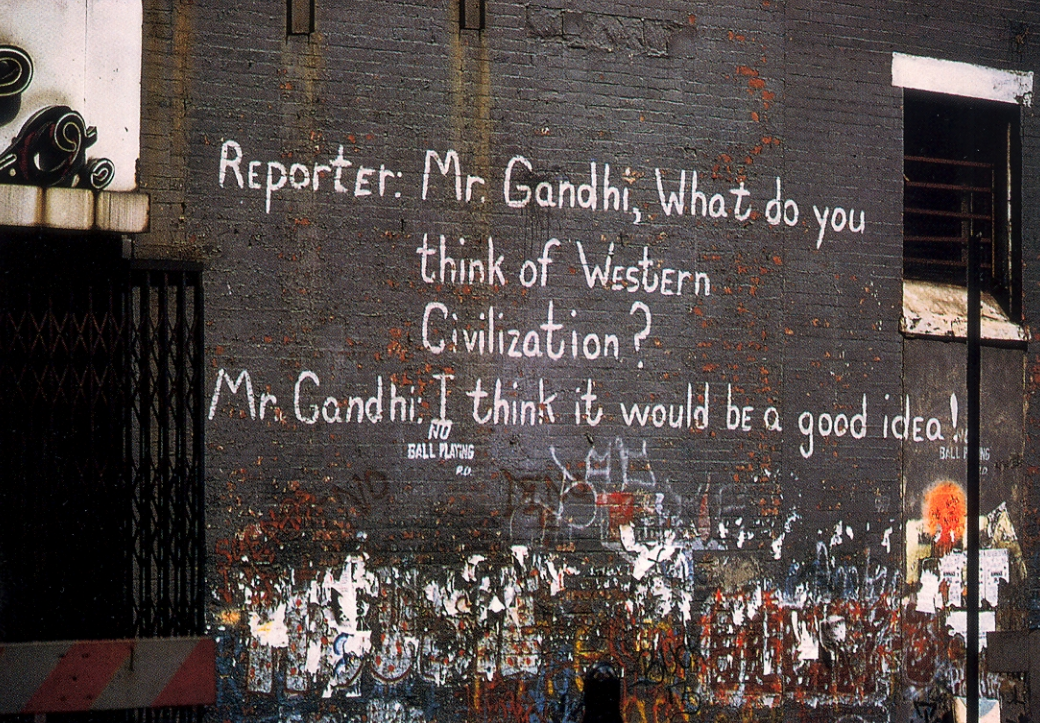
Sight Gag: Mr. Gandhi's Neighborhood

gandhi1

Credit: Anonymous Post Card

“Sight Gags” is our weekly nod to the ironic and carnivalesque in a vibrant democratic public culture.  We typically will not comment beyond offering an identifying label, leaving the images to “speak” for themselves as much as possible.  Of course, we invite you to comment … and to send us images that you think capture the carnival of contemporary democratic public culture.

 0 Comments

Conference: Feeling Photography

Feeling Photography
University of Toronto
October 16-17, 2009

“Feeling Photography” is an international, interdisciplinary conference that will bring together scholars working in a range of interpretive and theoretical approaches to interrogate the relationship between the affect, emotion, and/or feeling and the photograph. The conference will be held at the University of Toronto and is sponsored by the Centre for the Study of the United State and the Toronto Photography Seminar.

The conference features plenary addresses from the following scholars: Lisa Cartwright (UCSD); Ann Cvetkovich (UT Austin); David Eng (Penn); Marianne Hirsch (Columbia) and Leo Spitzer (Dartmouth); Christopher Pinney (University College, London); Shawn Michelle Smith (School of the Art Institute of Chicago); and Diana Taylor (NYU). We have assembled fifty-two papers from our fall CFP into sixteen panels featuring scholarly work from across the globe and the disciplines. Panel topics include Children and the Political Management of Affect; Feeling Together: Publics and Counterpublics; Emotional Geographies; Marketing Emotions: Loss, Fear and (Comic) Loathing; Racial Affects; Emotional States: Citizenship and Photography; Instrumental Images: Bodies, Cities and Empires, 1903-1918; Digital Affects; Public Intimacies; Touching Photo; Visual Witnessing: Photography and World War II; Feeling First: Documentary and Left Internationalism; Photography, Trauma, and the Ethics of Witnessing; Queer Affect(s); Affective Economies; Facial Tics – Faciality.

Early registration deadline for the conference is September 1st. To Register, and for further information, see www.torontophotoseminar.org.  Our email contact is Feeling Photo.

Conference organizers are Prof. Elspeth Brown, University of Toronto; Prof. Thy Phu, University of Western Ontario; and Prof. Matt Brower, University of Toronto with the assistance of David Sworn, graduate student in History at the University of Toronto and Nina Boric, Munk Centre. For the Toronto Photography Seminar, see www.torontophotoseminar.org; for the Centre for the Study of the United States at the University of Toronto, see http://www.utoronto.ca/csus/.

 1 Comment

What We Dare to See

solar-eclipse-india-709

A total eclipse of the sun is a rare phenomenon. In ancient times it was understood to be an omen or portent.  Herodutus reports that an eclipse halted a battle between the Lydians and Medes, noting that  “when they saw the onset of night during the day …[t]hey stopped fighting, and both sides became eager to have peace.” Would that it had the same effect in contemporary times.  Superstitions of one sort or another continue, of course, particularly in tribal and polytheistic cultures, but from the perspective of the so-called “modern” world an eclipse is a natural event that manifests what we might call the “sublime,” an awe-inspiring spectacle, simultaneously beautiful and foreboding; as a sublime object a total eclipse commands our attention even as we know that looking at it directly is forbidden lest we risk losing our sight altogether.  And more to the point, we almost always take the dare.

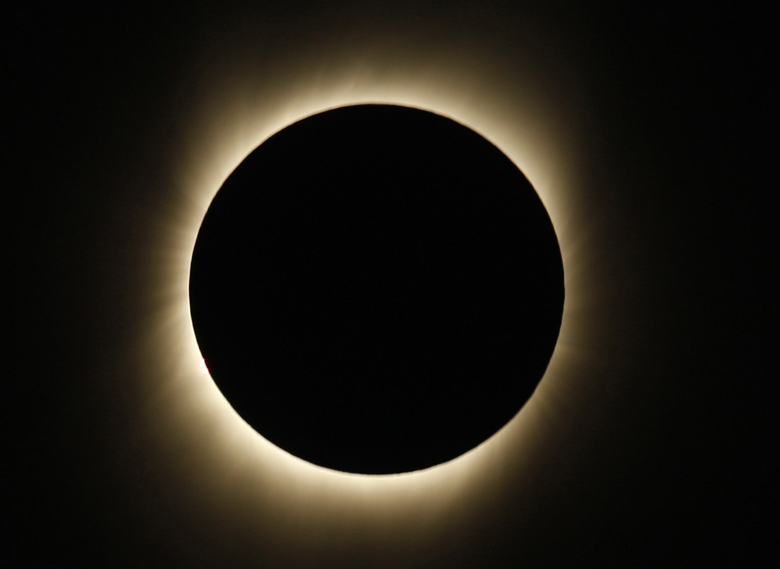
There was a total eclipse of the sun that crossed nearly half of the earth last week, cutting across most of East Asia from India to China and lasting for nearly seven minutes  And we looked.  Not directly, of course, but through various media that filtered our vision.  Those in the direct path of the eclipse relied on indirect projection, smoked glass, exposed slide film or x-rays, and all other variety of solar filters.  The rest of us have had to rely on photographic representations such as those available at The Big Picture to satisfy the desire to look at the forbidden object.

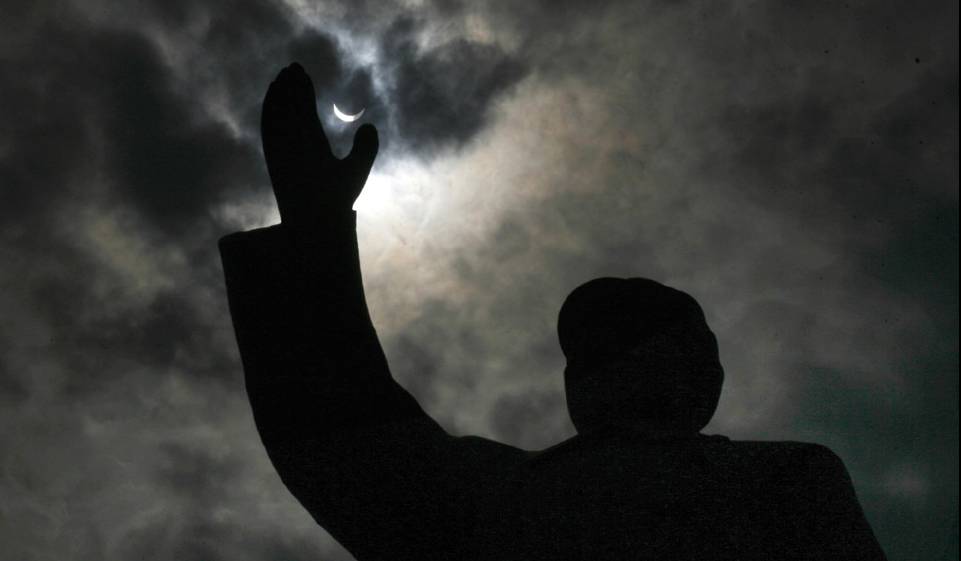
Viewing an eclipse through a camera’s lens or a view finder can be no less dangerous than unmediated observation (and maybe more so to the extent that it telescopes and magnifies the view), but that doesn’t seem to have deterred the various photographers who alternately took pictures of people viewing the eclipse and pictures of the eclipse itself.  Interestingly enough, pictures of the eclipse are divided into two categories, those that feature various stages of the eclipse itself without any external reference points (as with the photograph above) and those that locate the eclipse against the silhouette of various cultural backgrounds, such as in a statue of Chairman Mao in Hubei Province.

mao-eclipse

Such photographs are interesting allegories for the naturalizing mystique of photography itself: a technology that presumes to separate the viewer from the thing viewed at a safe distance, even as it creates the illusion of being there.  So we can presume to view (and in viewing to experience the “beauty” and “pleasure” of)  a solar eclipse—or other manifestations of the sublime such as wars and catastrophes—without the risk of wound or demise.  Of course here the silhouette of culture against nature emphasizes the illusion and thus reminds us of the real  distance from the thing we are viewing, both physically and technologically. What we need to remember is that photographs don’t always foreground their artifice, and therein lies the true risk in what we dare to see.

Photo Credits:  Saurabh Das/AP Photo; Stringer/Reuters

 0 Comments

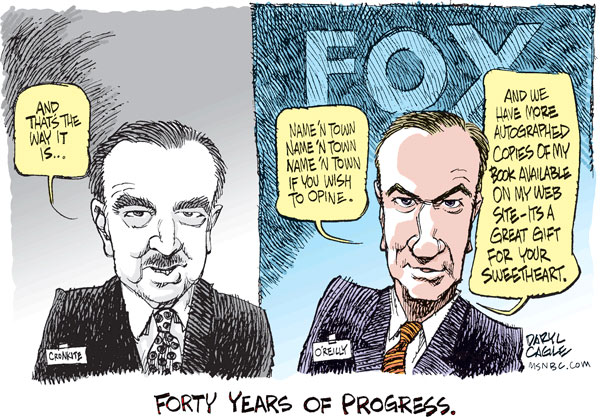
Sight Gag: P-R-O-G-R-E-S-S

cronkhite

Credit: Cagle

“Sight Gags” is our weekly nod to the ironic and carnivalesque in a vibrant democratic public culture.  We typically will not comment beyond offering an identifying label, leaving the images to “speak” for themselves as much as possible.  Of course, we invite you to comment … and to send us images that you think capture the carnival of contemporary democratic public culture.

 0 Comments

Remembering Apollo 11: Techno-Porn and Modernity's Gamble

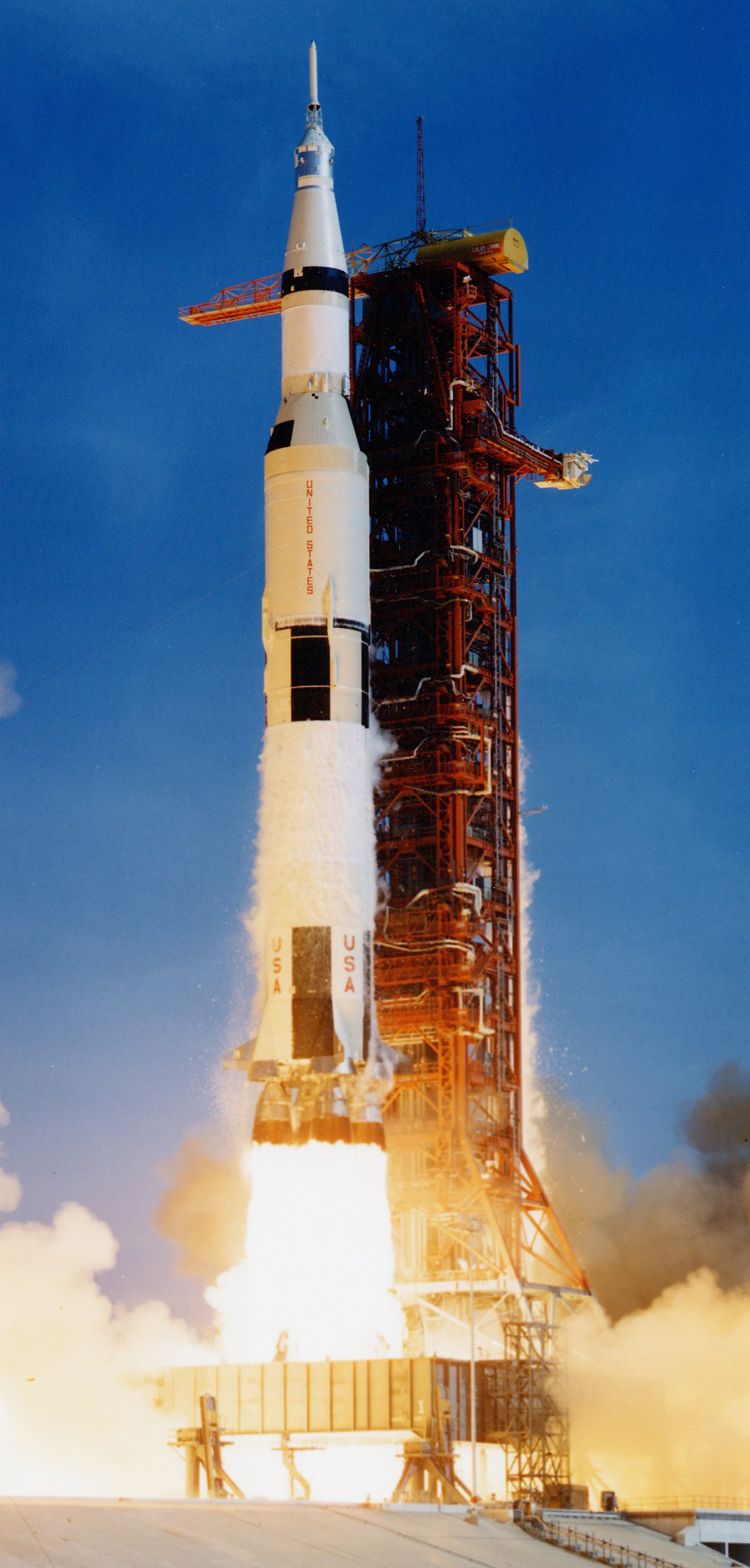
a13_c69pc442-1

The 40th anniversary of the Apollo 11 moon landing has been the occasion for commemorating a moment of national triumph—by some accounts “the” moment of national triumph in the post-World War II era—with slideshows of  “remembrance” at many of the major media outlet websites (e.g., here and here).  The photos at these slideshows display a ritualistic pattern of representation that features heroes (both the astronauts themselves, as well as the engineers and technocrats that made it all possible) and images of the earth as if shot from the heavens, a vantage that  no ordinary mortal could ever achieve.  But more than that, these slideshows are dominated by images that fetishize the technology itself, as with the photo above of the Saturn V rocket that hurled the Apollo 11 astronauts into space.

The photograph is a sublime display of raw and unfettered power.  I am typically reluctant to concede the generally all too easy identification of a phallic symbol, but it is pretty hard to avoid the ascription here.  The long, thin projectile is literally “blasting” off from the launch pad, powered by nearly 7 million lbs. of fuel (according to the caption).  And it is not hard to imagine it as a representation of  a nationalist (notice the red, white and blue color scheme) and technological orgasm, a physical expression of force further accentuated by the sheer size of the photograph itself, a 10 X 20 inch reproduction at the website where I encountered it, that far exceeds the dimensions of my 22 inch monitor and requires that I scroll up and down to see the entire image.  Indeed, in its own way the photograph as such functions rather like the foldout in a “girlie” magazine that requires the viewer’s active participation in order to take in the somewhat “larger than life” object of desire.

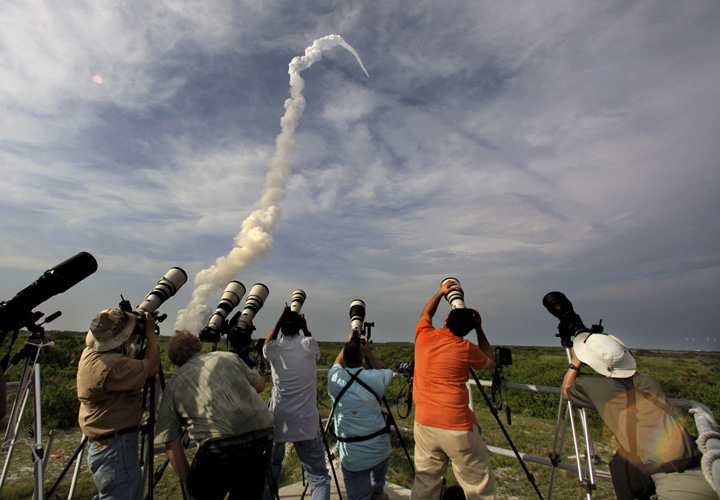
The national media has been complicit with the promotion of NASA and the space program virtually from the beginning, and so I was not really surprised when, in the midst of all of the nostalgia for Apollo 11—and visual remembrances of  what we might characterize as vintage techno-porn—I encountered a slideshow at the Sacramento Bee that once again seemed to make a fetish out of our more contemporary space technologies, this time in conjunction with the International Space Station and the recent launch of the Endeavour space shuttle. But what took me by surprise was the slide that ended the show:

endeavour-blast1

The photograph is distinct in a number of important ways that warrant comment.  First, of course, is the simple fact that the image features the technology of photography itself rather than the space technology.  There is no way to know if those with the cameras are professional photojournalists or pro/am photographers, but in either case the point is clear that the spectacle we are witnessing—whether it is the blast off from a launching pad or a close-up of the space station floating ever so serenely in orbit—is not immediate to our ordinary human perception but rather is refracted through a lens that creates the appearance of closeness or distance, that can expand or diminish the magnitude of the object or event being observed, and so on.  So, for example, compare the size and distance of the image of the Endeavour in this photograph with the image of the launch of the Apollo 11 above.  What these photographers can see with their eyes and what they will capture with their cameras is not exactly the same thing.  The photo is thus something of a reminder of both the fact and effects of technological mediation.  And more, it is a reminder that the camera itself is complicit in some important respects in creating the objects of our desire; and this is no less so in observing the idealized presentation of technological wonders themselves than when we are gazing upon the eroticized body.

But there is a second and more subtle—perhaps even more important—point as well.  Although the billowing plumes of white smoke indicate a powerful force, it is nevertheless a finite power, as we see that what rises must inevitably fall (pun intended).  Indeed, the downward slope of the smoke is at least vaguely reminiscent of some images of the descent of the Challenger space shuttle after its disastrous explosion, and thus perhaps the image is a cautious reminder of the anxiety that seems necessarily to accompany modernity’s gamble—the wager that the long-term dangers of a technologically intensive society will be avoided by continuing progress: every step forward entails some risk, the bigger the step the bigger the risk.   Put differently, for all of the positive effects and affects of our landing on the moon in 1969, our remembrances of that event have included virtually no consideration of the costs expended, including the deaths of the Apollo 1 astronauts, or those who flew aboard the Challenger and Columbia space shuttles.  And to remember Apollo 11 in this way is to idealize the event that took place on July 16, 1969, to airbrush it, if you will,  and in a manner that converts our memory of that day into something of a fetish.

I wonder if we can separate progress and the risks—the triumphs and disasters—of living in a technological society quite so easily.  And if we do, we surely must ponder the ultimate costs.

Photo Credits: NASA; John Raux/AP

 3 Comments

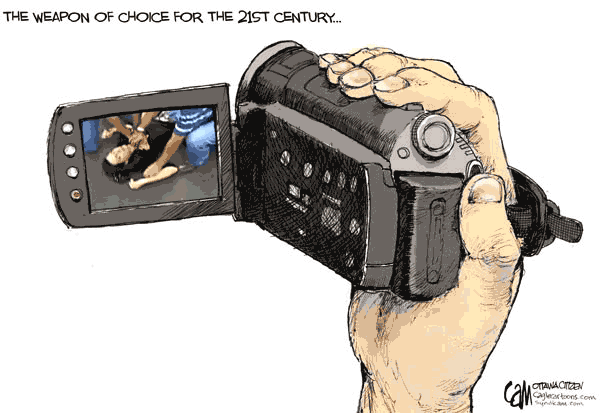
Sight Gag: Weapon of Choice for the 21st Century

camq

Photo Credit:  Cam Cardow, Ottawa Citizen

“Sight Gags” is our weekly nod to the ironic and carnivalesque in a vibrant democratic public culture.  We typically will not comment beyond offering an identifying label, leaving the images to “speak” for themselves as much as possible.  Of course, we invite you to comment … and to send us images that you think capture the carnival of contemporary democratic public culture.

 2 Comments

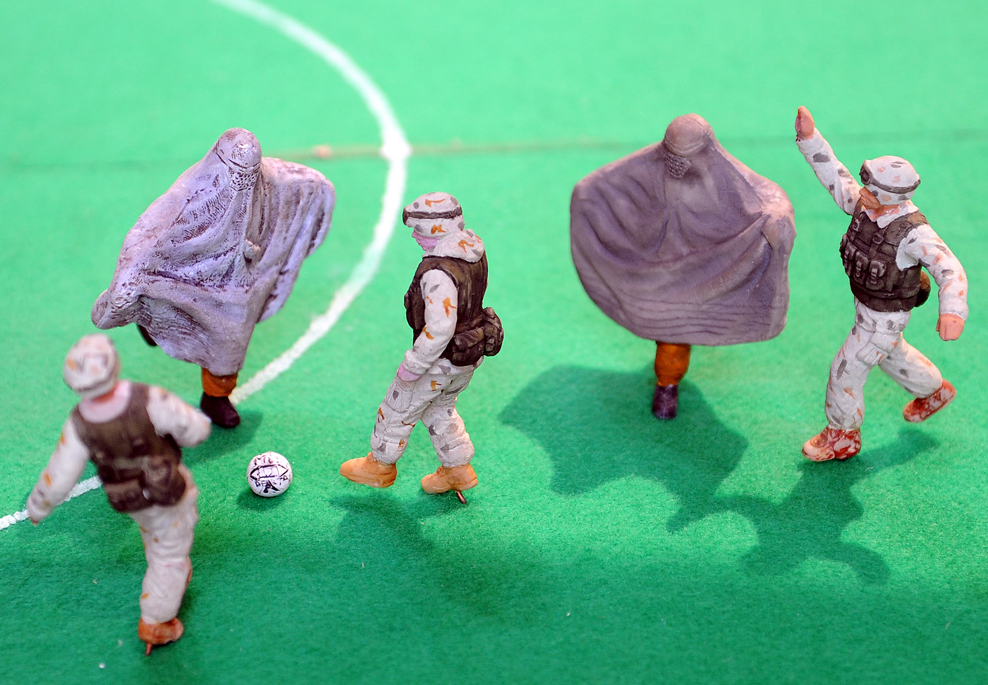
SIght Gag: War Games

war-games

Photo Credit:  Alberto Pizzolia/AFP/Getty Images

“Sight Gags” is our weekly nod to the ironic and carnivalesque in a vibrant democratic public culture.  We typically will not comment beyond offering an identifying label, leaving the images to “speak” for themselves as much as possible.  Of course, we invite you to comment … and to send us images that you think capture the carnival of contemporary democratic public culture.

 0 Comments