Apr 08, 2011
Aug 16, 2010
Jan 25, 2008
Feb 17, 2012
Jul 24, 2007
Aug 17, 2011

The Third Crusade

afghan-bible

The “Summer Surge” has begun in Afghanistan, though more with a whimper than a bang if we measure it in terms of media attention.  The death toll creeps higher each day, but one has to search hard to find any mention of it.  The stories that do appear on a war that is now eight years old (and counting) tend not to be headline fare in most U.S. news outlets, and those stories that do appear exude something of an everyday, taken-for-granted quality about the whole matter.

While news stories seem lacking, there have nevertheless been a small number of slide shows cropping up at various news outlets (here and here, for example) over the past several weeks.  What marks these slide shows is their almost singular banality as they repeat over and again the same, tired, visual clichés for representing war that we have become accustomed to in recent times: tight close-ups of marines—in many cases young boys trying to appear like hardened veterans—expressing intense and stern determination; images of U.S. troops preparing to do battle or returning from battle or approaching and searching what appear to be empty villages or fighting the boredom of war or playing games with local children; photographs that feature the advanced technology of U.S. warfare, including weaponry, night vision capabilities, and so on.  Rarely and only occasionally do we see some actual fighting—and perhaps for good reasons—but on the whole what we are shown are stock pictures we have seen before and but for the fact that they emphasize a desert locale, there is nothing particularly distinctive about them.  In short, there would appear to be no news here.

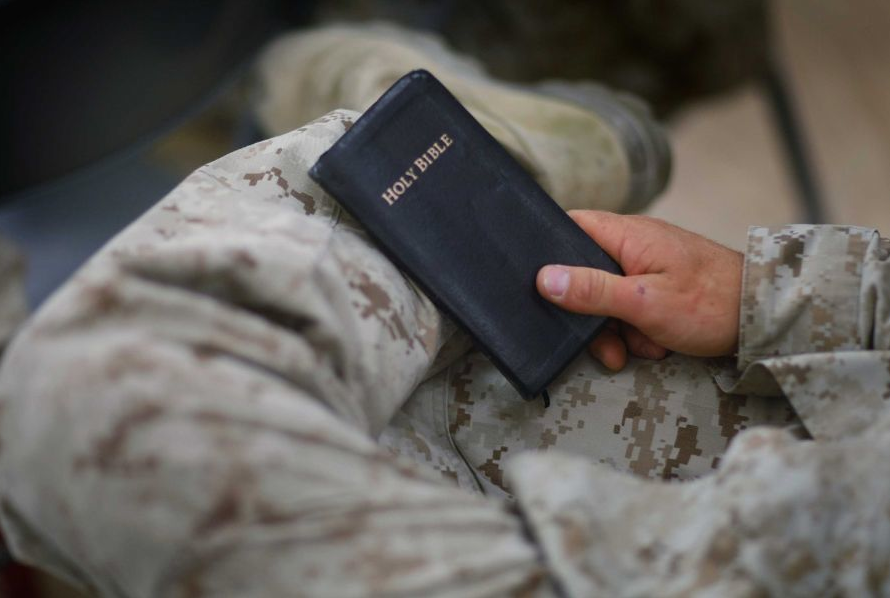
And yet, for all that, it would be imprudent to ignore what such visual displays show us and how such “seeing” contributes to normalizing our understanding and attitudes about the war.  The photograph above led off a recent slide show of forty seven images at the Denver Post website titled “Marines Pour Into Afghanistan.” One might imagine such a slide show beginning with photographs of marines parachuting from planes or embarking from helicopters, literally “pouring into” the Afghani countryside, but instead of emphasizing the activity of the headline caption we encounter an anonymous and relatively passive soldier.  That the image crops out the face and head of the soldier does more than just accent his anonymity as a cipher for the U.S. military, for the photograph is shot as if literally from his point of view.  Notice how the camera locates the viewer in the physical space of the soldiers’ head and eyes.  We see what he sees—or what we might imagine that he sees if he were to hold his gaze—and thus the photograph coaxes our identification with his very being by suturing our vision with his.

And what he/we see, of course, is the Holy Bible, which sits at the very center of the image.  And more, along with the hand that holds it, it is photographed as if in a portrait, where the face is in sharp focus and all that surrounds it is softened so as to direct and hold our attention on the main object.  One might think of the photograph in this respect as one more cliché of war rhetoric, an aestheticized visualization of the old saw that “there are no atheists in foxholes.”  But of course the conflict in Afghanistan is at least in some measure a religious war, and as such representations of the Holy Bible take on a much larger significance.  Here, it is not just a symbol of  comfort for those in harms way—though it may certainly be that—but poised at the beginning of the slide show as it is, it frames the meaning of all that follows.

But what is that meaning?  We get something of a clue by attending to the brief narrative paragraph that precedes the above image where it quotes the commander of the 2nd Battalion, 8th Marines as he speaks to his troops as they are about to embark on their military mission: “You’re going to change this world this summer and it starts this morning.”  The name of that mission is “Operation Khanjar, or Strike of the Sword.” Now look at the photograph one more time and notice that the Bible holds the place where one might otherwise imagine a weapon—a rifle, or in an earlier epoch, perhaps a sword—particularly in the hands of a Marine about to occupy  hostile terrain.   Yea, though I walk through the valley of the shadow of death …

There are other ways to interpret the photograph, to be sure, but the point here is that the photograph needs to be interpreted. And this is all the more so when the images shown by such photographs appear to be all too normal and ordinary, or when they beckon our identification all too seamlessly.

Photo Credit:  Joe Raedle/Getty Images
 2 Comments

Sight Gag: Digital Liberty

matson

Photo Credit:  Matson/St. Louis Post-Dispatch

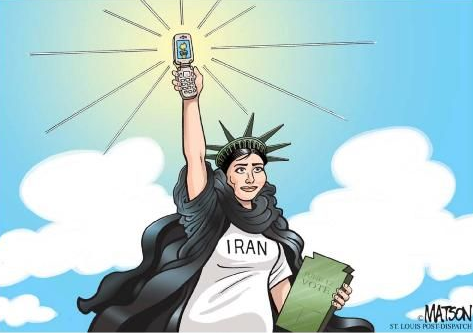
“Sight Gags” is our weekly nod to the ironic and carnivalesque in a vibrant democratic public culture.  We typically will not comment beyond offering an identifying label, leaving the images to “speak” for themselves as much as possible.  Of course, we invite you to comment … and to send us images that you think capture the carnival of contemporary democratic public culture.

 1 Comment

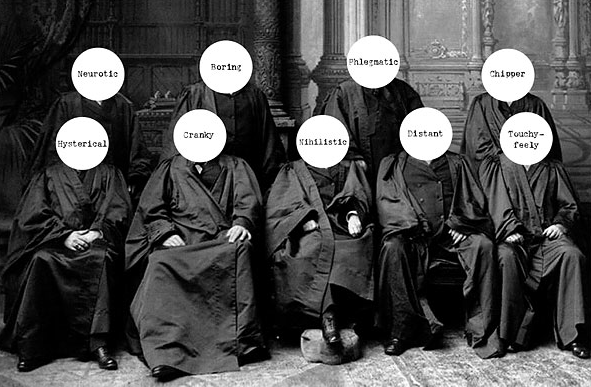
Sight Gag: Judicial Temperament

judicialtemperament

Credit:  Knickerbocker

“Sight Gags” is our weekly nod to the ironic and carnivalesque in a vibrant democratic public culture.  We typically will not comment beyond offering an identifying label, leaving the images to “speak” for themselves as much as possible.  Of course, we invite you to comment … and to send us images that you think capture the carnival of contemporary democratic public culture.

 1 Comment

Then and Now

Can you name the location of this photograph?  If you need a hint click on the image.

tsquare-today

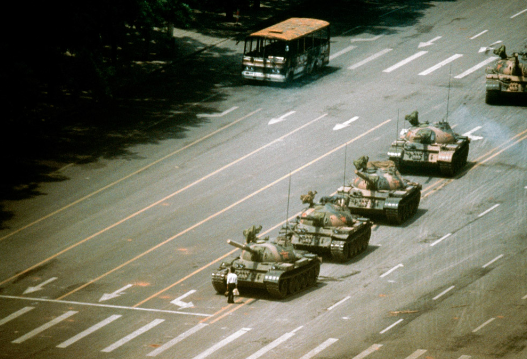
Even those who actually recognize the scene probably misidentify it.  Most westerners would be inclined to say that it is Tiananmen Square, though it is actually Changan Avenue, which is a bit east of the square.  On its face that small detail of misnaming would seem to be relatively unimportant, after all, what really matters was the event, right?  And the iconic photograph nails that as a lone individual stands down a row of tanks. Of course, when we say “iconic photograph” we have a bit of a problem too since there are at least four different photographs that are commonly referred to as “the” photograph.  But again, perhaps that too is just a trivial matter as each image is really quite similar and collectively they appear to confirm the relevant facts—a man, a row of tanks, a public thoroughfare, etc.  So what if the four images are not identical to one another—if in some you have a close-up and in others you can see the wide street and bus, or if in some the man is carrying a bag in each hand, but in at least one he no longer has a bag in his right hand?  What difference does it make?  Maybe nothing.

Then again, perhaps it calls our attention to the ways in which photographs become reductive representations of places and events that can (and often do) direct (or misdirect) our attention and, subsequently, our memory.  What was the dance between the man and the tank all about?  Was it about a lone, heroic individual standing up against incalculable odds in a scene that might have been played out in the mythic American west with Gary Cooper cast as the man holding the bags?  Or was it one small part of a mass, collective demonstration, a radically democratic  (and potentially dangerous), grass roots  revolution?  Did that photograph inflect a liberal or a democratic moment?  Perhaps the photograph above coaches an answer.

It is not hard to see this photograph as a visual quotation of the iconic image of the man and the tank.  Taken from almost the identical vantage of the iconic photograph(s), it shares many of the high modernist aesthetic conventions of the original that make it easily identifiable to western audiences:  It is universal rather than parochial (it could be anywhere in the world), it is geometric rather than organic (notice how the scene and all that it contains are disciplined by rigid angles and vectors), it is functional rather than customary (the street is designed to “move” masses of people from one place to another rather than to accommodate social interaction), and so on.  But more, it is shot from on high and at some distance.  The viewer thus looks down upon the scene with a degree of objective detachment that James C. Scott affiliates with “seeing like a state,” a panoptic vantage “that is typical of all institutional settings where command and control of complex human activities is paramount.”  That the iconic photograph has circulated mostly (and almost exclusively) in the west is a clear indication of who is viewing whom, and who presumes cultural hegemony. But what is being naturalized here?

The template is framed in a figural dialectic defined by the relationship between “then” and “now.”  And from this chronotopic perspective, what is different are the particular figures within the scene.  In 1989 we had a showdown between the heroic individual and the authoritarian state, in 2009 we have the traffic and commerce symptomatic of a busy thoroughfare in any city in the world.  What is important to notice is that in each photograph the anonymity of the actors remains intact, with this crucial difference: then they were defined as political agents caught in a struggle between good and evil, now they are seen as global consumers defined (as so often in the U.S.) by their cars.  What was thus then cast for western eyes as a liberal-democratic revolution is now cast as a liberalized, global economy of undifferentiated, mass consumption. Liberalism, it would seem, is the trump card.  Their present is our past … again.

That could be useful framing of the social order, as it animates the possibilities for trans-global identification, or it could reduce our sense of the possibilities for a global civil society to a neo-liberal economic hegemony disciplined by the narrow and limited conventions of  late modern design.  Its all a matter of what we choose to see and remember.

Photo Credit: David Gray/Reuters  (For more on our consideration of the original “tank man” image and its various iterations and appropations see chapter five in No Caption Needed (the book) and posts here and here.)

 0 Comments

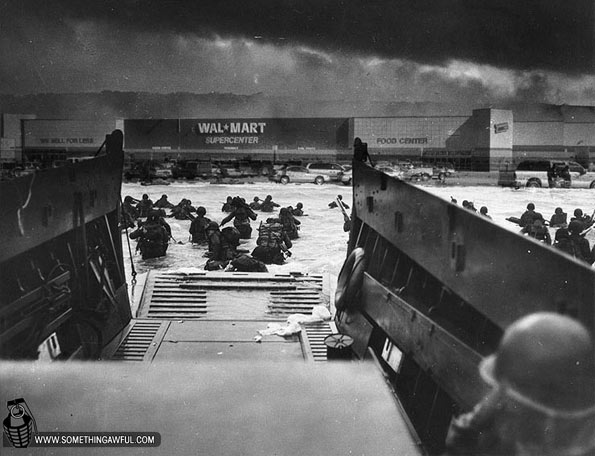
Sight Gag: Saving Private Walton

slightbutsteady_01jpg

Credit:  Somethingawful.com

“Sight Gags” is our weekly nod to the ironic and carnivalesque in a vibrant democratic public culture.  We typically will not comment beyond offering an identifying label, leaving the images to “speak” for themselves as much as possible.  Of course, we invite you to comment … and to send us images that you think capture the carnival of contemporary democratic public culture.

 0 Comments

Being Private in Public

“Liberal democracy” is a political paradox animated by the competing and often contradictory demands and interests of individual and collective living.  The liberal-democratic conundrum manifests itself in numerous civic contexts, but none more clearly than in those situations in late modern society that underscore the tension between the public and private spheres of life.  One solution to such quandries might be to balkanize our public and private selves—to perform one sense of self in public and another and different sense of self in the privacy of our homes—but of course the two are not so easily separated; indeed, insofar as “public” and “private” are dialectical terms, defined contra one another, one might imagine the relationship between our public and the private selves as opposite sides of the same coin: distinct from one another but nevertheless literally and inextricably connected.  The problem for  maintaining a productive liberal democratic life then is in learning how to enact a sense of our private self in full view of a public of  strangers while accommodating the demands of civic decorum.

There is perhaps no more mythic public setting in U.S. civic life than Times Square.  A carnival of commerce, signage, flashing lights, and more, it is often characterized as the “crossroads of the world.” It is also the site of one of the most famous and often reproduced photographs of American life, Alfred Eisenstadt’s “Time Square Kiss,” an image that embodies the key tensions between the public and private selves of the two kissers—sailor and nurse, anonymous man and woman—who spontaneously and yet decorously perform one of the key obsessions of private life in full view of an attentive public of strangers.  That it is a somewhat restrained kiss, and that it achieves the full support of all who observe it seems very much to the point as eros is present, but contained. We have written extensively about this photograph both here and elsewhere and I will not repeat what we have had to say about it any more than I already have.  That said, the Eisenstadt photograph came to mind recently as it was announced that Times Square had been converted into a pedestrian mall that provoked, in the words of the NYT, the sense of “being in a big public room.”

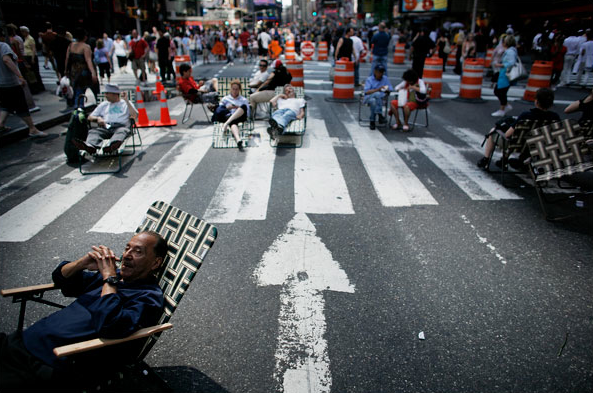
The photograph above was taken on May 25th, the day after the area was closed to traffic and it shows a wide range of individuals in various social configurations lounging in the middle of Broadway as if a day at the beach.  Apparently oblivious to the activity that surrounds them, each individual or group seems caught in and contained by his, her, or their own private universe.  The physical markers of public life are there, to be sure, including a curb, street vectors, pylons placed to identify boundaries, and stop lights in the distance, but none of this seems to have much social significance as a couple eats their lunch, a group of three engage in what appears to be nonchalant conversation, a man and woman (husband and wife?) sleep and read as if in lounge chairs in their own living room, and an isolated, lone man seems lost in self-contemplation; others simply walk about. The point, of course, is that there is no sense of a public here. Less a “big public room,” the photograph portrays a thoroughly fragmented social order, a setting in which the conventions of private living have completely colonized the most public space in America and where individuals have seemingly forgotten how to perform their private selves in public in a way that acknowledges others and  accommodates to the demands and decorum of civic life.

It is really hard to know what to make of this scene. On the one hand it is no doubt churlish to complain about a world in which individuals are given the freedom and safety to relax in a public thoroughfare, unhindered by the needs and demands of others.  And yet, on the other hand, one can only wonder what the effects will be of a social order that so completely reduces the norms and conventions of public life to the unrestrained habits of private living.

Photo Credit: Damon Winter/New York Times

 1 Comment

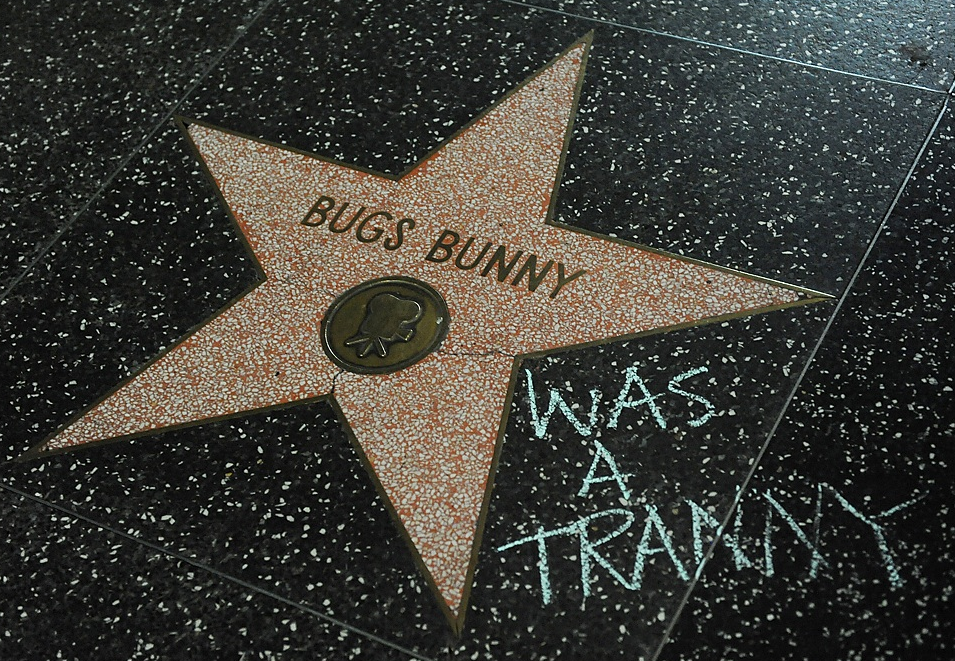
Sight Gag: Tranny Bunny

Photo Credit:  Mark Ralston/Agence France-Presse/Getty Images

“Sight Gags” is our weekly nod to the ironic and carnivalesque in a vibrant democratic public culture.  We typically will not comment beyond offering an identifying label, leaving the images to “speak” for themselves as much as possible.  Of course, we invite you to comment … and to send us images that you think capture the carnival of contemporary democratic public culture.

 0 Comments

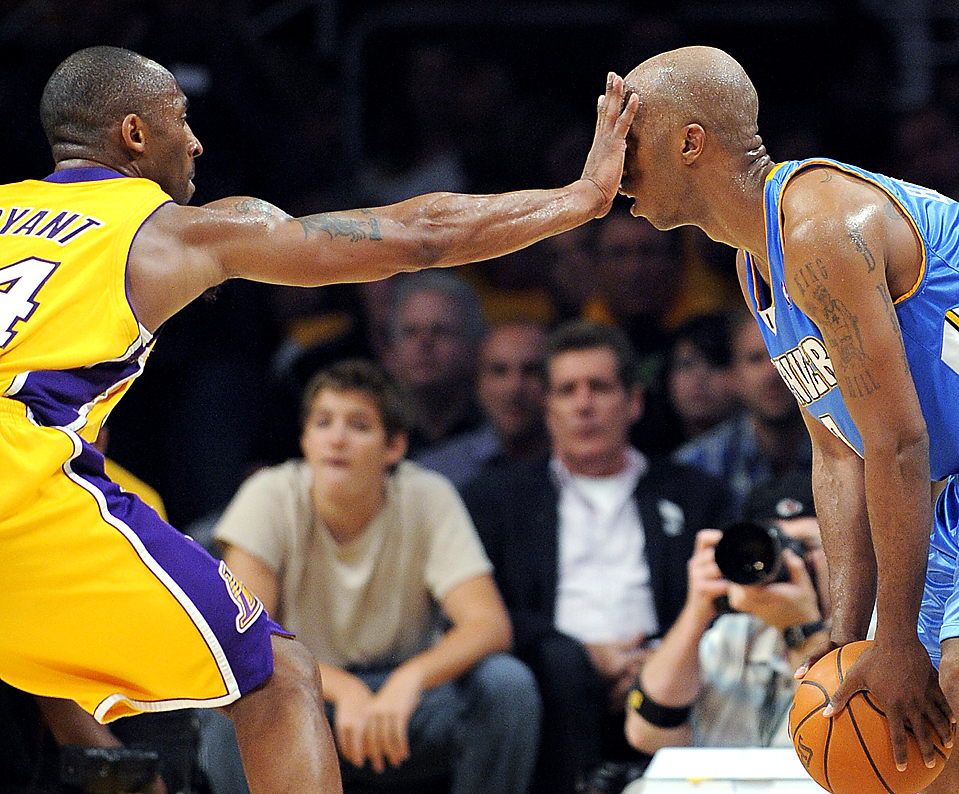
Sight Gag: Noncontact Sport (Kids: Don't Try This At Home)

Photo Credit:  Mark J. Terrill/AP

“Sight Gags” is our weekly nod to the ironic and carnivalesque in a vibrant democratic public culture.  We typically will not comment beyond offering an identifying label, leaving the images to “speak” for themselves as much as possible.  Of course, we invite you to comment … and to send us images that you think capture the carnival of contemporary democratic public culture.

 1 Comment

Learning For Life

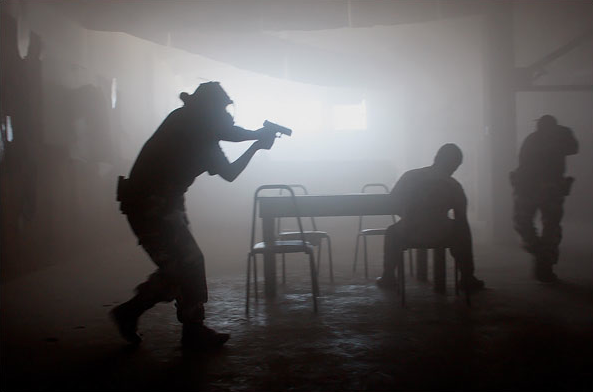
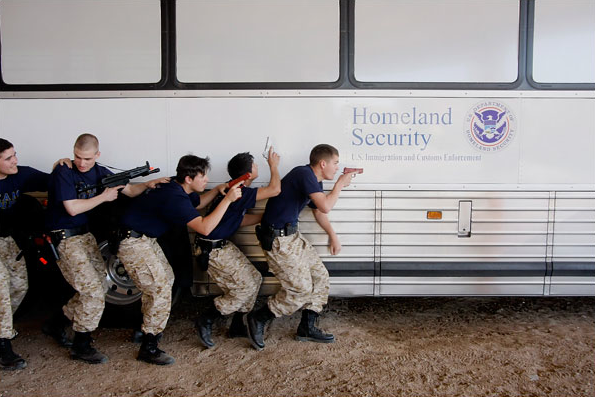
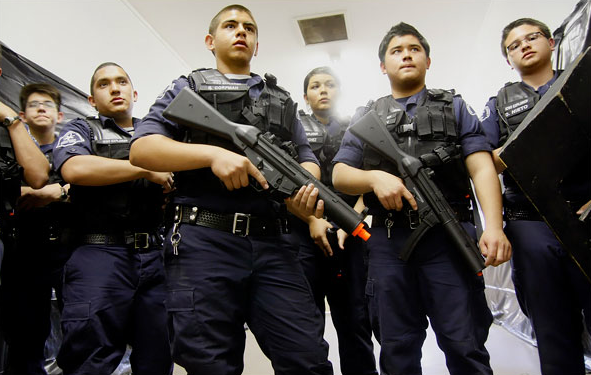
The scene above has a familiar aura about it: It could be a photograph of a drug bust somewhere in Mexico or Colombia, or it could be a rescue scene from an episode of a TV show like 24 or The Unit.  But it is none of these things.  Rather, it is a photograph of a group of Explorers in California “portraying Border Patrol agents rushing into a room filled with fake poison gas” and “aiming their weapons at a man before realizing he was a wounded hostage.”

Explorers is a coeducational affiliate of the Boy Scouts of America that is currently run under the auspices of a program called “Learning for Life.”  According to the Learning for Life website, the primary goal of the program is “career exploration … designed to help young people make intelligent decisions regarding their future.”  Explorer posts in the U.S. boast over 145,000 youth members, 35,000 of whom  participate in the specific program dedicated to careers in “law enforcement,” which, among other things, works to train youth (age 14-21) in how to “to confront terrorism, illegal immigration and escalating border violence.”  In short, it is something of a paramilitary version of the Jr. ROTC programs that populate many of our high schools and which functionally reduce citizenship and patriotism to the model of military life—a rigidly hierarchical world in which independent thinking is not only frowned upon, but severely disciplined. Military and paramilitary organizations are vital and necessary arms of government, to be sure, and we would be poorer as a nation without their presence or the many dedicated individuals who serve in them.  That said, one has to wonder if such militaristic “Learning for Life” programs offer the most effective model for animating critical thinking and a productive civic life amongst our most impressionable citizens.

But there is an something more to be said.  We have written regularly here at NCN about what we call the “normalization of war,” a collection of cultural practices which naturalize and reinforce a war culture that in turn animates a pernicious cycle of violence (e.g., here, here, and here).  I was reminded of this process of normalization by the picture above, which was embedded in a NYT slide show that included a number of photographs of Explorers “playing at” hunting down suicide bombers, hijackers, snipers, and illegal immigrants with toy guns  Setting aside the fact that the vast majority of  “illegal immigrants” are otherwise law abiding citizens—and in any case, certainly not terrorists—the larger point to make is that collectively the photographs teeter back and forth between an implicit and certain playfulness and dead seriousness.

This ironic tension is a palpable reminder of the fine line between the attitudes of play and serious business, and how the former can seem innocent (and in some contexts even ambiguously endearing, as in this image that recently appeared in the Washington Post and was the topic of discussion over at the Bag), even as it coaches (and too easily converts into) more solemn and severe behaviors.  Notice how the same toy guns that seem harmless in the top photograph appear threateningly dangerous in the bottom image.  Put differently, these photographs visualize the very logic that underwrites the production of a war culture: making warlike behavior seem harmless—and indeed fun—even as it gestures toward a putative, if not ominously mistaken, larger purpose. Learning for life, indeed.

Photo Credits:  Todd Krainin/NYT  Crossposted at The Bag.

 4 Comments