Oct 20, 2014
Mar 08, 2010
Apr 10, 2013
Feb 28, 2008
Apr 26, 2013
Feb 27, 2013

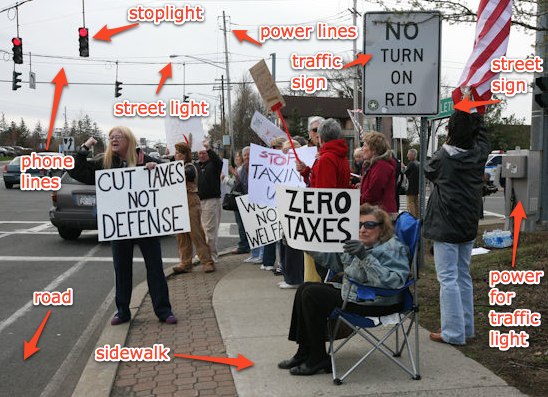
Sight Gag: Let's Have a Tax Holiday!

Photo Credit: www.crooksandliers.com

The “Sight Gag” is our weekly nod to the ironic and carnivalesque in a vibrant democratic public culture. We typically will not comment beyond offering an identifying label, leaving the images to “speak” for themselves as much as possible. Of course, we invite you to comment … and to send us images that you think capture the carnival of contemporary democratic public culture.

 1 Comment

"The Real Thing"

Last week I encountered a number of photographs in various mainstream journalistic slideshows of the Terra Livre (Free Earth) indigenous camp meeting that took place in Brasilia and where thousands of Indians from numerous Brazilian tribes congregated to demand government attention to indigenous issues.  Most of these photographs, shot in middle distance and at oblique angles that put them on display for the viewer, featured Indians dressed in colorful tribal costumes, applying or displaying body paint, playing instruments and performing traditional dances, and the like.  Not a single caption mentioned a single indigenous issue nor could I find I newspaper article anywhere that described or discussed the event.  There to be seen, there evidently wasn’t anything worth reporting on—or at least writing about.

In order to understand this somewhat odd situation we might take account of one photograph that actually stands out from the rest for its apparent critical and ironic appeal.  It is a fairly tight close-up of Cacique Raony Kayapo, a member of the once nomadic Kayapo tribe that now lives in the Brazilian rainforests, as he downs a can of Coca-Cola before attending a protest march at the Terra Livre indigenous camp.

The photograph could be an ad for Coca Cola—and indeed, I would not be surprised if I were to see it on a billboard in the near future.  Or it could be a critique of western, cultural imperialism (think “The Gods Must Be Crazy”), though that seems less likely if only because the tight close-up and low angle invite the viewer to identify with the scene.   But there is another point to be made.  For the image also performs—or perhaps neutralizes—the ideological problem at the heart of the tension between traditional society and modern globalization.  Indigenous groups like the Kayapo recognize the need to protest against modern concerns that threaten their very survival, such as the building of dams and the polluting of rivers caused by growing gold mining projects, but at the same time they have become “addicted” to the sweet allures of modern society—whether nutritionally empty soft drinks or the technological wonders produced by late capitalism such as satellite television.  And as long as one has to have a swig of Coke before standing up to the lords of globalization it seems that the battle is over before it ever begins.

Appearances aside, then, publications of the photograph (and it showed on a number of mainstream journalistic slideshows) function less as an act of visual irony and more as prima facie evidence in support of the globalization thesis itself.  No articles accompany the image (or any of the images of the Terre Livre indigenous camp published by the mainstream media) because they aren’t necessary to make the point: whatever “local” issues vex the Kaypao and threaten their ecology, what matters is that they have embraced the economic symbols of western globalization. Seeing is believing.  What more need be said?

Photo Credit:  Eraldo Peres/Reuters

 0 Comments

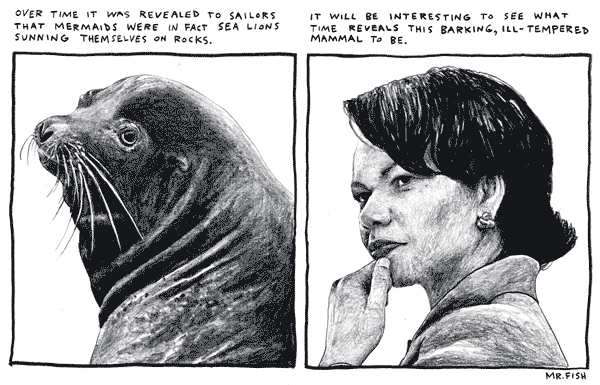
Sight Gag: Frost/Nixon Rediva

* * * * * * * * * * * * *

Condoleezza Rice Interviewed at Stanford, April 2009

Q: Is Waterboarding Torture:

Rice:  The president instructed us that nothing we would do would be outside of our obligations, legal obligations under the Convention Against Torture ….

Q: Okay.  Is waterboarding torture in your opinion?

Rice:  I just said, the U.S. was told, we were told, nothing that violates our obligations under the Convention Against Torture.  And so by definition, if it was authorized by the president, it did not violate our obligations under the Convention Against Torture.

Credit:  Mr. Fish

The “Sight Gag” is our weekly nod to the ironic and carnivalesque in a vibrant democratic public culture. We typically will not comment beyond offering an identifying label, leaving the images to “speak” for themselves as much as possible. Of course, we invite you to comment … and to send us images that you think capture the carnival of contemporary democratic public culture.

 0 Comments

In the Interest of a Useable Past

There are only a very few dates in U.S. history that are instantly recognizable by most citizens:  July 4,  December 7,  June 6,  September 11; for baby boomers, maybe, November 22.  But beyond that, we tend to remember events more than dates; and when such events are no longer present to the collective mind’s eye they tend to fade into the dustbin of history—part of the academic historian’s palette, to be sure, but increasingly difficult to access as a usable past.  Few people recall the significance of May 3rd in U.S. history.  I didn’t, and I have studied and even published essays and books that speak to the momentous events of that day in 1963; or at least I didn’t recall the significance of the date until I literally stumbled upon the two photographs below while surfing the web and looking for something to write about yesterday morning.
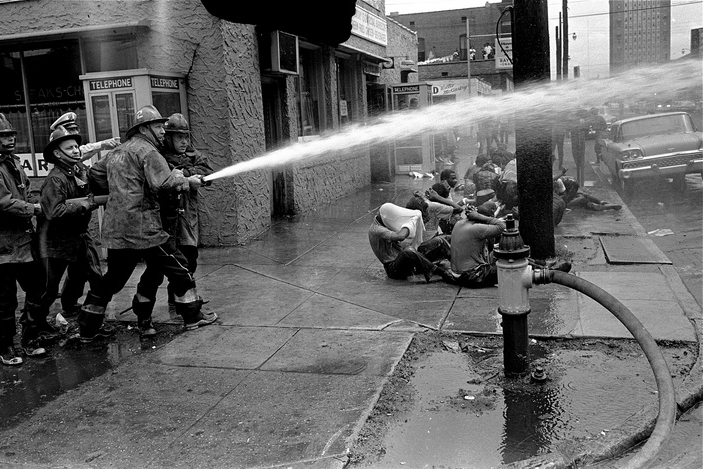
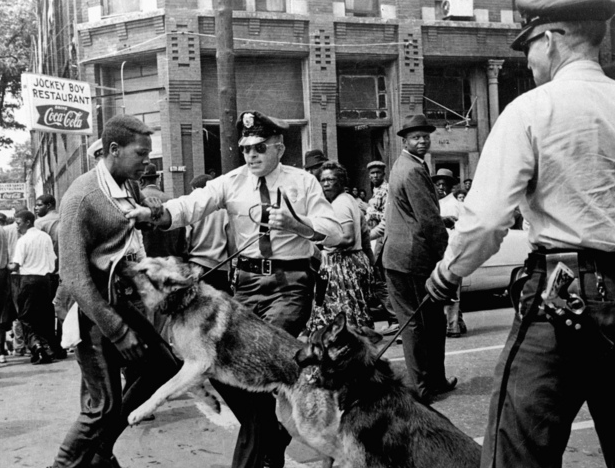
The images were included in a slide show titled “This Week in History” and buried deep on the Camera Works page of the Washington Post beneath twenty three other slide shows on a potpourri of topics ranging from the swine flu crisis, the Chrysler bankruptcy, and President Obama’s first 100 days in office to the Kentucky Derby, a photo exhibit at the MOMA on the recent history of fashion, a retrospective on the architecture of Frank Lloyd Wright, the visit of an eight year old beaver to a veterinary dentist, images of animals from around the world, and  the top ten sports photos of the week.  As far as I can tell, nothing else in the WP commented on the events of May 3, 1963 in the city of Birmingham, Alabama, nor for that matter was the topic addressed by any of the major news outlets or agencies, including the local Birmingham News.  It is almost as if the events of that day have faded from collective memory, no longer necessary to a productive and usable understanding of our nation’s bloody racial past.

The point is accentuated some by the front page of Sunday’s NYT, which included two stories above the fold, one touting President Obama’s professorial pragmatism in thinking about the Supreme Court and the other titled “In Obama Era, Voices Reflect Rising Sense of Racial Optimism.”  Replete with photographs, the later story featured polling data indicating that 2/3s of Americans hold that “racial relations are good” and illustrates the point with anecdotal data of blacks and whites “communicating”  on the streets, at the gym, and so on.  The article concludes with the words of an African-American auditor from Tampa, FL, “I’m not saying that the playing field is even, but having elected a black president has done a lot.”  It would seem as if we have moved beyond the days of Bull Connor and the KKK; and if so, maybe it is time to let the images of water cannon and attack dogs fade into the recesses of our collective memory as the nation heals its wounds and moves forward.

Or maybe not … for buried within the NYT article is the report of  statistics from the Southern Poverty Law Center indicating that there has been a 50 percent increase in the number of active hate groups in the U.S. since 2000. The Times barely recognizes the point, concerned more with the “sense of racial optimism,” but the significance of those numbers is underscored in last week’s edition of Newsweek, which repeated them as part of a feature story on the recent “rebranding” of white supremacist groups as “mainstream” political organizations.  The online version of the article was accompanied by a slide show of images such as these:
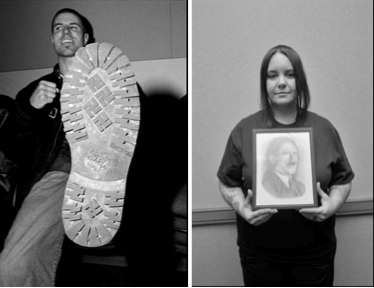
What is disturbing about these photographs is not just that they put hateful symbols on display, but that they are happily posed—and by young people, the next generation of Americans—without the hint of public shame.  Indeed, it is no stretch to imagine these individuals proudly posting these images on social networking sites like Facebook or You Tube with full expectation of their viral dissemination.

Walter Benjamin says that to “articulate the past historically” means to “seize hold of a memory as it flashes up at a moment of danger” and thus to recollect the present (and one can only assume its implications for the future) in relationship to a prior moment in time.  To fail to do this, he suggests, is to take the risk that “even the dead will not be safe from the enemy if he wins.”  I would like to think that the election of President Obama has put an end to the American Tragedy of racial discord and set the nation on a trajectory to an ever hopeful future.  I would like to believe that we could securely tuck away the photographs of May 3, 1963 or to recall them with the same simple curiosity that leads me to wonder about Frank Lloyd Wright’s architectural genius or the dental problems of aging rodents.  I worry, however, that if we fail to articulate our image of President Obama’s election with our images of that fateful day that we do a grave disservice to ourselves and to the safety of future generations of Americans – and more,  to the many who gave their lives in the name of racial justice.

Photo Credits: Charles Moore/Getty; Bill Hudson/AP; Bruce Gilden/Magnum and Newsweek

 2 Comments

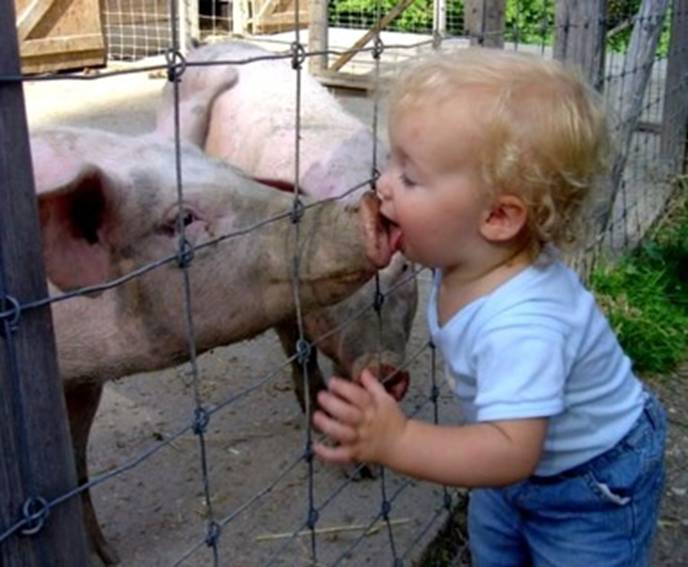
Sight Gag: Don't Forget to Wash Your Hands Frequently

Photo Credit:  Unknown e-mail.

The “Sight Gag” is our weekly nod to the ironic and carnivalesque in a vibrant democratic public culture. We typically will not comment beyond offering an identifying label, leaving the images to “speak” for themselves as much as possible. Of course, we invite you to comment … and to send us images that you think capture the carnival of contemporary democratic public culture.

 2 Comments

The Public Veil of Death

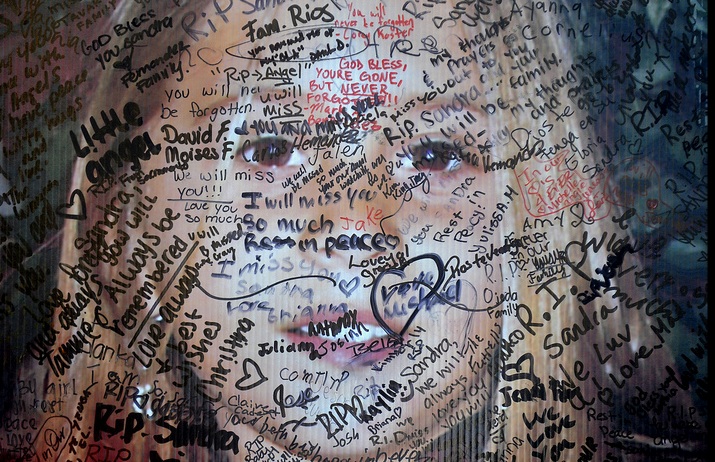
The photograph above is a haunting image of Sandra Cantu, an eight year old girl who was abducted, sexually molested, and brutally murdered, her lifeless body found stuffed inside of a suitcase in an irrigation pond near her home in Tracy, California.  The image is part of an eight foot poster that emerged in a spontaneous public memorial outside of the trailer park in which she lived, along with candles, stuffed animals, flowers, balloons, etc.  What makes the photograph so evocative is the way in which it underscores the function of the writing on the poster-sized photograph as something of a public shroud that veils the precious and innocent life so tragically cut short, even as it accents the vitality and penetrating demand of her eyes.

There was a time, not so terribly long ago, when post-mortem photographic portraits of loved ones—and especially children—were taken and cherished as private momento mori, reminders of the fragility of human life and of our own mortality.  Such images today are considered morbid.  Instead, now we remember deceased loved ones by photographs of them taken while they were still alive, and usually such images are the candid snapshots that fill our family photo albums, the nostalgic Kodak moments that seem to be the accoutrements of middle-class, private life.  Indeed, it is not rare to attend a private wake in which digital slides shows of such snapshots become the center of attention, as much if not more than the casket or urn.  In the photograph of Sandra Cantu, however, the private snapshot has been refashioned as a public image, albeit with a significant difference.

The snapshot in a private wake functions to invoke and reinforce the identification between the deceased and the bereaved in very personal terms.  Here, however, the point of identification is more public than personal—more a demand for protection (and perhaps a public reflection on that demand) than a simple reminder of innocence and happier times—and as such it invites our consideration as a symbol of our civic and political relationships.  Hence, what was once a candid snapshot has been reproduced as a larger than life portrait and fixed in a very public setting, its political voice announced and secured.  But there is more, for note too how the collective public signature weaves a scrim that separates the viewer from the girl, almost as if to protect her from the voyeurs’ gaze.  And yet, as in this case, such protection can only go so far.  The photograph thus takes on the quality of a civic momento mori, an allegorical reminder of both our civic responsibilities as well as how fragile public efforts to protect one another—and especially our children—can be.

Photo Credit:  Michael Mccollum/AP

 0 Comments

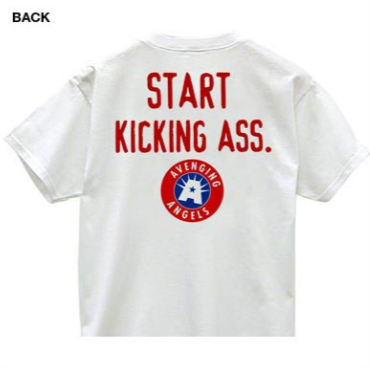
Sight Gag: Our Better Angels

To see the back of the t-shirt click here or on the image.

Credit:  Avenging Angels

The “Sight Gag” is our weekly nod to the ironic and carnivalesque in a vibrant democratic public culture. We typically will not comment beyond offering an identifying label, leaving the images to “speak” for themselves as much as possible. Of course, we invite you to comment … and to send us images that you think capture the carnival of contemporary democratic public culture.

 0 Comments

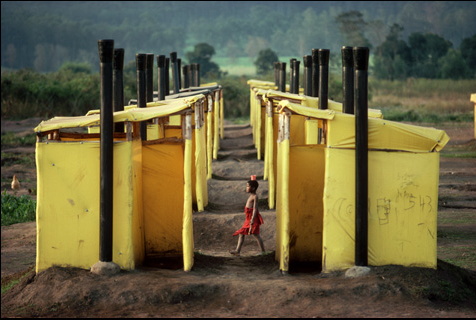
Photographer's Showcase: Peter Turnley's "The Family of Man"

Peter Turnley is an occasional contributor to NCN and today we feature images from his version of “The Family of Man.”

To see the full show click here or on the image above.  If you are interested in the opportunity to work with Peter Turnley he hosts a number of highly acclaimed workshops.  For more information click here or contact Peter at peter@peterturnley.com.

 0 Comments

Lest We Forget

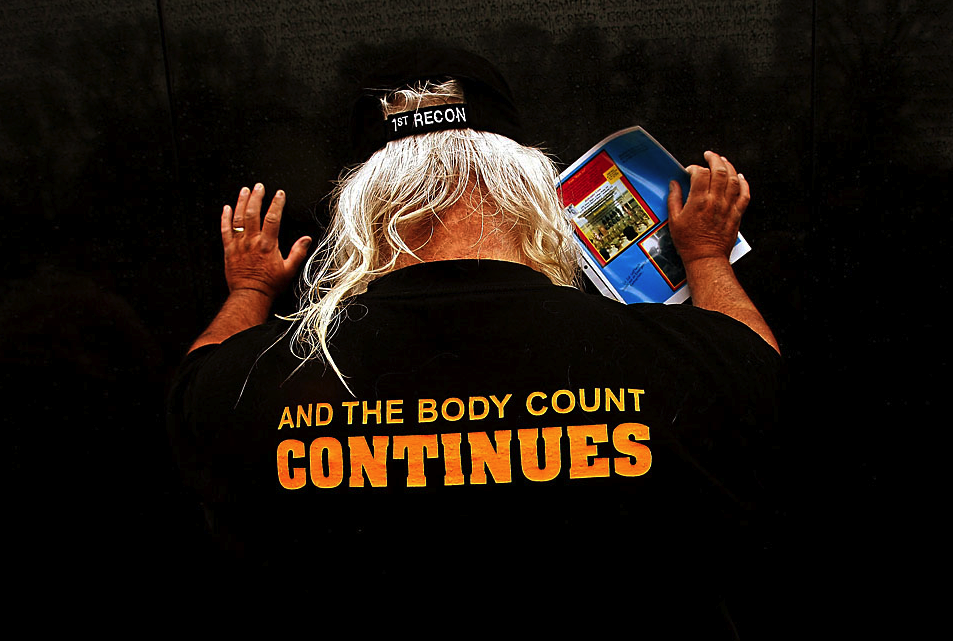
The third Monday of April is celebrated as Patriot’s Day in commemoration of the battle of Lexington and Concord.  Since 1998 it has coincided with In Memory Day, a memorial remembrance held at the Vietnam Veterans Memorial for those who “died as a result of the Vietnam War, but whose deaths do not fit DOD criteria for inclusion upon the wall.”  It is hard to know just how many of the 3.5 million men and women who served in Vietnam fit in this category, but the In Memory Day Honor Roll now includes 1,800 names, most of them having died as a result of the effects of “Agent Orange exposure or emotional wounds that never healed.”

There are numerous photographs of the event but the one above of an anonymous veteran putting his hands on the Wall is perhaps the most visually provocative. Shot from behind and in medium close distance, the polished black surface of the granite blends almost perfectly with the black t-shirt and hat, inviting the momentary illusion that the veteran is literally one with the Wall.  Only the glare and shadows near the very top of the image disrupt the spell by just barely illuminating the names etched into the Memorial and thus invoking the linear perspective that enables a degree of visual separation between the two; at the same time, however, that very perspective complicates our understanding of the relationship between those who died in combat and those who presumably survived the conflict only to contribute to the “body count” in a different register.  That tension is further underscored visually by the way in which the orangish tint of his arms and hands draw our attention from the black Wall to the orange legend on the back of his t-shirt, a stark verbal reminder that the devastating human costs of the Vietnam War have extended—and continue to extend—long past the final battle and retreat.  The red, white, and blue matting that frames the photo he holds up to the wall is an equally poignant reminder of where the responsibility lies—not with individual soldiers, anonymous or etched in stone, but with the nation state that fostered the war in the first place.

If the photograph was simply a journalistic representation of a particular memorial event, or more, even an evocative representation of the continuing sufferance of U.S. involvement in Vietnam, it would easily deserve to be displayed throughout the land for citizens and leaders alike to see and contemplate.  But the context for interpreting the meaning of the image cannot be so easily contained, especially at our current moment in history as the war in Iraq morphs into the war in Afghanistan, and so the photograph speaks in more than a simple or literal voice.

By official estimates there have been 4,274 U.S. military deaths in Iraq since the beginning of the war in 2003 plus an additional 678 U.S. military deaths in Afghanistan.  But if our Vietnam experience has taught us anything it is that such literal “body counts” are only the beginning. By even the most conservative estimates 1 in 6 (or 16%) of all returning veterans from Iraq suffer from some form of PTSD (i.e., “emotional wounds that never heal”) that has been linked to excessive levels of obesity, alcoholism, and drug addiction, as well as “epidemic” levels of suicide—with far too few getting needed or effective treatment.  As in the past, it is often difficult to see such psychic wounds, or worse, it is all too easy to see past them; and yet, as the photograph above seems to suggest, the degrees of separation between combat deaths and other forms of the “body count” is often something of an illusion that we retain at our own peril.

And so the photograph takes on the quality of an allegory for the complexity of war’s costs; indeed, perhaps it is a visual analog to George Santayana’s warning that “those who cannot remember the past are condemned to repeat it.”

Photo Credit: Win McNamee/Getty IMages

 0 Comments

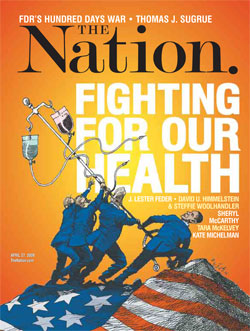
Sight Gag: In Critical Condition

Credit:  Dusan Petricic; Gene Case & Stephen King/Avenging Angels

The “Sight Gag” is our weekly nod to the ironic and carnivalesque in a vibrant democratic public culture. We typically will not comment beyond offering an identifying label, leaving the images to “speak” for themselves as much as possible. Of course, we invite you to comment … and to send us images that you think capture the carnival of contemporary democratic public culture.

 0 Comments