Apr 22, 2009
Aug 28, 2011
Aug 05, 2009
Sep 10, 2008
Nov 10, 2013
Apr 30, 2008

Dulce et Decorum est, Pro Patria Mori

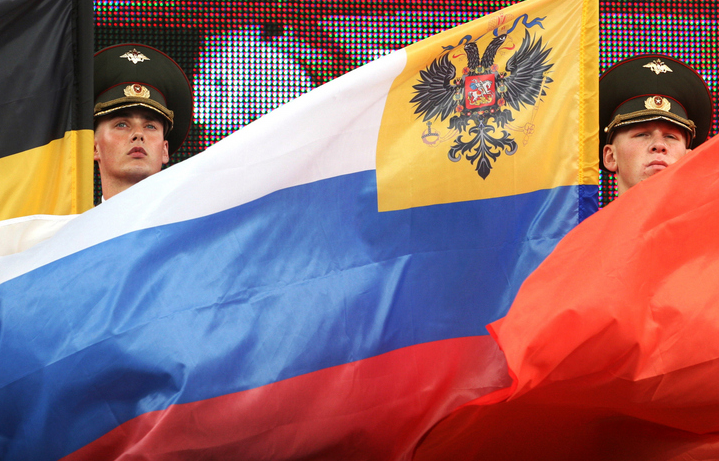
I’ve written previously about my eighth grade teacher, Abraham Elias, who taught me to memorize poetry when all I really wanted to be able to remember were things like batting averages and shooting percentages.  I did it because he inspired me to do so, but I was never really sure how well the exercise would ultimately serve me.  And yet, as the years have passed I’ve found myself returning to those poems over and again—almost as if I can’t help it—as I try to make sense of the world around me.  And so it is today with this photograph of two “Russian military officers tak[ing] part in a Flag Day Holiday in St. Petersburg” that appeared last week on-line at the Washington Post.

The words that billowed forth from consciousness when I saw this photograph are originally from the Odes of Horace (iii 2.13): “Dulce et decorum est Pro patria mori.”  In English: “It is sweet and fitting to die for one’s country.”  But truth to tell I’ve never read the Odes.  Where I encountered these words was in Wilfred Owen’s anti-war poem, “Dulce et Decorum,” written in 1917 during the Great War, the first of “the war to end all wars.”  Owens’ point, of course, was that Horace’s aphorism was a lie told to boys and young men in an effort to nurture a desire for military glory and to mobilize their bodies to national interests without regard to question or cost.

What is most striking about the photograph is the uniform intensity of the youthful faces staring straight ahead, teenage boys trying ever so hard to look like the men that they want to be, strong and in control.  Note the cold and emotionless expression on their faces.  It is perhaps what we might call the look of a killer, and thus altogether out of place on young boys who we might otherwise imagine playing soccer on a school field or trying to steal their first kiss.  But here that stoic look is legitimated and glorified by the adornment of military regalia and the national flags that simultaneously cover and substitute for their bodies. It would be hard to mistake these boys as anything but interchangeable instruments of the nation state.  And indeed, the very proportionality of the image, with their faces barely peeking out from behind the unfurled and flapping flags, underscores the sense in which they stand behind the nation in a doubled sense, both subordinate to it and propping it up at the same time.

The photograph here is from an eastern European country, and it would be easy to deride and dismiss it as the artifact of a once and future totalitarian nation-state, but of course the image is less about Russia than it is about the apparatus and mechanisms of nationalist desire, which seem always and everywhere to feed upon its youth regardless of its particular geographical location.  Those could be young American faces and US flags, and of course we have encountered such images all too frequently.  What remains is for us to see them for what they are. 

Dulce et decorum est, pro patria mori, indeed.

Photo Credit:  Sergei Kulikov/AFP-Getty Images
 2 Comments

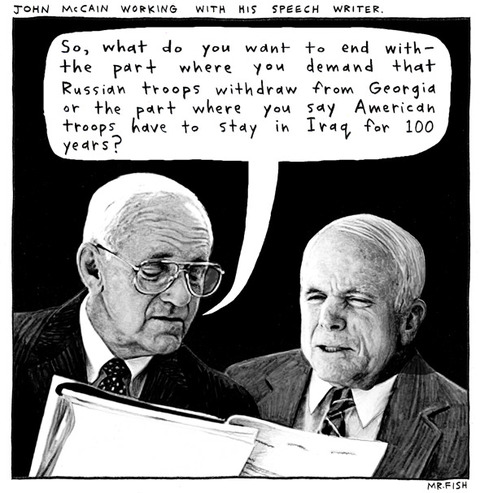
Sight Gag: Behind Every Great Leader … Is His Behind

Credit: Fish

Our primary goal with this blog is to talk about the ways in which photojournalism contributes to a vital democratic public culture. Much of the time that means we are focusing on what purport to be more or less serious matters. But as Jon Stewart and Stephen Colbert often remind us, democracy needs irony, parody, and pure silliness as much as it needs serious contemplation. For our part, we will dedicate our Sunday posts to putting such moments on display in what we call “sight gags,” democracy’s nod to the ironic and/or the carnivalesque. Sometimes we will post pictures we’ve taken, or that have been contributed by others, or that we just happen to stumble across as we navigate our very visual public culture. Sometimes the images will be pure silliness, but sometimes they will point to ironies, poignant and otherwise. And we won’t just be limited to photography, as a robust democratic visual culture consists of much more. We typically will not comment beyond offering an identifying label, leaving the images to “speak” for themselves as much as possible. Of course we invite you to comment … and to send us images that you think capture the carnival of contemporary democratic public culture.

 0 Comments

Gone Fishin'

“It’s summertime,” and as the saying goes, the “livin’ is easy.”  Or at least it will be for your NCN guys as we take the week off to recharge our batteries before the political conventions kick in and the new school year begins for us.  It has been a great year for us and we appreciate the support of everyone who has written in with comments and suggestions, criticism and encouragement.  We will be back on August 18th.

 0 Comments

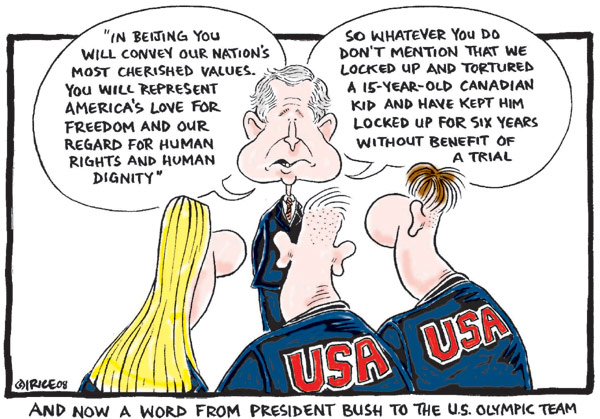
Sight Gag: In Search of Human Rights (and Wrongs)

Credit: Cameron Cardow; Ingrid Rice

Our primary goal with this blog is to talk about the ways in which photojournalism contributes to a vital democratic public culture. Much of the time that means we are focusing on what purport to be more or less serious matters. But as Jon Stewart and Stephen Colbert often remind us, democracy needs irony, parody, and pure silliness as much as it needs serious contemplation. For our part, we will dedicate our Sunday posts to putting such moments on display in what we call “sight gags,” democracy’s nod to the ironic and/or the carnivalesque. Sometimes we will post pictures we’ve taken, or that have been contributed by others, or that we just happen to stumble across as we navigate our very visual public culture. Sometimes the images will be pure silliness, but sometimes they will point to ironies, poignant and otherwise. And we won’t just be limited to photography, as a robust democratic visual culture consists of much more. We typically will not comment beyond offering an identifying label, leaving the images to “speak” for themselves as much as possible. Of course we invite you to comment … and to send us images that you think capture the carnival of contemporary democratic public culture.

 0 Comments

Color and Politics

This week we are pleased to welcome Aric Mayer as a guest correspondent.  Aric’s work has previously been featured in our Photographer’s Showcase here and here.

The entire media experience this week seemed dominated by questions of color and politics. Numerous polls were taken asking variations of the question, “Is America ready for a black president?”  The results came back mixed.  Maybe yes, maybe no.  The question here has to be, what exactly does this mean?

The color palette below was generated from four popular images of Barack Obama and John McCain. These are the combined colors needed to recreate images of both of their faces in their entirety.

As a photographer with extensive experience in photo retouching for national publications, one of the first things that I learned was how to measure the color of a skin tone in an image. Colorimetrics is an interesting and exact science, and suffice it to say that it is possible using ink densities and light measuring tools to describe skin tones in very specific ways. What is surprising is how subtle the differences are between the skin tones of all races. Hues across the spectrum of ethnic groups vary only by a few percentage points. It turns out that all the possible hues and tones of human skin color do not make up an actual rainbow of diversity, but in fact are only a tiny sliver of the possible colors in the visible spectrum. Indeed, skin tones exist in a fairly mundane part of the spectrum, consisting mostly of light tans into dark browns, with subtle variations in color. These colors are dwarfed by the incredible diversity of other colors in the world, greens for instance, the color of chlorophyll. While we are hyper-attenuated to the cultural meanings of skin colors, we tend to categorize them into large groups; what we lack is a cultural language with which to accurately describe their appearance.

Biases and barriers in the political polls are written right into the questions. Barack Obama is not visibly black, nor is John McCain actually tinted white. But the cultural divide between them is frequently shown to be as extreme as the end points on the possible spectrum. The real polling question should not be, “Is America ready for a black president?” But instead, “Is America ready for what might lie between the two extremes?” 

 3 Comments

The More Things Change …

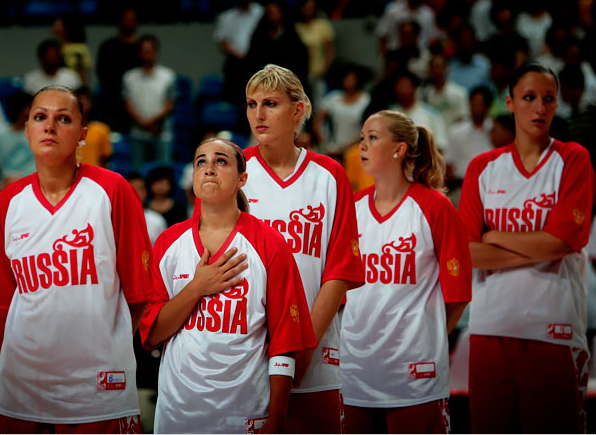
What you are looking are members of the Russian Olympic Woman’s basketball team just prior to an exhibition match against the United States in Hainilng, China.  The young women in the front with her hand on her chest and her eyes fixed above is Becky Hammon, a former All American at Colorado State University and currently a member of the top-ranked San Antonio Silver Stars of the WNBA.  She is also a native of South Dakota and, as of this past year, a naturalized citizen of Russia.  There has been something of a small controversy brewing here, as some such as U.S. basketball coach Anne Donovan, have accused her of being unpatriotic, but Hammon’s more numerous defenders have been quick to point out that there is nothing new about naturalized citizens playing in the Olympics, and the simple fact is that she was not originally invited to try out for Team USA and this was her one opportunity to participate in the Olympics.  And truth to tell, the look on her face as the Star Spangled Banner plays tells you what uniform she would much rather be wearing, and given the intensity of the gaze—in contrast to the bored and nonchalant indifference of her teammates—I doubt it is simply because it would give her a much better chance of winning a gold medal. This is not a picture of an unpatriotic U.S. citizen regardless of the uniform she is wearing.  Indeed, it displays the passionate love of country with a powerful and subtle nuance that reminds us of the tension between nationalism and individualism.

There is more to this picture, however, than the pained and conflicted loyalties of a single, individual athlete, however pronounced that might be.  For it also stands as a marker of the changes that have taken place in world of geopolitics over the past 30 years.  In the late 1970s the Cold War between the United States and Russia (then the USSR) was at full tilt and the tensions animated by ideological differences between western capitalism and Soviet style communism were no more evident than in the politics of the 1980 Winter and Summer Olympic games held respectively in Lake Placid, NY and Moscow, Russia.

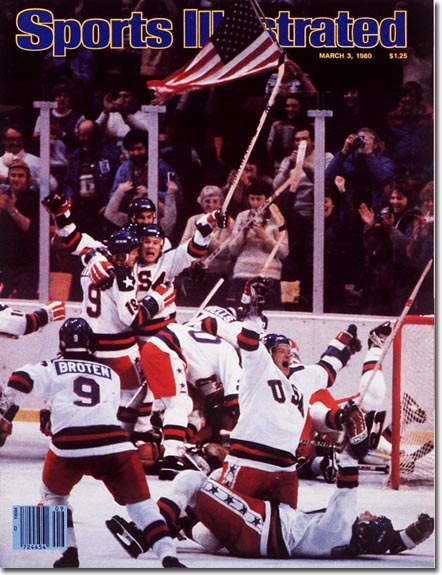
The Winter Games came first, and the picture above stands in stark contrast to the most famous image to come from the Lake Placid games of a ragtag collection of U.S. college hockey players who “miraculously” defeated a Soviet team which, by almost any standard, consisted of seasoned and “professional” veterans.

The present day image comes from before the sporting event not after, and so it is marked by a degree of calm and reserve that we would not expect to find following an upset victory, but the larger point to be made is that the contemporary photograph would never have been taken in 1980 (and if taken surely not featured in the NYT), precisely because it would have been anathema to the spirit of the times—a Cold War world where national citizenship trumped all.  We have no doubt not yet moved fully into the “globalized” world that recognizes the legitimacy of post-national citizenship—and, indeed, we clearly continue to live in a country where at least one version of the cold war optic organized around the notion that walls of national separation and isolation might be a good thing persists— but that such a picture as the one of Hammon could even be taken and featured in a mainstream news outlet suggests at least the possibility of such transformation to a more complex and nuanced sense of citizenship on the worldwide stage.

But there is perhaps one additional point to be made as well.  For while we have a photograph from Lake Placid that helps to foreground the difference between a Cold War world and a post-Cold War world, there is no contrasting image to be found from the subsequent Summer games later that year in Moscow.  The reason, of course, is because the U.S. led a boycott of the Moscow games and no such pictures exist period.  And the reason for that boycott:  in the summer of 1979 the Soviet Union had invaded …. Afghanistan. There are differences, to be sure, as we are tracking “terrorists” and not seeking to oppress “freedom fighters,” and yet, the more things change …

Photo Credit:  Elizabeth Dalziel/AP


 4 Comments

Sight Gag: Free Speech Zone


Credit: Safety State

Our primary goal with this blog is to talk about the ways in which photojournalism contributes to a vital democratic public culture. Much of the time that means we are focusing on what purport to be more or less serious matters. But as Jon Stewart and Stephen Colbert often remind us, democracy needs irony, parody, and pure silliness as much as it needs serious contemplation. For our part, we will dedicate our Sunday posts to putting such moments on display in what we call “sight gags,” democracy’s nod to the ironic and/or the carnivalesque. Sometimes we will post pictures we’ve taken, or that have been contributed by others, or that we just happen to stumble across as we navigate our very visual public culture. Sometimes the images will be pure silliness, but sometimes they will point to ironies, poignant and otherwise. And we won’t just be limited to photography, as a robust democratic visual culture consists of much more. We typically will not comment beyond offering an identifying label, leaving the images to “speak” for themselves as much as possible. Of course we invite you to comment … and to send us images that you think capture the carnival of contemporary democratic public culture.

 0 Comments

Looking From the Inside Out

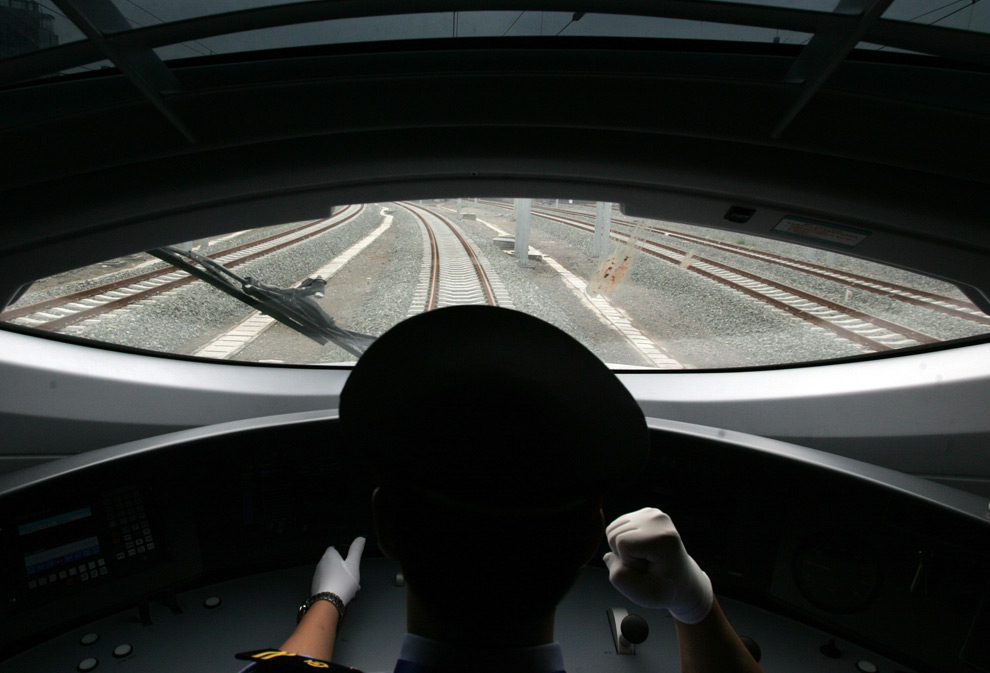
What we have here is a photograph shot from inside the new, “bullet train” that will begin running on the high speed Beijing-Tianjin express railway starting on August 1, 2008, just in time to accommodate the high traffic of foreigners who will be attending the 2008 Summer Olympics.  It runs at a speed record 394.3 kmh, thus traversing the 135 km from Beijing to the port city of Tianjin in less than 30 minutes and representing the height of modern urban mass transportation technology.  The photograph puts the viewer just behind the driver, and thus aligned with both the technology and, perhaps not so incidentally, efficient and effective modern state control of the world in front of it.  

What struck me most about the image is how it operates both in tandem and in tension with the now famous photograph of the lone protestor stopping the tank near Tiananmen Square in 1989.  On the one hand, it shares all of the aesthetic conventions of high modernism that we find in the iconic image of the man and the tank.  The orientation is universal rather than parochial, geometric rather than organic, functional rather than customary, and so on.  This aesthetic—what anthropologist James C. Scott calls “seeing like a state”— is reinforced by the tonality of the image which, while in color, nevertheless veers towards the grey scale of the photographic spectrum and thus gestures towards the abstract and schematic orientation of  much scientific representation.

On the other hand, there is something of a reversal of perspective.  In the original Tiananmen Square photograph the viewer is an outsider looking in on another culture from a safe distance—and in this context it is important to note that as famous as the 1989 photograph is in the western world for its manifestation of an heroic, liberal individualism, it has very little recognition and resonance within China itself—whereas here the outside viewer is invited to share the panoptic vision of the modern state from the inside.  And note how that view is circumscribed by the window that narrowly restricts any peripheral vision, creating something of a tunnel vision effect that enables us to see no more than how clean the tracks ahead are, how totally devoid they are of anything that might derail the train from its appointed task of moving passengers from here to there quickly and efficiently.  In short, we can only see what the apparatus—state, technological, what have you— enables us to see.  And, of course, this can be a problem when you are on the inside looking out, whether as the driver or as an unwitting passenger. 

The question then is, what are we missing in the process?  If there were a lone individual standing on the tracks trying to stop the train he or she couldn’t be seen—and at this speed perhaps all that would remain is that reddish-brown smudge on the windshield.  Then again, protestors—individuals or otherwise—are not likely to stand in the way of this train as they have been relegated to “Olympic Protest Zones” in designated parks, and at that it is unlikely that most dissidents will successfully negotiate the bureaucratic barriers to political protest that include applying for a permit in person, five days in advance of a demonstration, and with detailed information such as the slogans to be used, the number of demonstrators, and so on.  Maybe that is what we miss when we look only from the inside out.

Photo Credit:  STRA/AFP Getty Images and The Big Picture

 1 Comment

Sight Gag: No Joke!

Credit: Anonymous but for details see the LA Times.

Our primary goal with this blog is to talk about the ways in which photojournalism contributes to a vital democratic public culture. Much of the time that means we are focusing on what purport to be more or less serious matters. But as Jon Stewart and Stephen Colbert often remind us, democracy needs irony, parody, and pure silliness as much as it needs serious contemplation. For our part, we will dedicate our Sunday posts to putting such moments on display in what we call “sight gags,” democracy’s nod to the ironic and/or the carnivalesque. Sometimes we will post pictures we’ve taken, or that have been contributed by others, or that we just happen to stumble across as we navigate our very visual public culture. Sometimes the images will be pure silliness, but sometimes they will point to ironies, poignant and otherwise. And we won’t just be limited to photography, as a robust democratic visual culture consists of much more. We typically will not comment beyond offering an identifying label, leaving the images to “speak” for themselves as much as possible. Of course we invite you to comment … and to send us images that you think capture the carnival of contemporary democratic public culture.

 3 Comments

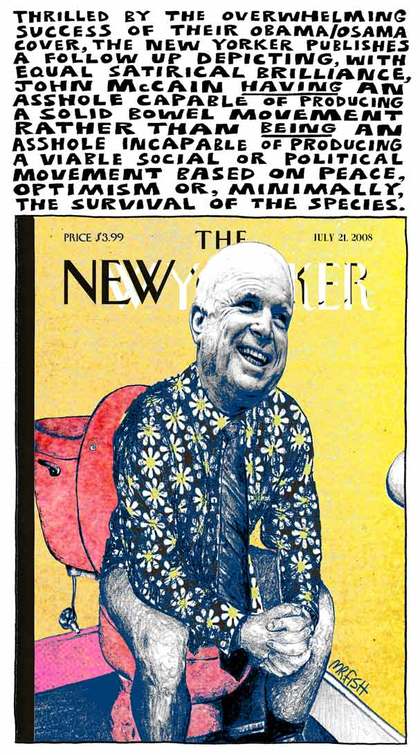
Sight Gag: On The John

Credit:  Mr. Fish

Our primary goal with this blog is to talk about the ways in which photojournalism contributes to a vital democratic public culture. Much of the time that means we are focusing on what purport to be more or less serious matters. But as Jon Stewart and Stephen Colbert often remind us, democracy needs irony, parody, and pure silliness as much as it needs serious contemplation. For our part, we will dedicate our Sunday posts to putting such moments on display in what we call “sight gags,” democracy’s nod to the ironic and/or the carnivalesque. Sometimes we will post pictures we’ve taken, or that have been contributed by others, or that we just happen to stumble across as we navigate our very visual public culture. Sometimes the images will be pure silliness, but sometimes they will point to ironies, poignant and otherwise. And we won’t just be limited to photography, as a robust democratic visual culture consists of much more. We typically will not comment beyond offering an identifying label, leaving the images to “speak” for themselves as much as possible. Of course we invite you to comment … and to send us images that you think capture the carnival of contemporary democratic public culture.

 0 Comments