Dec 15, 2013
Jun 20, 2014
Jul 14, 2010
Jun 29, 2008
Nov 02, 2008
Mar 01, 2015

The Global Neighbor: Behind a Glass Darkly

Photographers occasionally shoot images of people reflected in windows, framed by windows, or looking through windows. Such images can be visually distinctive while also prompting more reflexive viewing: one sees both the image and some aspect of seeing. The two images below are examples of this visual thinking, while also reflecting other conventions that mediate global communication.
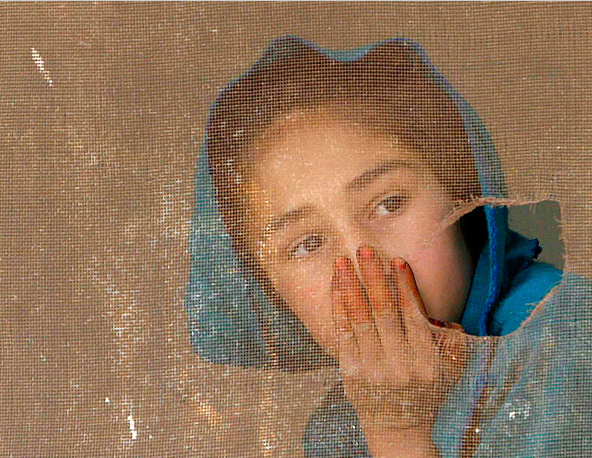
afghan-window-veil.png

This photograph shows an Afghan schoolgirl. The good news is that she is in school–not a given in Afghanistan. The bad news is that the photographer has put her under the veil. The window screen stands in for the chadiri she is likely to wear as a woman, while the rip in the screen might be a trace of orientalist fantasy, one shaded further by the stain on her hand. The implication is that, despite being in school, she still needs to be liberated. She would welcome that, it seems, as she is looking not through the screen but through the tear. That gash in the screen could stand for poverty or accident, but it makes the screen appear the more inevitable. Although a close-up shot of a vibrant young girl, she remains on the other side of a barrier. That barrier dulls perception in both directions. She seems a lost soul, ghost-like, someone who can see and be seen but not someone we can touch or help, as she really is from another world.

There are others in that world.
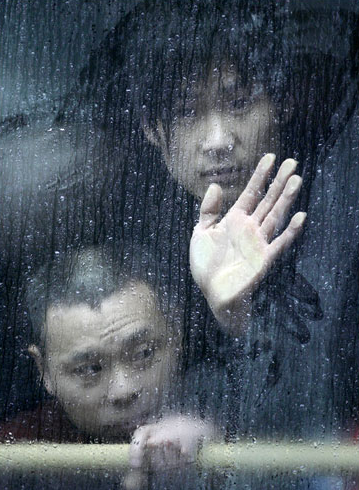
china-window.png

This is actually only a temporary confinement, as they are passengers in a Chinese train delayed by heavy snow. But that news is the least of it. Surely this is a vision of the human condition of separation, of the transparent barrier that stands between any human being and another. One grips the rail and looks to the side, warily; he has learned to expect the worst. The younger man still can admit to his yearning to connect. He looks at us, reaches out and puts his hand to the glass, as if we might place ours against his, as if we could touch and not feel only the cold glass.

Each photo tells us that it is not enough to see; we also need to connect. The Biblical allusion in the title of this post is to the beautiful poem in 1 Corinthians 13. Now we see in a “glass” (in the oft-quoted King James translation, referring to a mirror) darkly, but when united with God we shall see face to face. This vision of heaven doubles as a vision of how humanity might live with itself. Indeed, it might be that one step to achieving heaven on earth is to see one another as if face to face. To do that, we have to not settle for merely being able to see through barriers that still dull empathy and divide one from another.

Photographs by Rafig Maqbool and Vincent Yu for the Associated Press.
 0 Comments

A Sparrow Falls in Sadr City

This one is heartbreaking.

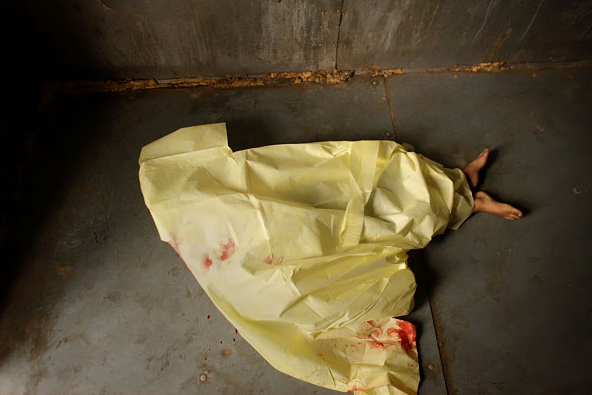
iraqi-dead-boy.png

I can’t help but think of a small bird lying in the dirt. Small yet once throbbing with life and song, now lifeless, soon to disappear entirely. Perhaps it’s the bright yellow–so unusual for a shroud yet somehow appropriate for a child–or the shape of a broken wing with the telltale blood, or the feet sticking out birdlike from beneath the body. Such a small, innocent thing. Do not speak here of the grandeur of war, or of forging character and testing national resolve.

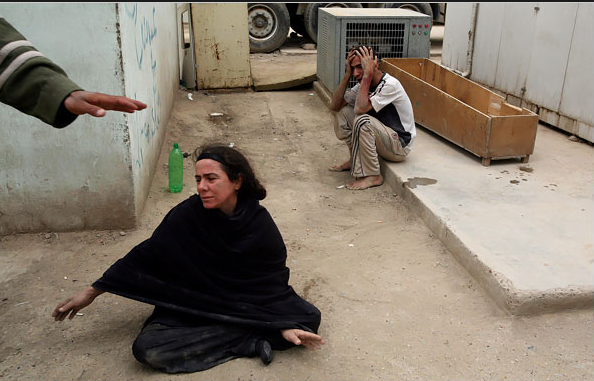
There is a companion photograph, this one of the boy’s parents grieving outside the morgue.

iraqi-parents.png

In the first photo, the body is both there but not there. Here the body is not there but there–signified by the open coffin that will be used to put him away forever. Even the parents are both there and not there: physically present, but hopelessly distracted, lost in their grief, separate from each other, from anyone else, from themselves. The mother could be a wounded bird, flopping awkwardly in the dirt, not yet killed but crippled by the blow.

In the first photo, the bare feet evoke the vulnerability of a small animal but also are the one sure mark of a human body. Likewise, the hand extending into the second picture may be the one sign of human compassion in the scene. I don’t know, but it seems as if someone is cautioning the photographer to not get too close or otherwise intrude on the grieving parents. That small gesture holds out the promise that others could recognize their pain and respect their need to mourn. Thus the hand cues response to the photograph as a whole, suggesting that others might care for those being harmed by the war. The question remains whether that is a plausible hope or an empty gesture.

Photographs by Michale Kamber and Joao Silva for the New York Times.

 2 Comments

A Dream Deferred

king-dream.png

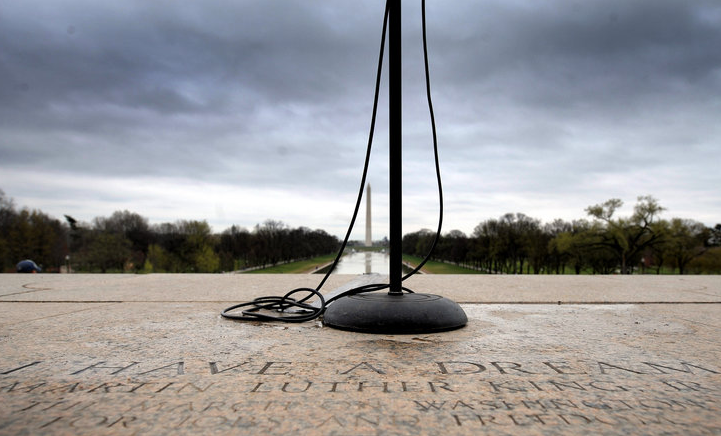
This is the vantage point from which Dr. Martin Luther King, Jr., proclaimed his “Dream” in 1963 of a world in which “little black boys and little black girls will be able to join hands with the little white boys and white girls as sisters and brothers.” I have listened to King’s oration hundreds of times and I have published essays on that moment in history; and more, I have taught the speech in classes more times than I can remember and I never—not ever!—fail to be deeply affected by the sound and the power of the words. But all of that paled in comparison to standing in the exact spot that King stood, literally cast in the shadow of Lincoln and gazing out upon the broad vista of the National Mall with the reflecting pond leading one’s sight to the Washington Monument. The Mall was not entirely full on the day I was there, but I could easily imagine it packed with a quarter of a million people, sitting and standing in common cause for racial equality guided by King’s eloquent tones and his vision of a “beloved community.” It was a truly spiritual moment.

And then I saw this photograph in the Washington Post and it brought me up short. The clouds are a steely grey and somewhat foreboding, as they engulf the top of the Washington Monument and seem to be moving forward to enshroud the entire Mall, and by extension the nation that it stands in for. There is no sun, and so Lincoln’s shadow is nowhere to be seen. But most of all, there are no crowds of people—black, white, brown, yellow … —joining hands or otherwise; what we have instead is something of a civic and social void underscored by the lone microphone stand that substitutes metonymically for the absent King—the eloquent voice of our national social conscience. Shot straight on and from ground level the microphone stand is placed in linear perspective with the Washington Monument and seems to dwarf it in size. And what it made me consider is how seductive the romantic mythos of the National Mall can be with its magnificent views and enormous monuments, and yet how symbolically empty (and even ominous) that mythos can be when there is no one to speak for social justice or when there is no one there to listen.

Photo Credit: Tim Sloan-AFP/Getty Images

 1 Comment

Sport on Planet Arrakis

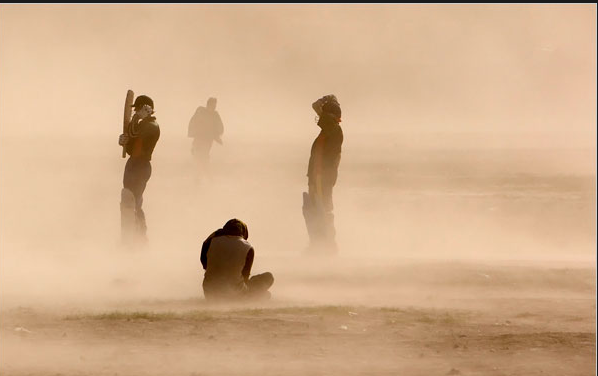
One of the basic ideas of this blog is that photographs can depict more than what was happening in front of the lens. This added value can include highlighting larger patterns and processes and also providing imaginative projections of current tendencies. This is what some artists try to do by writing, and science fiction is particularly keen on exploring possible technological and political consequences of present tendencies. This comparison came to mind when I saw this photograph from Afghanistan.

sandcricket.png


The caption confirms that these are cricket players in a sandstorm. It also adds that they are on a “playground,”but something seems lost in translation. The scene looks more like something out of Dune (the book, not the movie). Recreation on the desert planet Arrakis may not be a lot of fun, but we can marvel at how humans can adapt to anything. At the same time, the imperial influence seems to be alien and superficial rather than any genuine improvement of the place. The storm and much more may pass, but there is something poignant about this image of human beings defined by arbitrary rules and shared isolation on their desert planet.

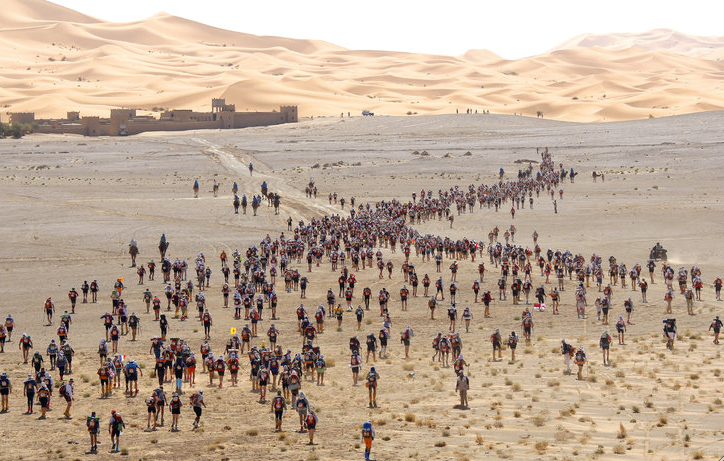
With this photo sitting on my desktop, I wasn’t entirely surprised when a second appeared a few days later.

morrocorace.png


You are looking at the competitors begin the 150-mile Sand Marathon in Morroco. The race includes a full marathon, and a 50-mile day, and others as well across varying terrain. The race has to be run while carrying all their equipment on their backs and getting only 9 liters of water a day. Again, the old fort, the desert, and the peculiar, imported form of ritual play by hardy adapters could be from Dune. Where one would think survival would be enough, more is achieved, but always by staying close to the severe limits of nature.

My comparison may be fanciful, but I can’t help but think that these photos are displayed for reasons that go beyond being visually distinctive or documenting unusual forms of recreation. They might also be images of a possible future. That would be a future not on some distant planet, but on this one, should it become ruined by some combination of unrestrained emissions, deforestation, warfare, and other forms of ecological destruction.

Photographs by Ahmed Masood/Reuters; Pierre Verdy/AFP-Getty Images.

 0 Comments

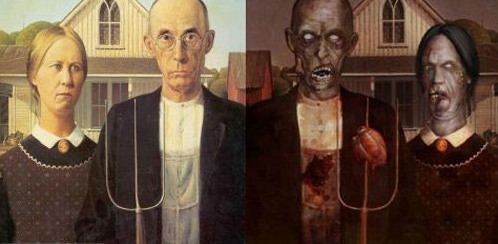
Sight Gag: American (Gothic) Nightmare

nightmare.png

Credit: Marco Lanzagorta, Dread Reckoning, American Gothic

Our primary goal with this blog is to talk about the ways in which photojournalism contributes to a vital democratic public culture. Much of the time that means we are focusing on what purport to be more or less serious matters. But as Jon Stewart and Stephen Colbert often remind us, democracy needs irony, parody, and pure silliness as much as it needs serious contemplation. For our part, we will dedicate our Sunday posts to putting such moments on display in what we call “sight gags,” democracy’s nod to the ironic and/or the carnivalesque. Sometimes we will post pictures we’ve taken, or that have been contributed by others, or that we just happen to stumble across as we navigate our very visual public culture. Sometimes the images will be pure silliness, but sometimes they will point to ironies, poignant and otherwise. And we won’t just be limited to photography, as a robust democratic visual culture consists of much more. We typically will not comment beyond offering an identifying label, leaving the images to “speak” for themselves as much as possible. Of course we invite you to comment … and to send us images that you think capture the carnival of contemporary democratic public culture.

 1 Comment

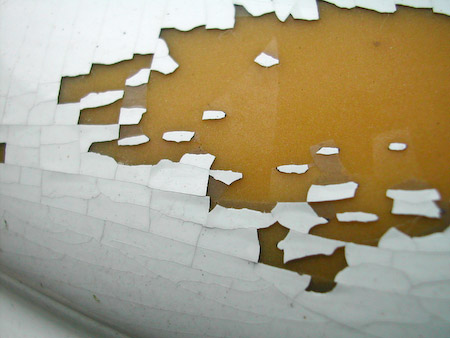
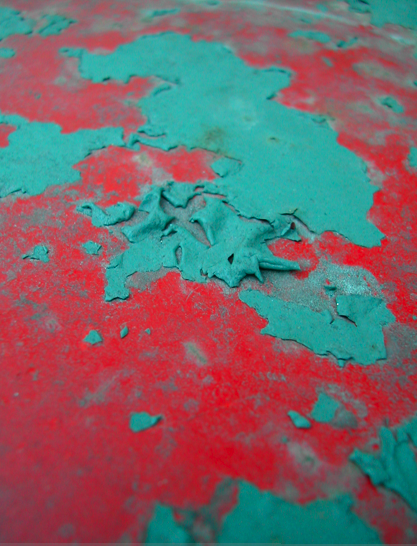
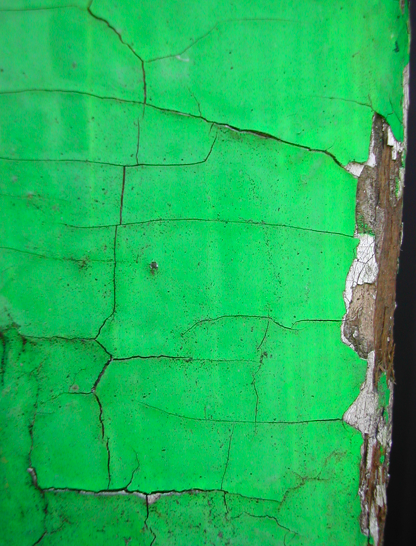
Photographer's Showcase: The Ways of Paint

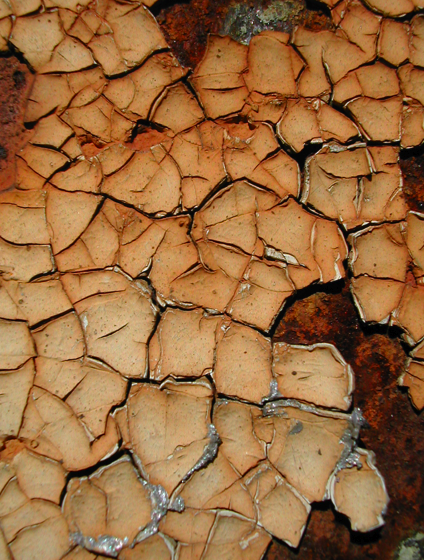
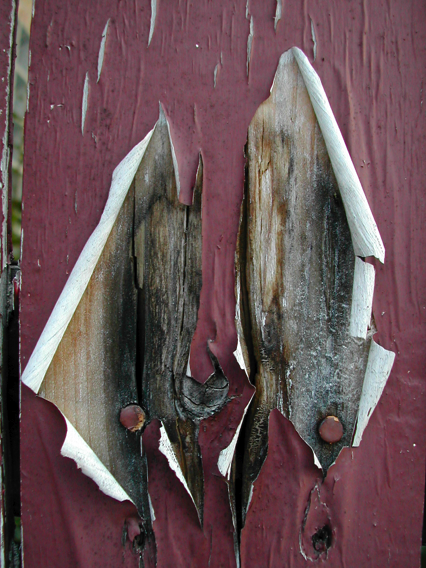
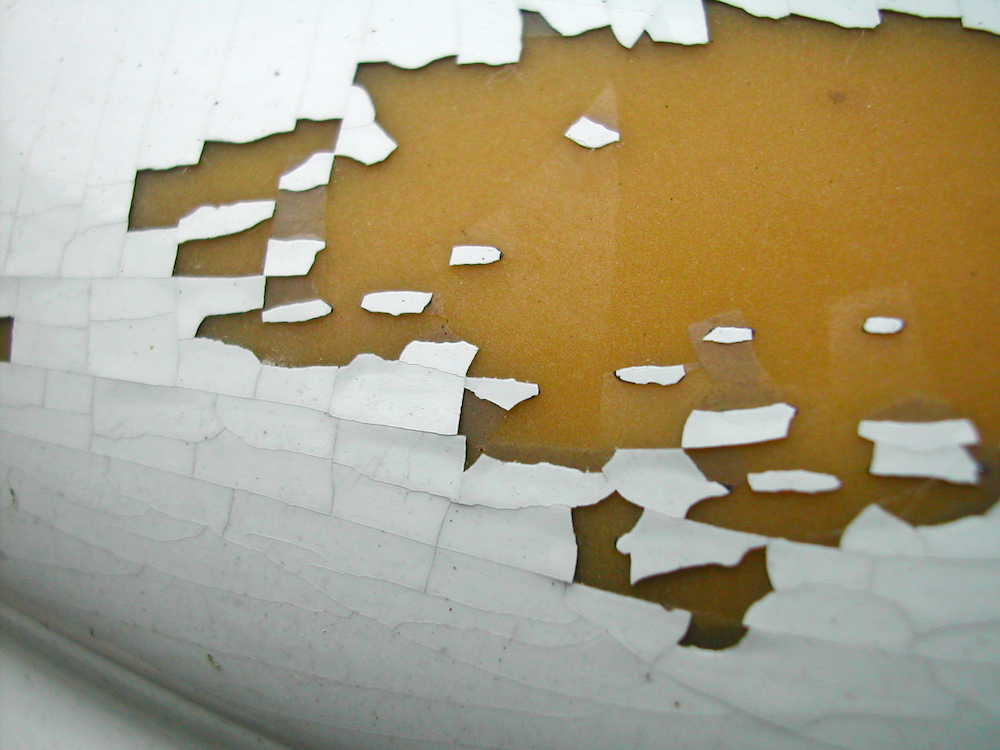
This week our showcase takes us outside the ambit of photojournalism. David Sutton is a professional photographer who creates remarkable portraits of people and their animals. His distinctive black and white images have appeared in numerous media outlets and brought him the unique honor of being named the best pet photographer in America by the magazine Forbes FYI. You can see some of David’s portraiture at his studio website. Today’s showcase provides a glimpse of some of David’s other work and of how he sees the world in color. The five photographs below are from a series entitled The Ways of Paint. David remarks that he is intrigued by how “paint reveals processes.” And so it does, while also becoming richly evocative.

eggshellearth.jpg

sut-2.png

sut-3.png

sut-4.png

sut-5.png


 0 Comments

The Wall

fence-1.png

I hated that I was required to memorize poems when I was in the 8th grade. But I had one of those truly inspirational teachers by the name of Abraham Elias, and when Mr. Elias said memorize poems … well, I memorized them. I never imagined that it would become an useful exercise. But then I encountered the above picture in an LA Times slide show titled “Building a Better Fence,” and the words came tumbling out, almost as if I couldn’t control them:

“Something there is that doesn’t love a wall,
That sends the frozen-ground-swell under it,
And spills the upper boulders in the sun,
And makes gaps even two can pass abreast.”

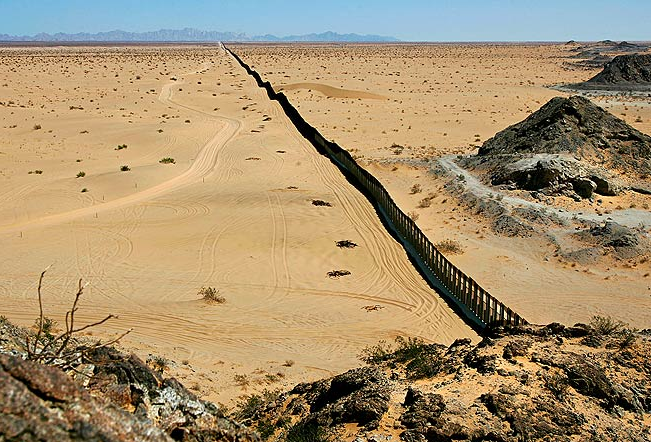
The photograph is of a portion of the 15–foot-high wall fence that stretches 40 miles east of San Luis, Arizona and separates the U.S. from the Mexican state of Sonora. In case you can’t tell, that is Sonora on the right side of the wall fence and San Luis, Arizona on the left. When completed the wall fence will start in San Diego and extend in fits and starts some 700 miles along the 2,000 mile U.S./Mexico border. Sometimes walls fences are designed to keep people in, like was the case with the Berlin Wall, but here the wall fence is designed to keep people out, protecting the U.S. from its neighbors to the south. In our post-cold war era this is what we call “homeland security.”

The need for serious immigration reform in the U.S is real, to be sure, but a 700 mile wall fence across a barren dessert valley in the name of national security is … well … insane. Indeed, upon first glance my initial thought was that the photograph above was actually an April Fool’s Day joke, but then I recalled that President Bush had signed an order to start such an enterprise and that the U.S. Congress had actually designated an initial 1.2 billion dollars (of what is expected ultimately to be a 6 billion dollar expenditure) to begin the task. But even still, I had to check to make sure I wasn’t reading The Onion.

The photograph marks the absurdity, if not the futility, of such an effort. The wall fence, which looks as much like a crack in the earth as anything, extends from an unidentified “here” to an infinitely distant and unknowable “there.” Its scope is thus hard to imagine, all the more so as we recall that the wall fence itself will only cover one-third of the border dividing the U.S. and Mexico. The viewer is located on the U.S. side looking across the wall fence line into Mexico, but of course we know this only because the caption tells us so since the two sides of the wall fence are equally barren and desolate, virtually and otherwise indistinguishable from one another. The arbitrary and political nature of the boundary between the two nation-states and of the location and exercise of power to enforce the separation is thus pronounced. And more, the very thought that such a physical boundary can be sustained for any extended period of time seems to be mocked by the natural landscape of the desert which promises to encompass and contain all that would disturb its contours.

It is difficult to see the poet’s “ground-swell” from this perspective, shot on-high and from a distance, nor are the two-abreast “gaps” that render such structures altogether ineffective apparent, but rest assured that they are there or will soon appear. For historically that has been the nature of walls and fences, whether in Berlin or Belfast or Jerusalem or Padua or elsewhere. What they are designed to keep out always finds its way in, and what is being contained always finds a way to leak or leech out. And for all of their failures such structures only fortify and reinforce the obsessive paranoia and fear of the alien that led to their being built in the first place, one more event in a cycle of state driven violence that keeps us from discovering more humane solutions to our problems.

The poet had it right, “Something there is that doesn’t love a wall.”

Photo Credit: Don Bartletti/LA Times; and the poet, of course, was Robert Frost, the poem, “Mending Wall.”

 7 Comments

Lying to Tell the Truth about Hillary Clinton

The story of Hillary Clinton’s compulsive lying about being under sniper fire during a trip to Bosnia is already slipping away, so much so that she now is referring to is as a minor mistake. Well, I guess we should forgive and forget, right? (Wrong.) Before that happens, however, let’s take one last look at Hillary dodging bullets as she sprints across the tarmac:

clintonbosniajpg.jpg

As one astute reader put it at another blog, it depends on what your definition of “sniper fire” is.

Cynics will be gloating over this egregious example of how “all politicians lie.” That sloppy thinking only helps cynics and liars. Not everyone is in Hillary’s league, and she, not her opponent, has asked that people judge her on her judgment and experience. Note that character is not on that list, and the lie about her reception upon landing in Tuzla reflects both bad judgment and a misuse of experience. But, truth be told, her claim may have been not so much a lie in her own sense of things as a fiction–something not true that is told to convey a truth. OK, the snipers weren’t there, and she had to know it since she brought her daughter along, but you’ve just got to know that she is soooo ready to be a “war-time president.”

I don’t think earnest yearning excuses much, but if we grant Hillary any slack, she had better be ready to concede that visual commentary might tell the story slant to get a better sense of the truth. Like this:

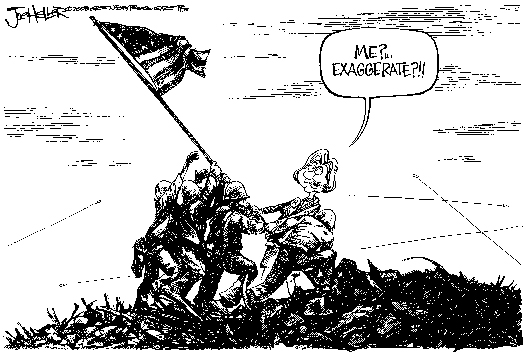
iwo-cartoon-hillary.jpg

Editorial cartoonists love to use the Iwo Jima icon. This one may seem a tad unfair because of how the icon is gendered, but, again, it’s Hillary who has said she’s the only one who ought to answer the mythical National Security Phone. What is more telling is that she is facing the viewer. In contrast to the anonymity of the soldiers laboring together selflessly on behalf of the nation, she is jumping in unbidden to serve personal ambition. Of course, she wasn’t claiming to be a soldier, and there are no bullets in the iconic photograph of the flag-raising, but the cartoonist has revealed more than one problem with Clinton’s lie.

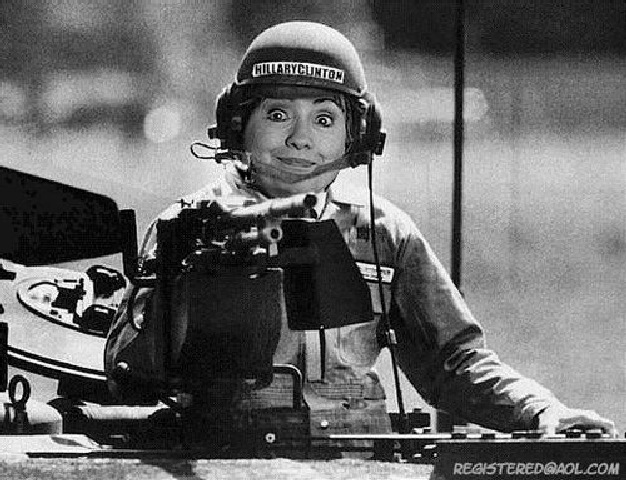
Hillary got caught telling a whopper; perhaps she ought to be given a dose of her own medicine. Some people wish it could be her Dukakis moment–that is, the equivalent of the 1988 Democratic candidate’s mistaken photo-op, when a shot of him riding in a tank became a defining moment of the campaign and one reason you don’t hear references to “President Dukakis.” That episode may be why you can see this image online today:

hillary-tank.jpg


Really, really unfair. I’m just broken up about it.

Photograph by the Associated Press. Cartoon by Joe Heller/Green Bay Press-Gazette (March 31, 2008). Photoshopped image by registered@aol.com. For scholarly discussion and examples of the use of the Iwo Jima template in editorial cartooning, see Janis L. Edwards and Carol K. Winkler, “Representative Form and the Visual Ideograph: The Iwo Jima Image in Editorial Cartoons,” Quarterly Journal of Speech 83 (1997(: 269-89, and Hariman and Lucaites, No Caption Needed, at pp. 121-124 (on Iwo Jima) and elsewhere.
 3 Comments

Iconic Images, Lego Art, and the Limits of Imitation

One of the characteristics of iconic images is that they are reproduced across a wide range of media, genres, settings, and topics. Actually, that is true of media more generally–think of how songs, jokes, quotations, recipes, fashions, and many other other things circulate widely–but it usually is not so intentional or distinctive as when it is done with widely recognized and influential images. Iconic photographs have been reproduced as drawings, paintings, sculpture, murals, graffiti, embroidery, beadwork, silkscreens, figurines, stamps, plates, coins, tattoos–you name it. Oh, yes, and Lego art:

lego-kiss.jpg

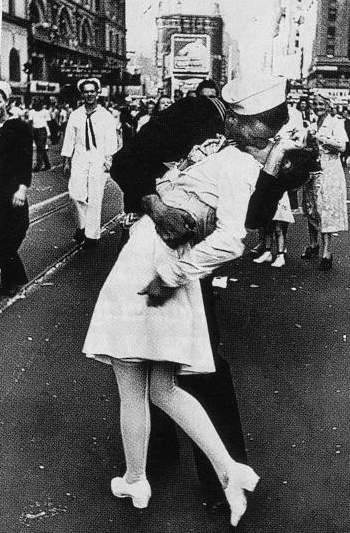
This is one of a set of nine that are posted at a Flickr page. The set contains reconstructions of three canonical photographs by Henri Cartier-Bresson, the Charles Ebbets’ shot of iron workers sitting on a beam hanging in empty space, Robert Capa’s photo of a soldier being shot in the Spanish civil war, the Times Square kiss, two from the Vietnam war, and the lone protester standing before a tank in Tiananmen Square.

The question is whether there is anything to be learned from the Legos. One wouldn’t expect much beyond what we already know: with a few key features in place, we can recognize the iconic image in any medium, and people can be clever when they have time on their hands. The odd imitation is basically a joke, and we marvel–briefly–that someone could get so much out of Legos or ice cream (it’s been done: the flag-raising at Iwo Jima) or whatever else is getting the iconic upgrade.

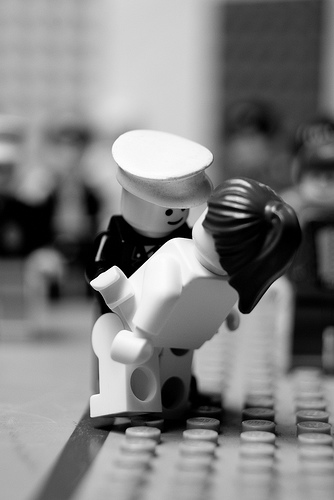
I wonder, however, if there isn’t more to the Lego art. Let’s take two examples–briefly. First, the Times Square kiss:

kiss.png

The Lego version captures both the strongest positive feature of the photo as well as one cause for criticism. The positive feature is the good vibe that so many people get from seeing a young couple passionately “kissing the war goodbye” on V-J Day. You get that feeling in the Lego work from the smile on the sailor’s face. In the photograph from Times Square, there is much more: youth casting off of wartime restrictions, Eros and regeneration triumphing over war and death, private and public life beautifully harmonized; what’s not to like? Well, there is one thing for some, and that’s how the woman may be a less that willing participant. He didn’t ask first, and so one form of domination could be giving way to another form of domination. And sure enough, the Lego art gets that as well: look at how awkwardly she is bent back, and how she is not returning his advance.

I could stop there, but let’s do one more:

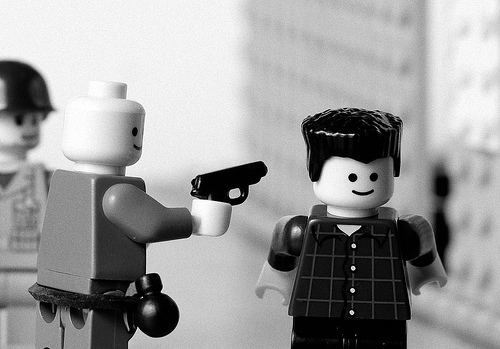
lego-shot.jpg

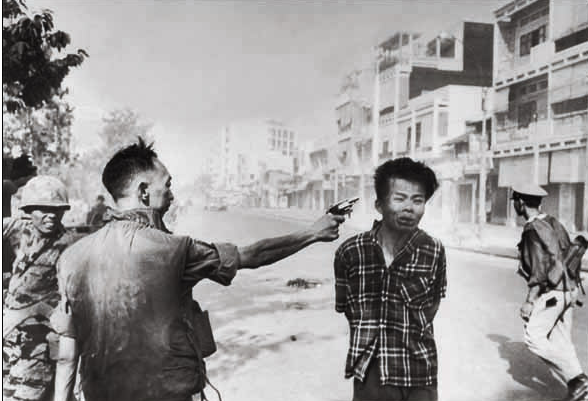
This is a reprise of the Eddie Adams photograph from the 1968 Tet offensive in during the Vietnam War.

eddie-adams-icon.png

Adams believed that the officer was justified in executing the bound prisoner of war, and perhaps a case can be made. But the photo records more than a single incident, and it fit too well with many other acts that were both criminal and marked by the official indifference that is displayed here. So, much to Adams dismay, the photograph became memorialized as a statement against the war.

And something like that ambiguity is evident in the Lego art. The smiles of the two figures, and particularly the one being shot, are just not right. They’re wrong because not in the photograph, and because not fitting with the scene, and because not appropriate for cuing our reaction to a killing. As with the iconic photograph, what seems to be a simple image is in fact one that churns complicated responses, in part because it isn’t right with itself.

There are limits to imitation. Not everything can be said in any medium, and some media can’t say much at all, but there still can be more there than we might think. Next up, iconic images in cornfield mazes. Really, they’re out there.

Photographs by Alfred Eisenstaedt/Getty Images; Eddie Adams/Associated Press.
 7 Comments

Radiant Agriculture

Every spring and fall the photographic record in the US includes a few stock images of agriculture. Spring images include tractors turning the earth and kids holding newborn lambs; typical autumn fare includes combines moving across the Great Plains and pumpkins waiting to be carved. Modern agribusiness and a mythic county life each get their due. For the most part, however, we don’t see where our food comes from. The near-complete separation of the production and consumption of food is more than a distribution of labor–it is one of the things that makes us feel modern. Not surprisingly, it also ensure that “food” becomes very elastic, so much so that the local supermarket can have over 100,000 different products for sale.

The absence of images about food production is part of this willful dislocation of eating from growing, killing, and preparing food. It also isn’t a big loss much of the time. Who wants to watch wheat grow? Even so, once in a while an image comes along that can stop me in my tracks. Like this one:

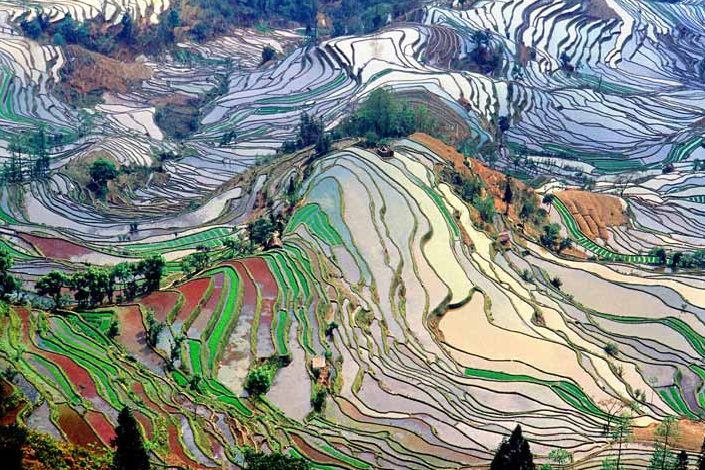
yunan.png

The photo is of a rice field in Yunnan province in Southern China. It’s displayed both as a photo of the day at National Geographic online and at the Yunnan entry at Wikipedia. I think it belongs in the tradition of Chinese fine art. Indeed, if it seems familiar that probably is because it evokes earlier art works. Those paintings also may have captured terraced fields on landforms that seem so dynamic that they might be clouds. They, too, will have showed a place as if it were both uniquely particular and some fantastic otherworld. They also have mastered the exquisite tension between energy and order that makes the scene appear at once airily ephemeral and so beautiful that it could be eternal. The photograph stands alone, however, because of how it captures the light. The bright-hued light doesn’t so much shine on the landscape as radiate from within it.

The photo’s sense of aesthetic harmony amidst powerful natural energies might carry over, through the caption, to the idea that this also is an image of the good life: carefully manicured fields hug the wild mountain, and one can imagine that farmers are serenely engaged in sustainable agriculture as they have been for millennia except when drunk on sunshine. In fact, Yunnan has been a poor province that only now is producing enough rice to feed itself thanks to the addition of high-tech seeds and other modern practices. And so we get to the next photo:

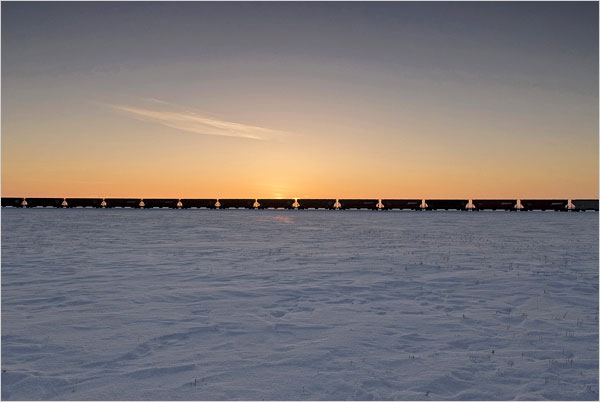
nd-horizon.JPG

This image from North Dakota seems almost funereal. The land is cold and empty, the sun is setting, and all that remains are a line of metal railroad cars that are evenly spaced as if sprockets in some cosmic abandoned factory. This is mechanized commodity crop production, and it’s hard to imagine anyone wanting to be in the picture. The image accompanied a report on North Dakota’s population decline; the story was entitled Not Far from Forsaken.

That’s not the whole story, however. This barren winter desert is an unbelievably productive source of food that is shipped all over the world. So let’s look at the photo again, for it, too, suggests the promise that was so vivid in the first image. As Kathleen Norris learned, Dakota also is a place of heavenly energy. Look at the sun in this photo as something radiating constantly through the land, through the networks of exchange that define every meal we eat, and, most important, through the wheat that lies in the rail cars waiting to be converted into food and all we can do when we don’t want for food.

Photographs by Eugene Richards/New York Times; Jialiang Gao.

 4 Comments