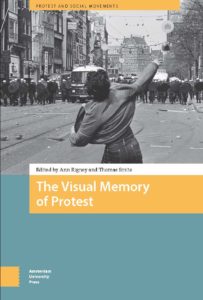
Available in hardback and as an open source pdf.
The Visual Memory of Protest is a fine book with a clear and compelling sense of purpose. The book has three converging foci: the first is the memory of activism, that is, the collective memory of protest events; the second is memory in activism, that is, how the memory of previous protests “informs later protest cycles”; the third is memory activism, “where activism is itself directed towards changing collective memory and the priorities in public commemoration” (14). These orientations can overlap, but the distinction is useful in analyzing and evaluating social movements and especially the role of media in social movements.
These foci also can be salient in respect to understanding national and perhaps regional differences as these can involve different cultures of memory. William Faulkner has said that the past is not even past, but in the US, he had to say it. Outside of the US public culture, the past can be much more palpable, contested, and dispositive in respect to both the realities and the aspirations of the present.
And that is why I like another feature of the book, which is that it does not include studies of events or media coverage in the US. The locales range across Europe, Latin America, India, and Hong Kong, along with some attention to global circulation. Western influence is still evident in the citations, which reflect the dominant configuration of media studies over the last century, but even there, change is evident, and one can see how valuable it can be bring different networks of media study together. In any case, the book is highly legible to anyone in media studies, and it provides a good introduction to the study of visual media for those social movement scholars who have been focused on other dimensions of movement organization or institutional change.
The attention to visual media may appear a bit retro, as if focuses primarily on photography and how photographic images are reworked through analog media such as posters, banners, and murals. Don’t look here for studies of discorrelated images, glitch cultures, interface effects, or other digital media aesthetics. This division of labor makes a lot of sense, however; or, at least it makes sense in respect to the “boots on the ground” pragmatics of social movements and what continue to be crucial media practices for their success. Obviously, I’m biased here, but we shouldn’t get sidetracked by a traditional vs. new media debate: all media are intertwined now, in both practice and inquiry. The research has made clear that photography continues to be a major factor in the coverage of protests, in the media used in the protests, and in respect to long phase effects such as the impact on collective memory, and because of how easily it moves through digital technologies.
What is especially important now—and in this volume—is an emphasis on how photography is remediated and reworked into other media. As a personal note, this transition from a primary focus on the original image as it circulated in its original media domain—photojournalism or art photography, for example—to becoming a template for production and circulation in other media, was exactly what defined the development of No Caption Needed. John Lucaites and I started with the first assumption, but the internet was growing fast as we worked on the book. As a result, we stumbled into a second focus on what we labeled “appropriations” of the iconic image across other media, genres, and topics, and we came to see that as the key to understanding icons as a genre of public culture. Now it is clear that appropriations are necessary to understand photography tout court, and that they are central to many digital media practices and to social movement protests. Throughout The Visual Memory of Protest, the authors seamlessly track how images are pulled across media, and especially the media of the street such as handbills, posters, graffiti, and clothing. And they do so without undue anxiety about twentieth-century problems of representation and authenticity. Hybridity without loss of identity is the new normal, and good thing, too.
This relative lack of anxiety about the purity and danger of visual representation brings me to three themes that I want to offer as means for working with the book. The first is that the book is a good example of the paradigm shift in the critical discourse on photography that John Lucaites and I promoted in our 2016 book, The Public Image. The shift was from the critical discourse developed by Alan Sekula, John Tagg, and many others, and disseminated globally by Susan Sontag’s On Photography. The discourse was a major intellectual accomplishment, not least as it pushed photography to the center of debates about modernity, but it also contained serious problems from the start and promoted comprehensive misrecognitions of photography as a medium and photojournalism as it is a democratic public art. I won’t rehearse them today, but these issues became more evident with the development of digital technologies, and many artists and scholars are moving on—even, however, as they still may unconsciously recur to the older discourse to explain (poorly) why media matter.
The Visual Memory of Protest provides good examples of how the new paradigm works: that is, as a practice that continues to draw on the older critical vocabulary, but also draws on more productive assumptions about media activism and civic spectatorship, and is oriented to doing more than issuing oft-repeated warnings about the cognitive, moral, cultural, and political effects of media domination. The older discourse wasn’t entirely wrong, of course, and so those distinctions and concerns need to be taken up when framing one’s research. The studies in this volume do so, cogently, but as I said, they do more as well. Perhaps the normative and aesthetic alignment with social movements helps, but the scholarship doesn’t have to be limited to protests; these studies of protest media are good media studies.
The second and third themes each are examples of how the paradigm shift in the discourse of photography can be extended. Extended not in clearly legible or predictable ways, but as examples of developing a new problems and concepts. Thus, a dialectical paring of scarcity and abundance runs as a thread through the volume—and sometimes using those two terms. On the one hand, there is pushback by several authors against the idea that digital media have brought in an age of image abundance, and renewed consideration of how memory and images (say, award winning images and iconic images) depend on conditions of scarcity. On the other hand, the volume as a whole is a demonstration of the affordances of image abundance, and the plenitude and innovations in image making that characterize activist movements, and how the dialectic doesn’t align neatly with a distinction between analog and digital media. Again, to take an argument from The Public Image, the dreaded “excess” of the image world was a staple of the older discourse on photography, but recoding “excess” as “abundance” is one feature of the paradigm shift, and the new term allows additional thinking about media. It doesn’t wish away the persistent and painful scarcities that continue to define the world, but it does provide a basis for challenging regimes of artificial scarcity.
The third and final theme that I will mention is that the volume hints at the value of formalist methods in media studies. “Hints” may be an overstatement, and formalism is certainly more my interest than the authors’, but consider this statement as illustrative: “This collection claims that struggles over the visual definition of events and for control of the public narrative—in the short term, in the form of news, and in the long term, in the form of cultural memory—is part of contention itself and not merely a byproduct” (10, my emphasis). The use of “form” here obviously is conventional, rather than being featured, but it also provides a subtext for the passage—and many like it throughout the volume. The study of visual memory becomes a study in pattern recognition—whether on the street or through data analytics—and of how formal features of an image work across media and across time—in both media artistry and audience uptake—and of how changes in media and memory can involve—or require—changes in cultural forms. Equally important, various chapters in the volume demonstrate how formalism need not be apolitical: the most obvious example is the use of silhouettes in Latin American social movements, but the several examples of images becoming or imitating templates apply just as well.
The editors get closest to the issue when they state, “The formal and affective echoes between new images and historical ones serve to link one protest cycle to another through a specifically visual form of resonance (Armstrong & Crage, 2006)” (19). A lot is packed into that sentence: two major modalities of mediation, how they combine to link past and present, and how the connection between images, and between images and audiences, is a difficult to grasp phenomenon identified through the synesthesia of visual resonance. This concept of resonance is one that comes up a lot in literatures on form, and 17 times in this volume. It bears more development, and visual memory might be a just the place for exploring it further.
Or so it seems to me. Again, this is a well-focused, coherent, and useful volume. It demonstrates how photography is remediated and reworked across many different media, within and across national cultures, to productively advance both social movement protests and the always endangered resources of collective memory. Visual media prove to be highly accessible, plastic, and effective as means for social movement protests, and social movements are shown to be important nodal points for collective memory and cultural change because of how and how well they use visual media. These contributions come from outside the US and are all the more valuable for that. Because they are grounded in a coherent research domain, they can be used productively in comparisons with many other movement and media studies. Because they unconsciously reflect a paradigm shift in the discourse on photography, they provide examples of how that works and of the work remaining to be done.
0 Comments