
The Occupy Wall Street protests have entered the phase where they have the attention of the mainstream media but now have to struggle to get their message out. The problem is twofold: the movement has more messages than organization, and the press can be astonishingly thick-headed about what happens outside of their usual ambit. Even though they had a full-time propaganda machine in Fox News, the Tea Party had the same problem. Now as then, the press is asking, “Just who are these people? To answer that question, someone started a Tumblr site, “We are the 99 percent.”
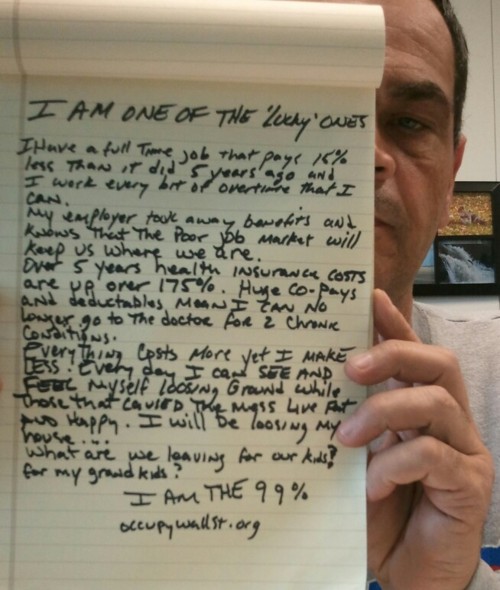
Each entry consists of someone writing a personal statement and holding it up to the camera. The paper comes from notepads, the photos are not in any way professional, and everything about the presentation underscores that these stories come directly from everyday life in an anxious time. Economics gets personal, and the personal is political once again. These citizens are making public statements to whoever will listen, in the hope that the government can begin to undo the damage it has caused by deregulation, regressive tax cuts, and unnecessary wars.
Public statement invite public debate, and it didn’t take long for a counter-site to emerge.
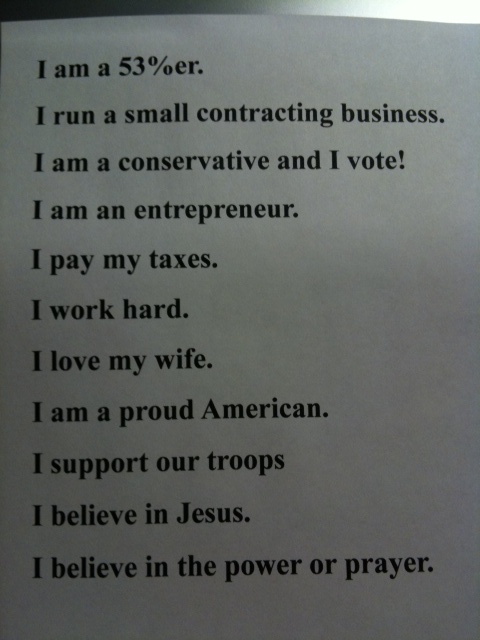
“We are the 53%” refers to the 53 percent of Americans who pay income taxes. Ironically, as the deep tax cuts and public sector job losses created by Republican policies have taken wage earners off the tax rolls, the right wing feels even more aggrieved. (Joe Klein sets out this point in more detail.) Nor does the 53% include social security, property, or sales taxes, etc., but who’s counting? In any case, the use of visual statements is interesting, and the debate is doing what democracies should do: get people to compare their experiences in order to work out some basis for agreement among conflicting viewpoints.
But when you get personal, you also had better be ready to take your lumps. Here’s the guy who apparently started the 53% site:
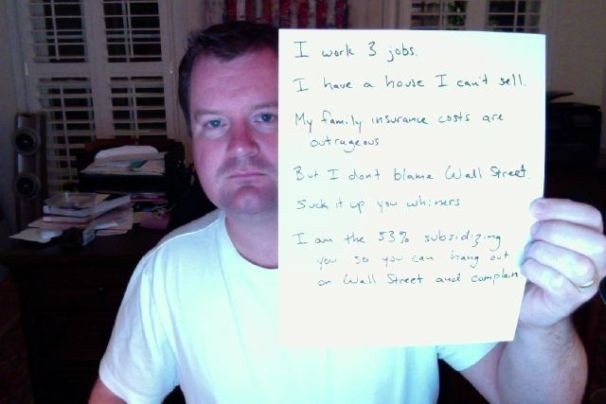
As Brad Delong notes, the job count might involve some fuzzy math. And then there are the two houses. Even when you don’t say a word, politics ain’t bean bag.
Photos are from the Tumblr sites. Thanks to Pandagon for the fair and balanced leads. A slide show of protest signs on the street is here.
Here is yet another tumblr to add to the mix of: http://westandwiththe99percent.tumblr.com/ These images do well to challenge the meritocracy myth that seems to drive the perspectives of the 53%ers.
You know that the 53% tumblr has at least one (and possibly many many more) fake images, right? http://www.dailykos.com/story/2011/10/15/1026620/-We-Are-the-53-is-Using-Fake-Images?via=search
I did not know, but I am not surprised. Thanks for the link.
While photographs of written notes makes these sites distinctive, I think it’s also worth examining who’s holding the papers. With the exception of a dog and someone of Indian descent, everyone pictured on the 53% website is white; the 99% is much more racially diverse.