Jan 09, 2012
Feb 01, 2012
Aug 29, 2012
Feb 02, 2011
Apr 05, 2010
Feb 19, 2014

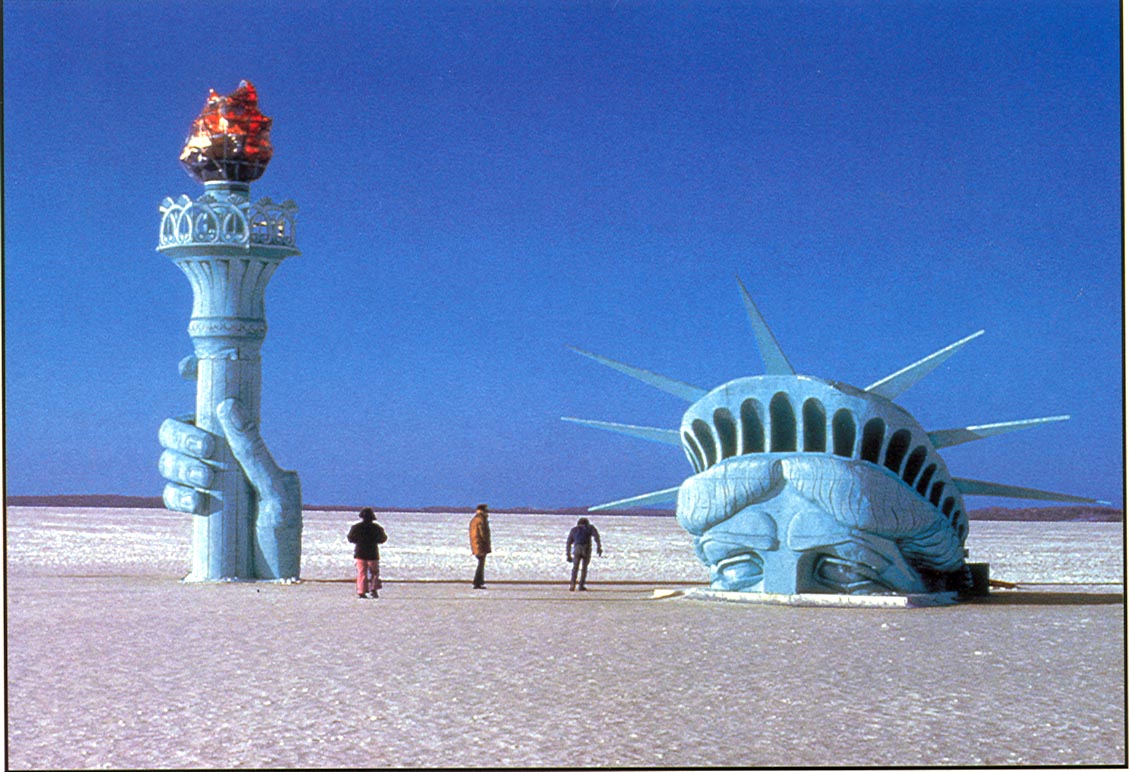
Sight Gag: Those Crazy Kids in Madison, WI

madison-statue.jpg

Our primary goal with this blog is to talk about the ways in which photojournalism contributes to a vital democratic public culture. Much of the time that means we are focusing on what purport to be more or less serious matters. But as John Stewart and Stephen Colbert often remind us, democracy needs irony, parody, and pure silliness as much as it needs serious contemplation. For our part, we will dedicate our Sunday posts to putting some of that silliness on display in what we call “sight gags,” democracy’s nod to the carnivalesque. Sometimes we will post pictures we’ve taken, or that have been contributed by others, or that we just happen to stumble across as we navigate our very visual public culture. And we won’t just be limited to photography, as a robust democratic visual culture consists of much more. We typically will not comment beyond offering an identifying label, leaving the images to “speak” for themselves as much as possible. Of course we invite you to comment … and to send us images that you think capture the carnival of contemporary democratic public culture.

Photo Credit: © Michael Kientiz, all rights reserved. Post Card of Life Size Papier-Mache Replica of Statue of Liberty from the Eyes Up on Lake Mendota, Madison, Wisconsin.  For other versions see here.


Digg!

 2 Comments

One Planet, Many Worlds

Americans like to think that the world revolves around the U.S. For vivid demonstration of a different perspective, look at this photo, which is dated September 11, 2007:
herder-german.png

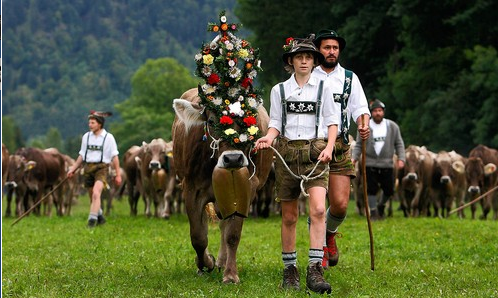
The caption said, “German herders guide a decorated cow and other cattle Tuesday on the move from high alpine summer pastures to lower altitudes in the mountains near Bad Hindelang, in southern Germany.”

Even without the 9/11 date, this picture strikes me as uncanny. The bucolic scene could be from centuries ago, except for the state-of-the-art hiking boots, perfectly machined clothing, and farmers who obviously have never wanted for food, good health care, and all the other benefits of late-modern European civilization. The cow’s ornate decoration is equally incongruous, like something found in a tourist boutique Christmas Store rather than on modern livestock who are blessed (as these probably are) if they can stay out of a wretched feedlot. Above all, these are German herders, and the idea that they are part of the labor force of a modern, high-tech nation just doesn’t mesh with the incredibly relaxed, ambulatory slowness of the scene. They obviously are walking at a cow’s pace–for those of you who don’t know, that is really s l o w–and they are doing so easily, comfortably. While I was getting edgy waiting impatiently for a traffic light to turn green, these guys were ambling through a verdant alpine valley. And what little work they were doing by walking downhill was being made into ritualized play.

Whether acting out an invented tradition or authentic examples of the German volk, the incongruity is extended further by the boy in the foreground. While mountain people should be hardy, wild, and reclusive, he looks so open and gentle. Though likely to grow up like the physically impressive men behind him, he appears vulnerable, still formed in the soft clay of childhood. He is presented directly to the viewer as if we ought to take him in, and so the photograph suggests that this pastoral scene might become part of our world. The herders are walking into our space, perhaps to bring their green harmony with them.

That sense of peace seems a long way from 9/11 and the urban canyons of New York or Chicago, but there are sharper contrasts beyond that. This photograph appeared in the New York Times on September 13:
herder-dinka.png

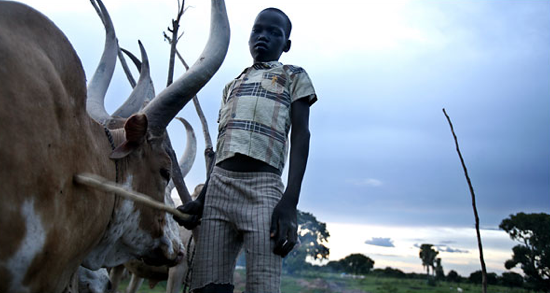
The story featured a sense of incongruity: “In Southern Sudan, Peace Alters a Way of Life.” Peace can do that, particularly when contrasted with rape, murder, starvation, forced migration, and other forms of terror that are never mentioned by the Times reporter. This picture isn’t about war, however, but about third world deprivation. The point of the story is that the Dinka way of life is becoming harder to sustain as young people are lured to the city. This boy is on the cusp: he herds the cattle, yet wears modern clothes. His indeterminate age symbolizes his indeterminate position: the caption informs us that his parents don’t know his age but guess he is about 11 or 12, i.e., about to enter the transition to adulthood. There are no adults in the picture, and the Western reader will conclude from the parent’s ignorance that they are either primitive or negligent, neither of which bodes well for a child caught between two worlds.

The photograph pushes this point. We are looking up at the boy as if he were in a position of power. But it is the wrong kind of power: he is a boy doing adult labor. This mismatch is reinforced by seeing his clothes come up short, by his sullen expression, and by the contrast with the open vista behind him. He is a capable herder but yoked to the cattle. His herding stick suggests the yoke and is matched by another stick protruding upwards to create an artificial border within the picture. The boy is already hardened by child labor in the desert and confined by the boundaries of his primitive society. (The benefits of living in this traditional society are no part of the story or the photograph.) Though revealing some of the incongruities of contemporary Dinka life, this photograph is not uncanny but rather one that makes reality seem hardened, depressing, and perhaps hopeless.

Two photographs, two boys herding cattle, two very different worlds on the same planet.

Photographs by Christof Stache/Associated Press, Evelyn Hockstein/New York Times.


Digg!

 1 Comment

Islamic TV: A Two-Headed Monster?

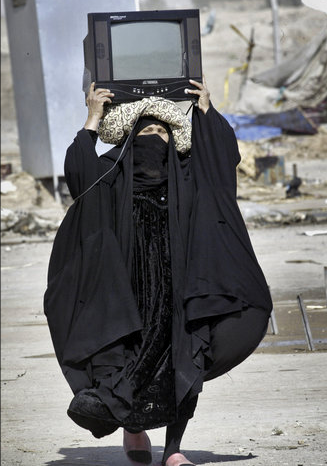
This image from the Washington Post Day in Photos lies right across the line between soft news and hard news.

burqa-tv-pic.png

On the one hand, it’s a visual joke. The incongruity of a woman from a traditional society carrying a TV rather than water or the wash on her head at once upends and reconfirms Western assumptions about the Arab world. She’s not completely not modern, and modern civilization is what she desires. See: the woman values that TV so much that she will carry it instead of more traditional necessities. Imagine: she’s all wrapped up and yet gets to see the world through the wonder of modern technology. On the other hand, the woman is engaged in the difficult task of carrying her household possessions through a war zone while probably leaving much behind. The caption adds that “about 2,000 Iraqis leave their homes every day due to violence and economic uncertainty resulting from the four-year conflict.”

Although cast as a representative of displaced Iraqis, I doubt the woman will elicit much sympathy. Indeed, the image calls the bluff of the serious captioning: the photo is striking but not for the reason given. As noted several times before in this blog, the burqa troubles the Western gaze whenever it is is placed in modern context. (Within the traditional setting, it confirms ideological assumptions instead of challenging modern norms of transparency.) By walking with the TV balanced on her head, the burqa-clad woman becomes a cyborg, both human and machine, organic and artificial, traditional and modern. She now has two heads, one veiled, turbaned, and a platform for the other, which is a blank screen capable of channeling the vast information flows of the modern media. Despite the visual joke, the latent fascination of the image is that she has become monstrous. Not terrifying, but more akin to a freak show. The fact that the photo is half soft news and half hard news reinforces this sense of an unnatural though not too dangerous mixture.

Of course, it’s not news at all. We know all about Al-Jazeera, and scholars, not least Martin Marty’s Fundamentalism Project, have documented that fundamentalists of all religions have no problem rejecting modernity’s values while becoming cutting-edge producers and avid consumers of modern media. It turns out that modern liberals are the ones who have a hard time managing that contradiction. Which is why the photograph above, which could be seen in a very ordinary way, instead implies that the two civilizations can never be blended but must instead be joined only precariously, amidst violence.


Digg!

Photograph by Alaa al-Marjani/Associated Press.

 1 Comment

Footwork at Reed College

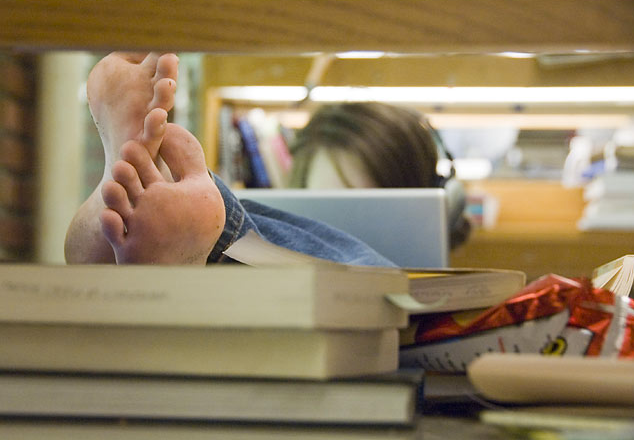
We could post about the war in Vietnam–oops, I mean Iraq–every day, but since continuing the quagmire depends on a loss of perspective, we should turn to other things as well. Like feet. Next week John and I will be giving a paper at a photography conference, where we will discuss why photojournalism features hands and feet when one could show more of the individual pictured. Like this:

feet-and-computer.png

This example may be somewhat more artistic than others we could show, and it has more of a pretext as it was part of a New York Times “Trendspotting” story on the custom at Reed College of going barefoot just about anywhere and any time. Even so, it’s not a typical news photo, which suggests that something else is going on.

Most of the images in the Trendspotting photo essay were mildly informative and less evocative. They showed students standing in line, standing in groups, and so forth. In each case we saw young people much as we often see them, and they happened to be without shoes. This much more distinctive photograph removes the student body (sorry, I couldn’t resist), but for the sharp focus on a pair of bare feet resting on a desk between books (front) and computer (middle). In the back of the photo we see the blurred top of a student’s head. He is wearing earphones, and the effect of the image comes in part from the contrast between the student’s heavily mediated experience–books, computer, digital music, even the food is processed–and the unmediated, elemental experience of resting his bare feet in the air. Whereas the other images showed more of the local culture through stock scenes such as standing in the lunch line, this one joins the special experience of higher education at an elite school with a seemingly universal symbol of youth.

Most people have neither occasion nor inclination to go around barefoot, or to study as much as is the norm at Reed. The photo does double duty at making the story significant: by foregrounding books, computer, and the obviously habitual posture of the student reading, the seeming frivolity of going barefoot–rather than working for a living–acquires a serious cast. The student isn’t working, but he is in training. Likewise, Reed’s foot fad stands in for the peculiar subculture of good higher education and makes it appealing through an iconography that channels the barefoot boy of American myth. Huckleberry Finn now goes to school, and leisure time is spent not on the river but drifting through the liberal arts.

Reed’s reputation includes both intensive study and liberal politics. Note the student’s longish hair. And so this post is about Iraq after all. Those feet are the feet of privilege and are not likely to wear combat boots. But there are places where privilege is used to learn, to discipline judgment, and prepare for both innovation and good stewardship. The press now provides many images of boots on the ground, and while honoring the sacrifice of working class youth it becomes too easy to forget their betrayal by those who benefited from the privileges of wealth without bothering to learn from history, deliberate carefully, and act with regard for others. We need boots on the ground, but we also need good education and good government. And not just for the few.

Photograph by Molly Gingras <gingrasm@reed.edu>.


Digg!

 12 Comments

Courting the American Dream in Ramadi


pplgl009.jpg

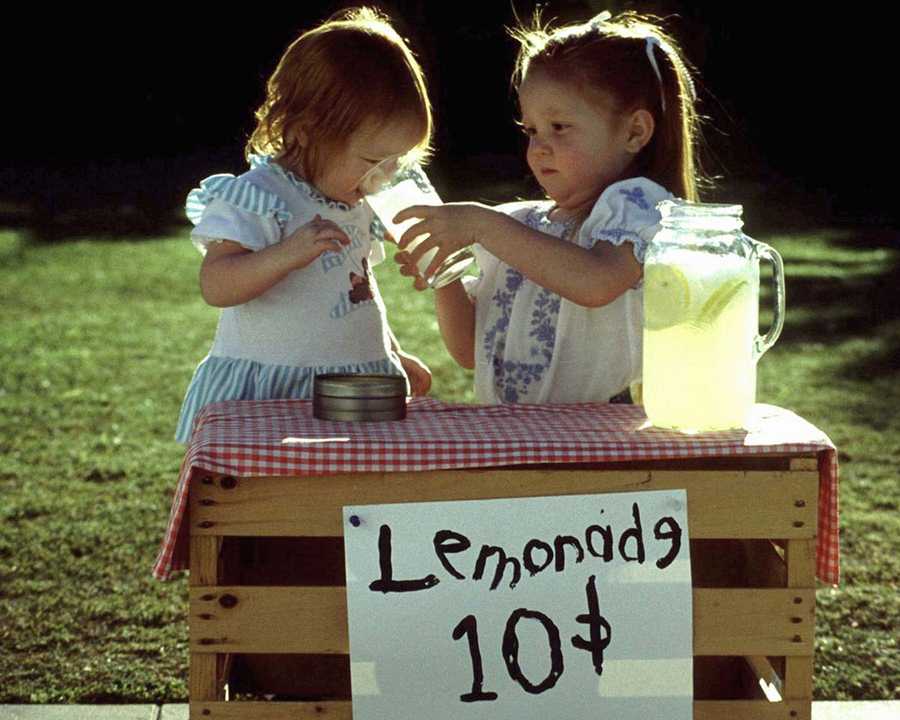
The lemonade stand. It is as American as apple pie, a time-honored tradition deeply rooted in the American dream and its Horatio Alger ethos. All it takes is an old soapbox or small table; some lemons, sugar, and ice; a few paper cups; a hand scrawled sign and, of course, some good old American initiative. For many children it is their first encounter with the spirit of capitalism, and hey, even if there isn’t much monetary profit at .10¢ or even .25¢ a cup, there is the social capital gained by cooperating with friends and neighbors, and learning how to encounter the marketplace, both of which may be far more important civic lessons.

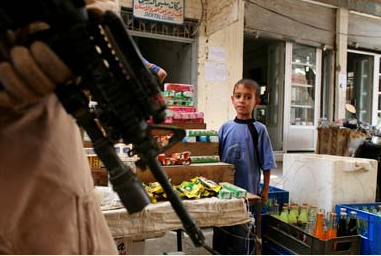
A safe and open marketplace is essential to a vital democratic public culture. What better way, one might then imagine, to demonstrate the success of our military surge in Iraq than to show a safe marketplace operating in the Al-Anbar Province, one of the most volatile and dangerous places in all of Iraq. And more, what better way to show that safety than with “a young Iraqi boy selling lemonade in the town of Ramadi …”

picture-2a.png

Prior to the surge, Al-Anbar Province had been the “hub of [the] Sunni insurgency.” But apparently not anymore, as over 6,000 U.S. troops walk the streets, along with a growing Iraqi police force and tribes of “provincial volunteers.” That the police force is beleaguered and the volunteers bear a striking resemblance to vigilante groups doesn’t seem to matter, for here in Ramadi, seventy miles west of Baghdad on the Euphrates River, safety and commerce seem to rule as the marketplace is open for commerce and, as the caption tells us, a young boy sells lemonade. At least according to the caption, one might imagine themselves on a street corner in middle America.

Upon a second glance, however, it is not clear that all is well. The eye is drawn initially to the boy who we might expect to see smiling for the camera or making a sales pitch to a potential customer. But there is none of that. The tentative and concerned look on his face and the gestural attitude of his body suggest that he is far from at ease with the situation. And with good reason, for the soldier and his weapon pose an ominous presence as they simultaneously frame and obscure the scene—perhaps a metaphor for U.S. military presence in Iraq writ large. Indeed, one has to wonder how truly safe things can be if something on the order of international martial law is needed to insure the everyday routines of domestic commercial life.

The contrast between the two images points in some measure to the problem of the project of exporting liberal democracy. A liberal democratic public culture relies upon the sense of trust that is generated by the kind of social capital we see being invested in the photograph of the two young girls at the top (or in any of the hundreds of pictures that you will encounter if you google “lemonade stand”). Such images are tinged with nostalgia and too easily romanticize our bourgeois and middle class sensibilities, and we need to be very careful about being too proud of ourselves in this regard, but the sense of trust and cooperation that they depict is necessary to such a politics. It is not the only thing, of course—the opportunity for free and open dissent come to mind as no less important—but it is essential. And it is hardly the cultural or civic attitude that is generated by a massive and sustained foreign military presence or roving tribes of provincial volunteers. To accent the point, one need only visualize the scene of the two girls at the top—innocent, pure, and white—with the soldier and his weapon framing and overshadowing the scene. It is virtually unimaginable.

Photo Credits: Central Ohio Center For Education, Richard Mills/The Times

Digg!

 4 Comments

“… the sometimes illusory promise of a fresh start.”

Ritualistic photographs of the first day of school operate in a number of different interpretive registers, some of which we discussed last week, but none is more pronounced in the public media than their function as visual tropes of a “fresh start.” With new clothes and new teachers everyone enters the schoolhouse door with a clean slate to make of the new year what they will—or so the myth of our merit-based, public educational system suggests. And the kids are rarely alone in such images, as adults are typically present to nurture and protect, as well as to legitimize the succession of authority as it passes from parents to teachers who serve both in loco parentis and as surrogates of the state :

picture-1.png

The power of a trope is that it relies upon conventional understandings of meaning, but it is also a figuration subject to ironic manipulations that can be turned against convention to create what Kenneth Burke called “perspectives by incongruity.” When used as such, a trope positions and encourages us to see things from a new or different view designed to induce an “attitude” or disposition to action. A good example of such an ironic turning of the visual trope of the first day of school as a “fresh start” appeared in the paper version of the NYT on 9/5/07 in a full-page photo essay titled “With Start of a New Year, Excitement and Jitters” (p. C14). The photo essay included six photographs from around New York City and the nation, five of which easily met the conventions of the trope of “fresh starts,” as students displayed the “excitement and jitters” of a new school year in pairs and small groups, while parents calmed nerves and teachers greeted and protected their charges. The lone exception was this photograph:

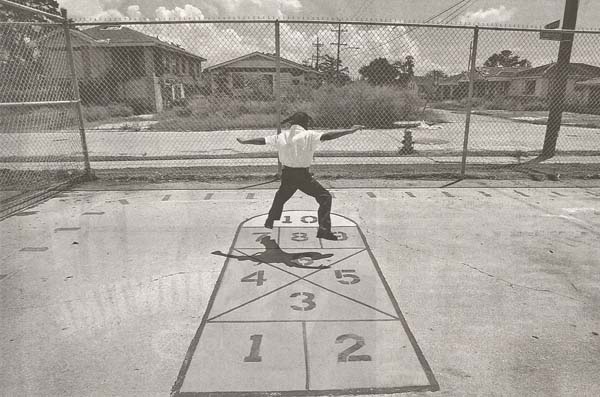
Katrina Hopscotch

Twice again as large as any other image in the photo essay, it appeared in the very middle of the page cutting across the fold. The caption directly beneath the image read, “A Fresh Start in New Orleans. A kindergartner at his school in the Lower Ninth Ward which reopened last month after Hurricane Katrina flooded it in 2005.” The image has appeared elsewhere on the web, and in bright and vivid color, but here it is in black and white (as were the other images in the photo essay). Instead of a blue sky and billowing white clouds that encourage the sunny optimism of a new day, we get the muted tones of a grey scale that flatten the image and mitigate the difference between the “in here” of the schoolyard and the “out there” of the rest of the 9th Ward. And what we find “out there” is quite literally a ghost town, replete with boarded up houses and unkempt lawns and shrubbery growing out of control. Notice too, that there are no people outside of the chain link fence. It is a public space without a palpable public. Indeed, it bears a striking similarity in this regard to many images we have seen recently of the barren streets of Iraq.

But there is more. For in every other picture in the photo essay the frame is filled with a distinct and manifest sociality: schoolmates are engaged with one another in groups and in pairs, while parents and teachers comfort and greet. And all are facing the camera, thus inviting some measure of communion with the viewer. The Bronx, Boise, San Antonio, it doesn’t matter, for these are common scenes from a national social imaginary that are acted out anew every fall in local communities throughout the land. But in the 9th Ward the conventions of sociality are either absent or subverted. The child is alone. Eerily so given that this is the first day of school. There are no reunions with friends or schoolmates, and parents and teachers are nowhere to be seen. Moreover, the student’s back is towards the camera, and thus there is no opportunity for eye contact or interaction between the child and the viewer. His only companion is his shadow, the spectral illusion of otherness that moves only as he does, and thus accentuates his sheer social isolation. Most noticeably, there is no adult presence that says “we care” or “you are safe here.” One might easily imagine it as a recipe for a social pathology.

And so the visual trope of the first day of school as a “fresh start” functions here ironically as an allegory for the fate of New Orleans. Just as the student, who should be with friends and teachers, is alone and isolated, so too is the 9th Ward in the larger scheme of things; and just as the student is left to his own designs to make his way without help or protection, so too, once again, is this New Orleans parish. “Sometimes,” a sidebar caption to the right of the photograph announces, the promise of a fresh start is “illusory.” And here we see the stark contrast between a national imaginary where fresh starts and renewal are taken for granted assumptions deeply rooted in the American dream, and a place where the pledge is a false promise … if not in fact a traumatic nightmare.

Photo Credit: James Estrin/New York Times, Mario Tama/Getty Images


Digg!

 0 Comments

Sight Gags: "September 12, 2001"

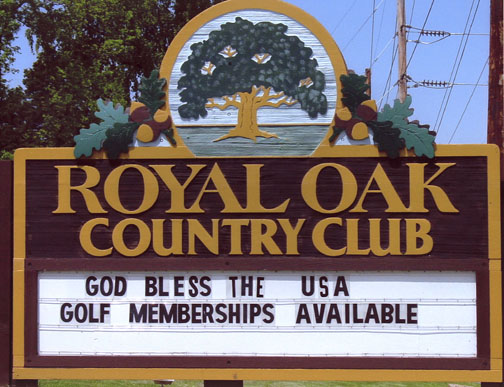
royal-oak5×7.jpg

Our primary goal with this blog is to talk about the ways in which photojournalism contributes to a vital democratic public culture. Much of the time that means we are focusing on what purport to be more or less serious matters. But as John Stewart and Stephen Colbert often remind us, democracy needs irony, parody, and pure silliness as much as it needs serious contemplation. For our part, we will dedicate our Sunday posts to putting some of that silliness on display in what we call “sight gags,” democracy’s nod to the carnivalesque. Sometimes we will post pictures we’ve taken, or that have been contributed by others, or that we just happen to stumble across as we navigate our very visual public culture. And we won’t just be limited to photography, as a robust democratic visual culture consists of much more. We typically will not comment beyond offering an identifying label, leaving the images to “speak” for themselves as much as possible. Of course we invite you to comment … and to send us images that you think capture the carnival of contemporary democratic public culture.

Photo Credit: John Lucaites


Digg!

 0 Comments

Remembering to Forget … Vietnam

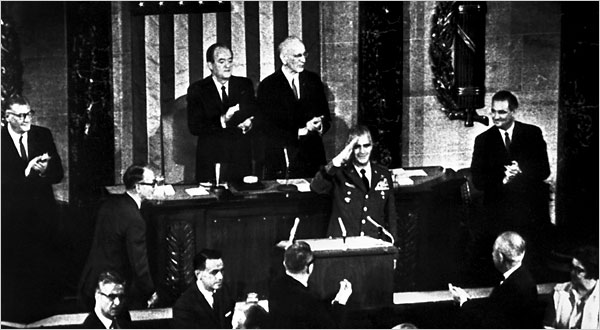
As we prepare for General Petraeus’s report on Iraq later this week, we should perhaps recall earlier times when Generals have addressed Congress in the interest of an embattled admistration seeking to prolong a contentious military engagement. Here, of course, we have General Westmoreland who had just travelled from Vietnam to “brief” the U.S. Congress on “military gains in Vietnam” in 1967, six months prior to the “Tet Offensive” :

08general-600.jpg

Of course, for Bush the Elder one of the significant outcomes of the First Persian Gulf War—Desert Storm—was putting “Vietnam syndrome” to rest. It is at least somewhat odd then, if not wholly ironic, that Bush the Younger would seek to revive the specter of Vietnam as a point of comparison to the current war in the Persian Gulf, particularly given how contentious it has become at home. Nevertheless, the current administration has made a concerted effort of late to use our experience in Vietnam as an analogy to support our continued military occupation of Iraq, lest a precipitous withdrawal of troops animate the middle east equivalent of the “killing fields.” It is an odd argument that seems to reverse the terms of George Santayana’s famous “Those who cannot remember the past are condemned to relive it.” Here, by reliving the past, it seems, we put ourselves in position to forget it. Washington Post columnist Eugene Robinson makes the case as well as anyone:

“Bush, Rove, Dick Cheney and the other principal architects of the Iraq war never served in Vietnam … [but] I’m less concerned with their hypocrisy than their distortion of history. To say that the US should not have withdrawn its forces from Vietnam is to say that there was something those forces could have done—something beyond napalm, carpet-bombing, destroying villages in order to save them—that would have led to some kind of victory. Of course, Bush and others don’t say what that special something might have been, because they don’t know. They’re seeing nothing but a historical mirage ….

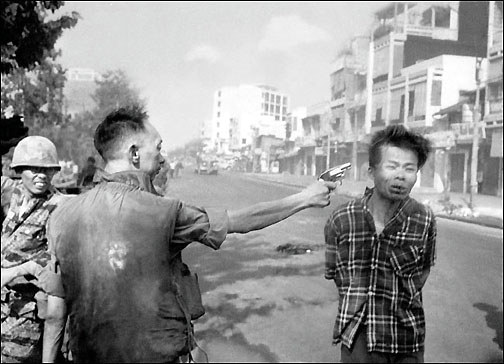
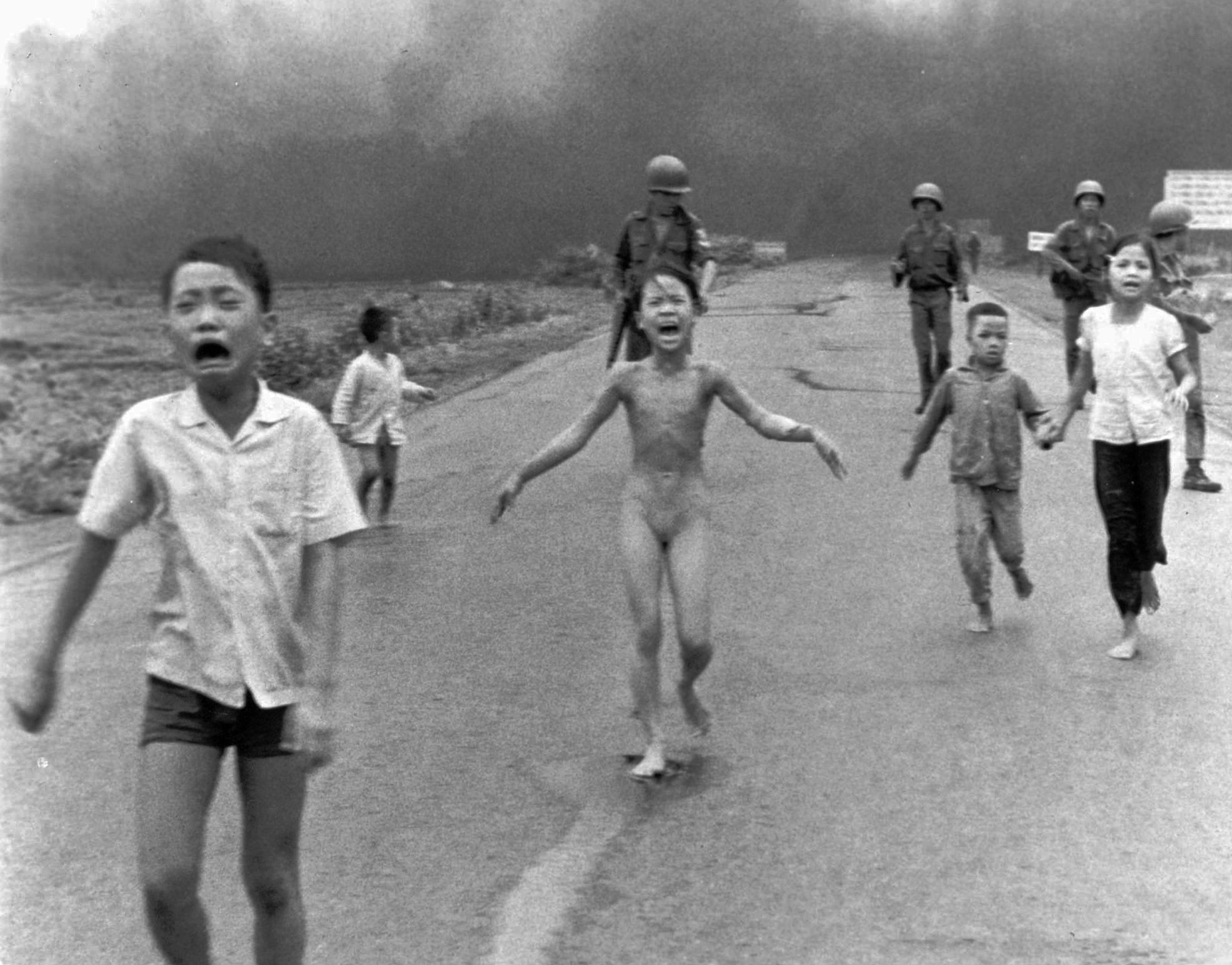
“George W. Bush wants us to remember Vietnam? Fine, then let’s remember those iconic images – the Viet Cong prisoner being executed in cold blood with a pistol shot to the temple, the little girl running naked and screaming from a napalm attack. Let’s remember how little we really understood about Vietnamese society. Let’s remember how wrong the domino theory proved to be. Let’s remember how much damage prolonging an unpopular war did to our armed forces and our nation, and how long it took us to recover”

For our part, here are the iconic images that Robinson invokes:

trodd-eddie-adams-01.jpg

985640413apmrade_viet_2d11g-copy.jpg

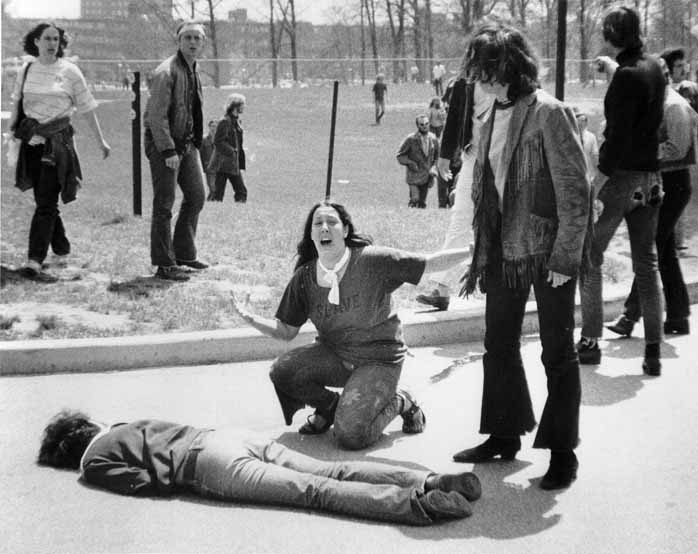
And lest we forget the effects of a government that actively strives to limit and demonize public dissent from a policy of war, there is this poignant reminder:

kent1-copy.jpg

Photo Credits: Agence France-Presse/Getty Images, Eddie Adams/AP Photo, Nick Ut/AP Photo, John Filo/Hulton Archive/Getty Images.  The phrase “remembering to forget” comes from the fine book by Barbie Zelizer, Remembering to Forget: Holocaust Memory through the Camera’s Eye.


Digg!

 1 Comment

Thin-Skinned about the Veil

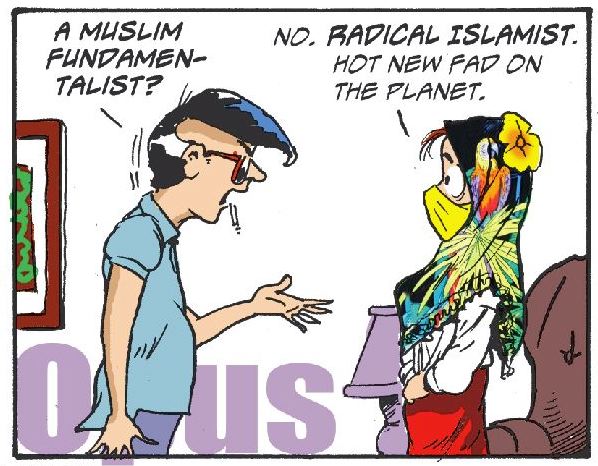
This week and last a number of newspapers, including The Washington Post, censored publication of the Sunday comic strip Opus by Berkeley Breathed.

burqini_la_grab.jpg

Why? According to Fox News, the Post was concerned about depicting a Muslim as an Islamist, and also about the sexual innuendo in the strip. (Obviously, the Post has not been reading its own strip that often.) The good news is that the Post’s stupidity now has Fox on record in opposition to censorship, but that is cold comfort from the network yet to discover irony.

The incident caught my attention because it provides another example of how the veil disturbs Western norms of public order. (Previous posts on this theme are archived under The Visual Public Sphere.) Although the Post may have been caught in a different trap, the strip itself gets its laughs from playing with what is–in the Western gaze, at least–something terribly serious. In the mind’s eye, we have a vision of radical Islam shrouding the world in theocratic darkness. In the comic strip, Lola Granola’s flower power veil is the perfect symbol of her faux counterculture fashionista spirituality, which is as stable as a butterfly and surely incapable of jihad. Perhaps the strip expresses the wish that Muslims would take their religion less seriously, although there is no doubt that just about any attitude is better than the cravenly egocentric and self-interested cynicism of Lola’s boyfriend, Steve. He, too, is too serious, and it is left to the reader to have a good laugh at how bent out of shape people can get about religion (Lola), sex (Steve), and keeping up appearances (all of us).

As it happens, another story that works a similar vein was brought to my attention this week.

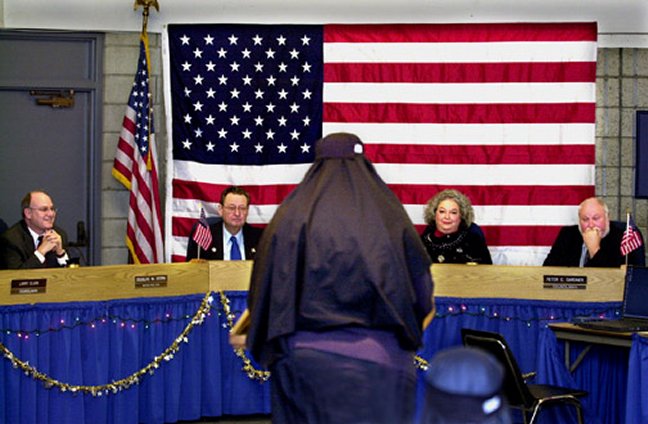
burquas-protest.jpg

You are looking at a protest at the Rancho Palos Verdes (CA) City Council. When the council selected member Doug Stern as mayor pro tem rather than member Barbara Ferraro, who had been expected to be granted the position through rotation, five women entered the meeting covered in burqas. Needless to say, it appears that this did not go over well on the council or in some quarters of the surrounding community. (Several local news reports are collected at Doug Stern’s web page. Stern is not exactly an objective source, but he’s what I’ve got.)

Once again, I think we need to lighten up a bit. If you want to, you can look at the opposed symbols of flag and burqa and see the clash of civilizations. The protest draws on that framework to imply that instead of opposing the Taliban abroad we are imitating them at home. Likewise, you can look at the contrast between the faces of the council members (including Barbara Ferraro) and the burqa-clad figure with her back to the camera, and you can see a choice between, on the one hand, Western transparency and individualism and, on the other hand, Middle Eastern illegibility and oppression. Again, the protest implies that the one has been substituted for the other. But I can’t help but see something else: Lola Granola.

My point, if I have one, is not that the demonstrators are flakes. Their detractors have already said as much, but I don’t want that kind of seriousness either. Rather, I’d like to see everyone become a bit less tense about the veil, and perhaps even a bit more open to discussion about cultural difference, and most of all, able to laugh at ourselves as we make a mess of things in our own backyard. The burqa-clad demonstrators made their point, but they are a better example of unintended silliness than democracy as it is practiced up close and personal. On the other side, the ever so conventional council members seem to make a virtue of being self-important–and, really, do they need to be backed by two flags, one of which is the size of my garage?

We don’t need either institutional censorship or small town gossip to police public expression, and we always need a laugh. Thanks to Opus, I got one twice today.

The full cartoons are here and here.


Digg!

 1 Comment