Oct 11, 2010
Mar 24, 2013
Jan 19, 2016
Dec 04, 2013
Jul 18, 2007
Oct 14, 2007

Photographer's Showcase: On The Fringe at Carnaval

6a00df351e888f883401310f94ea14970c-800wi

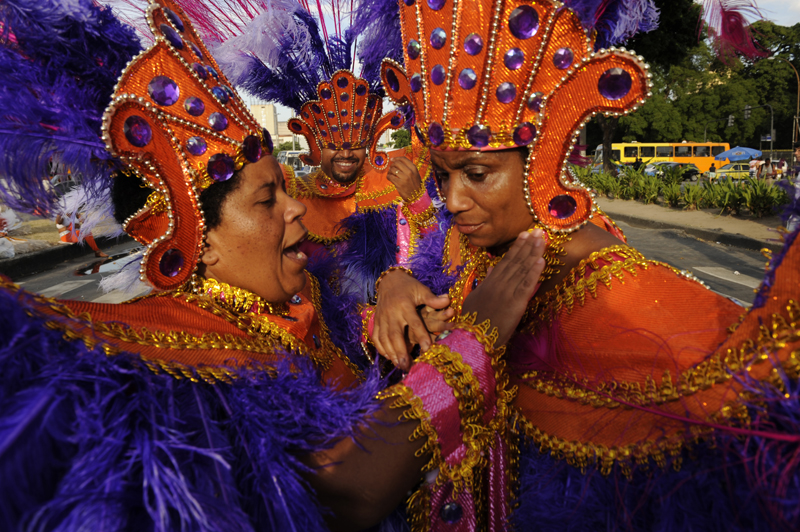
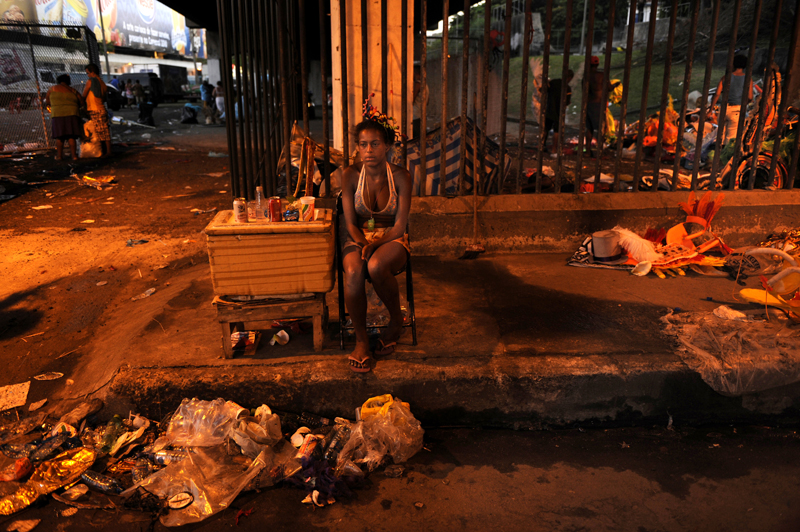
Peter Turnley, a frequent contributor at NCN, returns this week with his most recent work from the recent Carnaval in Rio de Janeiro.  The Rio Carnaval is one of the largest annual public festivals in the world, and it is not hard to find  photo slide shows that feature the colors and the “flair, charisma, spontaneity, sensuality and joy” of the event so emblematic of life in Brazil.  In this photo essay Peter turns the attention of his lenses away from the main event—the parades and dance competitions that take place in the  Sambodromo, the stadium of Samba—to the fringes of the celebration that include everything from preparation to aftermath.

6a00df351e888f883401310f9541b8970c-800wi

To view the photo essay click here.

 2 Comments

Water, the New Oil

w11_07797008

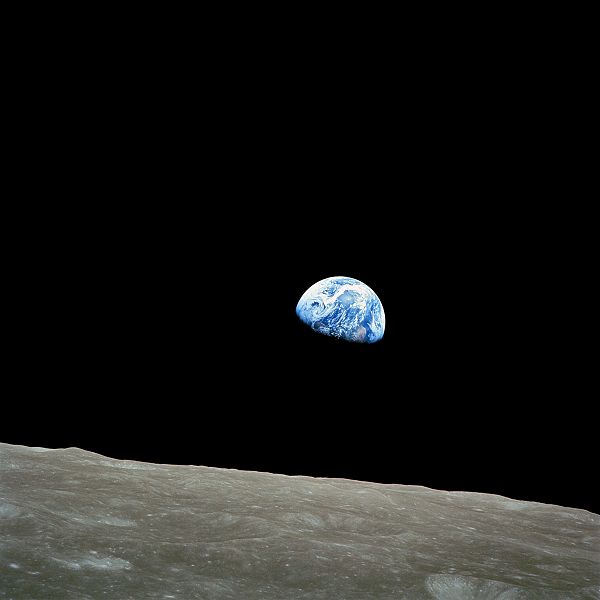
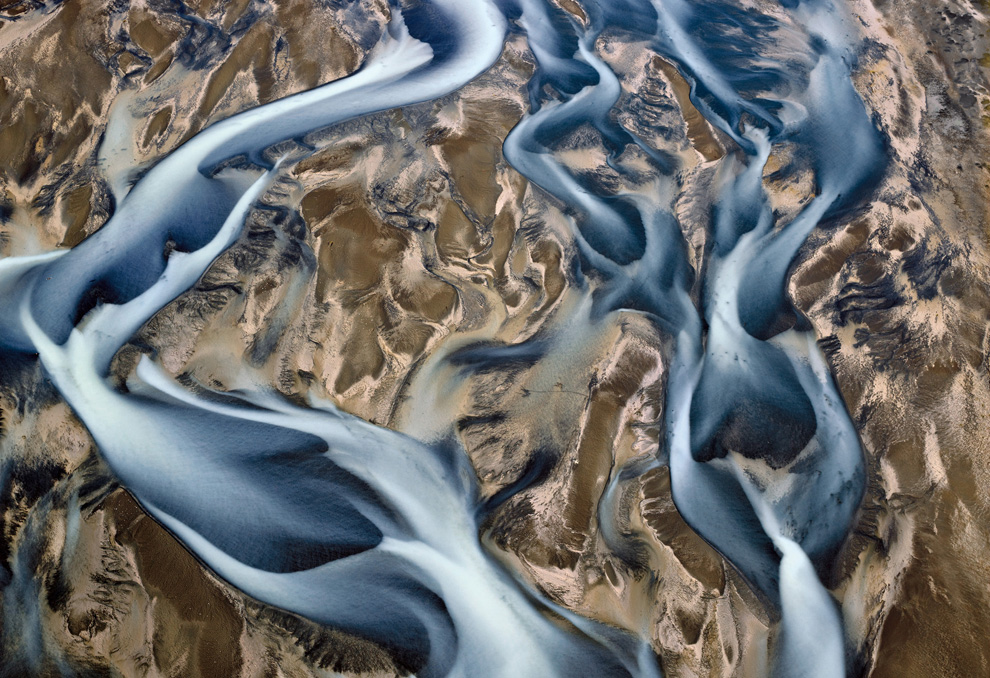
Oil, we are often told, is the lifeblood of late modern, industrialized civilization (here, here, and here) and certainly there is plenty of evidence that we behave as if we believe it.  But as the photograph of Iceland’s Kolgrima River shot from somewhere in the heavens suggests, the real lifeblood of any civilization on earth is water. I say shot from the “heavens” because it is less realistic than what might be the most recognizable photograph shot from outer space, William Ander’s iconic Earthrise, a clearly mechanically produced image that implicitly foregrounds the technology that enabled it.  Here the image has something of an abstract expressionistic quality to it that nevertheless underscores the naturalistic blending of land and waterways, a surface manifestation  of an underlying essence accented by the soft contrast of the muted pastels.  One can almost imagine the earth as a living entity, the blue veins throbbing in unison as they work to carry the nutrients necessary to bolster and sustain the ground.  It is a beautiful and compelling—almost utopian—God’s eye view.

70% of the earth is covered by water, but 97% of that is found in oceans and seas, with another 2.4% in glaciers and polar ice caps.  That leaves very little fresh water for all of its various needs, including most importantly consumption, sanitation, and agricultural production. This has not yet proven to be a disasterous situation in the United States—despite some scares as the recent drought in the southeast—where the average resident consumes 100 gallons of water a day.  But to put it in context we need to note that in some places in the world the most indigent people subsist on 5 gallons of water a day—when they can get it.  Nearly 50% of the people on earth do not have water piped into their homes, and in some developing countries women walk an average of 3.7 miles a day to get what they need.  And the most sobering fact of all is reported by the Water Resources Group (sponsored by the World Bank Group and a number of global financial, industrial, and agribusiness concerns), which notes that by 2030 water demand will exceed supply by over 50% in some developing regions of the world effecting over 1.5 billion people.

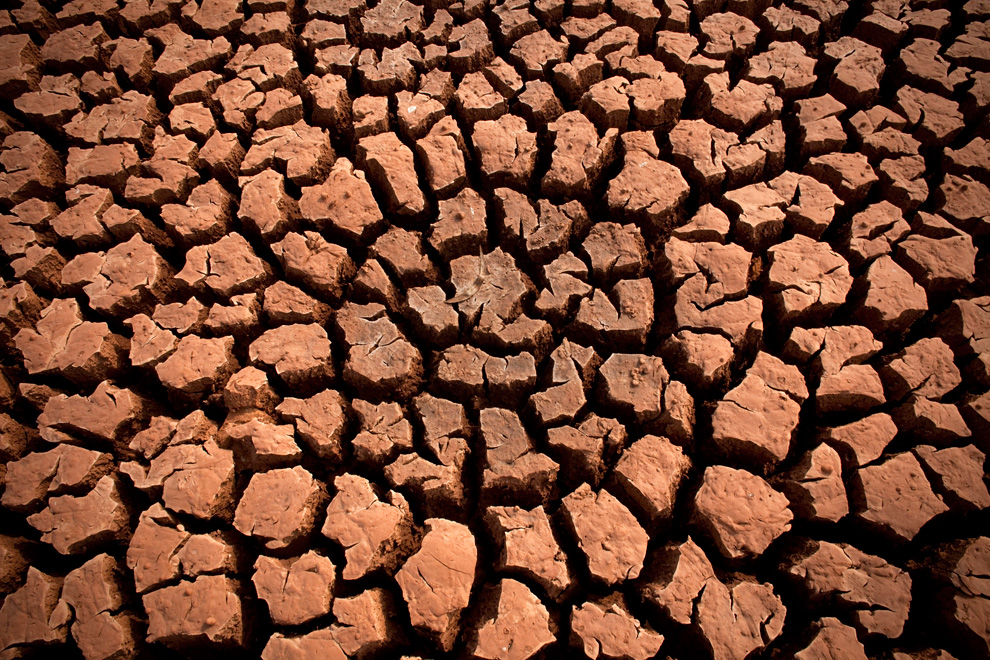
And so, to return to earth from the heavens there is this image of a reservoir in China’s Yunnan Province:
w21_22549131

The contrast between the two images could not be more stark.  Here the earth is dried and cracked, its parts broken and fragmented rather than blended.  There is nothing that approximates movement in the photograph; indeed, there are no signs of vitality at all.  One of the often claimed effects of such desertification is a dangerous reduction in biodiversity, but here it is hard to imagine any biology at all.   Of course, even the slightest accumulation of moisture might change that, resulting in a dessert oasis, but the extreme close-up of the photograph locates the image in the here and now.  It is a human’s eye view,  and it underscores the immediacy and palpable effects of the threat.

Water, not oil, it would seem, is what is most essential to life on earth.  One can only imagine what the world will be like in 2030 if we don’t come to terms with that sooner rather than later.

Photo Credits: Hans Strand/National Geographic; Ariana Lindquist/Bloomberg.  March 22, 2010 was World Water Day.  The April issue of National Geographic features the importance of water to life on earth.  We thank The Big Picture for calling our attention to the topic.

Cross-posted at BAGnewsNotes.

 0 Comments

SIght Gag: "… and the second time as farce."


Conservative-History-Americ

Credit: John Sherffius, Boulder Daily Camera

Sight Gags” is our weekly nod to the ironic and carnivalesque in a vibrant democratic public culture.  We typically will not comment beyond offering an identifying label, leaving the images to “speak” for themselves as much as possible.  Of course, we invite you to comment … and to send us images that you think capture the carnival of contemporary democratic public culture.

 0 Comments

Photographer's Showcase: Shaped By War

Shaped by War: Photographs by Don McCullin

Imperial War Museum North, Manchester, England

Screen shot 2010-03-18 at 10.42.26 PM

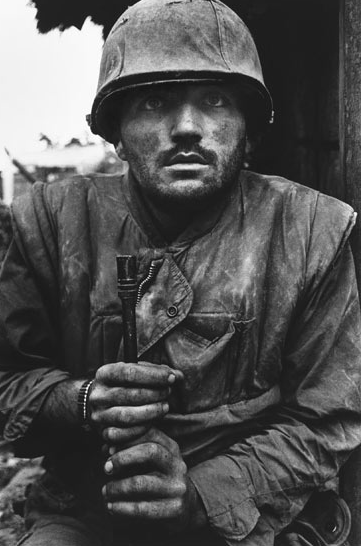
For more than 50 years, Don McCullin’s images have shaped our awareness of modern conflct and its consequences. His courage and integrity, as well as the exceptional quality of his work, are a continuing inspiration and influence worldwide.  The Imperial War Museum is collaborating with McCullin in  featuring a major exhibition of over 200 photographs, objects, magazines and personal memorabilia that shows how war has shaped the life of this exceptional photographer and those across the globe over that past five decades.  The exhibit runs in the Special Exhibitions Gallery of the Imperial War Museum North in Manchester, England, from February 6 to June 13, 2010.  It is free to the public and will travel to Bath (September to November, 2010) and London (October 2011-January 2012).  To see a slide show of McCullin’s photographs click here, to see a brief interview with him click here.

 1 Comment

"… and a little child shall lead them."

EPA

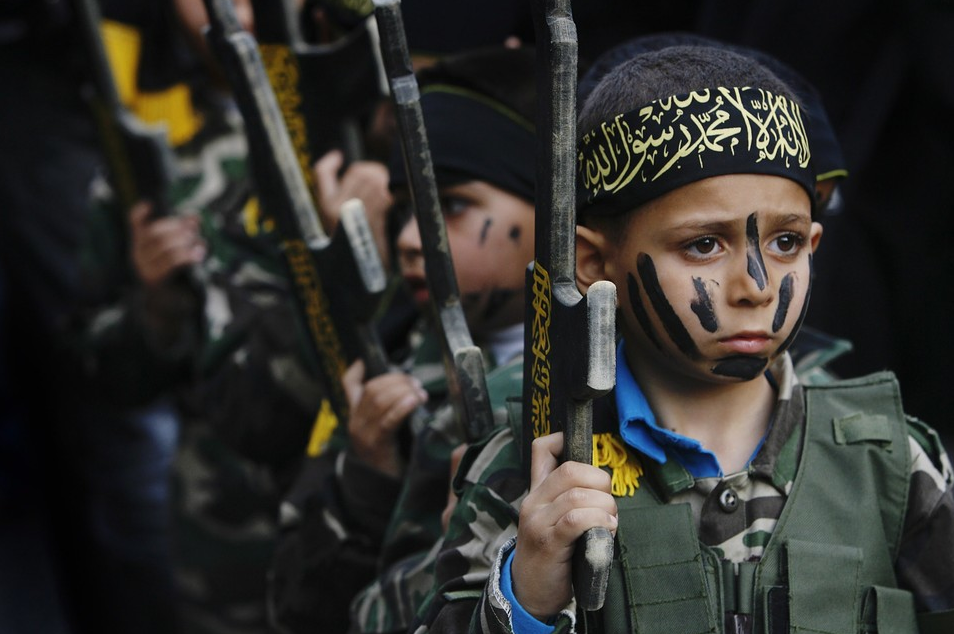
The trope of “youthful innocence” is a common photojournalistic convention, often marked by photographic representations of children playing as if they were adults.  Such images can range from the somewhat ordinary and everyday—a young girl selling lemonade to passersby for 10¢ a cup—to the extraordinary—a young boy saluting the passing caisson of his assassinated father.  But in almost every instance what we are being invited to see is a glimpse into a generational future animated by a nostalgia for the purity and  innocence of youth unencumbered by the world of experience.  And even when the world of experience insinuates itself, as with the John-John salute, the point of the photograph seems to be that what these children will become is forecast by how they manage the tension between innocence and experience.  In recent time we have been inundated with images of Middle Eastern children “playing” with guns and other weapons of war, and in this context the trope has become a harbinger of a threatening and dystopian world.

I emphasize the word “playing” in the last sentence because, as with the photograph above, the romance of youthful inexperience is transformed into a tragic mythos in which all sense of the child as behaving “as if” an adult has been obliterated, and with it, all hope that the next generation can see its way to a better or more peaceful future. The above image is of a group of “young supporters of the Islamic Jihad movement,” marching at a rally in Gaza City to show “solidarity with the Al Aqsa mosque in Jerusalem.” The toy guns and uniforms are clearly pronounced and thus underscore the potential militancy of the image, but they are not the key signifiers of the shift from romance to tragedy.  To take the full measure of force of the symbolic transformation you have to look at their facial expressions, and more specifically their eyes, which teeter between being altogether vacant and deadly serious, and in either case are wholly dissociated from our expectations of an otherwise idealized world of youthful innocence.

What clearly marks this and other such photographs from the Middle East is the presumption of their sheer otherness.  These simply could not be “our” children for they lack any and all sense of the purity or carefree joy of childhood that presumes to define the western world.  Their experience is not ours.  The conclusion is wrong, or perhaps more accurately, wrong headed, but what is important to  remember is that the idealized, romantic mythos of the relationship between worldly experience and youthful innocence is every bit as much a fiction as its tragic transformation, and that indeed, the former is ever at risk of morphing into the other.

Photo Credit: Ali Ali/EPA/WSJ

 2 Comments

Sight Gag: Texas Textbook Massacre

Screen shot 2010-03-13 at 10.39.57 PM

The thing is, it’s no joke.  To find out the bloody details, click here.

Credit: Huffington Post

Sight Gags” is our weekly nod to the ironic and carnivalesque in a vibrant democratic public culture.  We typically will not comment beyond offering an identifying label, leaving the images to “speak” for themselves as much as possible.  Of course, we invite you to comment … and to send us images that you think capture the carnival of contemporary democratic public culture.

 1 Comment

A Moment's Rest

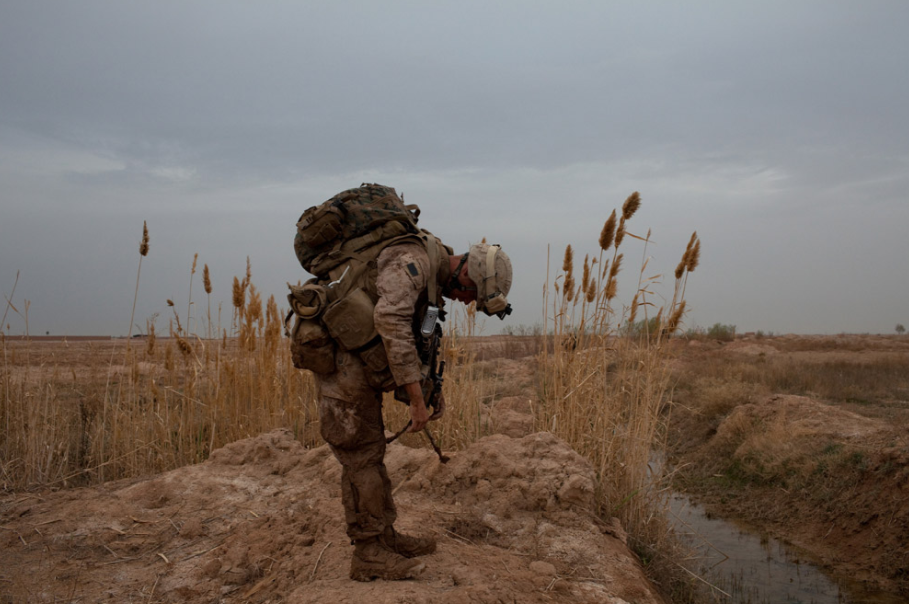
moments rest

The caption reads, “Towards the end of a two-day road-clearing mission, a marine got a moment’s rest.”  It is a reminder of war’s numbing brutality, not just as a matter of lives and limbs lost, but in terms of its impact on the human soul.  Bent double, his shoulders slumped, he appears to be exhausted by the sheer weight of his weapon and equipment, if not more so by the stressful weight of his charge to clear a road of bombs on what appears to be a road to nowhere; we might say that he is suspended in a state of rest—somewhere between standing and sitting, or perhaps in a liminal state between life and death — but we surely can’t say that he is resting.   His line of sight is directed downward.  He can see no more than the craggy ground beneath his feet—if he see’s at all.  And where he will go next is not clear as he seems literally to have come to the end of the road.  Perhaps that’s the point.

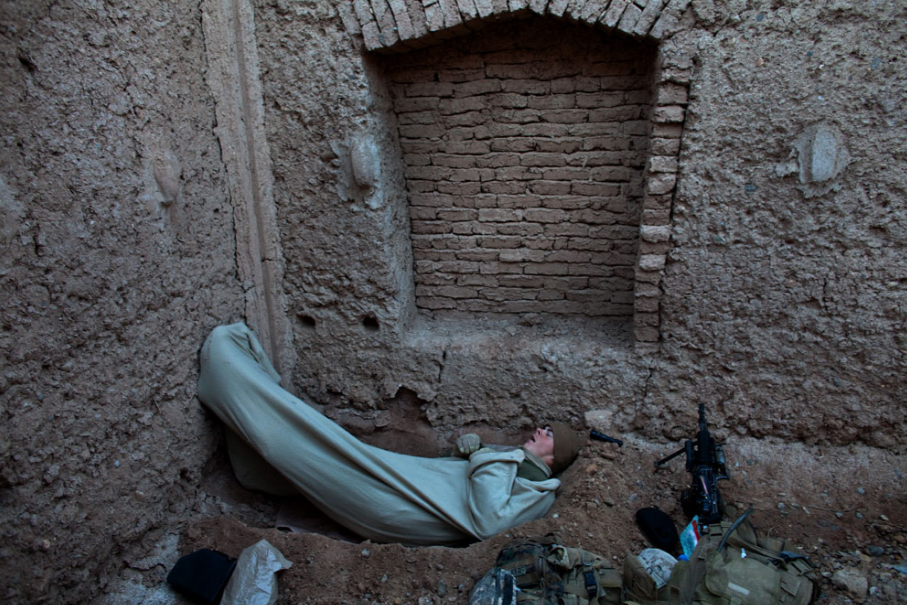
War takes its toll in many ways, not least by how it deadens the human spirit by thoroughly disrupting the ordinary routines of everyday life like eating a meal or taking a bath, or as in the picture below, getting a restful night’s sleep.

restful moment

Once again we see a soldier who is utterly exhausted, or as perhaps the photograph implies, “dead to the world.” In Greek mythology Thanatos and Hypnos – the personifications of death and sleep – were twin brothers, hardly distinguishable from one another.  And so it is here.  The scene, with its bricked-in doorway invites comparison with an ancient burial crypt, the sleeping bag calls forth images of modern war’s ubiquitous body bags, and the “bed” itself  bears resonance with a shallow grave. The awkward and rigid tilt of his legs and back implies the state of rigor mortis. His hands seem to be ceremoniously placed upon his breast, as one often finds with a funereal corpse, and the expression on his face is frozen in place.  Only the color in his cheeks resists a totalizing narrative of death.  One might confuse him with any number of images of homeless people slumbering in alleyways or under bridges—and how many of them are recognized for the veterans they are?—but for the conspicuous presence of an automatic weapon within his arm’s reach, a clear sign of his warrior status.  In all likelihood he is only half asleep—once again in a liminal state somewhere between sleep and death—ready to muster at the crack of a rifle.

War kills, and there is nothing new in recognizing that.  What we too often fail to see is that it also produces a “living death” that bears its cost in different but no less tragic terms.

Photo Credit: Tyler Hicks/NYT.

Cross-posted at BAGnewsNotes.

 0 Comments

Sight Gag: Republican Spring Training

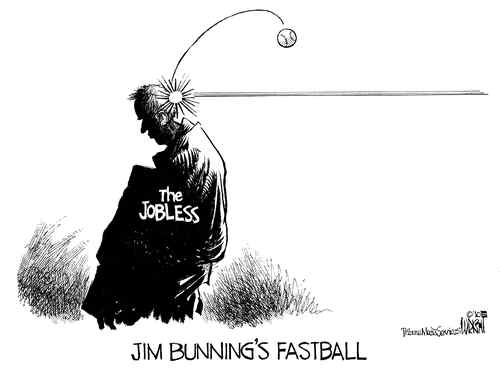
Jim Bunning American Hero

Credit:  Found at All Hat No Cattle

Sight Gags” is our weekly nod to the ironic and carnivalesque in a vibrant democratic public culture.  We typically will not comment beyond offering an identifying label, leaving the images to “speak” for themselves as much as possible.  Of course, we invite you to comment … and to send us images that you think capture the carnival of contemporary democratic public culture.

 1 Comment

Photographer's Showcase: Locked and Found

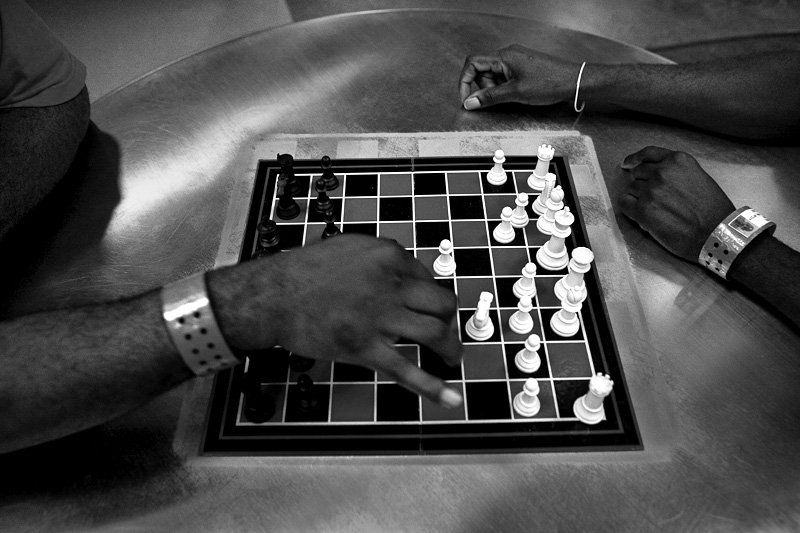
09_07_18-Take-A-Picture-103

Locked and Found” is part of Robert Gumpert’s “Take A Picture, Tell a Story” project begun while working on a short documentary concerning the closing of San Francisco’s County Jail 3, the oldest count jail in California at the time.  He had the idea of connecting photographs of inmates with whatever story they wanted to tell except for a story of an open case.  The project  began in 2006 and is regularly updated.  To see the archive of photos and to hear the stories click here or on the above photograph  of Thaddeus Stevens and Roy Westry taken in August 2009.

 1 Comment

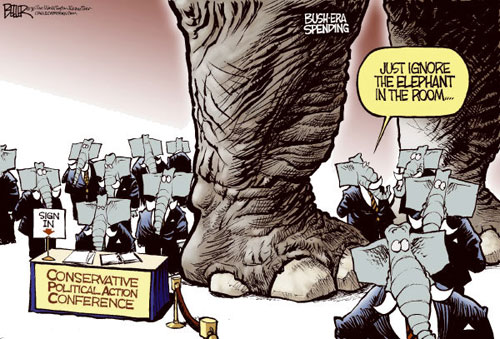
Sight Gag: The Elephant in the Room

Elephant-in-Room

Credit: Nate Beeler, Washington Examiner

Sight Gags” is our weekly nod to the ironic and carnivalesque in a vibrant democratic public culture.  We typically will not comment beyond offering an identifying label, leaving the images to “speak” for themselves as much as possible.  Of course, we invite you to comment … and to send us images that you think capture the carnival of contemporary democratic public culture.

 0 Comments