Nov 12, 2007
Mar 23, 2008
Jun 12, 2011
Feb 24, 2010
Mar 21, 2008
Mar 02, 2015

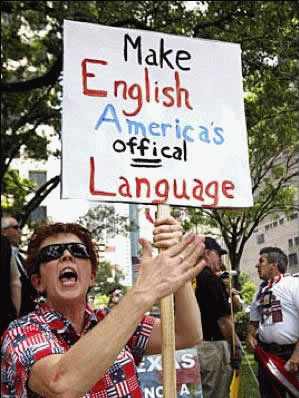
Sight Gag: English as a Second Language?

4-14-offical-sign-protester-75-20090913-51

Credit: All Hat No Cattle

“Sight Gags” is our weekly nod to the ironic and carnivalesque in a vibrant democratic public culture.  We typically will not comment beyond offering an identifying label, leaving the images to “speak” for themselves as much as possible.  Of course, we invite you to comment … and to send us images that you think capture the carnival of contemporary democratic public culture.

 6 Comments

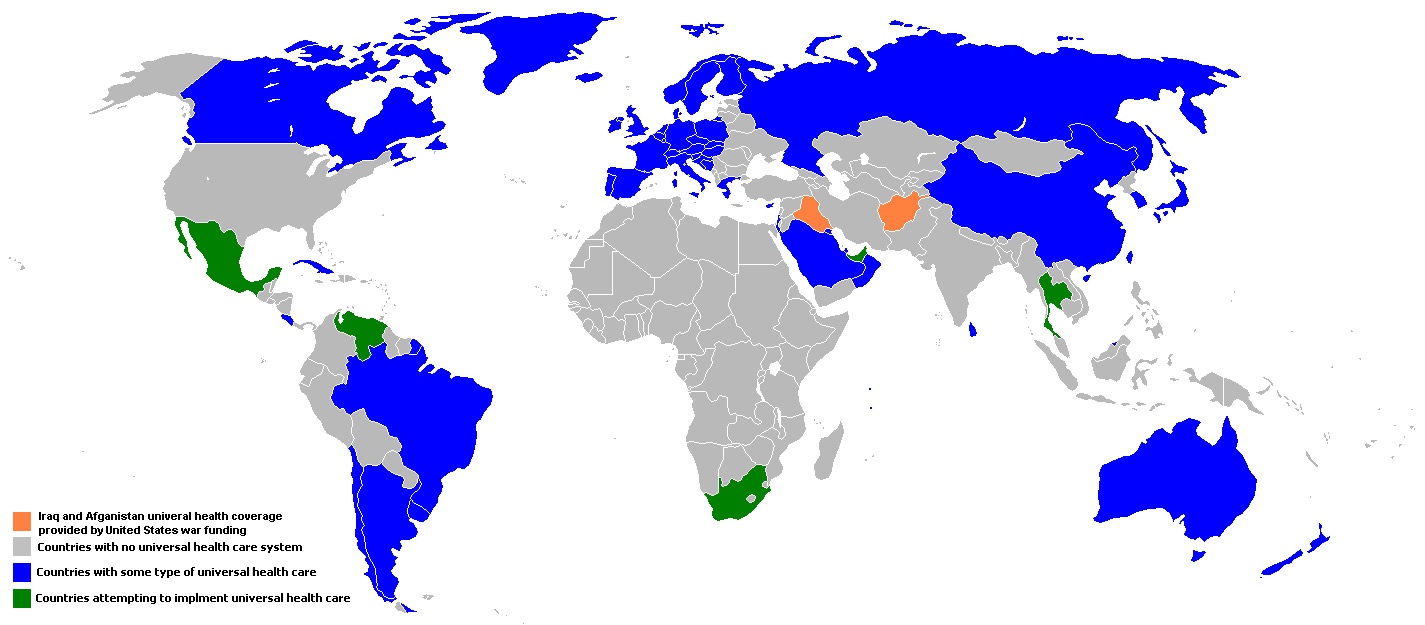
Sight Gag: Mapping the Terrain

feb_health_care

For full size and to read the legend click here.

Credit: Unanonymous (Linked from SchizoAmerica)

“Sight Gags” is our weekly nod to the ironic and carnivalesque in a vibrant democratic public culture.  We typically will not comment beyond offering an identifying label, leaving the images to “speak” for themselves as much as possible.  Of course, we invite you to comment … and to send us images that you think capture the carnival of contemporary democratic public culture.

 0 Comments

Global Reflections on a National Treasure

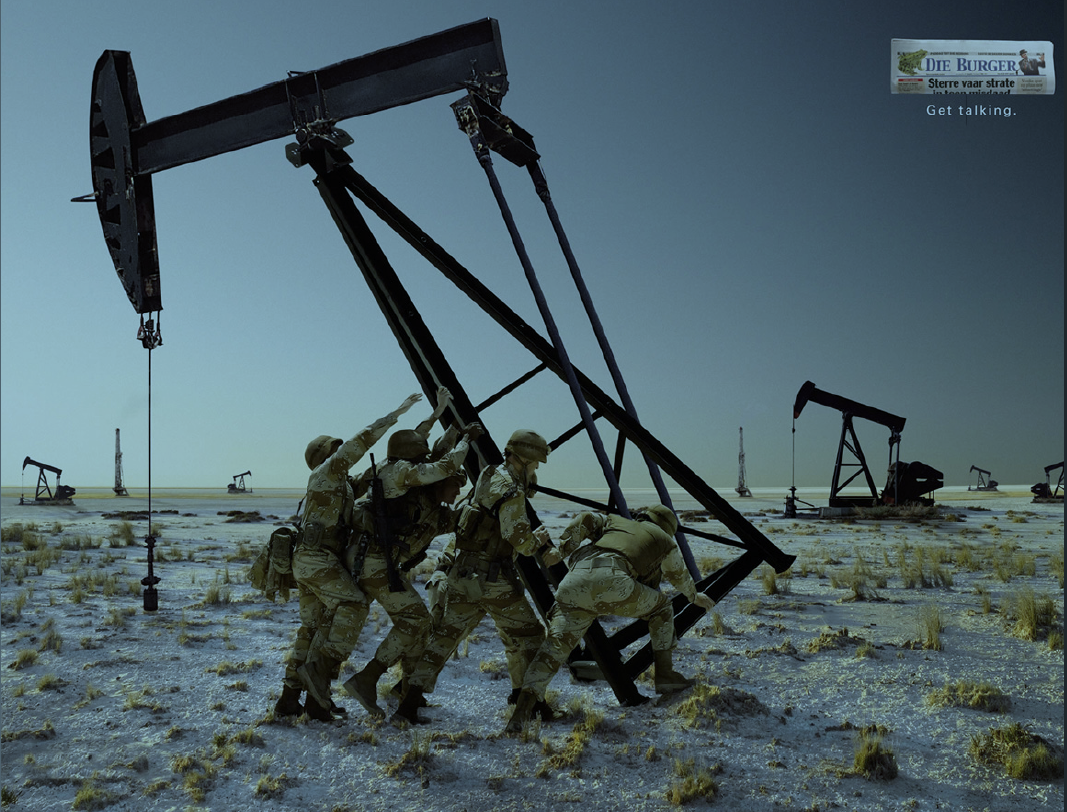
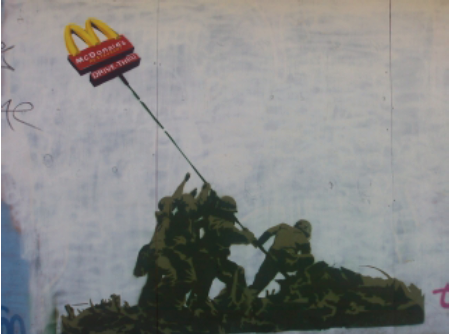
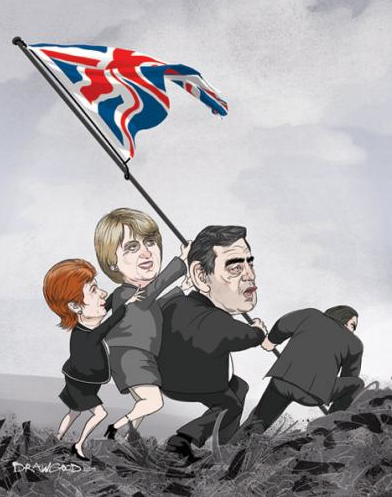
We have written here at NCN on numerous occasions about Joe Rosenthal’s iconic “Raising Old Glory on Mt. Suribachi” (here, here, here, here, here, and here).  While there is much to be said about the photograph our basic approach has been to call attention to how it operates as an eloquent inventional resource (by some accounts, a national treasure) for performing civic identity.  The power of the photograph, we maintain, is in large measure its aesthetic capacity to transcribe three related but nevertheless different (and sometimes competing) commitments to egalitarianism, nationalism, and civic republicanism.  This transcription animates an  expansive public emotionality that opens the image to to a wide array of interpretations and subsequent appropriations or usages that range from reverential civic piety to a deeply seeded public cynicism.

A month doesn’t go by that we don’t encounter new appropriations of the photograph (and we are much indebted to the many readers who direct our attention to them), and interestingly enough, increasingly many of these appropriations come from sources outside of the U.S.  Sometimes such appropriations seem to be reflecting directly on U.S. foreign policy (as with the first two images below), but in other instances the appropriation seems to speak to a more transcendent meaning that the image invokes as it appears to have little or no connection to the location of the photograph in the symbolic economy of U.S. public culture(as in the last image).  We are not entirely sure what to make out of all of this just yet and we will return to the subject of the global appropriation of U.S. iconcic photographs in a subsequent post.  But for now we leave you with three of the most interesting recent appropriations of the Iwo Jima icon and invite your reflections.

die-burger

Die Burger: Iwo Jima (FCB Advertising Agency, Cape Town, South Africa)

museumplein

Raising the Flag at Museumplein (Stedelijk Museum, Amsterdam)

iwo-britain

Raising the Flag in the U.K.

Photo Credits: Chad Henning, Zoran Koracevic, drawgood

 4 Comments

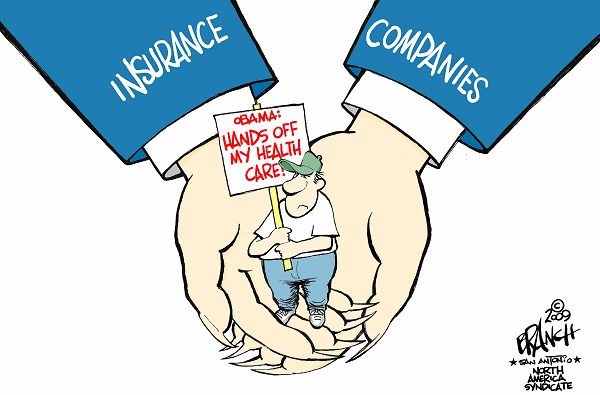
Sight Gag: You're In Good Hands …

6a00e55026407188330120a5971f1b970c-800wi

Credit: Branch, San Antonio Express

“Sight Gags” is our weekly nod to the ironic and carnivalesque in a vibrant democratic public culture.  We typically will not comment beyond offering an identifying label, leaving the images to “speak” for themselves as much as possible.  Of course, we invite you to comment … and to send us images that you think capture the carnival of contemporary democratic public culture.

 0 Comments

Bearing the Public Pall

ted-kennedy-funeral

Bearing the pall is an honored ritual in western funerary traditions according to which typically the most intimate friends and family members of the departed carry the casket that cloaks and contains the bodily remains. Until recently I thought of this as a rather instrumental ritual, activated largely by the pragmatic need to transport the body from one place to another in solemn and decorous fashion. This past spring, however, my mother passed away at the age of 83 and I came to realize the larger symbolic significance of literally touching the coffin, of making physical contact with the deceased, even if only by proxy and separated by the ritualistic container. I can’t say that I have the words to describe the actual feeling accurately, but there was something powerfully transcendent about it—almost as if I was making contact with a different plane of existence.

My experience was personal and private and I haven’t discussed it with anyone until now. Nevertheless, I was reminded of it by this photograph of Senator Edward Kennedy lying in repose at the JFK Presidential Library in Boston. The individuals kneeling at the coffin are five female family members, but in the visual tableau of the photograph they function as faceless surrogates for the thousands of anonymous members of the public who stood in line for hours just for the opportunity to pass the casket on the other side of a velvet rope and to pay their last respects to a life dedicated to national public service. The photograph underscores the solemnity of the occasion—heads bowed, hands folded, and notice how the pall is illuminated in a space otherwise shrouded by shadows cast by the backlit scene—but more than that it channels an ineffable, transcendent, affective sense of belonging that is arguably essential to communal life, animated here by decorously “touching” the coffin with our eyes.

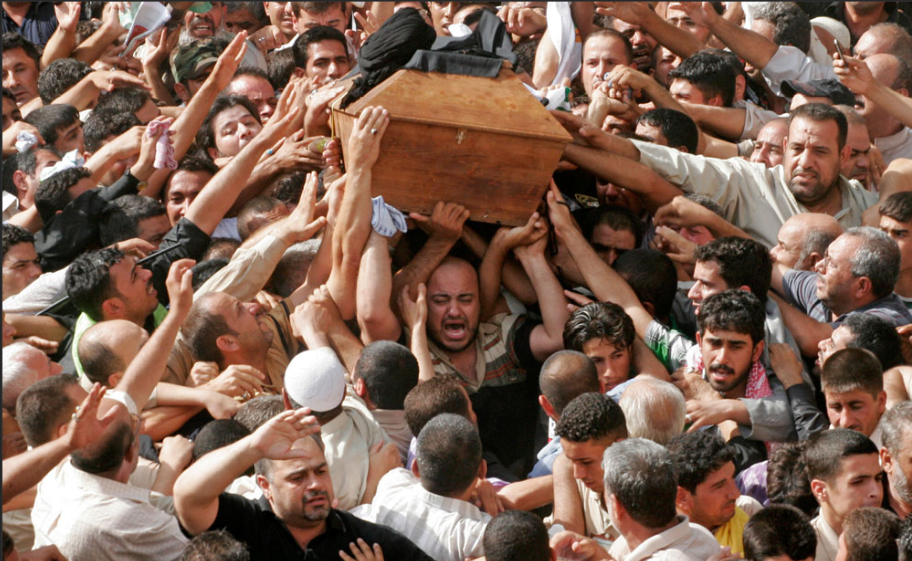
The photograph above was the first image in the NYT’sPictures of the Day” for August 25, 2009. The second picture in that slide show was of the funeral procession for Abdul Aziz al-Hakim, an influential Shiite theologian and the leader of the Islamic Supreme Council of Iraq who had died of lung cancer.
abdul-aziz-funeral

The NYT employs the two photographs to make the point that “very different” leaders—one quintessentially western, the other quintessentially eastern—were mourned in “very different ways,” contrasting the rational and decorous “solemnity of the public farewell to Senator Kennedy” as “thousands of visitors continued to line up to pay their respects,” with the unfettered “emotion of the public farewell” to Abdul Aziz al-Hakim marked by the “thousands [who] poured into the streets amid tight security.”

And indeed, the normative differences and implications of the two photographs are surely pronounced, as one displays a scene that is apparently stately and reserved, a modicum of order and restraint, while the other purports to reveal a dangerous mob “pouring into the street” and warranting “tight security.” In one image the facial markers of emotional expression are hidden from view as the faces of the individuals cannot be seen, either turned away from the camera and directing attention to the coffin or veiled by distance and dark shadows. In the other image, however, shot in the harsh light of day, facial expressions of intense emotion are prominent and pronounced, not least the man in the very center of the image who appears to be bearing much of the weight of the coffin and crying out in grief. And there are other differences as well, as one image genders the public it displays as passively female, the other aggressively male.

And yet for all of the differences what stands out most in need of comment is the profound similarity between the two photographs as each indicates a ritual of mourning predicated on making a direct, affective connection between a surviving public and its deceased leaders as a performative, transcendent marker of civic identity.  Call it “solemnity” or call it “emotion,” the simple fact is that communal life demands affective connections.  If we are going to come to terms with the profound tensions between east and west we might not find a better place to start than in acknowledging and taking  account of this radical similarity.

Photo Credits:  Damon Winters/NYT; Loay Hameed/AP

 4 Comments

Sight Gag: C-I-A! C-I-A!

cia-torture-emblem

Credit: Aislin, The Montreal Gazette, 8/29/09

“Sight Gags” is our weekly nod to the ironic and carnivalesque in a vibrant democratic public culture.  We typically will not comment beyond offering an identifying label, leaving the images to “speak” for themselves as much as possible.  Of course, we invite you to comment … and to send us images that you think capture the carnival of contemporary democratic public culture.

 1 Comment

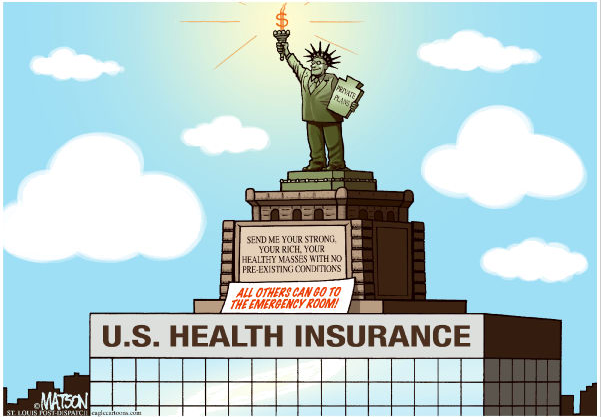
Sight Gag: The New Colossus For the 21st Century

new-colossus

Credit: R. J. Matson/St. Louis Post Dispatch

“Sight Gags” is our weekly nod to the ironic and carnivalesque in a vibrant democratic public culture.  We typically will not comment beyond offering an identifying label, leaving the images to “speak” for themselves as much as possible.  Of course, we invite you to comment … and to send us images that you think capture the carnival of contemporary democratic public culture.

 0 Comments

On The Difference Between Seeing Forests and Trees

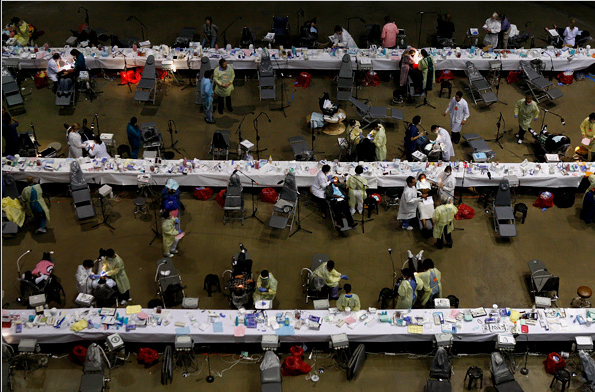
The national health care debate has received an enormous amount of attention over the past few weeks, but for the most part the focus has had less to do with the state of health care and more with the incivility of protestors. As President Obama put it, “TV loves a ruckus.” Apparently so too does the print media where most of the photographic record has featured groups of protestors and reformers holding signs and/or shouting at one another, town hall meetings seemingly out of control, and the president addressing audiences in what appears to be stump speech fashion. What we have seen very little of has been any visual evidence that might help us to reflect on the actual problem of the health care system itself.

The difficulty is figuring out how to show a systemic crisis. We can display photographs of individuals in need of some, more, or better health care, but in the very process such images typically individuate the problem in ways that minimize its magnitude (we only see one person or family at a time) and mask its bureaucratic complexities (systems, by their nature, are abstract and multifaceted processes that are rarely evident in the individual case). The photograph below wrestles with these problems.

medical-care-la

At first glance it might be hard to know what one is looking at. The photograph is shot from above and at some distance, rather like the way in which we often photograph scenes in which too close proximity to an event might put the photographer at risk of bodily harm. As we will see, the photographer’s well being is not at risk here, and so there must be some other function being served by the photographic aesthetic. The key point to note, however, is that the distance from the scene of action is accentuated by the fact that we get a fairly wide field of vision that frames the image as a landscape: it invites us to take in a wide vista, to see the whole rather than to focus on any individual part—to see the forest rather than the trees. And truth to tell, no individual is recognizable as such; indeed, in most instances it is difficult to identify even typical demographic markers as race and gender with any accuracy. There are individuals here, to be sure, but the significance of their individuality is visually minimized in the face of some larger communal or collective quality—whatever it is that they are doing or whatever it is that has brought them all together.

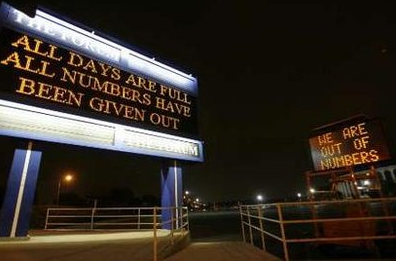
Here the photograph becomes harder to decipher. And so we need a caption to direct our attention: “Thousands Line Up for Free Health Care.” What we are looking at is not an overhead shot of a flea market or a trade show but a makeshift medical clinic set up inside of The Forum in Inglewood, California by Remote Area Medical, a nonprofit agency that provides free medical and dental care to people living in “remote” parts of the United States and throughout the world. One might not ordinarily think of Los Angeles County as “remote,” but therein lies at least one dimension of the systemic problem of health care in the U.S., for many—by some accounts the number is as high as 46 million citizens or 15% of the population—the issue of access is not a function of geographical proximity to medical care facilities but rather a function of the inability to pay for medical services. And in this instance thousands of people stood in line over night—many for more than one day—in order to “take a number” that would allow them access to medical services that their lack of health insurance would otherwise have made prohibitive. What the story fails to note is that when the numbers ran out many were simply turned away.

Much of the current debate over health care has emphasized the question of choice: will health care or health insurance reform effect the private, individual choice of medical services and practices. And no doubt this is a decisive issue for many people. But as this photograph suggests, if we step back to look at the entire health care system rather than the desires of private individuals, we might recognize that a considerable portion of the national community have no real choices at all.

Its all a matter of what we are able—or willing— to see.

Photo Credit: Ruth Fremson/New York Times

 1 Comment

Sight Gag: Diversity of Species in the Rainforest

oroverde-rainforest-foundation_thumb

For full size image click here.

Credit: Oro/Verde

“Sight Gags” is our weekly nod to the ironic and carnivalesque in a vibrant democratic public culture.  We typically will not comment beyond offering an identifying label, leaving the images to “speak” for themselves as much as possible.  Of course, we invite you to comment … and to send us images that you think capture the carnival of contemporary democratic public culture.

 1 Comment