Apr 09, 2014
Nov 05, 2012
Apr 18, 2014
Aug 17, 2007
May 13, 2012
Apr 16, 2012

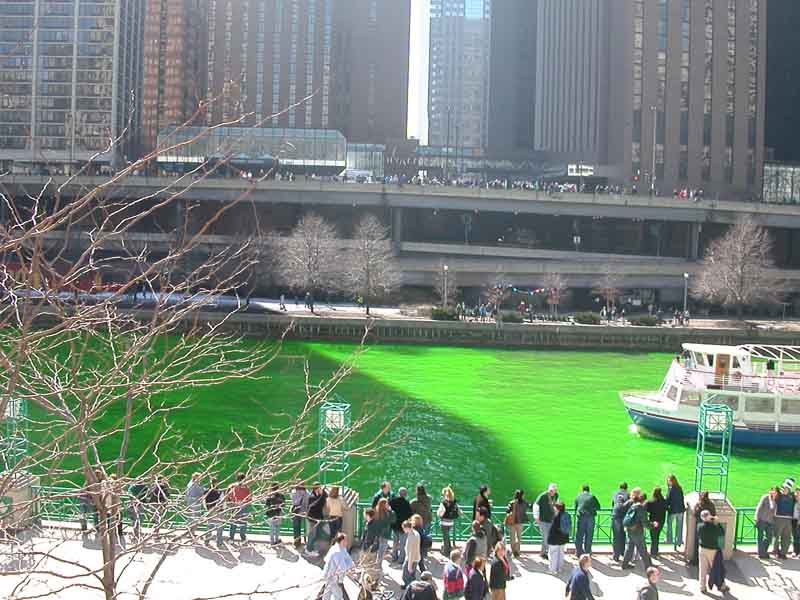
St. Patrick's Day 2008

Neither John nor I give a damn about St. Patrick’s Day, but it did seem odd that it would be moved to protect Holy Monday from contamination. Is nothing sacred?

So it is that we offer this retrospective:

chicago-river-green-1.JPG

In Chicago, they dye the river green. They do so by adding orange. Question: what + orange = green? Second question: Do we really want to know?

st-pats-beer-guy.jpg

As you can see, he has a special hat for the parade.

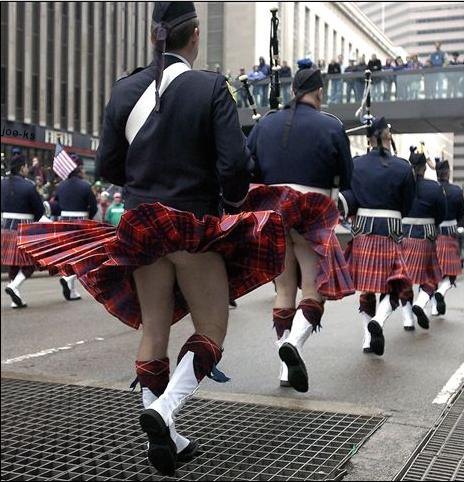
st-pats-kiltblown.jpg

OK, the Church may have a point after all.

 1 Comment

"Lost and Found" in a Baghdad Marketplace

Eight U.S. soldiers were killed in Baghdad early this week, the deadliest single day for Americans troops since the “surge” this past summer. But, of course, it would be hard to know this by reading the national newspapers. On the NYT website it barely received notice at all, cast in tiny type and posted below the bar on the home page, subordinated to the carnival of reports on the sexual peccadilloes of “Client #9,” as well as stories on efforts by the Federal Reserve to jump start the economy, and the travails of college and university soccer, track, and softball coaches who simply don’t have the resources dedicated to “revenue earning” sports like basketball and football. The story of the bombing faired only slightly better at the WP, where it was front and center on the home page, but again set in small type and subordinated to a much larger headline announcing “Coupon Cutters Help Military,” a human interest story about senior citizens at an American Legion Post who do “their part in the war on terror” by clipping coupons and sending them to military families overseas.

As for pictures of the bombings, well, nada. Nothing. A visual void. It is always hard to know how to judge the absence of evidence, visual or otherwise, but in this case it would seem that the lack of pictures is evidence of the very presence of absence; or put differently, we have become so inured to the continuing presence of the war, it has become such an ordinary, everyday event, that reports such as this don’t even rise to the level of awareness. “Eight soldiers died in Baghdad yesterday, and in basketball the Celtics beat the Bulls …”

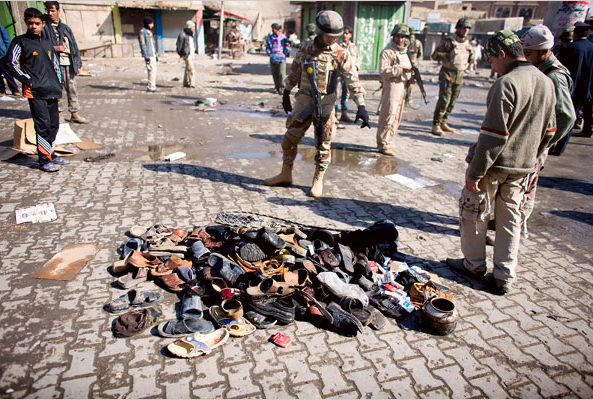
One month ago today we reported on what was then considered to be the “worst attack in months.” It was a suicide bombing in a Baghdad marketplace, not unlike the event that took place this week. No U.S. troops were killed in this earlier bombing, though 65 Iraqis died and twice that many were injured. But there were pictures of the after-effects of the attack, and perhaps we can learn something by looking at one of those photographs published at the time in a NYT slide show.

post-surge-bombing.png

It is an altogether curious image. The caption reads “Iraqi soldiers and civilians examining a pile of shoes left in Ghazil market.” That might at first seem obvious, but if you bother to trace the line of sight of just about everyone in the photograph you quickly realize that no one is actually looking at the pile; indeed, they seem to be looking almost everywhere but at the shoes. It is almost as if the shoes are hidden in plain sight—rather like news reports of the more recent bombings. And there are other oddities as well. For one, the shoes themselves are massed together as if a “lost and found” collection. The passive construction of the caption—“a pile of shoes left in Ghail market”—is telling in this regard, suggesting the image of articles of clothing either misplaced or forgotten by irresponsible school children, not the remains of the dead and injured that have been purposefully collected. For another, the scene is thinly populated, certainly not what we would expect to see in a vibrant marketplace; but note too that the people that are there are spaced in a pattern that invites a sense of complete and utter disconnection. Ironically, then, we have a public marketplace in which people are present, but any sense of the public communion essential to a productive and robust civil society is altogether absent.

In one register, then, the photograph is a visual study of the trope of presence and absence. The shoes of the people who should be populating the public space are present, but the people themselves are absent; the state (“Iraqi soldiers”) and private individuals (note the more general characterization “civilians” and not the more politically affected “citizens” ) are minimally present, but the civil society that might connect them as part of a common culture in communion with one another is absent. But more than this, the representations of presence and absence function as an allegory for the effects of war and collective violence on civil society more generally, framing the photograph itself as something of a metaphoric “lost and found box”: the visual display of a scene in which a thoroughly fragmented polity searches in vain for what for what it can never quite seem to find (or what it desperately needs), even as it implicitly harbors the hope that what is lost is safely waiting to be found hidden away somewhere.

The oft told myth, of course, is that wars unite communities in common cause—and in some ways they surely do that—but such is also a romantic notion that sublimates the larger sense in which wars tear civil society asunder, making it unrecognizable even when all of the elements seem to be in place. This is one of war’s most profound tragedies and it is often hard to see.

Photo Credit: Eros Hoagland/NYT

 1 Comment

The Olympics of the Street

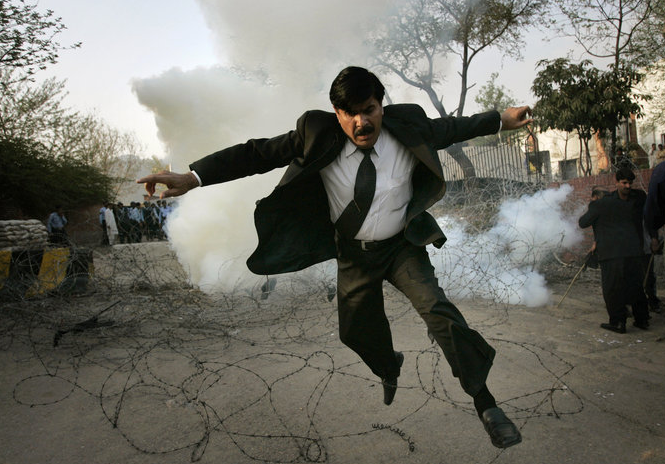
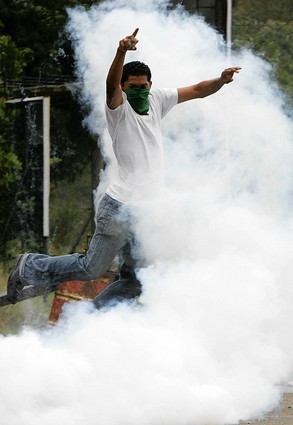
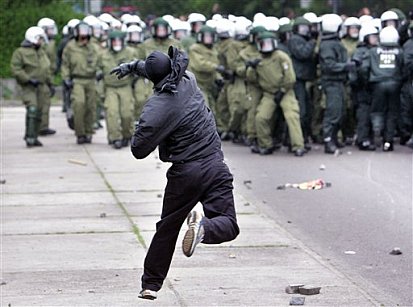
The photographs below are interchangeable with thousands of others, each of which captures something usually overlooked. I am referring to the athleticism required to get through a street demonstration that is being attacked by “police” or other military force. The image below gives one example.

paki-running.png

This guy is having to outrun tear gas through an obstacle course of barbed wire. He is hurling himself forward, full out, while staying focused on each step as he also looks ahead to shift direction yet again. He could be a halfback running through a drill at the NFL combine. But he’s too small for that, of course, and too old and not completely in control of his body. No surprise, as he is a lawyer in Pakistan. Although demonstrating much greater physical ability than he needs in his day job, he is strictly amateur.But the tear gas run is an international event, and so we can see younger and more agile competitors:

tear-gas-athlete.jpg


This is am image Whitman could love: we see a young man beautifully active. He looks like an athlete–well muscled, balanced, gracefully coordinated–and he moves through the obstacles and the gas with speed and agility while still able to direct others. In the US, he could play quarterback; he’s from Panama, however, and so settles for the Olympics of the street.

But which event to enter? Instead of the tear gas run, many are drawn to the rock throw.

rock-thrower.jpeg

Again, this photograph shows a fine athlete in top form. You can guess that he will do well in each part of the event: the run from the crowd into the dangerous open space before the troops, the throw itself, and the run to safety from the counter-attacking swarm. This particular competitor is in Germany and exhibits the superb skill we expect of the German team. At the same time, some doubt whether he can make the adjustment from contending with the relatively civil German police to the much rougher conditions of the Middle East and elsewhere.

And so we get to the injuries. As with any Olympics, success depends on both training and luck. You probably have seen photos of Olympic runners falling or crashing into hurdles and grimacing in shock and pain. It’s the same–well, worse, actually–in the street.

man-writhing.png

The caption for this photo from the West Bank states that the man on the ground was “kicked in a confrontation with Israeli soldiers.” From the look of it, the caption should have read “kicked in the groin.” It’s tough out there.

In some parts of the world, athletes gravitate to organized sports programs. From there, the best are then trained, challenged, and rewarded toward ever greater refinement of their ability. Their lives may become dominated by one thing while years of preparation can end in a career-ending injury, but there are worse problems to have. In other parts of the world, however, that talent–like so much talent–is largely undevloped. Walled into systems of domination, trapped in cycles of violence, and denied jobs, a civil society, and any prospect of a better future, they are left with the rag-tag activities of life in the street. In spite of that we can see moments of physical grace. That can be admired for a moment, and then we should recognize how much is being wasted.

Photographs by Emilio Morenatti/Associated Press; Arnulfo Franco/Associated Press; Michael Probst/Associated Press; Abbas Momani/Agence France-Presse, Getty Images.

 1 Comment

The Difference Between Water and Waterboarding

bush-water.png

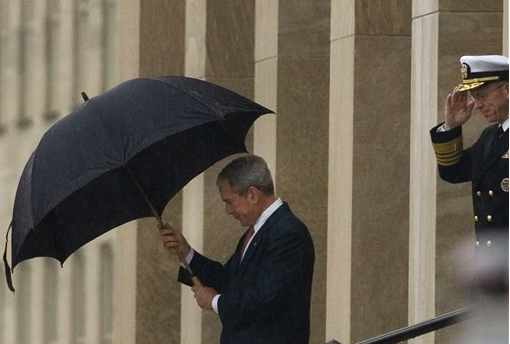
What we have here is an apparently innocuous photograph of Admiral Michael Mullen, the Chairman of the Joint Chiefs of Staff saluting President Bush as he leaves the Pentagon on Friday, March 7, 2008. It is raining–hence the umbrella–although it doesn’t seem to be coming down all that hard. But of course even the smallest amount of mist or precipitation could stain the President’s tailored suit or effect its drape; at the least it might make it somewhat uncomfortable to wear. And who needs that. The photograph was used by the WP the following day, Saturday March 8th, in conjunction with a report that President Bush had just vetoed an intelligence authorization bill that would have banned the use of “waterboarding” as a CIA interrogation technique.

The President continues to insist that waterboarding is not an act of torture—after all, Americans don’t use torture!—though it is hard to imagine how having water forced into one’s mouth, nose and sinus cavity so as to create the sensation of drowning would be anything less. And in point of fact, we have brought U.S. soldiers who have used the practice to justice before military tribunals in both the Phillipines in 1901 and in Vietnam in 1968. In 1947 Japanese officers who employed the technique against American soldiers in World War II were found guilty of the use of torture by the Tokyo War Crimes Trials and sentenced to fifteen years at hard labor.

The photograph is marked by irony, of course, but there is more. For what this photograph puts on display is the image of an administration that is habitually shielded from the world that exists outside the halls of power that here surround and protect it, as well as from the effects that its actions have in that world. Torture may “work” in the fictional universe of TV shows like 24, or in the sadistic imaginations of neoconservative chicken hawks, but elsewhere its record of usage is a consistent and abysmal failure in every regard except as a profound violation of human rights.

But don’t expect the President to understand that. For him, unwanted water is an inconvenience. For the American people it is has become an element of shame.

Photo Credit: Haraz N. Ghanbari/AP

 1 Comment

Photographers Showcase: Whiskey, Tango, Foxtrot

This week’s showcase photographer is Ashley Gilbertson. He will need no introduction for many NCN readers. Gilbertson is an internationally recognized photojournalist whose work has appeared in Time, Newsweek, and the NYT and many other national and international publication outlets as well. Deeply concerned with the problem of social conflict he has photographed everything from Kosovar refugees to heroin addicts in Melbourne to the gun trade in Papua to the accelerated disappearance and destruction of the Uyghur culture to Aids patients in China. In 2004 he won the prestigious Robert Capa Award for his work in Fallujah and was also named the National Photographer of the Year.

Gilbertson is perhaps best known for his recent work on the American experience in Iraq and his 2007 book of photographs and reflections titled Whiskey Tango Foxtrot: A Photographer’s Chronicle of the Iraq War. We are very pleased to showcase a small bit of that work here at NCN.

Click on the photograph below for a brief Quicktime movie slide show of Ashley Gilberson’s work from Iraq.

salmanpak_22.jpg

 0 Comments

Who's Afraid of Pink and Blue?

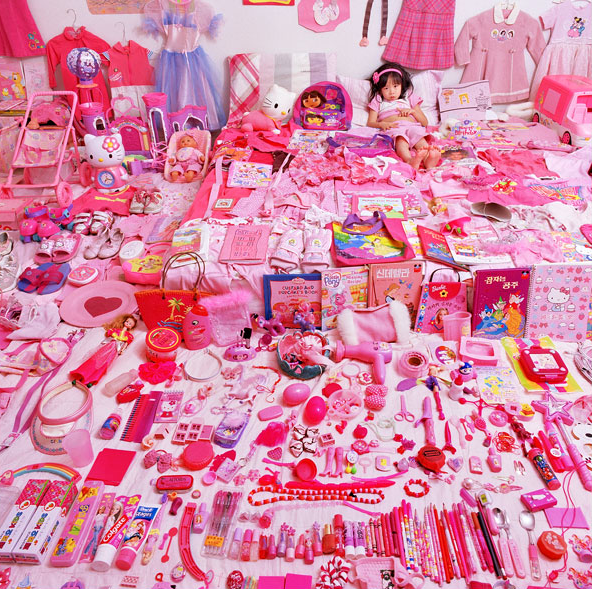
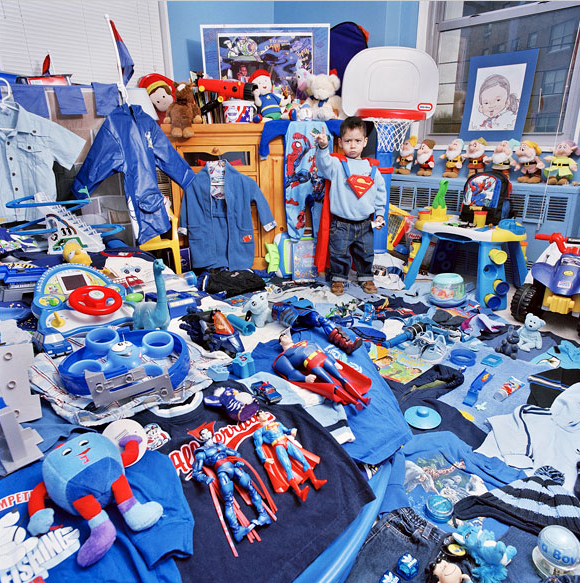
In the late 1940s and throughout the next decade Life magazine would regularly put private individuals and and their nuclear families on display with their accumulated property: consumer goods. One of many visual convention for doing this was to have the family surrounded by their prized possessions, collected en masse and organized in a careful and orderly fashion, a visual metaphor perhaps for their ordered and conformist lives (and much more as well).

I was reminded of this visual trope when I came across a NYT slide show reporting on “The Pink and Blue Project,” a photographic installation by JeongMee Yoon that will soon be on display in Chelsea at Manhattan’s Jenkins Johnson Gallery.

pink-1.png

blue-1.png

One is struck immediately by the sheer mass of consumer goods accumulated “by” five year old children – consumers in training – but it is the stereotypical and gendered color schemes which appear to convert the images into something bordering on a spectacle. The title for the slide show announces a “Wonderful World of Color” – a phrase that no doubt resonates for those of us old enough to remember watching “Disney’s Wonderful World of Color” on Sunday evenings in the late 1950s and early 1960s – and it would seem to be the coordinated concentration of bright color that animates the author of the accompanying article, Bonnie Yochelson, to note that the project delights “the eye” while “coercing a smile.” Color, it would seem, trumps gender segregation and “compulsive shopping.” And while the smile she remarks upon is “coerced,” it is nevertheless an approving smile.

What Yochelson misses is the way in which the “wonderful world of color” diverts our attention from an even more pronounced (and arguably troubling) element of the spectacle: not simply the sheer mass of similarly colored consumer goods, or even the ways in which color simultaneously marks and masks a narrow and conventional set of gender stereotypes, but the way in which everything within the scene is carefully ordered and organized, literally schematized as if by a structural anthropologist. Like the convention from Life that it seems to mimic, the project thus becomes something of a cipher for the underlying assumptions of bourgeois life, and not least the commitment to a rigid sense of order and regimentation disciplined by cultural demands for the accumulation and conspicuous display of wealth and possession. And in this context it should be noted that one has to look to pick the children out amidst the exhibit of consumer goods, a sure sign that like everything else in the hyper-ordered scene, they too are possessions; and like the glittering commercial trinkets that “coerce” our smile, they are put on public display by and for the benefit of cultural and economic interests that exceed their easy control.

In some ways we have not come far from Life’s America of the 1950s and 60s.

Photo Credit: JeeongMee More

 1 Comment

Late Modern Pickled Punk

Perhaps the most controversial of carnival exhibits in the late nineteenth- and early twentieth-century was known in the argot of the freak show as “pickled punk,” the preservation and display of fetuses, usually with some pronounced and spectacular deformity. Such displays titillated a curiosity for “knowledge” of the abnormal and bizarre, but like carnival freak shows in general, the practice largely died out in the 1940s with advances in medical knowledge that offered scientific explanations for the freaks, as well as a shift in public attitudes about the propriety of putting such oddities and anomalies on public display. Pickled punk saw a revival in the U.S. in the 1950s and 60s, but was soon outlawed in many states.

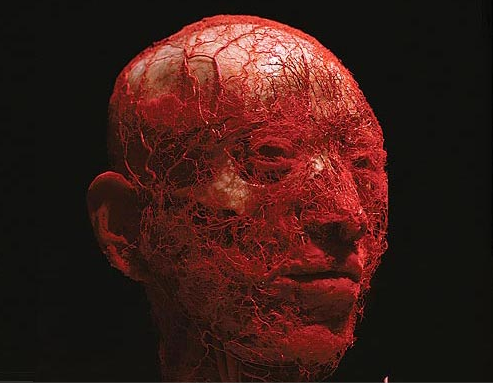
I was reminded of the history of the freak show, and of pickled punks in particular, when I saw this photograph, the first image in the recent reprise of a 2005 slide show at the Chicago Tribune :

ctred.png

What you are looking at is the vascular system of a human head that is on display as part of a traveling exhibit at the Museum of Science and Industry titled “Body Worlds.” “Body Worlds” is one of a number of different shows which exhibit human bodies that have been flayed, vivisected and “plastinated.” Plastination is a chemical process that removes waters and fats from a dead body, replacing them with reactive polymers that deny bacteria the nutrition they need to effect decomposition. “Body Worlds” exhibits have been shown throughout the United States and Europe in recent years and with the avowed purpose “to educate the public about the inner workings of the human body and [to] show the effects of poor health, good health and lifestyle choices.”

There is surely need for great scientific literacy in the United States, but one has to wonder if what animates these shows is really an interest in knowledge or a perverse desire to encounter the macabre. I’ve not yet attended one of these shows, but I have talked with several who have and they report that the displays include everything from plastinated body organs (often deformed or diseased) to a wide array of  human bodies performing a full range of activities that include kneeling, smoking a cigarette, dribbling a basketball, shooting an arrow, sitting at a table while playing poker or chess, emulating Rodin’s “The Thinker,” and so on. And with the exception of the “The Smoker,” whose blackened lungs stand as a warning against the use of tobacco, there seems to be very little display or discussion of knowledge about human anatomy that would otherwise be hard to come by, though there is a great deal of attention to the technology of plastination, as well as praise and celebration of its inventor, scientist-artist Gunther von Hagen, who comes across in many ways as a contemporary P.T. Barnum.

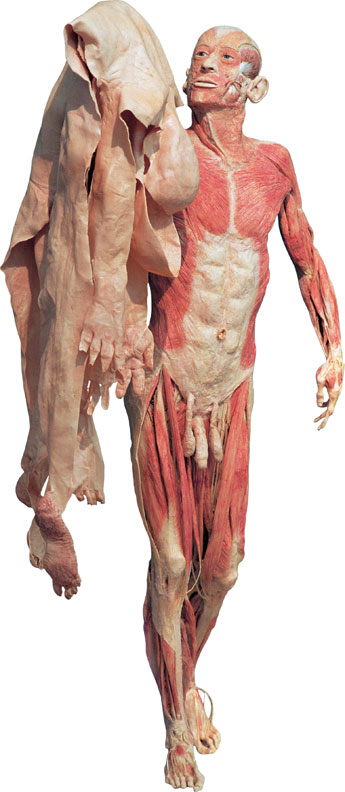
Knowledge or entertainment? What’s the big deal? And why shouldn’t the mass dissemination of knowledge be entertaining? It is, of course, hard to know quite where to begin here, but one thing that clearly gets lost in all of this is that we are looking at flayed and vivisected corpses that at one time housed living and breathing human beings, their nameless bodies thoroughly objectified and put on display for our visual consumption. Questions have been raised recently about where the bodies actually come from, but there is another point to be made, for it is hard to imagine how these displays are designed more to prime or sate our thirst for knowledge—or to inure us to the dead or decaying body as part of an avant-garde intervention against bourgeois taboos—than to titillate our desire for macabre spectacle. Indeed, in a slightly different register we might actually call it pornography. How else can we explain the reported “fascination“ with images like that of “The Skin Man“ holding out his own outer shell for our examination (and edification)?

1152653010.jpg

In its own way it would seem to be a late modern form of pickled punk.

Photo Credits: E. Jason Wamsgans/Tribune; Gunther von Hagens/Body World

 10 Comments

The Joy of Voting

Every year or so at election time we are reminded of how apathetic American voters are by one or another group that calls attention to the low U.S. voter turnout in comparison to other countries. The antidote to this condition is to be “rational,” for voting, we are told, is the rational thing to do: every vote can make a difference, by voting you have a voice in the political, use it or lose it, and so on. The problem, of course, is that no matter how rational it is to be rational, few of us live our lives exclusively by the standards of such a calculus (even when we can figure out what the rational thing to do is!). The question then, perhaps, is not why do so few people vote, but in fact why do so many actually choose to go to the polls?

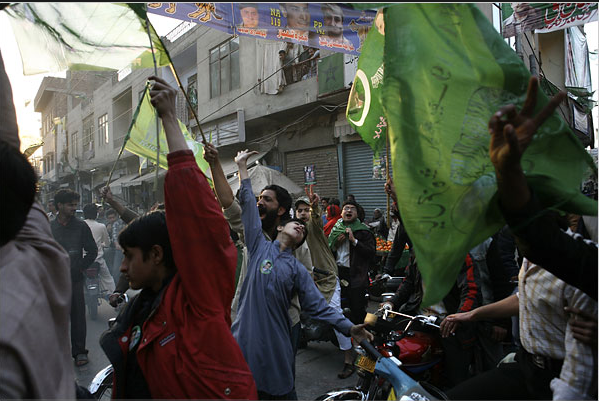
One possibility, of course, is that voting is altogether irrational, contrary to one’s best interests according to a carefully calculated cost-benefit analysis. A different answer is suggested in this photograph that appeared in the NYT this past week following the parliamentary elections in Pakistan.

p-election.png

Voting in this election might have been the rational thing to do, although the caption points out that those going to these polls did so “fearful of violence,” but what the photograph features is a moment of unfettered, collective joy and celebration. The figure dancing in the middle is a cipher of almost pure affect, channeling the emotion that courses up and down the street. This election is about more than aggregating personal preferences: in the process citizens have become part of something that is larger than individual self-consciousness. The joy of voting here is an almost transcendent act; it is not inconsistent with a rational appeal to aggregate one’s votes and thus gain the power of numbers, but it is clearly more than that—a ritual of social life and collective being.

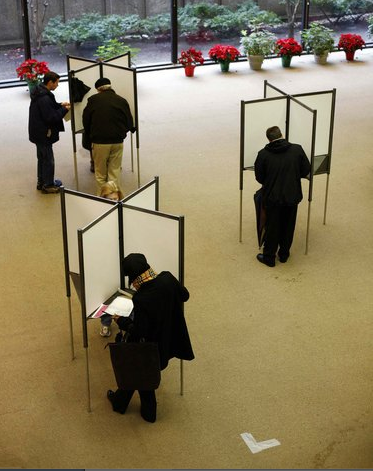
In the U.S., of course, we worry a good deal about the influence of such demonstrations of public affect on the voting process. And so while political campaigns themselves seem to be acceptable occasions for public spectacles, parades, and overt displays of collective emotionality, voting itself is rendered as an individual and isolated moment of private reflection. This photograph from this past week’s Washington Post is typical of how the voting process is ritualistically represented by the mainstream media:

individual-voting.png

Nameless and faceless individuals visually and physically segregate themselves from the influences of the public as they register their voice and opinion guided by nothing by conscience—and, presumably, rationally calculated private interest. Indeed, there are no signs of the public whatsoever, a point underscored by the high angle and long distance of the image that would ordinarily contextualize the setting in a public space, but here only emphasizes the stark, drab, emptiness of the room which could be anywhere—and nowhere.  Note too how the image highlights the fragmentation and separation of private individuals. What the picture shows us then is a scene that symbolically underwrites the autonomous individuality featured in contemporary liberal-democracy, and one that mutes the affect or joy that goes along with being members of a community of strangers. Good reasons aside, it is little wonder so many people choose not to vote.

Photo Credits: Tyler Hicks/NYT; Shannon Stapleton/Reuters

 3 Comments

The Neo-Con Nightmare: Hope

The latest theme among the punditry–and once again, one serving conservative interests–is that Barack Obama is a silver-tongued, spell-binding, mesmerizing, messianic orator whose powerful rhetoric is creating a cult of personality. (They really are saying this.) Charles Krauthammer is the latest to weigh in, although largely to summarize his colleagues’ profound insights. One might think it would be an understandable response if the current president had been a model policy-maker, but that obviously is not the case. And it wasn’t that long ago when conservatives were telling us that Ronald Reagan ought to be celebrated for how he made us believe, after the doldrums of the Carter years, that it was “Morning in America.” That message of hope has been conveniently forgotten, it seems. So what’s up?

The convention of capable writers attacking eloquent speakers goes all the way back to Plato. In brief, the cautionary note against demagoguery is an important warning in any democracy, but one often used on behalf of oligarchic interests. And there are two very important considerations: whether the charge is correct in the particular case, and what the alternative is. Furthermore, it can be difficult for some people to tell the difference between bombast and eloquence, and the alternative often gets a pass as one assumes that other speakers with different styles are somehow more substantive, or those with less ability are nonetheless adequately effective.

But those are not the problems we have at the moment. No, the problem is that the currently regnant ideological regime has acquired enormous power, influence, and wealth through the politics of fear. No wonder they now are afraid. Obama isn’t just an orator, but his oratory has done something far more important than enchant his audiences. He has given voice to a new, rightly hopeful America that already exists. If you want to see them, take a look:

obama-vibe.png

These are faces in a crowd that was listening to Obama last month in South Carolina. I liked this photograph the moment I saw it. That response is cued by the smiles in the center of the frame, but by more as well. To the extent that faces can tell the story, these people aren’t just watching, they are listening and responding, and actively so. They are not being snowed but rather attending intelligently and liking what they hear. They are in a good mood because they are responding in kind to a speaker who respects them enough to appeal to their intelligence and their belief in a good society. They are neither stupid nor poor, nor vulnerable to a demagogue because of that. But that is not the whole of it.

The profound beauty captured in this photograph is that they are comfortable with one another. Black and white, young and middle-aged, Southerners all, they are pressed together and yet each is completely at ease. The good vibe comes not from seeing Obama’s luster reflected in their faces, but from who they already are individually and together. This is the America that has been emerging, however fitfully, in that last twenty years. This is the America that wants to hope and deserves a president who can recognize and respect and strive for all that hope represents.

The Krauthammer column appeared in the Chicago Tribune on Presidents Day. The Republican claim to be the “party of Lincoln” became ever more strained with the the continuation of Nixon’s “Southern strategy” throughout the Karl Rove era. Now it appears that it was not enough to abandon Lincoln’s vision of America; his eloquence has to be rejected as well. But let us not forget the challenge he has set before us forever. Politics may not be able to escape vicious partisanship, but it should not succumb to it, and the highest calling of the political leader is to bring people to respond to their common problems by drawing on what is good and true within each of us. As Lincoln knew:

“I am loath to close. We are not enemies, but friends. We must not be enemies. Though passion may have strained it must not break our bonds of affection. The mystic chords of memory, stretching from every battlefield and patriot grave to every living heart and hearthstone all over this broad land, will yet swell the chorus of the Union, when again touched, as surely they will be, by the better angels of our nature.”

Photograph by Jim Wilson/New York Times. You can read all of Lincoln’s First Inaugural Address here.

 6 Comments

Madonna and the Santa Clones at the Dog Show

Question: is an icon one or many? On the one hand, an icon is supposed to be unique, representing the singular achievement, the ne plus ultra of a field of human endeavor. Michael Jordan is an icon, not Scottie Pippen or many other top-tier players. Babe Ruth, not Hank Aaron or Sammy Steroid. Einstein and Picasso, not Bohr and Braque. The Mona Lisa, not . . . Well, that gets to the other hand, which is that the icon is iconic because it is widely distributed, something that may have become distinctive through constant reproduction regardless of individual merit. Thus, the icon appears to be both singular and the latest iteration of a series, both unique and the characteristic instance of a type. Nobody understands this better than Madonna:

madona.png

Here she is posing with actress Holly Weston at a publicity shoot for their movie “Filth and Wisdom.” The combination of title and double image invites snide remarks, but that’s taking the cheap bait. I like the photo because of how it captures Madonna’s genius for making herself heir to all the blondes produced by the Hollywood dream factory. We have realized since Warhol’s Marilyn series that the blonde du jour is performing a type, but Madonna makes that a virtue rather than a dirty little secret.

This photograph captures the visual iteration beautifully. Madonna is in focus and set forward at the head of a series. The younger woman is somewhat fuzzy, as if still in the process of formation. They seem to be perfectly sequenced in space and time, the one rightly receiving the spotlight that eventually will be on her successor. Above all, each is one of a series that can extend indefinitely–and will, as all that is required is processes of reproduction that obviously are well in place. Image, publicity, bone structure are all a sure thing. The “mechanical reproduction” of the camera replicates the culture machine and genetic mechanism alike.

According to Walter Benjamin, mechanical reproduction destroyed the “aura” of the individual work of art as well as its relationship to tradition. Absent this anchoring in “ritual,” artistic production becomes politicized. For all his brilliance, Benjamin’s observations can get in the way of understanding how culture depends on constant iteration of visual forms. To see this, one might shift from fine art to vernacular practices and pagan rituals, like this one:
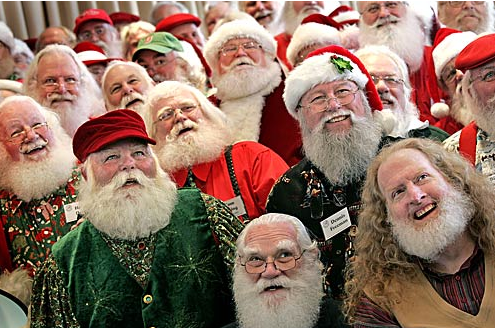
santa-clones.png

You are looking at a photo from this year’s annual convention of the Amalgamated Order of Real Bearded Santas. If there is a rival organization of Fake Bearded Santas, I haven’t heard of it. This group meets every year in Southern California, which no doubt it just the place for letting your hair down after the Christmas rush.

I get a kick out of this image for several reasons. Their easy association with ritual is mirrored in their behavior for the camera, where they all lean together and smile on cue for the group snapshot. The photographer may have asked for a big “Ho Ho,” but they probably smile easily. We also can smile at the few outliers in the group: the Lord of the Rings afficiando in the front right, and the wary ball cap guy in the left rear. The real comic effect, however, comes from the photo being a study in duplication. Santa Claus should be a single, iconic figure, and he is–but only because there are Santa Clones in every department store in the country.

And so we get to the dog show. To get some distance from Benjamin’s anxiety about the mass media, we might consider how it is that humans are continually reproducing images of visual iteration. Like this:
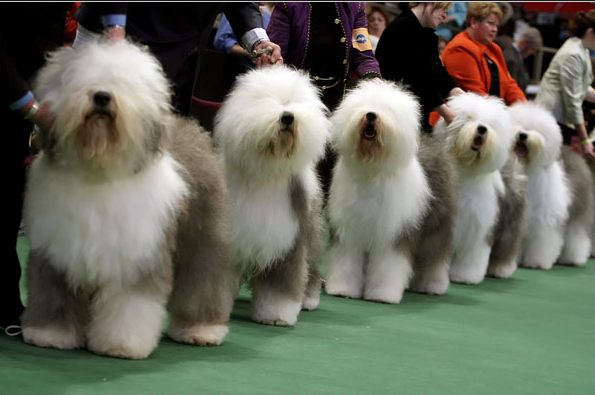
dog-line-sheepdogs.png

These are Old English Sheepdogs lined up for judging at the Westminster Dog Show. I won’t doubt that each of these dogs are individuals, but the photograph highlights their species identity and regimented styling. The most distinctive Old English Sheepdog will be the perfect iteration of the type, which stands behind that dog in a long series issuing from the twined processes of nature and culture.

Despite the attempt by these photographs to put a good face and good vibe on cloning, I’ll bet that the anxiety about mechanical reproduction remains. Celebrity culture, vernacular culture, subculture, all are exercises in the reproduction of the same. Cloning isn’t something that emerges unbidden from modern technology, but rather one more instantiation of something humans do all the time. If you don’t like it, there still is reason to blame the camera, which is both an apparatus of reproduction and a means for naturalizing cloning. But I wouldn’t, for these images and others offer more than apparatus and ideology. They are how we see ourselves as we are, seriatim.

Photographs by Markus Schreiber/Associated Press, Karen Tapia Andersen/Los Angeles Times, and Timothy A. Clary/Agence France-Presse/Getty Images.

 4 Comments