Nov 21, 2007
Feb 08, 2012
Aug 24, 2007
Apr 27, 2009
Feb 24, 2013
Aug 21, 2013

"… the conquest of the world as a picture."*

The recent G-20 meetings were the occasion for thousands of anarchists, and anti-capitalist, anti-war, and pro-environmentalist protestors to converge upon London, as has become something of a ritual for such international events.  No one seems to know exactly how many protesters there really were, though various media reports range from 20,000 to 35,000.  The Guardian reported that 5,000 police were deployed for the event, most of them in the financial district.  By conservative estimates, then, the ratio of police to protesters was somewhere between 1:4 and 1:7.  Protesters, of course, are meant to be seen, why else show up!  And most of the pictures reported by the mainstream media obliged by toggling back and forth between images of the carnivalesque and the clash between protesters and police, often resulting in dramatic images of bloody violence.

We can find all of this at the Boston Globe’s “Big Picture” website, but we find there as well an additional set of photographs that points to a different and more interesting phenomenon: images that accent what Ariella Azoullay refers to as the “civil contract of photography.” The citizenship of photography that she calls attention to is animated by the logic of photography—an agreement as to the relationship between the photograph and “what has been” or what might be in the image—and the ways in which it functions as a mechanism of social interaction (and control).
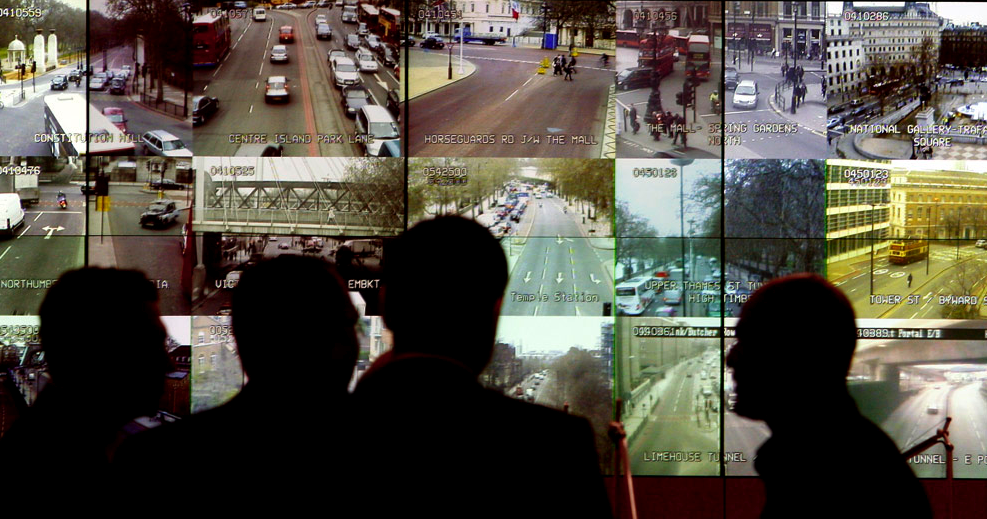
The scene above is a wall of CCTV screens in a command and control center in London from which the police can monitor live security feeds of “prominent areas” of the city.  It has an Orwellian quality to it, to be sure—Big Brother is watching—not least because the heads viewing the scene are back lit and thus cast in dark and foreboding shadows that provide a stark contrast with the daylight of the screens. As such, the image directs attention to its own technology, and thus the visual grammar that animates it; in short, what we are looking at is itself a photograph—a visual representation of the command and control center once removed—that relies upon the logic of photography as it displays a site for interpretive resistance to the mechanism of surveillance that is being exacted by the state precisely by making it transparent.

Nor are the broader implications of the civil contract of photography lost on the protesters themselves, who were armed not with guns or nightsticks or other riot gear (like the police) but with cameras.
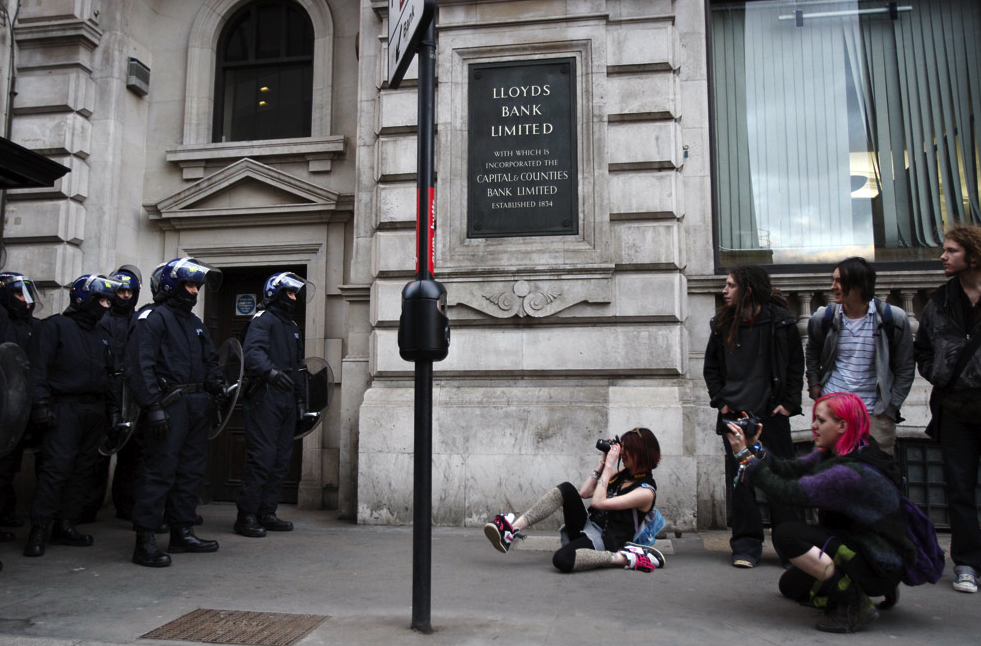
There are numerous photographs that make the point (see photos 11, 12, 19 and 20 at the Big Picture), but I like this image the most, in large measure because of how the police appear to react. Their purpose is to protect the bank from the protesters, and of course they are doing that, but it all seems so out of proportion: they are larger in number and size, and in any case they are girded for battle; the protesters sit and squat awkwardly on the ground as they take pictures or stand about nonchalantly with their hands in their pockets.  On the face of things they certainly don’t seem to be much of a threat.  Change the context just a bit and we might imagine them as tourists out for a day in the city.  And that is precisely the problem for the police who seem literally stopped in their tracks, as if they don’t quite know what to do.  Indeed, it could be a scene out of a Monty Python skit.  Should they pose for the camera or charge? Caught in the gaze of the lens—and thus the implied civic contract of the photograph—their power seems mitigated, if only for a moment.  But that moment is enough to shift the ground of agency and control, if not for the people in the image itself, then at least for those who see the photograph, i.e., those cast in the role of spectators who, by the virtue of the civic contract, are nevertheless called upon to render judgment.

*The fragment here is from Heidegger and reads in full, “The fundamental event of the modern age is the conquest of the world as picture.”  It appears in “The Age of World Pictures” published in Electronic Culture, ed. by T. Druckery. New York: Aperture, 1969.  I came across it in Ariella Azoulay’s “The Ethic of the Spectator: The Citizenry of Photography,” Afterimage, September/October 2005, 39. For a more detailed discussion of her ideas see The Civil Contract of Photography, MIT Press, 2008.

Photo Credits: Kirsty Wigglesworth/AP, Adrian Dennis/AFP/Getty Images

 3 Comments

Holocaust in the Furniture Business?

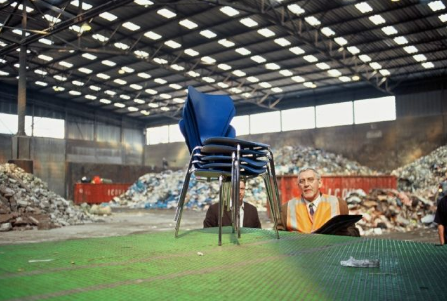
A state decrees that its pure stock is being diluted and displaced by inferior populations, many of them from Eastern Europe. The situation is becoming intolerable, and drastic steps must be taken. A Bekämpfung (fight) is declared. The world is notified and even asked to help the state assert its legal right to protect its property and identity. A systematic program of extermination begins.

In this photograph, a shipment of the impure element is being assessed for disposal after having arrived at the processing center.

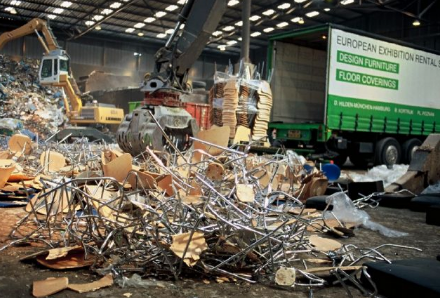
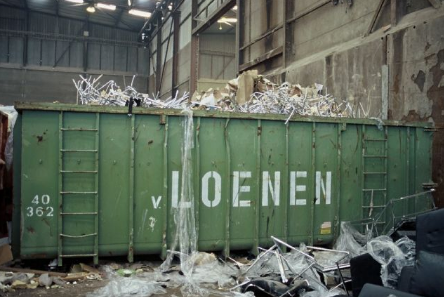
I’d understand if you think I’ve got a screw loose. Chairs are not people. Manufactured objects are recycled all the time–and it’s considered virtuous to sort your cans and plastic containers to that end. But I was paraphrasing the statements made by the Fritz Hansen furniture company at a weird web site where they display their efforts to collect and destroy copies of their signature lines. If their declaration of a struggle to maintain the purity of their brand had been nothing but text, I might have skimmed right over it. But then there are the images: the site includes two slide shows and a video of chairs being destroyed, along with a video of the company president justifying the program. The stiff demeanor, Germanic accent (it’s a Danish company), bureaucratic prose, and gray modernist architecture could all come from a movie on the Final Solution. Or so it seems when you look through the slide show.

I know my reaction is not unique because a reader tipped me off to these images, which have an uncanny resemblance to Holocaust photographs. At first, the allusion is very faint: a sense of vulnerable bodies being exposed, assessed, and destroyed in an industrial setting. The second image goes a step further: those flesh-colored torsos could be naked bodies being readied for the gas. The next image goes further still, evoking the skeletal corpses being stacked like cord wood in the concentration camp yard.

I’m not going to show the originals; one reason is that I’m assuming they already can be called to mind. And that raises another issue, because the company insists that “A copy has nothing to do with an original.” That assertion of radical difference among similar things cuts in several directions at once: back to fascism and across the contemporary digital world–where, for example, my copies of their images apparently have nothing to do with the original–and forward to a future when more and more of human life and capabilities will be copied into other things. Fortunately, however, the “Republic of Fritz Hansen”–they really say that–is ready to take a stand for the industrial equivalent of racial purity.

I would not endorse dismantling copyright laws, but there is something disturbing about producing photographs of destruction. Perhaps my sympathetic reaction is what is really out of place–an example of the emotional response typically evoked by the photographic relationship but rightly applied only to people. Because chairs are shaped to conform to the human body, they become accidental copies of the body, and that also makes misplaced identification a likely response. On the other hand, I wonder about the emotional condition of those who take pleasure in destroying things that are so much a part of the common human world.

You can see the Fritz Hansen display and one of the slide shows here. The videos, including the interview, and the written statement and another slide show are here. A site that mourns “Endangered Machinery” is here, which I learned about after an earlier post on When Machines Die.

 1 Comment

Sight Gag: And You Thought O'Hare was Bad!

Click here or on the picture for the full story.

Credit:  The Onion (with thanks to Jessica Rudy)

The “Sight Gag” is our weekly nod to the ironic and carnivalesque in a vibrant democratic public culture. We typically will not comment beyond offering an identifying label, leaving the images to “speak” for themselves as much as possible. Of course, we invite you to comment … and to send us images that you think capture the carnival of contemporary democratic public culture.

 0 Comments

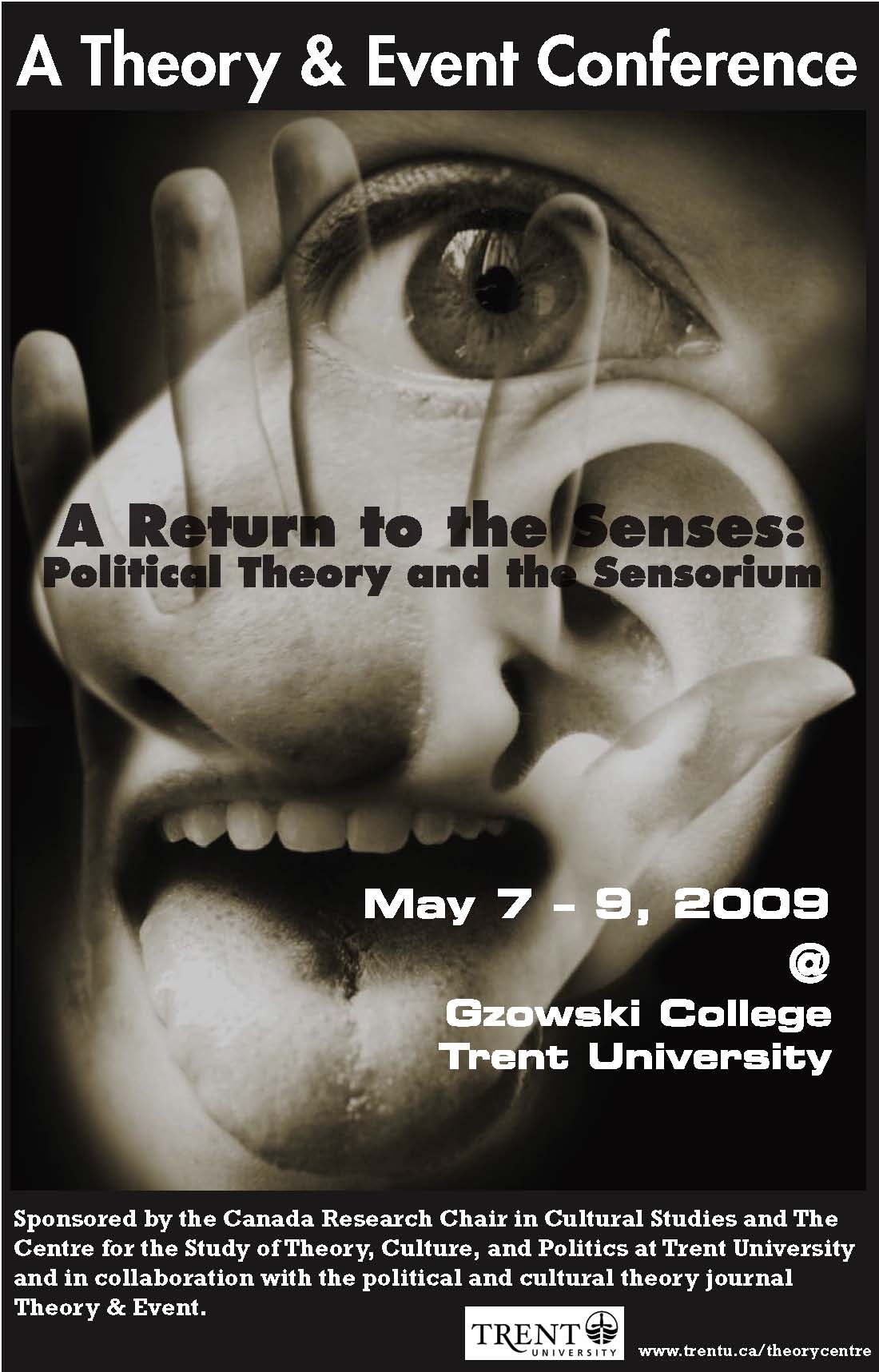
Conference: Seminar on Rhetoric and Politics in Contemporary Discourse

Persuasion: Seminar on Rhetoric and Politics in Contemporary Discourse

A seminar organized by the Goldsmiths’ Centre for the Study of Global Media and Democracy and the Centre for the study of Culture and Politics, University of Swansea

May 5, 2009, 2-5 pm

Small Hall Theater, Richard Hoggart Building

Goldsmiths, University of London

Persuasion is one of the most fundamental of democratic political activities. But it is also one of the most ambiguous. Does democratic development and expansion require the slow substitution of persuasion or rational conviction or, on the contrary, the proliferation of opportunities for rhetorical contestation? Where is the line between persuasion and force? Are there standards of truth or consent that guarantee the democratic character of a persuasive activity? What forms of rhetoric distinguish a democratic polity from tyranny? What happens to political persuasion in an economy and culture dominated by commercial persuasion? How can we best understand and analyse the forms, modes and locations of contemporary political rhetoric as manifested in visual and media cultures?

This interdisciplinary seminar explores the modes of democratic persuasion, the methods for its explication and interpretation and the prospects for rhetoric both in the academy and in the contemporary multifaceted polis.

Speakers: Aleatta Norval (University of Essex), Michael Carrithers (Durham University), Rochana Bajpai (SOAS), Alan Finlayson (Swansea University),  James Martin (Goldsmiths).

The event is free and open to all, but please contact James Martin (j.martin@gold.ac.uk) if you’d like to attend.  Seminar to be followed by a wine reception in the SCR.


 1 Comment

Wall Street Bankers Battle Fargo Flood

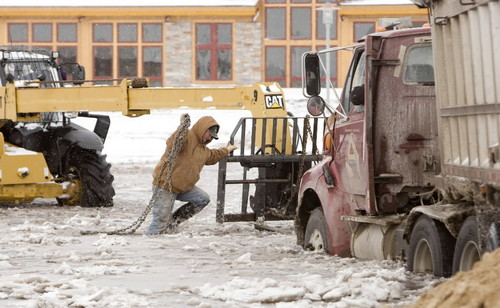
Exhausted emergency crews and volunteer workers building the dikes in Fargo, North Dakota had their spirits lifted today as hundreds of executives from Wall Street arrived to save the city from the worst flooding on record. As the grateful residents looked on, one financier after another picked up shovels, sandbags, and whatever else was needed to hold back the mighty river.

After he had slogged knee deep through ice-clogged water to hook a towing chain to a semi that was stalled in a flooded parking lot, this hardy banker said that he was happy to be able to help. “We couldn’t stay home when we saw people just like us having to struggle. Besides, I like to get my hands dirty.”

Fargo residents have become used to offers of help in the past week, but they were impressed nonetheless by the crew from Wall Street. “These guys have a lot of practical know-how,” said Jim Johnson of Johnson and Johnson Motors, “and they make really good decisions–especially about managing risk downstream.”

The bankers were a bit surprised by the fuss being made over their contribution. “We really couldn’t do otherwise,” said one, “because this was such an obvious call on our commitment to the common good. We have been fortunate lately, and we really appreciate the opportunity to give something back to the community.”

“After all,” said another, “that’s what it’s is all about, right?”

Photograph by Michael Vosburg/Fargo Forum Photo Editor, March 27, 2009. You can see additional photos of the flood control effort at the Fargo Forum and The Big Picture.

 2 Comments

Walling in the Nation State

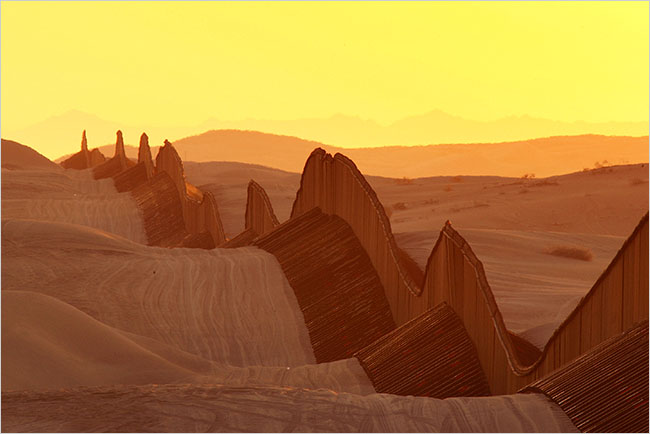
It’s a beautiful desert image, something one might see in Arizona Highways or National Geographic. And the dark brown ridge snaking towards the horizon? It could almost be a natural formation, one exemplifying the waveform topography and severe plain surfaces of this barren environment. Close inspection reveals construction material, however, and so it could be an art installation: perhaps something by Christo that will be up for only a short time before being dismantled to return the scene to pure space and light.

Don’t be fooled by the beautiful design. You are looking at a section of the “fence”–otherwise known as a wall–that separates the US from Mexico. This massive construction project has been going on for several years now, almost completely under the radar. You will not have noticed a shortage of illegal alien labor in your city, but you can rest assured that they had to become ever more ingenious or courageous to get here.

I wish we had built the wall as an artistic work–if only to take this one photograph before tearing it down. Others will say the wall is justified, of course, even though the US once boasted that it had undefended borders. Whatever the cost-benefit ratios for various immigration restriction technologies, there is additional significance any time a nation creates a wall.

Walls are uniquely symbolic, and paradoxically so. Those erecting them are demonstrating their power, wealth, and commitment to control and order on their terms. Think of the great powers who have built walls: China, Rome, the Soviet Union, Israel, and now the US.

The same list reveals the other side of the symbol: a wall is an admission of political failure. Walls are put up precisely because the state cannot keep people out–or, with the Berlin Wall, in. They are erected because a people can’t be beaten, dominated, bought off, or otherwise managed without changing the state’s relationship with the world.

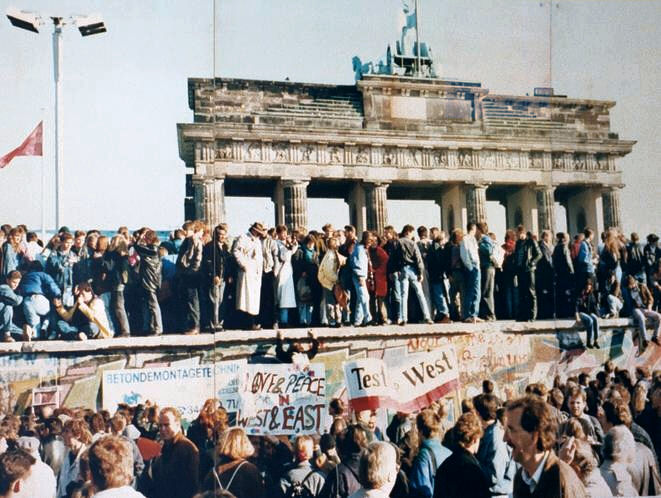
We might want to think of the wall along the border of the US later in the year. In November, 2009, there will be official and unofficial celebrations of the 20th anniversary of the collapse of the Berlin Wall. The media will be circulating photographs such as this one.

Such photographs should be valued. They remind us that a wall once was torn down by the power of the people. The nation is still present in this photo, signified to any German by the Brandenburg Gate in the background, but the people are in the foreground and have become the living enactment of the dissent and democratic self-assertion previously known only through the graffiti smeared across the brick barrier.

The people of Berlin could take down that wall because they were on the right side of historical change, and because it had become all too clear within East Germany that a society cannot thrive by walling itself in. In the 21st century, the US government is on the side of the builders of walls, which I’d like to think is not the right side of historical change. The first photograph above is part of the process of creating an enclaved nation: you see only an empty space and bare surfaces–no people, no dissent, nothing political at all, really, just a natural formation. The border is both secure and desolate, nothing ordinary citizens need think about. All that remains is to await the barbarians.

Photographs by David McNew/Getty Images and from the Wikipedia Commons. For another comparison of the two walls, go to the announcement for the 2009 Joint Conference on “Migration, Border, and Nation-State.”

 4 Comments

Sight Gag: Pun Intended

Credit: Craig Damrauer/NYT

The “Sight Gag” is our weekly nod to the ironic and carnivalesque in a vibrant democratic public culture. We typically will not comment beyond offering an identifying label, leaving the images to “speak” for themselves as much as possible. Of course, we invite you to comment … and to send us images that you think capture the carnival of contemporary democratic public culture.

 2 Comments

Terrorist Bombings: From Stopped Time to Still Life

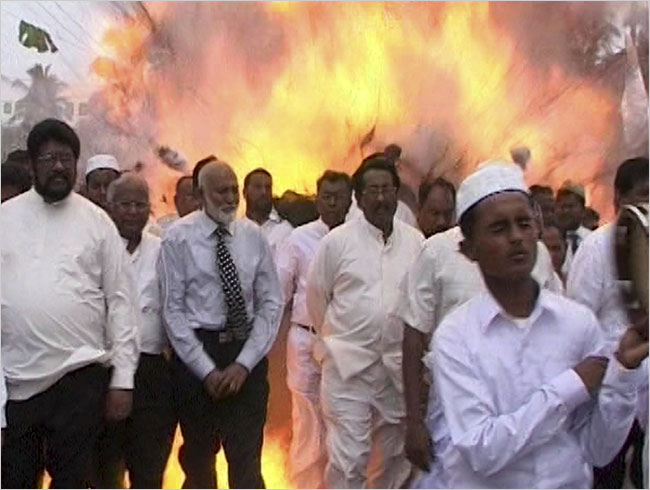
Representation in any public art today has to include using old forms to capture what is distinctive about our time. Eventually new forms emerge, and we should ask what might become the artistic conventions of a “catastophile” society in which disaster and violence are fatal attractions and spectacular sources of energy. One image that might be on the cusp of old and new is this screen shot of a bombing in Sri Lanka:

This image is distinctive in that the television camera is recording the instant that a bomb exploded at a Muslim festival in Akuressa, killing 15 people. Whereas almost all bombing photographs are of the aftermath, here you can see the blast pattern blossoming in a single, beautiful, terrible, moment of real time. For once, the blast is there to be seen–and sovereign, fully realized in itself without any rationale or judgment. If my account is sounding like a Facist aesthetic glorifying violence, that is indeed one lineage that applies, but not the only one.

The photo is not a pure aesthetic of violence precisely because of the tension between the sheer, annihilating force of the blast and the people about to be enveloped by the shock wave radiating toward them. The fire is already roaring down the street toward the backs of their legs, someone’s destruction already evident from the shirt blown into the air in the upper left. Yet there they are, ordinary people dressed in nicely pressed shirts standing as if posed for a group portrait–Say Cheese!–and completely oblivious to the blast. What is in fact one event seems to be two very different events joined together by special effects. The photograph actually captures another distortion: what should be two separate things–the violence of war and a civic festival–are actually smashed together. Spectacular violence usurps the civic spectacle.

The photo from Sri Lanka captures something important because of its stunned suspension of temporal movement. The moment of stopped time–which is part of every photograph–here reveals the moral chasm between violence and civic life. That is not the only way to capture the reality of civil war, however.

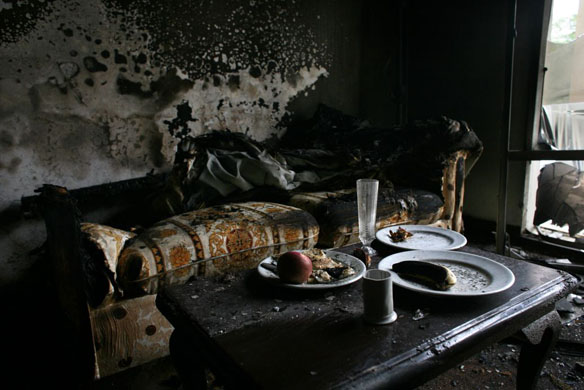
This photograph of a burnt hotel room was taken at the Marriott Hotel in Islamabad. The blast last September killed at least 60 people and injured more than 260. This image could be the opposite of the one above. Instead of the moment of immolation, we see the slow aftermath of loss; instead of people about to be harmed, we see a room abandoned to emptiness; instead of fire, cinders.

What most strikes me is how the picture works as a still life. The plates, glass, cup, and food could have been done by an Old Master. The play of light and shadow, and of sheen and substance, creates that timeless depiction of inevitable decomposition that was the subject of the genre. And so this tableau could be anywhere in the world, a small monument to gracious living that was instead lost to destruction. Seemingly timeless, but perhaps all too representative of our time.

Photographs by Reuters TV and Pedro UgarteAFP-Getty Images. The term “catastrophile” comes from Peter Sloterdijk, Critique of Cynical Reason, trans. Michael Eldred (Minneapolis: University of Minnesota Press, 1987), p. 120.

 1 Comment

Traces of Everyday Life on Desolation Row

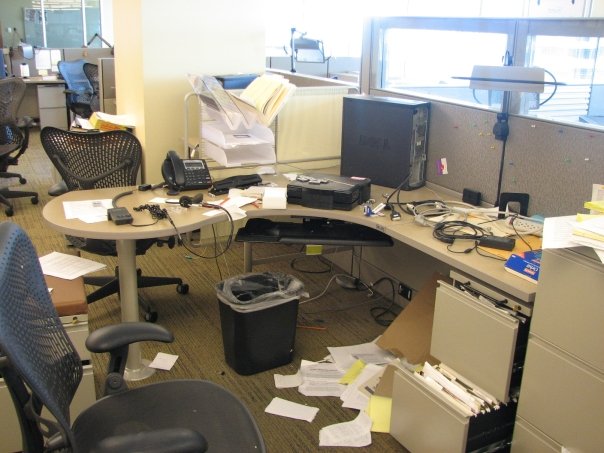
The following photographs were placed on a facebook page to provide continued documentation of the closing of the Rocky Mountain News. The photos were taken on March 19, several weeks after the paper went out of business. This picture could be from more than one corporate office today.

You are looking at the hardware of the white collar workplace: computer, phone, other electronic paraphernalia, ergonomic chair, files, wastebasket, paper littering every surface. . . . . Welcome to my world. On the good days, a place like this is humming with energy, activity, and deadlines, and, of course, arguments, delays, and frustrations, but also coffee breaks, conversations, and jokes. Places like this becoming living communities where people spend a lot of their time, give a lot of their talents, and find an important source of meaning, identity, and self-respect.

In the days of The Organization Man, the office was thought to be the source of Bob Dylan’s Desolation Row. When you look at the shabby, barren, modernist decor, the label seems to apply again. But times had changed and now work looks pretty good, and the desolation comes not from the work but from business shutting down. When only the hardware is left, there’s nothing there.

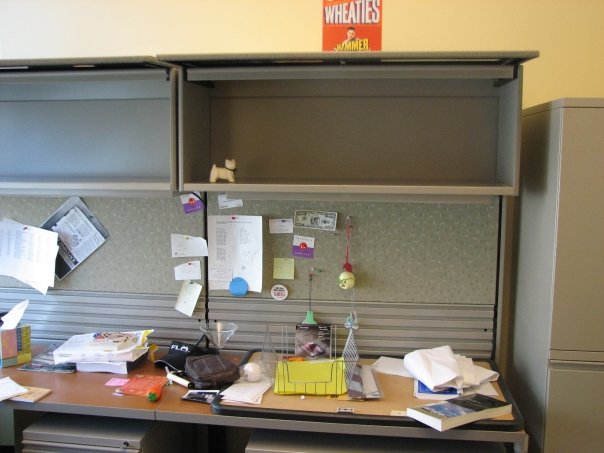
Nothing there, except for a few traces of personality. I love the way that people decorate their desks and cubicles to remake the impersonal space into something richer. Usually you see signs of those other important sources of personal meaning, family and friends, and you learn something about the individual. The gaping, empty shelves in this cubicle shout out the fact that the work has been taken away, yet the little dog, the trinkets stuck on the bulletin board, the book, photograph, ball cap, and even the box of tissues remind us that a real person worked here. The unemployment statistic was created in an instant, and someone will have taken a few hours to box up some things and then walked away from the rest, but the signs of a past life linger on.

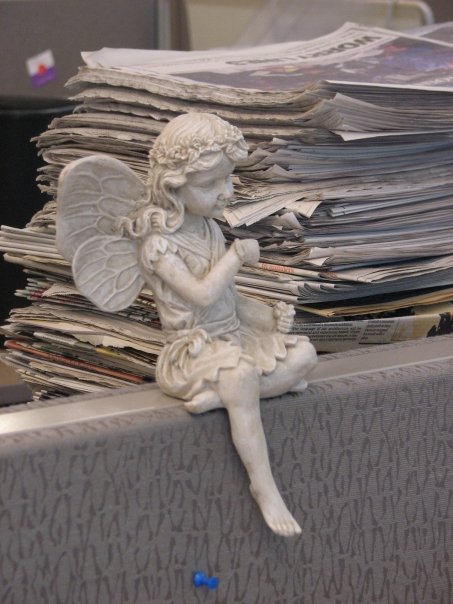
Material signs of a missing spirit–could this figurine be any more apt? She was someone’s small homage to the imagination–a fairy the same color as the impersonal office decor and yet evocative of another world. She sits precariously on the cubicle divider in front of a stack of papers, a symbol of vulnerability and crash that reveals just now fragile newspapers are today. And not only newspapers.

Though obviously an inexpensive bit of kitsch, it’s sad that the figurine was abandoned along with the old editions awaiting recycling. But perhaps it wasn’t abandoned, and left instead as a good luck charm. A promise that spirit and creativity can return to desolation row.

The photographs were taken by Dean Krakel and put up at his facebook page as What They Left Behind; the link was sent to me by photographer David Sutton.  An earlier post on the last day at the Rocky Mountain News is here.

 0 Comments