May 29, 2011
Aug 26, 2009
Dec 19, 2010
Mar 20, 2011
Aug 29, 2008
Feb 24, 2012

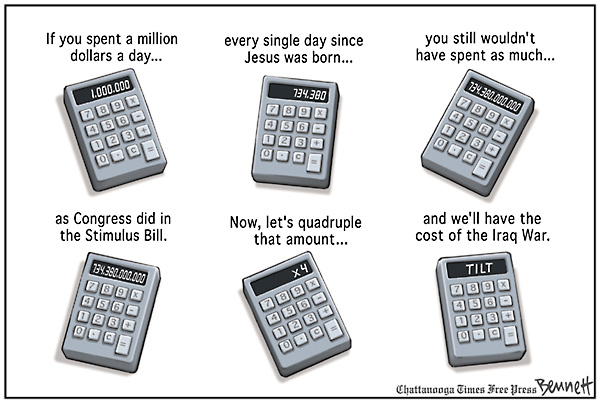
Sight Gag: Lest We Forget

Credit: Bennett at the Chatanooga Times Free Press

The “Sight Gag” is our weekly nod to the ironic and carnivalesque in a vibrant democratic public culture. We typically will not comment beyond offering an identifying label, leaving the images to “speak” for themselves as much as possible. Of course, we invite you to comment … and to send us images that you think capture the carnival of contemporary democratic public culture.

 1 Comment

War Images at Work

Today we welcome guest correspondent David Campbell.

Photojournalism’s representation of war is often standardized, familiar, even clichéd. Regardless of the time or place it can seem like we have seen it before, regularly and repeatedly. But if we always approach the problem from the same vantage point – asking how the event is represented – we run the risk of missing vital dimensions and important effects of the image, as this picture from Nepal demonstrates.

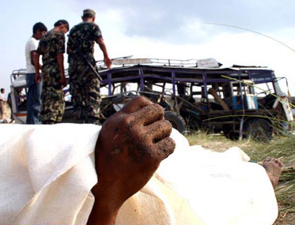
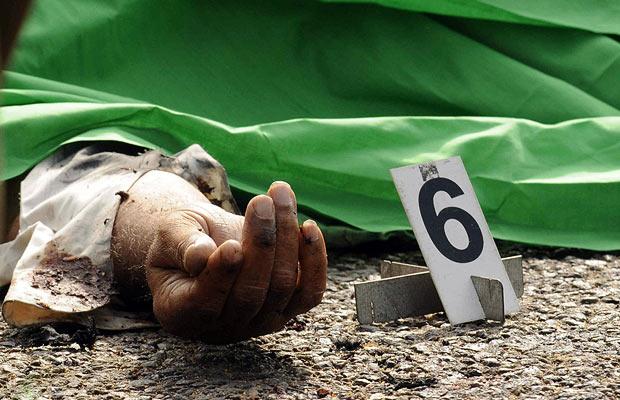
This picture comes from that country’s decade-long civil war which ended in November 2006. The passenger was among 36 killed when Maoists bombed a bus near Madi in June 2005. As one of the 15,000 people who died in this period, he was an unknown statistic in what was, for the rest of the world, a forgotten conflict, an event that had disappeared from the radar even before it could be remembered.

We could read this image, which is being recirculated through a book launched at this year’s biennial Chobi Mela festival of photography, as the making visible of something we should have known about. Or it could be another testament to lives lost, marked by hands of death. Or we could see it as a further instance of the indirect marking of mass death, preserving dignity while recording loss. While such accounts provide understanding, they do not draw our attention to the larger significance of this image. If we shift our focus from representation to enactment, from meaning to work, we can appreciate this photograph for its vitality in the present rather than merely its record of the past.

As one of the 179 photographs by 80 photographers selected from the more than 2,000 submitted for the exhibition “A People War: Images of the Nepal Conflict 1996-2006,” this picture toured Nepal throughout 2008. As a book and exhibition, “A People War” contains what individually might be regarded as unremarkable images in the global archive of war photography. Its catalogue of uniformed guerrillas, grieving widows, destroyed infrastructure, damaged individuals and mobilizing soldiers could, by themselves, have been drawn from any number of conflicts. Despite the editors desire to forgo showing unvarnished violence (hence the photograph of the bomb victim’s hand), there are pictures that shock, especially those that record the lynching of a teacher and journalist.

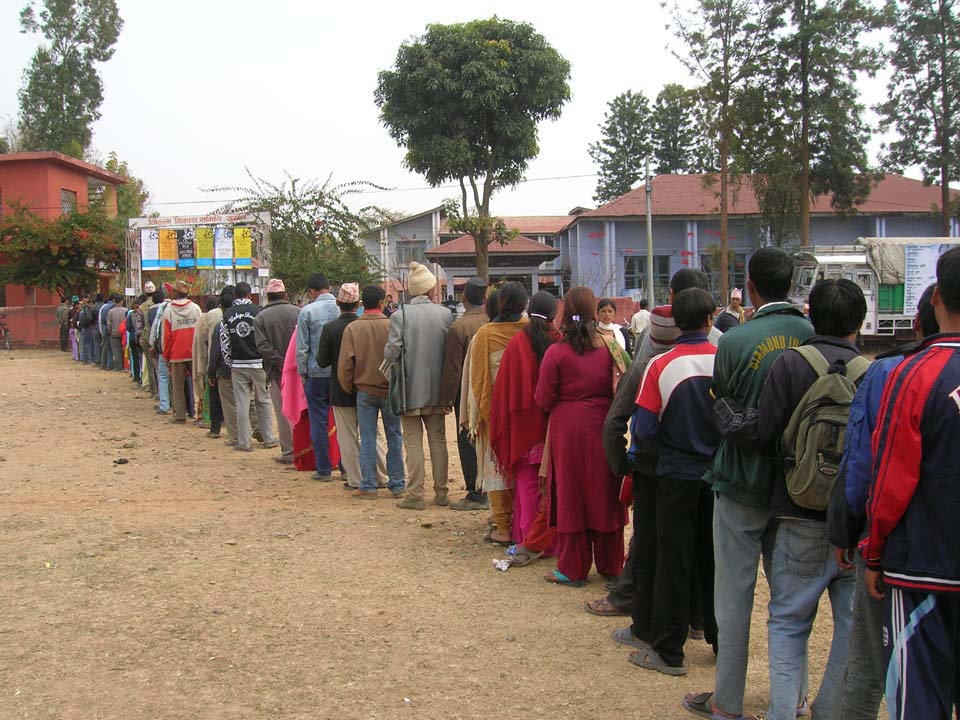
If, however, we view the images collectively and ask ourselves what work they are doing through the book and the exhibition, then they become something quite remarkable. Being shown within a year of the war’s end, this collection is an act of raw experience, a detailed encounter with what the conflict’s participants and victims have suffered so recently. Nepalese responded to this act in large numbers, with more than 350,000 people queuing to see it in 30 towns across the country – as in this picture from Surkhet. With thousands of free copies of the book distributed to public and school libraries across the countries, and a Nepali language budget edition made available for widespread sale, the organizers have ensured the photographs the broadest circulation possible.

People did not just look at the pictures. They engaged with the photographs. Mothers looked for evidence of missing family members, soldiers faced the consequences of their actions, and children witnessed what the future could be like if politics did not triumph over violence. To this end, the exhibition is also a warning to a fragile country. It functions as a statement in defense of the new federal republic, using the photographs to speak of a time to come, declaring that even if that future is not yet capable of being pictured, Nepalese know only too well what it could look like.

Photographs by Kumar Shrestha and Kirin Krishna Shrestha/nepa-laya. A gallery of additional images of the exhibition is available here.

 2 Comments

The Street, a Park, and the Unseen Middle East

I am suspicious of references to “the Arab Street,” particularly when the phase is applied–as it often is–to nations and other vast swaths of territory that are not Arab or not exclusively Arab. Several years ago Christopher Hitchens declared that it was a vanquished cliche, but he was misusing it himself to justify the rush to war by the Bush administration. And he wasn’t speaking of its persistence as a visual convention.
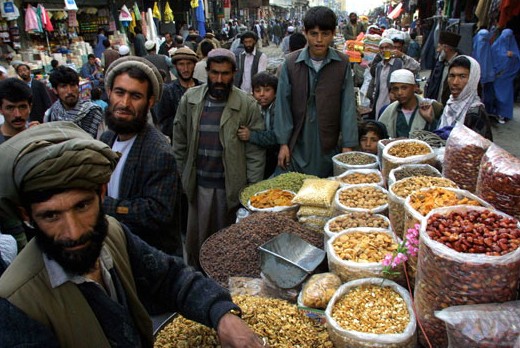
The caption of this photograph at The Guardian says only, “Nowruz celebrations in Afghanistan.” Nowruz is the name of the Iranian New Year, which is celebrated in a number of countries by people of several faiths. The baskets of dried fruits eaten during the holiday provide the only visual connection to the colorful festivities, and you have to know more than the paper tells you to see that. For many viewers, this will a thoroughly conventional image of the Middle East.

That image is one of throngs of working class men massed together in the street. What little business is there is in the open air markets lining each side of the densely packed urban space. We see small batches of everyday goods on display–probably to be bartered for, no less. The open baskets of food are a sure marker of the underdeveloped world. (Imagine how many packages it would take to wrap up that fruit for sale in the US.) Everything fits together into a single narrative, but the masses of men and boys make the scene politically significant. This is the place where collective delusions take hold, where mobs are formed, and where unrest can explode into revolutionary violence and Jihad.

Which is why I get a kick out of this photograph of another Nowruz celebration.
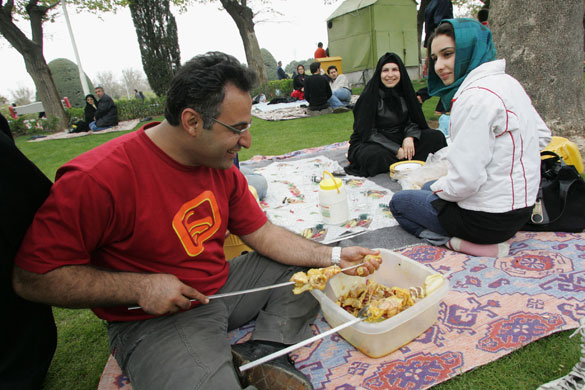
The caption reads, “An Iranian man skewers chicken for grilling as he picnics with his family.” My first thought when I saw the image was to check and make sure it wasn’t taken in Chicago. This also is a very familiar scene: grass, blankets, families and friends, plastic containers of food, dad getting ready to do the grilling.

What is astonishing is that I was able to see them at all. A typical summer holiday photo becomes a radical disruption of Western visual conventions when taken in Iran and shown in the US. Of course, it wasn’t shown in the US: this, too, is from the UK paper.

In this photo, there is no Arab street, and no Iranian masses dominated by Mullahs and demagogues. A middle class tableau reveals that so much of what is in fact ordinary life for many people in Iran and elsewhere in the Middle East is never seen in the US. And it isn’t seen because it doesn’t fit into simplistic categories, outdated stereotypes, and a dominant ideology. All that is shown and implied in the cliches is of course also there, but it is there as part of a much more complex and varied social reality.

As evidence of how things might appear a bit different, notice how seeing the second image can affect perception of the first one. In the second, it seems evident that the family is posing for the photograph. They’re doing exactly what they would have been doing but now with the additional, amused awareness that it is, for a moment, also an act. And sure enough, if you look back to the first photo, you can see the same thing. And if you can see that, they no longer need appear as a mass, or poor, or threatening, or anything but people enjoying a holiday. Much like people in the US were doing this past weekend to celebrate St. Patrick’s day, thronged together, in the street.

Photographs by Natalie Behring-Chisholm/Getty Images and Behrouz Mehri/AFP-Getty Images.

 12 Comments

Ritual Violence and Accidental Symbols

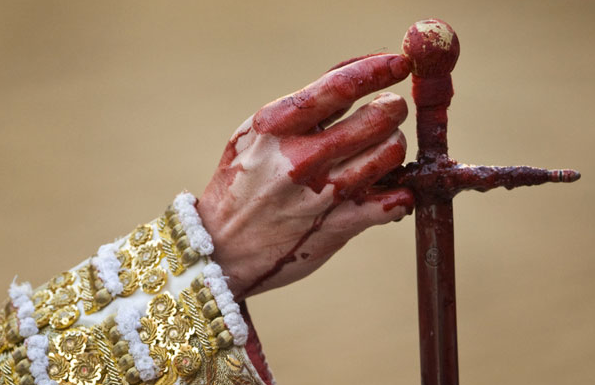
I thought it was the hand of a priest:

Protestant upbringing + Lent + gold embroidery + blood + cross = mistaken perception based on murky tales of medieval cultic practices involving lurid displays of mortification. From there it’s a quick step to announcing that, once again, the church has blood on its hands.

In fact, the cross is not even a cross. And the priest is a matador. The matador’s hand is holding one of his swords, one obviously still sticky with the bull’s thick blood.

But one could say that this is not a sword. For anyone familiar with Christian iconography, the sword could very well double as a cross, and as only a cross, and particularly when smeared with blood. If the imagery seems medieval, that might say only that the medieval artists behind the allusion got it right. If so, the spectator should also be seeing the blood of Christ; if applied to the bullfight, the point would be to believe that God cares not for the supposed triumph in the ring but for the poor animal as it suffers and dies.

Those in the arena will have seen something else as they appreciated the choreography of that ritual violence. The photo captures some of that drama, beginning with the blood bonding of the ornately clad matador, embodiment of art and civilization, with the animal nature of the bull. The antique weapon, gilded clothing, and refined use of the hand together create a charmed circle of performance within which the blood can flow, again and again and again.

That is not the only example of ritualized violence, however.

It could be the hand of a penitent, or of a priest preparing to administer the Host, or of a beggar, or someone about to give a blessing. It is not a hand, however, but a dead hand. There is no blood, but someone was slaughtered in public much like any bull in a ring. There are no vestiges of the middle ages, as this is a thoroughly modern scene with plastic tarp and aluminum hardware. But it is ritualized for all that. Another terrorist bombing in Sri Lanka, an act of violence so common that they have developed little metal fixtures for managing the forensic investigation.

And not without symbolism. That number six refers to a segment of the crime scene marked for photographic identification, yet it signifies more as well: there were others, there will be others, we’re each just a number, take a number and wait and your number will come up soon. There is no blood, but this bureaucratic item is equally horrific. We are supposed to believe that although the killing continues, everything is under control. Everything is not under control. And in a world of ritualized violence, accidental symbolism may be one way to get back to the suffering.

Photographs by Daniel Ochoa de Olza/Associated Press and AFP/Getty Images.

 4 Comments

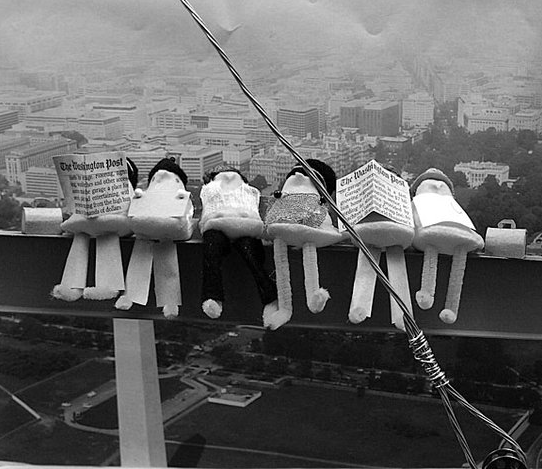
Sight Gag: Peeps Atop a Skyskraper (c. 1932)

Photo Credit:  Diorama Creater/Washington Post

The “Sight Gag” is our weekly nod to the ironic and carnivalesque in a vibrant democratic public culture. We typically will not comment beyond offering an identifying label, leaving the images to “speak” for themselves as much as possible. Of course, we invite you to comment … and to send us images that you think capture the carnival of contemporary democratic public culture.

 0 Comments

On Barbie's Fiftieth Birthday

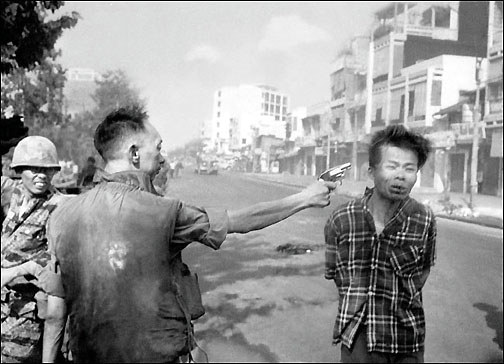
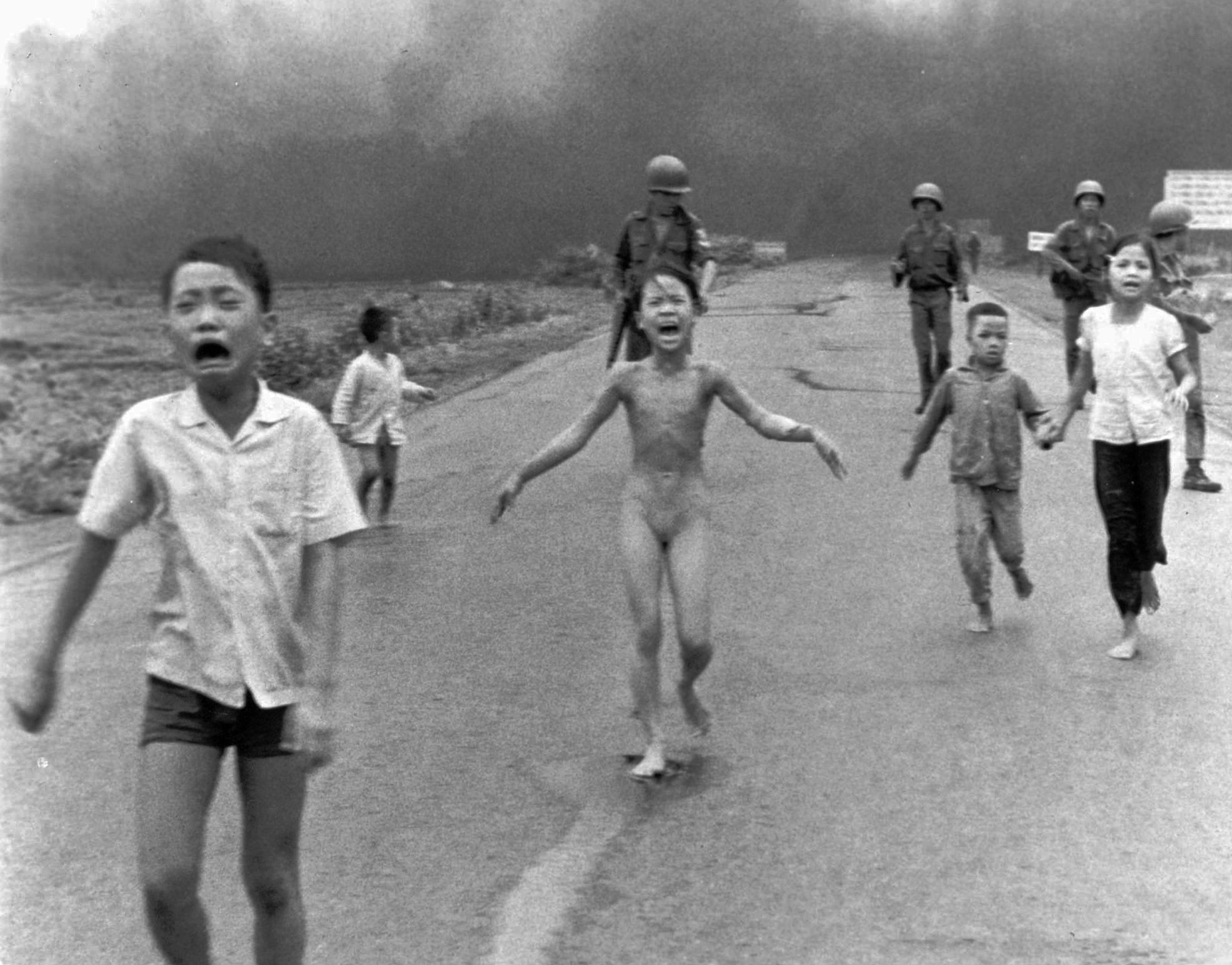
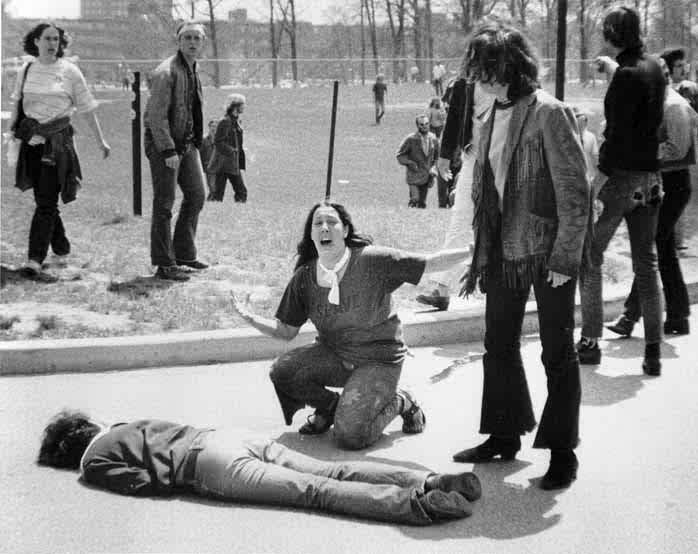
We have written about Eddie Adams’ infamous, Pulitzer Prize winning photograph of the execution of a Viet Cong prisoner in the middle of a street in Saigon before (here, here, and here) It is among a small handfull of photographs regularly referred to when one talks or writes about the Vietnam War—the others include most prominently the “Burning Monk,” “Accidental Napalm,” and the “Kent State Massacre.”

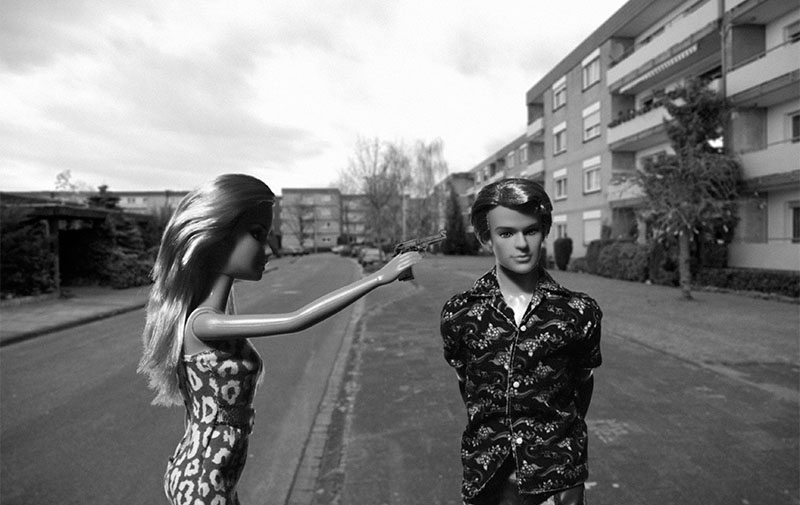
As with so many other iconic photographs, it retains its symbolic currency through mass circulation and reproduction, a process of distribution that animates it as an inventional resource for cultural commentary and critique as it is appropriated, performed, and parodied to particular cultural and political interests.  We were recently reminded of the ubiquity of such usages by a post at frgdr.com where a number of such efforts have been collected.  A quick google search turned up a number of others, including one by an artist named minipliman that appears to be joining the mass media celebration of Barbie’s fiftieth birthday:

We leave it to our readers to decide how the legend for this image should read … though on second thought, perhaps in this case “no caption” really is needed.

Photo Credit: Eddie Adams/AP; minipliman

 2 Comments

The Man Without a County

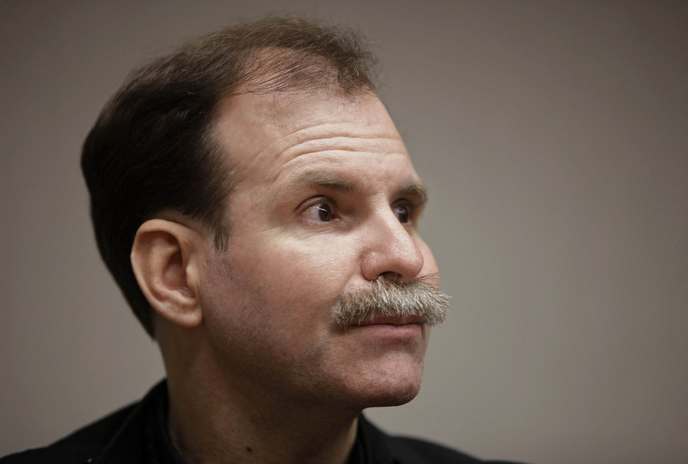
This photograph is altogether commonplace.  A simple headshot of an altogether ordinary, middle-aged, white guy.  He looks healthy.  His face is washed, his hair and mustache neatly trimmed. He is what we might call “clean cut.”  If you passed him on a street corner you probably would not give him a second glance.  There is something of an irony to this last statement, but more on that later.

His name is Daniel Fore.  He is a resident of Oak Park Village, a quiet suburb on Chicago’s west side famous for the many houses and other structures built by its number one son Frank Lloyd Wright.  Oak Park Village considers itself to be a small and friendly community fully committed to social and political diversity.  Indeed, Oak Park Village is so committed to diversity that in 1973 it issued a “diversity statement” that is now prominently featured in a sidebar on its website. That statement reads, in part:

“The people of Oak Park choose this community, not just as a place to live, but as a way of life … Ours is a dynamic community that encourages the contributions of all citizens, regardless of race, gender, age, ethnicity, sexual orientation, disability, religion, economic status, political affiliation or any of the other distinguishing characteristics that all too often divide people in society. . . . Oak Park recognizes that a free, open, and inclusive community is achieved through full and broad participation of all its citizenry.  We believe the best decisions are made when everyone is represented in decision-making and power is shared collectively.  Oak Park is uniquely equipped to accomplish these objectives, because we affirm all people as members of the human family (emphasis added).”

But back to Daniel Fore, the ordinary guy in the picture above—the guy who doesn’t appear to warrant a second look.  He has been living in Oak Park Village for at least the past twelve years, where he has regularly attended Village board meetings and is recognizable around the town as a community activist.  All of that turns out to be irrelevant, however, as his recent petition to run for the Oak Park Village Board (signed by 800 members of the community) was challenged because he listed his residence as “homeless” and the only address he gave was an Oak Park PO Box.  The challenge was upheld by a Cook County judge because he did not list a “home address” on his nomination application.  (Aside: The irony here is much too rich to ignore given the tales—perhaps apocryphal—of the numerous deceased voters on the Cook County voting rolls who nevertheless cast ballots in elections throughout the 1960s; of course, one can only assume that these voters did have home addresses).

The Court’s ruling is under appeal, but the point to note is that the commitment to a “free, open, and inclusive community” where “the best decisions are made when everyone is represented in decision-making and power is shared collectively” apparently doesn’t extend to the homeless who have been summarily excluded from the “human family.”  And the exclusion is doubly ironic, for just as we (shamelessly) avert our eyes from the homeless we encounter sleeping in alleys or panhandling on street corners, refusing to give them a second glance, so too now have the courts and our laws looked away.  As the unemployment rolls rise and as the number of house foreclosures add to what seems to be a growing “class” of homeless people—many, if not most who will look and be no more or less ordinary than Daniel Fore—one wonders how long we can continue to do that and lay claim to being a truly democratic society.

Photo Credit:  M. Spencer Green/AP in the Washington Post

 0 Comments

The Texture of Decline

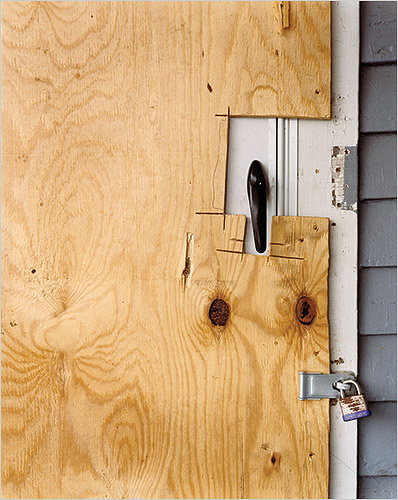
I’ve written recently about the need to dial down aesthetic expectations in order to document the reality of the current economic catastrophe. A photograph from the cover of this week’s New York Times Magazine provides an eloquent example of how a humble image can capture the consequences of an economic disaster.

You are looking at a boarded-up doorway of an abandoned house in the Slavic Village neighborhood of Cleveland, Ohio. The neighborhood’s name might evoke the Immigrant Dream and so heighten the significance of the image, but I don’t think that is needed. The visual surface of the image presents an unrelenting litany of decline and disruption.

The plywood board, which looks like the cheapest stock you can get, has been hacked roughly with a saw to be cut to the frame and door handle. The cutting obviously was done sloppily, because what the hell does it matter for a job like this? Cutting like that also can be done quickly, as if the crew has a lot more to board up. (Cleveland has at least 10,000 abandoned homes.) The padlock is rusty–real old, as if bought as part of a shipment of thousands of used locks, or maybe it’s the lock the family assumes they’ll never see again. The one piece of new equipment is the hasp attaching the plywood to the door frame; not something most homeowners or real estate companies want to have on hand.

The materials are cheap as can be. And can be so, as they really are not much more than “keep out” signs. Anyone over age ten can break through that door if they want to. The house is not in great shape either. Flaking paint, the door frame unpainted after pulling off a hinge, the flimsy outer door, all suggest that this wasn’t a high end development to begin with–certainly nothing that would drive the imagination of those frenzied to bail out Wall Street firms, big developers, and others “suffering” because their McMansions have temporarily declined in value. By contrast, this photo is a study in how those near the bottom can still have far to fall.

And then what? The photo’s final effect comes from being an image of foreclosure–of literally shutting out, closing early, stopping. We see layers of blockage: the board, hasp, lock, closed door, frame–every part of the image says you might go forward but can’t. Even the shingles jut forward but recede to wall, and the trace of an old hinge reminds that the current hasp also could be removed instead of locked. Likewise, the viewer’s gaze, which is pulled toward the vanishing point in the middle of the picture, is continually interrupted by the closed surfaces. The close cropping insures that no windows, yard, or neighborhood view soften the effect of hitting this wall. The image might be described as adding insult to injury, as it stops any attempt to take the long view, larger perspective, or other means for rationalizing away the actual destruction. Instead, it says, look at this shuttered house, up close, in all its sad particularly. This is the texture of decline.

Photograph by Reuben Cox for The New York Times. The photograph was part of a slide show about the housing disaster in Cleveland; the slides accompanied the story, “All Boarded Up.”

 1 Comment

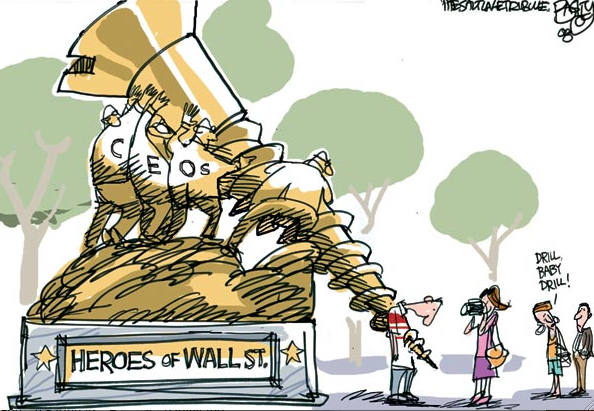
Sight Gag: Flags of Our Fathers

Credit: Pat Bagley

The “Sight Gag” is our weekly nod to the ironic and carnivalesque in a vibrant democratic public culture. We typically will not comment beyond offering an identifying label, leaving the images to “speak” for themselves as much as possible. Of course, we invite you to comment … and to send us images that you think capture the carnival of contemporary democratic public culture.

 0 Comments

Photographers Showcase: Pontiac, Michigan

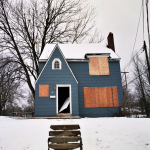
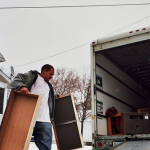
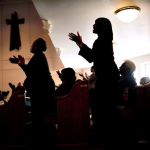
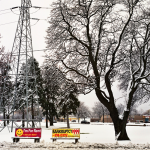
We welcome back Ashley Gilbertson who recently spent time “embedded” in Pontiac, Michigan, a city of 60,000 that is heavily reliant upon the economic presence of General Motors.  It is a picture of the effect of the economic crisis on a small, upper midwestern town.  Ashley is now affiliated with VII Photo and you can see some of his more recent work there, including some of his work on Wall Street for Vanity Fair.  The slide show below was originally part of a multimedia show at the NYT.

 2 Comments