Aug 27, 2008
Jul 21, 2013
Feb 08, 2015
Jan 30, 2011
Sep 14, 2012
Oct 17, 2014

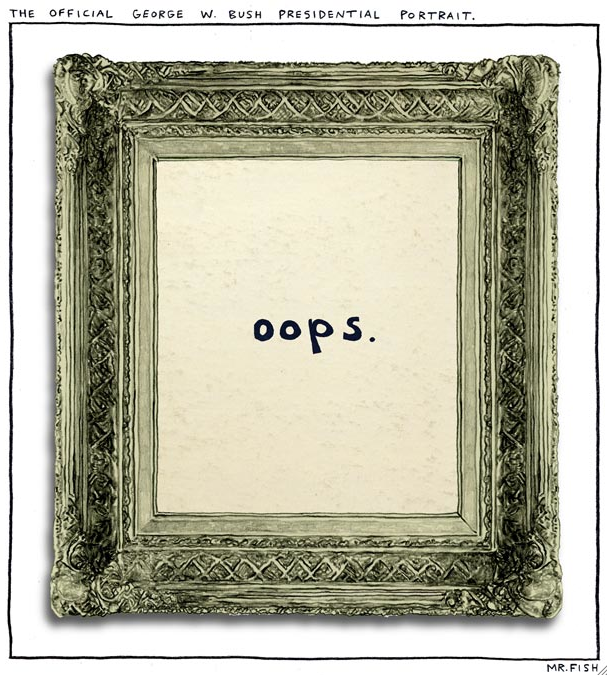
Sight Gag: Presidential Portrait

Credit:  Mr. Fish, LA Times, January 8, 2009

The “Sight Gag” is our weekly nod to the ironic and carnivalesque in a vibrant democratic public culture. We typically will not comment beyond offering an identifying label, leaving the images to “speak” for themselves as much as possible. Of course, we invite you to comment … and to send us images that you think capture the carnival of contemporary democratic public culture.

 1 Comment

What if God Counts?

So Hamas and Israel both wanted war and each got their wish. The war was no surprise when it came and the outcomes are predictable as well. Israel will use its overwhelming military superiority to smash enemy infrastructure while also killing many civilians, which will allow Hamas, broken but not destroyed, to claim moral and political victory. The international community will broker another truce, the band-aid of humanitarian aid will be restored, rocket attacks on Israel will diminish for awhile, and the occupation policies that have turned the West Bank and Gaza into prisons will continue. A rejuvenated IDF will claim that it did indeed, as the Defense Minister promised, restore “peace and tranquility,” a phrase notable for not including the word “justice.” Then the rocket attacks or suicide attacks will resume, Israel will again be given the worthless admonition that it should allow itself only a proportionate response–which, technically, would be firing rockets at civilians–and so it goes. It is tempting to simply say, “a pox on both your houses.” But then there is this:

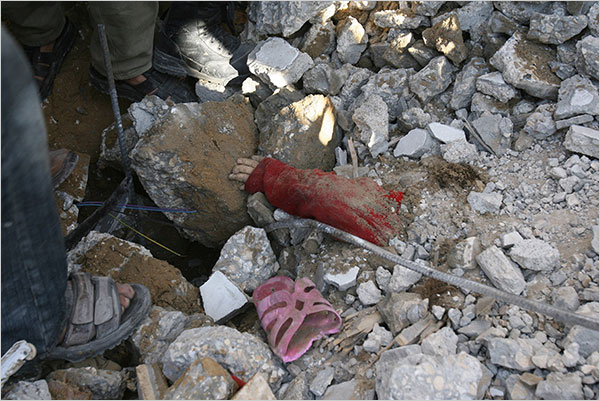
A child’s arm protrudes from the rubble of a building destroyed by an air strike. This is one death among many–500+ civilians and counting–including perhaps the woman whose half sandal also is in the picture. It is one picture among many, and one of of the least dramatic, but I can find no other that so eloquently communicates the crushing sorrow of war’s devastation. The mass of concrete crushing the child also completely crushes any hope. This is not a scene of rescuers digging frantically in a race against time. Instead, the several adults simply stand there, helpless. It’s as if they are granting the child a last moment of dignity before they have to tear the broken body out of one grave only to return it to another.

This is why we shouldn’t turn away or throw up our hands in disgust. Each death is a separate tragedy, not merely another datum to be aggregated into the geopolitical assessment. But it is not enough to mourn the individual loss of life if that does not also include a commitment to facing the deep causes of this war and the other wars now underway–most of them killing far more people than will die in Gaza. Precisely because each death is so wasteful, unnecessary, and immoral, it should be counted in another sense: as a measure of collective political failure.

Let me put it this way. What if God counts? (I realize that belief in God is rather difficult these days, but let’s at least consider the idea a useful fiction.) What if, that is, God judges not so much by weighing reasons but simply by how many are harmed? It makes sense, if you think about it. God (for example, in Judaism, Christianity, and Islam, just to name a few religions) is supposed to see through our social identities, our many rankings and all the aggrievements they involve. God calls on us to transcend social ascription and avoid false pieties and idolatries, all on behalf of living in justice and compassion with one another. Nor has divine judgment ever given points for wealth or firepower, or for sacrificing children for one’s cause. The more I think about it, the more clear it seems: God would put great weight on how many were harmed, and what was done on all sides to prevent harm, while being much less concerned about who had the better rationale on any particular day.

Think about it: not what you intended, and not whether you were right, but simply how much damage you caused. Relentlessly counting while turning a deaf ear to our many arguments, no wonder God’s judgment is said to be so terrible.

In the short run, it would seem that God’s judgment should fall on Israel: a handful of deaths on one side and hundreds on the other, not to mention the continuing toll taken by the occupation. But that may be too simple. Surely God also follows the money, which goes back to the U.S. on one side and sources throughout the Arab world on the other side. And this is a small war by comparison with the American wars in Iraq and Afghanistan and even more so compared to the wars raging across central Africa. Again, war is a collective failure, and ultimately the judgment rests on us all.

Photograph by Mohammed Abed/AFP-Getty Images.

 6 Comments

Captioning the New Year

The new year has started very much like the old year: renewed war in the Middle East, exceedingly uncivil civil wars in Africa, spasms of terrorism and counter-terrorism in Asia, drug wars in Latin America, and economic decline everywhere. That’s not the whole story, of course, but it is a continuing story.

Faced with another year of violence, journalists and citizens alike have to make choices about how to depict and understand what is happening, and how to do so without becoming cynical or otherwise numbed to the obligations and possibilities for change. One place to begin is by looking at this photograph.
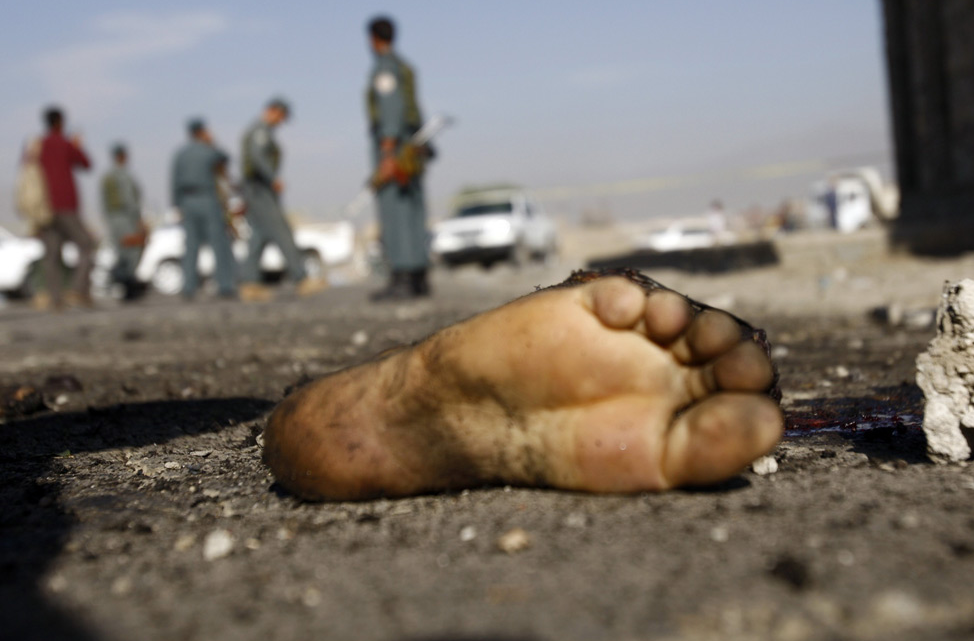
Recently I got somewhat lyrical about two images of “Hands of Death.” Now we are looking at the foot of a suicide bomber in Afghanistan. Rather than speak about the photograph directly, let me ask you how it might be captioned.

That’s a real question. What are we to make of this awful, pathetic, powerful image? How should we label it to use it well–that is, to provide material for public thought?

I’ll suggest several captions that occurred to me, along with their implications for framing events to come. First, “Picking up the Pieces.” Cute, isn’t it? But that is what has to be done. After the dramatic cataclysm of the blast and perhaps heroic efforts to save the wounded, someone has to pick up the shards of material, bone, and flesh that remain. At the same time and for much longer, someone has to pick up the pieces of shattered families, broken communities, a damaged society. The violence that has occurred is still occurring, not only in the continuation of political struggles, cycles of violence, martial habits, and the arms trade, but because the harm already done lasts for decades among the living. Whatever will come to pass, surely one of the tasks facing governments and individuals today is to pick up the pieces still strewn about, the sorry fragments of past destructiveness that have to be gathered up and put to rest as part of moving forward.

I also thought of labeling the photograph as “The Human Remnant.” Although we don’t typically look at the soles of our feet, much less think of them as emblems of humanity, that foot now becomes expressive. It looks capable, vulnerable, well cared for, and generally a sign of how humans are a distinctive species. The top of the foot has been seared by the blast, leaving the soft, fleshy underside as the only trace of the human being who existed before ideology, socialization, self-immolation. Perhaps that foot could have walked down another path; indeed, isn’t that true of everyone? Thus, the image reminds us of how war wastes human potential. But let’s not get too sentimental. He killed three other people, and the soldiers, munitions makers, and strategists also are human, as are the torturers and those who authorize torture. It is not enough for humanity to endure.

Other captions include: “Putting Your Best Foot Forward” and “Adding Insult to Injury.” The first ranges from contempt to cynicism, while the second plays off of the cultural significance in the Middle East of showing the soles of one’s feet. I could go on, but you get the point. One question we face in the new year is how to represent, understand, and react to a world riven by violence. This is not an academic question.

Photograph by Ahmad Masood/Reuters via The Big Picture.

Update: Thanks to the double post at BAGnewsNotes, you can read additional comments there.

 5 Comments

NCN on Holiday

Your faithful correspondents are going to be not so faithful for the next two weeks. NCN will return to our regular schedule on January 5, 2009. Until then, please feel welcome to browse in our archives, and be sure to scroll down this page to see the slide show by Patrick Andrade that went up on December 19.

It has been quite a year, and John and I are grateful to have been able to contribute to the ongoing discussion of politics and visual culture. There are many reasons for doing anything, but we want to be sure to acknowledge the continued attention and occasional comments by our many readers. If you drifted away, we probably would pull up the tent and move on. Thanks to each of you for keeping this blog alive, and best wishes for the new year.

Photographic still of Scrooge (Alastair Sim) and the ghost of Christmas Present, from Scrooge, the 1951 adaptation of Charles Dickens’ A Christmas Carol.

 0 Comments

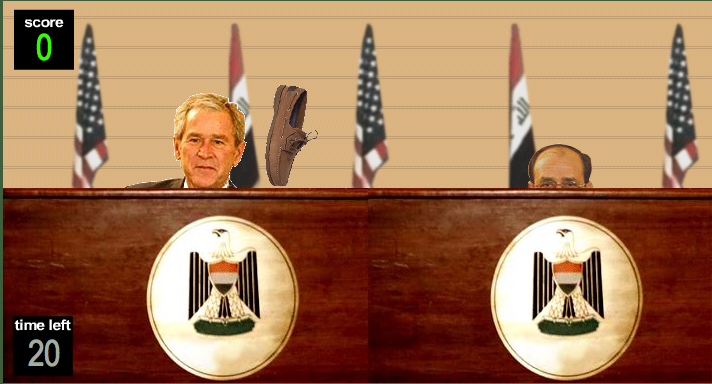
Sight Gag: Sock and Awe

To play the game click on the image.

The “Sight Gag” is our weekly nod to the ironic and carnivalesque in a vibrant democratic public culture. We typically will not comment beyond offering an identifying label, leaving the images to “speak” for themselves as much as possible. Of course, we invite you to comment … and to send us images that you think capture the carnival of contemporary democratic public culture.

 1 Comment

Patrick Andrade at the Crossroads of the World

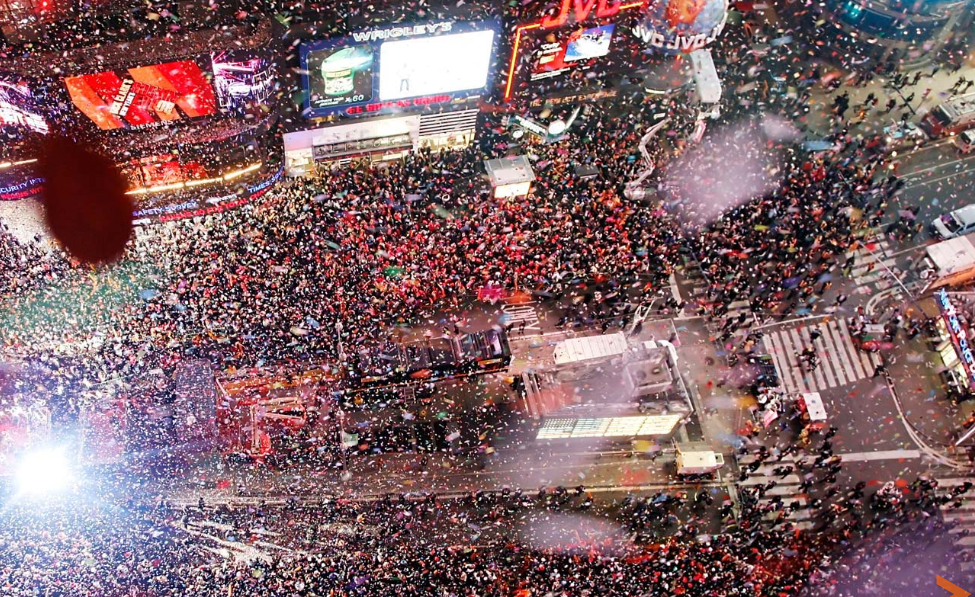
NCN is very pleased to end the year with a stunning slide show by photographer Patrick Andrade.  The small island of concrete sidewalk at New York City’s Times Square is most commonly known as “Military Island”. This year the island has witnessed the bombing of a military recruitment station, anti-war and pro-war demonstrations, several promotional events, and the election of a new president. The following photographs were all made during 2008. To see the slide show click on the image below.

 0 Comments

The Birds’ Eyes’ View


Earlier this week Hariman commented on how the camera aids our fundamental desire to anthropomorphize animals, to see them “as being like us,” by directing our attention to their eyes—the windows to the soul—which allow a special point of identification and contact between humans.  And the evidence is pretty compelling, made all the more so when we consider the obverse, i.e., photographs that underscore the zoomorphic representation of humans as if they were animals.

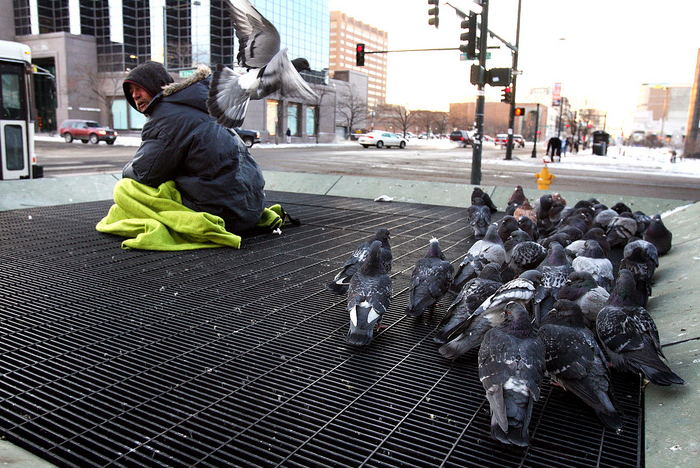
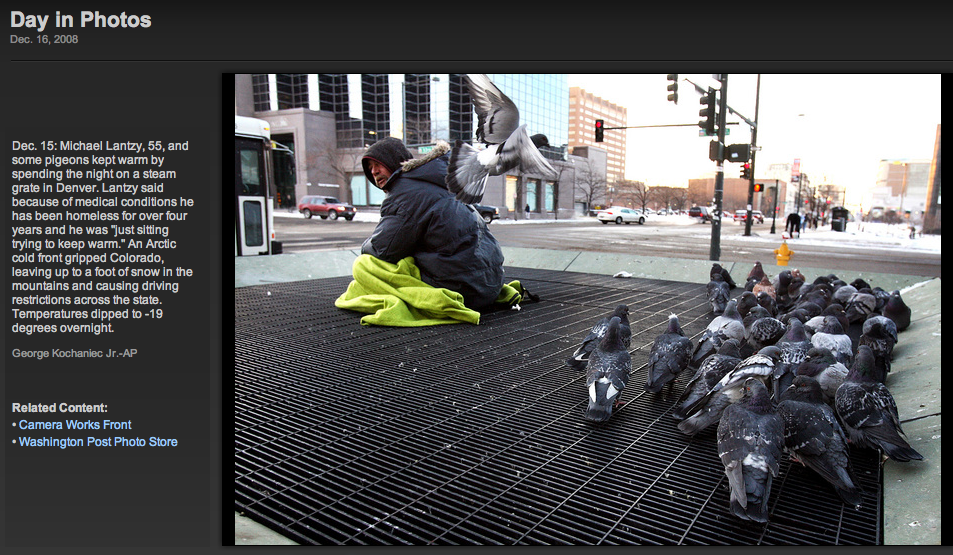
The photograph here is of “Michael Lantzy, 55, and some pigeons kept warm by spending the night on a steam grate in Denver.” According to the caption Lantzy has been homeless for four years, and identifying him by name would seem to distinguish his humanity from the pigeons with which he shares the limited space of public warmth, as does the very physical separation between the lone individual and the clustering flock of birds.  But there is a strong sense in which the image resists the humanizing impulse of the caption, making it hard to see Lantzy as a distinct individual, or quite possibly even as human.


Pigeons are an urban nuisance.  They are believed to carry communicable diseases and their nesting habits are squalid. Cleaning up after the mess they leave behind can be both costly and dangerous.  The homeless are often characterized in similar terms and the photograph here accents the point of identity.  Shot from a  slightly elevated angle, it directs the viewers attention downward to the ground where homeless and pigeons alike are obtrusively roosting at the intersection of a public thoroughfare.  The oblique angle from which the viewer observes the scene diminishes the difference in size between man and flock, while his gun-metal grey coat blends in almost perfectly with the colors of the birds’ plumage.  The overall effect is to accent sameness and to undermine difference, even as it denaturalizes the landscape.  This last point is important, for it is unlikely that the average pedestrian would view the scene portrayed here from this vantage as they walk by on their way from one place to the next.  The photograph thus frames a somewhat exotic view (as if in a zoo) of the urban landscape.

One might be inclined to view the photograph as an ironic comment on a public and communal immorality—treating humans as vermin—but to do so requires us to recognize and acknowledge a clear difference between human and non-human in the picture.  To this end, one might point to the lime-green blanket on which the man rests as a sign of a primitive, human instinct, but pigeons (like the homeless) are also notorious scavengers, and so what might function otherwise as a humanizing distinction is weighted down in this photograph by the more pronounced points of animalistic similarity. What is needed to disrupt the zoological analogy is something that gives direct and pronounced access to the man’s soul, a sense of his inner-being, his humanity, that would make it difficult or even impossible for another human to ignore his plight or presence. It is to my own shame that when I encounter a homeless person on the street I will often avert my gaze so as to avoid eye contact—the demand for human recognition—as if to make the “problem” before me disappear.  And in this photograph it is notable that we have no access to the man’s eyes (as we have no access to the birds’ eyes) and thus nothing that would demand that we recognize his unique humanity. Just as we anthropomorphize animals by accenting the human quality of their eyes, so we animalize (dehumanize) strangers by erasing (or otherwise “veiling”) the windows to their soul.


But there may yet be an important and productive irony animated by the photograph.  For while the man is identified with the pigeons he is also quite clearly separate from them.  Indeed, the pigeons seem to treat him with the same kind of benign and nonchalant neglect that tends to animate our public response to the homeless (when it doesn’t devolve into out-and-out violence). Like most of us, they choose not to see him, even as they hold him at some distance.  It gives new meaning to  the phrase “a bird’s eyes view.”

 Photo Credit: George Kochaniec Jr./AP


 4 Comments

Photography and the Animal Eye

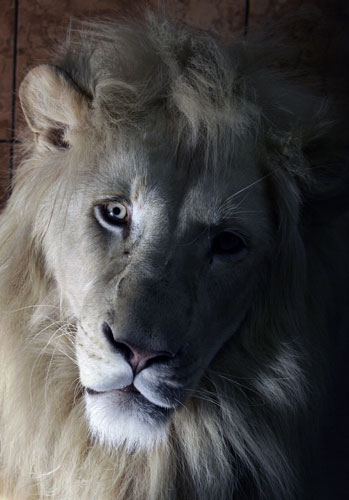
Animals are conventional photographic subject and a minor but persistent topic of photojournalism. They are quite prominent in Britain–for example, The Guardian photo page includes “This Week in Wildlife” as a regular feature, and the daily slide show often contains additional images as well. In the U.S. there probably is regional variation reflecting geographic and economic differences, but cute pets and tranquil wildlife are standard fare. Images of pets and zoo animals often contain anthropomorphic appeal, which is exactly why I find this photograph of a white lion in the Belgrade zoo so disturbing.

Penguins splashing in a concrete pool might be happy as clams, but large mammals always appear to be somewhere on a well-worn path to madness. This poor beast could be placed right into one of those paintings of animals playing poker, but for the fact that he looks so sad, at once perplexed and aware of what is happening to him. His intelligence–or emotional intelligence, if you wish–is captured in the brightly lit eye on the left, while the deep shadow on the right side of the photograph suggests that his mind is sliding into darkness. This effect is heightened by how the face appears to twist as it elongates to the nose and mouth. Perhaps but a trick of light, it also is another example of how the photo turns the anthropomorphic impulse against itself. We want to see animals as being like us–curiously, we do this as we make them captive–yet now we are confronted with the thought that they may be sentient and complex and emotional enough to suffer from being confined for our viewing pleasure.

I could quit there, but this was a rich week for animal photography. The next shot provides another angle on looking at animals looking at us.

This black rhinoceros is kept in the Frankfurt zoo. Again, the photo features the animal’s eye, now one that seems to reflect a duller intelligence, one trapped in a perpetual state of trying to comprehend what he sees. What strikes me is that he seems confined and burdened not by the zoo but by his own body. That eye looks out from amidst a huge head weighted with a great mass of horn, part of a massive carcass encased in thick skin, so thick it can become encrusted with mud or mold. That’s a lot to manage, and he seems consumed by the task, so much so that looking at us is almost too much to handle, one more burden for him to carry along with the rest of his bulk.

It could be worse, however.

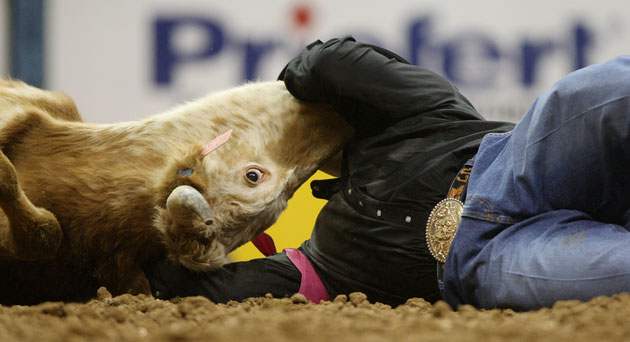
This rodeo steer is the animal eye taken down to its elemental condition of dumb, uncomprehending fear. He did not evolve for steer wrestling, and he looks out in terror as he lies there on his back, throat exposed. The image still has a strange anthropomorphic element to it, however, because of the way the two bodies converge. We see only the head of the steer while the wrangler’s body is rendered headless by the angle of the camera. The result is a minotaur. In the Greek myth, he had a man’s body with the head of a bull and lived within a maze. He was fearsome but trapped, confined to the maze like an animal in a zoo. The rodeo minotaur also is a figure of captivity. Steer and cowboy alike are trapped in their roles and in their bodies. Thrown together in order to survive, they may have more in common, and more need of one another, than we like to admit.

Photographs by Srdjan Ilic/AP Guardian, Frank May/EPA, and Isaac Brekken/AP Guardian. For an earlier post that ends on the animal eye, go here. If you appreciated the reference to the Greek myth, you might enjoy The Minotaur Takes a Cigarette Break.

 10 Comments

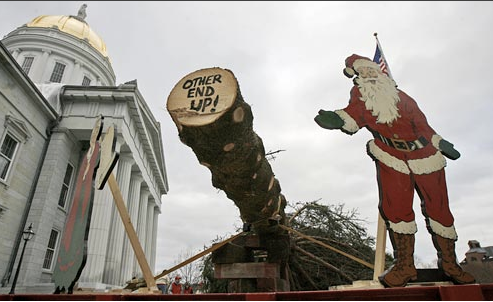
Sight Gag: Assembly Required

This is the 2008 version of the photograph.  For the 2007 version click here.

Photo Credit:  Toby Talbot/AP Photo

The “Sight Gag” is our weekly nod to the ironic and carnivalesque in a vibrant democratic public culture. We typically will not comment beyond offering an identifying label, leaving the images to “speak” for themselves as much as possible. Of course, we invite you to comment … and to send us images that you think capture the carnival of contemporary democratic public culture.

 0 Comments