Sep 04, 2009
Aug 14, 2007
Jun 26, 2007
Sep 07, 2008
Feb 10, 2008
Nov 06, 2007

Abandoning the U.S. Auto Industry

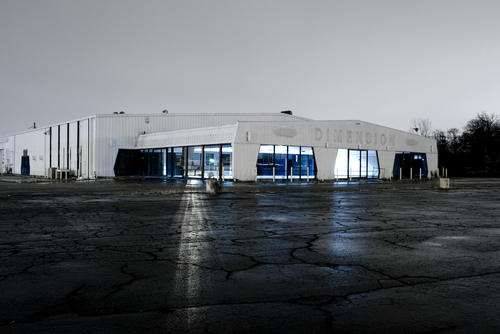
Yesterday Senate Republicans refused to support a bill to aid ailing U.S. auto makers. The New York Times report was accompanied by a photo of concerned pols, but I think this image gets to the heart of the matter.

This car dealership in Fort Wayne, Indiana had been vacated when the dealer moved to a new location. The photograph captures far more than the local news. A large, empty shell of building, surrounded by vacant space and cracked asphalt, reflecting pale light and a dull sky–the scene is an allegory of inertia, mismanagement, vanishing markets, and lack of vision.

Don’t expect to see it re-opened any time soon. The empty desolation of the photo captures the impact that shuttering the auto industry has on the economy. Each affected community is left with a big hole to fill and no obvious replacement.

I have no doubt that the bill, despite being endorsed by both the White House and Congressional Democrats, was not the best solution. I also doubt that the best solution was actually available at this time. Let’s hope a viable agreement can be crafted soon. No industry has ever deserved help less, but the Republicans shouldn’t blow up three states and put a hole in the side of the U.S. economy just because this is a good time to lean on the unions.

If there is a teachable moment here, it certainly includes several lessons about bad management. It also is yet another demonstration of the danger of minority rule. The Senate requirement of 60 votes for significant legislation seriously hampers the ability of the U.S. government to respond to important problems. The Senate Republicans can lecture the unions all the want, but their use of the supermajority rule exemplifies an inability to respond effectively to change–exactly the attitude that led the auto industry to their sorry state.

Photograph by Noah Gage/Flicker.

 3 Comments

An Act of Contrition

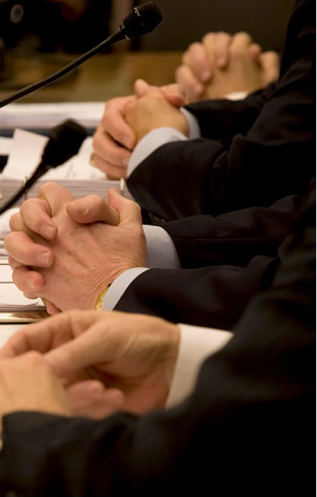
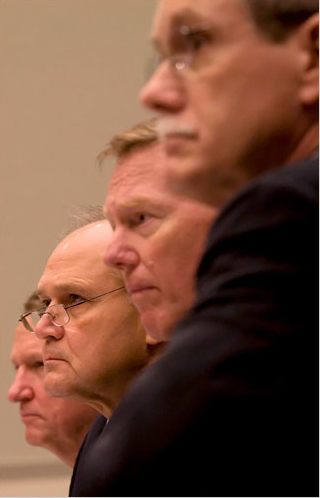
When the CEOs of the “big three” U.S. automakers came to Congress last month with hat in hand seeking a financial bailout they were admonished for their greed and arrogance—if not downright insensitivity—symbolized by the fact that they had arrived separately in private corporate jets.  When they returned this past week (via hybrid automobiles) they were a bit more contrite, as captured by the photograph below that appeared in a slideshow at the NYT website. They mark a pious stance, very much in keeping with the image of praying hands often associated with the “Act of Contrition”: “I am heartily sorry for having offended Thee … I firmly resolve with the help of Thy grace, to confess my sins, to do penance, and  to amend my life.”

The public performance of contrition is a puritanical art form—think of Bill Clinton’s multiple attempts to seek public forgiveness—that demands careful attention to a subtle and nuanced civic republicanism that negotiates the tension between individual humility and the capacity and resolve to do better.  One has to be both abject and majestic; totally subject to sovereign forces and yet capable of forging a virtuous path into the wilderness of the future.  It is not yet clear that the heads of the auto industry have entirely mastered the role, though the warm color temperature of the above photograph, as well as the one that followed it in the NYT slide show seems to signal some hope.

Cast in a cascading portrait that emphasizes file and not rank, their lips tightly pursed, their eyes riveted in unison upon the source of power and absolution—the duly representative agents of a sovereign “people”—the photograph offers the viewer the statuesque countenance of humble, virtuous men—the elect Captains of Industry—who understand the gravity of their past human failings, and yet nevertheless are eager to take on the responsibility to get the job done right.  Robert Nardeli’s eyeglasses are especially notable in this regard.  Symbols of human frailty, they sit low on the Chrysler CEO’s nose, allowing him simultaneously to see through them (to the immediate economic problem that sits in front of him) and over them (to the arbiters of the public trust).  Surely no less will be needed if the crisis is to be averted and the public’s faith is to be sustained.

But even as the second photograph above inflects the first, framing the act of contrition in the context of a traditional and stylized civic virtue, so too the very next photograph to appear in the slide show seems to inflect the first two photographs.  

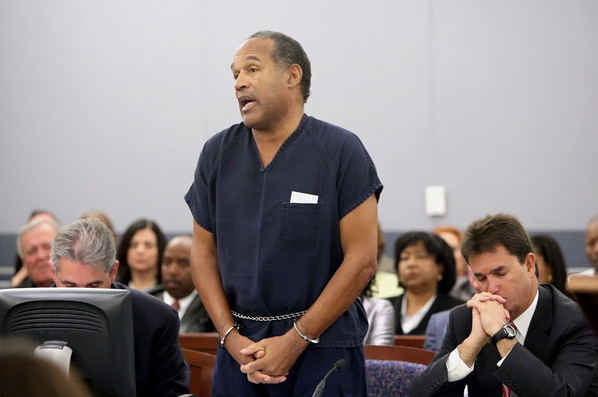
Here again we see the performance of an act of contrition, but the affect is altogether different: more farce than tragedy. The penitent is immediately recognizable, not just because his body is whole (in contrast to the fragmented bodies portrayed in the first two photographs), but also because of his celebrity and notoriety.  Having previously and arrogantly (if ambiguously) admitted to a dastardly crime for which he had been acquitted, here he seeks the mercy of the court by apologizing for his most recent “stupidity” by casting his crime as a “foolish mistake.”  The actual performance proved to be unconvincing to the judge, who sentenced the defendant to a minimum of nine years in prison with a 33 year maximum, but it is the photographic performance that bears special significance.

The success of public acts of contrition rely upon a modicum of belief that the “sinner” can rise above his or her human failings—or at the very least that a commitment to live up to the public’s faith will be treated with gravity and responsibility.  In this regard, there may be no greater crime than the arrogant disregard of the public trust.  And when such arrogance rears its head a second time, the warm tones that give the first two photographs their special cast and resonate with a hopeful future give way to the cold, harsh tones of reality evident in the last photograph.   Here, the body, no longer fragmented in terms of the mechanisms of human agency (hands and head) is intact, but more importantly, it also constrained and disciplined by both the instruments of the state (the shackles) and public opprobrium (evidenced by the expressions on the faces of the citizens sitting in the courtroom).  Scorned once, the photograph seems to caution, the people look on subsequent acts of contrition with profound skepticism.  And, we might add, as well they should.

Photo Credits:  Stephen Crowley/NYT; Isaac Bracken/Pool Photo  


 3 Comments

Hands of Death

Photojournalism is vexed by the problem of how to portray degradation and death without harming the dignity of those being photographed. The medium’s capacity for evoking emotional response and moral judgment cannot be separated from its ability to add insult to injury. With that problem in mind, one can appreciate why this photograph is not only striking but also an ethical achievement.
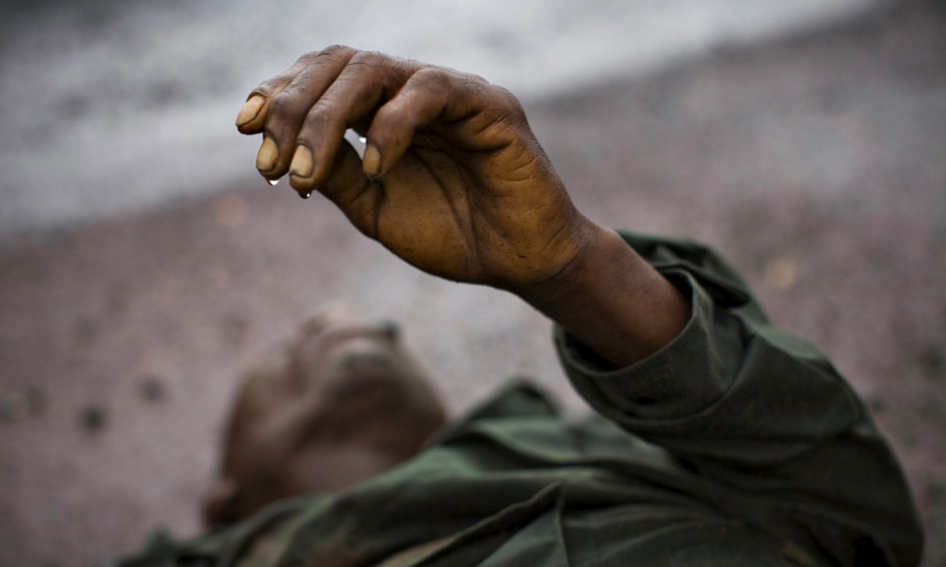
A Congolese government soldier lies dead in the road not long after having been shot in the head. He is one of many who have died or will die in the continuing violence in central Africa. It is easy to immediately think of him as a statistic. Another distant victim in yet another civil war, one about which the viewer probably has no interest, no knowledge, no connection. A war that becomes merely another example of the seemingly endless violence spreading through the jungles and across the deserts and up into the mountains around the globe as poor people are recruited to maim and kill one another for the benefit of unseen warlords.

Thus, it can be easy to dismiss him, except for that hand. There is something achingly beautiful about it. It seems so alive, or if we know otherwise, so etched with life. It is a particular hand, not the abstract symbol of labor, but the hand of an individual whose lifetime of experiences, however common, were encountered with all the particularity evident in each crease of skin, the line of each cuticle, the smudge of dirt. More than that, the image evokes all the skill of a hand, its capability for craft and communication. Caught in a last gesture, this hand seems to still want to communicate, to reach out or up, to plead, perhaps, or to touch and say goodbye.

We know that he is dead, however, and so the raindrops on the fingers become poignant. They course down his limb, set in rigor mortis, as they do on any other inanimate thing, and yet they still seem to signify life. As if he were still capable of bleeding, or of washing, as if he could perhaps be revived with cool water. But the point is not to keep hope alive. Rather, the hand offers mute testimony to the value of the life that has been lost. It presents him as an individual person but not merely because he had a name or a personality. And it records his death with dignity, suggesting how much has been lost without showing the devastation of the head wound.

Photojournalism can not be satisfied with avoiding habits of dehumanization, however, as it also has to confront and expose those practices in their worst forms, which are not done by shooting with a camera. This second photograph was in a number of slide shows recently, perhaps because it captures so well the gross destructiveness of war.
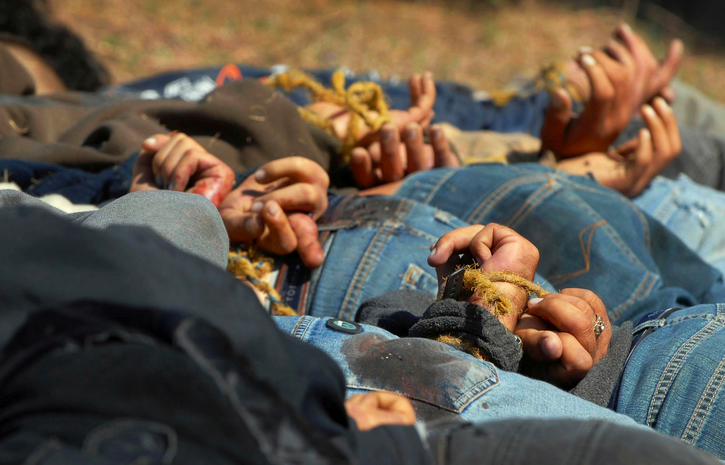
These are the hands of men executed near San Ignacio, Mexico. They are among the latest casualties in the border wars between Mexican drug cartels. (For a current report on the violence, see “Day of the Dead” in The Observer/The Guardian.) The photo documents the practice of tying up the victims, which in turn implies that this was a planned execution characteristic of high level gang warfare. It also captures the fact of murder without revealing the identities of the victims or the full violence done to their bodies.

These hands in this image accomplish something different from the work done in the first photograph. Where before dignity was salvaged from chronic violence, now the shameful nature of mass killing is exposed. These men were left this way to demean them, while the photograph exposes where the shame really lies–with those who kill, and with those could try to stop the killing but look the other way.

Equally important, now the implicit metonymy of hands signifying labor is rightfully in play. These men could have been productive laborers (and managers) had the work been available. Whatever bad choices they might have made, the narco-economy and its attendant carnage involves a terrible waste of human potential. The drug trade, like the arms trade, is a global business, and globalization can spread destructiveness just as easily as it can generate wealth. If hands could speak, these would beg to be given a second chance, one with real work that could lead to a better life.

The hands do speak. The question is, who is listening?

Photographs by Finbarr O’Reilly/Reuters (via The Big Picture) and the Associated Press.

Update: Thanks to Michael Shaw for the double post at BAGnewsNotes, where you can read additional comments by readers there.

 9 Comments

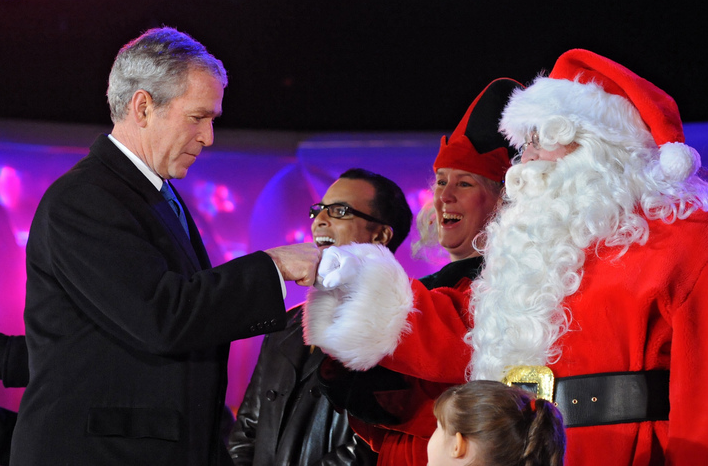
Sight Gag: "Fox News Update! Santa Claus Photographed Engaging in Terrorist Fist Bump!"

Credit: Jahi Chikwendiu/The Washington Post

The “Sight Gag” is our weekly nod to the ironic and carnivalesque in a vibrant democratic public culture. We typically will not comment beyond offering an identifying label, leaving the images to “speak” for themselves as much as possible. Of course, we invite you to comment … and to send us images that you think capture the carnival of contemporary democratic public culture.

 0 Comments

100 Awesome Photo Sites

Kelly Sonora at artcareer.net recently notified us of a list of the “100 Awesome Niche Photo Sites You’ve Never Heard Of.” The categories include organizations, photojournalism, outdoor and travel, wedding, event, and portrait, fashion and commercial, science and medical, fine art, education, DIY, business, technique, Photoshop, resources, photography law, and gear.

Other lists at the site include 100 free, essential web tools for digital artists, 100 must-see art blogs of every form, and 100+ awesome open courseware links for artists.

And that leaves only the big question, what kind of image would be appropriate for this post? Unfortunately, Art Career has not yet compiled a list of 100 awesome photographs for announcements on No Caption Needed. So, let’s go with this:

Photograph by Marc Moritsch, from a display of “Patterns in Nature: Lava” at National Geographic.

 2 Comments

Terrorism: The Day After

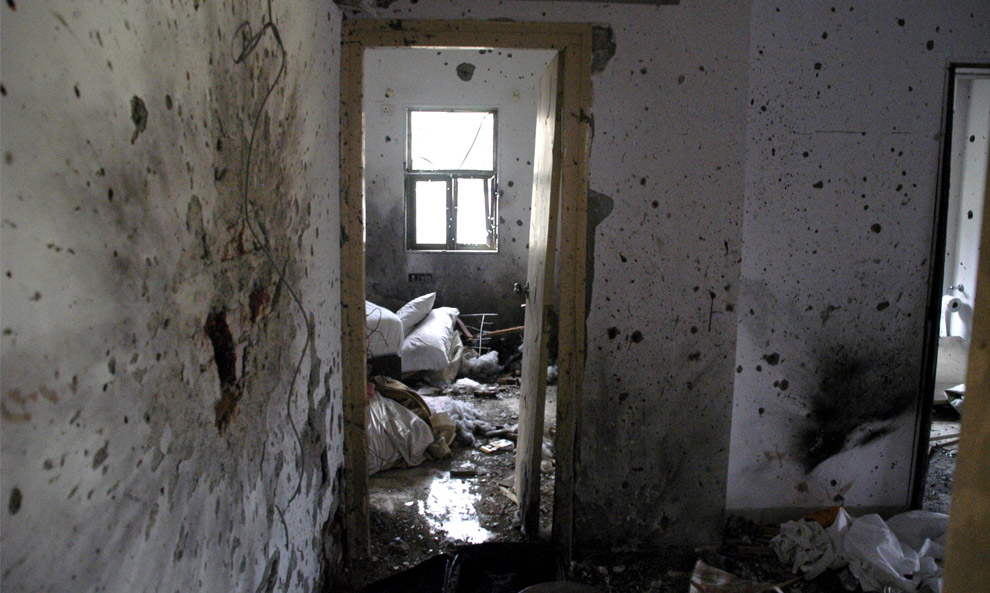
The terrorist attack in Mumbai may have been unusual in the scale of the assault and the firepower involved, but it soon was folded back into a familiar succession of images: smoke and fire billowing upwards from tall buildings, trapped individuals looking out of windows for help, soldiers and other emergency personnel converging on the scene, survivors being taken to hospitals, . . . and then images of assailants, victims, grieving families, and candlelight vigils. Now, as the attacks slide into the past for most of the world, we are left with shots of the physical destruction and initial efforts at restoring a sense of normalcy. These, too, are conventional, but I found two of them to be deeply evocative.

You are looking at a room in the Taj Mahal Palace & Tower Hotel in Mumbai. By peering into the rear of the picture, one can pick out security personnel, but they might as well be receding into the vanishing point. This image is the portrait of a room. More precisely, of the wreckage of what was once a room but now has been reduced to space and debris. There is something at once majestic and terribly sad about this ruin. The alternation of light and shadow could be the work of an Old Master, but that aesthetic reclamation only underscores the pathos of other human work having been torn down. The large fixture now laying on the floor near the center of the frame is a globe within a globe–the fitting symbol for how a hotel becomes a small world within the world of the city, itself a sphere within the human cosmos. Terrorism, like its older brother War, tears down worlds.

One small irony behind this poignant image is that the decor of the room before the attack might have struck one as garish or otherwise not to one’s taste. We can afford to be discriminating and judgmental, or inattentive and unappreciative, when things are not disrupted by violence. Amidst the wreckage, we are confronted with larger questions of loss, and so of what really should be loved.

This is an interior view of Nariman House, maintained by the Chabad Lubavitch organization. This image of the devastation caused by combat is perhaps even more disturbing than the one above, as it hits closer to home. Instead of the scale and decor of a grand hotel, we see the small spaces and frame doorways found in houses and apartments. Instead of a massive fixture for a public space, we see bedding and a broken bedframe, and, on the right, even a roll of toilet paper untouched by the carnage. The cumulative effect is awful. In place of what had been a familiar simplicity, there now is only an ugly mess. What should be a place for rest, repose, and taking care of the self, and for dreams, love, and creating a life with others, has been trashed, torn apart, violated.

Terrorism is one of the seeds of war, and like all war, it makes a mess of the world. What takes years of commitment, creativity, and effort can be ruined in minutes. These photographs of devastation remind us that war doesn’t just kill individuals, although that is horrible enough. The real target is civilization itself, that is, the built world that sustains communities, commerce, art, science, politics, friendship, families, and everything else that people find necessary for human life.

Photographs by Julian Herbert/Getty Images and the Associated Press.

 0 Comments

On The Relationship Between Black Thursday and Black Friday

Much has been made recently of comparisons between the Great Depression of 1929 and the current economic crisis all the way to the point of framing President-elect Barack Obama as the twenty-first century’s FDR.  Only time will truly tell if the analogy will be borne out (no pun intended), but there are good reasons to be skeptical.

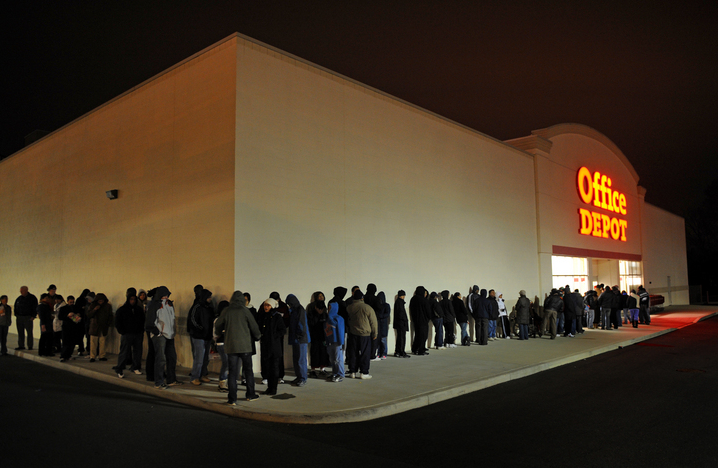
The photograph below is one of a number of similar images that appeared in on-line stories  and slide shows at a number of major newspapers this past weekend, reporting on “Black Friday”—the so-called “traditional” beginning of the Christmas shopping season.

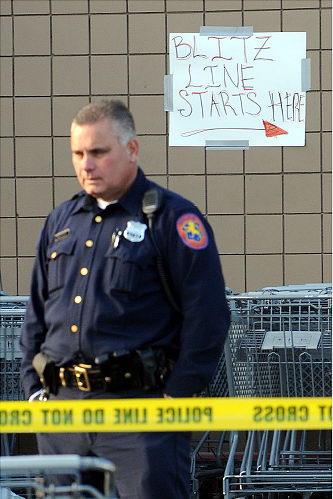
This photograph shows hundreds of shoppers lining up at 4:30 a.m. at an Office Depot near a mall in the Washington D.C. area, though comparable scenes were more commonly displayed at places like Macy’s and Wal Mart.  And while the visual tableau depicts an orderly line of consumers (or are they “utility maximizing rational individuals”?), the opening of the doors at 5:00 a.m. here and elsewhere unleashed a rabid feeding frenzy of consumerist gluttony (and one more for good measure). At a Wal Mart in Long Island, a riotous mob of 2,000 shoppers broke down the doors to the store and trampled a worker to death, all in the interest of saving $20.00 on a 50″ HDTV. And to put it all in perspective, Wal Mart anticipated the problem by hiring extra security and directing the behavior of its shoppers with a posted sign:

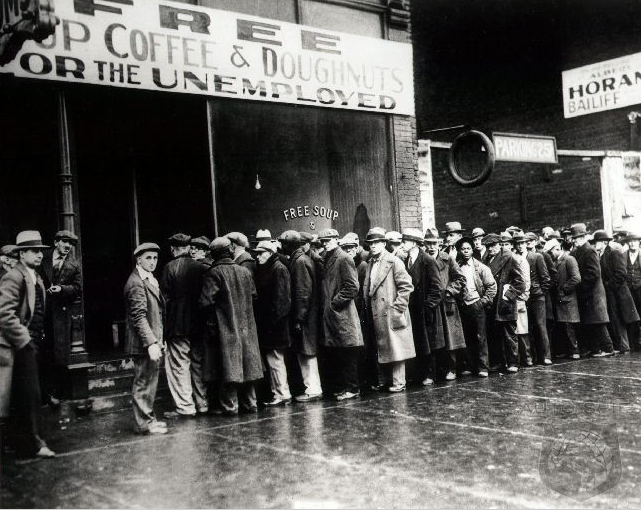
Such behavior, whether that of rational calculating individuals or greedy and riotous consumers—or mindless and insensitive store managersstands in marked contrast with the pictures most often affiliated with the Great Depression—the world that gave us “Black Thursday.”  

The difference, of course, is stark and pronounced. Then unemployed citizens lined up for free food (provided by civic organizations of one sort or another)  to satisfy their most basic physical hunger; today we line up as consumers to purchase mass produced items (provided by global capitalism) that satisfy a different, fundamentally psychic hunger. Then the government developed public works projects designed to enhance our national infrastructure and to provide employment for those most in need; today the government pumps hundreds of billions of dollars into the economy in order to “ease credit markets” (its own version of the “Blitz Line Starts Here” sign) and to encourage consumption.  And we are surprised when citizens accumulate debt by spending on credit rather than saving for a rainy day—or worse, trample and kill fellow citizens to purchase luxury items.  Indeed, we actually wonder how we got into the current economic crisis.

It may well be too late to turn back the clock to a time when being a good citizen and being a good consumer were separate identities, but if the soon-to-be President Obama is to live up to the comparison to FDR he is going to need to help Americans to understand the difference between the two, as well as the implications for our national character of the relationship between Black Thursday and Black Friday.

Photo Credits:  MIchael Williamson/Washington Post; Fariella/News; Unknown/National Archives


 8 Comments

Sight Gag: "And they say he is a lame duck president!"

Credit: Larry Downing/Reuters

The “Sight Gag” is our weekly nod to the ironic and carnivalesque in a vibrant democratic public culture. We typically will not comment beyond offering an identifying label, leaving the images to “speak” for themselves as much as possible. Of course, we invite you to comment … and to send us images that you think capture the carnival of contemporary democratic public culture.

 0 Comments

The Family Photograph

Guest post by Aric Mayer.

Over the past three generations, the volume of images casually generated out of family life has increased exponentially. From the early 1900s when the Brownie camera made photography something that can be practiced easily, families have made records of important events and people, hoping perhaps to create traces and artifacts that can bind the past into the present, keeping time from marching away. There is also the strange paradox that occurs as we stage current events in order to photograph them so that we can look back at a future time and see them again. We perform for a future audience of our selves and our friends, rewriting history as we live it. As film and now digital technologies have developed, the ease and number of these types of images has gown. It is hard to know what the final impact of this flood of visual information will be on the next generation.

Exactly eighteen months ago my wife gave birth to our two children Laszlo and Chloe. In our short year and a half as a family there is already the sense that time and events are forever passing—the first tooth, the first steps, the first words … every week seems to bring another first, and with it comes loss. The temptation is there to record everything, to make an effort to translate life into a document that we can hold and thereby inoculate our selves from the losses that time brings.  That would be impossible, of course, but it doesn’t stop me from trying, as in the process I have accrued 20,000 photographs of our personal lives together.

I recognize that when I am photographing, I am not simply recording events, but rather am converting them into frozen dioramas that do not necessarily recall the moments that they come out of. It is entirely possible to make a beautiful picture in the middle of crying and chaos. Likewise visual chaos can be made out of the mundane.

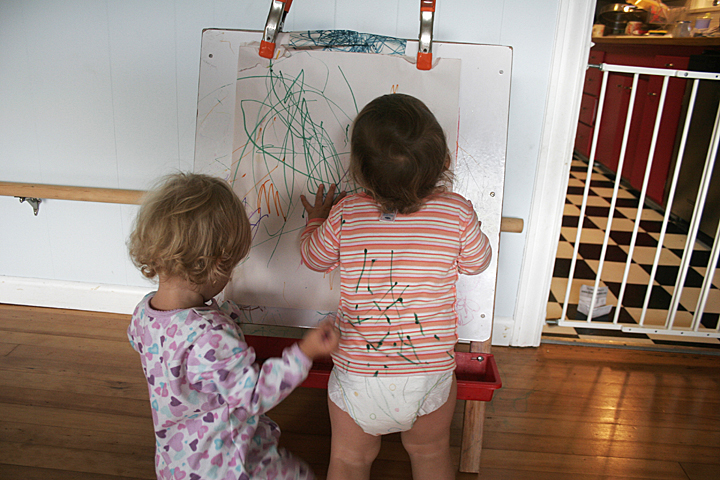
The photograph above is one of my favorites. Laszlo is drawing on paper. Chloe is drawing on Laszlo. And I am converting the scene into an image that frames them in that moment, creating a drawing of my own. It speaks to the multiple ways that we as families leave un-erasable marks on each other at so many levels. 

The taking of family photographs is not simply a way of stopping time or recording the present for future consideration. It is also a way of organizing how we see ourselves. After a day with my children, I still on occasion set up a slideshow on my computer and watch my photographs from that day for half an hour or more. Even though I was with them in person for the day, the photographs bring something different than our relational interactions. These images are also about me. Not in a narcissistic sense, although we must be careful how heavy handed we are in shaping our children’s images of self. These pictures contribute to how I see them and to how I organize my understanding of their place in my life. Included are pictures of the crying, scrapes and bruises, bad days, the other half of the picture. It is an intensely personal body of photographs. And by the time my children are in their early twenties, they will inherit hundreds of thousands of these images. Along the way I will select a few thousand that stand out for me. Who knows what these will mean to them? What will we even do with such an amount?

Editors Note:  The National Gallery of Art hosted a show titled “The Art of the Snapshot” in 2007.

 1 Comment

"Shane! Come back!"

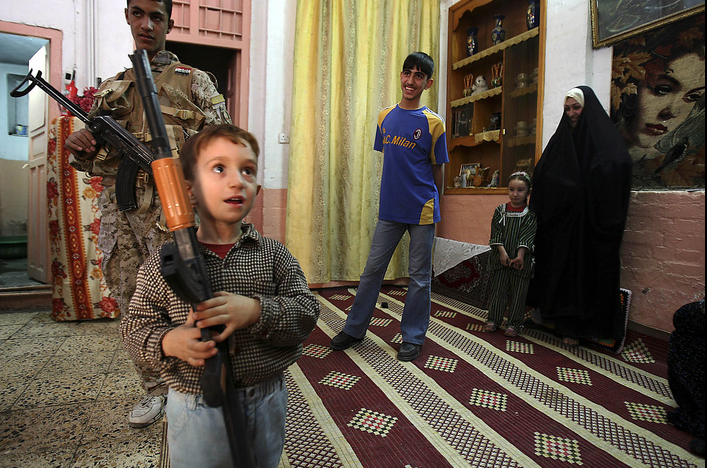
I have written previously about the regularity and profusion of photographs of children in the Middle East—Israeli, Pakistani, and Iraqi children in particular—playing with toy guns. Such images operate in a somewhat allegorical register as they invoke one or a number of ironic, dialectical incongruities between child and adult, innocence and maturity, play and reality, the pleasure and horror of war, plasticity and steel, “their” present and “our” past, and so on.  This photograph seems to capture all of that and something more.

The caption reads: “An Iraqi boy holds a toy gun during a joint American and Iraqi military security sweep in the neighborhood of Sariyah in Baghdad, Iraq.”  The key to the image, however, is in recognizing that the toy gun is incidental to the scene that that we are witnessing.  The boy holds a toy weapon, to be sure, but he does so awkwardly as if he doesn’t quite know how to use it, and in any case he does not hold it in a manner that might be thought of as threatening—or  even effective.  Nor is it the toy itself that draws the viewer’s attention—the caption to the contrary notwithstanding—but rather the young boy’s gaze.  But what could he be looking at?  What does he see?  And where have we seen this image before?

Of course, we cannot know for sure what he is looking at.  But the soldier standing behind him is Iraqi, and the boy is clearly not looking at the photographer, who is positioned at an oblique angle to the field of vision.  Given that the caption identifies this is a joint Iraqi-American “military security sweep” it stands to reason that the boy has fixed his gaze upon the American soldier—or at least that is what the interaction of image and text invites us to imagine. And what he sees there is clearly something that pleases and inspires him.  Indeed, it is the look of a child’s wonder, perhaps even hero worship, as if in the presence of a powerful and incorruptible majesty. One might discount it as the misdirected gaze of youthful innocence and naiveté but for the fact that the family members in the background giving their smiling approval to the scene that unfolds before their eyes as well.   

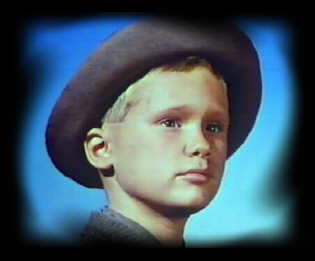
The young boy’s gaze is not new to us, at least not to those of us who were raised with the myth of the American west, where physical strength and a skill with six-guns (and the resolve to use both when necessary) served as individual virtues necessary to taming an otherwise dangerous frontier and to making the world safe and secure for democracy and domesticity.  Indeed, the boy’s gaze almost perfectly mirrors the look of Joey Starrett in the 1950s western Shane, the young boy (played by Brandon DeWilde) who worships the title character—a somewhat mysterious stranger with a gunslinger past that he is trying to forget nevertheless draws upon his strength of character to save the homesteading community from a brutish cattle baron—for precisely these virtues.  At the end of the movie, after having completed his work, Shane moves on, even as Joey cries “Shane! Come back!” for he knows that there is no place for him in the world that he helped to make safe.

It is highly unlikely that the photographer knew of or was modeling a sluice of U.S. popular culture circa 1950, but given the ways in which the Bush administration has framed the intervention in Iraq from the very beginning as an extension of our history as a gunfighter nation, the analogy—what biblical hermeneutical scholars might call an anagogical relationship or “in spirit” comparison—is apt.  And the current situation in Iraq makes the Shane myth all the more attractive as an interpretive frame for those who think of the U.S. military as the western hero carving out a path for civilization in the wilderness, leaving behind a feminized and domesticated community beholden to the those with the character and resolve to do the hard work at great personal expense.  As the U.S. allegedly prepares to leave one can hear this young boy’s plea to stay.  We can only hope that the incoming administration has the same good sense of Shane to realize that he has to move on

Photo Credit:   Hadi Mizban/AP

 0 Comments