Apr 28, 2013
Mar 27, 2009
Jan 31, 2014
Jan 28, 2013
Jun 02, 2014
Feb 17, 2012

Playing Through in Joburg

Things are not going well in the global street these days. The migrations created by wars, civil wars, failed states, famines, and the sheer anarchy loosed on too much of the world is driving people to the brink–and beyond. Every day the slide shows at the major papers catalog new scenes of deprivation, along with the familiar demonstrations that soon follow. Hands in the air, pushing against the police line, nameless masses call out for justice and for bread. And then the news moves on to the typhoon or the earthquake or the election or the game. What else can it do?

It was against this background of constant yet distant disruption that the photograph below stood out.

The New York Times caption read, “In settlements around Johannesburg, the belongings of fleeing immigrants have been looted, and their dwellings torn apart by mobs. Left, a resident of Ramaphosa used a golf club to demolish a shack.” That’s right, a golf club.

Like Barthespunctum, that club is the detail stabbing through the screen of cautious buffering that I bring to the news. Whereas the other photos became merely instances of familiar categories–the riot, the police response, the official Statement of Concern–this one disrupts deeper assumptions. What is going on? Does he actually golf? His form is pretty good: left foot planted, head down, letting the club follow the strong torque through the hips–this should be a a good rip.

OK, some will say that he probably stole the club. But not to sell it, apparently. Everything else in the scene fits the conventional story of poverty and the breakdown of social order. In that story, people throw rocks and set tires and cars and shanties on fire because, really, what else can they do? And in that story, the world is partitioned into safe zones and “trouble spots” sure to be somewhere else. We can play by the rules, keep score, be civil–“would you like to play through?” They can be left to their spasms of self-destruction.

Except for that damned club, which suggests that the two worlds overlap after all. If there can be golf in shantytown, then there could be riot at the country club. From that perspective, there is reason to pay attention to those behind you.

Photograph by Joao Silva/New York Times.

 3 Comments

Sight Gag: Save Us from the Commies!

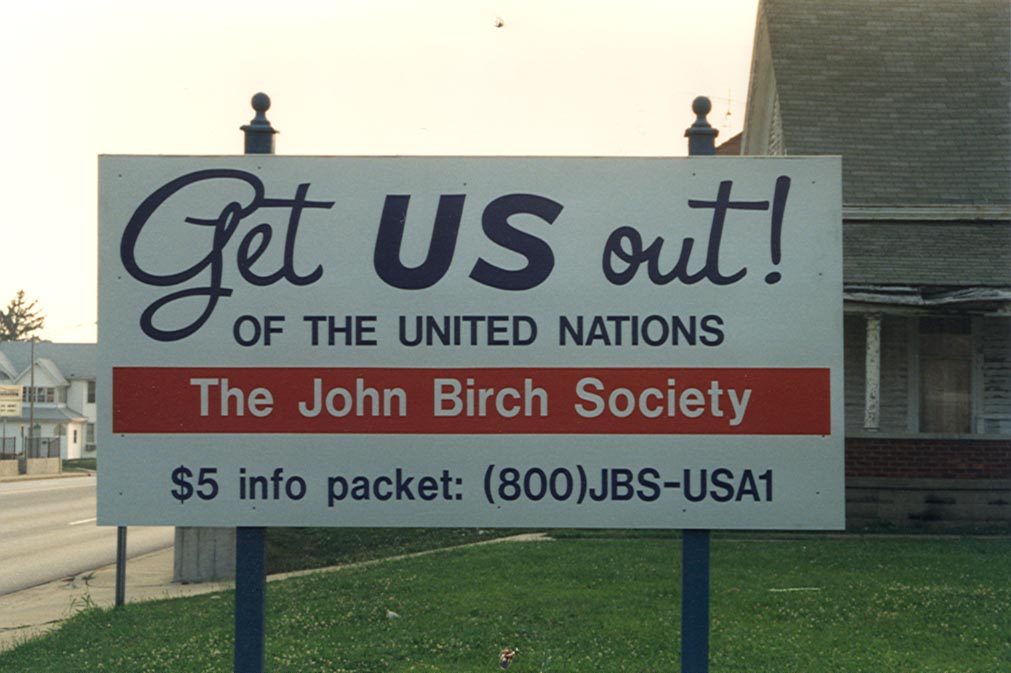
get-us-out.jpg

Photo Credit: John Lucaites

Our primary goal with this blog is to talk about the ways in which photojournalism contributes to a vital democratic public culture. Much of the time that means we are focusing on what purport to be more or less serious matters. But as John Stewart and Stephen Colbert often remind us, democracy needs irony, parody, and pure silliness as much as it needs serious contemplation. For our part, we will dedicate our Sunday posts to putting some of that silliness on display in what we call “sight gags,” democracy’s nod to the carnivalesque. Sometimes we will post pictures we’ve taken, or that have been contributed by others, or that we just happen to stumble across as we navigate our very visual public culture. And we won’t just be limited to photography, as a robust democratic visual culture consists of much more. We typically will not comment beyond offering an identifying label, leaving the images to “speak” for themselves as much as possible. Of course we invite you to comment … and to send us images that you think capture the carnival of contemporary democratic public culture.

 3 Comments

BUILT: Naming, Acting, and the Changing City

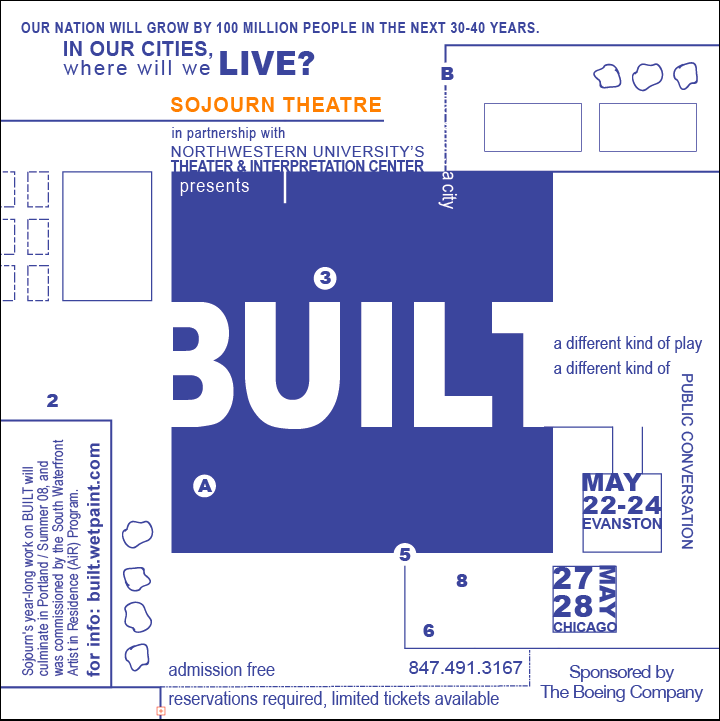
BUILT explores the changing city in the US and the challenges that will affect housing, infrastructure, neighborhood cohesion, and equity in the coming years. BUILT is a series of research, installation, dialogue, interview, and performance events of varied scale, including the opportunity for public conversation offered at this blog.

This week we celebrate the culmination of academic and public discussion in other forms of cultural performance. For those in the Chicago area, don’t miss the second image below. The first image is for any reader near or far who wants to play a name game. The image outlines a simple game. The game is named BUILT, but let’s pretend that is not going to sell. Another name is needed–one that will both capture the public imagination and communicate the idea of citizen participation in urban development. Now, conjure a name for the game.

Or, if the name alone isn’t going to do the trick, suggest changes that ought to be made in the game: What steps should be added or skipped? Should the visual design be altered or changed completely? How do we imagine change or development or getting people involved in making decisions about the urban fabric?

And if you have the opportunity, you might want to continue the conversation here:

BUILT is a performance/civic dialogue project and a collaboration of Northwesten University’s Theater Department & Portland, Oregon’s Sojourn Theatre, led by visiting artist Michael Rohd.

 0 Comments

In Memory of Making Sense Out of Senselessness

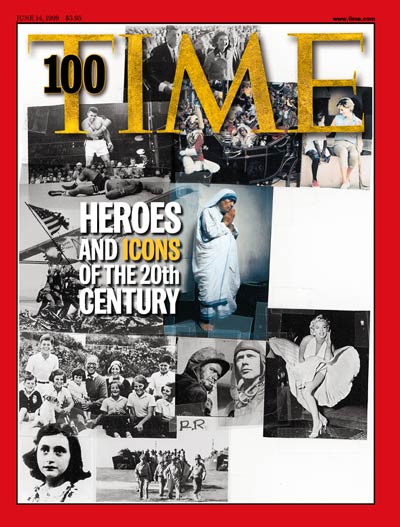
Last week we missed the passing of artist Robert Raushenberg (1925-2008), who maintained that he worked “in the gap between life and art.” Characterized as a “neo-dadaist” his work challenged the difference between traditional art objects and the objects of the everyday world (including everything from the “junk” one might find on the streets to snapshot photographs), creating what became known as “combines” and “assemblages.” By some accounts he sought to make “sense out of senselessness.”

Often controversial, he was also a prolific artist and his work occasionally graced the cover of Time magazine. He will be missed.

Note: For a commentary on the conflicted reception of Raushenberg’s work see James Johnson’s post at (Notes on) Politics, Theory, and Photography.

 0 Comments

The Many Shades of Racism

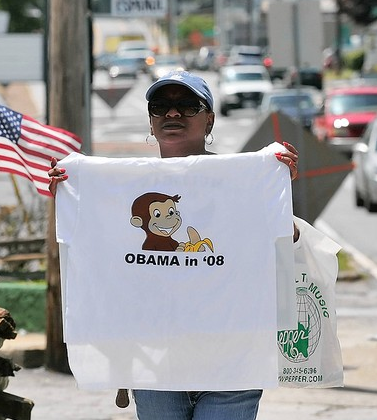
I learned to read at the age of five because of the tireless efforts of my grandmother who would spend hours teaching me how to sound out words and then sentences after working a full shift on a factory assembly line.  There wasn’t much money to buy books and so all that we read came from the public library.  Each Saturday we would get five new books.  And the books that I loved the most were a series of tales about a mischievous monkey by the name of Curious George who had been “rescued” from his native Africa and taken to live in a big city by “The Man in the Yellow Hat.” I would check the same ones out over and again, never tiring of reading about George’s adventures. I was reminded of all this recently when I encountered the image above and the recent controversy it sparked in Marietta, Georgia.

By now you probably know the issue.  Bar owner and ultra-conservative Mike Norman was selling the t-shirt displayed in the above photograph.  When challenged that the image was offensive to African-Americans he recoiled, claiming that he was “no racist” and that he had simply “seen” a resemblance between Senator Obama and the monkey while watching a cartoon movie.  In his words, “Look at him … the hairline, the ears, he looks just like Curious George.”  According to Norman, the comparison to a monkey was simply coincidental.  Watching Norman on CNN I initially considered the possibility that he was simply an uneducated redneck who really didn’t know how truly offensive and racist the image was.  That assumption was quickly proven false when it became clear that Norman was a notorious local provocateur (one sign outside of his bar announces, “I wish Hillary had married O.J.; another reads “INS agents eat free”) and he later acknowledged that he understood the connection between the image and racist stereotypes of the Jim Crow South, averring, “this is 2008 … not 1941 in Alabama, so get over it.”  But the question for me was whether someone could identify with the image of Curious George and not know that it was a racist image.  Was my grandmother a racist because she had allowed me to develop a close attachment to Curious George in the 1950s?  Was I? 

The answer to these questions, I fear, is yes.  Or at least a qualified “yes” with the acknowledgement that racism comes in many shades and that some are much easier to see (or to veil) than others.  As an example that seems less obvious to the sight, consider columnist Kathleen Parker’s recent endorsement of those who “would be more comfortable with ‘someone who is a full-blooded American as president’.”  Her argument is that politics is now driven by a “patriot divide” animated not by race or gender but by “blood equity, heritage, and hard-won American values.” And lest there be any confusion as to the target of her argument, she notes “Hillary has figured it out.  And the truth is, Clinton’s own DNA is cobbled with many of the same values that rural and small-town Americans cling to.  She understands viscerally what Obama has to study.” 

It is hard to know where to begin here.  But surely it is difficult to imagine an appeal to “blood equity” that isn’t fundamentally racist at its core.  And that one candidate can know America’s underlying core values “viscerally” while the other can only “study” it would seem to make the point.  Or maybe, like Mike Norman’s claim that his comparison of Obama to a “cute” monkey was only coincidental, so too, perhaps Parker’s contrast is simply a matter of happenstance. But I think not.  Norman, after all, is a caricature of himself, a local character that we might find in an episode of The Dukes of Hazard seeking out his fifteen minutes of fame; Kathleen Parker is a syndicated columnist whose reasoned missives are featured nationally as part of the Washington Post’s writer’s group.   Norman, it would seem, is really just trying to make a buck by selling parodic t-shirts and beer to his local constituency, and so perhaps he has an excuse (i.e., racism sells, or as he puts it, “it’s my marketing tool”), but what is Parker’s excuse?  I’m really curious to know.

Photo Credit:  Thinh D. Nguyen/AP

 10 Comments

Private Grief and Public Life

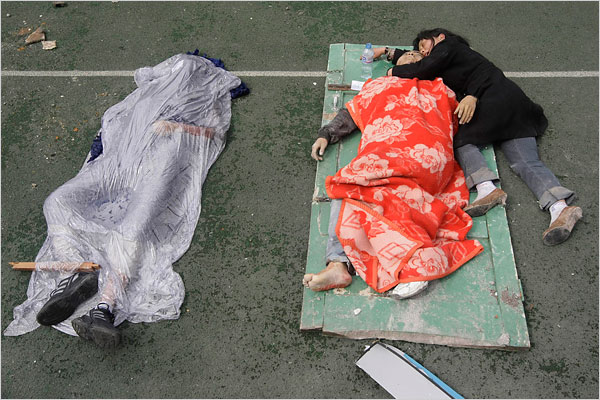
I’m not sure why, but the photos from China that have been devastating. Disaster coverage is familiar to everyone–whether it’s twisted wreckage or a bloated corpse, long lines of refugees or supplies stacked on the tarmac, we’ve seen it before. And we’ve seen people crying over lost homes, villages, loved ones. But somehow not like this:

Can a photograph be more tender, or more heartbreaking? The contrasts only make everything worse by underscoring deeper similarities. He looks as if he still could be alive, but he is as dead as the hardening body shrouded next to him. His covering is colorful, alive with color, but that only marks the vitality that has been lost. She holds him so lovingly, as if they had fallen asleep in each others’ arms, but she will never hold him again.

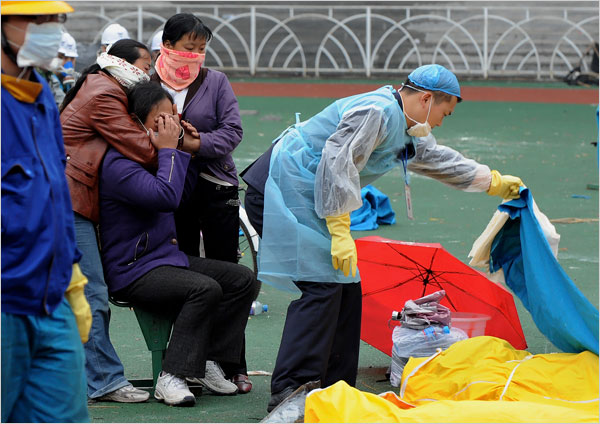
Nor is she alone in her loss. There are many images of parents, sisters, friends, stricken in their grief. Like this:

This woman has just identified a loved one. The shock is palpable–a heavy body blow driving her into herself. (The English word “grief” derives from the Latin gravis, heavy.) Her hands claw at her face, as if to scratch out her eyes. Other friends or family are with her, holding her, yet she is inconsolable.

This photograph is less elemental than the first. Instead, it is cluttered with signs of the public character of the disaster. A uniformed emergency worker fusses with tarps and other material while overseeing the body bags. The background suggests some public venue (a stadium?) and a stranger walks by on his own business. The informal masks, which are an indication of mass death, also signify the anonymity that divides private lives and public interaction. And that’s where we come in: anonymous spectators far away from those whose lives are being ripped apart in full view of the world press. Some writers on photography are appalled by the visual mediation of suffering, and they could describe these images as a voyeuristic indulgence in false sentiments that deaden genuinely ethical relationships.

And they would be wrong.

Second photograph by Mark Ralston/AFP-Getty Images; I misplaced the credit for the first photo but hope it will turn up.  (If anyone can let me know, it would be much appreciated.)

 3 Comments

What Disaster Photos Reveal

Photojournalism about natural disasters has always served a political purpose, which is why authoritarian governments censor it as much as anything else. US coverage of foreign disasters has at least two themes: first, demonstrating our magnanimity and the wealth; second, suggesting that authoritarian governments are incapable of helping their own people. Frankly, I’ve always liked the second half of this story: it’s good to be reminded that democracy, though not perfect, still works better than non-democratic regimes. Apologists for dictatorship rely on the conventional wisdom that dictators are more efficient than democracies. That overlaps with other hierarchies as well and so it seems natural to think that you can make the trains run on time by keeping decisions in the executive suite.

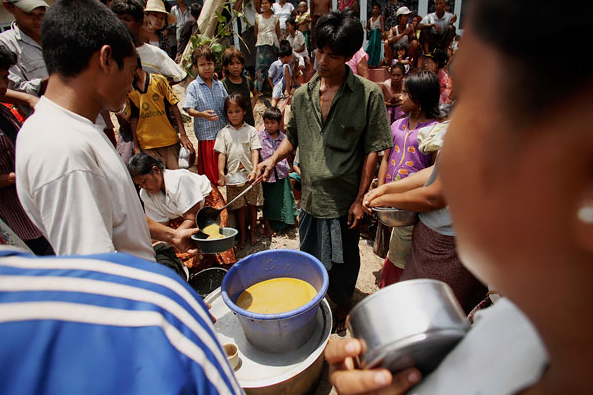
So it is that I don’t mind seeing Myanmar exposed for what it is, a brutal, incompetent regime whose only priority is holding on to power. When coupled with the many reports of that government’s control–and theft-of international relief, photographs such as this one speak volumes:

The government is not in sight, and people seem to be making do with whatever they were able to scrounge or share. The New York Times caption included the report that “Nearly one week after a devastating cyclone, supplies into the country were still being delayed and aid experts were being turned back as they arrived at the airport.” Look again at the one pan of food, then at the children waiting to be fed, and do the math. There is not going to be enough to go around.

Because of my commitment to democracy, I don’t mind this political message being added to the reportage. For that very reason, however, coverage of the earthquake in China should be seen as a genuine challenge to American complacency. Despite staggering levels of destruction and enormous difficulties due to terrain, weather, the remoteness of the region, and wreaked infrastructure, the response of the Chinese governments at all levels has been superb. From local first responders to mobilization of medical personnel on a large scale to sending in 100,000 troops, the scale, coordination, and competence has been obvious. In addition, you might also note the high levels of modernization and affluence. The heavy equipment, medical supplies, temporary shelters, equipment, clothing, and more are first rate.

There are dozens of photographs supporting this story, including this one:

Civilians are being helped around a mechanical hoe that is being used to clear a mountain road. That late model Volvo probably wasn’t airlifted in. As the refugees are helped out, fully laden and unarmed troops march in to the disaster area. People seem to know what they are doing.

Initial coverage in the US included criticism of Chinese restrictions on media coverage. When those restrictions were quickly ignored by the Chinese themselves and then lifted by the government, the criticism ended for the simple reason that there was nothing left to fault.

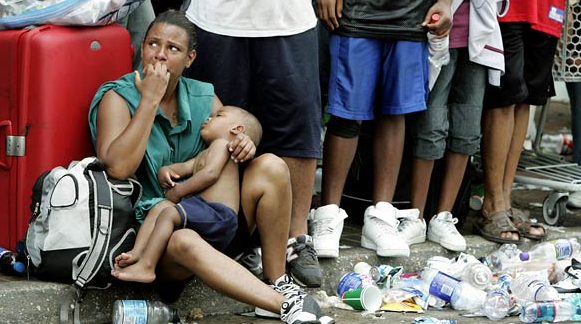
And so we get to Katrina. Although the response to that disaster may have been better than that of the despot in Myanmar, it nonetheless was terrible. Nor could the US claim that it was in a remote region or that vital infrastructure had been destroyed–Interstate highways went right to the door and the port remained open. So let’s take a moment to recall how things looked on the fourth day after the flood:

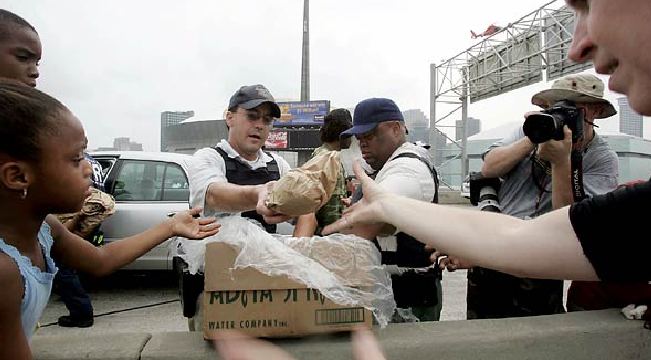
And the food? Peanut butter sandwiches:

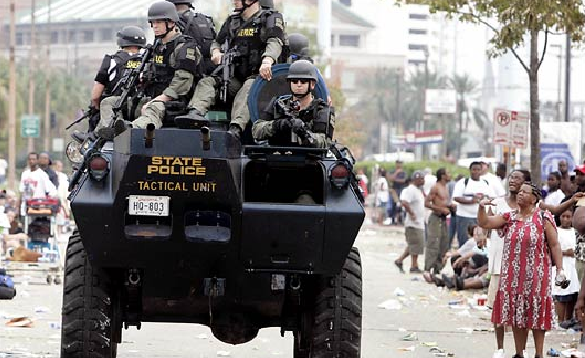
And the troops?

None of this is the full story. There were differences that have not been mentioned. Visual evidence, like any evidence, should treated with some skepticism. But, still. US or China: which scene looks more like a third world society–and a third world government?

Photographs by Chumsak Kanoknan/Getty Images; Du Bin/New York Times; Eric Gay/Associated Press; James Nielson/AFP-Getty Images; Eric Gay/Associated Press.

 5 Comments

Sight Gag: Stayin' Alive

Photo Credit: Alex Wong/Getty Images

Our primary goal with this blog is to talk about the ways in which photojournalism contributes to a vital democratic public culture. Much of the time that means we are focusing on what purport to be more or less serious matters. But as Jon Stewart and Stephen Colbert often remind us, democracy needs irony, parody, and pure silliness as much as it needs serious contemplation. For our part, we will dedicate our Sunday posts to putting such moments on display in what we call “sight gags,” democracy’s nod to the ironic and/or the carnivalesque. Sometimes we will post pictures we’ve taken, or that have been contributed by others, or that we just happen to stumble across as we navigate our very visual public culture. Sometimes the images will be pure silliness, but sometimes they will point to ironies, poignant and otherwise. And we won’t just be limited to photography, as a robust democratic visual culture consists of much more. We typically will not comment beyond offering an identifying label, leaving the images to “speak” for themselves as much as possible. Of course we invite you to comment … and to send us images that you think capture the carnival of contemporary democratic public culture.

 0 Comments

BUILT: Why Can't Bikes and Cities Just Get Along?

BUILT explores the changing city in the US and the challenges that will affect housing, infrastructure, neighborhood cohesion, and equity in the coming years. BUILT is a series of research, installation, dialogue, interview, and performance events of varied scale, including the opportunity for public conversation offered at this blog.

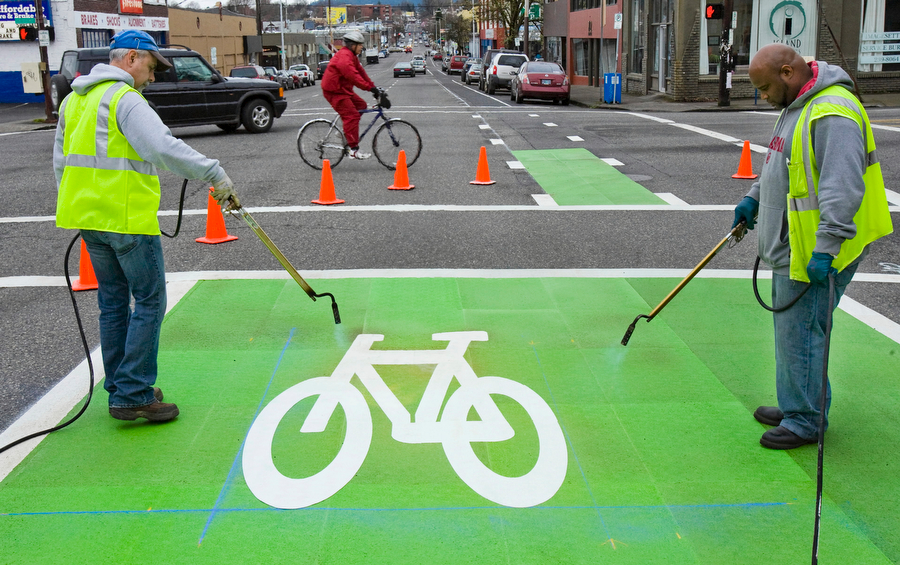
This week’s discussion begins with this photograph:


City of Portland transportation workers install a new bike box at the corner of SE 7th Ave. and SE Hawthorne Blvd. made of thermal plastic and sealed onto the road with propane torches

Bike box and automotive thoroughfare: accommodation or tokenism? Cooptation or change?

Sign and reality, sign and system: what happens when public space becomes public signage?

BUILT is a performance/civic dialogue project and a collaboration of Northwesten University’s Theater Department & Portland, Oregon’s Sojourn Theatre, led by visiting artist Michael Rohd.

 2 Comments