Mar 12, 2010
Sep 17, 2007
Mar 10, 2008
Mar 28, 2008
Jan 18, 2012
Oct 03, 2007

Sight Gag: The Crucial Moron Vote

Photo Credit:  Unknown

Our primary goal with this blog is to talk about the ways in which photojournalism contributes to a vital democratic public culture. Much of the time that means we are focusing on what purport to be more or less serious matters. But as Jon Stewart and Stephen Colbert often remind us, democracy needs irony, parody, and pure silliness as much as it needs serious contemplation. For our part, we will dedicate our Sunday posts to putting such moments on display in what we call “sight gags,” democracy’s nod to the ironic and/or the carnivalesque. Sometimes we will post pictures we’ve taken, or that have been contributed by others, or that we just happen to stumble across as we navigate our very visual public culture. Sometimes the images will be pure silliness, but sometimes they will point to ironies, poignant and otherwise. And we won’t just be limited to photography, as a robust democratic visual culture consists of much more. We typically will not comment beyond offering an identifying label, leaving the images to “speak” for themselves as much as possible. Of course we invite you to comment … and to send us images that you think capture the carnival of contemporary democratic public culture.

 0 Comments

Harlem, the Landscape

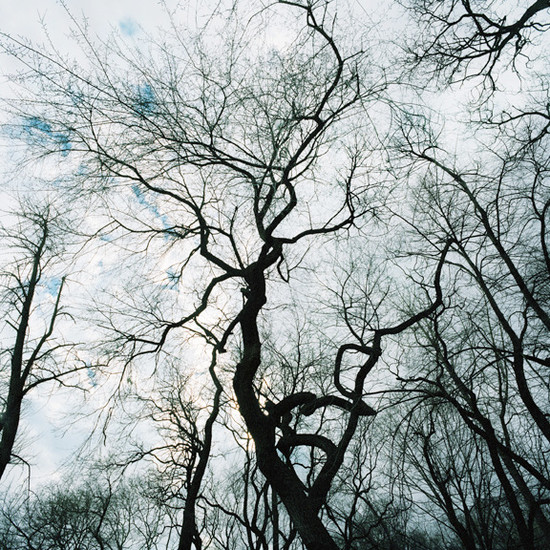
ArIc Mayer is an exceptionally thoughtful photographer whose work has been featured before at this blog. He has a new series of images that, like so much of his work, encourage contemplation of a subject that is otherwise trapped in stock images articulating a standard narrative. We know all about Katrina, right? Or the beauty of the American West. Or Harlem. We may have never been there, but we know the story. Aric never denies what is really there in the story, nor does he provoke the viewer to see things from some odd angle. Instead, he carefully works you into his line of vision until you start to think about what you are seeing. After that, you’re on your own, but that is enough.

The new set of photographs are from Harlem. You know, the streets teeming with bodies, sound, and signage. The once magnificent buildings now dilapidated, the streets lined with litter and grafitti, the iron grates on the storefronts and the lurid murals on the walls. Like this:

Oh, to be able to describe the beauty, the intelligence of trees. Beauty too rarely seen, for how often do we stop and simply look up? How often on a cloudy spring day, and in the city? What is more important, however, is not that he looked up, but that this is given to us without any sense of contrast. The message is not that a world of beauty and potential lies just above the concrete, nor the ugly insinuation that beauty is everywhere–i.e., even in Harlem. This is a photograph of nature, but not to denigrate urban life. There is no myth, no transcendence, no need to escape. Instead, a different resonance: wisdom, ancient ways, endurance, another dimension waiting to be heard.

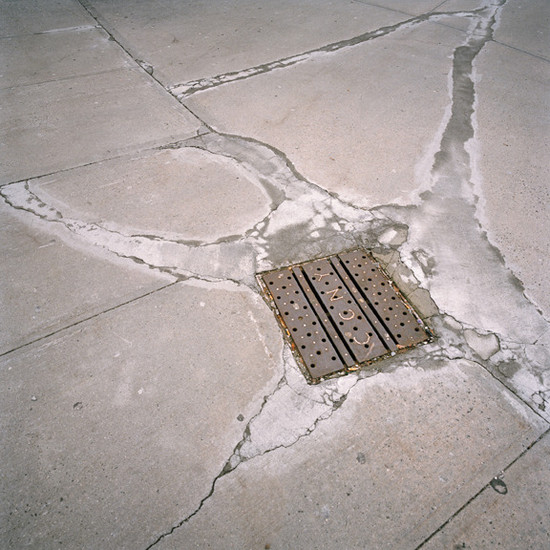
Perhaps even serenity:

But “serenity” is too simple. As with the first image, there is something poignant, even haunting about this photograph. A drain can conjure up images of water and of floods, or of blood and of too much being drained away, or of waste and the ultimate return to the earth. And yet this spot is so clean, and so well worn, as if rubbed smooth by many generations of spring rains. The bird-like shape of the lighter patch could be a totemic animal, or the drain some kind of communication device. If the stones could speak, would we listen? Were we to see the city anew, like a spring landscape, what would we see?

You can see the full set of Aric Mayer’s Harlem photographs here.

 1 Comment

Olympic Training and the Nation

We almost never write about sport at this blog, yet I’m putting two posts up this week on the run-up to the Olympics. Maybe it’s because the war in Iraq is all but won–based on recent coverage, anyway–so I need something new to talk about. More likely the increase in coverage is producing a fresh crop of images. Here’s another one that caught my eye:
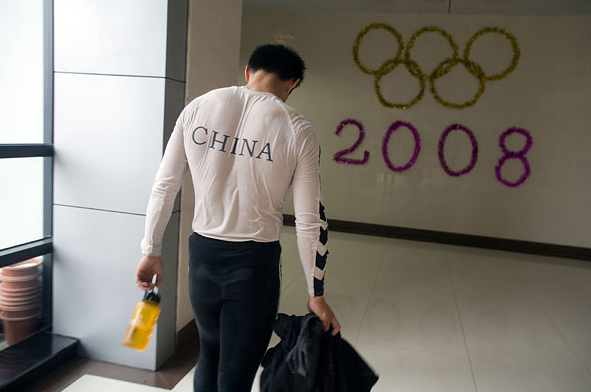
The New York Times story featured China’s heavy investment in rowing as part of its push to win the medals competition. The enormous investment is very real, but the whole idea seems quaint–just the thing you’d expect from a somewhat socially backward newcomer. Does anyone really care if medal total goes to China, the US, or the USSR–whoops! I mean Russia? The whole game is a relic of the Cold War. Aren’t such symbolic measures meaningless next to the real competition for oil, markets, and global economic dominance?

The short answer is yes, and the photo above illustrates just how the game is changing. Two things immediately define the image: the athlete’s magnificent physique and the high-end modernist decor. He is a superbly trained athlete walking through the functionally designed training facility. Both have all the marks of smart and lavish investment. Any difference between his individual person and the impersonal setting is covered over by their uniform simplicity and shared engineering.

The signage on his shirt and the wall also are part of the image. CHINA marks him as member of the national team, but this is not the flag-waving patriotism of a public ceremony. That shirt could just as well say NIKE or any other logo–you are looking at the new international style, another iteration of the high modernist culture of scientific training, standardized competition, and expert performance that links the top-tier athletes across the globe. By contrast, the Olympic rings and number on the wall look like crafts project from the local school–clearly a temporary addition. Cute, but hardly essential. After all, the Olympics are only the next event in an unending push for optimization.

In short, we can see the nation-state becoming a platform for economic and organizational power. This arrangement has enormous productive capacity and clearly can benefit some individuals. As it happens, however, much of what used to distinguish both the nation and interaction across national borders is changing, perhaps withering away. The contrast is even more evident when looking at another photo:
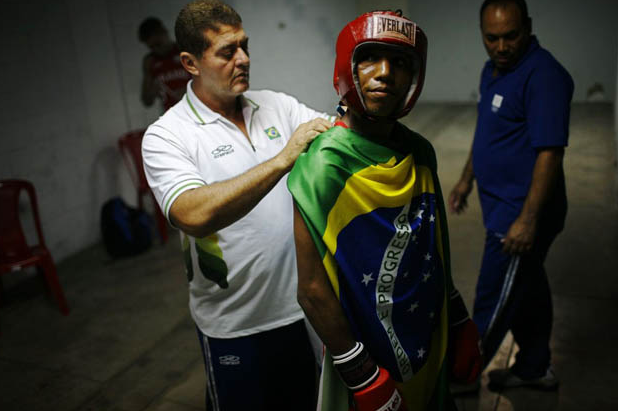
A boxer is being wrapped in a Brazilian flag prior to a qualifying bout for the Olympics. Boxing, which had a good run in the twentieth century as one of the premier sports nationally and internationally, is all but extinct. The setting in this photo does not suggest strong financial support. The flag is the only lavish thing there–colorful, rich material with plenty of drape to cover his body. Needless to say, it will come off very soon. The image is touching, really: this poor kid about to get beat on is putting on the national flag to become something larger than himself. It will be done to get the crowd on his side and intimidate his opponent, but not only for that. He wants to look good in that flag, and he’s proud to wear it. And that flag probably is about the extent of the support he will get from the state. Brazil has a lot going for it, but it’s still content to be a collective, not a platform.

That boxer probably could do a lot with Chinese training. But don’t feel sorry for him, for there is one more thing to see. It’s a coincidental effect in each case, but nonetheless food for thought. Standing amidst not much of nothing, the boxer is looking up, head held high. His face already looks cut, but he is unbowed. Now look again at the Chinese athlete. He is strong, perhaps thoughtful–going over the training routine one more time–but his head is down, as if habitually, submissively so. As if accustomed to the yoke. He is beautiful, but he is not free. Whether due to the state or the discipline, he is not free.

Photographs by Doug Kanter/New York Times and Rodrigo Abd/Associated Press.

 0 Comments

Emptiness at the Center of the Nation

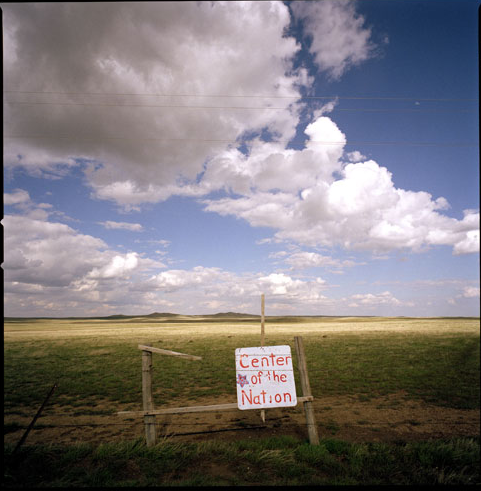
The New York Times ran a story yesterday entitled “In the Middle of Nowhere, a Nation’s Center.” The subject was the geographical center of the U.S., which is a windswept prairie in Butte County, South Dakota.

There is a monument, of course, but it’s in the nearby town of Belle Fourche. Most visitors–yes, there are visitors–are content to take their pictures there rather than trek out to the actual spot. The reporter’s sense of irony is light, in keeping with his respectful attitude toward the folks actually living there. The story even includes a feel-good ending. “But then, in this remote, still place, there comes a strange sense of reassurance: that in this time of uncertain war and near-certain recession, of home foreclosures and gas at $4 a gallon, at least somewhere in this nation a center holds.”

But does it hold? Or, more to the point, why would it not hold when no one wants a piece of it? And isn’t the scene pathetic? The abandoned landscape reduced to flee market status by the hand-scrawled sign? The Times story provides an inadvertent chronicle of how rural America, once vying for its place in the nation’s prosperity, has been bypassed for roads leading elsewhere. And let me add that $4 a gallon gas hurts them a lot more than it hurts you. But you already are accustomed to not seeing them, and there are no pictures of people in the slide show accompanying the story. All you have to do to complete efface the unpleasant fact that people still live there is remove the sign.

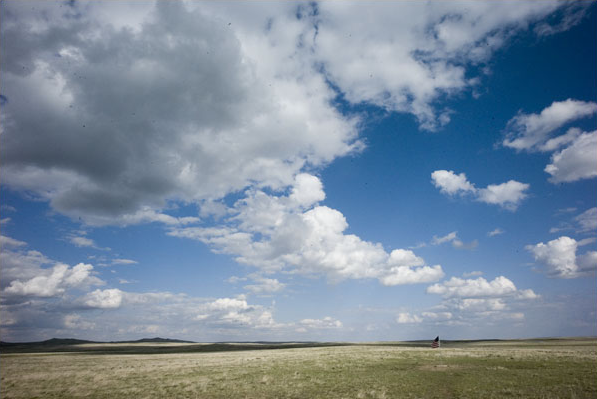
This is another photo from the slide show, and the last of the set. Now we have a classic shot of America the Beautiful, the mythic landscape of the American West and its message of endless possibility. That image was already in the first photo, but there it sets up the irony of the ragged sign, which in turn changes the magnificent vista into a desolate “moonscape.” Ironically, the sign declaring a center highlights its emptiness. When that emptiness is not marked by the visual excess of a verbal text obviously added to the scene, a tawdry bit of culture marring nature’s grandeur, then one can see fullness, a richly symbolic affirmation of national potential. Like the wind, endless, waiting to be harvested.

Or, like the sign, symbolic in another sense. With his assurance that “at least somewhere in this nation a center holds” the reporter offers a refutation of W.B. Yeat’s famous indictment of modernity in “The Second Coming.” But the center in question is not holding, not in South Dakota, anyway. Agribusiness, agricultural policies, transportation policies, and other very real historical forces are draining the land of people, soil, water, you name it. America has invested heavily in centrifugal processes, and seems to have little time to be centered, much less balanced, reflective, or attentive to its own.

Photographs by Angel Franco/New York Times. For another perspective on the Great Plains and what one can learn there about being centered, see the wonderful book Dakota: A Spiritual Geography by Kathleen Norris.


 9 Comments

Freedom and the Iron Cage in Modern Sport

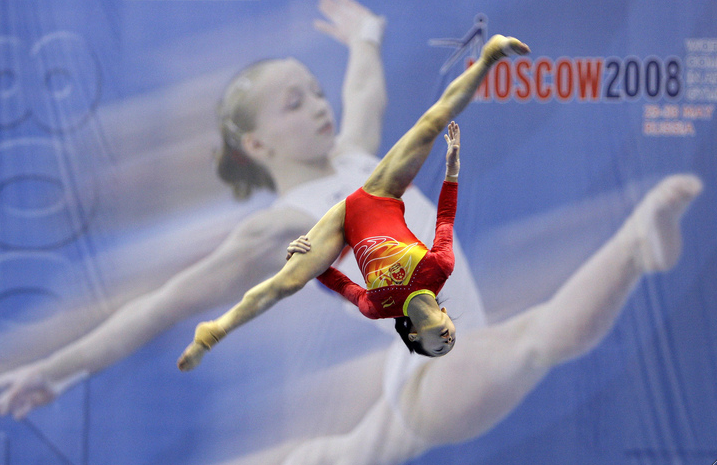
No one talks about building character when covering Olympic level gymnastics. If anything, the intensive training regimens that start soon after infancy are likely to stunt development of everything not necessary for athletic achievement. Denial is the order of the day, however, so the coverage is very soft focus when dealing with the production side of modern sport. What we do see are the intended results:

Unbelievable, isn’t it? Astonishing, amazing, incredible–and she’s barely past childhood. Nor is this a trick of the camera: look at her musculature, and the sure control of her limbs, and the arch of the neck as she keeps her eyes focused on the landing. She is flying through the air as the rest of us will never do, a moment of perfect freedom achieved only through extreme discipline.

The photograph presents a double image that supplies the soft focus background for her achievement. The athlete of the moment performs against an image of her type. Life and art are perfectly coordinated: the larger image in the background provides a sense of aesthetic tradition that frames and guides the live performance. The background image could be the performer herself at a slightly younger age, already radiating the innocence of a young girl perfectly composed, or the sport as it represents both excellence and aspiration. The athlete in the foreground reveals how innocence becomes transformed by the drive train of competition. She is entrained with the standard against which she will be measured, and yet upside down–everything she might have aspired to do, but at a higher level of difficulty.

Nor is she merely a study in form; the image is explosive, as if she has been launched from some modern catapult. Surely this is one sign of the incredible technological power of modern civilization–not least its capacity for complete optimization of human skill and energy toward a specific, highly defined task.

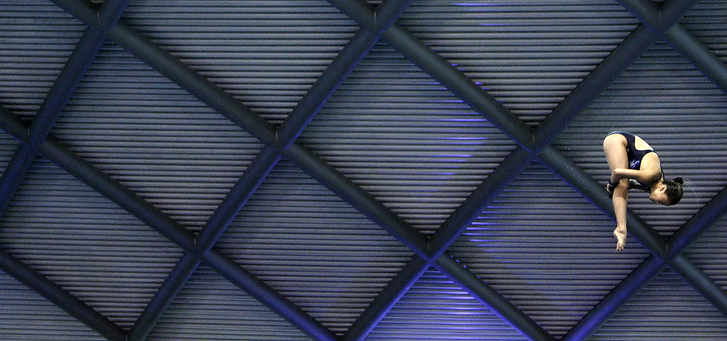
That relationship between the individual and social order might well be the subject of this photograph:

Like the photo above, this image features a world-class athlete at a warm-up event for the summer Olympics. The diver also is entrained with her background–each are studies in rectilinear form. Black and white or black and grey, squares become diamonds as they are pointed toward the water below. Oddly, she is placed off to the side, as if the building were the subject of interest; as if she were but an ornament hanging there to complete the architect’s design. The immensity of the horizontal space may imply an equally deep vertical drop, but the effect is not one of action or risk but rather of order, of individual and structure in perfect equipoise.

The images differ in their sense of time. The first implies a world of artistic continuity via ascending achievements. The girl of the past will be replaced by the girl of the present, who one day will be the background for even greater feats of skill and daring. Likewise, we know that she will retire at the ripe old age of 17 and still have the rest of her life ahead of her. Time enough to catch up on what she missed while settling into the lower world with the rest of us. In the second photograph, time has been stopped but for an instant–time enough to reveal that the individual athlete will drop from sight. She is suspended for a brief moment of glory, and then disappears. Another will appear in her place, and another, but always as iterations of the same. The dives may differ, but the fall and much else is constant. The individual flies through the air, but the structure remains.

Photographs by Grigory Dukor/Reuters and Leon Neal/AFP-Getty Images.

 1 Comment

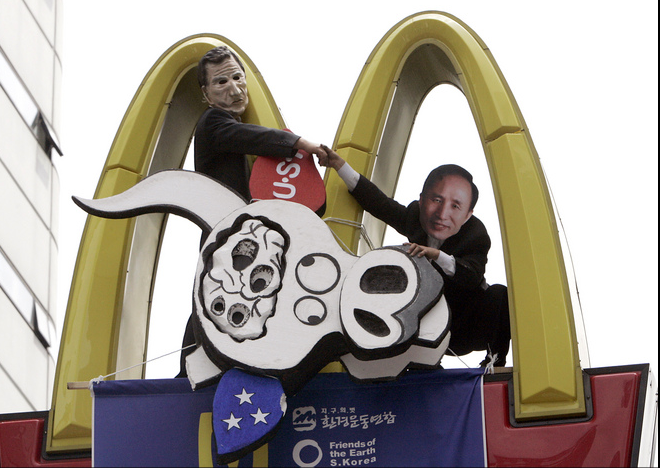
Sight Gag: Where (in the World) is the Beef?

Photo Credit: Lee Jin-Ma/Ap

(NYT Caption: South Korean protestors wearing masks of President George W. Bush and SOuth Korean President Lee Myung-bak occupy a McDonald’s sign board during a rally against U.S. beef imports in Seoul, South Korea. McDonald’s Korea says it uses Australian beef.)

Our primary goal with this blog is to talk about the ways in which photojournalism contributes to a vital democratic public culture. Much of the time that means we are focusing on what purport to be more or less serious matters. But as Jon Stewart and Stephen Colbert often remind us, democracy needs irony, parody, and pure silliness as much as it needs serious contemplation. For our part, we will dedicate our Sunday posts to putting such moments on display in what we call “sight gags,” democracy’s nod to the ironic and/or the carnivalesque. Sometimes we will post pictures we’ve taken, or that have been contributed by others, or that we just happen to stumble across as we navigate our very visual public culture. Sometimes the images will be pure silliness, but sometimes they will point to ironies, poignant and otherwise. And we won’t just be limited to photography, as a robust democratic visual culture consists of much more. We typically will not comment beyond offering an identifying label, leaving the images to “speak” for themselves as much as possible. Of course we invite you to comment … and to send us images that you think capture the carnival of contemporary democratic public culture.

 0 Comments

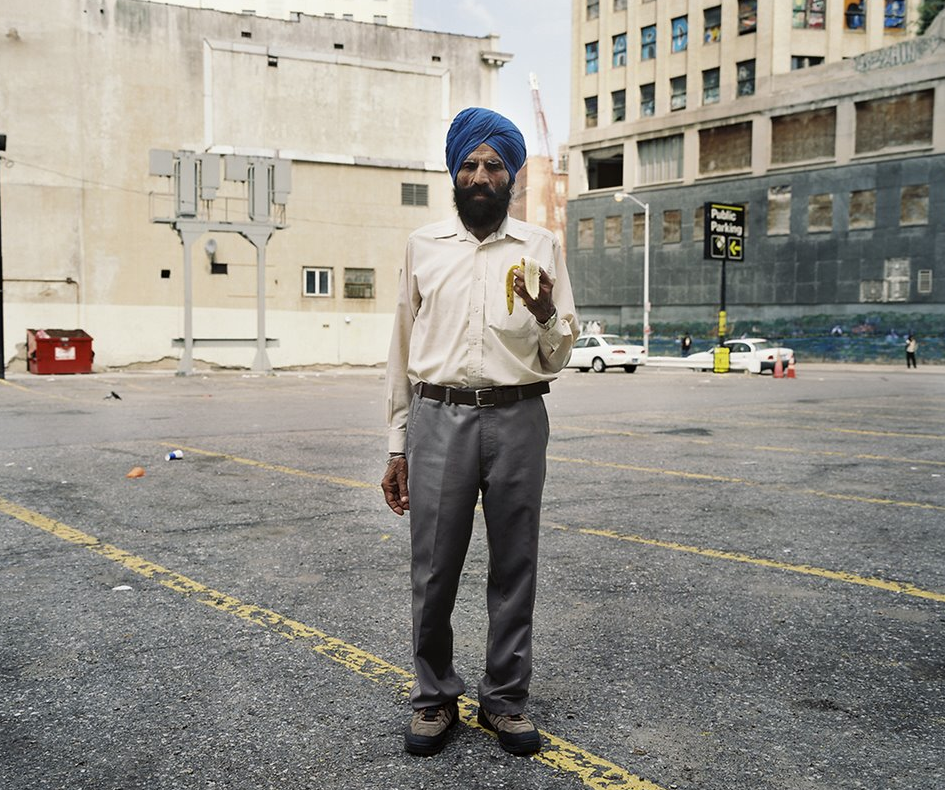
Photographer's Showcase: AMERIKA

Last month we introduced Tom White to the readers of NCN. Today we are pleased to announce a show that he has curated (along with Nico Silberfaden and Deirdre School) titled “AMERIKA, A Group Exhibition” that opens at the Bushwick Open Studies in Brooklyn, NY on Friday, June 6th 2008. The show includes the work of twenty four different photographers and speaks to the vexing question of American identity animated by what Ralph Ellison described as “the pathology of American democracy” and the discrepancies between our democratic ideals and social realities.

According to the catalog, “The photographers in this collection exemplify the cross cultural nature of America. While living here – whether American born, foreign immigrants or just passing through-each one represents a facet of htis diverse society and has a unique take on its culture. There is more than just a geographical link; each photograph in some way addresses the nature of American life. These pictures are grounded in a particular American reality, a ‘New Americana’ if you like…. If ‘America’ is the ideal, then ‘Amerika’ is the social reality.”

Click here or on the photograph above to see a sample slide show of the work in the exhibit.

 0 Comments

From Tragedy to Farce

There would seem to be very little in Scott McLellan’s recent exposé of the Bush White House that very many of us would consider to be “news.”  Much of it is, however, a poignant reminder of how consistently and extensively incompetent and irresponsible the current administration has been on issues large and small.  Its response to Hurricane Katrina is a prime example, as  McLellan notes that following Katrina, “the White House spent most of the first week in a state of denial.”  The first week, it turns out, was simply the tragic rehearsal for what would become (and continues to be) a farcical government policy of profound neglect and indifference.

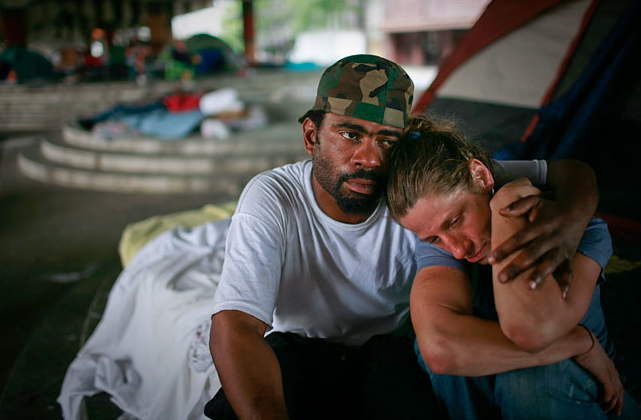
The point was driven home for me by the image of a couple who live in a tent in a “homeless encampment under a highway overpass” that was used to anchor a story in the NYT on the persistence of homelessness in New Orleans.

Every city faces the problem of homelessness, but according to HUD, since Katrina the numbers in New Orleans are off the charts, with 4% of the population currently living on the streets (by comparison, the homeless rate in NYC = .59%; Washington, D.C. = .95%; and Atlanta = 1.4%). And the numbers continue to grow!  With FEMA planning on closing down its final six trailer parks this coming week and the city’s plan to eliminate four major public housing developments that consist of 4,500 units, the situation only promises to get worse.  But such numbers, as astronomical as they are, are hard to process.  And in the end they reduce policy considerations to questions of an accountant’s bottom line that is all too easy for governments (or individual citizens) to overlook (especially when it doesn’t effect you directly, like, say, body counts in the War in Iraq).

The above photograph, on the other hand, captures the utter despair of individuals trapped by a system and circumstances that seem to be completely out of their control.  Indeed, the image resonates in many ways with Dorothea Lange’s “Migrant Mother.”  Notice, for example, the blank stare in the man’s eyes and how they avoid making contact with either the camera or the viewer, as well as to how he embraces the woman who clings to him as if a child in need of the protection that he knows he cannot provide; and notice too how she turns her face from the camera in shy resignation of her situation.  Differences between the two photographs  of race, gender, and age abound, to be sure, but they don’t (or at least should not) mitigate the simple fact that these are people in need and that we should be helping them.  There is one other difference, more pronounced and perhaps more significant:  Lange’s “Migrant Mother” helped to animate the social welfare state that assumed the responsibility to care for those in need; the photograph above marks the effects of a neo-conservative political imaginary that began with the father’s appeal to a “thousand points of light” and has achieved its nadir (or is it its zenith) with the son’s utter evisceration of a political culture of care and social accountability. 

Marx had it right, it would seem,  “all facts and personages of great importance in world history occur, as it were twice … the first time as tragedy, the second as farce.”

Photo Credit: Lee Celano/NYT

 1 Comment

Special Exhibit in Gallery I: Human Beings

One reason I enjoy art galleries is that they enhance the way I see the people around me. I begin to look at strangers with the same intensity given to the art on the walls. This gaze involves more than an eye for detail: people become at once universal and more perfectly unique. They become types yet acquire a distinctive aura. I see each one alone in existential space and yet rich with meaning and mystery. Above all, they become idealized. The beautiful people become more beautiful; those who look interesting become even more so; even those seemingly trapped, whether in low end jobs or their own stories, appear to be treasures of human experience and possibility.

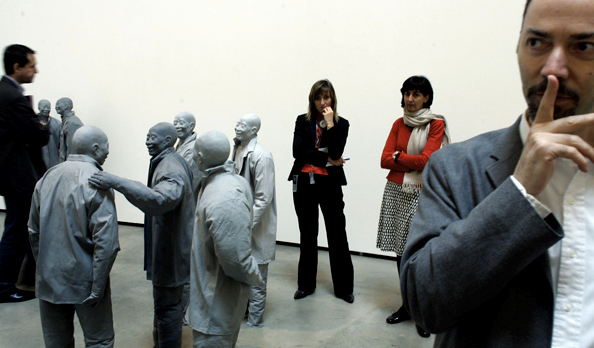
That is not the only way to see, however, and two photographs in the same week seem to challenge exactly this attitude to idealize when seeing life as art. The first photo shows gallery visitors together with a sculpture by Juan Munoz.

The visitors are the ones in color. I can imagine a space alien having to ask and perhaps being disappointed on hearing the answer. Perhaps the grayscale figures suggest a statement about uniformity or collective happiness, but they do look better off than those around them. And not by accident. Munoz is quoted as saying that “The spectator becomes very much like the object to be looked at, and perhaps the viewer has become the one who is on view.” But not prepared to be on view. The spectators here each look as if unaware of being seen and the worse for that. The two women are pensive at best and perhaps depressed. The two guys appear to be studies in corporate indifference (on the left) and self-interested calculation (on the right). And whereas the statues are dressed in clothing that looks both comfortable and styled for being in public, the male spectators look dressed to code while the women look somehow uneasily thrown together.

This contrast between life and art is inflected further by this photograph:

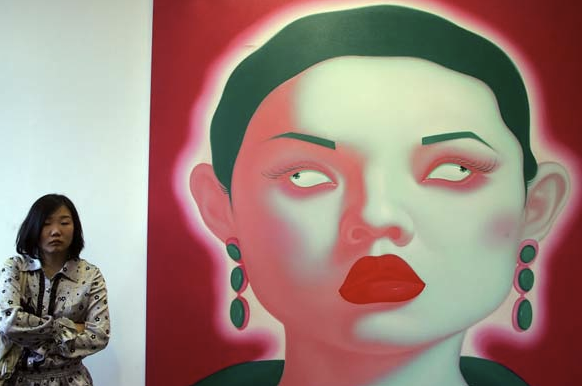
The photo was taken at an exhibition in Athens, Greece of contemporary Chinese artists. The work on the right is no smiley face, but neither is the one on the left. The one on the right at least has the excuse of being a commentary on itself, not least on the effect of being pulled in opposing directions. Having no aura and holding herself protectively, the one on the left is several times diminished by contrast with the larger, stylized fashionista. If at this point someone were to retort, “yes, but she’s a real person,” well, then the game really is lost.

These photographs achieve exactly the effect that Munoz hoped to create with his art work: “the spectator becomes very much like the object to be looked at.” It’s a small step from there to imagining ourselves on display in a museum gallery. What would other viewers say? “They were a sorry species, weren’t they?” “Do you think their artists were as depressed as the rest of them?” “Maybe they were different in private, but you think it would show. . . .”

It would show, wouldn’t it? Or is it just that museums are depressing? Or are the photographs unfair? It is easy to answer no, no, and yes. These are real people with rich inner lives and many moods including the inward reflection rightly activated in a gallery and easily misread. But art is there to help us take a careful look at ourselves. If we really looked at one another, what would we see? What would the spectator’s gaze reveal if taken out of the gallery? What is there to be seen in public? Depression, fatigue, loneliness, exhaustion, failure? All of the above.

Photographs by Vincent West/Reuters and Louisa Goullamak/AFP-Getty Images. The work “Many Times” (1999) is comprised of 100 figures in a single room. A Tate retrospective on the artist earlier this year generated a number of reviews that are available online. The painting in the second photograph was not identified in the caption accompanying the image in a Manchester Guardian slide show.

 0 Comments