May 24, 2013
Feb 12, 2008
May 27, 2011
Dec 02, 2013
Sep 05, 2008
Nov 06, 2013

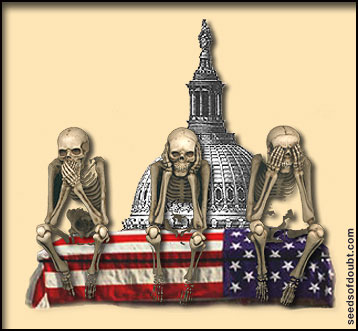
Sight Gags: Speak No Evil …

speak-hear-see-2.jpg

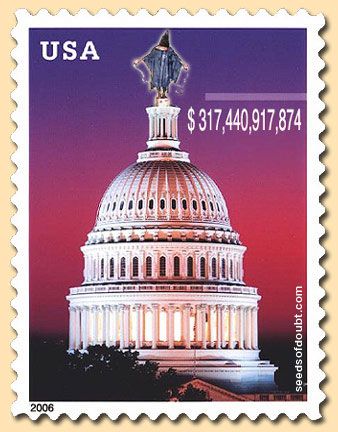
Credit: Daoud, Seeds of Doubt

Our primary goal with this blog is to talk about the ways in which photojournalism contributes to a vital democratic public culture. Much of the time that means we are focusing on what purport to be more or less serious matters. But as John Stewart and Stephen Colbert often remind us, democracy needs irony, parody, and pure silliness as much as it needs serious contemplation. For our part, we will dedicate our Sunday posts to putting some of that silliness on display in what we call “sight gags,” democracy’s nod to the carnivalesque. Sometimes we will post pictures we’ve taken, or that have been contributed by others, or that we just happen to stumble across as we navigate our very visual public culture. And we won’t just be limited to photography, as a robust democratic visual culture consists of much more. We typically will not comment beyond offering an identifying label, leaving the images to “speak” for themselves as much as possible. Of course we invite you to comment … and to send us images that you think capture the carnival of contemporary democratic public culture.

 0 Comments

"… Economic Girlie Men"

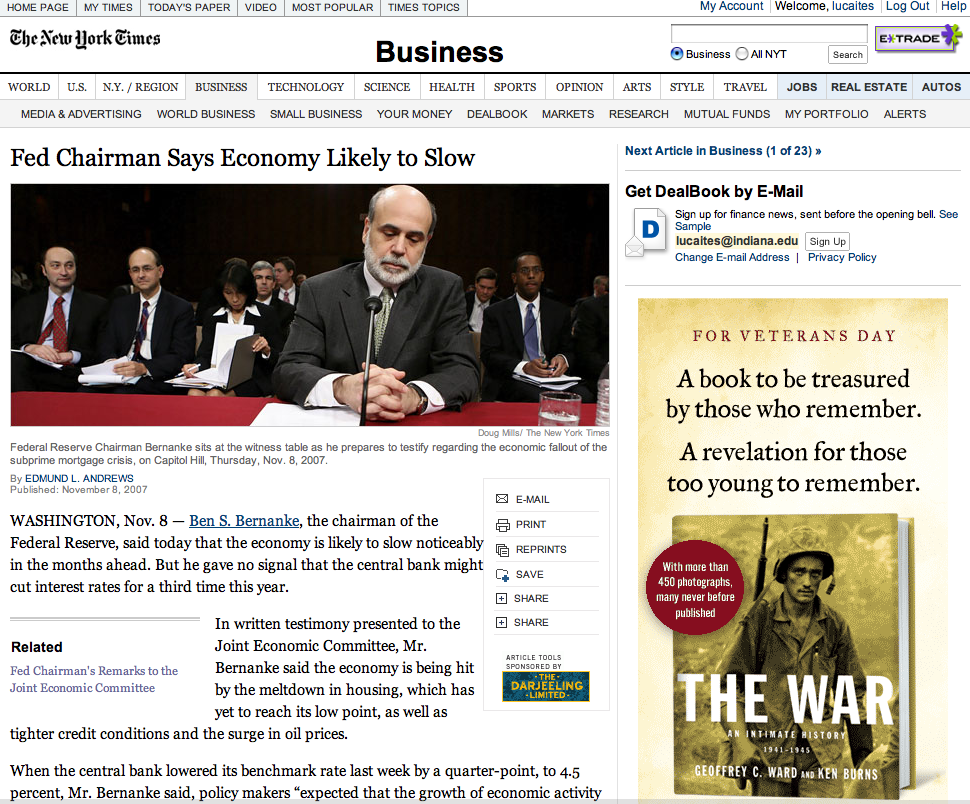
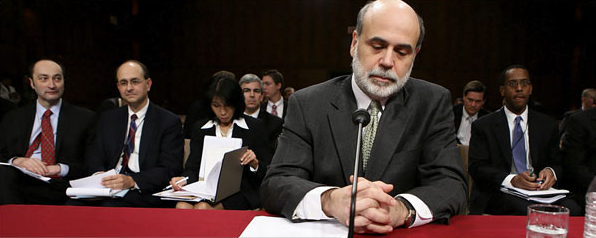
Stop the presses! The NYT reported yesterday that Federal Reserve Board Chairman Bernanke, speaking before the Joint Economic Committee of the U.S. Congress, announced that the economy is “likely to slow” in the 4th quarter and well into next year! But, there is no r——— here, just a normal economic correction produced by “significant drag.”
bernanke.png

The story leads off with a photograph* that is in many respects altogether unremarkable, a stock image of an official “suit” about to testify before a congressional committee, his notes and microphone arrayed in front of him, a gallery of bureaucrats behind him. It is business as usual. Your government at work. At the same time, it is hard not to see Bernanke as poised in prayer, his fingers reverently entwined, his eyes closed in contemplation, his head tilted down in supplication. Indeed, the camera seems to record a palpable, public display of ritualistic piety.

One can only imagine his subvocal prayer: “Dear Lord, please don’t let there be a recession! If you grant me this one request I promise …” Those aren’t exactly the words he uttered in his testimony, of course, but they are emblematic of his message and they come close to capturing his incantatory logic. It reminds me of when I was eight years old and I swore to be nice to my sister if my Lord and Maker would help the Yankees win the World Series (they lost to Pittsburg 4-3 and to this day I think it was punishment for sneaking a transistor radio into school and listening to the game in the boys room—but to be fair, I wasn’t exactly nice to my sister either). My guess is that Bernanke will have no more luck than I did. But I digress.

What makes the photograph especially interesting is how the display of piety appears to contrast with a photograph published by the NYT earlier in the day as part of a separate story concerning the “pinch” being felt by homeowners as a result of the mortgage and equity crisis and its implications for the impending economic (uhm!) “slowdown.”
equity.png

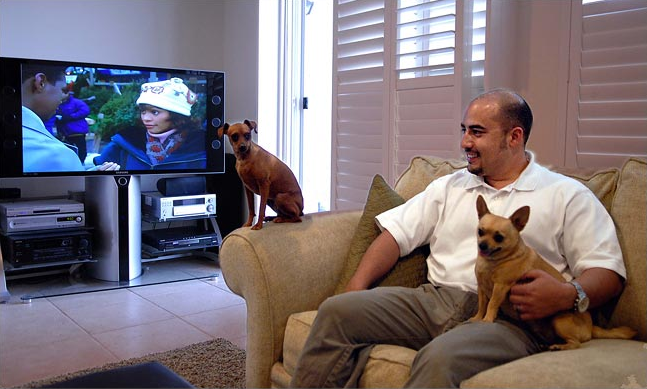
Here we have Marshall Whittey, a sales manager for a floor and tile company in Reno, Nevada. There is no piety here! We see Marshall sitting in his home surrounded by a few of his prized consumer possessions, most notably the media center behind him, including one of two large flat-screen televisions he recently purchased, as well as two lap dogs. We can only assume that the watch on his wrist is not some knock-off he found for twenty bucks at his local Wal Mart. Not shown, but described in the article are his 21-foot boat and his new truck, purchased simply because he “didn’t like the color” of the older one. It is the somewhat uneasy, caught-with-his-hand-in-the-cookie-jar smirk on his face that tells the story, for all of these goods – as well as his recent wedding on a “sumptuous private estate in Napa Valley” and his honeymoon in Tahiti – were paid for on a line of home-equity credit. As he put it, “It used to be that if I wanted it, I’d just go out and buy it and finance it … [but now] I’m feeling the crunch, and my spending is down significantly.” Down, but apparently not entirely out. The problem is that his house, which was once assessed at $500,000 is now worth much less than the $580,000 he owes the bank. But through it all Whittey remains “unflappable”: “We used to go out and eat three or four nights a week. Now we don’t go out at all.”

It is hard to know which is worse. The faux-piety displayed by Bernanke and his fervent wish that the economy is simply going through a normal and natural correction, or the total absence of either piety or contrition in Whittey’s smirk as it inflects his assumption that the penance for years of consumer gluttony is “eating in” more often. That might work for upper-middle class homeowners who are feeling “pinched” because they can no longer think of the equity in their houses as “piggy banks” to be raided with impunity, but it is surely little solace to those not quite so fortunate as to own their own homes (let alone half million dollar houses) during the economic “slowdown”–or ever.

What is important here are the ways in which the photographs work in concert with one another to frame a civic attitude towards the current mortage and equity crisis. It seems to me that there are two different ways we can read the conjunction of these photographs. From a realist perspective, the relationship is as as evidence to claim. As such, Whittey’s performance of impiety stands as a prime example of the problem that warrants the normal economic correction that Bernanke’s pious reverence for the laws of economics relies upon. The problem, you see, is those darned homeowners who simply can’t control their urges. From a different and more cynical perspective, the photographs function in an allegorical register, inviting us to see the somewhat malignant connection between a government bureaucracy reduced to empty ritualistic incantations and unrepentant, self-indulgent, consumer-citizens who lack any sense of responsibility to a common good that extends beyond their own private, acquisitive interests.

But here’s the rub: Whichever way you read the relationship between the two photographs, the civic attitudes they invoke reinforce the sense that the problem is not systemic but individual; indeed, it is rooted in the domestic psychology of private life, not in an economic system that relies more on consumers than citizens. Let the system run its course and all will be well. At base then, the photographs suggest, neither Bernanke nor Whittey are the “economic girlie men” that Arnold Schwarzenegger once admonished for their undue economic pessimism. Much to the contrary, each remains blindly hopeful. And more’s the pity. You can rest assured that we will all eventually pay the price.

*Between the original posting around 10:00 a.m. and when I returned to link to the story the picture disappeared from the website. Here is a screen grab of the picture in its original context.

Photo Credits: Doug Mills and Marilyn Newton/New York Times

Digg!

 6 Comments

And Where Have You Seen This Before?

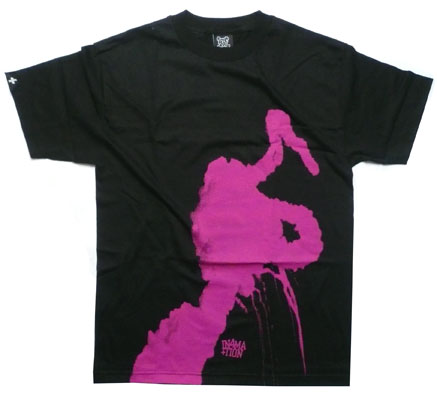
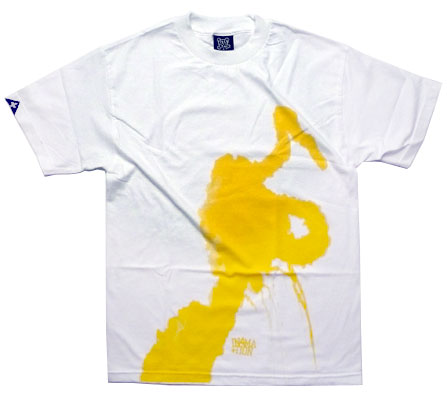
This t-shirt is available for sale at Turntable Lab 04, a website that tailors to hip-hop DJs and producers. Take a close look at the silhouetted pattern? Does it look familiar? Have you seen it somewhere else before? Maybe an abstract painting in a modern art museum? Or in a Rorschach Test? Somewhere else? Click on the shirt to see where.

43250.jpg

Credit: In4mation; and with special thanks to Erik Johnson, Northwestern University for bringing it to our attention.

Digg!

 0 Comments

Making Nice on a Day of Shame

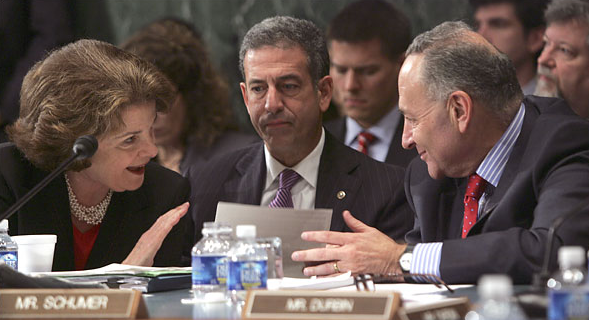
Yesterday was a terrible day in the history of the United States. I am referring to the decision of the Senate Judiciary Committee to endorse the nomination of Michael B. Mukasey for attorney general despite his refusal to state that waterboarding was torture. We should not declare that this is a point of no return–quite the opposite is required–but there is no doubt that American government has been stained.Not that you would know it from this photograph of the two Democratic Senators who voted for the nomination.

fein-schumer-shame.png

The photograph was taken after the vote. I can’t stand it. Feinstein (on the left) and Schumer (on the right) are so into the political schmooze, so full of themselves–having a great time, really. They’re allies on this one, political friends in the full glow of their complicity. Eye to eye, hand to hand, each turned to the other, enjoying the pleasure of their company. But for the difference in gender, they are almost identically arrayed: hair swept back, dark suitcoat, red tie/blouse, lighter pearls/shirt collar. . . it goes even further: they have the same wrinkles and smile lines, the same smile. They are each perfectly at home in the same mask, the same role.

And that’s the hell of it. This is just another vote, another moment of political frisson among those at the top, another day in the life of the successful pol. They have no idea of what they have done. How could they? They have no shame.

I am not bemoaning a loss of innocence, for much more than that was destroyed yesterday. The question is not whether US personnel have used, condoned, or supported torture; they have. Nor is it a question of whether this has happened only in Iraq or in other conflicts; it has happened before. In every case, however, those awful, ugly acts were done as part of the savagery of combat or the vicious calculations of Cold War terrorism, and they were hidden from view.

The Bush administration has gone much further: They have done nothing less than try to make torture an explicitly condoned, legitimate state practice. They have done so through several means: by expanding the practice of torture, including extraordinary rendition and prison interrogations at Abu Ghraib and Guantanamo Bay; by crafting the legal and administrative measures to institutionalize this immoral and dangerous extension of executive power; and by using their propaganda machine to make their practices appear to be the normal exercise of power during a time of peril.

And until yesterday, one could say that this was happening only because they controlled the White House and didn’t have to secure the approval of the Congress. But when two leading Democrats voted with all nine Republicans on the panel to approve the nomination, the devil’s bargain could no longer be disguised. The Republicans should not be excused for one instant, for their votes counted just as much and they could no more claim ignorance of what was on the line, but surely the blame has to placed above all on Senators Feinstein and Schumer.

They will have arguments justifying their decisions, of course. We will hear about the exceptional integrity of the nominee and the need to have a figure of accountability at the head of the Justice Department. That is nonsense. The confirmation hearing had already exposed Mukasey’s lack of integrity on the most important matter he would face as attorney general, and the institutional concern should not be the administration of a department already made useless. This is more than a matter on which reasonable people can disagree. No, the deeper problem is that the two Democratic Senators have endorsed the habits of public distortion that hide torture and in doing so destroy a society’s capacity for collective moral action. This is why the nominee’s evasions had to be stopped rather than condoned: they are as important to the practice of torture as the thugs recruited to inflict pain.

The committee vote is another demonstration of the effect torture has on a society. It destroys not only those being tortured but also those who do it, condone it, or otherwise allow it to continue. The loss is not of innocence, but rather of our capacity for moral life. Michael Mukasey represents not personal integrity but rather the habitual distortion of public speech–distortion that is essential for immoral government.

This is not the first time a society has begun to lose its fundamental sense of right and wrong, and more than that, its capacity to understand suffering and act on behalf of justice and compassion. The Biblical prophets saw the same thing, and they appealed to what sense of shame might yet remain among the leaders and the people. To see what they meant, you need look no farther than the figure between Feinstein and Schumer: Russell Feingold clearly knows better. He not only voted against the nomination, you can see that he is feeling the unseen darkness spreading around him.

Photograph by Doug Mills for the New York Times.


Digg!

 12 Comments

The Corporate Come-On

Business is all about the bottom line, right? While the rest of us might drift along in a miasma of desire and fantasy, business executives are making their decisions on the basis of hard facts, cold calculations, and careful strategic assessments. After all, would you decide to invest millions of dollars on the basis of a whim in the heat of the moment? Well, you might, but surely they would know better.

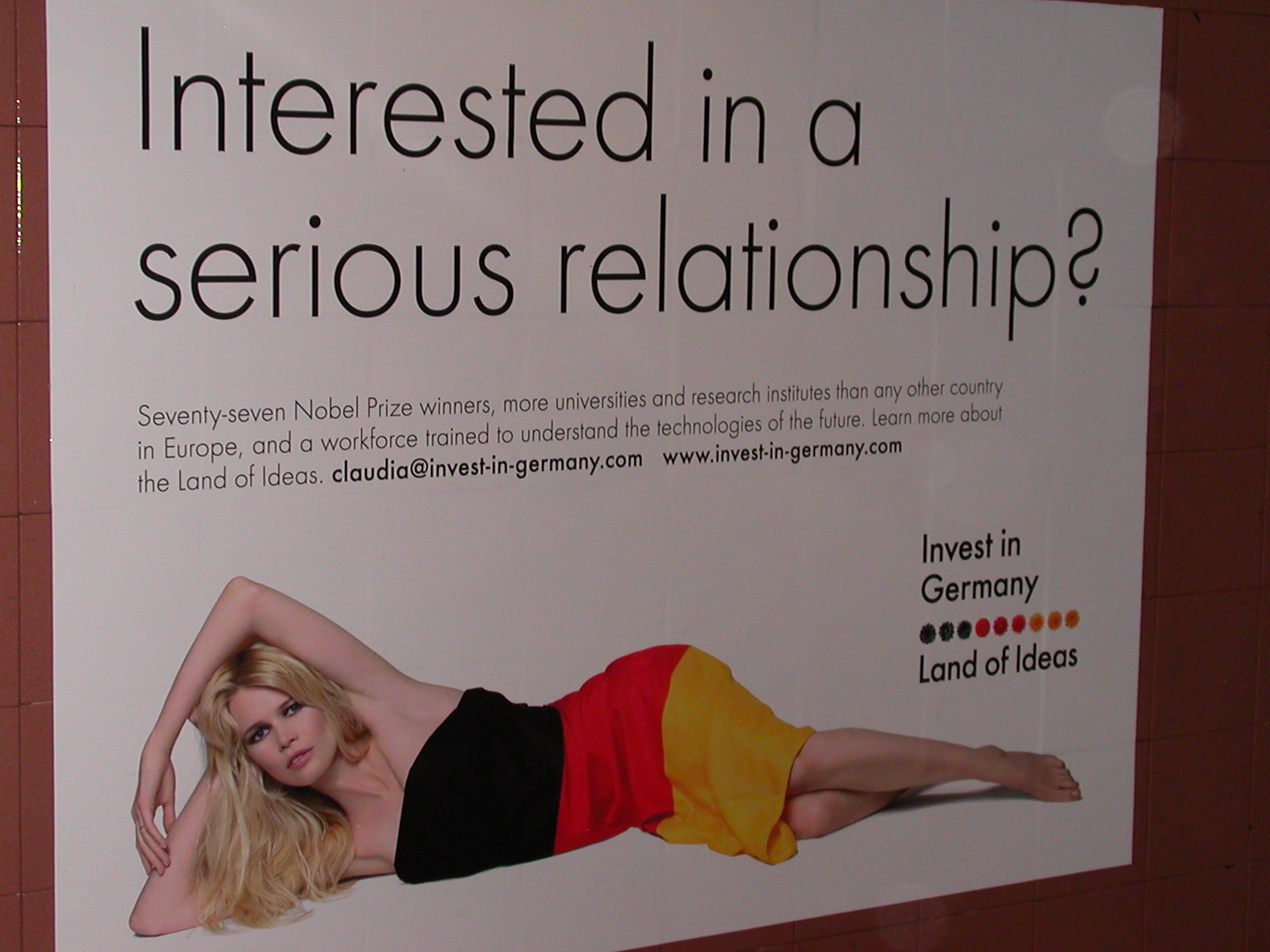
The Federation of German Industry, in conjunction with the German government, is betting otherwise:

schiffer-grand-ctrl-05.JPG

For the record, you are looking at fashion model and actress Claudia Schiffer wrapped in a dress–or towel–in the colors of the German flag. From the look of it, she can’t be wearing much else. I don’t know about you, but this is not the image that would have come to my mind if you had asked me to visualize “Germany–Land of Ideas.” It does, however, give new meaning to investing.

I doubt the ad actually will cause some CEO to hang around the stage door of the Federal Republic, but it does reveal a thing or two about the “serious relationship” between capital and the nation-state today. Germany is completely feminized, needing to attract a man to be economically viable over the long term. He might like what he sees, but he always can go elsewhere. She might not like waiting, but he will decide whether to put his money into her or some other woman–maybe that slut, Italy. The state is in the role of seducing capital–and not, for example, regulating it.

Of course, the guy who buys this is in for a surprise or two. The German labor force is not as uniformly Aryan as Claudia, and German labor laws might seem like a cold shower to the American CEO. The ad itself may be not so much contradictory as tongue-in-cheek clever. It’s a fantasy, but we know it’s fantasy and can chuckle along. Fair enough, but look at two more in the series, which make the erotic framing increasingly bizarre:

schiffer-grand-ctrl-13.JPG

schiffer-grand-ctrl-14.JPG

What started as a soft sell has become something between a gang bang and a challenge. Come on, boys, have you got what it takes? There’s still the irony–the second ad says that “roughly half of Europe’s nanotechnology companies are based in Germany”–but the text is going one way and the image another. One might debate whether Germany is the Land of Ideas, but the idea here comes from that great German advertising executive, Sigmund Freud: the German nation needs the phallus of capital, and the bigger the better.

I learned of these ads due to a fine presentation at my recent conference by Melissa Aronczyk, a doctoral candidate in the Department of Media, Culture, and Communication at New York University. Melissa’s research focuses on the phenomenon of nation branding and its implications for national identity, state policy and citizenship. She can be reached at melissa.aronczyk@nyu.edu.


Digg!

 0 Comments

"… the Shadow Knows"

bush-shadow.png


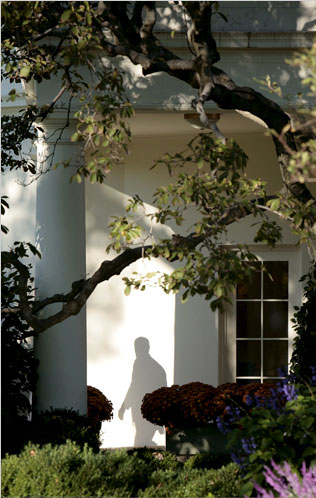
Last week over at BAGnewsNotes Michael Shaw featured a picture of President Bush leaving the oval office in preparation for a trip to Southern California to “view the damage done by the wildfires in Southern California.” Difficult to see in the predawn shadows cast on the West Wing of the White House, but nevertheless physically present, the president is pictured in sharp contrast to the brightly lit window of the Oval Office through which we see Vice President Cheney who apparently has stayed behind to handle whatever everyday business might need tending to – say the war in Iraq. The photograph was a poignant comment on who might actually be running “the show” in Washington, D.C. these days. There was a time when the president would stay close to the Oval Office during times of crisis, and the vice president would function as the official emissary of the White House, but in this image the roles are clearly reversed.

I was reminded of that image when I saw the above photograph posted at the New York Times this past week. Once again the president is leaving the White House, this time on a trip to campaign for a Republican senate candidate and to visit troops graduating from boot camp at Fort Jackson, SC. And once again he leaves via the west portico of the White House in almost the exact location as in the previous picture. But there are important differences that deserve comment.

First, of course, this later image is taken not in the early morning hours when darkness still shrouds the White House and when one would hardly expect to see a great deal of pomp and circumstance as the president moves about. Rather, it is shot in the light of day, sometime in the early afternoon judging from the length of the shadows. And yet the president is completely alone – no entourage, no secret service, no military honor guard. Indeed, he appears to be slinking off in broad daylight – which may in fact be what he is doing given the gravity of national problems and the partisan, photo-op purposes of his trip. In this instance there are no lights on in the Oval Office—it is completely dark— and so it is hard to know if anyone is attending to business at all. The key difference between the two photographs, of course, is that here we don’t actually see the president, but rather his silhouette, a gossamer-like presence that recalls the flickering images in Plato’s cave. And notice too that his spectral stature, relative to the door he has just passed, suggests that the man casting the silhouette is a mere shadow of his appointed, presidential self, certainly not someone who is apparently up to rigors of his high office. No longer even just an emissary for the White House, here he is reduced to a shadowy existence that borders on political nothingness.

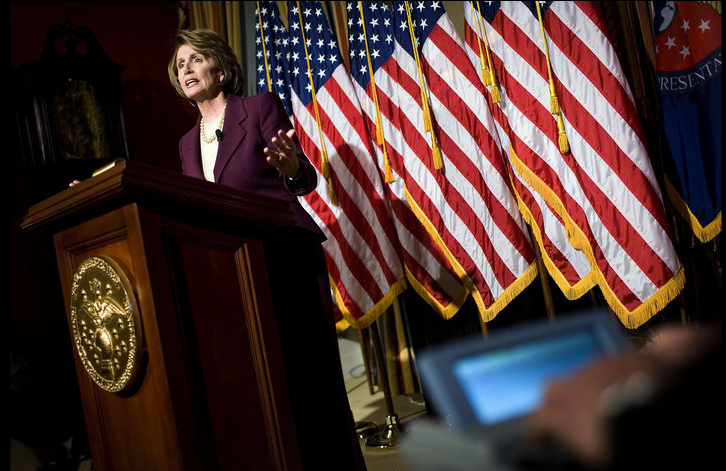
The salience of this most recent rendition of Lil’ Bush is emphasized by contrasting it with a photograph of Nancy Pelosi, the Speaker of the House, which appeared on the Washington Post website on the same day.

pelosi-shadow.png

Shot at an oblique and low angle, the image catches the hint of an LED screen in the lower right corner, thus foregrounding the political theater being performed. Normally we might imagine this as a somewhat critical move, but notice how it distinguishes this image from the picture of the president. The image of the president is shot straight on and without any attention to the camera capturing the scene; it thus implies an ironic realism to the image that underscores the fact that this is not George Bush playing the role of being president, here he is off-stage, and … what you see is what you get. A mere shadow.

But there is more. For while the Speaker is the focal point of the image, her presence looms large relative to the ceremonially adorned rostrum at which she stands—and notice that she is speaking, literally acting out her role for the American people, and as the caption tells us, in defiance of the president’s threat to veto a revised version of the SCHIP —her physical body actually occupies only the left third of the screen. Behind her, and dominating the remaining two-thirds of the image is a bank of six American flags. The pomp and circumstance altogether absent in the Bush image (thus again emphasizing the realism of the image) is here in spades. And just left of center is the shadow of the Speaker cast on the screen of flags. Her shadow is smaller than she is (just like Lil’ Bush), but here it appears with economy and force, situating her visually where she might prefer to stand politically – acting in the name of the American people, in the full light of day (or at least in view of the media), and in a decisive but moderate stance, again, just left of center.

There are numerous points that could be made here, not least the extent to which those of us on the progressive Left should feel more or less uncomfortable with the second image and the ways in which it blends speaker and nation, visually understating the row of flags (which really do seem excessive) displayed as the source of national identification and authority. But for now I want to call attention to how the “shadow” can function differently as a conventional, visual marker of power and presence, at once minimizing or maximizing one’s stature, inviting either alienation or identification.

Photo Credits: Matthew Cavanaugh/European Pressphoto Agency; Joshua Roberts/Bloomberg News


Digg!

 1 Comment

Sight Gags: Voting with Your Backside?

vote.png

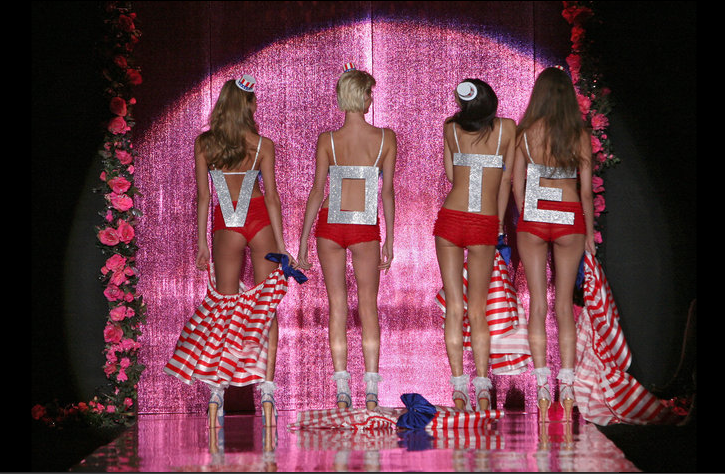
Photo Credit: Diane Bondareff/AP, “Models Display the Word ‘Vote’ as part of the Betsey Johnson 2008 spring/summer collection show at Fashion Week in New York on September 11, 2007,” Washington Post Day in Photos, September 12, 2007.

Our primary goal with this blog is to talk about the ways in which photojournalism contributes to a vital democratic public culture. Much of the time that means we are focusing on what purport to be more or less serious matters. But as John Stewart and Stephen Colbert often remind us, democracy needs irony, parody, and pure silliness as much as it needs serious contemplation. For our part, we will dedicate our Sunday posts to putting some of that silliness on display in what we call “sight gags,” democracy’s nod to the carnivalesque. Sometimes we will post pictures we’ve taken, or that have been contributed by others, or that we just happen to stumble across as we navigate our very visual public culture. And we won’t just be limited to photography, as a robust democratic visual culture consists of much more. We typically will not comment beyond offering an identifying label, leaving the images to “speak” for themselves as much as possible. Of course we invite you to comment … and to send us images that you think capture the carnival of contemporary democratic public culture.

 0 Comments

Conference Paper Call: New Media Worlds

Exploring New Media Worlds:

Changing Technologies, Industries, Cultures, and Audiences in Global and Historical Context

An international conference hosted by Texas A&M University, February 29 to March 2, 2008

Integrating fields of study in a time of change; setting a new agenda for media studies.

Papers and proposals are invited on any aspect of the conference themes, offering reports of new research, position-taking conceptual essays, discussions of media and telecommunication policy, and both international and historical comparisons on changing technologies, industries, cultures, and audiences.

The program will include keynote speakers, roundtable discussions, thematic panels, prominent scholars as respondents, and time for interaction. A wide selection of papers from the conference will be published. Travel grants are available for student members of the National Communication Association (see our webpage for more information).

Send papers or proposals (abstracts or annotated outlines) with a 50 word professional biography by email attachment to mediaworlds@tamu.edu. Panel proposals are also acceptable. Deadline: November 20, 2007.

For more information see http://comm.tamu.edu/mediaworlds; email mediaworlds@libarts.tamu.edu or Rothenbuhler@tamu.edu.

Keynote speakers: Larry Grossberg; Steve Jones; Vinny Mosco; and Ellen Seiter.

Confirmed participants: Carole Blair, Sandra Braman, Celeste Condit, Bruce Gronbeck, Andrea Press, Ronald Rice, Paddy Scannell, Joseph Turow, Angharad Valdivia.


Digg!

 0 Comments

Fashion Zombies and Social Energy

It’s been Fashion Week in the papers more than once this fall. Milan, Paris, London, New York, and even Chicago had shows providing a ready supply of exotic creations, otherworldly spectacles, and wretched excess. And then there were the clothes.

You don’t have to look too long to see that most of the images fall into a very few genres, and that photojournalism is providing free publicity for the industry. For example, Elle on line features Runway, Detail, and Backstage photos–all equally posed–and news coverage often will give you one or more of each.

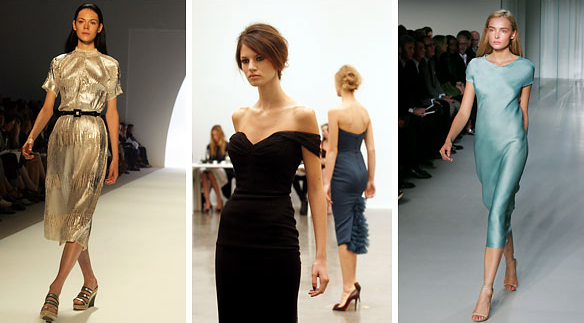
That doesn’t mean that the photojournalists don’t inflect what they see. It isn’t hard to do, but they nonetheless should be given some credit for emphasizing the incredible lifelessness of the models. This is done in several ways, including showing a line of models that look like clones, and showing backstage shots suggesting that the completely passivity and vacuousness seen on the runway is not a pose. I’m sorry that I’ve misplaced some of the better images to make the point, but look at this triptych from the New York Times:

fashion-tryphtic.png

The two outer panels show us the clones. Despite different hair color and dresses, the two models have equally blank expressions and nearly identical bodies and walks. One can look very closely and identify many small differences, of course, but the effect of the pairing is to push the viewer in the opposite direction: they could just as well be the same model. That, of course, is the point of the exhibition, which is to feature the dress and not the person inside.

The middle panel provides the backstage shot. It could be used for a party quiz: is the women in the foreground alive or a mannequin, or perhaps one of the next generation of Stepford Wives? Again, you might be able to peer into her face and see great depth; readers of Russian literature are welcome to the challenge. It is more likely that the image, like those on either side of it, suggests that the vacuum-like isolation surrounding each model is matched by a vast interior silence.

I think these portraits of the models may be a gender-comprehensive protective mechanism: Just as most of us aren’t going to wear high-fashion apparel most of the time, if at all, we really wouldn’t want to be one of those anorexic dopeheads, or marry one. That fantasy comes at a cost, however, for it carries with it the idea that fashion is but the inert material that we use to drape our bodies and decorate an impersonal world. That’s true enough some of the time–and a good thing, too–but it can lead to highly misleading conclusions about what it means to be normal, reasonable, or human.

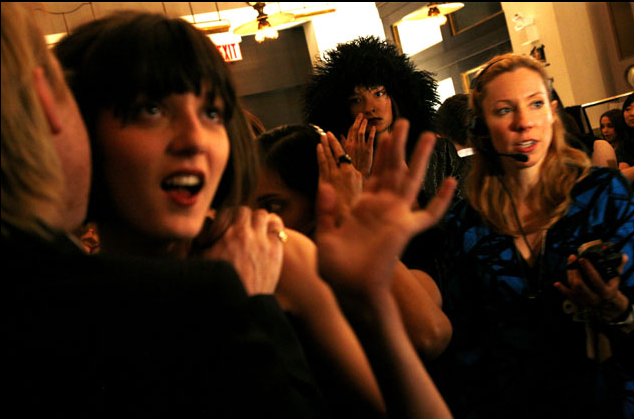
To get a sense of what is missing, look at this image:

fashion-week.png

Taken by Patrick Andrade, it’s only caption is “Fashion Week.” Another backstage shot, this one is anything but posed. The image is pulsating with social energy. Those in the picture are crowded together yet gesticulating and talking avidly. The brunette on the left seems to be exclaiming about someone off camera while the guy with his hands on her shoulders seems to be trying, not very well, to calm her down. The blond on the right talks not only to those around her but into her miked headset. This scene features the handlers who are frenetically managing the show and perhaps for that more like you and me. But it’s really not about this or that occupational role. Those in the scene crowd up against the viewer as if we were at a party. The background could be any office or apartment, and the off-kilter angle and lurid lighting reminds me of more than one great night out.

What makes the image even richer is that it still includes the conventional model, in this case the brunette with the bone structure, exotic hair, and glazed look in the background. Again, she could be what you’d expect at good party: is that a wig? Is she a he in drag? What’s he on? She does seem to be pretty stoned, and the gesture of her hand looks more like the involuntary tic of serious coke habit. We still get to dish on the models, but now they’re just one part of the social scene and well in the background.

The point is not who gets the fashion world right. This photo has captured something much deeper: how fashion is one expression of the ferocious energies unleashed by our being social animals.

Photographs by Hiroko Masuike, Erin Balano, Hiroko Masuike for the New York Times; Patrick Andrade, http://www.patrickandrade.com/


Digg!

 1 Comment

"Bewitched, Bothered, and Bewildered"

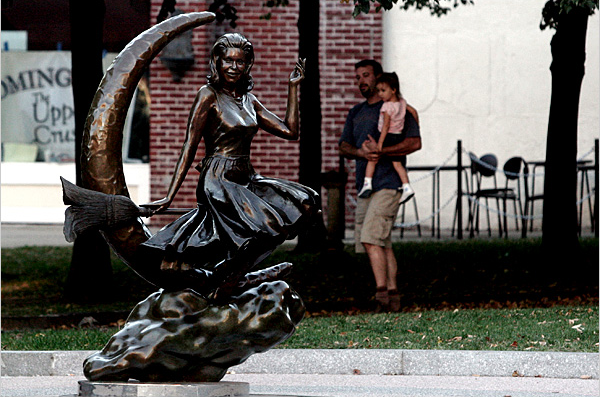
bewitch1.png

The picture is of a life size statute of “Samantha Stevens,” portrayed by Elizabeth Montgomery in the 1960s television show Bewitched, and arguably America’s most famous witch. Witches are typically cast as ugly and scary beings, and hence their prominence on Halloween. But Samantha Stevens was a beautiful and loving witch (as well, we might note, as an excellent housekeeper and the perfect wife and mother). For my generation, “Sam” Stevens stood in stark contrast to Margaret Hamilton’s portrayal of the “The Wicked Witch of the East” in The Wizard of Oz, and even to this day she maintains a fairly large fan base supported by websites, collectibles, and the like.

As a photograph the picture is really quite unremarkable. An altogether ordinary, slightly off-center “snapshot” of a statute; precisely the kind of image we might find in a private photo album documenting a family vacation. What makes the photograph notable here is that it was shot by a NYT photographer and that it appears in a NYT travelogue feature that regularly promotes places to which members of the upper middle classes might “escape” the rigors of everyday life, such as Aruba, St. Lucia, and Jamaica. Titled “The Ghost’s of Salem’s Past,” this slideshow promotes the devil may care attitude of Salem, Massachusetts, a quaint and quiet New England town that is represented by the NYT as operating at the juncture of the sacred and the profane, part historical landmark and part theme park. These attributions may not be inaccurate, as Salem relies almost exclusively on tourist traffic for its economic survival. And so it not only has to trade on its history, but it has to make witchcraft desirable – literally a commodity that consumers are willing to buy. And therein lies the problem, for the truly important lesson of Salem’s “history” should be addressed to its visitors as citizens and not as consumers.

Salem, of course, is the home of the Salem Witchcraft Trials of 1692, generally understood to be the most notorious (if not actually the first) “witch hunt” hysteria in the nation’s history. By the time the hysteria had ended over nineteen men and women had been hanged on Gallows Hill for allegedly practicing the dark arts, and another, octogenarian Giles Corey, was pressed to death under heavy stones, defying his executioners to his very end by taunting them to use “more weight!” The trials are regularly acknowledged as one of our darkest moments and are frequently pointed to as the first and most enduring challenge to what eventually emerged as the promises of civil liberty and social justice grounded in a commitment to religious toleration. Put differently, its legacy as a “usable past” is as a reminder to what can happen in the face of mass hysteria and the irrational fear of others within in our midst (which is not to say that all fears of the other are by definition necessarily irrational).

However much Salem attempts to retain a sense of its usable past, and thus to altercast its visitors as citizens with a responsibility to the sacred demands of civic democracy—and there are important efforts to do so, such as with the Salem Village Witchcraft Victims’ Memorial in neighboring Danvers—it nevertheless is confronted with powerful economic realities that animate its profane, consumerist, theme park sensibilities. So it is, that when the Samantha Stevens statute was dedicated in 2005, the television show being memorialized was described as “timeless” without even a hint of irony, let alone recognition for how its prominent placement in Salem risked overshadowing and domesticating the towns’ truly timeless and tragic history. It is as understandable as it is regrettable, at least for the residents of Salem.

But look at the picture one more time. Although shot by a professional photojournalist, it actually looks like it could have been taken by an amateur. Indeed, studiously so. The framing of the image—whether the statue or the man and child in the background—is off-center. Shot with a long lens but at a moderately wide angle, and with the shutter stopped down, the foreground and background are both in relatively sharp focus; the effect is thus to emphasize how cluttered the scene looks to be. And the exposure is all wrong as well, highlighting strong contrasts between the statue and the multiple backgrounds, and thus emphasizing shadows that make it very hard to know where one should direct their gaze. In short, it perfectly imitates what we might imagine to be an amateurish snapshot found in a personal photo album designed to document a family vacation. And as such, it invites the viewer to identify with it as a private consumer and not as a public citizen; come to Salem, it beckons, not to reflect upon your nation’s tragic past, but indeed, to “escape” that past by experiencing a “timeless” and happy fiction. What seems less clear are the stakes that the NYT has in all of this. Indeed, what is somewhat understandable, even bewitching, in Salem, MA, is both bothersome and bewildering when valorized by one of our leading institutions.

Photo Credit: Robert Spencer/New York Times; and with thanks to Stephen Olbrys Gencarella for introducing me to the carnivalesque atmosphere that pervades Salem, MA, and not just on Halloween, where it is the site of one of the largest public parties in the land, but to the ongoing struggle within Salem to negotiate the tension between economic survival and social justice.


Digg!

 0 Comments