This is one of those images that leaves me speechless:
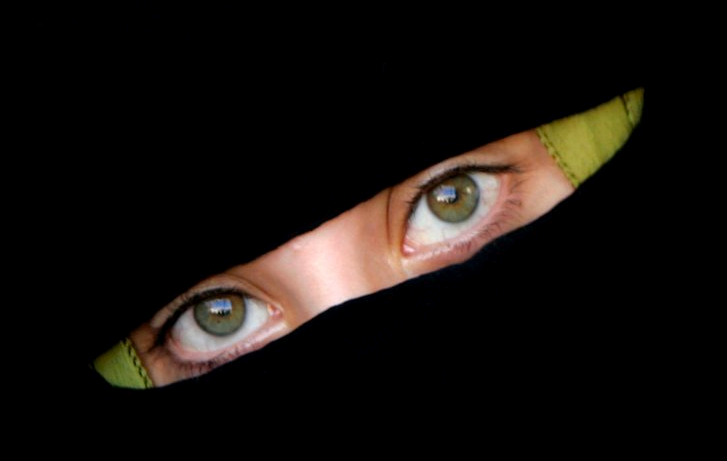
It is so elemental, so purely visual, that language seems completely unnecessary. We see a woman seeing, with almost every other thing about her obliterated to blackness. We see only her eyes, the “window of the soul,” and that through a slit, as if she were looking out of a crack in a prison wall. She looks out intently, as if seeing through that narrow aperture were as necessary as breathing.
Many would say that she is in a prison: encased in the burqa and the comprehensive confinement of women that it represents. She might agree with that account of her life, or she could complicate it. For example, we can observe that she also is wearing a green scarf that matches her eyes: a world of culture, fashion, personal care, and relationships with other women and her family all follow from that little fact. More to the point of the day the photo was taken, the caption reported that she was protesting against the imprisonment of 9200 Palestinian prisoners. They, she might say, are the people you should care about if you oppose unjust imprisonment.
At that point at lot of people might start talking, and so speechlessness is not the problem. But there was another reason I was stunned by the image. This photograph evokes a standard narrative of Western personhood and yet places it at the edge of intelligibility. The eyes represent the face which represents the essential individual, and all of this is heightened by contrast with the confinement and uniformity of the burqa. Likewise, the eyes looking out symbolize the belief that each person yearns to escape restriction to realize the freedom that is the necessary condition for full realization of the self.
And yet at the same time the image makes this interpretation acutely vulnerable, even strange. If humanism is evoked, it also is compressed, reduced, taken down to the most minimal condition of communication: a look, without context, through a tear in a shroud. James Elkins remarks in The Object Stares Back that faces are difficult to understand or describe because “they are the very beginning of our understanding of unity and coherence” (195). This image reveals the unity, coherence, and fundamental integrity of the human person, and yet it also takes us back to a terrible moment of origin–or the verge of extinction. This may be the closest we can get to seeing a person, and she is all but incomprehensible for that.
But you may not have seen that at all. In fact, I didn’t write about this photo when I first saw it; though stopped in my tracks, I also suspected that it was unduly manipulative. (I was able to write about it only when I came across it again by accident yesterday.) There are many uses for a photograph, and images of the burqa are proliferating in the mainstream media. The easy point to make is that they are fodder in a propaganda war in a supposed clash of civilizations. I think more is going on, not least the visualization of interesting problems within liberalism. One wonders how much the idea of the person depends on such images, perhaps because it is weakening or shifting on some other, unidentified dimension. We also might ask whether this photograph is one example of making a fetish of individuality at the expense of collective action on behalf of peace.
The good news is that Orientalist erotic fantasies, although not completely absent, are not being pushed here. They may even be displaced by the belief that the veil hides essentially modern women waiting to be released from oppression. That won’t be entirely accurate, but it may be largely true, and history shows that one could do much worse.
I’ve gone from being speechless to rambling. There are other connections to make, including the famous image of the Afghan girl on a National Geographic cover. In any case, I think the value of the photograph above is not how it reveals anything about a particular woman or women behind the veil, but how it challenges those looking in.
NB: This is another in a series of posts on the relationship between the veil and Western norms of visibility, publicity, and political identity. They are filed under The Visual Public Sphere.
Photograph by Hatem Moussa for the Associated Press (Washington Post, Day in Photos, August 13, 2007).