Jun 06, 2011
May 20, 2011
Oct 12, 2012
Dec 05, 2010
Dec 17, 2010
Mar 13, 2013

Sight Gag: Pax Britannica

bt-greece-gallery-305-copy.jpg

Note: If you don’t get the gag, click on the flag. And if you need more, go here.

Our primary goal with this blog is to talk about the ways in which photojournalism contributes to a vital democratic public culture. Much of the time that means we are focusing on what purport to be more or less serious matters. But as John Stewart and Stephen Colbert often remind us, democracy needs irony, parody, and pure silliness as much as it needs serious contemplation. For our part, we will dedicate our Sunday posts to putting some of that silliness on display in what we call “sight gags,” democracy’s nod to the carnivalesque. Sometimes we will post pictures we’ve taken, or that have been contributed by others, or that we just happen to stumble across as we navigate our very visual public culture. And we won’t just be limited to photography, as a robust democratic visual culture consists of much more. We typically will not comment beyond offering an identifying label, leaving the images to “speak” for themselves as much as possible. Of course we invite you to comment … and to send us images that you think capture the carnival of contemporary democratic public culture.

Photo Credit: Bustedtees


Digg!

 2 Comments

Out of Sight, Out of Mind

This past week the Washington Post published a four part series in its “special reports” on “America at War” titled “Left of Boom: The Struggle to Defeat Roadside Bombs.” The series is a super-saturated, multi-mediated cornucopia of maps, graphs, slideshows, videos, and transcripts, including a glossary of terms for the uninitiated (if you don’t know the difference between “Left of Boom” and “Right of Boom” go here). Part II is titled “There Was a Two Year Learning Curve … and a lot people died in those two years.” The past tense here is telling, and a not so subtle reminder of the WP‘s long standing support for administration policy in Iraq. The report includes a slide show narrated by WP photographer Andrea Bruce who, “recounts an encounter with a roadside bomb while embedded in Baquabah, Iraq. The June 2004 attack seriously injured two soldiers who were traveling in an unarmored Humvee.” Before you can get to the slide show, however, you have to click the word “continue” on the screen below:

wpwarning.png

I clicked. The story is about two Humvees—one armored, one not—attacked by an IED. There were no fatalities. No one lost any limbs. Those in the unarmored vehicle suffered severe head trauma. Some of the images are hard to look at, and the injuries are surely serious, but we have seen far worse from previous wars, as well as the current one, if not always in the mainstream U.S. press, then at least in the foreign press and at readily available websites such as here and here. So why the warning? Why the dark shroud to veil the images? What propriety—what interest—is being protected and preserved?

The answer might be in part a function of how normalized—or plain inconvenient—the war has become, at least for those of us sitting safely and comfortably back in the States. Now longer than any other war the U.S. has participated in (with the exceptions of the Revolutionary War and the Vietnam “police action”), Operation Iraqi Freedom has become something of a fact of life. Sure, it’s a campaign issue in this political season and the “conduct of the war” is identified as the top concern in public opinion polls, but only for 28% of the projected population. In other words, for the vast majority of American people the war has become just another issue, like the economy or health care or immigration. The ordinariness of all of this is accented by the graphic design of the WP website.

normalization-of-war.png

“America at War” is part of the “Special Reports” section of the website. It is buried in the left hand column and deep below the hard news; indeed, it sits directly beneath the section labeled “Entertainment News.” If one finds the special reports and clicks on “America at War”—one of several such reports—they get the screen above. On the left side we find a densely packed frame full of textual information, assorted hyperlinks, and a picture of soldiers doing something at night—it is not quite clear what is happening in the picture, but oddly enough the photograph is from the slide show that is veiled by the warning of disturbing images. On the far right, in its own frame, is a space alien advertising cheaper mortgage rates. The choice here is simple: You can read about one of the longest wars fought in the name of the “American People,” as well as the effects of the continuing occupation of a foreign land that has resulted in the deaths of thousands of U.S. men and women and countless Iraqis, or you can save a few hundred bucks each month. You can be a citizen and exercise civic responsibility, or you can be a consumer looking out for your own private interests. And should a sense of civic responsibility get the better of you, but you don’t want to be “disturbed” by the “violence and graphic nature” of what you will see, well, hey, just don’t bother clicking on the slide show. Out of sight, out of mind.

The problem, of course, is that those who are living the war in Iraq don’t have quite the same luxury. The photographer, who narrates the veiled slide show, reflects, “One thing that strikes me about this one incident now looking back is how normal it is, how this happens everyday …” For those in Iraq the war is not a slide show that can be erased with a simple click of the mouse, or ignored with a turn of the head, no matter how “disturbing” it might be. It is, rather, an event that “happens everyday.” The tragedy for us at home is that we harbor the illusion that the war is just another issue that we can choose to attend to or not depending upon how it comports with our sense of decorum and propriety—or perhaps our own private interests. Out of sight, out of mind … indeed.

Credit: Andrea Bruce/Washington Post


Digg!

 1 Comment

Sputnik: The 50-Year-Old Dream

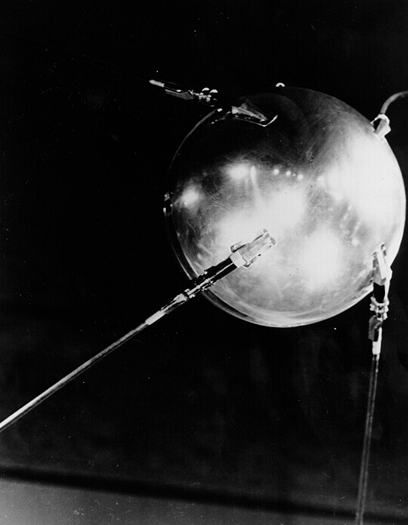
Today is the 50th anniversary of the launch of the Sputnik satellite:

sputnik-nasa.png

The launch is still seen as the official beginning of the Space Age. Doesn’t that term sound quaint today? “Grandpa, what was the Space Age?” Even so, the anniversary is an occasion for news stories, commemorative events, a documentary film, special (promotional) reports, retail products, and surely a joke or two.

NASA’s home page features presentations on the “50th anniversary of the space age” and on the history of NASA. Perhaps I’m over-reading, but I can’t help but think that the agency is a bit ambivalent about the occasion. Why, when it is their moment of origin? Because they have invested so heavily in “manned” space travel, rather than in the much less dangerous and much more cost effective “unmanned” technologies. Now that the space race is over and the shuttle program has become something like a children’s museum in the sky, that investment seems increasingly mistaken. Even the myth itself is shopworn: space is not the “final frontier,” astronauts are not explorers, science and technology are transforming life on earth rather than transporting it into space.

Dreams die hard, however, and I don’t like to be a cynic. So it is that this photograph caught my eye a few days ago:

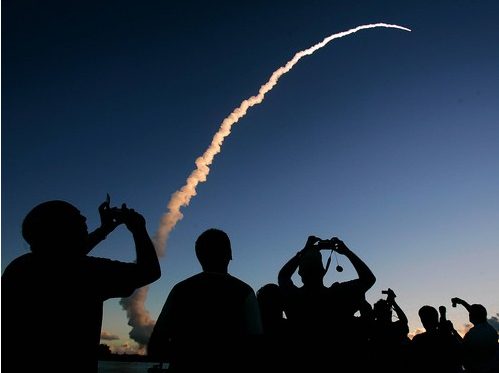
dawn-liftoff-rh.png

You are watching spectators looking up at the launch of the Dawn spacecraft, which is beginning an eight-year trip to the asteroid Vesta. There are no teachers on board.

This strikes me as a poignant photograph. It is an image shaped by alignments and contrasts. The craft named Dawn launches at dawn, nature and culture perfectly aligned to carry us forward into a bright future. As it escapes “the surly bonds of earth,” the contrail becomes ever more bright and pure–and distant. As the trajectory bisects the pictorial space on the diagonal, it likewise seems to ride the edge between sunlight energy and the cold blackness of outer space. As the craft arcs cleanly outward, it seems to leave cares, fears, conflicts, all forms of gravity behind.

And we are left behind. That, too, is represented in the picture. Against the bright escape of the machine, a group of human beings look up in awe. They are silhouetted, cast in darkness, as if made of the dark earth. We don’t see individuals but rather something like a group of hunter-gatherers, or perhaps Druids or some religious cult. We are reminded that they are moderns from the cameras being lifted up as if an offering. We see not a premodern cult but rather a camera culture hoping to snare an image. And that image is itself such a tenuous connection to the craft soaring out of sight. One machine surges away into a place we will never go, while a smaller machine only serves to accentuate how we far removed we remain from one kind of heaven.

The rocket launch begins in a darkened swirl of exhaust and soars to light. Those who have come to marvel at the technocratic sublime are left with little patches of light. Data flows back to NASA, and this is real science, also thoroughly human and likely to advance knowledge that can benefit life on earth. We don’t need to be on Vesta, and the machine will do the job. But it can do nothing to stop the yearning, while the camera can remind us that even as we dream of escape, we do so while living as human beings have always lived–sharing a common fate, bound to gravity and darkness, yet capable of joining together in a common life.  All are bound by the same limits, members of the same tribe.

I like the photograph for another reason as well, one that comes from comparing it to the file photo of Sputnik. In that image, we see only the machine, its metallic surface enhanced further by sharp black and white contrasts. It is a machine for a hard environment of energy and void, where neither death nor life have any meaning, only thrust, structure, data. The satellite looks self-sufficient, the epitome of modern design that in turn represents a technocratic future. Perhaps the commitment to lifting up astronauts was, in that context, a kind of humanism. If so, that moment also has passed. Now we stand as if in the second photograph. Our machines go not in advance of us, but in place of us, whether into space or into the ocean and the bloodstream. But they go for us, not as an end in themselves. After all, we are back in the picture.

Sputnik photograph from a NASA commemorative photo gallery; launch photograph by John Raoux/ Associated Press.


Digg!

 2 Comments

Shared Suffering in Iraq and America

In November, 2000, President Clinton traveled to Hanoi and stated in a speech there that “This shared suffering has given our countries a relationship unlike any other.” The statement need not be literally true to be an achievement. To the extent that it became true that day, it was something that reflected not only the war but also the healing and growing together that had ensued in the followed decades. Let us hope that some day the same can be said for the US and Iraq. It surely would take time, but the reason for doing so is already all evident in photojournalism’s coverage of this war.

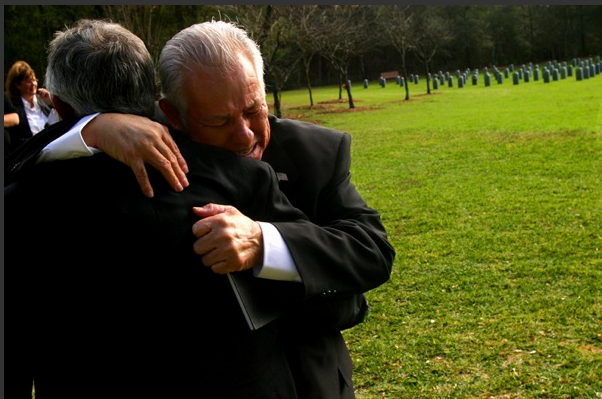
Two examples brought this thought to mind. One was the post at BAGnewsNotes yesterday about a new book by photographer Andrew Lichtenstein entitled Never Coming Home. Lichtenstein chronicles eight of the funerals occurring across America for those killed in the war. You can see some of these heartrending images in a photo essay at Alternet. One of a father collapsing in grief on someone’s shoulder is undoubtedly a portrait of suffering:

man-grieving.png


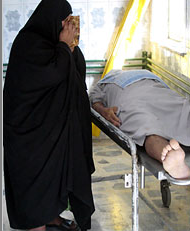
And for every loved one lost here, there are many more destroyed over there. This image from yesterday’s New York Times is one example of how grief knows no boundaries:

iraqi-wife-grieving.png

The caption of this page 10 story says that “An Iraqi woman wept next to her husband’s body yesterday in Baquba. Violent civilian deaths in Iraq declined last month.” That mixed message is typical of Times coverage of late (some would say, all the time). We can be certain, however, that the statistical decline means little to this woman. What remains to be seen is whether we can make an emotional connection across the barriers of war, geography, and culture.

Unfortunately, while the visual image may be the best means to establish empathy on the scale required, the archive presents its own obstacles to emotional understanding. While the photographs of American grief are now available in an elegiac photo essay and a beautiful book, those of Iraqi parents are not getting quite the same packaging. This photo appeared as a black and white image in the print edition, and then as a thumbnail image online. I was grateful that it was there, but the thumbnail sizing seems almost obscene, as if a deliberate strategy to minimize the depth of her loss. And while the American dead are respectfully interred in closed caskets, her husband’s body is laid out as if on a slab at the city morgue or as a cadaver suitable for an anatomy class. And instead of seeing the father’s face contorted in grief, hers is obscured by a handkerchief. Instead of seeing an individual, we see an anonymous figure draped in the burqa that signals, to the Western gaze, the less than full personhood of those confined within traditional cultures. The only means of communication are her hands. A message may be there, but we see only the gesture of loss, experienced by a social type, the Iraqi woman. That is a long way from sharing suffering.

And yet she does touch me. There is so little left in that room, and the light coming in like a breeze flowing through the window hints at a transfiguration, as if his spirit has already ascended. That may be, but she stands there like a pillar of grief. If only she had a shoulder to cry on. One of ours, perhaps.

Photographs by Andrew Lichtenstein; Ali Mohammed/European Pressphoto Agency.


Digg!

 0 Comments

The Ordinary Habits of Citizenship

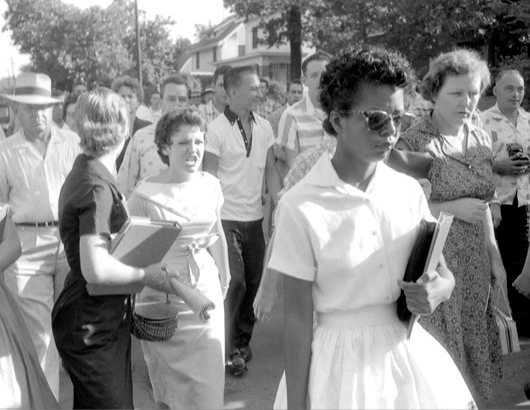
This past week marked the 50th anniversary of the desegregation of Central High School in Little Rock, Arkansas, one of the signature events of the U.S. Civil Rights movement of the 1950s and 1960s. It was, of course, a chilling moment, as President Eisenhower federalized the Arkansas National Guard and deployed the 101st Airborne Division to maintain public order and to assure the safety of the now famous “Little Rock Nine.” Photographs of the military occupation of Little Rock abound, but the single image which quickly came to define the moment in the national imaginary, and that has subsequently circulated as the premiere image of the event, is Will Counts’ photograph of Hazel Barnes verbally assaulting Elizabeth Eckrich on a public street.

counts.png

I was only five years old when the photograph was taken, and have no recollection of the event whatsoever. But the image has been seared in my memory from the moment I first encountered it in 1968 in the wake of the Detroit and Newark “race riots” and the assassination of Dr. Martin Luther King, Jr. I was in high school at the time and I remember a class discussion in which a number of my classmates agonized over “how all of this could happen.” The next day the teacher brought two photographs to class to fuel the discussion, this one and the image of dogs attacking a man in the street of Birmingham, Alabama. Much of the discussion that day circulated around the image from Birmingham, but this image bothered me much more. Only now do I know why.

The photograph from Birmingham was captioned by the national media as the actions of a racist state run by a racist governor. In the picture from Little Rock, however, the state was missing. There were no guns or dogs. Just citizens. The photograph made me realize for the first time that “politics” had to do with something more than just politicians. I could not understand the relationship between hatred and the hierarchy of racial alterity (indeed, I am quite sure that I did not have anything even approximating the words for it then), but I could see it in the vicious snarl of Hazel Barnes’ mouth and the forward, challenging thrust of her body, as well as in Elizabeth Eckrich’s tightly contained and focused countenance, her mouth closed and thus voiceless, her identity masked by the dark glasses and marked by what Orlando Patterson would later call the slave’s “social death.”

My appreciation for the photograph grew recently while reading Danielle Allen’s Talking With Strangers: Anxieties of Citizenship since Brown v. Board of Education, which provided the words to my somewhat intuitive response to the image. She writes, “… what gives it its immediate aesthetic charge, is that the two etiquettes of citizenship – the one dominance, the other of acquiescence – that were meant to police the boundaries of the public sphere as a ‘whites only’ space have instead become the highly scrutinized subject of the public sphere…. In one quick instant, looking at photos of Elizabeth and Hazel, viewers saw, as we still do too, the skeletal structure of the public sphere, and also its disintegration. Once the citizenship of dominance and acquiescence was made public, citizens in the rest of the country had no choice but to reject or affirm it…. Even today, the photo provokes anxiety in its audience not merely about laws and institutions but more about how ordinary habits relate to citizenship” (5, emphasis added).

The picture continues to be disturbingly poignant, certainly no less so because of the continuing animosities that we find demonstrated in the images we have of the racial divide in post-Katrina New Orleans or, more recently, in Jena, Louisiana. But above and beyond all of that, it also teaches us that photojournalism is about more than just reporting the news, for it functions also as an optic that enables us to see and to be seen as citizens by putting the habits of civic life on display. Indeed, this might be its most important social and political function. Sometimes the words needed to characterize and describe our habits of civic engagement are unavailable or simply do not exist; after all, one of the mechanisms by which power and domination works is to make it very difficult or even impossible to verbalize (and thus lend coherence and legitimacy to) the contrary needs and interests of the subordinate or subaltern classes. What cannot be spoken, nevertheless, can oftentimes be seen, as with the hierarchy of “domination and acquiescence” depicted in the photograph above; and if it can be seen and displayed, then surely it is something we can (and need to) talk about. Photojournalism, in other words, is a vital public art for a democratic public culture that helps us to identify, evaluate, and engage the ordinary habits of citizenship that might otherwise remain unmarked.

UPDATE: For an interesting article and slide show concerning this photograph and the integration of Little Rock see David Margolick’s Through a Lens, Darkly in the October Vanity Fair.

Photo Credits: Will Counts/AP

Digg!

 4 Comments

The Photographic Oracle

The September 23rd Sunday Times Magazine (London) contained a story on this year’s winners of the International Photography Awards. I have to say that I found the collection very strange because so many of the images seemed soooo dated: two head shots of auteurs, two female nudes, a posed scene of the bourgeois family cracking apart in an elegant restaurant. Where have the judges been for the past fifty years? As I flipped through the pages, I was reminded yet again of why fine art photography is such a small thing among the fine arts, and why photography’s artistic vitality usually is found not there but in photojournalism. That was the set-up for this image:

farran-bagg-winner.png

Ok, now we are in the 21st century. Again, I see a possible future world of post-human species where androids dream of electric sheep. By contrast, the Magazine’s caption tries to pull it back into a familiar humanism: “Bagg’s 2006 self-portrait features shiny lips and ‘plumes of red smoke.'” Not to worry: this is an individual person engaged in an act of self-expression, and the only manipulations are a bit of lip gloss and some red dye no. 5.

I don’t think so. This is the image of a facial mask, a mouth, a species, a thing from another order of being, an oracle. What they call smoke may be some post-industrial fluid, blood, breath, bio-informatic desire, or visual speech carrying the one true Word of a new revelation.

What is most revealing, however, is that this is not something from a vat in the 22nd century. This is one part of human nature, now. It may be how we would look to anyone, artist or victim or alien or machine, who saw us as we are and not as we think we are. We might wonder what they would say.

Photograph by Farren Bagg.


Digg!

 0 Comments

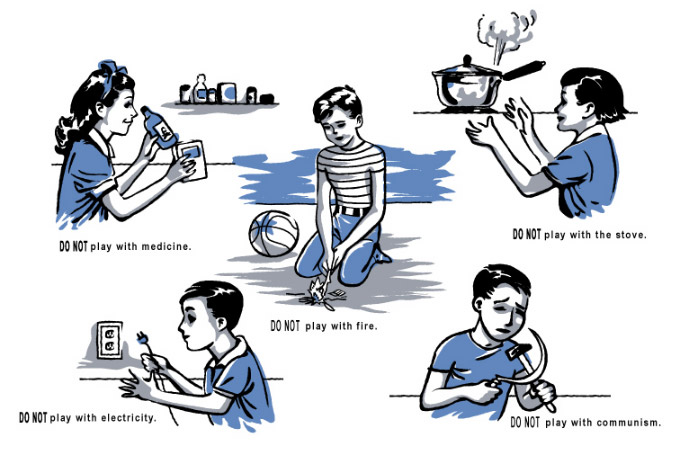
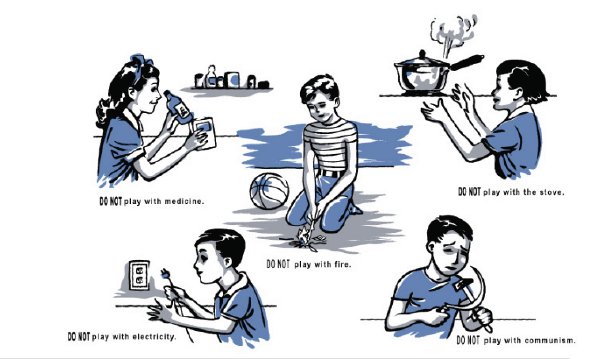
Sight Gag: "DO NOT play with …"

communism.jpg

Our primary goal with this blog is to talk about the ways in which photojournalism contributes to a vital democratic public culture. Much of the time that means we are focusing on what purport to be more or less serious matters. But as John Stewart and Stephen Colbert often remind us, democracy needs irony, parody, and pure silliness as much as it needs serious contemplation. For our part, we will dedicate our Sunday posts to putting some of that silliness on display in what we call “sight gags,” democracy’s nod to the carnivalesque. Sometimes we will post pictures we’ve taken, or that have been contributed by others, or that we just happen to stumble across as we navigate our very visual public culture. And we won’t just be limited to photography, as a robust democratic visual culture consists of much more. We typically will not comment beyond offering an identifying label, leaving the images to “speak” for themselves as much as possible. Of course we invite you to comment … and to send us images that you think capture the carnival of contemporary democratic public culture.

Credit: Rocky Davis, Illustrator

Digg!

 0 Comments

Death Camp: The Second Time as Irony

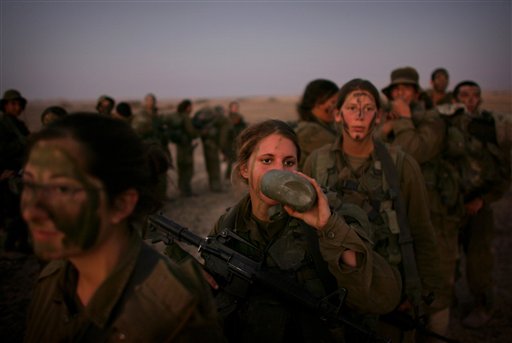
I have been troubled by this photograph since it appeared recently:

ap47405iu_israel_wome_01ezo.jpg

The photograph was taken December 20, 2006, during the final stages of a training march in southern Israel. It was circulated the week of September 17, 2007 to accompany stories about a commission report recommending that Israel’s military should allow women into front-line combat positions, including special forces.

This topic is a minefield, and I doubt I can say anything without offending some readers. The question of policy activates commitments to gender equality and the defense of Israel, as well as criticism of Israel’s security strategy and of militarism more generally. Equally important, each of these issues carries arguments about who has more or less authority to speak at all on the matter.

I have typically progressive positions on these issues, but I doubt that alone explains why I was stopped short by the photograph. I don’t just see the image alone, but two others that lie beneath it like a palimpsest. It draws its rhetorical power from one of these images, while the other raises a horrific specter that should be stated in the hope of critical reflection.

The first image to which the photo alludes is the typical shot of military troops, often special forces, deploying in full combat gear including the camouflage face paint applied for battle. We see these images in newspaper photographs, recruiting ads (Army Rangers, Navy Seals), movies and movie posters, and video games. In like manner, the woman in the front of the frame and the tall woman in the middle both are streaked with the black paint. That, along with the canteen and the caption push the viewer to see the women as combat troops in the making: trained, tough, and ready to go. If you look at the second and third women, they almost already have the thousand yard stare.

And maybe that’s what reminded me of the second image that lies latent within the photo: the image of Jewish women standing in line in a concentration camp. There actually are a number of such images; you can see one set here at the Yad Vashem web site. Look again at the photo above. Maybe you see only the gear and strong women. I see that and I also see Jewish women standing in a line, captives of the national security state.

What makes judgment so difficult in this case is that both images can be true at the same time. Israeli women are and will be everything one could ask of a special forces commando. And these women could be killed because of self-destructive state policies that are the issue not only of concerns about security but also of militarism and paranoia.

I have to add that all this is still far better than anything Hamas would do. Israel is not the reason the IDF needs women on the front lines. Israel is not where we need to worry about women being confined and denied basic civil and human rights. And as my friends who are hawks love to remind me, Israel is a vibrant democracy. This last point is exactly why I have to say what I saw in the photograph. There is reason to speak because Israel is a democracy and therefore open to public opinion, not to mention the financial, military, and political support that is provided by the US government and thus the legitimate concern of every US citizen. Perhaps I’m mad to be haunted by the image, but I believe that at times Israel, like the US, like many powerful states historically, can be dangerous to others and to its own people. Should the women in the photograph have to die in the defense of Israel, I see no basis for criticism of the report’s policy recommendation. But that defense may not be necessary, or, most important, may be more likely to occur precisely because of state policies that rely too much on military superiority and the normalization of war. Perhaps the question of Israel’s defense has nothing to do with my reaction to a photograph. It may be, however, that a photo shows more than we would like to admit about how people can become enslaved by force, even when it is of their own making.

Photograph by Oded Balilty/Associated Press.


Digg!

 0 Comments

"… the World is Yours!"

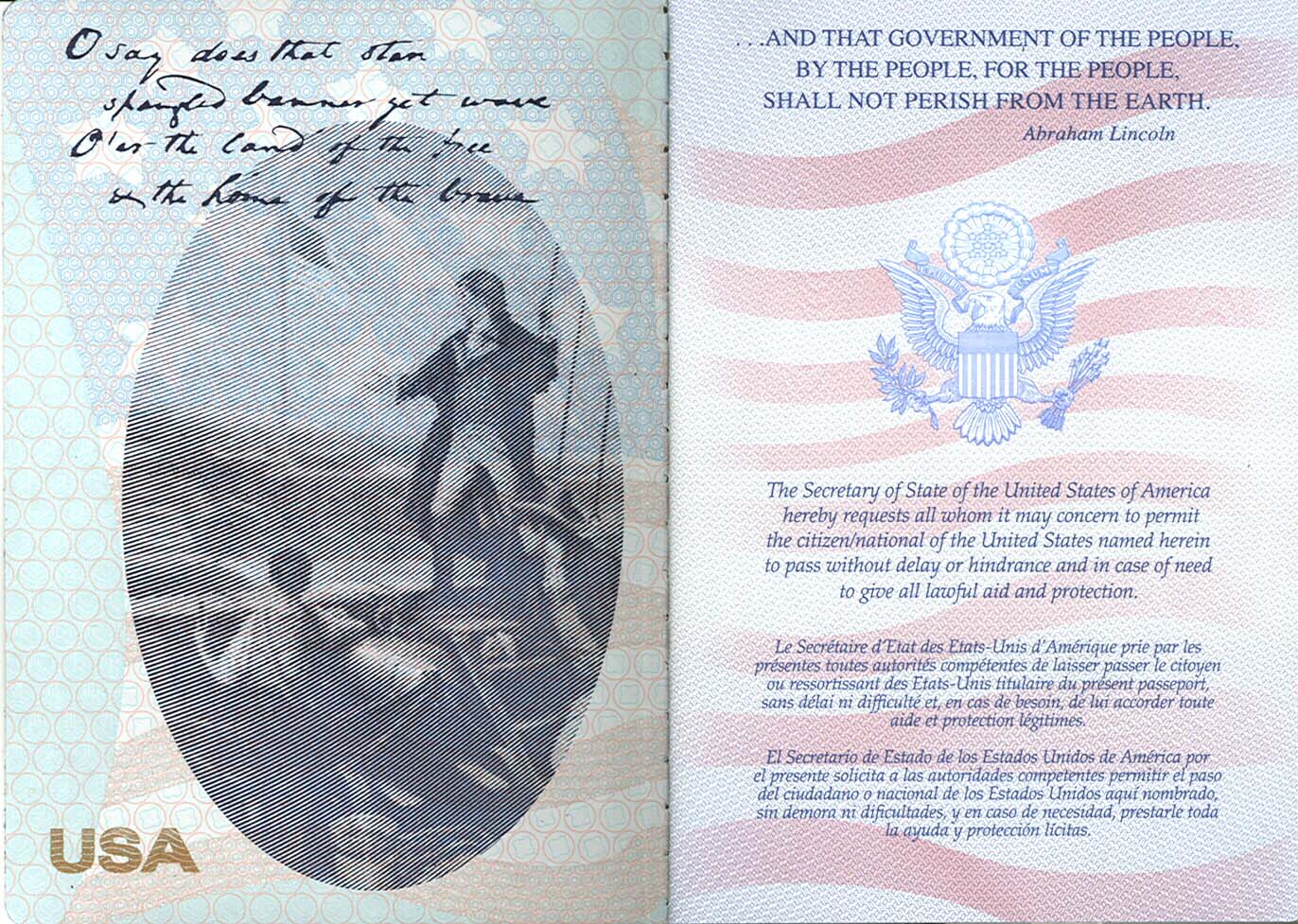
You don’t need to have a passport in order to be a U.S. citizen. But, as the brochure included with the new passport I recently received in the mail announced, “With Your U.S. Passport the World is Yours.” Well, sort of anyway. The first thing we learn upon opening the brochure is that this is an “Electronic Passport.” It’s not exactly an ankle bracelet, but “the information stored in the Electronic Passport can be read by special chip readers from a close distance.” One can only wonder what that last phrase might mean. The Department of State website assures us that it is “centimeters” and that the process is further secured by the latest “anti-skimming technology” (a fact that will no doubt impress every fourteen year old hacker paying attention). One less skeptical about how the current administration uses language and executive authority in the interest of national security to monitor its citizenry would probably not be paranoid, but then, as the saying goes, “just because you’re not paranoid doesn’t mean they’re not out to get you.” Truth to tell, however, it was not the electronics that made this new passport stand out for me, but its visual presentation.

There is much to comment on here, not least the story of America’s “manifest destiny” that is told in monochromatic drawings and photographs on every page, captioned with quotations that extend from George Washington to John Kennedy and include scriptures from the “Golden Spike,” the Statute of Liberty, and a Mohawk “version” of a Thanksgiving Address. I will revisit this archive in the weeks ahead. Today, however, I want to take a look at the inside front cover of the passport as an allegory that contains and directs the iconography of the whole.

passport-1ab.jpg

The first thing one encounters is a lithograph of Moran Percy’s 1913 depiction of Francis Scott Key gesturing to the garrison flag flying above Fort McHenry on the morning of September 13, 1814, following a massive, twenty-five hour long bombardment by the British Navy. Two weeks earlier the British Army had ransacked and burned down portions of the White House in Washington, D.C. Defending Baltimore Harbor was vital to repulsing a full scale British invasion and the 1,000 troops garrisoned at Forth McHenry proved to be up to the task.

The script written across the image is from Key’s poem “The Defense of Fort M’Henry,” and as most schoolchildren learn, it was subsequently set to music, renamed “The Star Spangled Banner,” and finally designated as the National Anthem in 1931. All of this might seem like trivial information but for the fact that references to the flag as it “yet waves” over the “land of the free and the home of the brave” became a fairly common trope in the wake of 9/11. There is no explicit mention of the more recent aerial attacks on the WTC and the Pentagon, of course, but the linkage between past and present is activated by a complex allegorical semiotic.

To see how, begin with the letters “USA” embossed in gold and placed on the lower left corner of the page. They stand apart from the painting and the script written across it, and yet they are very much one with both, a thoroughly modern caption for what purports to be a 19th-century imagetext. Indeed, boldfaced and uniformly blocked, the three gold letters stand in stark contrast to the pen and ink scroll that cuts across the image and bleeds onto the antique, elliptical matting of the painting. The aesthetic thus marks both the differences and continuities between then and now. Then we fought to secure our place among the world of nations, a newly birthed and independent nation-state emerging out of old world Europe, just as today we assure our continued sovereignty and security in (some might say hegemony over) a globalized, late modern world, now the gold standard among nations which, as the quotation from Abraham Lincoln on the right page intones, “shall not perish from the earth.”

Lincoln’s words operate in several semiotic registers. First, they are written in a contemporary font and in all capital letters. They thus function aesthetically to triangulate the relationship between Key’s 19th-century script and the modern typography of the golden inscription of the “USA.” As it was then, so it is now, and so it shall always be. The point is further reinforced as we realize that the entire two pages are printed across the image of the “Star Spangled Banner,” a flag tested in battle, and punctuated beneath Lincoln’s words with the imprimatur of the national seal. The eagle looks to the olive branch of peace and not the thirteen arrows of war, but we know how quickly that can change. Thus note how Lincoln’s words from the “Gettysburg Address” situate the overall image within the traces and contours of the U.S. Civil War, another challenge in a progressive history of such battles that have tested the sovereignty and resolve of the American nation. And thus the image that announces the U.S. Citizen to foreign lands, seeking passage “without delay or hindrance,” functions less as an introduction and more as an allegorical warning: for just as “confederates” were subdued then—and here one has to think of Sherman’s scorched earth policy—so now those who threaten the nation risk the wrath and retribution of all out war and occupation.

One might need to know a fair bit in order to develop this reading, but it is all common knowledge for anyone with the rudimentary understanding of U.S. history that one gets as part of their secondary school level high school education. We might wonder then who the primary audience for all of this is? Is it the heads of state implicitly identified by the Secretary of State’s “request” to “all whom it may concern,” repeated three times in English, French, and Spanish (what happens when one travels beyond the boundaries of these three Romance languages)? Or is it the “American people” who will have been “educated” to appreciate and perform the pious celebration of national strength and bravado as a ritual of national public memory—and to what particular ends? After all, as the brochure accompanying and explaining the passport declares, “With Your U.S. Passport the World is Yours!”


Digg!

 5 Comments

Why They Hate Us

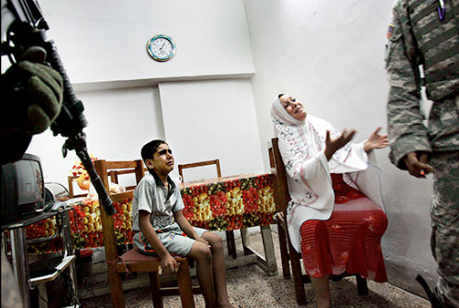
I don’t like to belabor a point, but as long as a few Republican senators stonewall any serious attempt to withdraw from the war in Iraq, the press and the rest of us will have to keep up the drumbeat for change. So we have yet another set of images from Iraq, these in conjunction with a special series in the Chicago Tribune that followed a troop of soldiers Inside the Surge. The photo essay shows the troops in camp, on the move, playing with kids in the street, and the like. The usual stuff of embedded coverage. And as happens often enough, they catch something of the other side of the myth of GIs handing out candy bars. Like this:
 

surge-search-picture-2.png

The caption reads, “The sister and nephew of a suspected insurgent cry during a nighttime raid of a house by soldiers in Bonecrusher Troop.” Hey, someone might say, it could all be an act. Ok, it could, although we are told later in the story that the suspect was released. And even if mom is acting, or perhaps trying to be reasonable, look closely at the boy. He is terrified. Hunching down into himself, close to crumpling, his face a mask of fear and shame and pain; he will not forget this night.

I’m also struck by several other elements in the photo. One is the standard of living. These are not the wretched poor of the “Arab street.” It is much more likely that they are middle class, exactly the people who were least likely to object to the changes promised by the Bush administration. Their usual preoccupation of the evening probably would be not building bombs but rather keeping the boy at his homework. I also notice that the room is so clean and spare. The emptiness of the room might be an indirect sign of the boredom and general social deprivation that is the common experience of so many civilians trapped in the war zone. In order to avoid the danger of life outside, they are confined to a few rooms and left with each other and the TV, if the power is on.

And then there is the gun in the right foreground. (That gun has appeared more than once in American photojournalism, as John noted here.) Sure, it’s pointed down, but were it to be raised boy and mother would be right in the immediate line of fire. No wonder the boy is afraid. Cordoned by soldiers on each side, mother and child beseech one who turns his back to them while the other holds them under the gun.

And they are not the only soldiers in the house. Here is another photo:
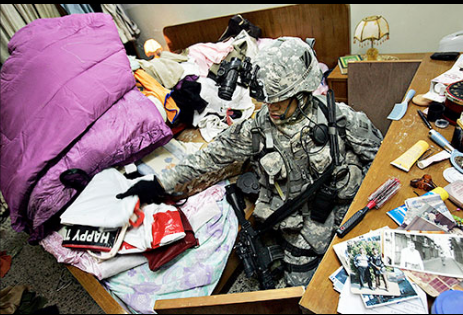
surge-search-picture-1.png

The caption reads, “Staff Sgt. Stephen Yacapin of Bonecrusher Troop’s 3rd Platoon searches a bedroom for weapons or other evidence of insurgent activity during a raid in Baghdad.” Like the mythical WMDs, he will not find weapons here either. We can see what does turn up, including a purple comforter, a hairbrush and comb, hair gels or something of that sort, snapshots of family or friends, a magazine or folder in English, a purse–not exactly the raw materials of a terrorist cell. We also can see that he’s tearing the room apart. Maybe he’s going to put everything back in place, but it is going to be hard to stack the drawers again and put square corners on the bedsheets while outfitted like a storm trooper from Star Wars. I do not question his need to be outfitted for combat, but what is the Bonecrusher Troop doing in anyone’s bedroom?

And from the look of it, it could be anyone’s bedroom. I’ll bet I could get everything there from Target. Putting that room back together may not be hard to do, and the mess may be be a great harm, but surely they will feel that this raid was a violation of their intimate space, for that is what has happened.

These photos are not the whole story, nor are they any more true literally that those that show soldiers being friendly. But they should remind us that the Iraqi citizens’ experience of the US occupation is deeply personal. Pundits who pretend to ponder the great question of Why They Hate Us need look no farther then these images. This is not about the clash of civilizations, the supposed oxymoron of Islamic democracy, or any other Big Idea. This is about being terrified in one’s own home.

You would think Americans could empathize: Recall these words from the Declaration of Independence:

He [the King of Great Britain] has combined with others to subject us to a jurisdiction foreign to our constitution, and unacknowledged by our laws; giving his assent to their acts of pretended legislation:

For quartering large bodies of armed troops among us . . .

Of course, many Americans do understand, in part because they have seen photographs like these. The general public is not the problem.

Photographs by Kuni Takahesi for the Chicago Tribune.


Digg!

 3 Comments