Apr 21, 2020
May 24, 2010
Sep 07, 2008
Jan 28, 2015
Oct 09, 2011
Jan 18, 2013

Is Athens Burning?

Yes, it is.  And German Chancellor Angela Merkel tweeted that she had “Upgraded Greece from Hellenic to Heroic.”  (Isn’t that clever!)  I can think of a number of reasons that she might want Greece to no longer be Hellenic.  Some of the arguments fall on one side of the debate about how to manage the Greek economy, for the Greeks had made social welfare into an art form and need reform on several levels.  And some of the arguments fall on the other side, for the EU policies are draconian and probably counter-productive while making the EU look more and more like Greater Germany.  So, what is it to be?  I’ve already alluded to the movie Is Paris Burning?, which tells how the German commander of Paris disobeyed Hitler’s order to destroy the city before it could be rescued by the Allied forces.  One also could imagine a variation on a scene from Chinatown: as Jack Nicholson slaps Faye Dunaway repeatedly, she answers with each blow: Hellenic – Heroic – Hellenic – Heroic – Hellenic – Heroic.  As in the movie, the answer isn’t quite what you were supposed to hear.

As the news broke in the US Sunday evening, the headline at the Huffington Post screamed, “Historic Buildings Torched by Rioters as Austerity Vote Passes.”  I immediately imagined the Acropolis in flames (which would take some doing).  Turns out the scale was well below that level of “historic.”  But the symbolism was there implicitly: Athens, the source of Democracy and Western Civilization was burning.  Somehow the West really is declining, collapsing into civil war, convulsed with deep antagonisms, incapable of resolving political and economic problems of its own making much less delivering on its promises and realizing its full potential.

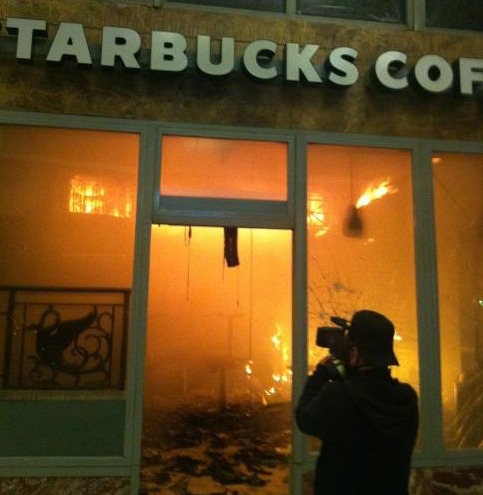
The photos that first popped up on Twitter seemed to both confirm and complicate this story.  The image above lies outside the narrative, as we don’t think of Starbucks as a historic structure (even if it could be located in one), and yet I find it all the more disturbing.  I’m not one to cry for multinational chains, but there is something particularly martial and vicious about torching a familiar storefront.  There are times when protecting the present can be a much more serious business than preserving the past, and I’m not just referring to security operations.  The fact that the cameraman’s hat looks like a storm trooper’s helmet deepens the sense that something like war really is happening, and that a city and perhaps a civilization really is being burned rather than handed over to those who live there.

Analogies should only go so far, of course.  Merkel is not remotely like Hitler, and the demonstrators who are burning local businesses are not freedom fighters.  But one could rightly suspect that a great deal of damage may be done by bankers following orders.  Despite the warnings of those such as Paul Krugman who really do know better, political elites in both Europe and the US are more committed to dangerous neoliberal doctrines than they are making democracy work as it should.

And so we get to another image from last night.
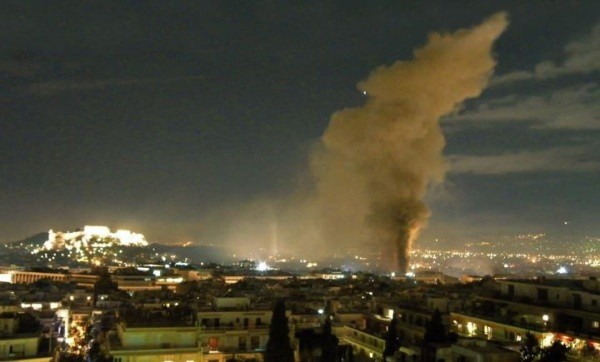
Hellenic or Heroic?  A citadel of democratic aspirations or a city under fire?  The ominous shadows, lurid hues, and a tower of smoke that looks like a tactical nuclear explosion all give the scene an apocalyptic tone.  What truth will be revealed, and what rough beast is slouching towards Athens to be born?  Who really is destroying the city, and are the fires in Athens a symbol of collapse or a sign of the essential struggle between mass and elite come round again?

Photographs by Martin Geissier/Twitter and Nectar de Angel/Twitter.


 1 Comment

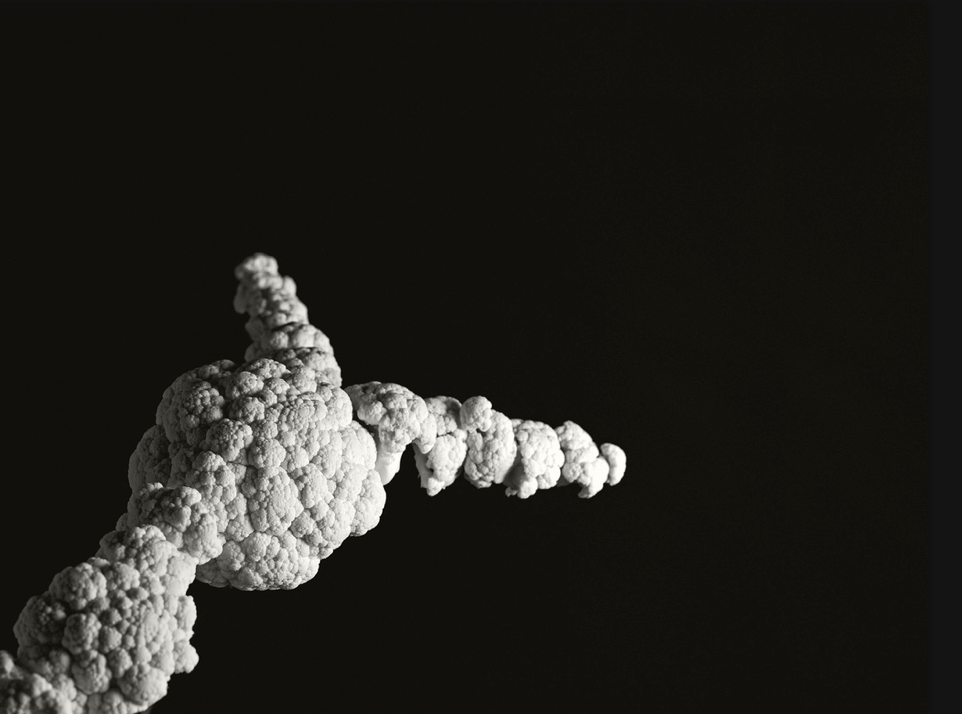
Sight Gag: In Memoriam, Cauliflower Space Shuttle Challenger (1986)

Credit: Laser Bread; With thanks to Bryan Blankfield for bringing this to our attention.

Sight Gags” is our weekly nod to the ironic, satiric, parodic, and carnivalesque performances that are an important part of a vibrant democratic public culture.  These “gags” may not always be funny or represent a familiar point of view, but they attempt to cut through the lies, hypocrisy, shamelessness, stupidity, complacency, and other vices of democratic life.  Of course, we invite you to comment … and to send us images that you think might deserve a laugh or at least a wry and rueful look by those who are thinking about the character of public life today.

 2 Comments

Occupy. (The Exhibition)

Occupy.


Fovea Exhibitions presents a slideshow on continuous loop from February 11-March 4, 2012.

143 Main Street, Beacon, New York

Opening reception: Saturday, February 11 from 5pm to 9 pm.

 Fovea is a volunteer-run 501(c)3 educational charity dedicated to promoting public understanding of world events and social issues through the medium of photojournalism.  You can donate and become a member here.  Their home page is www.FoveaExhibitions.org.

Photograph by Nina Berman/Noor.

 0 Comments

So What’s the Problem with Global Warming, Anyway?

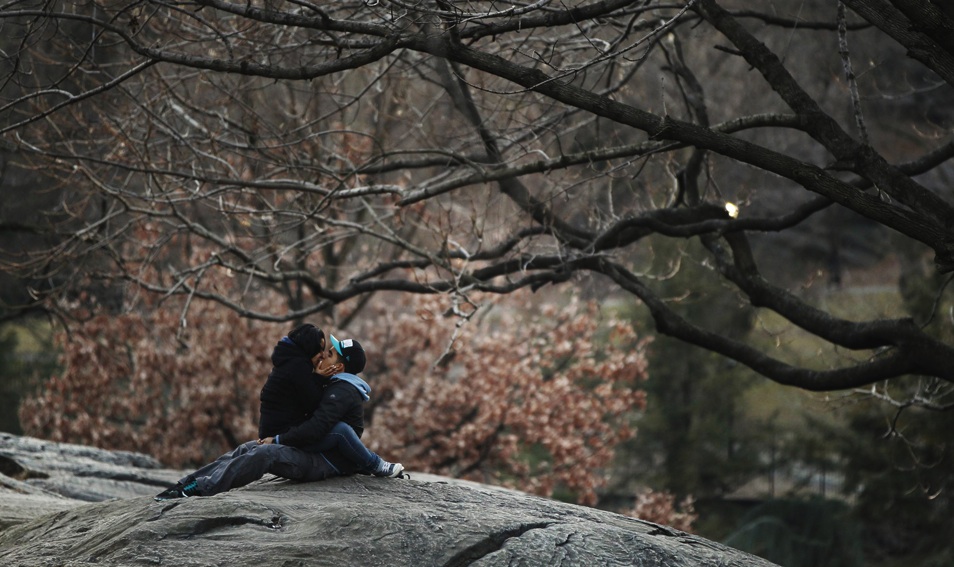
Here it is the beginning of February and the temperature in Indiana has been hovering in the mid-40s and low-50s.  Last week one day it was in the mid-60s.  Walking around campus has been a sheer delight, and a far cry from the typical weather one experiences in Indiana in the winter months.  I don’t know what the temperature was when this picture was taken last week in New York’s Central Park, but this is surely not the picture of “love in bloom” we might expect to see at this time of the year with couples skating in Rockefeller Center or maybe making snow angels on the Central Park lawn—or snow plows trying to figure out how to navigate around parked cars on otherwise deserted Manhattan streets.  And so the question is, what’s the problem with global warming, anyway?

Of course, we might not be so sanguine if we lived in Europe where an otherwise mild winter has turned abruptly to historically aberrant and excessively frigid temperatures as low as minus 40 degrees Fahrenheit in many places.

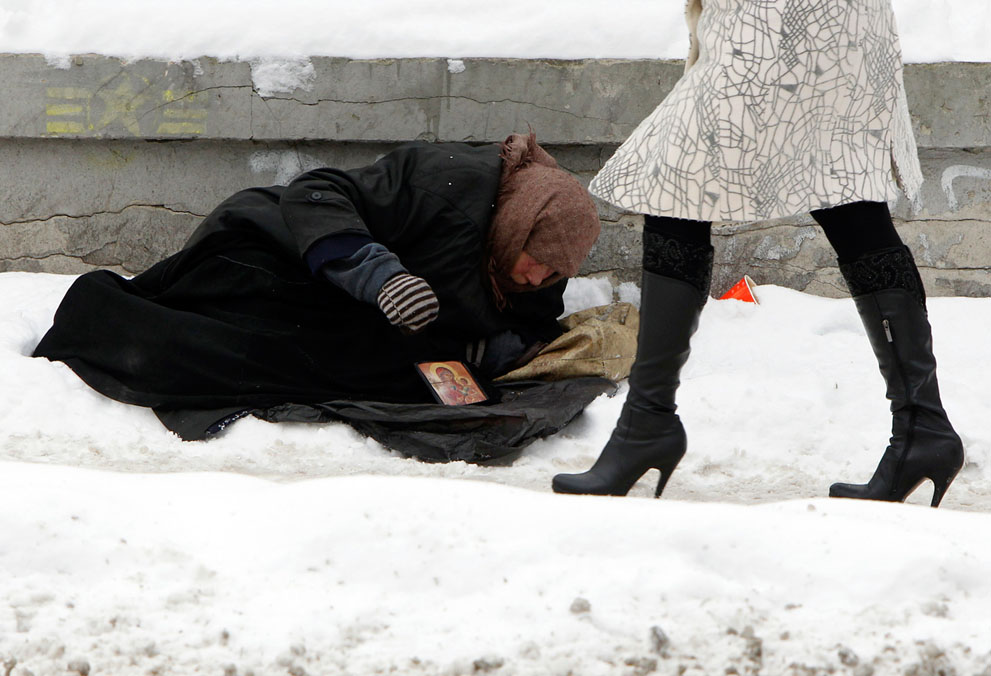
The scene above is from Kiev where the temperature is 8 degrees Fahrenheit, but the blowing wind no doubt makes it much colder than that.  And here, of course, we see at least part of the problem, for while the weather can be the background for a romantic liaison, it can also accent the effects of social and economic distance.  The woman walking has perhaps been inconvenienced by the frigid temperatures, but not so much that it has kept her from making her way down the street in stylish, high-heeled leather boots.  And judging from her stride it doesn’t seem as if she has noticed the prostrate woman laying in the snow and begging for alms or that she plans on slowing down or stopping.  And when she finally gets home it is altogether likely that her flat or house will be appropriately warm. The woman on the ground, on the other hand, is bundled in mismatched clothing and protected from the snow beneath her by what appears to be a plastic bag.  In all likelihood she is homeless.   And like so many of the poor and homeless, wherever she sleeps this evening her “inconvenience” will be much more acute, resulting in debilitating frostbite or even death. The numbers are hard to calculate, but even the most conservative estimates indicate that over 300 Europeans have died in the past two weeks due to exposure.

None of this proves manmade global warming, of course, but the conditions documented by these photographs surely corroborate the growing consensus to that effect of virtually every scientific organization that has studied weather patterns and climate change, including the National Academy of Science and the Union of Concerned Scientists.  And more, they gesture to at least one of the moral implications of our failure to preserve a sustainable environment, for surely it is the homeless and impoverished who will bear the initial brunt of the floods and draughts that are all but inevitable future effects of our current environmental practices and policies.

As I ponder these photographs it leaves me altogether amazed that serious candidates for the presidency can conclude that climate change is the result of “a substantial number of scientists who have manipulated data so that they will have dollars rolling into their projects” or that  global warming is a “hoax.”  Then again, it was barely less than a year ago that the Republican members of the  U.S. House Energy and Commerce Committee voted down an amendment to a bill that called for Congress to accept the scientific consensus that “climate change is occurring, it is caused in large part  by human activity and it is a threat to human health” on a 20-31 party-line vote.”

 And so, back to the question: What’s the problem with global warming, anyway?  And the answer has to be that the problem is that we seem determined to decide such matters on party line votes that systematically (and quite proudly) ignore the scientific facts.  And more, we forget that the spring-like conditions of a romantic liaison in the park during the dead of winter will have its costs, if not now, soon, and they will point to even deeper problems and contradictions within our collective lives.

 Photo Credits:  Lucas Jackson/Reuters; Gleb Garanich/Reuters

 4 Comments

Starship Troopers and Other Super Bowl Fantasies

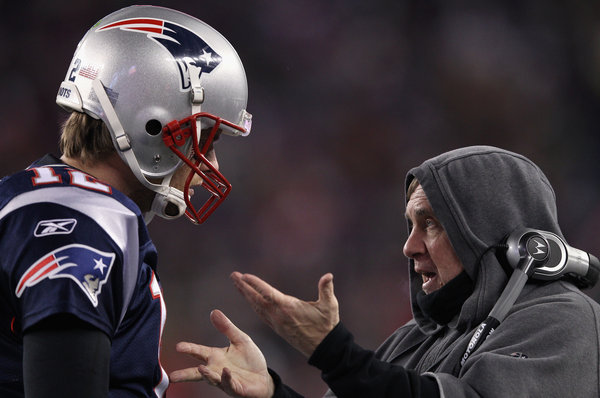
OK, it also could be Star Wars, if Yoda–or is it Obi-Wan Kenobi?–would give advice to a helmeted officer of the Imperial Guard, or something like that.  Either way, it’s a long way from Bart Starr and Vince Lombardi.  By 2012, the Super Bowl has become the ultimate mainline mash-up: sports, advertising, food, fashion, fundraising, socializing–so why couldn’t a sports photograph double as a place where two sci-fi films come together?  Come to think of it, that might make for a good ad. . . .

The basic structure of many of the Super Bowl ads is parodic: create a comic imitation of some habit of popular culture or everyday life, place your product in the mix, and hope that the audience of over a 100 million people likes the joke.  The production values are sky high and the jokes are lame, but what did you expect?  Which is one reason I like this photo, as it delivers quite a bit at a bargain price.

The allegorical significance of Star Wars is that the United States is reflected in both sides of the cosmic conflict between the Empire and the rebel forces: democratic ideals and imperial policies, civic virtue and a military-technocratic complex, freely given friendship and the libido dominandi. . . . The list goes on and that’s part of the point, as the two sides are not easily disentangled (as father and son each learned).  Starship Troopers traded on the same market, and the allegory was both clumsier and more direct: an otherwise liberal society (say, on matters of class, gender, and race) could still become a fascist state sustained by perpetual war.

And so we get back to the photo above.  On the one side, the fully equipped, imperial battlefield commander blazoned with propaganda symbols of a long extinct democratic revolution; on the other side, the sage in his humble, monkish habit has set technology aside to communicate a deeper, more organic wisdom.  Will he be able to get through the training and other institutional habits encasing the young commander?  But what if he is the one working for the Dark Side?

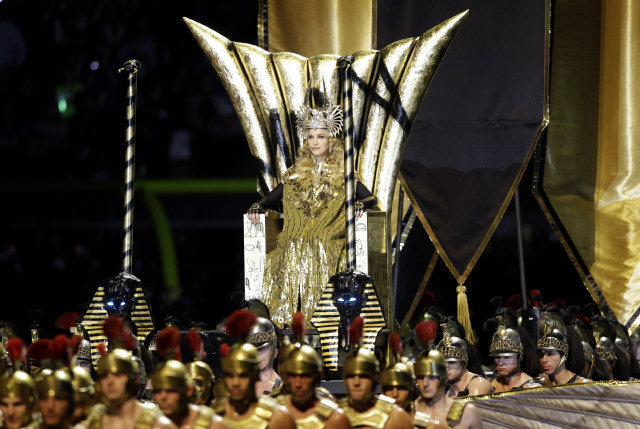
Silly, perhaps, but then football was never free of myth: think of The Four Horsemen of Notre Dame, winning one for the Gipper, and other hoary tales.  Likewise, science fiction has always been about the present, and about the relationship between politics and society.  The Super Bowl is a relative newcomer, but thanks to the power of spectacle it’s catching up fast.  An extravaganza for the masses where tickets cost thousands of dollars, it knows a thing or two about contradictions.  Thus, the photo above captures something of the spirit of the age: an age where all media are mixed media (to quote W.J.T. Mitchell) and mixing genres is now second nature in media production at all levels from major media events to what’s on your smart phone. Even so, it’s still a photo from the sports page.  To really see how far fantasy football can extend, you have to go to Madonna.

Eat your heart out, Cleopatra.  The material girl keeps the political allegory going strong, but now we’re back in a Pharaonic court.  Like what you see, America?  This past could be your future, and remember: the job of litter bearer can’t be outsourced.

Or maybe it’s just for fun.  Or perhaps it’s really a football picture after all.  You make the call.

Photographs by Elsa/Getty Images and Matt Slocum/Associated Press.  I discuss Madonna’s use of the courtly style in Political Style: The Artistry of Power, pp. 83-86.

Cross-posted at BAGnewsNotes.

 2 Comments

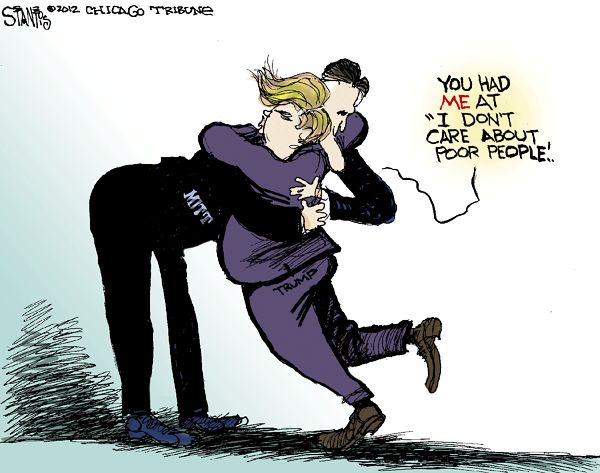
Sight Gag: But Don’t Forget, He Doesn’t Care About Rich People Either

Credit: Stantis/Chicago Tribune

Sight Gags” is our weekly nod to the ironic, satiric, parodic, and carnivalesque performances that are an important part of a vibrant democratic public culture.  These “gags” may not always be funny or represent a familiar point of view, but they attempt to cut through the lies, hypocrisy, shamelessness, stupidity, complacency, and other vices of democratic life.  Of course, we invite you to comment … and to send us images that you think might deserve a laugh or at least a wry and rueful look by those who are thinking about the character of public life today.

 0 Comments

Peter Turnley: Photographs from Havana

Peter Turnley has put up a slide show of photographs from Havana, Cuba.  The show is titled “CUBA: A Grace of Spirit” and features 45 images.

While at Peter’s website, be sure to check out some of the other shows.  Some of this work comes from his Street Photography Workshops, which are instructional trips that one might think of as a combination of urban exploration and a master class.  Forthcoming workshops include the Rio Carnival, Feb. 14-22 and Barcelona, April 22-28.  You can learn more at Peter’s website.

Photograph by Peter Turnley/Corbis, 2006.


 1 Comment

Caught in the Shadows

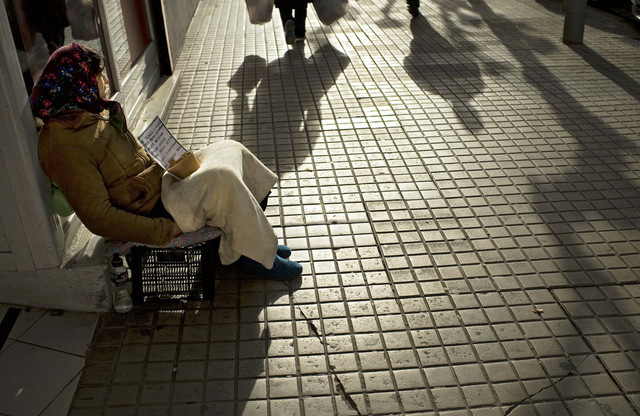
The woman above is a beggar.  The scene is Pamplona, Spain, but there is nothing that marks its location per se.  In point of fact, within the last six months I’ve seen the almost identical scene in New Orleans, Chicago, St. Louis, and Indianapolis.  And my guess is that others have seen it in many other cities and towns as well.  Or maybe not.  For while such scenes are all too present we have conditioned ourselves not to notice, to be blind to the situation.  Indeed, we teach our children that it is impolite to stare at such people, and I fear that we learn our lessons all too well, choosing as adults not just to avoid staring but to take comfort in not seeing them at all.  The problem that is created is a vexing one, as the photograph illustrates:  The poor, the unemployed, the homeless are compelled to perform their abjection in public as a means of survival, but at the same time they must shroud themselves under the veil of a shadow, seeable but not noticeable, observable but not seen.  It is hardly a situation conducive to encouraging public assistance, but then that doesn’t seem to be its purpose. Indeed, it seems to underscore a public-private dichotomy that forces (enables?) us to imagine (but never really see) the downtrodden as private individuals and not as members of a public, civic community.

What makes this photograph provocative is how it reminds us that we are all subject to the veil of the shadow.  Notice how those passing by, whether walking to or fro, cast (or are cast in?) their own shadows. There is a difference, of course, as the shadows of those walking are dynamic, exuding a sense of agency, while those of the beggar are altogether static, belying any sense of intentional action whatsoever.  In an  important sense, however, the difference is minimal, no more really than a function of how the light casts its rays upon us—illuminating or hiding us by turns.  And when we see the photograph in this context it is not difficult to imagine how quickly the roles played by the actors in the scene above can be reversed as casting a shadow morphs all too easily into being contained by one.  In a sense, one might say, the photograph stands as a visual reminder of the cultural aphorism, “there but for the Grace of God …”

It is a humbling lesson, but one all the more important for it if we are to recognize and attend to the precarious and  profound economic differences that seem to separate us.

Alvaro Barrientos/AP Photo

 2 Comments

America in Black and White

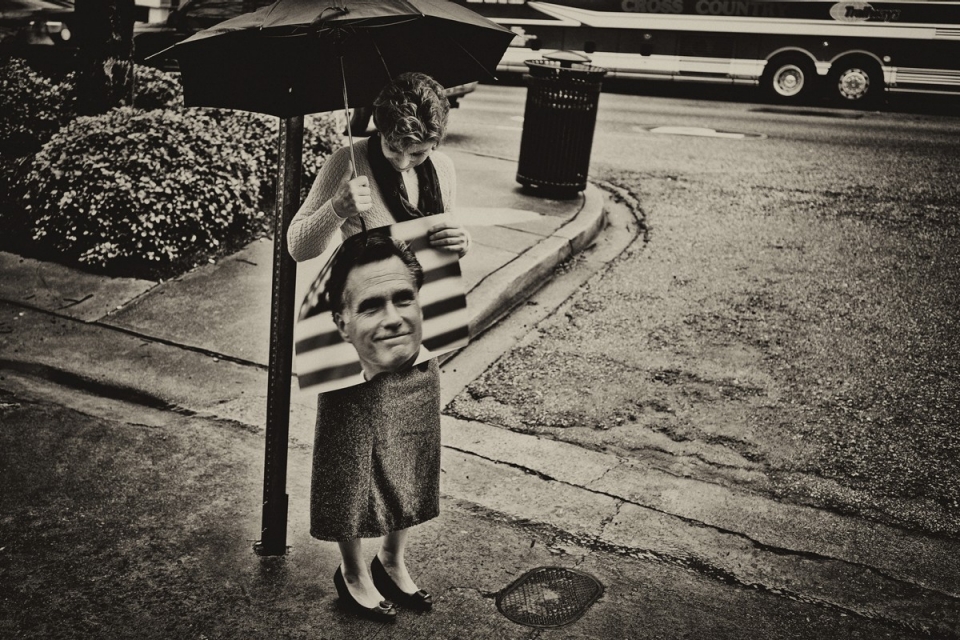
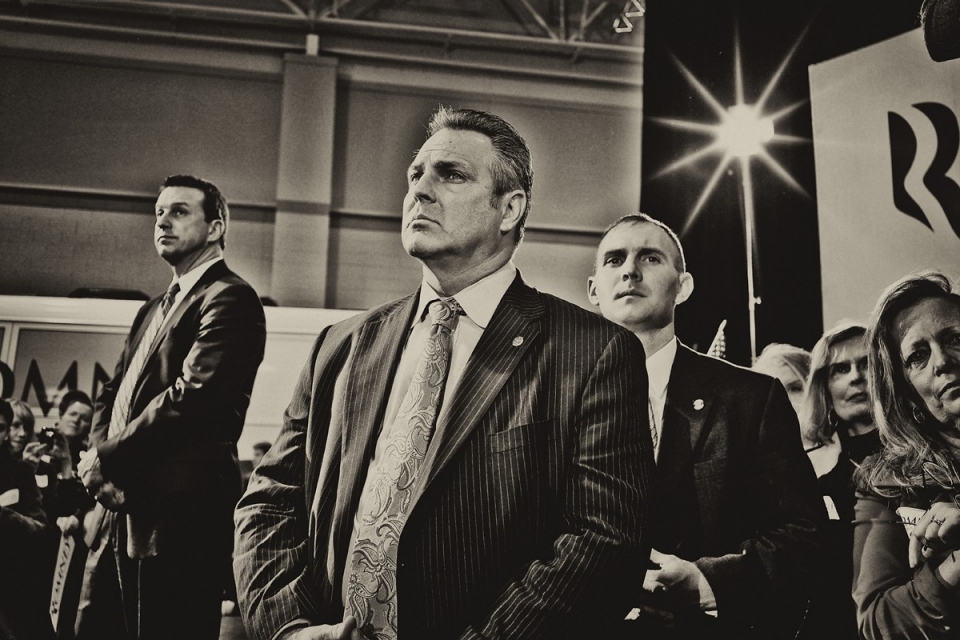
Color photography has become so ubiquitous and so useful that I now am skeptical when a photojournalist resorts to black and white.  Color no longer is the medium of advertising alone, nor is black and white the medium of documentary truth.  You might say that we’ve learned to think with a color palette, and if a photograph is given a retro look, we risk losing information on behalf of artistic pretension, or assuming documentary truth that hasn’t been earned, or succumbing to nostalgia rather than learning something about the present.  To see what still can be accomplished, however, take a a look at a recent series by Charles Ommanney on the Republican primary campaign in South Carolina.

Substitute George Romney for his son Mitt, and this photo from Greenville could have been taken in the 1960s.  Perhaps there have been changes in public trash bin design, or in bus wheels, but otherwise her clothing, hair, and everything else in the picture could be built for time travel.  She may be wearing contacts, of course, and may have a much better job than would have been available to a woman fifty years ago, but I find it striking that so little seems to have changed in half a century.

And that, I believe, is a very important implication of Ommanney’s artistic choice to use black and white.  You’ll have to see the rest of the show at Newsweek/The Daily Beast, but I’m confident that many viewers will see what I see.  Other than a few very small details such as the occasional smart phone, the photos suggest that nothing has changed: ordinary citizens of a homogenous society listen to a wealthy, good looking candidate campaign in a one-party state.  The election rituals include flags, banners, signs, funny hats, and public speaking as the candidate presses the flesh and otherwise shows that he’s a man of the people.  The people don’t look too well off, but they’re proud, and the campaign is exciting but still a relatively humble, egalitarian process.

Of course, that process is run by men–and men who mean business.  And that is just one part of how there is something creepy, even downright ugly about the photographs, as you can begin to see with this shot from North Charleston.  This is not a welcoming image, but rather something much closer to a portrait of white resistance.  The photographs are astonishingly homogenous, and it becomes clear that the world of the Republican primary is a black and white world–and the primary process one that is for whites only.

Whatever his intentions, Ommanney has brilliantly captured how the GOP is trying with all its might to turn back the clock.  Against the reality of a multiracial, multicultural, pluralistic civil society and an African-American president, they want to make the present look as much as possible like the past.  That past ideal may be the ruinous economic policies of the last Bush presidency or the vicious social order recently illustrated in The Help, but it’s always a past that most Americans today want to leave far behind. Indeed, we can look to a photograph form another primary campaign in South Carolina to see just what a difference there is between the new America and the old.

Ommanney’s images do more as well.  There can be some reassurance in the thought that politics may have changed less than many pundits suppose.  Of course, the South is now a Republican stronghold rather than Democrat, the primary campaigns probably are financed more than ever before by a small number of wealthy donors, the media saturation is complete, and the struggle for the soul of the nation is as difficult as ever, but the process still is democratic, demanding, unpredictable, and revealing.  History may be more than a reactionary political vision or an artistic device, but rather something that is being lived and moved forward, however slowly and painfully, year by year, day by day.

 2 Comments

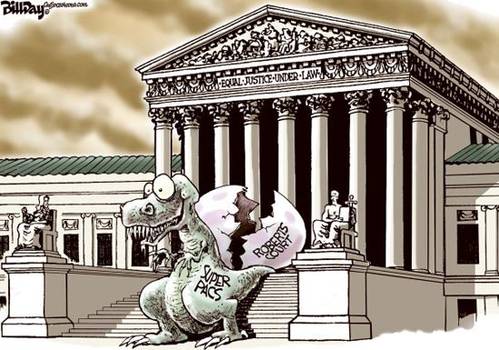
SIght Gag: Jurassic Pac

Credit: Bill Day

Sight Gags” is our weekly nod to the ironic, satiric, parodic, and carnivalesque performances that are an important part of a vibrant democratic public culture.  These “gags” may not always be funny or represent a familiar point of view, but they attempt to cut through the lies, hypocrisy, shamelessness, stupidity, complacency, and other vices of democratic life.  Of course, we invite you to comment … and to send us images that you think might deserve a laugh or at least a wry and rueful look by those who are thinking about the character of public life today.

 0 Comments