Jan 14, 2009
Jul 21, 2013
Apr 25, 2011
Jan 26, 2015
Apr 01, 2008
May 24, 2016

Sight Gag: Flags of Our Fathers

Credit: Pat Bagley

The “Sight Gag” is our weekly nod to the ironic and carnivalesque in a vibrant democratic public culture. We typically will not comment beyond offering an identifying label, leaving the images to “speak” for themselves as much as possible. Of course, we invite you to comment … and to send us images that you think capture the carnival of contemporary democratic public culture.

 0 Comments

Photographers Showcase: Pontiac, Michigan

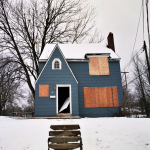
We welcome back Ashley Gilbertson who recently spent time “embedded” in Pontiac, Michigan, a city of 60,000 that is heavily reliant upon the economic presence of General Motors.  It is a picture of the effect of the economic crisis on a small, upper midwestern town.  Ashley is now affiliated with VII Photo and you can see some of his more recent work there, including some of his work on Wall Street for Vanity Fair.  The slide show below was originally part of a multimedia show at the NYT.

 2 Comments

Afghan Girl II (or Freedom's Just Another Word For Nothin' Left to Lose)

President Obama’s declaration that we will remove all combat troops from Iraq by the end of 2010 is something of a moment for celebration (if leaving a country that we occupied and brought to its knees under false pretenses and is now caught in the throes of sectarian violence can be seen as a moment of joy), but the pleasure of that announcement has to be mitigated a good deal by the fact that he has also committed an additional 17,000 troops to the war in Afghanistan (on top of the 32,000 troops already there). Al Qaeda is ensconced in the caves and hills of the Afghanistan mountains and the Taliban does arguably pose a national security threat to the U.S., so this may be justified at some level, though whether it is a winnable war or not—or what a victory here would actually look like—are certainly open question (just ask the leaders of the former Soviet Union … if you can find any of them). But what is troubling is the way in which we seem to have convinced ourselves that the reason we having been fighting this war, at least in part, has been to save the women of Afghanistan.

To be sure, I have no doubt that the women of Afghanistan are treated in ways that are horribly inhumane and cannot possibly be justified in any way by appeals to cultural differences or long standing traditions. But there is a continuing and nagging cultural meme that presumes to justify U.S. military presence in Afghanistan as somehow connected to securing the human right of these women. It’s not part of the official rationale for our being there as far as I know, though I do recall Laura Bush making such a public appeal a few years back, but the concept nevertheless seems to float along within the public discourse in a network of vaguely connected narratives and cultural associations that functions as a sort of moral imperative for our presence there; and here’s the point: it does this in a way that distracts attention from the larger public debate we should be having about our national interests and concerns in this part of the world and how we should go about accomplishing them.

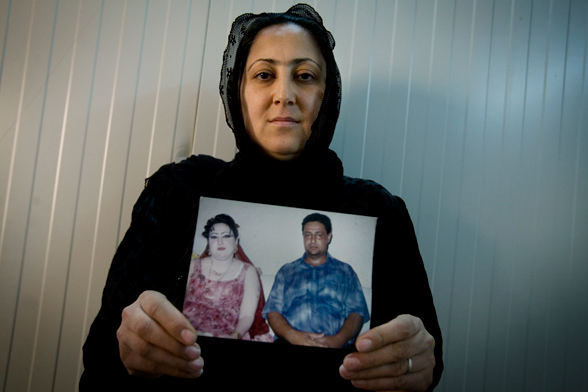
The presence of this meme was given visual prominence this past week on the front page of the NYT as part of a story (and a website slide show) dedicated to the idea that talk of women’s rights in Afghanistan is starting to take hold and with the clear implication that it is a direct effect of the U.S. defeat of the Taliban in 2001. The photograph is of a seventeen year old woman by the name of Mariam, who had been forced to marry a forty-one year old blind man at the age of eleven and was then beaten and otherwise abused because she failed to conceive. She eventually fled and found refuge in a woman’s shelter

The narrative is full of pathos, and one would have to be cold hearted not to be deeply affected by it, but what distinguishes it from numerous other such stories one can find on the internet is the image that anchors the report, a photograph that bears distinct resemblance to the photograph of the now famous “Afghan Girl” that graced the cover of National Geographic in 1985 and again in 2002, and has been a persistent sign of U.S. concern for the plight of women and war refugees caused by the Soviet aggression. And so instead of focusing attention on the fact that we will increase our military presence in Afghanistan to nearly 60,000 troops, we are encouraged to a state of self-satisfaction in the knowledge that we have somehow done better than the evil empire that preceded us in a war that seems never to end.

But there is more. For one week earlier the NYT reported on the plight of Iraq’s war widows. According to the United Nations 10 percent of all Iraqi women aged 15 to 80 are widowed—740,000 in all—and without the resources to sustain themselves, often forced to resort to begging, prostitution, or “temporary marriages” required to procure even a modicum of state support. Many if not most of these women were widowed by sectarian violence unleashed by the U.S. invaston and at least some—there is no way of knowing exactly how many—have lost their families to American gunfire and missile attacks, such as Nacham Jaleel Kadim, age 23, pictured below who lost both her twin sisters and her husband.

If we are truly concerned about the plight of women in the Islamic world perhaps we should start here.

Photo Credit: Lynsey Addano and Johan Spanner for the New York Times

 0 Comments

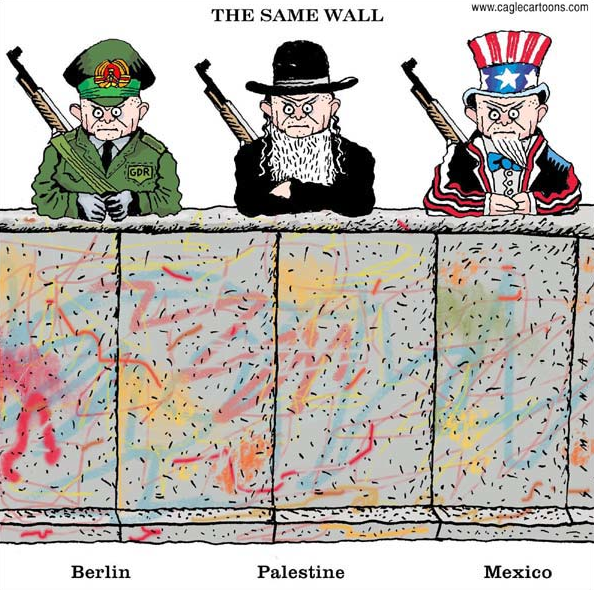
Sight Gag: The Same Wall

Credit:   Osmani Simanca, Brazil

The “Sight Gag” is our weekly nod to the ironic and carnivalesque in a vibrant democratic public culture. We typically will not comment beyond offering an identifying label, leaving the images to “speak” for themselves as much as possible. Of course, we invite you to comment … and to send us images that you think capture the carnival of contemporary democratic public culture.

 0 Comments

Fly Air ICE and Repatriate in Comfort

One thing that nearly everyone on the political spectrum seems to agree about is that the U.S. immigration bureaucracy is an incredible mess.  Of course, there is no consensus on what the problems are, let alone the solutions, but there truly doesn’t seem to be anyone who thinks that the status quo is acceptable.  I suppose that’s a start, but if we are going to make any real progress we need to come to some agreement over key terms, and there, of course, is the rub, for at the heart of the issue of  immigration policy is a disagreement over terms: is the problem a matter of  “undocumented immigrants” or “illegal aliens”?

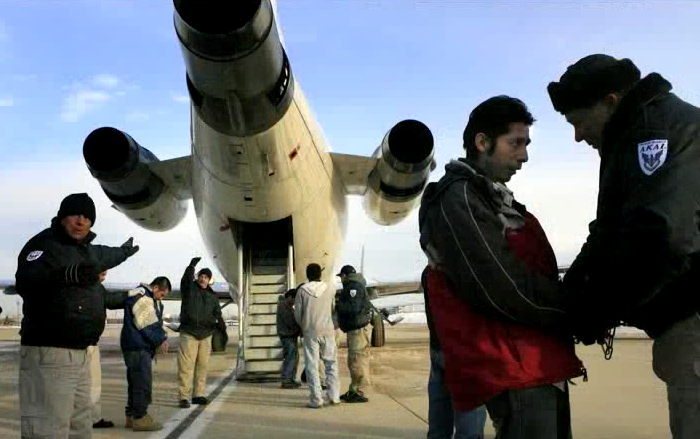
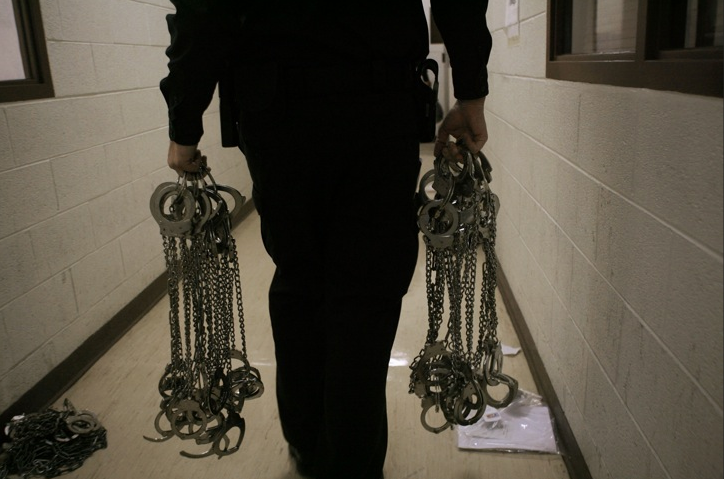
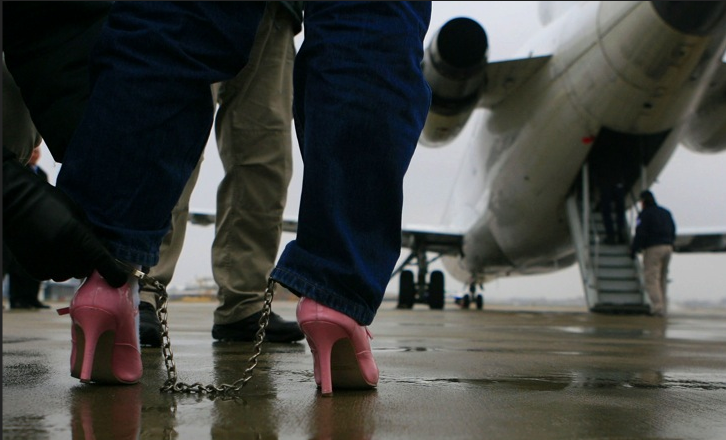
I was led to think about this problem this past week when I came across a photo-essay in the Chicago Tribune on “Flight Repatriate,” one of a fleet of Boeing 737s contracted by US Immigration and Customs Enforcement (ICE) to “expedite the removal” of  “illegal immigrants” to their “homeland,” often in Central or South America, but also Asia, Africa, and the Middle East.  Since October 2007 ICE Air has transported more than 367,000 immigrants to their countries of origin (a 77% increase in the number of deportations since 2006), the vast majority of whom have lived peaceful and law abiding lives within the US borders, notwithstanding their designation as “illegal.”  Animated by a desire for “cost effectiveness and safety,” Air ICE flights include “sandwiches, cheese and crackers, fruit, bottled water, civilian clothing, checked baggage and a private nurse.” As one ICE official put it, “there is no reason why we can’t treat them with as much respect as is possible.” Indeed, “nonviolent” passengers can even have their shackles and handcuffs removed on international flights.  It is hard to imagine how anyone could complain.  And yet …

From the moment of its origins the U.S. has been a land of immigrants, and across the broad expanse of that history the vast majority of those immigrants—starting with the pilgrims and moving forward—have been “undocumented.”  The development of the modern nation-state changed all of that, of course, but not even a bureaucratic sensibility can mitigate the irony of castigating “undocumented immigrants” as “illegal aliens.”  The doubled shift in terms is much to the point, as the absence of documentation becomes not just a sign of exclusivity, i.e., non-citizenship, but of criminality, just as one’s status as an immigrant becomes a sign of alterity that warrants a stigmatizing alienation further marked by the presumed need for armed guards, caged busses, and shackles and handcuffs.

Some undocumented immigrants might be criminals (rather like, say, some Wall Street bankers and financiers can be criminals) or even dangerous individuals, but it is somewhat churlish to designate and treat them as such simply because they lack the proper documentation—or at least one might imagine that a democratic society would adopt a more liberal and humane attitude towards such persons. 

But then again, perhaps one can’t be too careful.  After all, in the right hands even a three inch heel can be a deadly, dangerous weapon. 

Photo Credits: Alex Garcia/Chicago Tribune


 3 Comments

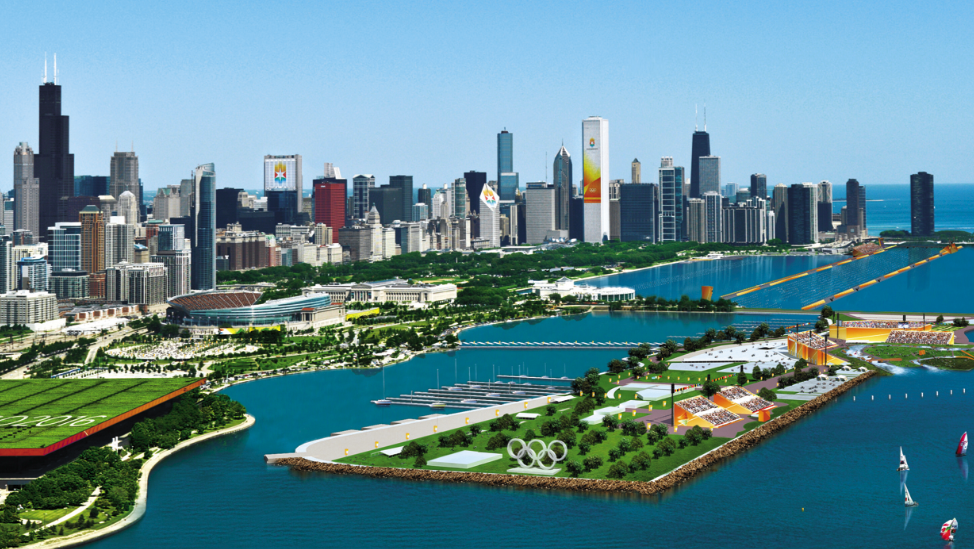
Sight Gag: Chicago Skyline, 2016 (No Joke!)

Credit: Chicago 2016

The “Sight Gag” is our weekly nod to the ironic and carnivalesque in a vibrant democratic public culture. We typically will not comment beyond offering an identifying label, leaving the images to “speak” for themselves as much as possible. Of course, we invite you to comment … and to send us images that you think capture the carnival of contemporary democratic public culture.

 1 Comment

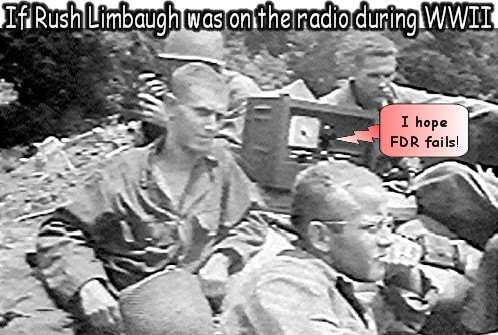
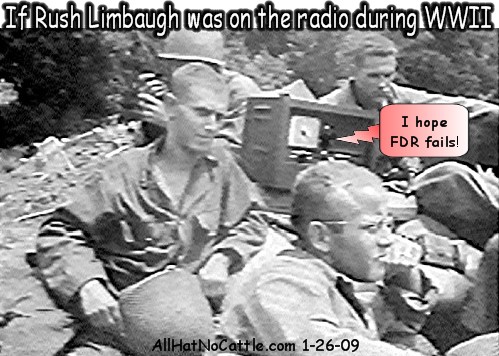
Sight Gag: Another FDR Comparison

Credit: All Hat No Cattle

The “Sight Gag” is our weekly nod to the ironic and carnivalesque in a vibrant democratic public culture. We typically will not comment beyond offering an identifying label, leaving the images to “speak” for themselves as much as possible. Of course, we invite you to comment … and to send us images that you think capture the carnival of contemporary democratic public culture.

 0 Comments

Photographer's Showcase: "Everything is Possible"

Today we are very pleased to welcome Peter Turnley to NCN with a photographer’s showcase.  Peter is truly among our very finest photojournalists and not just because he is a maestro with the camera, but because he operates it with a profound social conscience.  His work as an unembedded photographer during the first Persian Gulf War (aka “Desert Storm”) was central in breaking through efforts to manage and control western perceptions of what was going on.  But no less important was his very earliest work (with his brother David) on race in America (1976) or later efforts from Tiananmen Square (1989) or his work for outlets such as Newsweek, Stern, Life, Paris Match and the list goes on, covering world conflicts everywhere from the Balkans, Somalia, and Rwanda to the Israeli-Palestine controversy.   No less important has been his coverage of the U.S. homefront in the wake of war and conflict.

In this Photographer’s Showcase Peter Turnley features photographs that he took at the recent Inauguration of President Obama. One might wonder why we return to this moment of public elation so quickly, as recent wrangling over the economic stimulus package has served as a sober reminder of the hard core reality of the political world that we live in. We do it mostly because Peter’s photographs are a sensitive and powerful reminder that even in such a political world, “everything is possible.”

Click on an individual photo in the gallery below to see a slightly larger version of the image and Peter’s caption.  Click on the slightly larger photoraph a second time to see a large version of the image.

 3 Comments

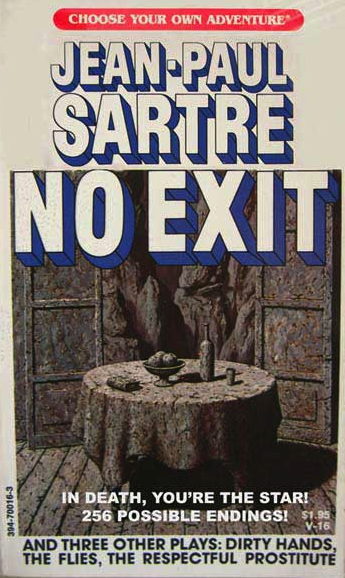
Sight Gag: No Exit

Credit: Something Awful.com

The “Sight Gag” is our weekly nod to the ironic and carnivalesque in a vibrant democratic public culture. We typically will not comment beyond offering an identifying label, leaving the images to “speak” for themselves as much as possible. Of course, we invite you to comment … and to send us images that you think capture the carnival of contemporary democratic public culture.

 0 Comments

"R-e-s-p-e-c-t, Find Out What It Means to Me …"

In the classical tradition “decorum” called attention to the linguistic, aesthetic, and ethical standards of propriety designed to coordinate the relationship between thought and expression. The eloquent orator was decorous when he performed his civic persona in a manner that seamlessly and invisibly embodied a style of expression and a substance of thought that was appropriate to the audience and occasion being addressed.  More than just a set of rules for eloquent speaking, however, decorum was understood to be a normative habit of civic participation that would animate the balance or harmony “necessary for the comprehension and direction of life in the pluralistic space of public experience.”*  It was, in short, a control against unrestrained ego necessary to managing the tension between individual desires and collective responsibilities in civic life.

The photograph below depicts the fundamental  problem of the late governorship of Rod Blagojevich as a failure of decorum—a complete and utter lack of civic harmony.
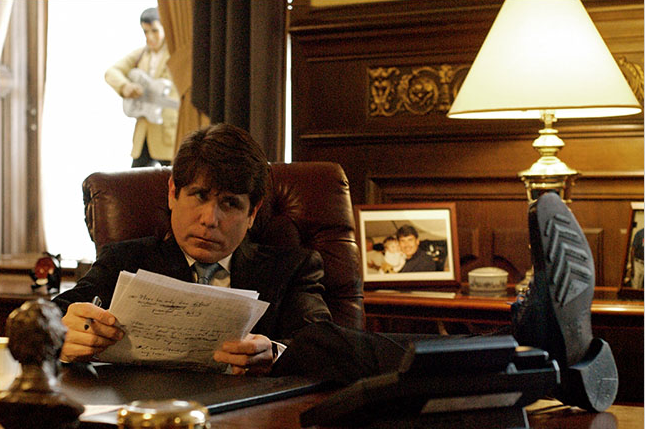
We like to think that the conduct of our leaders will call us to a higher standard of public responsibility as citizens, an entailment, perhaps, of the assumption that as elected servants of the public they are temporary stewards of an office that is larger than themselves.  We often accent this assumption by talking about how an elected official will “grow into the position,” underscoring both the sense in which the office transcends the mortal embodiment of any one person, as well as how the formal demands of the office shape and control any given occupant.  But in this photograph—which occupied the four middle columns, above the fold on the front page of the NYT on the day that Governor Blagojevich was unanimously convicted on an article of impeachment—none of these assumptions seem to abide.
A governor’s office is a public, symbolic space, its size and visual tableau functions as a marker of its long standing history and civic power, a reminder that the “office” is bigger than the current office holder.  Here, however, the photograph diminishes the effects of such magnificence by photographing the governor in a relatively tight, middle-distance close-up.  Indeed, the photograph contradicts the assumption that the office is bigger than the man by making it seems as if the physical space of the office can barely contain him, a point further accentuated by his slumping posture, as if the chair is too big for him and he never grew into it.

But there is more, for one might expect to see the governor’s office festooned with the emblems of the state—flags, the state seal, artifacts that mark the state’s history, and quite possibly photographs of the sitting governor as he conducts the business of his office.  And surely such things exist somewhere in the office.  But here, however, there is none of that.  Instead, the governor is triangulated by a small bust of Abraham Lincoln, a much larger, statuesque figurine of Elvis Presley (that recalls the ridiculous photograph of President Nixon posing with Elvis in the Oval Office of the White House), and a framed snapshot of Blagojevich, the private citizen, with his children. Decorating one’s workspace with personal effects is a habit of contemporary life, but even in the private sector the assumption is that such artifacts will operate moderately, in the background, visible and yet not seen—hence decorous.  One would anticipate even more such moderation in the governor’s office, but here the emblems of personal eccentricity and private life dominate the mis-en-scène almost to the point of impropriety.  

What gives the photograph its dramatic force, and in the end what pushes it fully beyond the bounds of propriety, is the shoe poised awkwardly and somewhat precariously on the edge of the desk.  Truth to tell, I will occasionally put my feet on my desk in my office when I am reading a manuscript or talking on the phone.  But I would never do it if someone else were in the room, and certainly not if there was a photographer within viewing distance (let alone a NYT photojournalist).  And the reason is quite simple:  doing so marks the space as private and proprietary. To do so in an otherwise public space is a sign of arrogance and disrespect; to do so as an officer of the state, literally posing for the a NYT photographer, marks the behavior as a gesture, as an intentional performance of utter contempt for the office and all who might see it.

More even than Blagojevich’s absurd claim to the NYT reporter that “[we] should have been more selfish, not selfless,” the photograph is a representative (visual) anecdote of the deep habits of his governorship and why he is deserving of public opprobrium whether he is guilty of the formal charges against him or not.  More, it is a reminder of why the standards of public decorum are valuable guides to the harmony and ministrations of civic life.

Photo Credit:  Amanda Rivkin/New York Times

*Michael Leff, “The Habitation of Rhetoric” in Contemporary Rhetorical Theory: A Reader, ed. John Louis Lucaites, et al. New York: Guilford Press, 1993, p. 62.


 2 Comments