Aug 17, 2007
May 13, 2009
May 03, 2013
Jul 13, 2017
Aug 27, 2012
Jan 15, 2012

Stay Tuned For Something Big

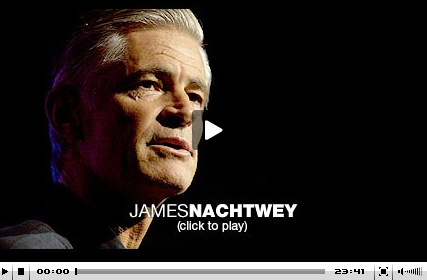
Photojournalist James Nachtwey was one of the 2007 recipients of the TED Prize. TED stands for Technology, Entertainment, Design and it brings people from these three worlds together to spread ideas, mostly by challenging fascinating thinkers to “give the talk of their lives in 18 minutes.  These talks are available on-line at TED.com.  The annual prize winners are given a $100,000 award AND granted one WISH to help change the world.  James Nachtwey’s wish is to “break [a story that the world needs to know about] in a way that provides spectacular proof of the power of news photography in the digitial age.”  That story will break on October 3 both on-line and around the world. Don’t miss it!


James Nachtwey’s Homepage

 0 Comments

Sight Gag: Survivor – An All New Season

dirtysoundfx-copy.jpg

Credit: SomethingAwful.Com

“Sight Gags” is our weekly nod to the ironic and carnivalesque in a vibrant democratic public culture.  We typically will not comment beyond offering an identifying label, leaving the images to “speak” for themselves as much as possible.  Of course, we invite you to comment … and to send us images that you think capture the carnival of contemporary democratic public culture.

 0 Comments

Fantasy Island

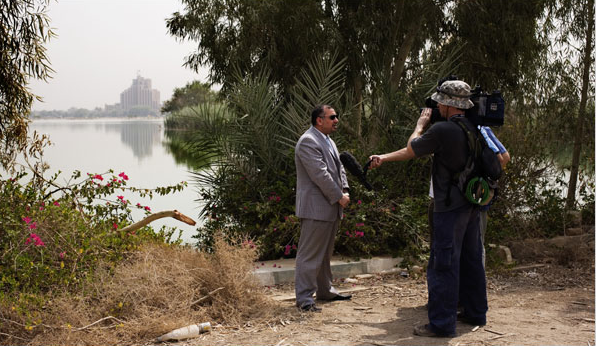
It is hard to find much to smile about in the news these days what with the U.S. economy in the toilet, sectarian conflicts erupting throughout the world, and nature following its own rhythms and paths to devastating destruction. And so when I saw this picture featured front and center on the NYT website yesterday with the headline “A Vision of Tourist Bliss in Baghdad’s Rubble” I broke out in laughter –and then I double-checked the URL to make sure I hadn’t inadvertently clicked on the website for The Onion.

The man we are looking at is Humoud Yakobi, the head of Iraq’s Board of Tourism, who is looking to convert a small, bombed out island in the Tigris River and within sight of the Green Zone into a fantasy island getaway that would include a “six star” hotel, an amusement park, and luxury villas “built in the architectural style of the Ottoman Empire-era buildings in Old Baghdad.” It would be topped off with – and I kid you not – the “Tigris Woods Golf and Country Club.” The only thing missing, it would seem, is Ricardo Montalban’s “Mr. Roarke” and his sidekick Tattoo. The problem, it seems, is not only finding financial backers to fund the 4.5 billion dollars to underwrite the enterprise, but reckoning with the fact that the target audience—Western tourists—tend to be “sensitive to bombings and things like that” (at least in the opinion of the head of the media relations department of Iraq’s tourism board).

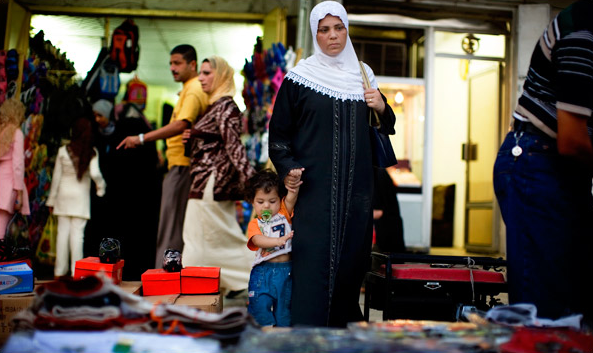
The return to normalcy will surely require venture capitalists willing to take risks on Baghdad’s future and so perhaps we should not be overly cynical here. And yet it is hard to be anything but cynical when the NYT’s “Week in Review” features another story that presumes to underscore the first stages of the return to “calm” and “normal” with a photograph of a mother and child walking about safely in a mixed Sunni-Shiite neighborhood:

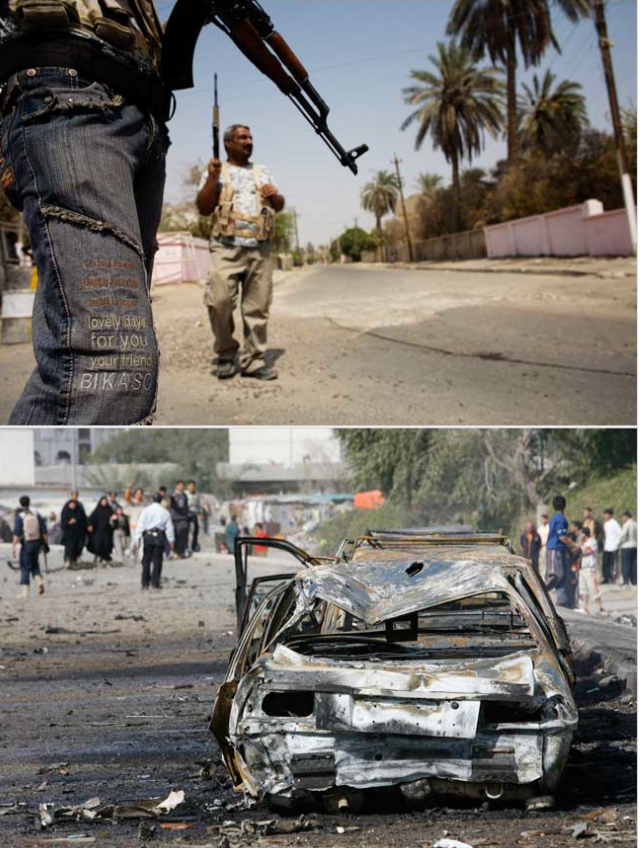
Of course, one cannot look beyond the edges of the photographic frame, and so it is impossible to see what, if anything, enables or secures the apparent calm and safety.  And as if to acknowledge this absence the NYT slips in two small clickable photographs sutured together in a sidebar labeled “Street Scenes”:

It is important, I think, that the two images function as a vertical diptych, forcing the viewer to take them in seriatum as part of a coherent narrative.  The top photograph, the caption tells us, shows members of the “Awakening Council” controlling a local “checkpoint.”  The bottom photograph is a car bombing from “early 2007” and is captioned as a once “frequent” scene.  The implication then is that the only thing that stands between the bombed out cars and the scene of relative calm  in the Sunni-Shiite neighborhood are these local militias.

This logic of the visual narrative is impeccable and if we stop here we might be inclined to read the story as designed to animate support for U.S. policy and the Bush administration’s Pollyanna conclusion that “the surge” has helped Iraq recover its middle American, Main Street calm.  But I think another possibility has to be considered.  For surely one implication of the visual logic has to be that just as one needs to look outside of the frame of the first photograph to discover what might be supporting the relative calm, one needs equally to look outside of the diptych to discover what supports the Awakening Councils—which are, after all, groups of former Sunni insurgents funded as mercenaries by the U.S. government as part of a “hearts and minds” campaign –and to wonder what will happen when that support dissipates.

The answer to this question is by no means clear, but given the history of this region one has to assume on par that the return to sectarian violence is a very real likelihood.  And so we come back to the article that reports Hamoud Yakobi’s plans to build a luxury, tourist retreat on an island in the Tigris River.  It really is an absurd fantasy, but then again perhaps no more absurd or fantastic than portraying a neighborhood controlled by former insurgents hired as mercenaries by a foreign and occupying government as somehow a return to normalcy.  And maybe that was the point all along.

Photo Credits:  Max Becherer/Polaris and New York Times; Ali Jasim/Reuters.

 5 Comments

Sight Gag: At Last an Answer to the Age Old Question (Why Did the Chicken Cross the Road?)


Photo Credit:  Erin Gay/AP, Seattle Times, September 14, 2008

“Sight Gags” is our weekly nod to the ironic and carnivalesque in a vibrant democratic public culture.  We typically will not comment beyond offering an identifying label, leaving the images to “speak” for themselves as much as possible.  Of course, we invite you to comment … and to send us images that you think capture the carnival of contemporary democratic public culture.

 0 Comments

Public/Private Tears of Joy

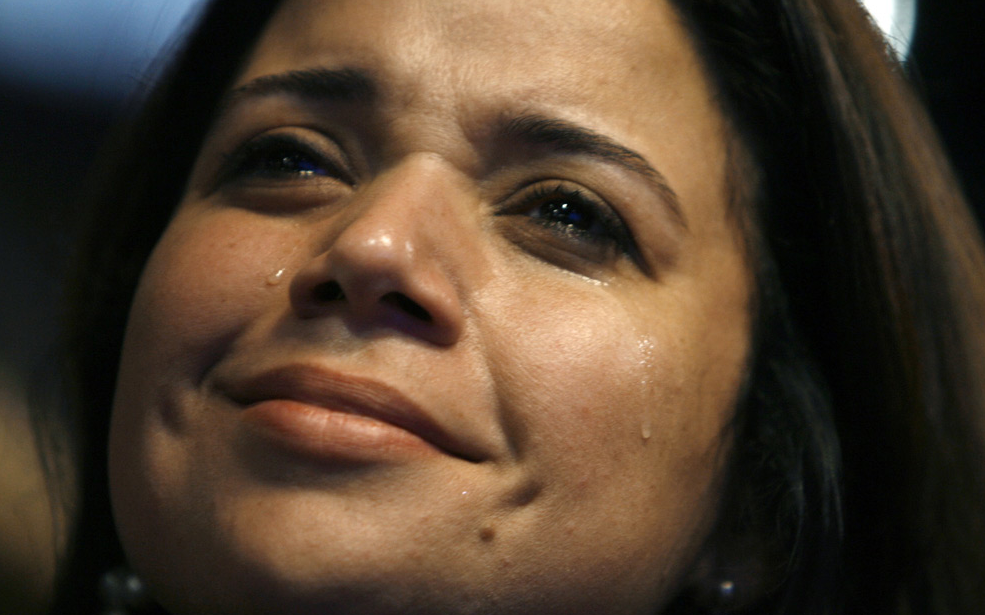
A recent slide show at The Big Picture on the 2008 Political Conventions consists of thirty-six photographs oscillating back and forth between the events that took place first in Denver and then in Minneapolis.  And what we see, quite clearly, are nearly identical, highly ritualized media events.  Most of the pictures are of crowds cheering on their respective candidates or of the candidates and their families themselves.  Two images call attention to protestors (interestingly enough both are from the Minneapolis Convention as if there were no protests in Denver) and, as has become the custom in recent years, several images reflexively call attention to the presence of the media itself.  What I found most interesting, however, were these two photographs:
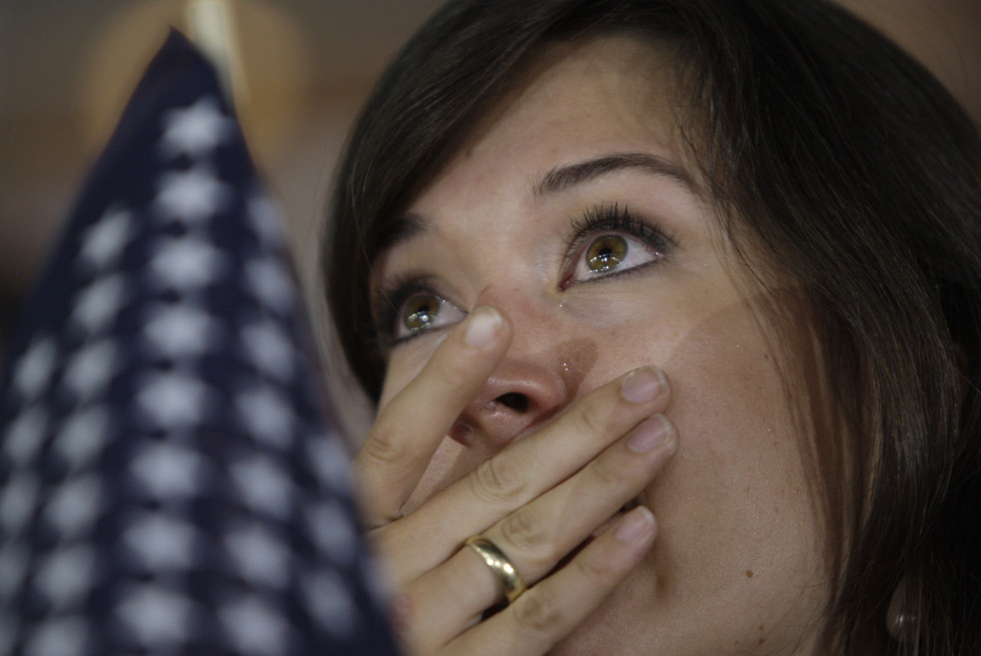
 

Nearly identical images, their captions accent the relevant theme as each describes a woman/delegate “crying” in the presence of the acceptance speech of her chosen candidate.  Their passion in each case is palpable and intense, as each woman/delegate looks up to what we can only assume she sees as her political savior.  It is the expression of awe one might imagine in the presence of an overwhelming and sublime power, what Max Weber might have called “charisma.”  And regardless of what one might think of either candidate, the point here seems to be that the expression of such affect is an inherent part of the political process, an authentic component of the ritual of political identification.  Indeed, one would be hard pressed to say which is the Democrat and which is the Republican.*

The very way in which the photographs are framed seems to be telling in this regard. Shot from below and in extreme tight focus the images are cropped to exclude almost all signs or symbols that might distinguish and underscore party affiliation or opposition.  Even the two markers of institutional affiliation in the top image – the shield of the U.S. flag in soft focus and the gold wedding band on her hand – call attention to ambiguously normative and largely homogeneous identifications.  Republican or Democrat, the images seem to suggest, it doesn’t matter, the expression of emotion in public is inimical to our political being.  As such, these two women are something like visual synecdoches for the body politic. 

But there is more, for the expression of emotion that they privilege is not only clearly gendered feminine (we don’t see men crying for joy in the images of this slide show, nor do we tend to find them anywhere … and when we do find something comparable, as say with Howard Dean’s famous verbal “cry” for joy four years ago in Des Moines, Iowa, it is clearly vilified as inappropriate and “out of control”), but it is also portrayed in highly privatized terms.  Crying, in the western world at least, is typically an individual, not a communal, behavior, and it is generally seen as the expression of a deeply personal, individual psychic state that is more or less anathema to good public policy.  The implication here, then, is that such emotional responses are fine—perhaps even to be encouraged as a antidote to apathy and alienation— so long as they are socially disciplined and restrained. And here notice how the woman in the first image wipes away her tears, almost as if to hide them from the outside world, and the woman in the second image seems to be clenching her facial muscles as if to hold the tears back.

One can cry in public, it seems, but to do so is to isolate oneself  in some measure from the polity; it is to turn inwards in ways that divorces our “liberal” sensibilities from our “democratic” sensibilities, and in so doing nullifies the otherwise potent potentialities for a genuine “liberal-democracy.”  And it is precisely in this sense that the framing of the two photographs fully isolates these women as individuals from the thousands of delegates surrounding them, as well as the synesthesia of collective activity—the chanting and clapping and banner waving—that is the hallmark of such occasions.

What these photographs display then is the incredible ambivalence we have to the presence of public emotion.  Whereas in one sense these women seem to channel the body politic, in another, and at the same time, they stand as something of a caution to a too close psychic connection between the individual and the collective.  And the question for us is how to negotiate an authentic public emotionality that is not oppressively reduced to and restricted by the normative demands of a privatized, bourgeois sensibility.

* The first image is from Denver, the second from Minneapolis.

Photo Credits:  L.M. Otero/AP Photo; Damir Sagolj/Reuters 

 12 Comments

Sight Gag: Patriotic Porn

Photo Credit:  Judy Patrick/Alaska Stock in Newsweek, September 15, 2008.

“Sight Gags” is our weekly nod to the ironic and carnivalesque in a vibrant democratic public culture.  We typically will not comment beyond offering an identifying label, leaving the images to “speak” for themselves as much as possible.  Of course, we invite you to comment … and to send us images that you think capture the carnival of contemporary democratic public culture.

 8 Comments

John McCain and The Chocolate Factory

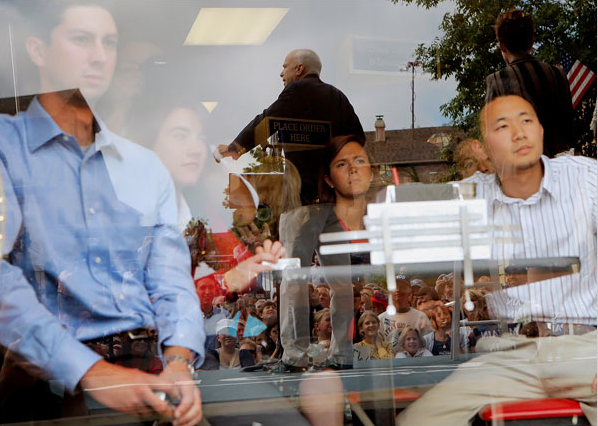
One can only wonder what the McCain campaign had in mind when they decided to hold a rally this weekend in Cedarburg, Wisconsin against the backdrop of a confectioner’s shop called “The Chocolate Factory,” but surely the allusion to “Willy Wonka” could not have escaped them.  Lest you forget, the world of Willy Wonka is a child’s utopia, a fantasyland where trees and grass are edible, ice cream doesn’t melt, the very finest of chocolate is abundant, and all of the labor is done by the Oompa-Loompa—a dark-haired, bronze-skinned, dwarfish tribe from Loompaland, a small island in the Pacific Ocean—who work for cacao beans.  And what child wouldn’t love such a world?  The problem for McCain, of course, is that children don’t vote and surely adults are smart enough to know that the promises for a comparable political utopia, say a world in which an accumulated national debt of $9,674,423,286,469.86 (and growing at the rage of $1.93 billion per day) can be managed with extensive tax cuts, is no less a fantasy than Willy Wonka’s Chocolate Factory.

But then again, maybe not. 

The photograph above is somewhat telling in this regard.  The photographer is standing at an oblique angle to the stage from which McCain speaks; the camera is aimed not at McCain, but at the storefront that is behind him and so what we see directly are the faces of customers sitting inside The Chocolate Factory; beyond that we see a reflection of what they see, including McCain’s back and the audience that he sees and addresses.  And the difference between the two audiences could not be more pronounced.  Those in the front appear to be on the same plane as McCain, neither looking up at him nor down upon him; they are thus positioned visually to judge him as equal citizens. The expressions on their faces are uniformly intense, seemingly unaffected by his appeals if not in fact somewhat skeptical of them. One could imagine them asking hard questions. But of course McCain has his back to this audience and thus doesn’t see them. In the world of fantasy, ignorance is bliss.  By contrast, the audience he does see—and indeed, the one he speaks down to—looks up at him with childlike adulation; and note here how the faces that are the most prominent in the reflection of the audience that stands in front of him are those of smiling children.  It is hard to imagine them asking pointed questions.

Two audiences, the photograph seems to suggest, both youthful and thus pointed to the future, but one mature and reflective, the other immature and animated by its sweet tooth; one seemingly ignored by the candidate and the other cast as children easily enticed by the fantasy of endless pleasures that exact no palpable costs.  And the question the photograph seems to ask is, which audience will the American people choose to be?

Photo Credit:  Bryan Snyder/Reuters

 3 Comments

Sight Gag: The Seven Deadly Sins

“Sight Gags” is our weekly nod to the ironic and carnivalesque in a vibrant democratic public culture.  We typically will not comment beyond offering an identifying label, leaving the images to “speak” for themselves as much as possible.  Of course, we invite you to comment … and to send us images that you think capture the carnival of contemporary democratic public culture.

Photo Credit:  trixiedelicious

 1 Comment

Sight Gag: Homeland Dream

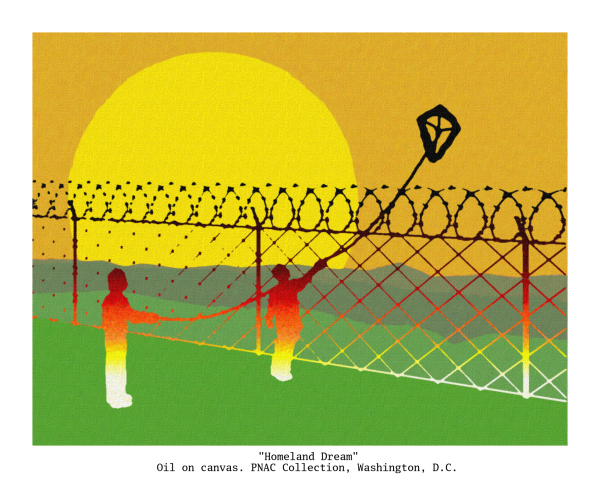
“The beauty of a global state is difficult to communicate in words alone.”

Credit:  Safety State

“Sight Gags” is our weekly nod to the ironic and carnivalesque in a vibrant democratic public culture.  We typically will not comment beyond offering an identifying label, leaving the images to “speak” for themselves as much as possible.  Of course, we invite you to comment … and to send us images that you think capture the carnival of contemporary democratic public culture.

 1 Comment

Yes We Can

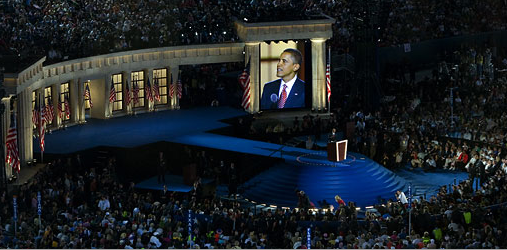
Robert and I were trained in the discipline of rhetoric where we cut our teeth as scholars by studying the great speeches of the past, beginning in antiquity with Demosthenes and Cicero and extending through the nineteenth century with the likes of Frederick Douglass, Abraham Lincoln, and Elizabeth Cady Stanton, and culminating in the last century with the orators like Martin Luther King, Jr. and Malcolm X.  Some insist that the venerable art of oratory has died in the late modern era, but it was alive and well tonight in the Mile High City where over 80,000 people congregated in a football stadium to listen to political speeches. And what speeches they were, from first to last, including both a former vice president and Noble Prize winner and a retired nurse from Pittsboro, North Carolina. The apogee was reached by the guest of honor, whose words and tones subtly and eloquently channeled the strains of Martin Luther King, Jr.’s “I Have A Dream,” delivered 45 years ago to the day. But for me the final speaker’s oration recalled memories of another Democratic National Convention Speech delivered 28 years ago in New York City that ended with these words, “the work goes on, the cause endures, the hope still lives, and the dream will never die.”

Yes We Can!

Photo Credit: Stephen Crowley/New York Times

 10 Comments