Sep 07, 2012
Mar 15, 2015
Nov 11, 2012
May 03, 2015
Dec 15, 2008
Jul 07, 2014

Sight Gag: A Work of Art … ?

Credit:  David Pearson, et al., Great Ideas, Volume III

Our primary goal with this blog is to talk about the ways in which photojournalism contributes to a vital democratic public culture. Much of the time that means we are focusing on what purport to be more or less serious matters. But as Jon Stewart and Stephen Colbert often remind us, democracy needs irony, parody, and pure silliness as much as it needs serious contemplation. For our part, we will dedicate our Sunday posts to putting such moments on display in what we call “sight gags,” democracy’s nod to the ironic and/or the carnivalesque. Sometimes we will post pictures we’ve taken, or that have been contributed by others, or that we just happen to stumble across as we navigate our very visual public culture. Sometimes the images will be pure silliness, but sometimes they will point to ironies, poignant and otherwise. And we won’t just be limited to photography, as a robust democratic visual culture consists of much more. We typically will not comment beyond offering an identifying label, leaving the images to “speak” for themselves as much as possible. Of course we invite you to comment … and to send us images that you think capture the carnival of contemporary democratic public culture.

 0 Comments

Terrorism: Ya' Gotta See It To Beat It

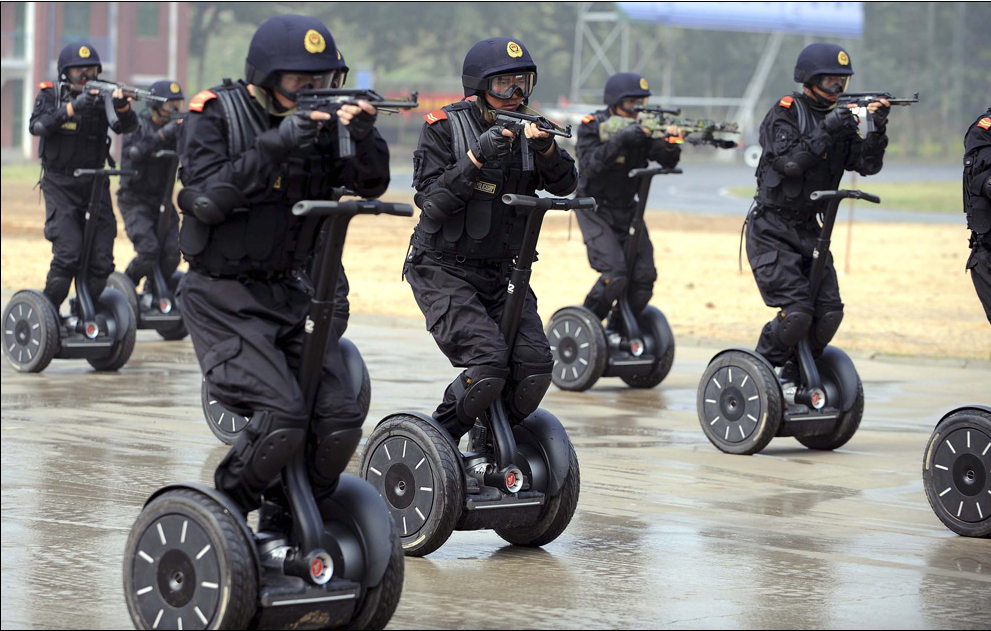
The Big Picture has put together an awesome display of images that show how Beijing is preparing to secure the Olympics against terrorism while using the latest technology.  

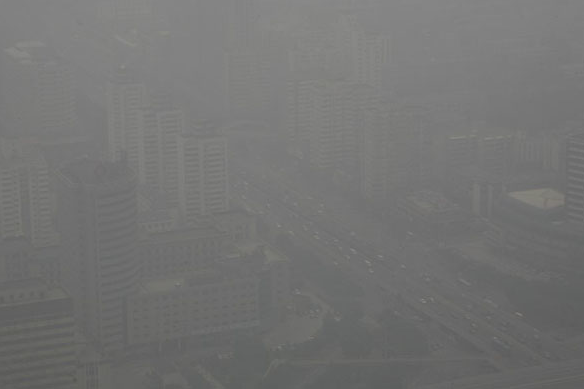
But, of course, with terrorists we know that the problem is you can’t always recognize them … and that is no small problem in China these days, as this daytime photograph of one of Beijing’s main avenues from the Guardian reveals:

Photo Credits:  Xinhua/Fan Changguo/AP Photo; Reinhard Krause/Reuters

 2 Comments

"All The News That's Fit to Print"

I used to think that claims of a “slow” summer news cycle were something of a myth. But the past several weeks have had me rethinking that position as I search for interesting and engaging news stories and photographs. Apparently the NYT is having a similar problem. Consider, for example, this photograph, which was featured on the front page of the NYT website for a short period of time yesterday afternoon:

What could the topic be? If you look close enough you might be able to tell that it is Invesco Field, the home of the Denver Broncos. But professional football is still several months away, and why would the NYT be featuring the Broncos in any event? Perhaps it has something to do with the high cost of sport tickets making it difficult for average Americans to attend professional sporting events. Or maybe it concerns the environmental impact of releasing thousands of balloons into the crisp, clean atmosphere of Mile High, Colorado.

All of these guesses would be wrong. Instead the article that this photograph anchors concerns the story—“rumored for days”—that the Democratic National Committee has announced that Senator Barrack Obama will accept his party’s nomination for the presidency at Invesco Field rather than at the Pepsi Center in downtown Denver. The reason, apparently, is that Invesco Field is a bigger “stage” that can host 75,000 people, whereas the Pepsi Center can only host 21,000. In short, moving the coronation of the party’s leader enables a much larger public spectacle—something, say, on the order of the Super Bowl … only one where “regular” Americans get to attend.

One might think that such a move would be welcomed by the networks who are always looking for ways to dramatize news events by making them larger than life, but in this case the network executives seem to be upset because they will have to “reconfigure plans long in the making,” changing venues and working outside. After all, and notwithstanding all of the sports metaphors used to describe the presidential campaigns, this isn’t really the Super Bowl; and besides, how can we expect the major news networks to adapt to the constraints of reporting on an event taking place in an NFL arena … it would be unheard of. (Maybe they should bring in ESPN to cover the acceptance speech.)

I really have to admit that my first thought upon reading this article was that someone from the Onion had hacked the NYT website and inserted one of their brilliant political parodies. The photograph, then, would be a sardonic comment on the political ritual of convention spectacles as little more than bread and circuses, or perhaps the journalistic impulse to anchor stories with photographs that only bear the most general and passing relevance to the facts being reported. But this is the NYT, right? And surely the “paper of record” has safeguards against such security breaches, right? And yet, truth to tell, after reading the last line of the NYT story I’m not so sure: “For its part, the Republican National Convention Committee released a statement dismissing the venue change as favoring style over substance. ‘Senator Obama and his fellow Democrats are more focused on stagecraft and theatrics than providing real solutions to the challenges facing our nation,’ the statement said.” And in case you don’t get the joke, click here.

Photo Credits: Doug Pensinger/Getty Images

 2 Comments

Sight Gag: Kickin' Back

Photo Credit:  Valentina Petrova/AP

Our primary goal with this blog is to talk about the ways in which photojournalism contributes to a vital democratic public culture. Much of the time that means we are focusing on what purport to be more or less serious matters. But as Jon Stewart and Stephen Colbert often remind us, democracy needs irony, parody, and pure silliness as much as it needs serious contemplation. For our part, we will dedicate our Sunday posts to putting such moments on display in what we call “sight gags,” democracy’s nod to the ironic and/or the carnivalesque. Sometimes we will post pictures we’ve taken, or that have been contributed by others, or that we just happen to stumble across as we navigate our very visual public culture. Sometimes the images will be pure silliness, but sometimes they will point to ironies, poignant and otherwise. And we won’t just be limited to photography, as a robust democratic visual culture consists of much more. We typically will not comment beyond offering an identifying label, leaving the images to “speak” for themselves as much as possible. Of course we invite you to comment … and to send us images that you think capture the carnival of contemporary democratic public culture.

 3 Comments

Wrapped in the Flag

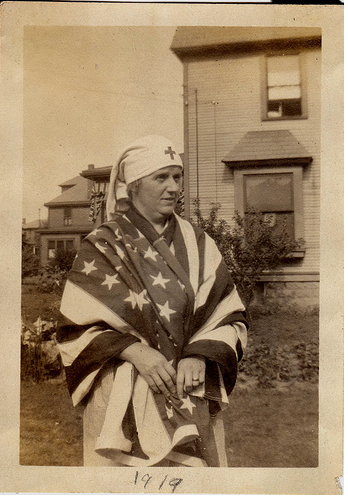
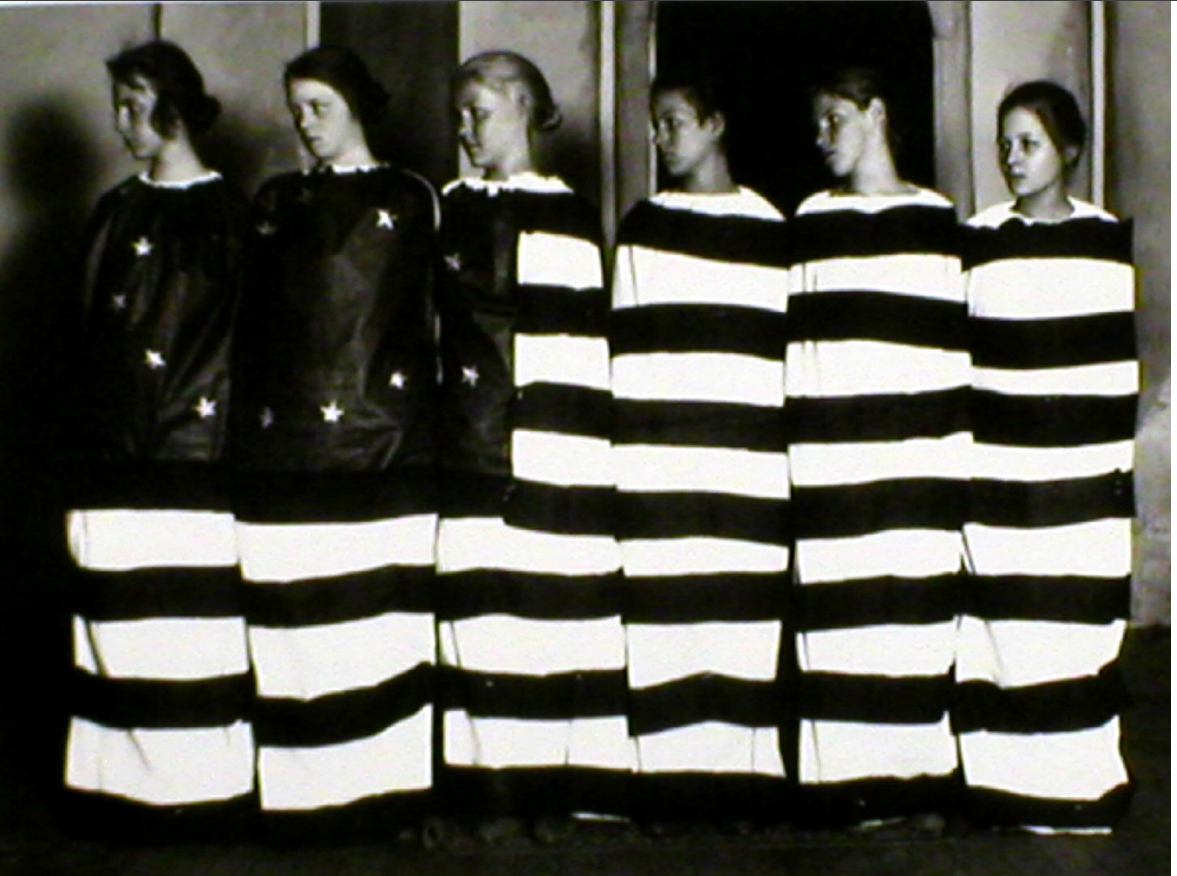
Red Cross Volunteer, 1919


Flag Day was officially established in 1914.


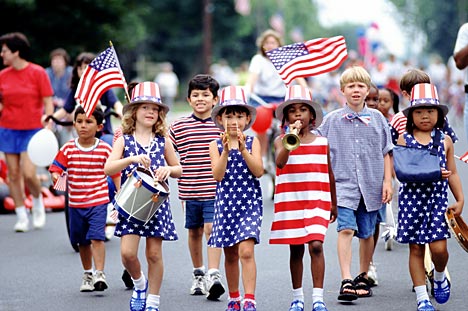
The Fourth of July became a legal holiday in 1941. Ariel Skelley/Corbis


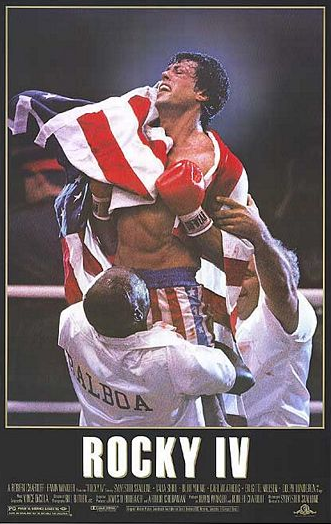
Rocky wins the Cold War in 1985.


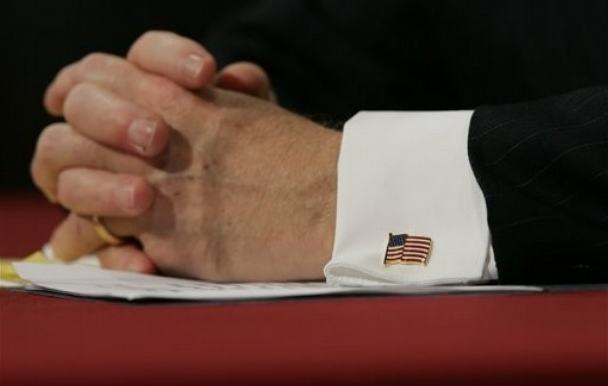
Robert Gates testifies at his confirmation hearings before the Senate Armed Services Committee on December 5, 2006. J. Scott Applewhite/AP


“When fascism comes to America, it will be wrapped in a flag and carrying a cross.’ Sinclair Lewis, It Can’t Happen Here


 0 Comments

Ersatz Patriotism in a World Turned Upside Down

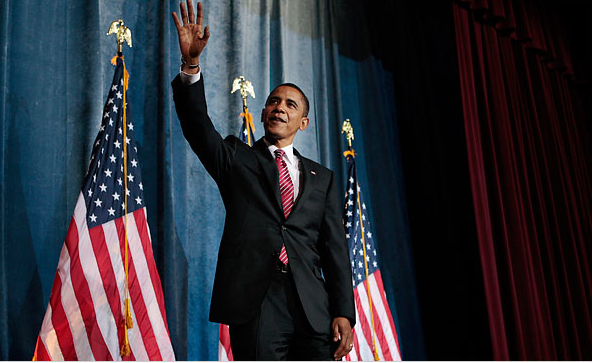
The charge that Senator Barack Obama is “unpatriotic” is so preposterous that it is hard to imagine any sane person not driven by partisan extremism actually taking it seriously.  And so I found it somewhat disheartening that the Senator himself would succumb to such charges to the extent of posing before a bevy of U.S. flags while wearing a red, white, and blue tie (against the backdrop of a white shirt and dark blue suit) as well as a flag pin, or for that matter that the NYT would feature a photograph of it on it’s website this past weekend.

The picture is altogether conventional, of course, and we have seen such images of Senator John McCain (and many other politicians from points all along the political spectrum) in comparable poses all too frequently.  Such photographs show up with clocklike regularity to the point of being barely noticeable except for their absence.  But one might have hoped for something a little less ordinary, if not less excessive (and a lot less ersatz), from the candidate for change.  Indeed, and it pains me to write it, but there is a sense in which the photograph and the mode of patriotism it performs profanes Obama’s otherwise eloquent and compelling plea to locate American patriotism in something a bit more substantial than a “political sword or a political shield.”

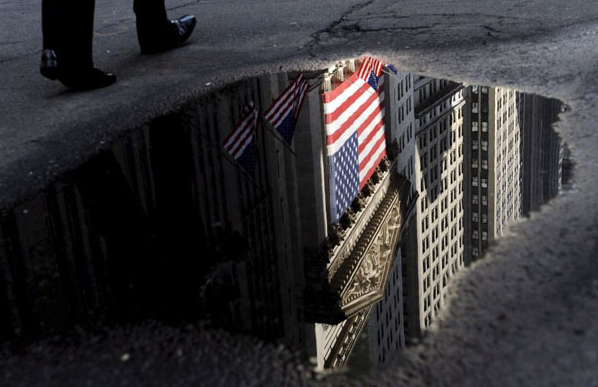
This is not to say that one should not honor the flag (nor that politicians should not be sensitive to their public image), but it is to question quite seriously the point of excess at which public displays of flag-waving patriotism by our leaders turn Old Glory into a nationalistic fetish that trivializes both the flag’s political significance and the value of a reflexive patriotism. The symptom of such excess is captured rather eloquently in this photograph of four U.S. flags as they are inverted by their reflection in a puddle on Wall Street:

The building to which the flags are attached is the New York Stock Exchange.  The image thus captures the rich ironies of the identification of the United States with the street often characterized as the “economic capital of the world” as each seems to have stumbled from grace and economic power on the global stage in recent times. It is literally a world turned upside down as the flags are now displayed both with the stripes above the shield and backwards; no longer furling on high, something to which we might look up to, they seem to reach upward to the ground (or is it to consciousness?) as if buried deep below (or should we say repressed?), virtually begging for attention; indeed, rather than something to be revered, the flag—or all four of them to be exact—are barely noticeable at all by passersby as pedestrian feet seem not even to break stride in their presence.

During a week dedicated to celebrating the nation’s birth it should give us pause to reflect on the effects of an ersatz patriotism.

Photo Credits:  Jae C. Hong/AP; Justin Lane/EPA

 2 Comments

Sight Gag: The Warning

Photo Credit: John Lucaites

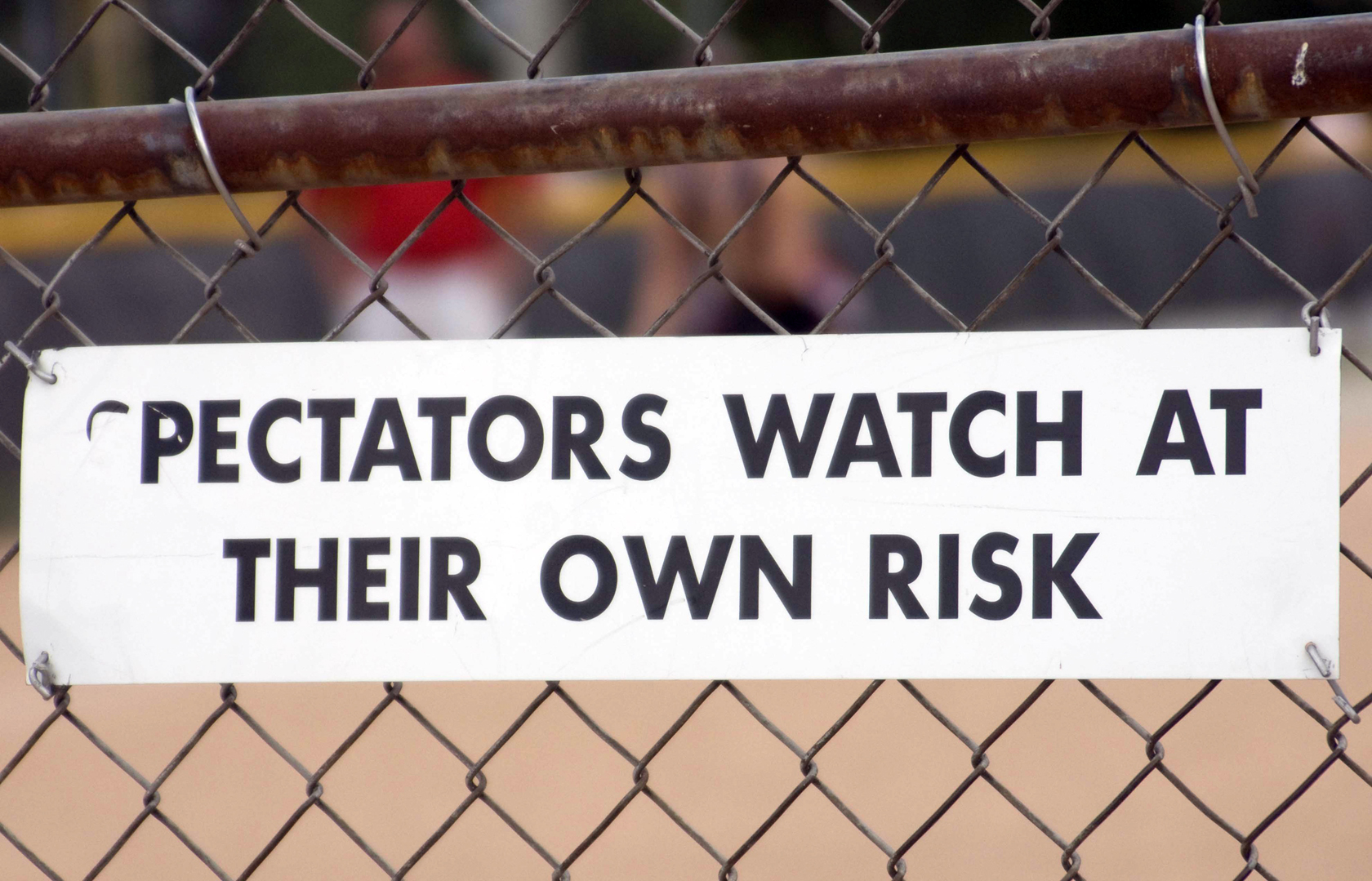
Our primary goal with this blog is to talk about the ways in which photojournalism contributes to a vital democratic public culture. Much of the time that means we are focusing on what purport to be more or less serious matters. But as Jon Stewart and Stephen Colbert often remind us, democracy needs irony, parody, and pure silliness as much as it needs serious contemplation. For our part, we will dedicate our Sunday posts to putting such moments on display in what we call “sight gags,” democracy’s nod to the ironic and/or the carnivalesque. Sometimes we will post pictures we’ve taken, or that have been contributed by others, or that we just happen to stumble across as we navigate our very visual public culture. Sometimes the images will be pure silliness, but sometimes they will point to ironies, poignant and otherwise. And we won’t just be limited to photography, as a robust democratic visual culture consists of much more. We typically will not comment beyond offering an identifying label, leaving the images to “speak” for themselves as much as possible. Of course we invite you to comment … and to send us images that you think capture the carnival of contemporary democratic public culture.

 0 Comments

Sight Gag: Constitution 2008

At NCN we say are fond of saying that the world is there to be observed you just have to look close enough. So the question is, what do you see in the picture above?  Need help? Here is a partial close-up. Still can’t tell … this is closer still.  And once again.  To read the artist’s description, go here.

Photo Credit:  Chris Jordan/Running the Numbers: An American Self-Portrait.

Our primary goal with this blog is to talk about the ways in which photojournalism contributes to a vital democratic public culture. Much of the time that means we are focusing on what purport to be more or less serious matters. But as Jon Stewart and Stephen Colbert often remind us, democracy needs irony, parody, and pure silliness as much as it needs serious contemplation. For our part, we will dedicate our Sunday posts to putting such moments on display in what we call “sight gags,” democracy’s nod to the ironic and/or the carnivalesque. Sometimes we will post pictures we’ve taken, or that have been contributed by others, or that we just happen to stumble across as we navigate our very visual public culture. Sometimes the images will be pure silliness, but sometimes they will point to ironies, poignant and otherwise. And we won’t just be limited to photography, as a robust democratic visual culture consists of much more. We typically will not comment beyond offering an identifying label, leaving the images to “speak” for themselves as much as possible. Of course we invite you to comment … and to send us images that you think capture the carnival of contemporary democratic public culture.

 1 Comment

High Noon in Sadr City

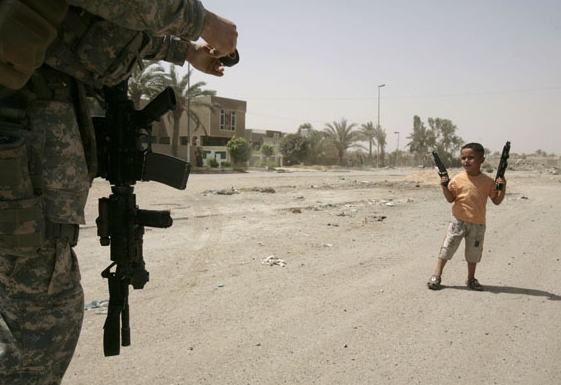
One of the earliest posts I did here at NCN was of a photograph of three Iraqi children staging a mock execution with toy guns.  The image, which literally stopped me in my tracks, bordered on the surreal, the expression on the boys faces marking a dialectical tension between the “pleasure” and “horror” of human violence.  I’ve thought of that photograph often over the past year, especially as I have encountered more than a few photographs of children with toy guns, not least this AP photograph which showed up this week on the Guardian website.

The caption reads “Baghdad, Iraq: A child armed with plastic toy weapons approaches a US soldier on patrol in Sadr City.”   As with the photograph of the mock execution, it is fraught with tensions that make it hard to distinguish between the real and the surreal.  At first blush, the scene invites comparison to a shootout between two gunslingers squaring off in a frontier town. But of course the opposition between a fully equipped US soldier carrying a high powered, automatic weapon and a young boy – he can’t be more than eight years old – with toy guns suggests that something more than a simple parody is taking place here, though what is not exactly clear:  on the one hand, we might view the scene with the same kind of  reflexive and approving  smile we use when we see children trying to act like their parents, cutely imitating what they take to be adult roles; on the other hand, we have a young Iraqi child “approaching” a US soldier in one of the most dangerous suburbs in one of the most dangerous countries in the world right now while appearing to point “toy weapons” at him.  And, of course, any hint of an approving smile has to fade to deep concern. Are they really toy guns?  Is this an innocent child or an insurgent?  And even if the child poses no immediate threat to the soldier, is this an insurgent in the making, someone he will have to worry about down the road?

One might argue that these last few questions reflect a typically western paranoia—and in large measure I would be inclined to agree—but it has to be tempered by the fact that in the past year we have seen more than a few photographs of Iraqi and Palestinian children wielding “toy guns” that they had received as presents and marking them as members of a culture that actively nurtures violence.  Of course, if you are a male who grew up in the 1950s and early 1960s as I did, there is a good chance that you too received toy guns as presents and did your part to help make the world “safe for democracy” while storming the shores of Iwo Jima in your own backyard.  And so where is the difference?  One answer is that anymore we rarely see images of US children playing with toy guns (go ahead … search “toy guns” and “kids” at Google Image and see what you come up with).  This is not to say that contemporary US children are not enchanted with guns and weaponry—as I was out for my afternoon jog today I came across a five year old playing with a set of toy golf clubs, except he wasn’t using his putter in imitation of Tiger Woods, but as a rifle trying to shoot me as I passed; and certainly the cottage industry of “shoot ’em up” video games would make the point as well—but it does suggest how the public visual economy functions to constitute a palpable cultural difference between the West and the Middle East.  If nothing else, it implies the sense in which “their present is our past,” and operates as a marker of our “cultural progress and superiority.”

But there is, I think, an additional and more important point to be made.  As I noted above, virtually all of the contemporary photographs of kids with guns that have circulated in recent years are of either Iraqi or Palestinian children, literally the future citizens of countries widely assumed to support state terrorism and thus a direct threat to the United States and its European allies. During World War II U.S. propaganda typically represented Allied children as they went to school or church, played baseball, did chores around the house, and in general represented an uncorrupted innocence, while Axis children were represented as being trained in the arts of war (see, for example, Frank Capra’s Prelude to War).  I do not want to suggest that photojournalists are complicit in some sort of concerted propaganda effort, but there can be little question that something like a visual trope is at work here as the visual representation of children—abroad and at home—become powerful signs of what purports to be a potent and pernicious cultural threat.

Return now to the photograph above and attend closely to its caption:  “A child armed with plastic toy weapons approaches a US soldier on patrol in Sadr City (emphasis added).”  The word “approaches” seems to domesticate the image some, as an “approach” is not necessarily a threatening move.  And indeed, the image itself reinforces this ambiguity as it is shot from behind the soldier and at waist height, thus making it impossible to see his face and eyes, and so difficult to interpret how he is reacting to the child’s behavior: Is he smiling in recognition of his own childhood “playing soldier” in the backyard?  Or is there the look of caution and concern?  And yet, for us the viewers, operating within the contemporary visual economy of representations of Middle Eastern children, it may well be that “armed” is the more important verb in the caption, for while the child carries “plastic toy weapons” there is nothing to suggest that he is “playing” at anything.  And while the “approach” might appear somewhat innocent, there are too many markers within the larger visual culture to suggest that “plastic toy weapons” are simply a precursor to the real thing.

Photo Credit:  Petros Giannakouris/AP


 10 Comments

A Kodak Moment

Over the past few weeks Midwestern states including Iowa, Wisconsin, and my home state of Indiana have experienced monstrous storms and heavy flooding with homes being ripped off of their foundations and entire towns and cities being submerged for days on end.  If the damage and devastation is not quite at the level of Hurricane Katrina it is nonetheless tragic enough and it will take years for many of these communities to recover—if recover they can.

Local photojournalists have done an excellent job of documenting the storms and their effects, but as with any such “event” there is a fairly conventional litany of photographs that seem to recur: aerial views of the flood waters (which of course distance the viewer from the event in something like a God’s eye view); shots of the incredible damage effected by natural forces gone out of control—including both long shots that invite a sense of magnitude and then extreme close-ups (often of personal possessions) that encourage a sense of viewer identification;  forlorn victims (there but for the grace of God …); people—neighbors and/or strangers, it is often hard to know which, and the ambiguity itself is telling—helping and/or comforting one another; officials either surveying the damage or lending assistance; children easily and inventively adapting to the changed circumstances as they find ways to convert the damaged world into a new kind of playground; and so on. Taken as a whole, and repeated over and again in different newspapers, magazines, websites, and television broadcasts, such images constitute a visual narrative with strong normative implications for communal living.

In the days immediately following the floods in central Indiana much attention was dedicated to families who seemed to have lost everything—homes, vehicles, furniture, clothing, etc.  I was thus initially surprised to find a series of photographs in the Indianapolis Star that focused attention on people who had dedicated their attention to salvaging and preserving family photographs.  
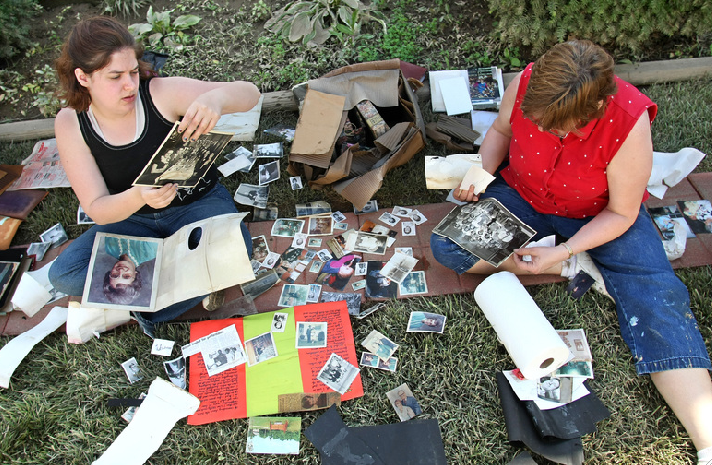
Here a granddaughter and grandmother “sort through family photographs to help clear off the mud and the preserve them” in Columbus, Indiana, one of the towns hardest hit in the southern-central part of the state.  As I studied this photograph and several others like it I recalled Nancy West’s wonderful book Kodak and the Lens of Nostalgia, a cultural history of the snapshot that examines the ways in which for generations Kodak has “taught” us how to take and display photographs—generally of children playing; special events that mark the passing of time such as holidays, anniversaries, graduations, etc.; prized possessions such as homes and cars; and, of course, family vacations—and in the process to produce a nostalgic sense of family history as representing something of a happy and ideal past.

That last point is something that students often resist until I require them to bring their family photo albums to class (and the “family photo album” is a social practice that seems to transcend class, race, and most other demographic categories), but it doesn’t take a great deal of reflection to realize that even if pictures of “unhappy” moments in the family history were taken they rarely if ever make it into the family archive of visual memory.  And that we value such memories is underscored by the photograph above.  Surely, one might imagine, given the magnitude of the destruction wreaked by the floods, that these women have more pressing tasks confronting them, but here they take precious time to “sort through” their past—two women crossing the divide of family generations working together to “preserve” a particular sense of family memory.

A second photograph from the same community—but not of the two women above—effects a shift from long view to close-up and in so doing accents the practice of snapshot preservation as cultural (and maybe even universal) rather than idiosyncratic. 

The disembodied hands make the point:  This could be anyone.   Of course, the hands are gendered, and so there is a sense in which such preservation is cast as “woman’s work”—a stereotype displayed in the longer shot above—but there is a different point to be made.  Notice how the hands work carefully and gently to wipe away traces of the flood, and in so doing it also erases part of the history of the image, seeking to preserve the millisecond captured by the camera in its original condition, unaffected by the passage of time. It only makes sense, of course, but it also should call our attention to how the photograph itself and its preservation in a frame or an album or an old shoe box is always already an erasure of the past in the interest of a nostalgic recollection of happier, less troublesome times.

And the reason for all of this, it seems, is clear, for the power of memory and the emotional connection to something larger than ourselves is palpable and no less essential to social sustenance than food and water is to the physical sustenance of the body. It is a point, you may recall, imaginatively developed in Ridley Scott’s Bladerunner, a movie of a not-too-distant society where androids otherwise indistinguishable from human beings nevertheless lack the experience ordinarily accumulated across the life cycle and necessary for the management of the rawest human emotions.  The solution, it turns out, was to implant a past that they could believe in, and for these androids the “reality” of their memory implants was manifest in the family photographs that they treasured and carried with them.   It didn’t matter that they were real or true; what mattered was that they were realistic and valued.

As the Kodak slogan used to say, “We capture your memories forever.”  

Photo Credit:  Matt Detrich/Indianapolis Star; In addition to Nancy West’s Kodak and the Lens of Nostalgia be sure to see also Marianne Hirsch’s Family Frames: Photography, Narrative, and Postmemory.


 3 Comments