Apr 25, 2008
Oct 28, 2007
Aug 26, 2013
Mar 09, 2009
Feb 17, 2012
Apr 22, 2020

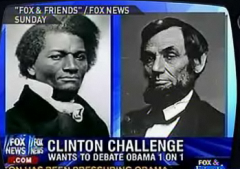
Sight Gag: Lincoln-Douglas Debate (Fox Style)

lincoln-douglas.png

(For the full story click here.)

Our primary goal with this blog is to talk about the ways in which photojournalism contributes to a vital democratic public culture. Much of the time that means we are focusing on what purport to be more or less serious matters. But as Jon Stewart and Stephen Colbert often remind us, democracy needs irony, parody, and pure silliness as much as it needs serious contemplation. For our part, we will dedicate our Sunday posts to putting such moments on display in what we call “sight gags,” democracy’s nod to the ironic and/or the carnivalesque. Sometimes we will post pictures we’ve taken, or that have been contributed by others, or that we just happen to stumble across as we navigate our very visual public culture. Sometimes the images will be pure silliness, but sometimes they will point to ironies, poignant and otherwise. And we won’t just be limited to photography, as a robust democratic visual culture consists of much more. We typically will not comment beyond offering an identifying label, leaving the images to “speak” for themselves as much as possible. Of course we invite you to comment … and to send us images that you think capture the carnival of contemporary democratic public culture.

 1 Comment

BUILT: Section 8 Made Simple

BUILT explores the changing city in the US and the challenges that will affect housing, infrastructure, neighborhood cohesion, and equity in the coming years. BUILT is a series of research, installation, dialogue, interview, and performance events of varied scale, including the opportunity for public conversation offered at this blog.

This week’s post focuses on the cover of a book by a firm in Texas:

real-estate-cover.jpg

From inside the cover:


“The Section 8 program is a truly public-private relationship that serves the needs of low-income families by providing safe, quality housing opportunities using public funds for financial assistance. Public Housing Authorities (PHAs) manage the Section 8 program within specific geographic areas, and they represent the public side of the public-private relationship. The private side of the relationship is made up of real estate investors who profit by making their investment properties available to the Section 8 program.

As you will see, savy real estate investors reap many benefits from the Section 8 program that others who invest in real estate miss completely. This includes on-time rent collection, long-term tenants, shorter vacancy times, and at market or above market rents. But investors who participate in the Section 8 program get an added benefit that doesn’t relate to the bottom line – they are helping to serve the public interests by providing housing to those less fortunate.

Given all these benefits, the natural question that comes to mind is “Why don’t all real estate investors participate in Section 8?” Why indeed.

Once a new investor said to me, “I can do what you do and save money.” I said, “Exactly! I want you to be able to do what I do. That way, more Section 8 clients will have a decent place to live. However”, I also told him, “if you ever find yourself in legal trouble would you represent yourself, or have an attorney represent you? And if you chose to represent yourself, do you know how to properly defend yourself?”

If you are serious about your investments I would urge you to seek professional representation to ensure you are getting the most out of your investment and to reduce the time that you must invest in each property.

Having said that, this book will give you some tips on how to not only defend yourself, but will show you how to work within the Section 8 program to save you time and a lot of frustration.

Buy the book – Learn the process – Make a difference for yourself and your community!

$24.95

One might ask, What exactly is this book selling? How is it selling it?

BUILT is a performance/civic dialogue project and a collaboration of Northwesten University’s Theater Department & Portland, Oregon’s Sojourn Theatre, led by visiting artist Michael Rohd.

 5 Comments

Empire and Serenity in Visual Poems

One of the important characteristics of photography is that it is used across public and private life. Most people have not printed a newspaper or erected a statue, but everyone has taken snapshots. Photography is a democratic art, and so we are exposed to a wide range of images that in turn offer many different moods. Likewise, there always is an audience for those images that stand out from the rest because they are so evocative. This blog devotes a lot of space to those images that are patently newsworthy and so caught up in complex structures of meaning and power. Some images, however, ought to be seen as poems–indeed, as small poems that capture a specific experience, emotion, or moment of reflection.

The visual poem can stand for everything from state power to personal serenity. There are always court poets and the course of empire has its bards–think of Kipling. The image below is as good as anything intoned at a public ceremony.

shuttle-launch.jpg

This photograph of a space shuttle launch is a visual gem–and also, of course, laughable in its fully realized phallic symbolism. But those who groove on shuttle launches will love it. This is the dream of technocratic power: sheer technological ascendancy, harnessing nature to overcome gravity on the way to a glorious apotheosis with the heavens. And safely, even serenely so. Set at a distance across the calm, glassy water, any sense of risk or cost is muted. The poem takes one outside of any context of debate, providing instead a fantasy of divinely ordained connection with great but not dangerous power.

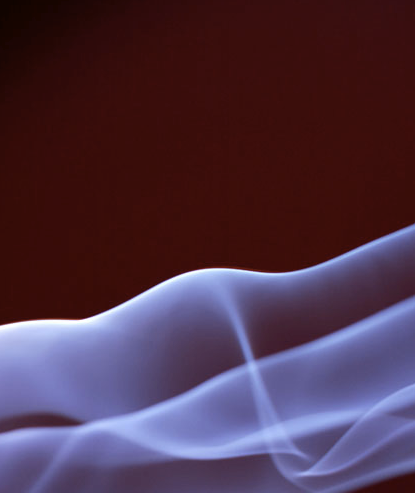
My placing the image in the context of poetry is odd, as most of the images that one could include are from the opposite end of the spectrum between public institutions and private pleasures. These include the endless supply of nature photos; look, for example at the many fine images by amateur photographers in The Daily Dozen at the National Geographic website or at similar digital archives provided by online news services. Some appear as well in the daily slide shows, and these images clearly are offered as moments of respite from the insistent clanging of the news. Images like this one:
smoke.png

This photo of incense smoke could be of a diaphanous fabric, the body it covers, the desert at night, sound waves, the music of the spheres. . . . Note also that it shares key elements of design with the one before it: smoke, light, and darkness combine to shape a dynamic form both composed and possibly eternal. Here, however, one joins that deep beauty by letting the image sink into the soul rather than watching in awe from a distance.

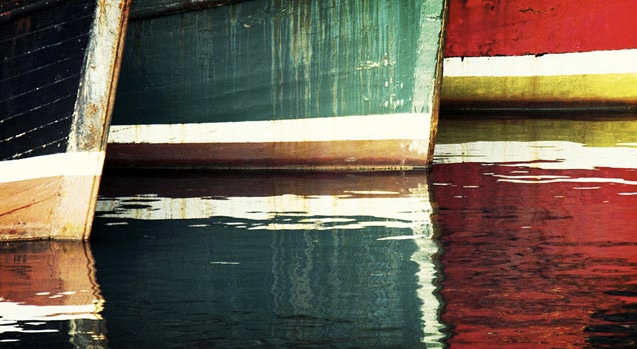
There are many poems, and many moods. Let me show you two more that editors thought we might want to see this spring.
boats-ireland.png

This image is literally reflective. Like the others, it suggests an essential harmony between nature and culture. Now, however, the objects are neither grand nor miniature but rather set to human scale. The boats’ colors, like the boats, are neatly demarcated in the water, suggesting social harmony as well. And they are both worn and colorful. Worn by good use but still distinctive, suggesting that although sharing a common mortality we can enjoy our individuality. Or, on reflection, we can do so if we don’t move too fast or demand too much.

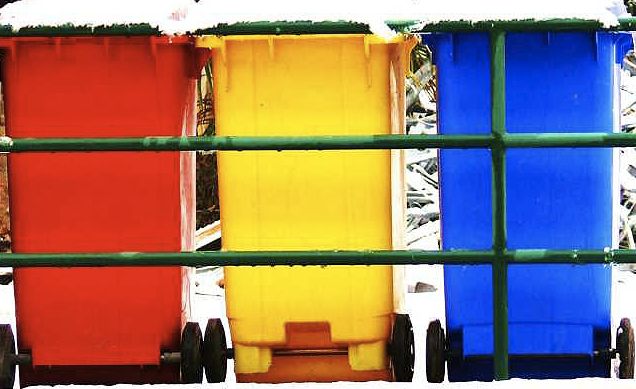
One should not let a moral ruin a good poem, so I’ll finish with one more image:
 

spanish-cans.png


Like the one before it, we see three colors and an unspoken coordination of nature and culture. Bright, plastic trash cans stand like crocuses in the late spring snow. Again, the coordination of the differently colored canisters suggests three households getting along easily. And just as the boats were in the common space of a harbor, here the ritual form of garbage collection has the public world as background for enjoying a moment of private delight. So perhaps there is a moral after all. This photograph is an image of hope and good cheer as it can be achieved in daily life. Empire will not go away, but spring will come.

Photographs by David Bortnick/NASA; Anna Arca/Guardian Unlimited; Rob Garbett/Guardian Unlimited; Leander Starr Jameson/Guardian Unlimited.


 2 Comments

Optical Noise in Iraq

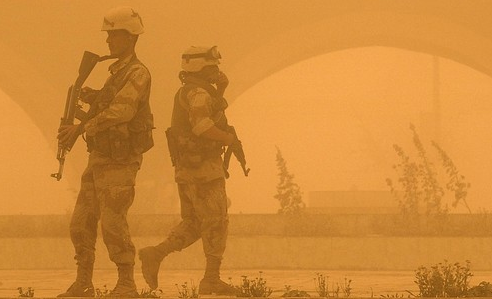
Coverage of the war in Iraq has been showing signs of fatigue lately, and for good reason. Now into the fifth year of the war, yet another parade of generals in Washington provided little consolation amidst the steady death toll–32 US soldiers in March, 46 so far this April, as well as hundreds of Iraqi deaths–and the many, many more who are wounded, traumatized, or refugees. But how many photos can you take of troops tramping through homes or dispensing medical care or just killing time? How often will we look at another bombed out vehicle or another general on PR duty? The carnage continues, but we all know that the political situation is not getting any better, everything is on hold until after the presidential election, and everyone is getting tired. Perhaps that’s why there have been a number of images lately like this:

sandstorm-iraq.png

It may be the season for sandstorms, but you wouldn’t have known it in previous years. Now, however, the slide shows have many variations on this shot. The sand is so comprehensive that it acts like an optical filter. The soldiers seem suspended like a prehistoric bug in amber. The one on the left has become doll-like, a GI Joe figure to be moved around but incapable of changing anything. The one on the right could be lost in thought. Everything is slowed down, grinding to a halt, as if there were sand in the gears of history.

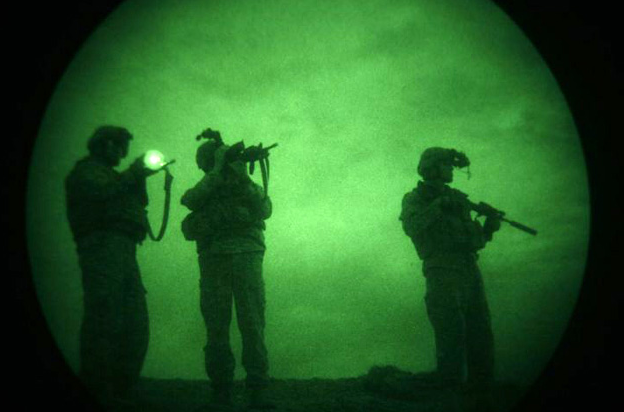
If there had been only one of the sandstorm images, I would have let it pass. But they kept appearing, and then I noticed that there was another series also being spooled out. Images like this one:

night-vision-101st-airborne.png

This is a photograph taken through the night vision equipment used by US troops. The fact that the photo is taken through a scope or similar instrument while on patrol gives these images some sense of action, but there still is the sense that everything is happening in slow motion. Slow probably is good when men are walking around with guns at night, but the photo creates a sense of suspended animation. The green filter is not eco-friendly green but rather something from a heavy dream. Warriors stand in archetypal tableau as if at the gates of some netherworld. The green air is noxious, miasmic. The war is not a place for action; it is a place that will never change.

Both images may be surreal–or prophetic. They also might be examples of what we could call “optical noise.” That term could refer to the visual din in images cluttered with signage, but I’m referring to something else. Each photograph is an image of the war, but one in which the visual equivalent of white noise is omnipresent. That noise doesn’t occlude the image but it does interfere with emotional response. And, of course, it is tiring.The first photograph shows a scene that could be clear at another time; the second shows something that would be invisible without the cyborg eye. In neither case are we able to see clearly. In both we have a metaphor for the present state of the war, one in which we have seen too much and yet not enough. A war in which everything seems mired in sand, trapped in a bad dream, waiting for change, for clarity.

Photographs by Alaa Al-Marjani/Associated Press and Rafiq Maqool/Associated Press. (The first is from Najaf, Iraq; the second is from Mandozi, Afghanistan. There are many night vision images from Iraq, but this was the one close at hand when putting up this post. There are differences between the two wars, but both now are subject to optical noise, which is created by the repetition of stock images while providing a metaphor for the current stalemate.)

 4 Comments

Greenwashing the Softporn Aesthetic

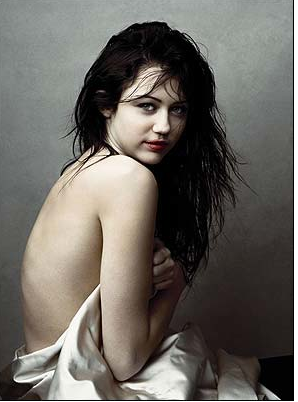
The connection between edgy, avant-garde, fashion photography and a soft porn aesthetic is nothing new, especially in high end fashion magazines like Vogue. When it shows up in the NYT it can create a flap, as it did when the 2007 Holiday issue of T featured a photo shoot of 17 year old model Ali Michael in a series of seductive images, including one photograph that revealed the barest glimpse at an out of focus breast. Sex sells, of course, and as one NYT Magazine editor justified the decision to publish the photographs, “We’re well past the point in our culture when there is a bright line that separates sexually charged images of men and women just short of 18 from art.” Of course, the line would seem to be a bit brighter between a woman just short of 18,” such as Ms. Michael and, say, 15 year old teen idol Miley Cyrus (aka, Disney’s “Hannah Montana”) whose topless and semi-clad portrait by Annie Leibovitz is featured in the current issue of Vanity Fair.

cyrus-by-leibovitz.png

Leibovitz’s portrait has created a controversy of its own, with advocates on one side worrying about the effect of the image on the preteens who look up to Cyrus as a role model and those on the other side concerned with the effect it will have on the “wholesome image” that underwrites the projected billion dollar industry that has grown up around the Hannah Montana brand. No one so far seems to be concerned with the degree to which Cyrus herself is being exploited in all of this, but that is a topic for another day.

What the controversy calls attention to for us, however, is that while we seem to live in a public culture that worries about the way in which adolescent sexuality is portrayed with real adolescents, we don’t seem to be worried when otherwise, presumably mature women are portrayed as if they embody a seductive, adolescent sexuality. At some point we have to ask, what difference does it make?

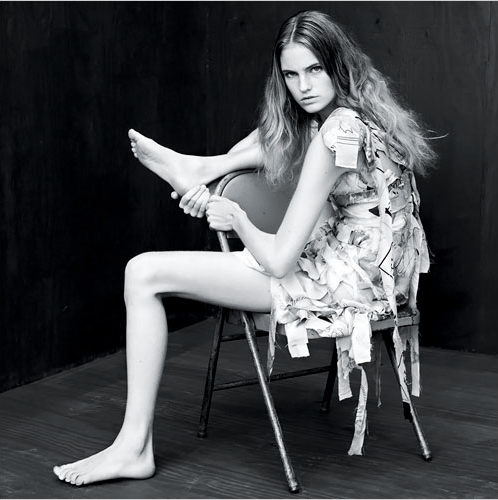
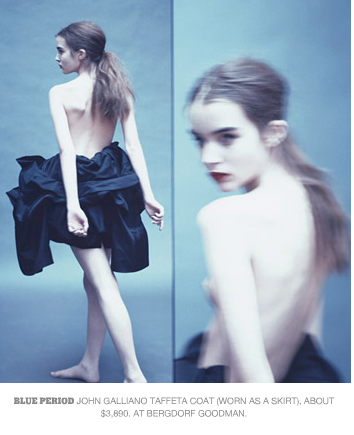
Consider, for example, this fashion photograph that appeared in this week’s Sundays NYT Magazine.

greenporn.png

We are never told the name of the model and there is no way to know her age. Nor does it matter. For whether she is fourteen or twenty-one, the point is that she is portrayed as a young Lolita, her supple body barely covered by a dress that seems to be in tatters. The expression on her face simultaneously performs a cultivated innocence and a primitive sexuality, the two reinforced by her bare feet and skinny, pale legs spread seductively around the back of a folding chair. Her long hair is both combed and yet unkempt, simultaneously complementing and accenting the tensions between nature and culture that pervade her pose and animate the adolescent sexual energy of the image. Shot in the grey scales of black and white photography and with the slightest hint of a soft focus, it has a subtle dream-like quality to it which invokes a surrealism that adds to its erotic appeal. (In this regard it contrasts with the muted, desaturated colors in Leibovitz’s portrait of Cyrus, which produce a harsher, somewhat gothic effect that seems hardly erotic at all.) And the question is, if we are troubled by Leibovitz’s photograph (or others like it, such as those of Ali Michael), why is there no hue and cry about images such as this which pretend to represent a seductive adolescent sexuality for mass consumption?

Part of the answer, no doubt, has to do with the vexed relationship between art and pornography. And so, of course, we have to take context into account. This photograph is one of six images that appeared as part of a story titled “Green With Envy.” The story focuses on eco-conscious fashion being marketed to a “well-heeled audience” by Earth Pledge and Barneys New York. It thus operates within the soft porn aesthetic of high fashion photography. The woman above is wearing a Maison Martin Margiela dress made from “silk head scarves that were bleached, cut into strips and asymmetrically woven by hand.” The price is available on request, though the eco-conscious fashion wear on display in the other five images ranges in price from $910 for a smock dress made of “undyed cotton” to $10,000 for a ruffled dress made from “biopolymer—a corn-based alternative to polyester.” What we have, then, is the greenwashing of a soft porn aesthetic, where one progressive cause (save the environment) seems to trump another (protect our youth from sexual exploitation).

Apparently there is no end to what sex can sell, including a sustainable earth. Surely this is no way to save the planet.

Photo Credits: Annie Leibovitz/Vogue; Earth Pledge and Barneys New York

 7 Comments

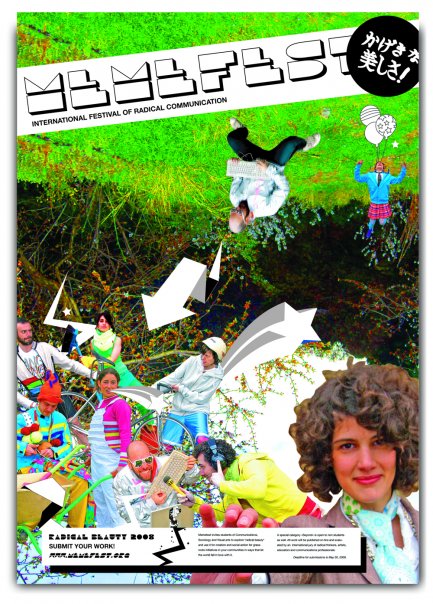
Paper Call: Memefest

MEMEFEST 2008:

EXPLORING RADICAL BEAUTY OF COMMUNICATION!

memefest.jpg

Memefest, the International Festival of Radical Communication–born in Slovenia and rapidly reaching a critical mass worldwide–is proud to announce its seventh annual competition. Once again, Memefest is encouraging students, writers, artists, designers, thinkers, philosophers, and counter-culturalists to submit their work to our panel of renowned judges.

This years festival theme is RADICAL BEAUTY. Participants will respond to an excerpt taken from themovie Rize and comment on it with their works. Here is how we defined radical beauty: Beauty is a cultural creation that expresses dominant values. In the 21st century beauty is often extremely commercialized. Radical beauty is a cultural creation that expresses the desire of a change in society. Radical beauty is about changing dominant values through action and creation. Grassroots projects are often the vectors of these changes.

As always, those whose work does not take a conventional format can enter the Beyond… category,where the name of the game is challenging mainstream practices and beliefs! Beyond… continues togrow in popularity as a category not only because of its avant-garde appeal but because it is open to non-students as well.

Memefest occurs completely on-line at www.memefest.org, and all entries will be available for full access and commentary in the site galleries. In 2007, Memefest received almost 500 entries from participants of every continent on the globe (except Antarctica). We hope to get bigger, and to spread more of those good infectious ideas, so keep thinking- and creating.

Deadline for submissions is May 20th 2008! Good luck!

 0 Comments

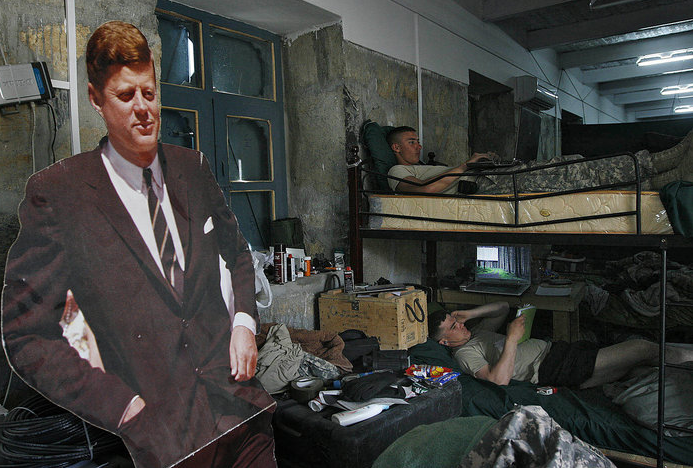
Sight Gag: "Ask Not What Your Country Can Do For You …"

kennedyasknot.png

Photo Credit: Rafiq Maqbool/AP

Our primary goal with this blog is to talk about the ways in which photojournalism contributes to a vital democratic public culture. Much of the time that means we are focusing on what purport to be more or less serious matters. But as Jon Stewart and Stephen Colbert often remind us, democracy needs irony, parody, and pure silliness as much as it needs serious contemplation. For our part, we will dedicate our Sunday posts to putting such moments on display in what we call “sight gags,” democracy’s nod to the ironic and/or the carnivalesque. Sometimes we will post pictures we’ve taken, or that have been contributed by others, or that we just happen to stumble across as we navigate our very visual public culture. Sometimes the images will be pure silliness, but sometimes they will point to ironies, poignant and otherwise. And we won’t just be limited to photography, as a robust democratic visual culture consists of much more. We typically will not comment beyond offering an identifying label, leaving the images to “speak” for themselves as much as possible. Of course we invite you to comment … and to send us images that you think capture the carnival of contemporary democratic public culture.

 0 Comments

BUILT: Huddled Masses, Living Here?

BUILT explores the changing city in the US and the challenges that will affect housing, infrastructure, neighborhood cohesion, and equity in the coming years. BUILT is a series of research, installation, dialogue, interview, and performance events of varied scale, including the opportunity for public conversation offered at this blog.

In the coming years, the population of the US will continue to expand with increasing concentration in urban areas. There is no one plan for how that will happen. Where will we live? Will we be thoughtful about that? Can we imagine better cities, neighborhoods, and homes? Will we act to achieve that vision?

And who will be involved? As before, we begin with a photograph:

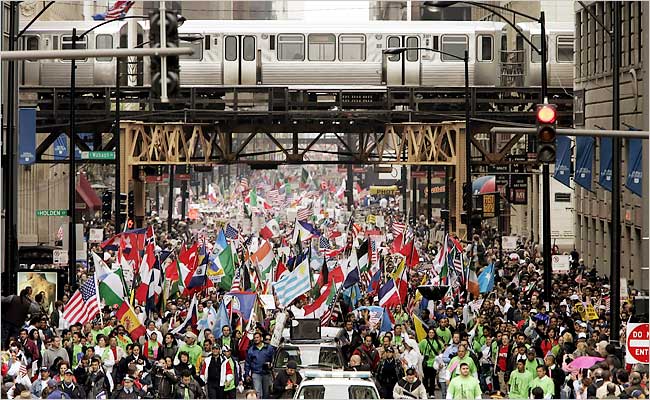
immigration-march.jpg

In the BUILT process, we’ve been working around notions of place, power, ownership, and voice. This photo of Chicago residents marching in last year’s national immigration rally foregrounds the role of democratic dissent in urban life. It poses a deeper question as well, one regarding national history (whether in the US or elsewhere): how do we, and how have we, shared space? What factors determine, influence, and establish the right to inhabit space–to claim and name a place?

BUILT is a performance/civic dialogue project and a collaboration of Northwesten University’s Theater Department & Portland, Oregon’s Sojourn Theatre, led by visiting artist Michael Rohd.

Photograph by Charles Rex Arbogast/Associated Press. The full text of the poem alluded to in the title of this post is available here.

 11 Comments

In Search of "the people"

The tradition of transporting the Olympic torch from Mt. Olympia to the Olympic Stadium via relay was inaugurated at the Eleventh Modern Olympiad, more commonly known as the 1936 Berlin Olympics, and under the watchful eyes of Adolf Hitler and the German Third Reich. Needless to say, there was no question that the spectacle, captured by Leni Riefenstahl in her documentary Olympia, served an explicit political purpose; and equally certain, there were no dissenters present at the event (or at least visible to the cameras that captured the occasion for posterity). Any discussion of the recent protests for human rights surrounding the relay of the torch to Beijing for the Twenty-ninth Modern Olympiad needs to begin by remembering the origins of the tradition.

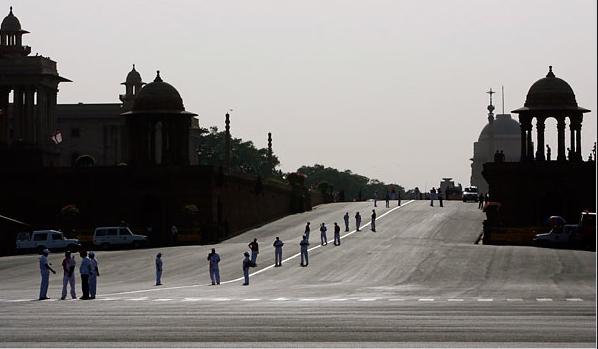
China’s record of human rights violations have been featured in western photojournalistic venues recently, oscillating between images of the often brutal oppression of Tibetans and images of protesters around the world urging a boycott of the Beijing Olympics. And, of course, photographs of protesters challenging the Olympic relay have been especially prominent. The photograph below, however, is somewhat unique amongst such images and in its own way it is a provocative allegory for the problem that China and the International Olympic Committee face.

tibetanpeople.png

What we are looking at is the route that the Olympic torch was to take in New Delhi along Prakash Vir Shastri Avenue, the major boulevard that runs throughout most of the city and eventually passes Rashtrapati Bhavan, the palace and official residence of the President of India, seen here in the upper right hand corner of the photograph. Shot from on high and at a distance, the image situates the viewer as a spectator looking down upon the scene, but apparently not part of it. The wide angle underscores the fact that we are in a public space as it captures a major intersection in the road; the sharp contrast of shadow and light draws our attention away from the buildings on either side of the avenue to the width of the boulevard and the vectors that divide and guide the street traffic. According to the caption that accompanied the picture in the NYT, the people standing in the street are “officials wait[ing] for the torch … along a boulevard purged of spectators.”

The Olympic relay is designed as a spectacle, its ostensible purpose being to generate visible and worldwide enthusiasm for the pageantry and athletic events soon to follow. But, of course, a spectacle needs spectators, and here, the caption tells us, they have been “purged.” The choice of words is ominous, as is a midday image of a major boulevard in a major city absent any sign of its people. India is a democratic republic with a constitution that guarantees its citizens a wide range of civil rights, including freedom of speech and expression and the freedom of peaceful assembly. The dissent that is the product of such rights is essential to a vital democratic polity, but here apparently, the simple fear of anti-Chinese protests was enough to keep the public—supporters and dissenters alike— far enough away from the event so as to avoid “marr[ing] its appearance.” The irony is that in the process the Olympic relay in New Delhi was made into something of a caricature of itself. Designed to silence those who would urge a boycott on the Olympics, the photograph shows us what the effect of such a boycott might actually be: a spectacle without spectators.

From a slightly different vantage point, however, the photograph reinvests the viewer with a certain moral force, for while the framing distances us from the scene, it also nevertheless positions us as witnesses to a “purging.” And in this context it calls to mind the iconic photograph of the lone individual standing down a row of tanks in Tiananmen Square, shot on a similar public thoroughfare and from a comparable vantage. The difference, of course, is that the earlier photograph featured the liberal individual by his heroic presence, and here we are confronted with a democratic people by their forced and pronounced absence. What we need to remember is that in the end a functioning liberal-democracy requires both in some measure of equipoise and that we can never—not ever—let the fear of dissent compromise our commitment to either lest we destroy what we intended to save in the first place.

Photo Credit: Vijay Mathurs/Reuteurs

 0 Comments