Jan 21, 2015
Apr 27, 2014
Jan 25, 2008
Nov 09, 2011
Jun 21, 2009
May 01, 2013

Dutch Cabinent Bans Burqas

According to the Chicago Tribune, the Dutch Cabinet has asked parliament to ban burqas from all schools. “‘I value being able to look somebody in the eye,'” Prime Minister Jan Peter Balkenende said, referring to the fact that the robes cover a woman’s face. “‘I find it unpleasant.'” The PM may be referring to the Afghan chadiri, which, unlike many burqas, covers the eyes:

burqaface.jpg

I have to admit this habit spooks me too. It even was too much for libertarians, who banned one of their own from the US national convention. (She’s the one behind the veil in this photo.) At least the PM was honest enough to say that it bothered him, rather than pretend that he cared about lending support to a cultural practice that restricts women. After all, what’s more important?

I post on burqas from time to time because of how they raise important questions about the relationship between liberalism and norms of transparency. The PM’s comment may seem idiosyncratic but carries a set of common assumptions about how civil interaction presumes some openness to others’ scrutiny, how social trust depends on being able to assess character, how the eyes are sources of information about a person, and how good judgment includes aesthetic reactions. These notions can each be debated at length, but that is not where I’m going today. Instead, let me suggest an alternative headline for this post:

Dutch Cabinet Bans Sunglasses

The problem is that the reason given by the PM for banning burqas applies equally well to a widely accepted practice of veiling in the West. I am referring to wearing sunglasses when in public, like this:

fb-sunglasses-1.png

The caption read, “New York Giants wide receiver Plaxico Burress listens to a question during media day for Super Bowl XLII.” Wide receivers probably don’t have eye problems, so I’ll bet this was a matter of choice, just as it was for Antonio Pierce:

fb-sunglasses-2.png

So it’s not a black or white thing, either. It can get bright outside in Phoenix, but the first photo has clouds in the background and the same slide show had photos of other players not wearing shades. No, these dudes chose to cover their eyes and the reason probably had a lot more to do with “media day” than the weather. They are withholding visual access to their eyes, an act of resistance within a liberal social order. And it would not be news that wearing sunglasses makes people uncomfortable; indeed, that is one reason to do it.

Now this may not mean much to the Dutch cabinet. Some might say that the comparison doesn’t hold since the players haven’t really attended school, but that’s beside the point. The question is, why can pro athletes, rock stars, movie people, and anyone who wants to imitate them cover their eyes in public, while women who have little choice to do otherwise are punished for it?

Photographs: unknown; Julie Jacobson/Associated Press; Harry How/Getty Images.
 1 Comment

Mourners in the Snow

The last week’s online slide shows have been full of energetic images from the primary campaigns, striking images from Mardi Gras and the Brazilian Carnival, heartrending images of violence from around the world, and all too familiar images of ordinary people digging out from the latest snowstorm. None of these touched me quite like this one:

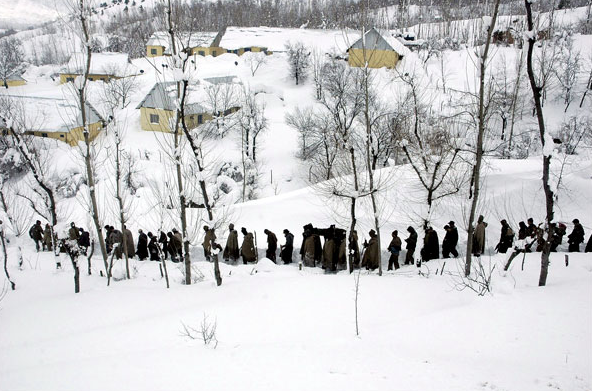
mourners-in-the-snow.png

You are looking at a procession of mourners from a village in Kashmir. They are carrying the body of a man killed by an avalanche. Heavy snows have killed a number of villagers and driven hundreds from their homes. These are Muslim mourners living in that portion of Kashmir controlled by India, but the political geography seems irrelevant. The snow is no respecter of prejudices, while the thick white cover seems to nullify all boundaries.

The snow also is slowly burying the houses while making walking very difficult. The mourners are strung along the one narrow path the winds through the barren scene. Wrapped up against the cold, they seem to share a deep separateness as if each were lost in thought. The one bulge in the line comes in the middle, where you can see that several mourners are carrying the dark coffin. The yellow buildings in the background promise the warmth and comforts of village life, but death sets the tone for this winter day.

The poignancy of the image may come also from its resemblance to another winter’s scene:

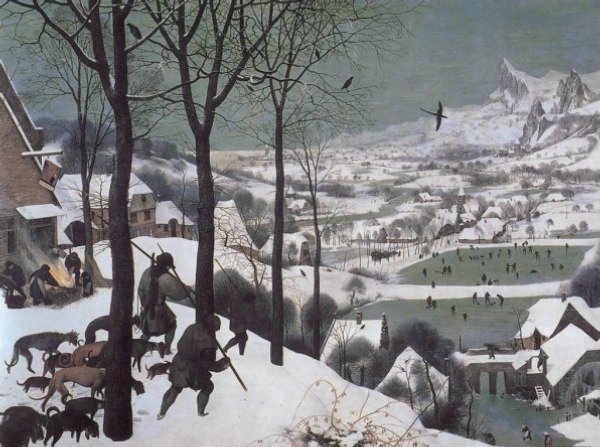
bruegel_hunters_in_the_snow.jpg

This is a copy of Pieter Brueghel the Elder’s painting, “Hunters in the Snow.” Completed in 1565, this masterpiece also features a somber procession of villagers within a drear winter landscape. The contrast between the vitality of the village and those in the procession is stronger than in the photograph, but tired hunters and their slow-moving dogs evoke a shared fatality where all species have to struggle against the inertia of nature to survive. They are lucky: even if the hunt was in vain, the are returning to a village that is doing well. Their little band will be warmed and fed as it is absorbed back into the community to rest and revive for another day.

There are other differences as well, but the two images share a vision of how the human community exists precariously within nature’s cold, impersonal, relentless mortality. The continuity of painting and photograph suggests something else as well. If the photo seems to look backwards, as if the Kashmiri villagers were still walking through a premodern tableau, the painting reminds us that the passage of time offers no escape from the human condition. In fact, one can image the photograph as a scene from a century to come, when humans regularly walk slowly through barren landscapes to bury their dead.

But that is getting ahead of the story. It’s been a hard winter for many people this year, and Christians are in the season of Lent, a dark, cold time defined by failure and loss. I find it fitting that a profoundly Lenten image is one of Muslim mourners, and strangely reassuring that an image of winter is one not of vexing inconvenience but rather of stillness and community.

Photograph by Farooq Khan/European Pressphoto Agency.

 0 Comments

Sight Gag: A Late Modern Epic

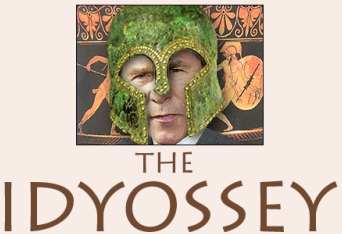
idyossey.jpg

Note: Click here to read eitherThe Idyossey or its companion piece,The Bushiad.

Our primary goal with this blog is to talk about the ways in which photojournalism contributes to a vital democratic public culture. Much of the time that means we are focusing on what purport to be more or less serious matters. But as Jon Stewart and Stephen Colbert often remind us, democracy needs irony, parody, and pure silliness as much as it needs serious contemplation. For our part, we will dedicate our Sunday posts to putting such moments on display in what we call “sight gags,” democracy’s nod to the ironic and/or the carnivalesque. Sometimes we will post pictures we’ve taken, or that have been contributed by others, or that we just happen to stumble across as we navigate our very visual public culture. Sometimes the images will be pure silliness, but sometimes they will point to ironies, poignant and otherwise. And we won’t just be limited to photography, as a robust democratic visual culture consists of much more. We typically will not comment beyond offering an identifying label, leaving the images to “speak” for themselves as much as possible. Of course we invite you to comment … and to send us images that you think capture the carnival of contemporary democratic public culture.

Credit: Victor LittleBear

 0 Comments

Kern Conference on Visual Communication

The schedule for the 4th Biennial Kern Conference on Visual Communication: Rhetorics and Technology is now online. The Conference takes place at the University of Rochester, April 10-14, 2008. If you’ve never been to one of these conferences and can get there you should attend. This year features a keynote address by Professor Thomas Benson, Penn State University; a master panel on the past, present, and future of Visual Rhetoric featuring Lester Olson-University of Pittsburgh, Carolyn Handa-University of Alabama, Charles Hill and Marguerite Helmers-University of Wisconsin Oshkosh, and Kevin DeLuca-University of Georgia; and a screening of Ron Osgood’s My Vietnam Your Iraq.

Perhaps the highlight for readers of NCN will be the panel on “Blogging Visual Politics” chaired by Cara Finnegan and featuring Michael Shaw from BAGnewsNotes, Jim Johnson from (Notes on) Politics, Theory & Photography, and your favorite bloggers from nocaptionneeded.com.

And of course you can round out the weekend with a visit to the George Eastman House and International Museum of Film and Photography.

For more information see the Conference website.

 1 Comment

My Vote, My Valentine

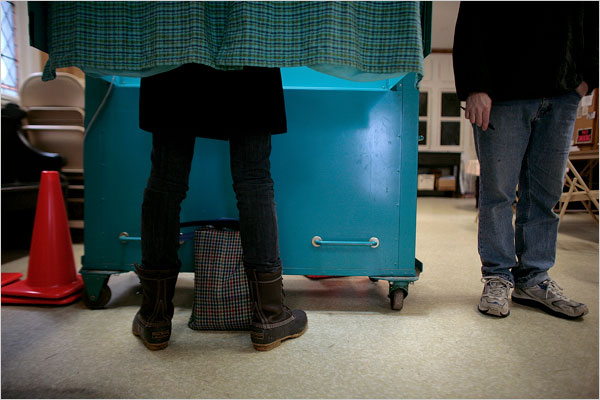
The Super Tuesday elections were reported yesterday with stories and graphics and victory celebration photos, and for once the hype may have been matched by the results and the good vibe. Perhaps the turnout will help the media move on from their theme of the week, which was fretting about the “arcane” primary process–as if monarchy would be more rational or bureaucracy more transparent. In any case, we all can take a breath, plug the answering machines back in, and get back to our less than super-sized routines. As one last look back, however, I’d like to put up a couple of images from the slide shows at the major papers that were part of yesterday’s coverage.The slides depict the considerable variety and common shabbiness of the places where America votes. Schools, churches, laundromats, garages, you name it–we haven’t moved up much from the days when Americans voted in taverns. Any one of the slides would do, but this one caught my eye for several reasons:

voting-feet-ny.jpg


By cropping the photo to feature people from the waist down, the trope of metonymy is put in play. John and I write about this focus on “boots and hands” from time to time because, first, such images are everywhere despite their individual peculiarity, and, second, they push forward a particular idea of the body politic. This image is a case in point: voters are known by their anonymity but assumed to have walked the walk and taken a stand on behalf of the polity. They are inherently fragmentary and so needing to be aggregated, but also inevitably plural and otherwise part of a society in which their are many walks of life. (If you don’t like cliches, even when used to make a point, this is not your day.)

The photograph elaborates this conception of democracy. By cutting out the markers of personality, we are left with a social scene and social types. The scene is totally functional: voting machine with wheels and handles for being moved in and out of storage, bare floor, warning pylons for when the floor is being washed, folding chairs and tables in the background. This is never going to be a personal, intimate place but rather a place where people congregate to do something in common. The clothes of the two figures take it a step further: jeans, dark coats, boots or worn shoes, these are the clothes of the mythical common man. She is a bit more stylish, he compensates for that. Their clothes are unconsciously coordinated with each other, as is her bag with the cloth on the voting booth. The only really garish color is the weird aquamarine of the machine, as if it were something for a party, which it is.

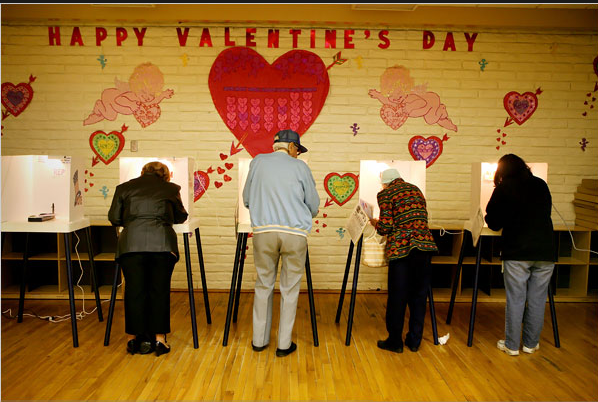
This last suggestion that democracy is somehow both routine and festive is taken a step further in the second photo.

vote-valentine.png

Again we have a functional scene–the wood floor and brick wall of a recreational center–and a social type–the elderly. There also is the visual irony, which contrasts the seriousness of voting with the frivolous decor of a holiday, and the bent postures of old age with the frizzy excessiveness of young love. The visual grammar places the elderly in the space of the real, with the decorations in the place of the ideal. Their complete lack of attention to the decorations makes it seem that whatever cupid symbolizes, its completely irrelevant to the preoccupations of old age.

There is a third contrast as well. I doubt that those in the picture are oblivious to either romance or decorative arts, but they are paying attention to their ballots. Thus, the photograph depicts not only youth and age but also romantic love and love of country. The photograph’s ironies are superficial but pose an interesting question: Can one have two loves? This is a fundamental question in a liberal-democratic society, where we regularly experience the tension between the right to a private life and the value of government by the people. The answer to the question is a choice. You can see the two loves as existing only side by side and ironically so, or you can see them as different but ultimately compatible. And on that question, the polls are always open.

Photograph by Nathaniel Brooks and Monica Almeida for The New York Times. The first was taken at Saint John the Evangelist church in Barrytown, New York, and the second at the Belvedere Park Recreation Center in East Lost Angeles, California.

 2 Comments

Vestal Virgins and Drag Queens in the Episcopal Church

Those familiar with the Western Christian liturgical calendar (both of you) will know that today is the beginning of Lent. The papers are full of street scenes from Mardi Gras: performers in outlandish costumes along with spectators reveling in the temporary disruption of routine and rationality provided by the carnival. Few of those at the party may know that they could find that year round in a church. The Episcopal church, for examnple:

episcopal.jpg

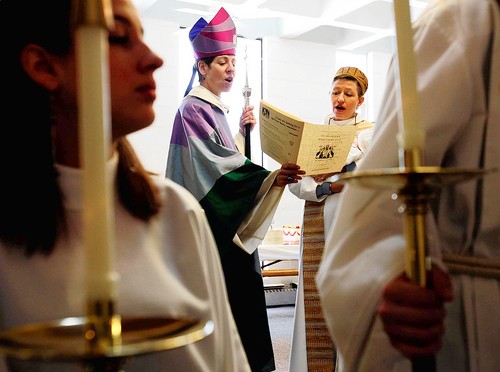
This photo was taken at the installation of a bishop in Chicago a few days ago. I think it’s a hoot: despite the solemnity of the participants, they might as well be on a float in New Orleans. The church may have bestowed specifically Christian meaning on every item of dress and decor, but since the crozier is whited out it is easy to see that the women could just as well be in a Druid or Roman or any other “pagan” ceremony. Chastely covered, chanting rhythmically, carrying phallic symbols, they might as well be Vestal Virgins. For all I know, the Zorastarians also might identify. In any case, they are maintaining a symbolic hierarchy of older women bearing colors and the sacred text, and younger women in white serving as acolytes. Some things never change, I guess. And that’s not the half of it. Take a look at this:

bishop.jpg

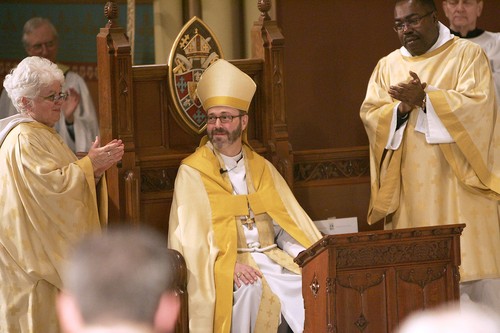
This guy could be at the center of the parade. He’s the new bishop. He looks like a little boy playing king. And, of course, he is dressing up, in a form of play, as something that he is not. He sits on a throne surrounded by those courtiers favored enough to be in his presence. Two races and two genders are represented but age is regnant and a white guy rules. Most important, however, he has adopted the regalia of a premodern monarch, a temporal king, seemingly without hint of irony.

And there is more irony than you might think. The story of this installation is that he is a gay-friendly bishop–a progressive on the battle line that is breaking the Anglican Communion apart. And so this post about an infrequent, highly ceremonial, obviously extraordinary performance of church ritual can’t avoid the deep questions. Why is it that, in a world crying out in pain, the mainline churches today are consumed with the question of who gets to be a member of their club? And who are they to tell people how to appear in public, when their leaders go in drag as if they were medieval kings? Why are we supposed to be reverent when they dress up in robes and crowns, but appalled when two men hold hands?

Lent is to be a time of reflection. In that spirit, I should acknowledge that my reaction to the liturgical costumes reflects a Protestant theology and aesthetics. And, of course, hypocritically so. Some Protestant clergy still don medieval robes on Sunday, as do academics once a year for commencement, so I can’t throw too many stones here. More important, instead of self-righteous criticism the Episcopal ceremony can prompt humility. The two photographs above remind me of when I watched my first Christmas pageant as a parent. The gaggle of kids stood there at the front of the church, glittery wings akimbo, golden crowns sliding over their ears, playing their parts with no clue of how small and awkward they looked. At that moment I knew, this is how adults look to God.

Photographs by Stacey Westcott and Jose M. Osorio for the Chicago Tribune.

 2 Comments

Post Cold War Nuclear Optic

John posts semi-regularly at BAGnewsNotes.com and occasionally we will double-post or link the posts here at NCN. This post appeared initially at the BAG yesterday. We encourage you to check in to see the comments it has evoked there.

************************************************

Anxiety over nuclear bombs is perhaps more pronounced today than anytime since the Cold War, marked by a persistent worry about unfriendly nations, renegade scientists, and terrorists of all stripes gaining access to enriched uranium and nuclear warheads. And yet, outside of a few editorial cartoons here and there, images of “the bomb” are missing in action. For all the talk of nuclear terror, you might expect to see the image of the explosion at Nagasaki or any of the hydrogen bomb explosions obliterating Pacific atolls. These were a staple of the Cold War era, but despite other similarities with the War on Terror, they are not to be seen.

At least that was the case until late last year when this image appeared on the front page of the NYT website as the anchor to a story about the debut of the 2007 Miami Beach Art Expo titled “Work With Me Baby.”

lucaites2bombsla.jpg

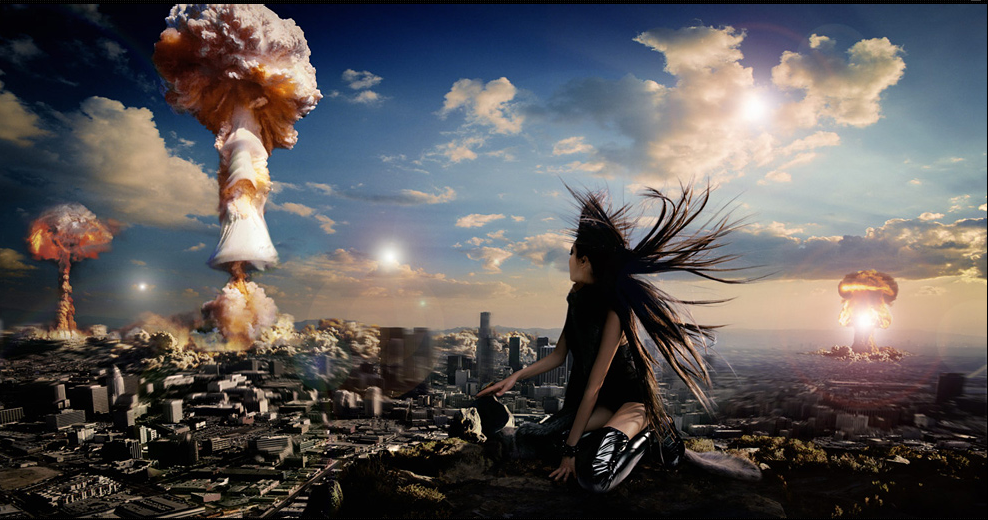
The photograph, created by fashion photographer (and music video director) Seb Janiak, clearly puts “the bomb” back in the public eye, but it does so in a manner that functions as an artistic challenge to the prevailing optic of the Cold War image of the bomb. The Cold War optic relied upon a logic of absence (there was no destruction to be seen, just the explosion in all of its grandeur), the formal perfection of the “mushroom cloud” (the explosion cast in terms of abstract symmetry), and it operated under the complete control of a technologically sophisticated. military-industrial complex (only with such access could one get close enough to take such pictures, whether from 35,000 feet or in the Marshall Islands).

In place of the structured absence, the target of destruction is now evident as we witness the immolation of an actual city (Los Angeles). The formal perfection of the explosions is retained in some measure, but notice that the affect is different: the cool, richly saturated blue sky dotted with puffy white cumulous clouds stands in stark opposition to the cold war optic. Where before one saw either high contrast black and white photographs which underscored the abrupt and violent disruption of the force of the bomb or color photographs heavily overcast in dominating red and orange hues which signified the overwhelming heat of the blast, now we’re in the artificial colors of a tourism postcard. Finally, the three explosions operate outside of the closed circuit of military control. Indeed, these would appear to be tactical nukes, precisely the kind that we imagine being smuggled into our cities by terrorists.

The key point, of course, is that the Cold War nuclear optic with its formal perfection and modernist abstraction is no longer adequate (if it ever was) to the potential problems we face. And yet those problems have not gone away for the absence of a compelling image (just as the problem of torture at Abu Ghraib was no less serious before photographs turned our attention to it). And so what is the newer optic we are being offered and what are its implications?

The question for us has to be, what’s going on here? In one sense the image is a step forward as it challenges both the image culture of the Cold War and the apparent cultural amnesia that has lately erased images of the mushroom cloud from the public’s optical consciousness. And yet, the alternative that it offers as a primary replacement seems to draw from the world of high fashion, a point underscored by the title of the article that the photograph anchors, “Work With Me, Baby.” These are the words of avant garde fashion photographers working fast and furious to capture a soft porn aesthetic that can be published in magazines suitable for middle class consumption. And so, one has to wonder, is this image one step closer to Walter Benjamin’s terrible prophecy that our “self-alienation has reached such a degree that it can experience its own destruction as an aesthetic pleasure of the first order?” Or is it a cautionary tale designed to warn us against our own cultural indifference? After all, it is really unlikely that fashion models will really save us from ourselves, let alone from the atrocities likely to erupt from the technologies of war.

Photo Credit: Seb Janiak, “L.A. Atomic, 2005”

 2 Comments

The Evolution of Violence in the 21st Century

Barbara Ehrenreich brings her book Blood Rites to a brilliant close by advancing the idea that war is a meme: a self-replicating pattern of behavior. She highlights Richard Dawkins’ observation that a meme can propagate as it does “‘simply because it is advantageous to itself.'” Her conclusion follows: “If war is a ‘living’ thing, it is a kind of creature that, by its very nature, devours us. To look at war, carefully and long enough, is to see the face of the predator over which we thought we had triumphed long ago.”

Let’s follow Ehrenreich’s injunction to look at war carefully, and do so while aware of another implication of her thesis. If war is a dynamic entity committed to its own survival, then it will adapt to elude environmental changes. Peace, prosperity, education, globalization, and similar threats need to be outflanked or infiltrated. One possible adaptation is to shift “backwards” from organized war between nation states to more primitive forms of violence. Two examples follow.

paki-clubbing.jpg

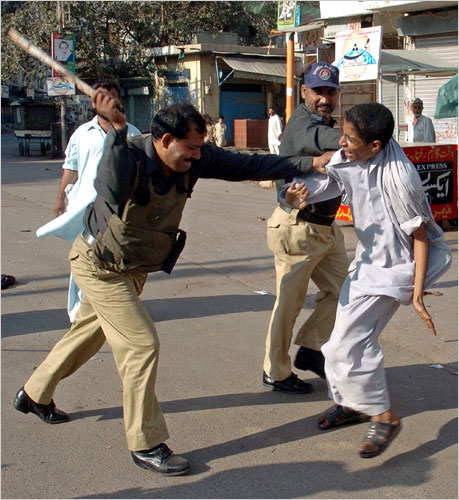
You are looking at a grown man clubbing a boy. The man is strong and practiced: holding the boy with one hand as he swings the club with full force. He keeps his eye on the target as he bring his weight into the blow. With any luck he’ll bring the thigh bone or the wrist, perhaps both. The boy can see it coming. His face is already a mask of pain and terror as he leaps to try to avoid the blow. The predator has him firmly in his grasp, however. The boy is young and thin and hobbled by his clothes; he could not be a threat to the man or to the state. He looks like at rabbit caught in the clutches of a wolf. Another member of the pack looks on approvingly.

The Chicago Tribune Photos of the Day caption said, “In Karachi, an anti-government demonstrator was struck by a police officer. There were protests in several cities around Pakistan.” The distortion is obscene. They might as well have said, “What else are the police to do when the entire county is under attack by those who would tear down the government?” Of course, the protests were on behalf of democratic government and justice, and the boy is not a demonstrator but a kid on the street who was most likely guilty only of acting like a citizen. The caption does get one thing right: state terrorism of the sort seen here–a common but mild version of the beast–is one of the forms of war in our time.

And here’s another:

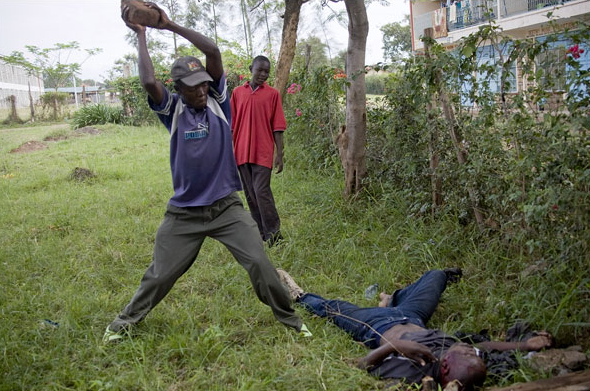
kenya-kill.png

I can hardly bear to look at this photo. If the young man on the ground isn’t dead yet, he’s about to be. Again, another male throws his full strength into the act of violence. His eyes are focused directly on the target–the head that is about to be crushed. Again, a bystander looks on with interest. They are in Kenya, but they could be many places in the world today. The guy with the rock is a Luo, and he is another strand in the propagation of war. This is another old pattern that has been resurgent in the past decades: rampaging violence let loose by the collapse of political and social order into anarchy. The state may still be a player behind the scenes, but in its place there is sheer destruction, mutilation, torture, and murder as done by roving bands of rogue males.

Either way boys are being ruined. And that may be the least of it. A third form of war’s predation today is the horrific rape and mutilation of many thousands of women throughout Africa. I don’t yet have the stomach to report on that. For the moment, let it be enough to look carefully at the two photographs above. They record the news but also show something worse. As “war” becomes contained, violence spreads like an epidemic. A new century is the scene for ancient forms of violence as the beast continues to devour its human prey.

Photographs by Rizwan Tabassum and Yasuyoshi Chiba, Agence France-Presse–Getty Images. The first image also brings to mind this photograph from the American civil rights movement. That image provoked strong public criticism of the white resistance in the South. But who protests similar violence on the streets of the world today?


 3 Comments

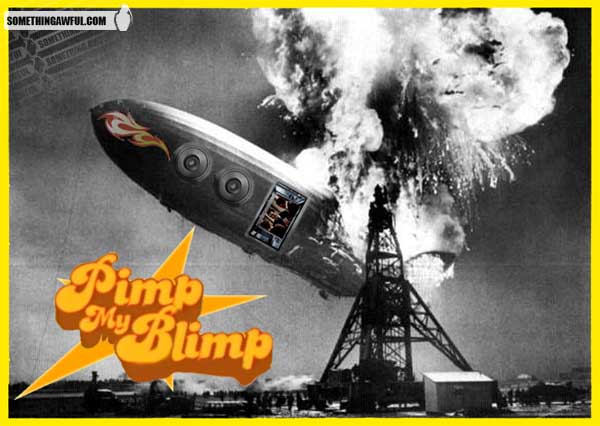
Sight Gag: Pimp My Blimp!

knackered.jpg

Credit: SomethingAwful.Com

Our primary goal with this blog is to talk about the ways in which photojournalism contributes to a vital democratic public culture. Much of the time that means we are focusing on what purport to be more or less serious matters. But as John Stewart and Stephen Colbert often remind us, democracy needs irony, parody, and pure silliness as much as it needs serious contemplation. For our part, we will dedicate our Sunday posts to putting such moments on display in what we call “sight gags,” democracy’s nod to the ironic and/or the carnivalesque. Sometimes we will post pictures we’ve taken, or that have been contributed by others, or that we just happen to stumble across as we navigate our very visual public culture. Sometimes the images will be pure silliness, but sometimes they will point to ironies, poignant and otherwise. And we won’t just be limited to photography, as a robust democratic visual culture consists of much more. We typically will not comment beyond offering an identifying label, leaving the images to “speak” for themselves as much as possible. Of course we invite you to comment … and to send us images that you think capture the carnival of contemporary democratic public culture.

 1 Comment

Photographer's Showcase: The Other China

This week we welcome Aric Mayer to NCN. Aric’s work has been sponsored by both Hasselbad and Fuji, and has appeared prominently in places like the Wall Street Journal (on Hurricane Katrina). His work regularly shows up at prominent art galleries and he helped to found the Pratt Artists’ League, an artists collective that specializes in promoting new curatorial models for emerging artists. According to detritus, he is a “dowser. Like a man with a willow branch searching out sweetwater he finds and captures the shot at just the moment it runs clear and pure. Potable; pellucid; powerful.”

The work shown here is from far western China. You probably have seen photographs recently touting the dazzling new structures going up in preparation for the Olympics. Aric’s work reminds us that, away from the spectacle, ethnic repression is still a fact of life for some in China today.

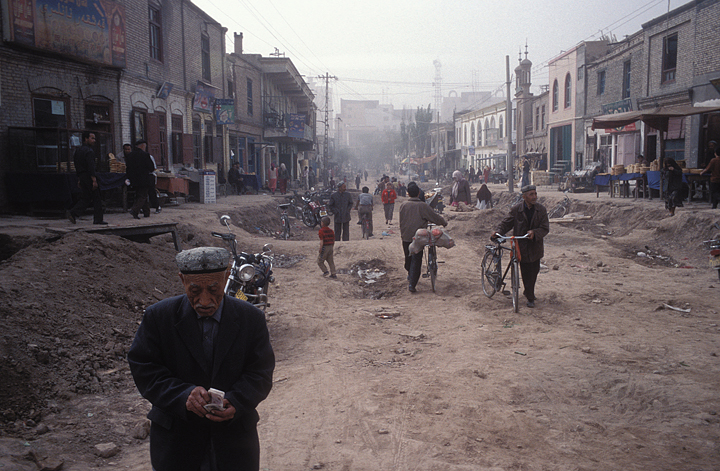
aricmayer1.jpg

An elderly man counts his money from the morning market in Kashgar. Kashgar is the largest trading town on the Silk Road in China. The Uygur have been doing business here for centuries.

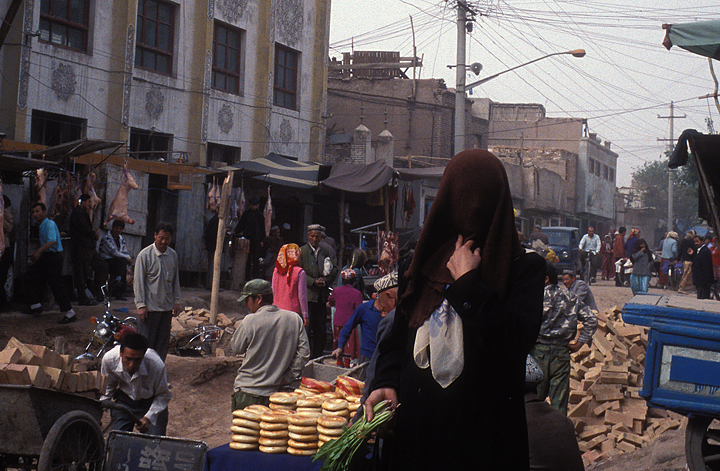
aricmayer2.jpg

A woman wears a traditional Uygur veil in the old section of Kashgar. The Uygur practise a unique brand of Islam, partly their own and partly under the control of the Chinese government.

aricmayer3.jpg

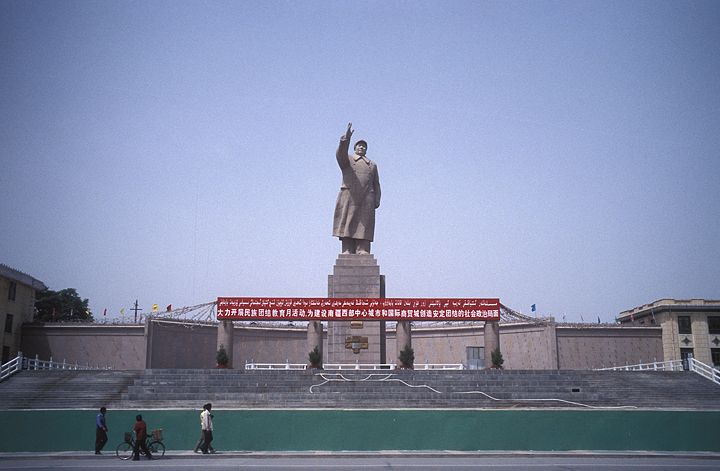
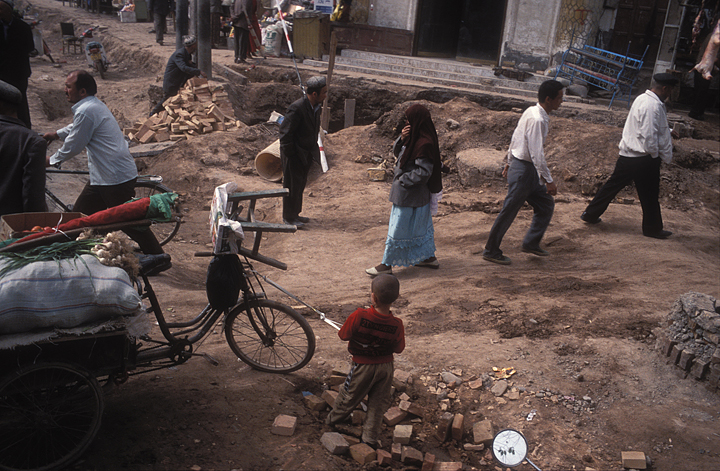
A 59 feet tall statue of Chairman Mao dominates the square in the center of Kashgar. As throughout China, much of the town has been torn down to make way for broad boulevards and big squares. The poorest sections of town are left alone. What is left of the original culture is often turned into theme park like tourist attractions.

aricmayer4.jpg

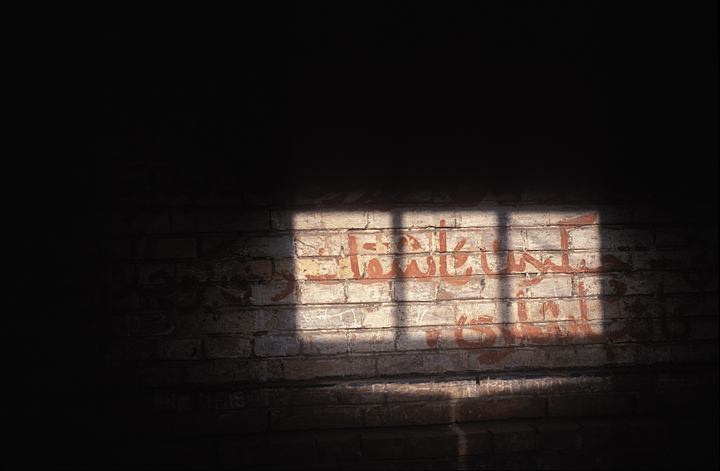
Light from a door illuminates text on a wall. The Uygur language is written in an Arabesque script. The Uygur guard their cultural heritage from assimilation into Chinese culture. Too often this forces them to chose between adopting the Chinese language and mannerisms for the economic opportunities that come with them, or staying with their Uygur heritage.

aricmayer5.jpg

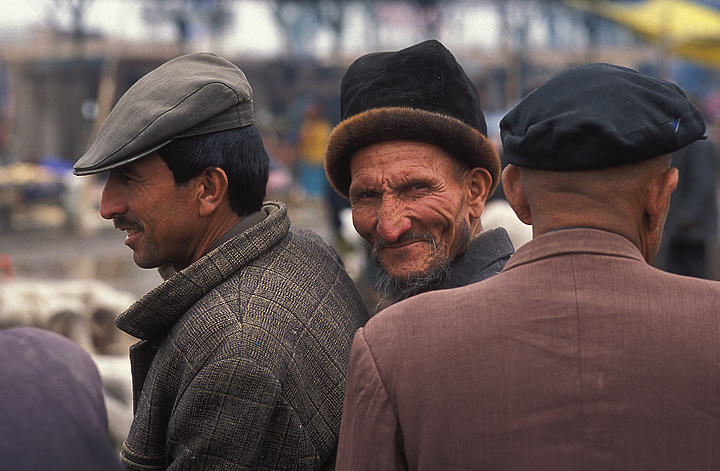
Uygur men at the livestock market in Kashgar. The Uygur are an ethnic minority in China. They trace their heritage back for 5,000 years in this part of the world. They speak an Arabic language, have their own Arabesque alphabet and have distinctly different features from the Chinese.

aricmayer6.jpg

A Uygur boy helps to move the day’s goods to and from the market.

aricmayer7.jpg

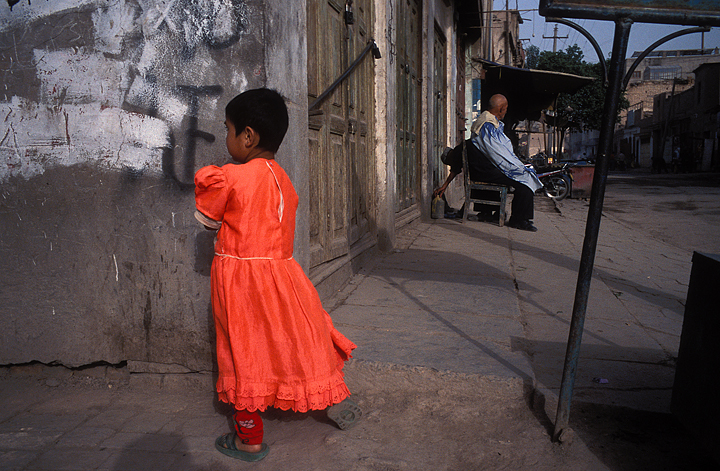
A Uygur girl heads to the market in a silk dress in Kashgar.

aricmayer8.jpg

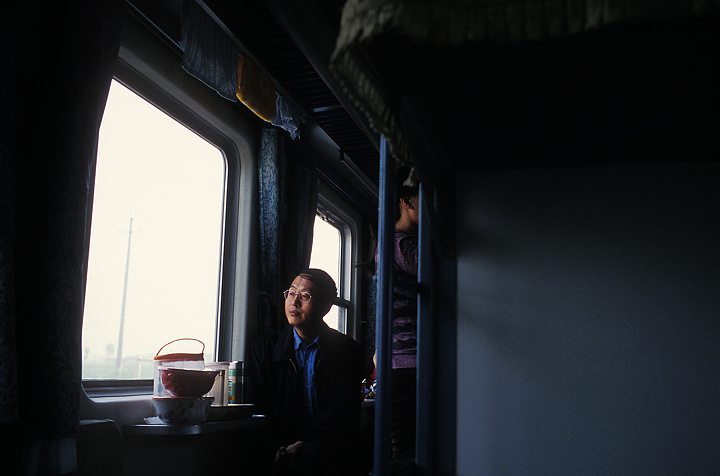
A Han businessman travels west by train from Beijing. He is heading to Urumqi in Xingiang, on the Northern side of the Taklamakan desert. With a population of 1.5 million, Urumqi is a fast growing business center for western China. Lucrative contracts are given to Han business owners, encouraging investment and immigration from the east. Many Uygur are left behind in this economic boom.


 6 Comments