Sep 22, 2010
Feb 14, 2014
Nov 28, 2016
Jul 31, 2013
May 03, 2010
Feb 11, 2009

The Final Betrayal

whiteside-1.png

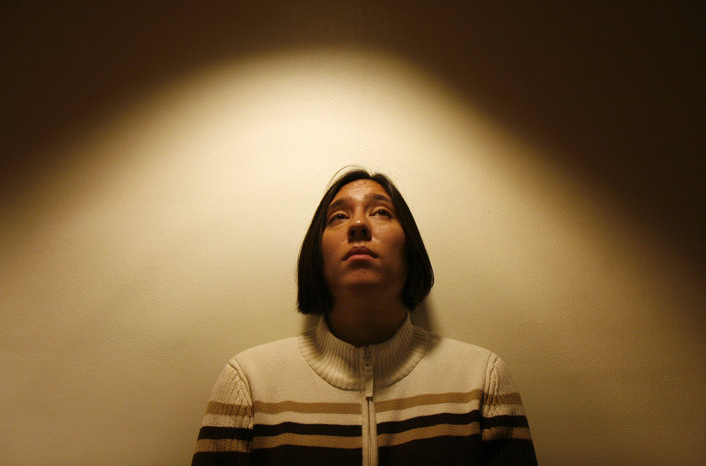
The photograph above is of 1st Lt. Elizabeth Whiteside. A graduate of the University of Virginia, she has served in the Army Reserve since 2001. Judged to be a “superior Officer” she consistently distinguished herself, first as an executive officer of a support company of 150 soldiers at Walter Reed Hospital, and then as a the platoon leader of the 329th Medical Company at Camp Cropper, a detainee prison near Baghdad which housed 4,000 prisoners, including Saddam Hussein. When Hussein was removed from his cell to be executed, riots ensued and Whiteside stepped up, helping to restore order and ensuring the safety of the doctors in the prison. The next day, she suffered a psychic episode in which she locked herself in a room with a mental health nurse who was also her superior; agitated and noticeably paranoid, Whiteside fired her gun twice into the ceiling. Moments later, with armed soldiers advancing on the door to the room, she pointed her M9 pistol at her own stomach and pulled the trigger. She was returned to Walter Reed Hospital as a patient where she now faces a possible court-martial that could result in life in prison.

Read that last sentence again and let it sink in. It could be the beginning of a tale by Kafka. Tragically, it is an all too real story reported in the Washington Post (12/2/07).

Psychic trauma is certainly one of war’s dirty secrets, a condition all the more troubling when we recognize that even the most conservative estimates maintain that 20% of the more than 1.4 million troops who have or who are serving in Iraq will experience some form of war-induced post-traumatic stress. Indeed, it is hard to process the magnitude of this condition – after all how can one imagine, let alone “show,” 300,000 sufferers of what is characterized as a silent and invisible disease. And yet the tragedy being reported here is not that those who go to war suffer psychic trauma. This is something perhaps even worse: the Pentagon’s abandonment and betrayal of honorable men and women who have voluntarily put their lives on the line to serve their country and who have been seriously damaged by the experience in the process.

In Whiteside’s case the military gave her the option of resigning with a “general under honorable conditions” discharge that would have deprived her of most of her benefits, including medical care. She chose to fight the charges against her instead, and as a result Maj. Stefan Wolfe, the prosecutor for the government, argued last week that she should be court-martialed despite the opinion of the Army’s own surgeon general that Whiteside had experienced a “psychotic, self-destructive episode.” It is hard to imagine what the military can be thinking here, but their position seems utterly stupefying and totally devoid of anything like compassion. If the tragedy of the Vietnam war veteran was that he was abandoned and betrayed by the society-at-large, it seems as if the tragedy of the Iraqi war veteran is that they are being abandoned and betrayed by their own.

The photograph of Whiteside above is a telling and poignant portrait of the problem. Judged to be a model soldier in every regard up to the very moment of her psychic breakdown, and thus the best that the military has to offer, she is shown here in the hallway of her Walter Reed Guest House as she awaits a decision as to whether or not she will face a court-martial. Standing at attention, but without uniform, she bears the countenance of the “thousand yard stare,“ though it is hard to know if this is the result of her time in Iraq or her more recent “war” with the military. Billeted in the “Walter Reed Guest House,” she is caught in a chasm between being a private citizen and a soldier, neither clearly one nor the other. Illuminated by a yellowing light, her face is nevertheless shrouded by a dark and foreboding shadow; cast in sepia tones, she is locked in a past that she can neither understand nor escape. Thus, her trauma continues. Most of all, she is alone. Completely and utterly deserted by those who should be protecting her. If the aftermath of the Vietnam War taught us anything, it was that such isolation and abandonment is anything but a recipe for psychic healing – not for individuals and not for the culture writ large. And yet the military refuses to see what would appear to be right before its very eyes, insisting that her defense is mere “psychobabble,“ as if shooting oneself in the stomach could be imagined as an act of sanity.

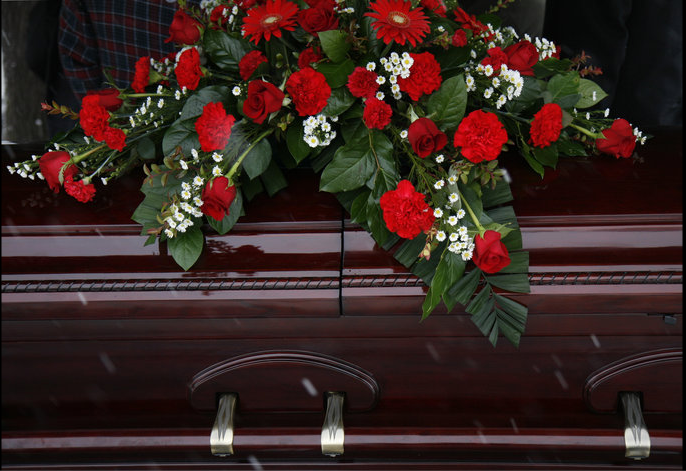
The depth of utter betrayal by the military of its own is magnified by another photograph that is part of the same story. While living with a group of mental outpatients on the grounds of Walter Reed Hospital, Whiteside befriended Sammantha Owen-Ewing, a twenty year old Pfc. who had been “abruptly dismissed from the Army” against the wishes of her doctors and who had lost access to all military benefits, including her medical benefits. Owen-Ewing recently committed suicide and Whiteside traveled to her burial service in Utah. The last picture in the WP photo-essay that chronicles Whiteside’s story is of Owen-Ewing’s casket:
owen-ewing.png

Its contrast with every one of the hundreds of funerals we have seen of military veterans in recent years is marked by the absence of a military honor guard, and, more noticeably still, the American flag. The argument of the photo-essay could not be more eloquent, as the substitution of flowers for the flag underscores both the simple dignity and decorum of a private funeral, as well as well as the military’s indecorous denial of its responsibility to care for its own.

Photo Credit: Michelle du Cille/Washington Post

Digg!

 0 Comments

City Sights and Civil Society

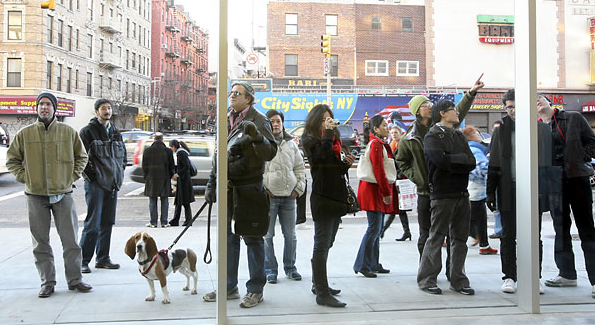
This photograph took up almost a full half-page above the fold for a recent report in the Weekend Arts section of the New York Times:

nyc-street.png

The caption says, “The New Museum of Contemporary Art Onlookers inspect the lobby and the facade of this seven-story structure on the Lower East Side, which opens tomorrow.”

And so they do. But why are we being shown the onlookers and not the building that they find so interesting? The photograph itself would not seem to be the reason as it is hardly a study in dramatic intensity. The viewer’s gaze is directed every which way, whether cued by the many different sight lines of the onlookers or by the way the view expands unevenly but consistently outward across the rear of the frame. The division of the horizontal axis by the posts into uneven thirds further breaks up the scene. The image becomes a triptych, but one that doesn’t tell a story and has only accidental coherence.

It is a remarkable picture, nonetheless, one that could hang on the wall of the museum. The photographer has captured what usually is only a blur in the background of our consciousness but now can be seen in pristine clarity. And what is seen? Society. Modern, urban, liberal-democratic society. Not all of it, of course: what we see is young, hip, affluent, cultured. But that’s easy to see. The street scene is defined not by those attributes so much as by habits of civic interaction that are much more broadly distributed in the developed world today. Look, for example, at the spacings between the individuals and the several groupings of people. The proxemic ratios there will be maintained whenever possible in public in the US.

Let me focus today on how this photograph exposes one dimension of the complex social experience on display. I’ve written before about how public life depends on visual norms, habits, and practices, and how critical theory can misrecognize these forms as long as it depends on assumptions that visual media are largely instruments of power by which elites create spectacles to manipulate the masses. By contrast, one can point out that even social critique calls for “transparency,” a visual metaphor that if nothing else assumes that someone is looking; more important, social phenomena are constantly changing, and social theory needs to do the same if it is to account for public culture as that is something different from manufactured consent. Today’s photograph provides one example of what one might look for if taking seriously the idea that modern civil society requires or at least makes use of forms of seeing.

Let’s simply catalog the many ways the sight is marked in this photograph. The caption features an art museum–an institution devoted solely to public viewing of visual artworks. The people in the photograph are identified as “onlookers”–defined by the act of looking. They may also be citizens, or New Yorkers, or connoisseurs of the arts, but all that is folded into “onlookers.” And looking on is a specific type of seeing: one is not within the scene being observed, not part of the action, but rather seeing “from the sidewalk” as it were. They are spectators, but not degraded by that. In fact, they are “inspecting” the building; although not inspectors, they are engaged in an inherently visual act that includes an assessment, in this case, an aesthetic judgment. That is what the architect assumes, and so we are seeing the other side of architecture: not the building, but the culture within which it makes more or less sense. The building will be judged according to how well it meets the visual challenge carried by the story caption, “New Look for the New Museum.”

And those are merely the captions. In the image itself we see people defined by looking, which clearly goes in many different directions probably reflecting different points of view. Even the dog is looking. More specific looking also is evident, from someone pointing to direct others’ view, to the woman pointing her camera, to the couple in the background who have to watch for traffic. The city is a place to look, from streets to signage to buildings. It also is a place to look at people: those in the picture are posed by the still image as if for inspection. The red coat in the right middle fixes that element of the scene, which is carried across the image by the common fashion of blue jeans, casual coats, shoes, headgear, bags, and postures. Like the woman in red, albeit to varying degrees, everyone has agreed to not only see but be seen. No burqas here.

This shared visual experience is given a reflective touch by the large windows (a transparent barrier) and the reflections off the polished floor. We see, but always through things (even the air can distort) or off of things (such a this web page). One reason people go to art museums is to become more intelligent about how they use their eyes, and the photograph is doing some of this work for those, like the onlookers in the photo, not yet inside.

The final touch is provided by the sign in the center rear of the composition: “City Sights NY.” This cheap sign for what I assume is a low-grade tourist operation is perfect here. On the one hand, it is the art museum’s opposite: a commercial, artistically worthless painting for pre-packaged “sight-seeing” for bumpkins. No wonder it is getting exactly zero attention from both those interested in the museum. On the other hand, it is just the other side of the same street: the city is a place for seeing, and people go there for that reason. The vulgar, vernacular signage tells us why the museum is there, for both are all about “City Sights NY.” And that is a story about not only New York but also anywhere people are to mingle together in modern civil society.

To see what I mean, just look at the picture.

Photograph by Suzanne DeChilo/New York Times.

Digg!

 6 Comments

Sight Gag: Which End Up?

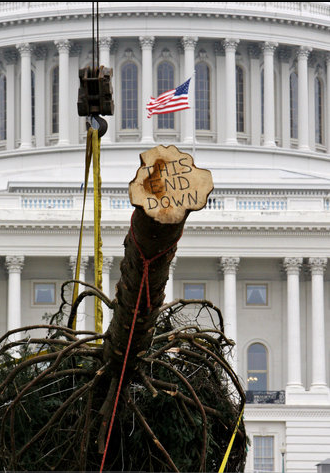
picture-13.png

Photo Credit: Charles Dharapak/AP

Our primary goal with this blog is to talk about the ways in which photojournalism contributes to a vital democratic public culture. Much of the time that means we are focusing on what purport to be more or less serious matters. But as John Stewart and Stephen Colbert often remind us, democracy needs irony, parody, and pure silliness as much as it needs serious contemplation. For our part, we will dedicate our Sunday posts to putting some of that silliness on display in what we call “sight gags,” democracy’s nod to the carnivalesque. Sometimes we will post pictures we’ve taken, or that have been contributed by others, or that we just happen to stumble across as we navigate our very visual public culture. And we won’t just be limited to photography, as a robust democratic visual culture consists of much more. We typically will not comment beyond offering an identifying label, leaving the images to “speak” for themselves as much as possible. Of course we invite you to comment … and to send us images that you think capture the carnival of contemporary democratic public culture.

 1 Comment

Public Health and the Cancer Ward

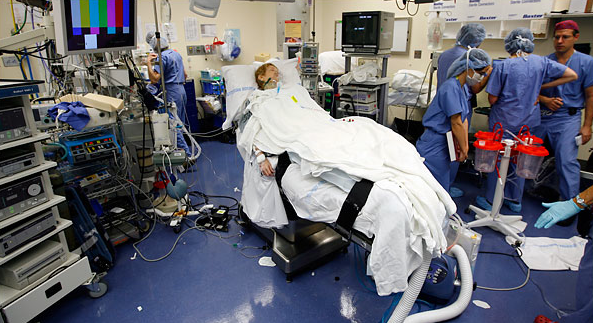
She doesn’t really have cancer. Nor does she die. The emphysema patient in this photograph is now walking without oxygen, enjoying her renewed appetite, and “‘very, very happy.” Thus, the title of this post, like the photograph itself, tells a lie.

or-patient.png

Or does it? Let’s first identify what’s misleading about the photograph. We see an OR/intensive care patient looking as if she has been left to die. Head and hand reveal her pale skin that is otherwise shrouded in layers of white, as if already prepared for burial or fading into some gauzy realm of the spirit. The turn of the head and lifeless droop of the hand suggest that she has no energy left. All but one of the staff in the room has turned their backs to her, and he is intently focused on something else. It’s as if she isn’t there or is already inanimate. Hooked to machines at each end of her body, their currents seem to flow through her uninterrupted on to the monitor hanging overhead that shows only a test pattern. The metal table could be used in a morgue. She is placed in the vanishing point of the picture.

Louis P. Masur deftly summarized a standard criticism of photography in a recent review: “‘The devious lie of a snapshot’ is a marvelous phrase. It is not the photographer who is devious, but the snapshot itself, which isolates and freezes action, disconnecting it from context and sequence.” (Masur is quoting photographer Thomas Hoepker.) This cautionary note would seem to apply directly to the photograph above: what looks like a death scene is in fact a woman beginning her recovery from disease to life.

I think there is more to be said, however. The image accompanies two stories, one about an operation used to treat emphysema sufferers by removing sections of their damaged lungs, and another, much longer front page story about how a past smoking boom among woman is now a major killer. As deaths from chronic obstructive pulmonary disease are rising like smoke in an updraft, and medical costs scaling upward along with them, considerable attention is being focused on the various techniques being mobilized to manage the disease. One strong theme of the story is that we must avoid blaming the victims. OK, but why was nothing said about blaming the tobacco companies, who are not mentioned in the article? We are to not blame individual patients, but we also are supposed to focus entirely on individuals. The disease is an “epidemic” but apparently not a public health problem having a common cause.

So there is something right about the photograph, in that it reproduces the newspaper’s framework for the story, which in turn is not merely a compositional strategy but one that reflects key features of how American health care is organized. When disease appears, the medical patient is the center of our attention, and she will live or die according to how well the society mobilizes high-tech, capital-intensive medical treatments for each individual.

The photograph can lie, but it also reveals.  This photo depicts three forms of inattention built in to our health care system: First, the photo depicts how medical staffers in the room are completely indifferent to her because she already has received their expert care; they know that there is little to worry about as they debrief, clean up, and make the transition to the next case. Second, because they are on the job, we don’t have to pay attention unless we’re likely to end up on the OR table. Epidemic? Not to worry. Third, by focusing on the effects and not the causes of the epidemic, the image models an artificial blindness regarding the causes of a serious public health problem: we are to not see the tobacco companies that work relentlessly to addict people to their carcinogenic drug.

I think the truth of the photo goes beyond its inadvertent performance of a form of blindness. Some of the bad news is seeping out of the frame. Look again at the scene, particularly at the swirl of wires and the rat’s nest of electronic gear. We are looking at a real place of work, but also a society that is held together by a snarl of gerry-rigged connections always on the verge of being jostled, bumped, or broken. It works because there is a lot of expensive equipment combined with serious, no-frills professionalism, but it also is a messy assemblage without any means for doing anything other than responding to disasters seemly not of its own making.

The room is functional but closed off from thinking about public health. The work done there is miraculous but very costly. The operations interrupt suffering but do nothing to prevent it. When her care is structured by the American health care system, the patient is in good hands, but she may be in a cancer ward after all. The question is not whether there is hope for her, but whether there is hope that the system can be changed. In the photograph, the patient is completely without the ability to do anything, and so is the public audience. She will live, but we may be dying.

Photograph by Damon Winter/New York Times. Masur’s review: “How the Truth Gets Framed by the Camera,” Chronicle of Higher Education, November 23, 2007, B6-B8. (Full disclosure: No Caption Needed is discussed elsewhere in the review.)


Digg!

 2 Comments

The Banality of War

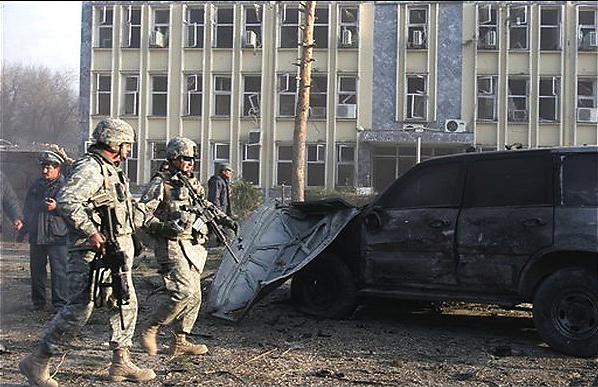
kabul-attack.png

Two soldiers walking past a burnt out vehicle on a city street. It is an altogether ordinary photograph of what has become an altogether ordinary event in the Persian Gulf region, if not the Middle East more generally. A somewhat long caption tells the story in a passive, matter of fact voice, “U.S. soldiers pass by a damaged armored vehicle following a suicide attack in Kabul, Afghanistan on Tuesday, Nov. 27, 2007. A suicide bomber blew himself up next to a convoy of armored vehicles used by foreigners in Kabul, in a huge explosion Tuesday that killed at least two civilians and left the wall of a nearby house in ruins, witnesses and officials said.” We have seen similar photographs hundreds of times in recent years and its only real distinction would appear to be its almost pure banality.

Appearances, however, can be deceiving. The photograph was published on the Washington Post website on Wednesday, Nov. 28th as part of an AP story titled “Afghans: NATO Airstrikes Kill 14 Workers.” According to the report, NATO warplanes were tracking Taliban insurgents in eastern Afghanistan and mistakenly bombed a road construction crew while they were asleep in their tents. The deceased workers, civilians from nearby provinces, were paid at the rate of $5.00 a day by Amerifa, a construction company contracted by the U.S. Army Corp of Engineers to build 135 miles of roads for the U.S. military. One NATO spokesman confirmed that two bombs had been dropped with “strong indication that we got a Taliban leader,” but another spokesman commented that the “situation is not clear … [and we are] trying to get a clear picture.” As if to mitigate the significance of the event, the reporter noted that “If confirmed that NATO hit the wrong target, the incident in mountainous Nuristan provice late Monday would be the first major blunder in months.”

It is really hard to know where to begin. According to the NYT, the road had been under construction for a year. And given that the project was under contract with the U.S. Army Corp of Engineers one might think that NATO would have access to its whereabouts. Surely such “blunders” could be avoided, particularly given the history of the involvement of U.S. and NATO-led forces in causing civilian casualties—so called “collateral damage”—in Afghanistan. But accidents do happen and tragic mistakes are made, particularly in war zones. And more, bureaucratic spokesmen are skilled in the rhetoric of obfuscation and the deferral of responsibility. And so, perhaps, what we have is just an ordinary day in the life of a war that seems to know no end. But none of that explains the photograph above which seems to have nothing to do with the accidental airstrike. Why exactly is it here? What purpose does it serve?

Normally we might assume that the photograph accompanying a news article is designed to provide evidence of the reality of the story being told, illustrating its facticity in a “seeing is believing” sort of way. Alternately, it might function to enhance our affective or emotional understanding of an event by creating lines of identification between the viewer and what is viewed. But, of course, in either case, there is the assumption that the thing pictured is an index of the event being reported. Here, of course, there is no direct relationship between the photograph of the remains of a suicide car bombing in downtown Kabul and the accidental deaths of 14 Afghan civilians by NATO military forces in the mountains of Nuristan.

There is probably no shortage of alternative explanations for what the photograph is doing here, but it is hard to imagine how any of them reflect positively on the Washington Post or its motivations. For example, it could be a mistake caused by the pressure of meeting a deadline, but that seems highly unlikely given the source.

An alternate explanation, far more insidious, is that it functions to defer attention from and to mitigate the significance of the accidental deaths of the 14 Afghani civilians. It does this in two ways. First, while the absence of a photograph does not automatically deny the existence of the event being reported, neither does it do anything to enhance our understanding of the event or to enable our identification with the lives lost. Such pictures were available, and the NYT used one in its report and in its daily slide show, but the Washington Post went in a different direction.

Second, the photograph itself invites a perverse logic that models itself after a version of the quid pro quo: Yes, it seems to say, it is possible that NATO “blundered” (although it would be only their “first major blunder in months”), but that is a collateral effect of a war on terror, an insane condition where the enemy is impossible to identify and the most dangerous insurgents are suicide bombers who show no respect for the “rules of war.” And as if to prove the point, look at the photograph. Here we have two soldiers walking past the “ruins” of a nearby house (not actually seen in the photograph but marked by the caption) and a “damaged armored vehicle” destroyed by a suicide bomber the day after the accidental airstrike. That it is an armored vehicle that has been destroyed underscores the power of the threat. Protection is impossible to come by whether you sleep in a tent, live in a house, or drive in a vehicle fortified to withstand attack. And yet, notice that the soldiers are relatively nonchalant and inattentive as they walk by. There is nothing new here. Just as we have seen similar images over and again in recent years, so too have they, albeit up close and personal. It’s just another day on the job.

And so, perhaps, the placement of the photograph with this story is a somewhat subtle endorsement of administration policies. One more indication of the utter banality of war and all that it produces.

Photo Credit: Rahmal Gul/AP

Digg!

 2 Comments

War, Terror, and a Chain of Photos

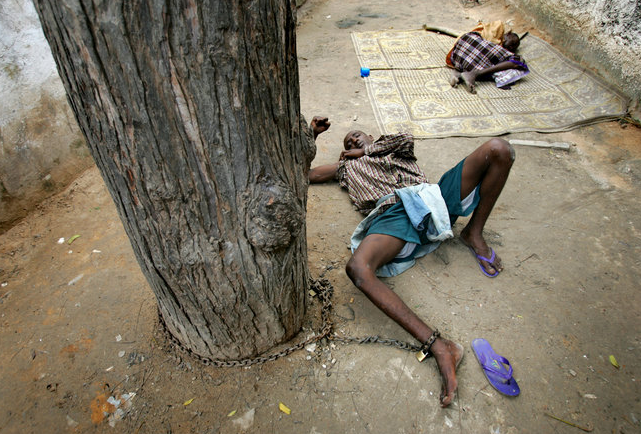
Recently the Chicago Tribune ran a special report on one of the lesser known consequences of war: an increase in mental illness among civilians. The story is set in Somalia and includes a slide show of scenes from the only mental health clinic in Mogadishu. Some of the patients will be dangerous to themselves or others, and so the problem arises of how to restrain them. In the West, this is done with drugs, locked wards, and other disciplinary technologies. In Somalia, the means are simple, though effective:

boy-chained-to-tree.png

This young man is chained to a tree. Viewers in the US shouldn’t get too judgmental, as here he could be “free” but homeless, sleeping in the ground, and less likely to be fed regularly. Better resources are needed in Somalia and in the US. My question is, what can photojournalists do to motivate public action on behalf of the mentally ill wherever they are? The press can be damned either way: one always will be faulted if not documenting a social problem, while visual documentation is subject to charges of creating an atrocity aesthetic and compassion fatigue. How, then, should we assess this image?

We can begin by asking how it seems unique, and then how it might nonetheless iterate prior images and assumptions. The photograph is distinctive because of how it places the young man prostrate, legs splayed and body core exposed, and because the girl huddled behind him suggests an unending series of damaged souls, and because the viewer towers above the scene. Indeed, the angle joins the viewer with the trunk of the tree: strong but immobile, anchoring a system of benign restraint but not responsible for the fetters. This is not a position of action.

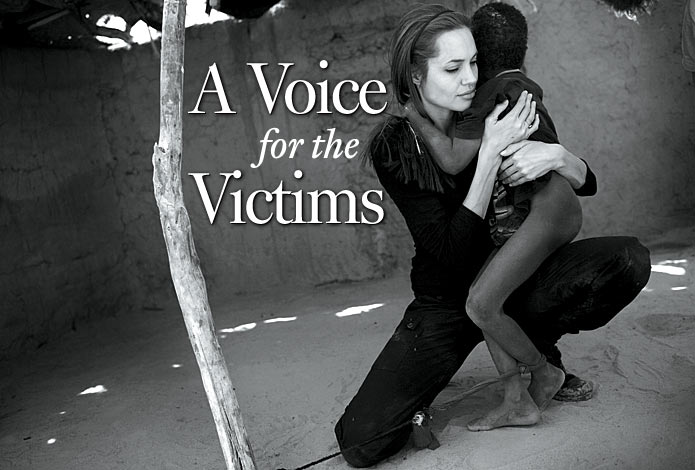
One reason the photo above caught my eye is that I’d seen it before.

jolie-with-title.jpg

This is the signature shot from the March 19, 2007 edition of Newsweek. (The image was brought to my attention last spring by Beth Iams, who wrote a fine paper on the magazine’s photo essay for my graduate seminar on visual rhetoric.) The story, “Star Power,” chronicled Angelina Jolie’s attempt to focus attention on the suffering in Darfur. Jolie states that “‘If I can draw you in because I am familiar, that’s great because I know that at the end you’re not looking at me, you’re looking at them.'”

Of course, the image is all about Angelina, and there are very few correspondences with the first photograph. I think the few that are there are important, however. The boy is restrained for the same reason in each, and perhaps the tether is becoming a visual convention. (There are other examples of this tether and other forms of shackling by the two photographers.) If so, we might consider how it not only depicts limited means but also implies more fundamental deficiencies. As long as the tether remains identified exclusively with mental illness, poverty, and Africa, it ties understanding to a host of assumptions about premodern medicine and social organization. Never mind that the restraints shown above are age-appropriate and keep the patient within the daily round of community life. Such considerations fall outside the modern disciplinary matrix.

Thee might be a second set of implications. We see not only restraint but also a black body, male, barelegged, tethered to a pole. I can’t help but wonder whether these images allude to lynching photos: whether hanging barelegged from a tree, as in the famous photograph from Marion, Indiana, or chained to one in order to be blow-torched, as in Without Sanctuary. Whatever the source, the association is horrific, and completely mistaken. It could be there, however, in the hope that the public would be motivated to act if they intuitively sensed that they were witnessing a similar descent into brutality.

If there is a chain of visual allusions binding African victims of war to American victims of terror, it surely is unconscious. One should ask whether it might also be influential, and to what end. Are the photos merely imitative of those before them, or are they artistic attempts to mark yet another breakdown in humane social order? Are we becoming complicit in normalizing violence, or is some potential for public action being suggested? Are they hypocritical reconstructions of a tragedy on familiar terms, which certainly is part of the Angelina Jolie story, or do they reflect some peculiar progress regarding public understanding of the suffering of others?

You tell me.

Photographs by Kuni Takahashi/Chicago Tribune and Per-Anders Pettersson/Getty Images. Newsweek gave a documentary tone to the second image by reproducing it in black and white; you can see it in color here. Note also the recently published Beautiful Suffering: Photography and the Traffic in Pain. Thanks again to Beth Iams, who can be contacted at elizabethiams@yahoo.com.


Digg!

 3 Comments

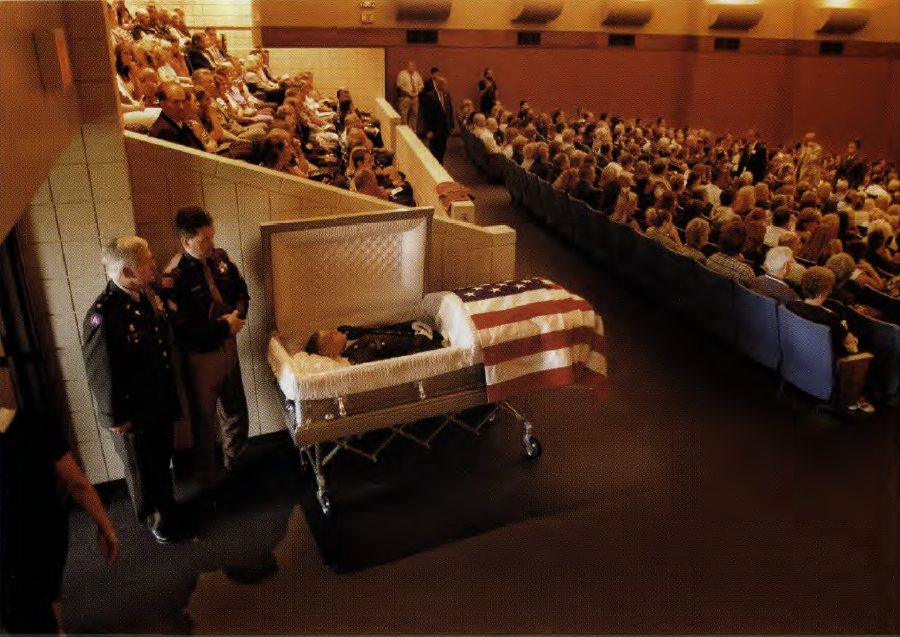
Public Mourning

turnley-casket.png

This photograph was taken by photojournalist Peter Turnley and published in Harper’s in August, 2004 as part of a photo-essay titled “The Bereaved: Mourning the Dead in America and Iraq.” It shows an open-casket funeral for Army SPC Kyle Brinlee, killed by an IED in Iraq on May 11, 2004. The memorial service was held in the Pryor, Oklahoma High School auditorium and attended by 1,200 mourners, including Governor Brad Henry. Brinlee’s family subsequently sued Turnley and Harper’s for violation of privacy, infliction of emotional distress, fraudulent misrepresentation, and a number of other torts. The district court rejected the suit in summary judgment, noting additionally that the event was both public and newsworthy and thus protected on first amendment grounds. The 10th U.S. Circuit Court of Appeals upheld the finding of summary judgment, noting that the publication of the photos was arguably “in poor taste” but that there was no basis for an actionable claim. The case made its way to the Supreme Court where it was recently denied a writ of certiorari, thus confirming the finding of the lower courts.

Legal issues aside, what I find most interesting is the Court’s aesthetic judgment that the publication of the image was arguably “in poor taste.” The conclusion here is qualified by the assumption that the family had expressly requested that no pictures of the open casket be taken. Whether that request was ever conveyed to Turnley or not is a fact in dispute, but even if it had been, the question of taste remains: What renders this a tasteful or tasteless image and what interests are served in making such a judgment?

We might begin by noting that it is an arresting photograph, doubly unique amongst the hundreds (thousands?) of photographs of military funerals that have been reported in newspapers and magazines over the past several years. The most obvious distinction, of course, is the open casket. Military funerals are not particularly rare, especially during times of war, but they do not typically feature open-caskets; and even on those few occasions when they do, there seems to be a standing photojournalistic convention against taking or publishing open-casket photographs. Turnley challenges that convention, and in a manner that subtly requires the viewer to acknowledge what is otherwise neatly hidden (or is it erased?) by the closed casket.

Contrary to the aesthetic judgment of the Court, then, what we have here is a photograph that is crafted with a deep and abiding sense of decorum and respect. Indeed, in my judgment it treats the event with far more reverence than might otherwise attend the depiction of such funerals where the ordinary conventions of representation are followed simply as a matter of form or habit.

Shot from a moderately long range that is neither overtly intrusive nor violates the conventional distance of personal space, the deceased is nevertheless recognizable as a soldier and a person. His uniform and white gloves lend an air of military formality to the occasion; the coffin, reverently dressed in the American flag, adds the mark of national honor. Cast in the yellowish hue of indoor lighting, the casket also catches rays of natural light from the doorway behind it and through which it will soon exit the auditorium, thus invoking both a sense of communal warmth and movement towards a brighter and purer light. Framed from a high angle and looking down upon the scene, one might even imagine an omniscient viewer monitoring the ceremony.

A second distinction, arguably more significant, is the setting for the photograph. Military funerals memorialize the death of individuals, and as such they are typically photographed at graveside, featuring family members and close friends. They are private ceremonies that take place in public, and the grief and mourning that they display is fundamentally domestic and personal even if it is of interest to and observed by a larger public. It is this tension between private ritual and public observance that no doubt contributed to the Brinlee family’s sense that its privacy had been violated despite the fact that they had invited the public and the press to attend the memorial service. Notice here, however, that the photograph is not shot at graveside, but in a recognizable, public setting. Indeed, in many locales the high school auditorium is a communal gathering place used for a variety of public rituals including voting, convocations and town meetings, the annual rite of passage known as “graduation,” and, as here, to honor and remember one of its own, a citizen/soldier who sacrificed his life to the common good. Note in this regard that the photograph does not appear to feature family and close friends so much as a fairly large slice of the community. Indeed, the only easily recognizable individuals in the photograph other than Brinlee are the police officers posed between the coffin and the exit, and their uniforms both overshadow their private selves and accent the very public and communal quality of the ceremony taking place. And so what we have is the representation of a community that has come together as one, as a public, to mourn its collective loss.

In Pericles’ Athens the entire citizenry would annually attend funeral orations designed for the community to grieve collectively as it to bore witness to those who had sacrificed their lives fighting for the common good. In our own time Memorial Day purports to serve a comparable purpose, but truth to tell, it functions more as the “official start of summer” than as an occasion for public mourning. And in the interim from one year to the next we too often represent military deaths either as nameless and faceless numbers designated by abstract body counts, or as private individuals whose loss is felt and mourned primarily by family and friends. Neither seems adequate to the task of addressing the communal grief that attends such losses. In his important book, Achilles in Vietnam, Jonathon Shay emphasizes the importance of the “communalization of trauma” – the collective sharing of the pain and responsibility for war in public acts of communicative interaction—for helping to heal the psyches of those who leave their families and friends behind and risk their lives in the name of the community. The communalization of trauma through localized, public acts of grief and mourning might be no less essential to advancing a productive and sustainable species ethic during a time of war. Peter Turnley’s photograph of the public mourning of Army SPC Klye Brinlee invites us to consider one way that might be accomplished with a great deal of taste.

Photo Credit: Peter Turnley/Harper’s

Digg!

 14 Comments

Ship Sinks, Fools Saved, For Now

On an admittedly slow news weekend, there was something about this photograph that tugged at me.

sinking-ship.png

The picture was front page above fold for a story entitled “An Icy Rescue As Seas Claim A Cruise Ship.” An iceberg punched a hole below the waterline, those aboard spent a few hours in lifeboats before being rescued, and the ship eventually went to the bottom of the Antarctic Ocean.

The story is sappy from start to finish. The Explorer was “fondly known in the maritime world as ‘the little red ship,'” as in The Little Engine that Could, perhaps. It closes with a staffer playing the role of the Old Salt who says, “‘She doesn’t want to give up, I can tell you. I still believe that perhaps it is not the last time that we see her.'” Well, maybe someone will try to salvage a 40-year-old single-hulled craft at the bottom of the world, but don’t bet on it.

If you don’t like the yarn, you won’t like the facts. Although named Explorer, the ship is a cruise ship, carrying “modern adventure travelers” for $7,000-$16,000 a pop. To put it bluntly, those on the ship don’t explore anything. Instead, they go on a set route to have preprogrammed experiences. No wonder they were in such “good spirits”after the rescue: the disaster was a genuine novelty, and one that proved to be just as safe as the trip to Shackleton’s grave. I have no doubt that the episode will be good for business.

Given the reasons to be cynical about this soft news story, why does the image take me down a different path? Perhaps because it looks like one of the toy boats powered by baking soda that I played with in the tub long ago. Or it could be the color: lying on its side on the cold ice flow, it resembles an animal bleeding to death in some lonely winter field. Or the name might matter after all: not just this explorer, but exploration is over, and the challenge now is not discovering some new region but rather living amidst natural scarcity. The ship is disappearing, and so are the ice flows around it. Although they are far more important, no one in the story romanticizes their loss.

Let me add something more to the allegory. Roland Barthes once remarked somewhere that the attraction of a cruise ship, which everyone knows is an antique technology, was that it created the sense of living in an autarky, that is, a self-contained, self-sufficient place. That sense of being a world onto itself is an illusion, of course, one similar to the notion that “modern adventure travelers” are exploring the unknown.

Both myths die hard. If the photo is poignant, it may be because we can imagine not just a ship but a civilization going under. That is, if modern civilization is to avoid disaster, it needs more than a double hull or other technological backups. Instead, we have to give up the idea that we are a law onto ourselves, that we can provide adequately and sustain indefinitely without regard to the natural limits and complex dynamics of the rest of the planet.

Photograph from Fuerza Aerea de Chile [Chilean Air Force] via European Presssphoto Agency.


Digg!

 4 Comments

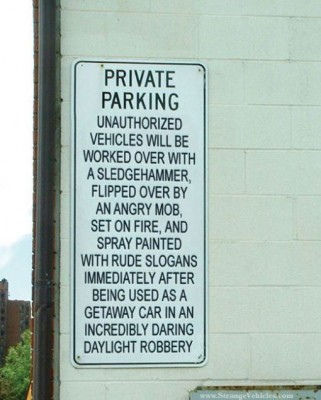
Sight Gags: No Parking Soprano Style

310120769_130ad2a8331.jpg


 Our primary goal with this blog is to talk about the ways in which photojournalism contributes to a vital democratic public culture. Much of the time that means we are focusing on what purport to be more or less serious matters. But as John Stewart and Stephen Colbert often remind us, democracy needs irony, parody, and pure silliness as much as it needs serious contemplation. For our part, we will dedicate our Sunday posts to putting some of that silliness on display in what we call “sight gags,” democracy’s nod to the carnivalesque. Sometimes we will post pictures we’ve taken, or that have been contributed by others, or that we just happen to stumble across as we navigate our very visual public culture. And we won’t just be limited to photography, as a robust democratic visual culture consists of much more. We typically will not comment beyond offering an identifying label, leaving the images to “speak” for themselves as much as possible. Of course we invite you to comment … and to send us images that you think capture the carnival of contemporary democratic public culture.


Photo Credit: Static Flicker

 0 Comments

Symposium: Changing Faces of Journalism

The Changing Faces of Journalism: Tradition, Tabloidization, Technology, and Truthiness

11/30/2007 The All-day Symposium

Location: Annenberg School for Communication

3620 Walnut Street, Philadelphia, PA 19104 215.898.7041

From 8:30 am To 6:30 pm

The Scholars Program in Culture and Communication and the Graduate Working Group in Journalism Studies present this all-day symposium at the Annenberg School for Communication.

Speakers include Elizabeth Bird, University of South Florida and a Visiting Scholar, Annenberg School for Communication; Pablo Boczkowski, Northwestern University; Peter Dahlgren, Lund University, Sweden, and a Visiting Scholar, Annenberg School for Communication; Mark Deuze, Indiana University; James Ettema, Northwestern University; Herberg Gans, Columbia University; Jeffrey Jones, Old Dominion University; Carolyn Kitch, Temple University; Julianne Newton, University of Oregon; Carlin Romano, Critic, Philadelphia Inquirer, and Chronicle of Higher Education, Lecturer, Annenberg School for Communication; Michael Schudson, University of California, San Diego, and Columbia University; Barbie Zelizer, Raymond Williams Professor of Communication, and Director, Scholars Program, Annenberg School for Communication.

For more information and to register for this free event, go to http://www.asc.upenn.edu/changingfaces.

 2 Comments