Jun 23, 2017
Aug 10, 2016
Apr 21, 2010
Jun 13, 2011
Apr 16, 2014
Nov 12, 2008

Sight Gag: Duck and Cover

burtturtle_anemi.jpg

If you want to see the movie short that brought Bert the Turtle to public fame in the late 1950s, click on the photo.

Photo Credit: Posted at Anemic Royalty

Our primary goal with this blog is to talk about the ways in which photojournalism contributes to a vital democratic public culture. Much of the time that means we are focusing on what purport to be more or less serious matters. But as John Stewart and Stephen Colbert often remind us, democracy needs irony, parody, and pure silliness as much as it needs serious contemplation. For our part, we will dedicate our Sunday posts to putting some of that silliness on display in what we call “sight gags,” democracy’s nod to the carnivalesque. Sometimes we will post pictures we’ve taken, or that have been contributed by others, or that we just happen to stumble across as we navigate our very visual public culture. And we won’t just be limited to photography, as a robust democratic visual culture consists of much more. We typically will not comment beyond offering an identifying label, leaving the images to “speak” for themselves as much as possible. Of course we invite you to comment … and to send us images that you think capture the carnival of contemporary democratic public culture.

 1 Comment

Democratic Image Report

Democratic Image Report

You can download a report on The Democratic Image Symposium of 2007 here.

redeye.gifFrom Redeye, The Photography Network:

It will be essential reading for anyone concerned with the current popular explosion of photography, and its use as a social and political tool.

The report features an extended essay by John Perivolaris covering the major themes and speeches of the event, which was the centrepiece of Look 07 in April 2007.

It includes a summary of the blog essays written either side of the symposium, all of the links referred to at the conference, and a selection of the photographs shown.

You’re also able to read the original blog hosted by openDemocracy.

And, most importantly, contribute to further discussion on this report.

All contributions on the report, its themes, or the event itself are very much welcome.

A remarkable photographic event.” – Pedro Meyer, Founder of Zone Zero

“This symposium … has altered my ideas about contemporary photography.” – Professor Esther Leslie, University of London

Symposium contributors include Pedro Meyer, Bill Thompson, Suvendu Chatterjee, Celina Dunlop, Mark Sealy, Anna Blackman, Tiffany Fairey, Geert van Kesteren, Mark Haworth Booth, Marysa Dowling, Irene Lumley, Francis Hodgson, Sarah Fisher, Clare Grafik, Greg Hobson and Paul Herrmann.

Contributors to the blog also include David Levi Strauss, Esther Leslie, Giuseppe di Bella, Mark Fonseca Rendeiro, Mary Fitzpatrick, Eivind H. Natvig, and many others.

 0 Comments

The News from Photos

It is difficult/to get the news from poems/yet men die miserably every day/for lack/of what is found there.

These words by William Carlos Williams stand as a critique of the news media and a challenge to the reading public. Even if the mainstream media cannot change, the question remains of what one should be reading and how one should read. Williams suggests that we are either reading the wrong things or reading the right things obtusely. Certainly the wars go on and men die for not knowing what they should know.

That said, I have never trusted the distinction between poems and news, political deception and artistic truth. You can find both artistry and bad behavior on both sides, and no democratic society can live on poetry alone. One place where art and news intersect is photojournalism. Applied there, Williams question acquires more precise reference: Are we getting the news–the real news–from the photograph? To do that, it would seem, we have to learn to recognize its poetry. And the difficult task would still remain: to see what can be found there that is not available in the photo’s reportage.

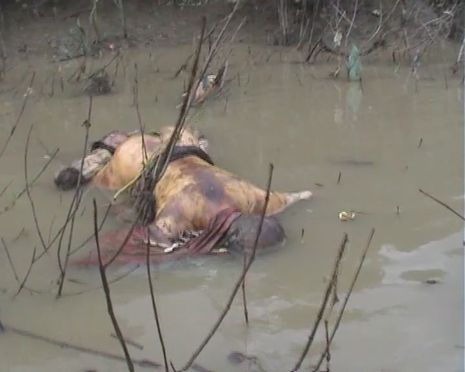
This is the ideal to which this blog strives, however fitfully. It should be applicable to any photograph. Today, I’m taking one that has been sitting on the desktop for two months. I’m not sure what I was waiting for, but one answer is that I was waiting for what has happened: amnesia. The photograph was featured item in a New Yorker report on the demonstrations against the brutal dictatorship in Burma.

murdered-monk.jpg

Certainly there is ordinary news here. Monks really were killed, whatever the government might say to the contrary. But what lies deeper than that? The New Yorker commentary provides one answer: the image “shows totalitarianism in its most physical form: the elimination not just of an individual’s life but of his value.” This observation followed a vague comparison to other atrocity photos. I think there is another, more patently artistic comparison that reveals a second truth.

The force of the photograph comes in part from comparison with standard images of Buddhist serenity. All the elements are there: the still pond, isolated reeds, monk in repose, all composed in simple aesthetic harmony reflecting alignment with the cosmic order. Surely this monk is undisturbed by desire, surely he is in harmony with his natural surroundings. Although his stillness is foreign to us, there is no doubt that he is close to God.

But, of course, the photo depicts not that image but rather its terrible perversion. The pond is still but filthy; the monk is serene because dead; his union with the cosmic order has begun via the body swelling with putrefaction. In place of the harmonious life, he has died miserably.

Cynics could say that he died because he did not understand the poems he had been reading. Would Buddha have taken to the streets? Well, Buddha did take to the streets, in Burma, and now the question is what we are to learn from that. I think the news of this photograph is that Burma has been turned into an ugly, brutalized semblance of what it was. The totalitarian society is one in which everything is the same and yet brutally perverted, violated and then recomposed as if the same as before. The news goes further. This process of violent, destructive, brutalization is going on across the globe. Not everywhere, but in too many places. As with totalitarianism in the 20th century, it happens when modern technologies are placed in the service of a primitive will to power, and when the rest of the world stands by and watches or forgets.

And so there really is no news here after all. And that may have been Williams’ point.

The photograph is a video still taken by a reporter for Democratic Voice of Burma; the epigram is from Williams’ “Asphodel, That Greeny Flower.”


Digg!

 3 Comments

The Familiy of Man in a Digital World

family-1.png

Writing in Newsweek recently (12/1/07), Peter Plangens reprises an argument that seems to emerge every now and then about the death of this or that medium or art form as it is confronted by newer and different technologies that somehow undermine its “aura.” Walter Benjamin probably made the most famous, recent version of the argument in “The Work of Art in an Age of Mechanical Reproduction,” but let’s not forget that it has a lineage that goes back at least to Plato’s critique of the technology of “writing” and its impact on the importance of the spoken word.

Plangen’s concern is photography, and his claim is that the “explosion” of digital technologies has created a medium that has “lost its soul.” Photography’s “soul,” apparently, is its connection to the “real,” for, as he puts it, “no matter how much darkroom fiddling someone added to a photograph, the picture was, at its core, a record of something real that occurred in front of the camera.” That was the original allure of photography, of course, but it was more a hope (or a faith) than an objective reality. And it didn’t take take avant garde photographers like Cindy Sherman to show us otherwise. Indeed, from the beginning the history of photography is replete with a wide range of examples that make the point, not least the work of prominent and important documentary photographers like Alexander Gardner during the Civil War (with his sharpshooter photograph) or Arthur Rothstein during the Great Depression (with his skull photograph). And these are not lone instances.

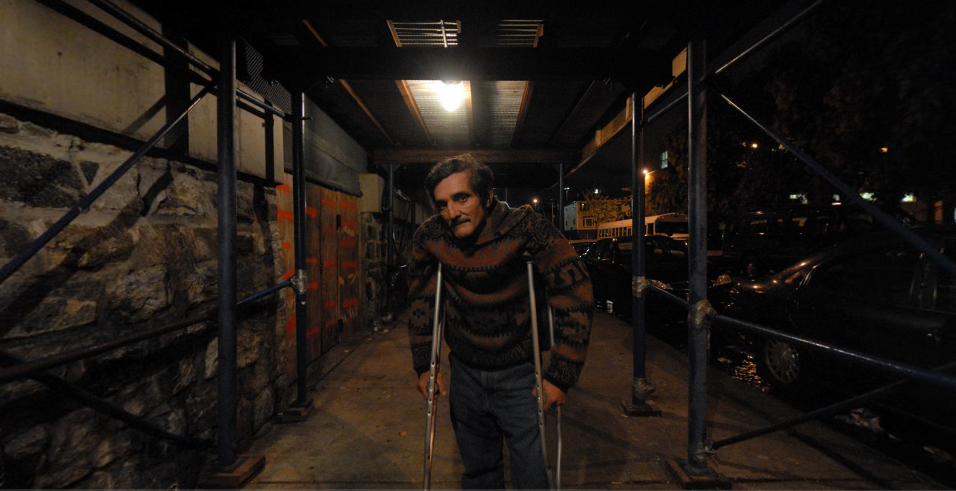
That said, while the advance of digital technologies has altered the way in which we think about and use photographs—and very clearly has reinforced a postmodern cynicism about realist representation that seems to worry Plantgen—it has also arguably invigorated photography as a cultural practice, enabling something of a rebirth out of the ashes of modernism. That rebirth includes not only a much wider democratization of the use of photography—witness the millions of digital cameras in everyday usage, many contained in cell phones that are carried about as a matter of course like one’s wallet or purse—but also in its capacity (in the words of Patrick Maynard) to “enhance and filter human power” in a broader spectrum of visual possibilities.As an example, consider the photograph above that was recently published in the on-line version of the Washington Post. It is a stand alone photograph of 55 year old Angel Lopez, the patriarch in a family of five who were unable to find refuge in a Bronx city shelter and were forced to spend the night on the streets.

It is a compelling and affective photograph, all the more so given that there is no story that accompanies it other than the caption which identifies Angel and his family members as “A Family in the Streets.” Shot in a middle space between the camera and a long street that invokes the conventions of classical perspective, distance is privileged as an aesthetic, bringing us closer to the homeless than we might imagine that we need – and perhaps would prefer – to be. Angel is in the very center of the image, his eyes making contact with the camera in a manner that demands recognition and a response. But what could his demand be? Clean and neatly dressed, he doesn’t seem to be the stereotypical homeless person or skid-row bum, and in any case the crutches make it clear that he has a hard time helping himself and thus stands in need of our care. In its own way the photograph is vaguely reminiscent of Dorothea Lange’s “Migrant Mother” with its projection of social responsibility for others. But, of course, it is hard to know.

Now click on the picture. A quick time movie should open in a new screen. Give it a moment to load. What we have here is a 360º panorama of the scene. Now we see not just Angel, but all of the members of his family. We are now pulled into the scene more directly as we see (and hear) Angel and his family briefly reflect upon their plight. While they all appear to be looking at the camera in their turn, they also seem to be interacting with one another as well, thus suturing the viewer into the scene in a manner that dictates a more complex social register. This last is underscored by the interactivity of the medium itself as the viewer can zoom in and out of the scene by manipulating the “+” and “-“ buttons on the screen.And with each click, of course, the social and political dynamic changes, pulling us in or pushing us out. But even as we zoom out and distance ourselves from the scene we are forced to take account of the full panorama.

No more “real“ than the earlier photograph, the panorama nonetheless invites and invokes a different affect, a different social and political interaction with the image; and I would argue it is at least potentially a more progressive kind of interaction because it doesn’t allow for a simple passive turning of the page. The image is still controlled in some measure by the camera and the photographer – the frame remains as a constraint on what we can see and know – but as a technology the photograph now filters the relationships between Angel and his family, the street, and the absent state in a somewhat fuller and more engaging fashion. Whether this increases or decreases our sense of compassion or willingness to work to make sure that such situations don’t persist is hard to say, but it would be interesting to consider how such usage would have altered the affect of 1930s FSA photography or Edward Steichen’s 1950s Family of Man exhibit (not to mention, say, the scene of a bombing). But however we evaluate the particular affect of this panorama, the larger point here is that the “soul” of the photograph is not contained by the particular technology of mediation per se, but is rather a function of how such images are received and used (or abused).

As long as we actively make and use photographs – engaging them and talking about them, drawing from them as markers of our sociality, as well as questioning and challenging their politics and affect – they are not likely to lose their soul as a simple function of the particular technologies through which they are enacted, be it framed in terms of the the “magic“ of the nineteenth-century daguerreotype or what Plangens blithely refers to as the “fairy tale” fantasy of Photoshop.

Photo Credit: Travis Fox, Washington Post; and with credit to Patrick Maynard, The Engine of Visualization: Thinking Through Photography (Cornell UP, 1997).

Update: For another critique of Plangens at American Photo go here.

Digg!

 6 Comments

The 21st Century Carcass

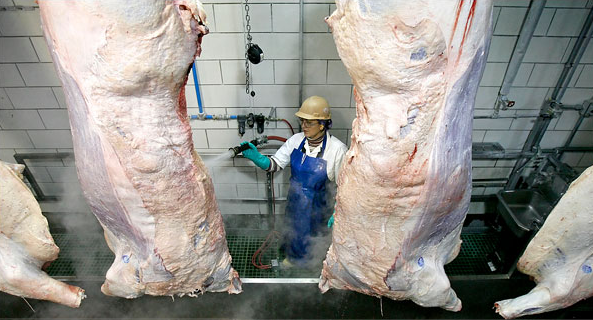
In 1906 Upton Sinclair published The Jungle, a muckraking novel that alerted the American public to the horrors of the meatpacking industry of the time. Millions of workers and all American consumers have lived longer and better lives as a result. Conditions have improved drastically since then, but safety remains a continuing problem in industrialized meat processing. The slaughterhouse is still a dangerous place to work, and meat periodically becomes contaminated. The latest threat is from a toxic strain of e coli. This despite surprisingly clean plants, acid baths, steam vacuums, and sophisticated testing. Needless to say, when it comes to survival, the bacteria have the edge. To give you a view of the steps being taken, the Times published this photo:

meat.png

It’s not often that photographs from the business page merit comment, much less awards. This one is typical. The focus is split between the objects in the foreground and the person in the background. Neither is the point of the picture, which is to show an industrial process. The diffusion is emotional as well. The photo communicates above all a sense of routine, ordinary, another-day-another-dollar activity; nothing to write a novel about. The conveyor belt moves things along, the worker directs a spray of water here or there, all against an unexceptionable background of white wall and grey pipes. You might be interested in how your meat is handled, but not to worry.

This ideological framing of viewer response is what is most typical about this business page photograph. What most interests me is the photograph’s distinctiveness, which is the brute presence of the carcasses. These amputated trunks are no longer animals, yet they are not yet slabs, much less cuts of meat. They are huge, visceral, bulging with muscle, bones, organs, everything that was alive but now is raw weight.

There is something scandalous about this image. One sees a packing plant and the anonymity of death; an industrial process, and the humiliation of being reduced completely to a condition of utility. Above all, there is again the massive reality of the carcasses. They are once living things now reduced to things, and yet they still resist somehow. Against the inevitable processing by both factory and camera, they remain massively, unintelligibly real. This is a scandal in the 21st century: against all attempts to transform everything into a virtual world of effortless consumption and digitized representation, some things refuse to surrender their reality.

Of course, those carcasses no longer exist, but the e coli do. The photograph of the carcasses can be a simple reminder that production is hidden during consumption; that is true of every form of production, including writing. Or it can be a scandal–literally, something that snares, in this case, that snares our attention. The hulking things in the photograph should snare our attention, they should offend the sensibility being constructed by the photograph, they should give offense to the idea that everything in our industrialized food production is doing fine as long as it is running smoothly.

Photograph by Kent Sievers/New York Times.

Digg!

 2 Comments

If Can't See Guilt, Can We See Character?

Discussion of a recent post raised an important question about visual thinking. In commenting on a murder suspect’s strategic manipulation of press coverage, I concluded that he still looked guilty.

Of course, I wouldn’t convict on that, and an astute reader noted that “the appearance of ‘innocence’ can only be another act,” and so it seems that there is no point whatsoever to looking for either guilt or innocence in how a person appears in public. And that’s before considering the role of racial, ethnic, and other forms of social bias in perception.

The focus of the earlier post was on the use of appearances rather than their accuracy. But what about their accuracy? I think most people would agree that you shouldn’t judge guilt or innocence on the basis of how a person looks. When that happens–and it does happen–the results include both false convictions and a free pass for con artists. But if that is true, why do we think we can see character?

And we do think we can see character. Scientists report that infants already are paying close attention to facial cues. People are constantly and often accurately discerning that others are in this or that mood. As we get to know people, we sometimes can read much deeper elements of personality on the basis of a glance. Photographs are used the same way, not least to communicate emotions. John and I have been reading social experience, attitudes, and ideas off of photographs for five months now and we rarely are called on this point. As long as the photographs are dealing with known individuals such as Bush, representative figures such as the latest casualty in Iraq, stock social types such as students, or common experiences such as shopping, there is little to be worried about. Whether right or wrong about the individual in the frame, the image provides a basis for conversation about those things that define collective life. And the court of public opinion is not a court of law.

All of this is a long introduction to another photograph:

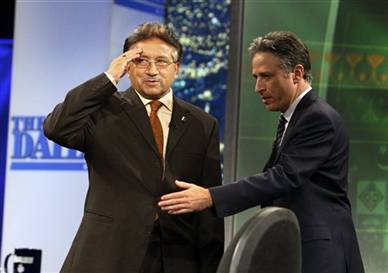
musharraf.png

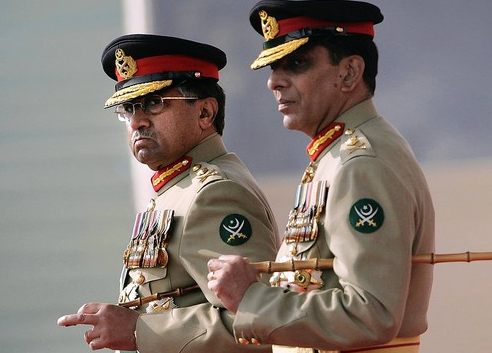
You are looking at Pakistan’s President General Pervez Musharraf reviewing an honor guard with his hand-picked successor, Gen. Ashfaq Kayani. There was this little problem of being a “President General”; fortunately, that term still embarrasses Musharraf’s patron, the US. So Musharraf has turned over direct control of the military, the better to maintain US support for his dictatorship. The transition involved a series of rituals, including a tearful speech. The tears may have been heartfelt; again, that is not the important question.

I’ll cut to the chase: I think we can see character here, and these guys are thugs. If that is too harsh, how about “hardened autocrats.” Of course, they will look otherwise in family photos, just as they will have behaved otherwise when playing with their kids. They may not be thugs all the time: just when in power or maneuvering to stay in power. So what? Any dictator can have a good side. The question is what side will be in charge when power is at stake. I think we can see the answer in this photograph. Musharraf may be a dedicated warrior against Islamic fanaticism, but he is no more a democrat than is Gen. Kayani.

And now for the quiz. What do you see in this photo: the appearance of innocence, or the character of an autocrat?

mush-on-stewart.jpg

Perhaps the question should be, if we can see character, why can’t we see guilt? One answer is that guilt is an assessment of past conduct involving a violation of a law, and these things are not to be seen in the present. There also is the complication of distinguishing between legal and psychological guilt, not least because some people need not hide guilt because they don’t feel it, while others can feel guilty for crimes they never committed. But perhaps there is another answer: the guilt is there to be seen, were we but able to see it. I would never convict on such evidence, but I can’t help but think that there is more to be seen than we realize, and that seeing it might get us closer to justice.

Photographs by Anjum Naveed/Associated Press; Digg screen grab of the You Tube video of Musharaff’s interview on The Daily Show with Jon Stewart.


Digg!

 2 Comments

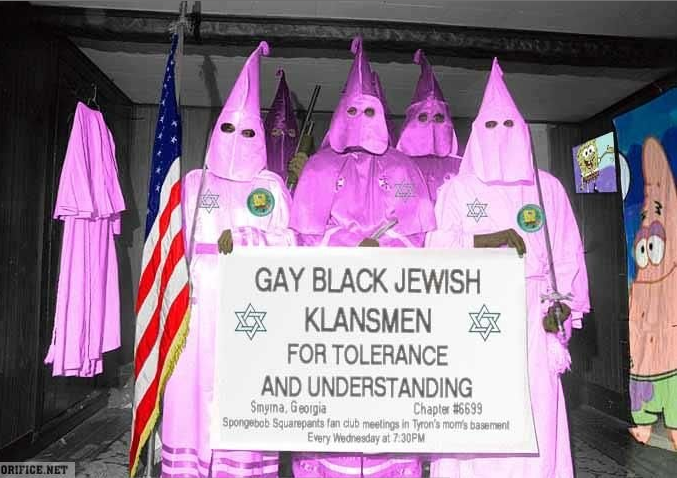
Sight Gags: Pink is for Tolerance

kkk-tolerance.png

Photo Credit: Unsought Input

Our primary goal with this blog is to talk about the ways in which photojournalism contributes to a vital democratic public culture. Much of the time that means we are focusing on what purport to be more or less serious matters. But as John Stewart and Stephen Colbert often remind us, democracy needs irony, parody, and pure silliness as much as it needs serious contemplation. For our part, we will dedicate our Sunday posts to putting some of that silliness on display in what we call “sight gags,” democracy’s nod to the carnivalesque. Sometimes we will post pictures we’ve taken, or that have been contributed by others, or that we just happen to stumble across as we navigate our very visual public culture. And we won’t just be limited to photography, as a robust democratic visual culture consists of much more. We typically will not comment beyond offering an identifying label, leaving the images to “speak” for themselves as much as possible. Of course we invite you to comment … and to send us images that you think capture the carnival of contemporary democratic public culture.

 1 Comment

Conference: Reading Photographs in Crisis: A Symposium

Reading Photographs in Crisis: A Symposium

This symposium will be held at the Leeds Humanities Research Institute (LHRI), University of Leeds, on Friday 14 December 2007.

The symposium marks the continuation of Photography and Atrocity, a collaborative research venture between the University of Leeds and colleagues at the Graduate Center of the City University of New York, together with other agencies, to analyze the politics, ethics and poetics of images of atrocity and crisis. For further information on the project to date, go to http://www.photographyandatrocity.leeds.ac.uk/

We are shown photographs of atrocity from around the world in our newspapers every day. But what is – or what should be – our response to these images? Are we consuming suffering? Or can we read photographs in a way to transform it? And how have such images been treated – and such questions been asked –in the past?The LHRI symposium will offer presentations by leading academics, curators and photographers from the United States, continental Europe and the UK. Confirmed participants include Elizabeth Abel (U of California Berkeley); David Campbell (Durham U); Mark Durden (U of Wales Newport); Marianne Hirsch (Columbia U); Rob Kroes (U of Amsterdam); Paul Lowe (London College of Communication & photographer); John Lucaites (Indiana U); Susan Meiselas (Magnum photographer); Nancy K. Miller (City U of New York); Simon Norfolk (photographer); Griselda Pollock (U of Leeds); Hilary Roberts (Imperial War Museum); Russell Roberts (Ffotogallery, Cardiff); Valerie Smith (Princeton U), Leo Spitzer (Dartmouth College). Each speaker will concentrate on one particular photograph made between World War 2 and the present, reading it in depth, contextualizing it and considering its ethical, political and aesthetic implications.

A full programme may be seen here. Registration fee (set at cost, to coffee and tea): students and unwaged = £3; waged = £5. There is limited seating; places will be allocated in order of registration. You should register in advance. A registration form may be downloaded here. Alternatively, if you are unable to download the word document, a pdf version is available here. (If you have problems downloading these documents, please first refresh your page, and if that does not work – please email Naomi French for an email copy of the form.)

If you need further information about the event, please write to Mick Gidley, Emeritus Professor of American Literature & Culture, at the School of English, University of Leeds, Leeds LS2 9 JT England, UK or via e-mail at g.m.gidley@leeds.ac.uk.

 7 Comments

Dueling Cameras in the Peterson Case

The wife of a police sergeant disappears, and stays disappeared. Turns out that she is–or was–his fourth wife, and the third wife had expired in suspicious circumstances, and the cop may have been using police department computers to get information on his (fourth) wife’s friends, and the story gets curiouser and before you know it, he resigns from the force while becoming both a police suspect and the hot story in the Chicago media.

And they say the suburbs are dull.

Even if this guy beats the rap, it’s clear there is much not to like, but that’s his business. My interest in how he has provided a lesson about the visual public sphere. Peterson clearly has adapted quickly and dramatically to the media mob camped outside his house. Here’s where he started:
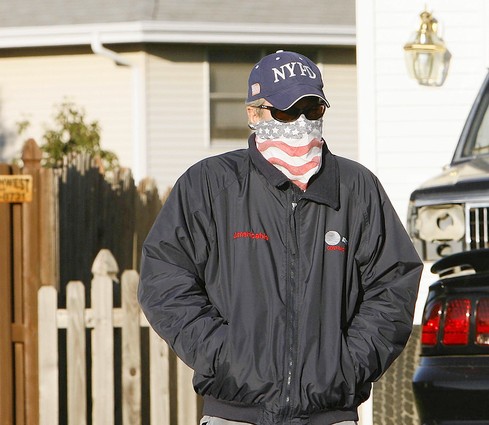
dad-american-burqa.jpg

The caption read: “Bolingbrook Police Sgt. Drew Peterson — whose wife, Stacy, has been missing since Sunday — steps outside his home for a few seconds as police investigators search his home Thursday. Asked about whether he was nervous, Peterson told the Tribune, ‘Why should I be nervous? I did nothing wrong.'”

Now it can get chilly in Chicago in November, but you don’t have to cover your face. I thought of doing a separate post on this photo and calling it “American Burqa.” By bundling up against the media gaze, Peterson is challenging our norms of public visibility. Some of us resist the demand to be seen, as when we wear sun glasses inside or ball caps pulled low, but that is always within the range of legitimate withdrawal into a zone of privacy. As Peterson shows, all you have to do is cover the face itself and your display of autonomy is no longer acceptable. No wonder the guy looks guilty as hell. The picture says, “withholding information, hiding something, and a law onto himself.”

It is easy to conclude that this strategy of hiding in the light is not so smart. But don’t conclude that Peterson is not cagey. The jacket and jeans combo, NYPD ball cap, and flag bandanna scream “selected for symbolic value.” He may not be nervous, but he is trying to put some visual spin on a bad situation.

Turns out that he’s also coachable. I’m speculating here, but I’ll bet he got a lawyer and some help on the presentation of self in public. Because this is what we saw more recently:
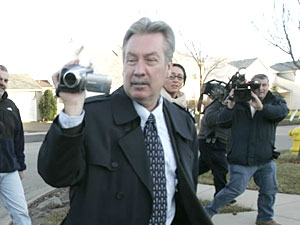
peterson-cameras.jpg

Whoa! Is that the suspect or his lawyer? Comfortably striding along in middle class attire, he turns his video camera on the press. Instead of denying the norm of public visibility, he ramps it up, creating a hypervisual scene of cameras recording cameras recording cameras. Instead of passively hiding in full view of an unseen camera, he aggressively records the press, thereby bringing them into the picture. Instead of looking isolated and guilty, he declares that he has nothing to hide while the press is unfairly ganging up on him.

He’s catching on, isn’t he? This is what conservative politicians and media flacks have been doing for years: shifting the focus from their actions to the media coverage, which then is denounced as excessive and unfair. You can’t paint Peterson completely with that brush, however, as his brash act has another, more distinguished lineage. This includes Garry Winogrand, a photographer who focused his camera on the technologies of media coverage (see his 1977 book, Public Relations), and, behind him, Walter Benjamin’s argument that photographic artifice depends on hiding the equipment. By exposing the cameras trained on him, Peterson has not only adopted a sophisticated strategy for deflecting the gaze, but also activated a more reflexive awareness of the role of photojournalism in shaping the story.

Even so, I think he still looks guilty as hell. It’s probably the smile. . . .

Chicago Tribune photographs by Antonio Perez (November 1, 2007) and Terrence Antonio James (November28, 2007). Thanks to Elisabeth Ross for reminding me of Winogrand’s work, which was included in her presentation on “Private Eyes and Public Lives” at the recent Northwestern University conference on Visual Democracy.


Digg!

 6 Comments

Mug Shots, Portraiture, and the Verdict of History

You might as well know that recently it’s been getting harder by the day to post at this blog. As far as I can tell, the press is rolling over to accommodate the neocon line that the surge has worked. According to that argument, any bad news now demonstrates that the liberal media refuse to change their script. Since violence is down, there must be a turn for the better, and so the president was right, and the press had better put up or shut up. Perhaps it’s a coincidence, but now we are getting little beyond but photo-op images of officials at press conferences, leaders walking together, soccer games in Iraq, and the like. And this is before we get to the soft news fare for the holidays. . . .That’s why it is heartening to see this image from the Art & Design section:

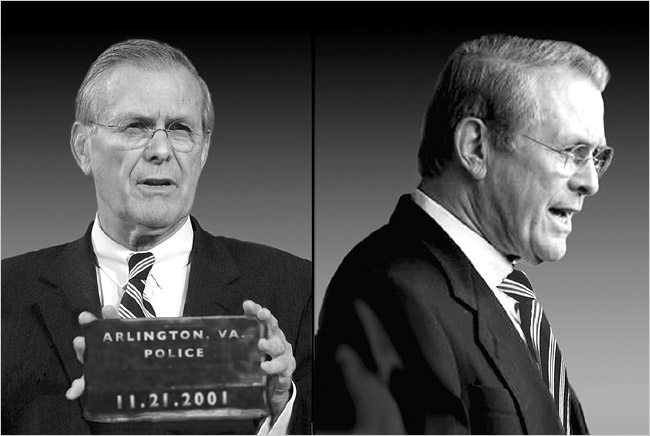
runsfeld-mug-shot.jpg

This is one of a series of prints by Nora Ligorano and Marshall Reese entitled “Line Up.” Each diptych presents a Bush administration official as if being booked for lying about Iraq; you can hear the vocal recording of the lie while you look at the print. They are on display as part of an exhibition of contemporary prints at the New York Public Library. According the the New York Times, “Line Up” has “prompted protests from some library patrons, attracted coverage by The Daily News, Fox News and USA Today, and has stirred the blogosphere.” It’s not often and probably a bad sign that the action is on the third floor of a library, but I’ll take it.

Of course, the Times doesn’t say that Bush administration lied, only that one can hear each “statement of questionable veracity.” And maybe it really doesn’t matter: the disaster is so comprehensive, the carnage so devastating, the loss of American lives and wealth ($3.5 trillion, according to the latest estimate) so permanent, it’s not worth arguing over this or that fragment of administrative speech. Better perhaps to look at the artwork and see what it has to tell us.

The joke comes from putting a high official in a mug shot. The humor actually runs rather deep: it can suggest that the offense could go beyond false statements; or that these officials are no better the the leader they deposed, Saddam Hussein, who also suffered the indignity of a mug shot; or that in a better world the Arlington police would arrest war criminals the same way they arrest common criminals.

But I think the joke is only the vehicle for a more interesting point, which is made by the fact that the photographs are of portrait quality. Sans the ID sign, the work could double as a heavily framed painting to be hung on the walls of the halls of power. When framed that way it becomes a character study. Forget the lie, but look at the habitual squint of a calculating man, and the assertive posture of a verbal warrior. The man on the left readily adopts a defensive position as he assesses, tests, counters, and feints while planning his rhetorical offensive. The man on the right is on the assault, a model of both composure and intensity as he rains words down relentlessly on those before him. Think of how easily these same portraits–these same characteristics–could be celebrated had the disaster been anything less than one of historical proportions.

Just as the neocon pundits are cowing the press, they will try to do the same with the history of the war. Willful blindness will become decisiveness, rigidity will be the courage of one’s convictions, immorality will be accepting the burden of leadership. (To understand the cause and consequences of this attitude, see Thucydides’ History 3.82-84.) They will spin the pictures the same way they spin the words. But thanks to two printmakers and the New York Public Library, it now will be a bit easier to see what was wrong.

Photograph by Jim Kempner/Fine Art.

Update: Michael Shaw of BAGnewsNotes posted today on another work from the “Line Up” series, one featuring a somewhat clownish Cheney. I couldn’t quite put my finger on what was odd about that piece, but Michael nails it.

To buy postcards of some of the images, go here. From the ad at Pure Products USA, it seems evident that Michael and I each saw one of the two faces of the exhibit. It involves parodic portraiture, and some images (e.g., of Cheney) emphasize the parody and others (e.g., Rumsfeld) the portrait. You can see the very powerful video installation here. A t-shirt is available here.

Digg!

 3 Comments