
At least since Nathanael West, artists have turned to California for periodic images of an American apocalypse. This photograph fits nicely into that category.
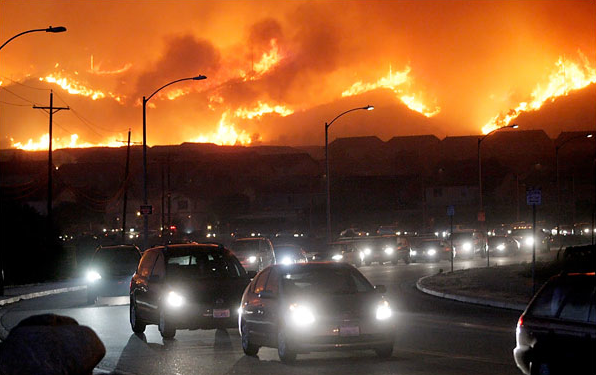
Cars stream along a Southern California highway as wildfires rage across the mountains. The fires seem all-consuming, yet beneath that terrible horizon motorists can still creep along in semi-darkness. Indeed, lights have to be turned on in the valley despite the radiant holocaust above. This fusion of fire and darkness seems a premonition of hell, perhaps the level reserved for those who are complacent amidst pending disaster.
The New York Times caption said that the traffic included residents fleeing their homes in the hills. The photo contains a larger story as well. Intensive automotive use is not the direct cause of the wildfires’ destructiveness, but it is a key part of a larger pattern of land use, resource consumption, and social organization that is the reason the fires burn so extensively and cause so much damage. Likewise, the combination of business-as-usual behavior on the highway (a good thing in itself, of course) and the emotional tone of the twilight exodus captures an attitude of normalcy-by-denial while suggesting its larger cost. That attitude will result in insurance claims being filed, homes rebuilt, and another turn of the wheel.
Perhaps one of the symptoms of a catastrophic culture is that people take more pride in surviving disaster than in preventing it. Nothing to brag about, of course, but calm, resolute determination to carry on during the worst of it and then rebuild. If a bridge collapses as happened in Minneapolis, then build a new and bigger bridge rather than reassess the mixture of automotive and light rail transportation. If the levees break as in New Orleans, rebuild the city right where it was rather than move it inland while improving on past inequities. If the financial markets collapse, shore up the banks rather than jettison the ideology that destroys public goods to fuel private greed.
Bearing up and rebuilding makes sense during a war, but the major economic and environmental damage of the 21st century has been self-inflicted. Take another look at the photograph. The End Time may not be here, but you may be looking at the last days of twentieth-century America.
Photograph by Dan Steinberg/Associated Press.
And then there’s Hotel California, a sort of aural complement to this photograph.
Maybe California’s association with the End Times stems from its status as the End Of The Line, as Far As You Can Go — where Huck Finn ended up when he lit out for the territories, if he just kept going. Surely there’s a poll out there somewhere that shows that 7 out of 10 Midwesterners believe that the first few Horsemen will ride out of those golden hills.
California always has been a fertile source of apocalyptic images, and as the world gets warmer, the hills burn more fiercely, and the death rattles of the internal combustion engine grow more seismic, the state that elected to be led by the Terminator will no doubt continue to make spectacular contributions to our millennial imaginary.
[…] Milos Bicanski/Getty Images and Jewel Samad/AFP-Getty. For other NCN posts on wildfire images, go here, here, and here. Share and Enjoy: These icons link to social bookmarking sites where readers can […]
[…] Image source: No Caption Needed […]