Recently USA Today ran a photo contest to answer the question, “Can a single image capture the essence of America?” Of the 1,035 entries, this one was judged to be the best:
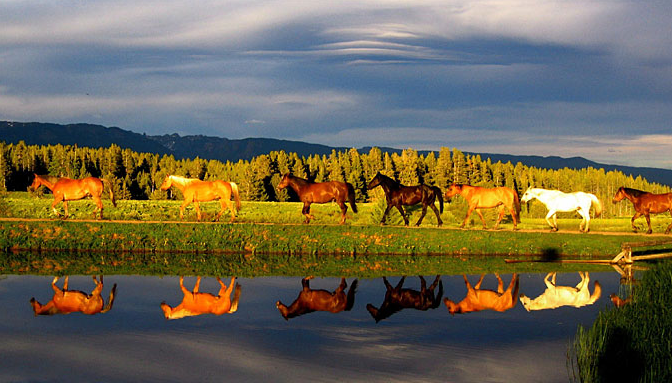
It’s a fine image, and one can easily concur with the judges’ statement that it has “gorgeous color, beautiful light and a killer reflection. The visual surprise makes the eye move back and forth, and the subject is emblematic of the American West.”
But wait a minute. There is a difference between the first half of that judgment and the second. Color, light, and the reflection are one thing, while surprise and emblematic representation are another. In fact, water reflections are standard stuff in nature photography, so there would be little surprise there (nor would viewers be likely to be confused about which horses are real). And what about the idea that the landscape is the definitive image of the American West–and therefore of America? Can you get more conventional than that?
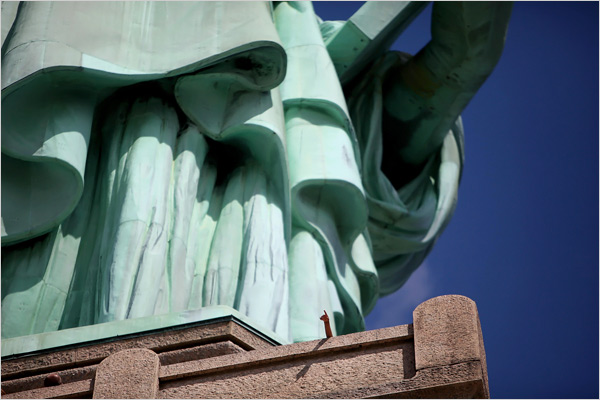
My unease wasn’t helped by the paper’s claim that the contest photos “capture America the beautiful beyond obvious landmarks to its glorious landscape and spacious skies.” OK, no Statue of Liberty, but the Western landscape is an equally obvious visual figure, and it is clear from the text that our perception is supposed to be shaped by the iconography of “America the Beautiful.” Sure enough, the second and third place photographs are from Antelope Canyon, Arizona and Arches National Park, Utah: in other words, they are beautiful examples of familiar scenes in the photographic archive of Arizona Highways, National Geographic, and similar house organs of travel photography.
The fourth place photo is of an ocean sunset, and so it goes. Most tellingly, of the top ten photos, only two–numbers 6 and 10–include people. In the first of these, we see children practicing with lariats at a “cowboy training camp” representing “family fun vacations in the American West”; in the second, there are tiny figures in the background of a photo of kites at a beach.
Don’t get me wrong–some of the contest entries are fine photographs. But what about the big question: do they picture America? If so, we may have a problem, because then America is in some important sense essentially empty.
If you look at the rest of the submissions, it seems evident that America is the West, which is largely void of people. As Richard Avedon, Michael Shapiro, and others have stated before, this is not an innocent idea. The photo operates ideologically, whether by hiding the workers, implying that natural resoures are boundless, or reinforcing assumptions about American exceptionalism and providentialism (as if Central Asia didn’t have similar vistas, or lacked God’s grace).
To be fair, however, we also have to note that these photos also are negotiating other problems of political representation: by not featuring people, no one ethnic or social group is given the privilege of being the “face” of America, and showing natural scenes through conventional iconography does supply the typical places and common objects that are necessary for the shared seeing that is a vital element of democratic public culture.
That said, it seems to me that we could do better. The dedication and skill of the amateur photographers in the contest needs to be augmented by critical discussion of how one might represent “the essence of America.” One argument is that there is no such thing to represent; another is that no one representation could do so. On the other side, the US is not simply a neutral aggregation of autonomous individuals having nothing in common, and collective living requires common images and ongoing judgments about what is more or less representative.
And let me say it as clearly as possible: America is not empty. Nor is the natural order of things walking serenely in single file. Nor can photographs represent a political community as neatly as still water reflects horses. Public life needs many images–these and others as well. America is beautiful, but not because the people are invisible.
Photograph by Joanne Panizzera/USA Today.
8 Comments