Mar 04, 2011
Mar 10, 2013
Mar 20, 2009
Jun 17, 2013
Dec 12, 2008
Jan 28, 2011

Afghan Girl II (or Freedom's Just Another Word For Nothin' Left to Lose)

President Obama’s declaration that we will remove all combat troops from Iraq by the end of 2010 is something of a moment for celebration (if leaving a country that we occupied and brought to its knees under false pretenses and is now caught in the throes of sectarian violence can be seen as a moment of joy), but the pleasure of that announcement has to be mitigated a good deal by the fact that he has also committed an additional 17,000 troops to the war in Afghanistan (on top of the 32,000 troops already there). Al Qaeda is ensconced in the caves and hills of the Afghanistan mountains and the Taliban does arguably pose a national security threat to the U.S., so this may be justified at some level, though whether it is a winnable war or not—or what a victory here would actually look like—are certainly open question (just ask the leaders of the former Soviet Union … if you can find any of them). But what is troubling is the way in which we seem to have convinced ourselves that the reason we having been fighting this war, at least in part, has been to save the women of Afghanistan.

To be sure, I have no doubt that the women of Afghanistan are treated in ways that are horribly inhumane and cannot possibly be justified in any way by appeals to cultural differences or long standing traditions. But there is a continuing and nagging cultural meme that presumes to justify U.S. military presence in Afghanistan as somehow connected to securing the human right of these women. It’s not part of the official rationale for our being there as far as I know, though I do recall Laura Bush making such a public appeal a few years back, but the concept nevertheless seems to float along within the public discourse in a network of vaguely connected narratives and cultural associations that functions as a sort of moral imperative for our presence there; and here’s the point: it does this in a way that distracts attention from the larger public debate we should be having about our national interests and concerns in this part of the world and how we should go about accomplishing them.

The presence of this meme was given visual prominence this past week on the front page of the NYT as part of a story (and a website slide show) dedicated to the idea that talk of women’s rights in Afghanistan is starting to take hold and with the clear implication that it is a direct effect of the U.S. defeat of the Taliban in 2001. The photograph is of a seventeen year old woman by the name of Mariam, who had been forced to marry a forty-one year old blind man at the age of eleven and was then beaten and otherwise abused because she failed to conceive. She eventually fled and found refuge in a woman’s shelter

The narrative is full of pathos, and one would have to be cold hearted not to be deeply affected by it, but what distinguishes it from numerous other such stories one can find on the internet is the image that anchors the report, a photograph that bears distinct resemblance to the photograph of the now famous “Afghan Girl” that graced the cover of National Geographic in 1985 and again in 2002, and has been a persistent sign of U.S. concern for the plight of women and war refugees caused by the Soviet aggression. And so instead of focusing attention on the fact that we will increase our military presence in Afghanistan to nearly 60,000 troops, we are encouraged to a state of self-satisfaction in the knowledge that we have somehow done better than the evil empire that preceded us in a war that seems never to end.

But there is more. For one week earlier the NYT reported on the plight of Iraq’s war widows. According to the United Nations 10 percent of all Iraqi women aged 15 to 80 are widowed—740,000 in all—and without the resources to sustain themselves, often forced to resort to begging, prostitution, or “temporary marriages” required to procure even a modicum of state support. Many if not most of these women were widowed by sectarian violence unleashed by the U.S. invaston and at least some—there is no way of knowing exactly how many—have lost their families to American gunfire and missile attacks, such as Nacham Jaleel Kadim, age 23, pictured below who lost both her twin sisters and her husband.

If we are truly concerned about the plight of women in the Islamic world perhaps we should start here.

Photo Credit: Lynsey Addano and Johan Spanner for the New York Times

 0 Comments

Cyborg Visions and Sinister Auras

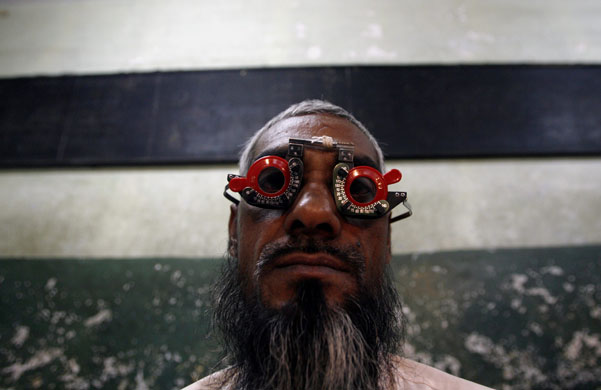
There may not be a reflective cue in every photograph, but some photos make up for that by reminding the spectator of how vision can be mechanized.

This photo goes in two directions at once, for the striking effect is created by combining modern technology (complete with plastics and calibration) and the colonial visual convention of the dark-hued peasant. The man can be seen as “native” and “primitive,” which makes the goggle-eyed apparatus seem even stranger than it might otherwise. The caption tells us that he is having his vision tested at an eyecare clinic in Mumbai, and so the narrative of modernization can draw down the initial shock of seeing a cyborg staring back at the camera. He isn’t seeing through us; no, he is being lifted up out of darkness.

And it that makes you feel better, you might want to take a look at this:

You are looking at another cyborg, one who is part of a system of surveillance that is projected back across his face. The half mask looks like something out of Star Wars. The military bearing makes him seem ready to be used without hesitation by the System that is mapping and monitoring the nation state. He looks proud of his role–and ready to launch the death ray on command. Some viewers might see this guy as One of Us, but few would want to be so intimately defined by technology.

In fact, this photograph of Captain Bob Edwards on duty at the North American Aerospace Defense Command in Colorado was taken after a US Airways jet landed in the Hudson River on Jan. 15. Amazingly, a 911 call in Queens could be linked to the Center, which probably provided help during the rescue. As with the first photo, the sinister aura that would be picked up by some viewers depends on the mind of the believer. Though likely to be relatively conservative in the first case and liberal in the second, the anxious viewer would be mistaken with each image.

Once that initial reaction is set aside, the opportunity arises to think about how we see mechanically. Sight in the first case, surveillance in the second: both are essential for collective life. (Yes, surveillance is a social good: read Jane Jacobs on urban design.) Modern engineering has provided immensely valuable technologies for improving both sight and surveillance. Both can be used abusively–from prying into private life to creating panopticonic work places–but they remain pervasive features of modern life that we usually take for granted. The question arises, what would we see if we looked at our cyborg selves without fear of what we might find?

Photographs by Arko Datta/Reuters and Kevin Moloney/The New York Times.

 1 Comment

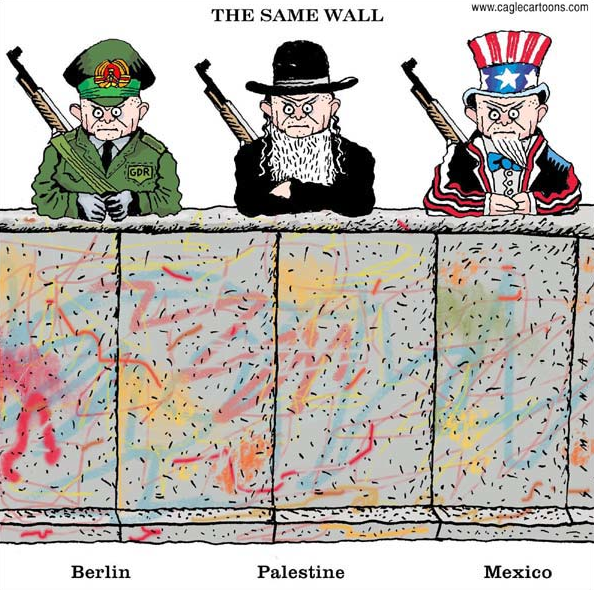
Sight Gag: The Same Wall

Credit:   Osmani Simanca, Brazil

The “Sight Gag” is our weekly nod to the ironic and carnivalesque in a vibrant democratic public culture. We typically will not comment beyond offering an identifying label, leaving the images to “speak” for themselves as much as possible. Of course, we invite you to comment … and to send us images that you think capture the carnival of contemporary democratic public culture.

 0 Comments

Facing Death at the Rocky Mountain News

Today the Rocky Mountain News will publish its last edition and go out of business.

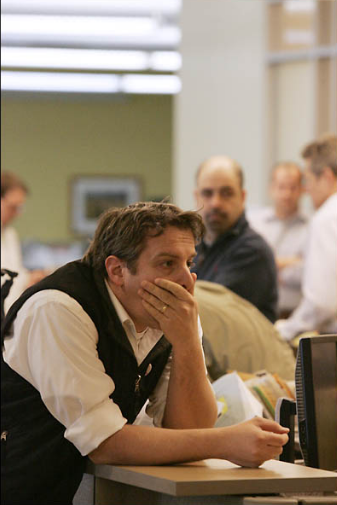
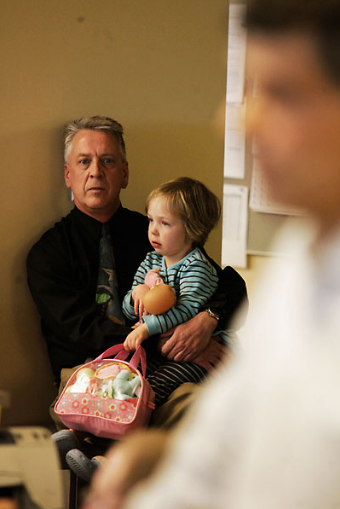
The closing was announced to employees of the paper yesterday afternoon. Like the pros that they are, they had the story up on their website immediately. Not everyone gets to report on losing their own job, and I doubt it is an experience to savor. The coverage included a photo essay with these pictures.

There may be some irony in a storied newspaper reporting on its demise with an online digital slide show, but the explanation of the paper’s collapse is not that simple. Nor will I go into it here. Let’s dwell instead on what it means to face the death of one’s job.

That stunned look is the face of someone who has just lost his livelihood, who works in an industry where re-employment may be impossible, and who has to somehow make all that not matter to the child in his arms. He is one of many in this awful spot, but I would bet that he feels almost completely alone.

The pictures tell the story of individual lives, a spreading economic disaster, and perhaps the death of an institution. The Rocky Mountain News was closing in on its 150th anniversary this year. American democracy is older than that, but its future has been secured for a long time by the press. Of course, it also is true that everything is changing, and the horizon is not uniformly dark, and the digital media are abounding with democratic energy while reformatting and extending much of what was good about journalism. But the faces in the Denver newsroom show what happens when you stare into the future and see nothing there.

Photographs by Darin McGregor, Judy DeHass, and Joe Mahoney for the Rocky Mountain News.

 4 Comments

Politics and Fashion in Modern Dress

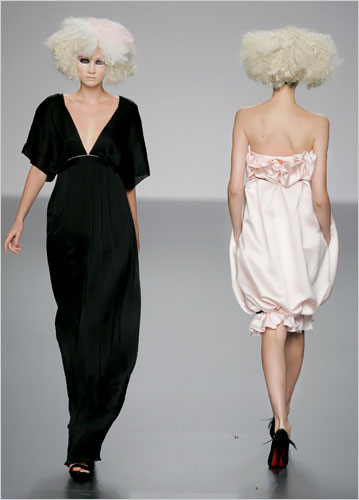
Fashion Week has been running for about a month around the world, and so the slide shows have been full of carefully staged displays of both elegance and excess. Usually excess, of course, but sometimes a bit of both.

This shot is a small masterpiece of visual design. The twin models signify difference articulated perfectly within a pervasive uniformity. They are two: front and back, pants and dress, black and white, hands loose and pocketed, legs and shoulders covered or bare. And they are one: identical in height, weight, posture, skin, hair, walk, training, occupation, attitude, and place. Were it a movie, we would assume the same actress had been doubled via special effects. Were it a science fiction movie, we would assume they were cloned from the same egg.

What it is, of course, is the aesthetic vision of modernism. If you aren’t sure, look at the spare, minimalist, rectilinear plane surfaces that make up the rest of the scene. The robotic women stand against the decor in the grammatical relationship of figure to ground, a process of reciprocal definition here honed to perfection by the additional technique of the mirror image. Even the decor is two-toned in the same manner as the models: grayed white wall and whitened gray floor could each be the reflection of the other.

One would expect the fashion houses to imagine the world as a hall of mirrors. The mirroring of one another may be more than an artistic conceit, however. Perhaps it is used to manage modern culture’s paradoxical development of individual identity within processes of production and distribution that produce comprehensive uniformity. Stated otherwise, mirroring may become useful precisely as modernity makes different people more and more uniform.

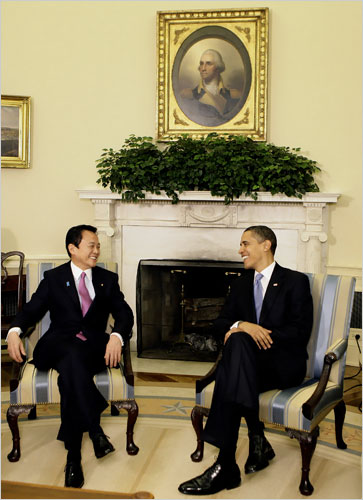
From that perspective, modernity itself seems to be on display in this otherwise conventional photograph:

The stock photo presents Japanese Prime Minister Taro Aso with President Barack Obama in the Oval Office. Look at how they mirror one another, much like two models waiting to be called to the runway. Two stylish men in identical chairs each look toward the other. They wear nearly identical suits, shirts, shoes, socks, smiles, and lapel pins. The are distinguished by differences in size and how they hold their hands and feet, and by their equally stylish ties: one a shiny pink and the other a subdued blue. They could be a nice gay couple.

They also are two official heads of state. One is the leader of a nation that recently experienced a decade of stagflation, and the other the leader of a nation trying to ward off that same fate. Their near-perfect mirroring of each other’s position in the modern world is highlighted by one other, slightly ironic use of the same technique. George Washington’s portrait sits above them, mirroring the two leaders below. Although supposed to bestow legitimacy on those below, his colonial era dress and incarnation within the pre-modern art of painting signal more difference than commonality, just as there is only one of him. He remains the distinctive work of art commanding an aura, while they seem more the issue of a process of mechanical reproduction.

But that aura seems faded and distant when set against the mutual admiration of the two models in the foreground. And so the two photographs mirror one another. In modernism, fashion is placed in one realm and politics in another, each ideally uncontaminated by the other. But that mirror image is another example of accenting small differences within the deeper uniformity of modern culture.

Photographs by Arturo Rodriquez/Associated Press and Doug Mills/New York Times.

 0 Comments

Fly Air ICE and Repatriate in Comfort

One thing that nearly everyone on the political spectrum seems to agree about is that the U.S. immigration bureaucracy is an incredible mess.  Of course, there is no consensus on what the problems are, let alone the solutions, but there truly doesn’t seem to be anyone who thinks that the status quo is acceptable.  I suppose that’s a start, but if we are going to make any real progress we need to come to some agreement over key terms, and there, of course, is the rub, for at the heart of the issue of  immigration policy is a disagreement over terms: is the problem a matter of  “undocumented immigrants” or “illegal aliens”?

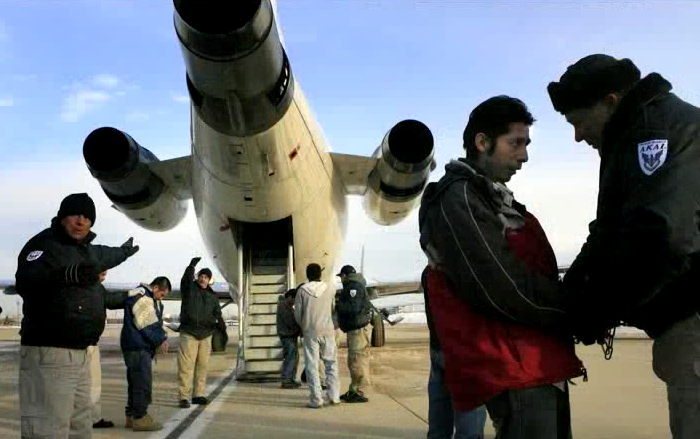
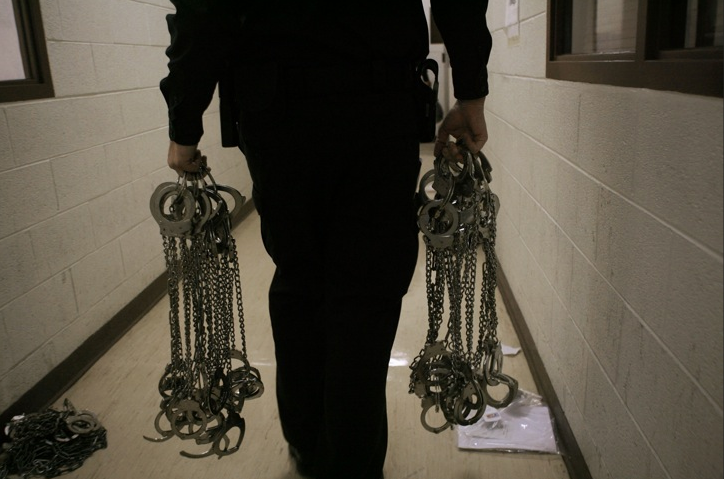
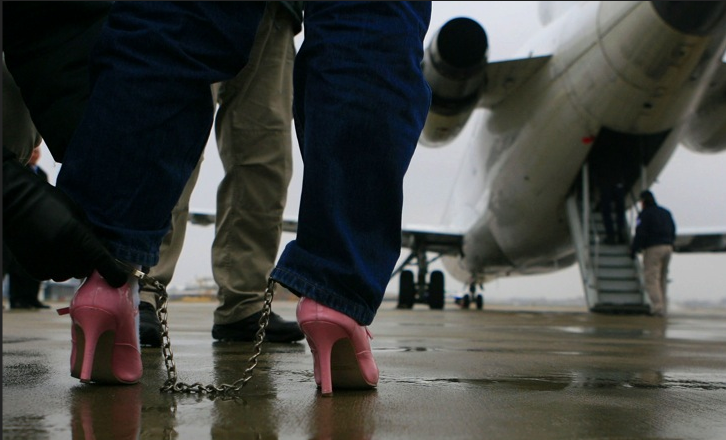
I was led to think about this problem this past week when I came across a photo-essay in the Chicago Tribune on “Flight Repatriate,” one of a fleet of Boeing 737s contracted by US Immigration and Customs Enforcement (ICE) to “expedite the removal” of  “illegal immigrants” to their “homeland,” often in Central or South America, but also Asia, Africa, and the Middle East.  Since October 2007 ICE Air has transported more than 367,000 immigrants to their countries of origin (a 77% increase in the number of deportations since 2006), the vast majority of whom have lived peaceful and law abiding lives within the US borders, notwithstanding their designation as “illegal.”  Animated by a desire for “cost effectiveness and safety,” Air ICE flights include “sandwiches, cheese and crackers, fruit, bottled water, civilian clothing, checked baggage and a private nurse.” As one ICE official put it, “there is no reason why we can’t treat them with as much respect as is possible.” Indeed, “nonviolent” passengers can even have their shackles and handcuffs removed on international flights.  It is hard to imagine how anyone could complain.  And yet …

From the moment of its origins the U.S. has been a land of immigrants, and across the broad expanse of that history the vast majority of those immigrants—starting with the pilgrims and moving forward—have been “undocumented.”  The development of the modern nation-state changed all of that, of course, but not even a bureaucratic sensibility can mitigate the irony of castigating “undocumented immigrants” as “illegal aliens.”  The doubled shift in terms is much to the point, as the absence of documentation becomes not just a sign of exclusivity, i.e., non-citizenship, but of criminality, just as one’s status as an immigrant becomes a sign of alterity that warrants a stigmatizing alienation further marked by the presumed need for armed guards, caged busses, and shackles and handcuffs.

Some undocumented immigrants might be criminals (rather like, say, some Wall Street bankers and financiers can be criminals) or even dangerous individuals, but it is somewhat churlish to designate and treat them as such simply because they lack the proper documentation—or at least one might imagine that a democratic society would adopt a more liberal and humane attitude towards such persons. 

But then again, perhaps one can’t be too careful.  After all, in the right hands even a three inch heel can be a deadly, dangerous weapon. 

Photo Credits: Alex Garcia/Chicago Tribune


 3 Comments

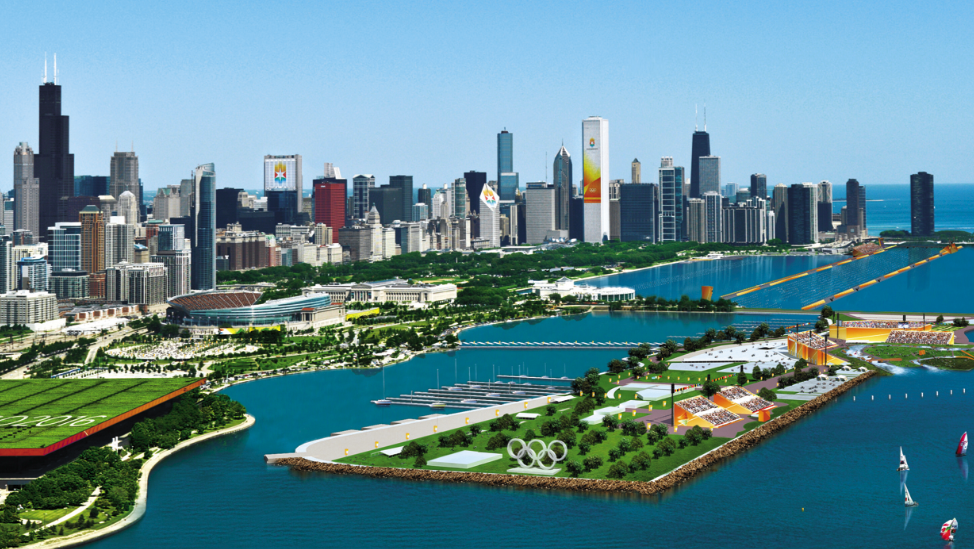
Sight Gag: Chicago Skyline, 2016 (No Joke!)

Credit: Chicago 2016

The “Sight Gag” is our weekly nod to the ironic and carnivalesque in a vibrant democratic public culture. We typically will not comment beyond offering an identifying label, leaving the images to “speak” for themselves as much as possible. Of course, we invite you to comment … and to send us images that you think capture the carnival of contemporary democratic public culture.

 1 Comment

Automotive Wreckage and Crash's Law

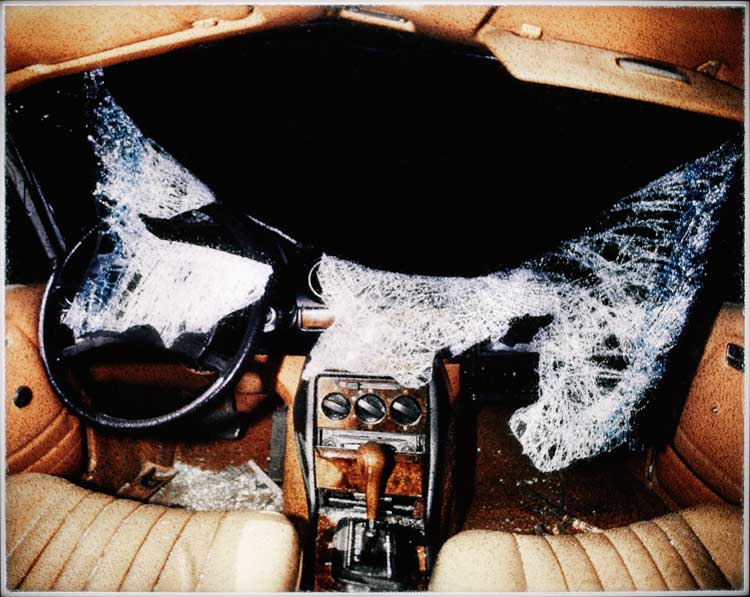
Close your eyes, think Big Three auto companies, and open them again:

Just about perfect, isn’t it? An out-of-date vehicle with crappy decor designed to distract you from substandard engineering has been wrecked by a head-on collision. And what do we see now that the barrier between the car and the outside world has caved in? Utter darkness.

Even if you stagger away from the wreck, head-on collisions are particularly awful because you know you should have seen it coming. Although the crash explodes in an instant, it was developing well before: when people weren’t paying attention, when merely adequate brakes were installed, or barely adequate regulations enacted. The long aftermath of an accident is the other side of a long winding of the spring beforehand. Emily Dickinson said it best:

Ruin is formal — Devil’s work
Consecutive and slow —
Fail in an instant, no man did
Slipping — is Crash’s law.

The Big Three didn’t collide with market reality overnight. They had been warned and warned, but they looked the other way, as did a lot of other people. The result is broken glass, broken dreams, and a dark future.

The photograph is by Nicolai Howalt, from his series Car Crash Studies. I found the series at Amy Stein’s blog on photography. The poem is an excerpt from “Crumbling is not an instant’s Act.”

Cross posted at BAGnewsNotes.

 1 Comment

Sunset in Oil Town

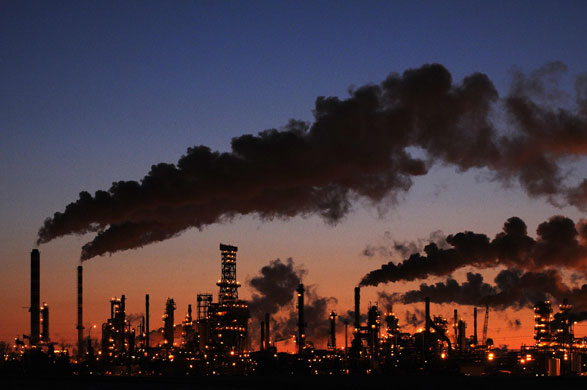
Today I came across a photograph that could be a picture-perfect illustration of how aesthetic judgment depends on context. I also discovered a photograph that could be a picture-perfect illustration of how political judgment depends on context. Fortunately, the two photos are identical:

This photo of an oil refinery in Edmonton, Alberta could be placed on a Petro-Canada promotional brochure. Surely for many of those in the business, and for a majority of those in North America in the last half of the twentieth century, this could be an image of progress. The sun is setting but that doesn’t matter as hundreds of lights wink on at the refinery that is a vital node in the great industrial system that has all but eliminated darkness in the modern world. The plant (note the word) seems to be a substitute for nature itself: electric light replaces sunlight, the steam from the towers plumes like beautiful clouds across the night sky, and all this because subterranean power is being drawn out of the deep earth.

The stacks, towers, and other structures are the work of civilization, of course. The industrial complex seems to be a city rather than one factory for powering distant networks. This seamless fusion of the natural and technological sublime is one source of the photograph’s appeal. We are brought to a limit condition–the setting of the sun, the outer edge of civilization–and yet can gaze safely on the power emanating from the other side. Awesome power that is contained by the machinery of civilization, from refinery to camera.

But that is only half of the story. The same image will have looked quite different to those who saw high-volume pollution instead of billowing vapor, and consumption of a non-renewable resource instead of production, and a massed concentration of corporate power instead of economies of scale creating mass prosperity. Likewise, the design and tonal values of the image can reveal not beauty and power fused together but instead an allegory of the decline of the industrial society. Now the sun is setting on both the landscape and the refinery. The orange glow along the horizon reveals what was always true: that this was an infernal place that could only end in self-destruction. The lights now look like torches that cannot hold off the impending night when the oil runs out, never to be replaced for hundreds of millions of years. Instead of replacing nature, this place is returning to nature as sure as night follows day.

I’m writing this at night, the computer screen aglow in a house illuminated and heated by power plants that draw on resources thousands of miles away, day and night, year in and year out, continuously, reliably, without my doing anything other than writing a check once a month. That has to be acknowledged. The oil does no good to anyone if never used, but it would be one of history’s great crimes to exhaust the supply before a sustainable alternative was available. Likewise, it seems foolish to deny that the image can be a symbol of progress, but the wiser choice might be to see it as an allegory of decline.

Photograph by Dan Reidhuber/Reuters.

 0 Comments

Photography and the Visual Recession

I’d like to consider why this is a good photograph:

We start by noting how it is a bad photograph: a dull, static, poorly lit shot of a dull, featureless, commercial building in an unknown location on a cloudy winter day. The building itself is of no obvious significance, and the image does nothing to elicit and direct our attention. Even when a caption is supplied–this is the plant of the Manchester Tool Company in New Franklin, Ohio that has been shuttered for ten months–nothing remains of visual interest.

In fact, the photo actually diffuses the viewer’s gaze. Your eye might be caught by the bright colors on the large sign, but it then is pulled along the left-to-right diagonal to the next sign that is smaller and less legible, and then instead of converging on a point it spreads out along the shadowed wall of the building, and from there it wanders right and left trying to draw things together into a coherent whole except that the building continues beyond the frame in each direction. Worse yet, the flag lifts the gaze up on the left but then leaves it hanging there, looking above everything else in the picture to the empty sky, and what is the purpose of having a flag waving over an empty building?

Even if you were one of the perhaps two readers worldwide who might be interested in buying a plant in Ohio at this time, this photo wouldn’t grab you. And it certainly is not one likely to be seen on someone’s desk or in a family album or even in the newspaper. So, what is it doing?

At some point last year a friend got in my face and said that I needed to be posting about the economic downturn. I gave a grumpy reply to the effect that doing so was easier said than done: a fragmentary medium such as photography wasn’t suited to depicting structural problems, and the news media limited themselves to a few stock images such as executives before Congress and workers at factory gates. But I knew he was right, and since then John and I have put up a number of posts on the economy. What I’ve noticed, however, is that the best photos have been uniformly bland images. Examples have included customers leaving a restaurant, an empty auto showroom, furniture dumped along a sidewalk, and others as well. They provide visual parables, but they do not feature the art of photography.

By contrast, the visual archive contains many images of both economic power and economic catastrophe. Think of the World Trade Center or famous images of the Great Depression such as Dorothea Lange’s White Angel Breadline. Even government response to the Depression was captured in monumental imagery, as in the photograph of Fort Peck Dam on the first cover of Life Magazine. But it seems that the economic mudslide we have experienced so far requires a different iconography.

What I like most about the photograph above is how the building seems to be withdrawing from view, receding into its minimal state of dull banality. Of course, it wouldn’t look much different in good times. Commercial real estate like this is not built for looks. But the “For Sale” sign wouldn’t be there, and the windows might be open and the walk shoveled, and, most important, the photograph wouldn’t have been taken at all. The image seems dull, cold, and aimless, but that is exactly what it is documenting: how the plant closing leaves nothing but an empty building, forlorn signs, and workers who are left out in the cold without work or opportunity when they need it.

Recession may include not only cutting back on luxuries but also cutting back on the optical extravagance of towering skyscrapers and dramatic action shots. The photojournalist’s task now includes documenting dispersion, retraction, erosion, and sad quietude. In doing so, it may bring us to dwell on the dull surfaces of ordinary life. Those surfaces were easily overlooked when driving down the road in an SUV using cheap gas to get to the mall. Now, however, they may be all that remain.

Photograph by David Ahntholz for The New York Times. See also the Times article, Months After Plant Closed, Many Still Struggling.

 6 Comments