Jul 12, 2007
Apr 01, 2011
May 20, 2013
May 27, 2008
Oct 08, 2007
Oct 26, 2015

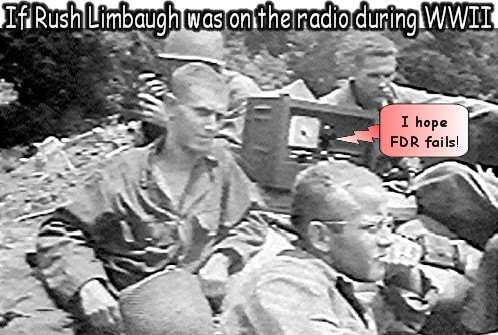
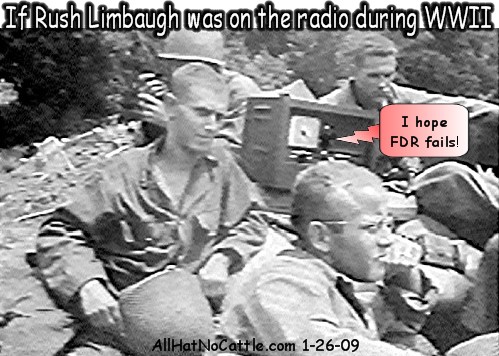
Sight Gag: Another FDR Comparison

Credit: All Hat No Cattle

The “Sight Gag” is our weekly nod to the ironic and carnivalesque in a vibrant democratic public culture. We typically will not comment beyond offering an identifying label, leaving the images to “speak” for themselves as much as possible. Of course, we invite you to comment … and to send us images that you think capture the carnival of contemporary democratic public culture.

 0 Comments

Photographer's Showcase: "Everything is Possible"

Today we are very pleased to welcome Peter Turnley to NCN with a photographer’s showcase.  Peter is truly among our very finest photojournalists and not just because he is a maestro with the camera, but because he operates it with a profound social conscience.  His work as an unembedded photographer during the first Persian Gulf War (aka “Desert Storm”) was central in breaking through efforts to manage and control western perceptions of what was going on.  But no less important was his very earliest work (with his brother David) on race in America (1976) or later efforts from Tiananmen Square (1989) or his work for outlets such as Newsweek, Stern, Life, Paris Match and the list goes on, covering world conflicts everywhere from the Balkans, Somalia, and Rwanda to the Israeli-Palestine controversy.   No less important has been his coverage of the U.S. homefront in the wake of war and conflict.

In this Photographer’s Showcase Peter Turnley features photographs that he took at the recent Inauguration of President Obama. One might wonder why we return to this moment of public elation so quickly, as recent wrangling over the economic stimulus package has served as a sober reminder of the hard core reality of the political world that we live in. We do it mostly because Peter’s photographs are a sensitive and powerful reminder that even in such a political world, “everything is possible.”

Click on an individual photo in the gallery below to see a slightly larger version of the image and Peter’s caption.  Click on the slightly larger photoraph a second time to see a large version of the image.

 3 Comments

Obama's Eloquence: Mistaking the Artist for the Art

I’m not sure anyone expected that the celebration of Barack Obama would have continued this long, yet it is still in full swing. For once, right-wing pundits may have a point when they lash back, but they also have a well-deserved credibility problem. The question remains, however: What might be lost in the shadows when all the lights are on Obama?

Let me offer one of the many answers that could be provided: By celebrating Obama too much, we can conclude that only he can do what he does well. When he is the only figure in the picture and the only hero in the story, it becomes too easy to see him as the sole embodiment of virtues that could be developed more broadly.

This conflation of the political leader and his skills is most evident in the responses to Obama’s eloquence. Perhaps because the contrast with his predecessor could not be greater, it quickly became commonplace to declare that Obama’s speeches, answers, and other remarks were astonishingly skilled. Make no mistake about it: he’s a very, very good speaker–and one whose speeches, like everything else he does, show all the marks of political genius. But you don’t have to be a genius to speak effectively.

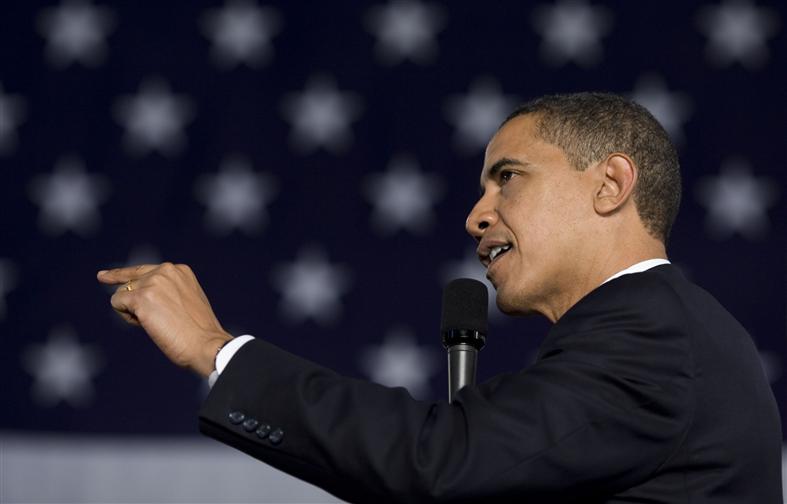
The photograph above features Obama’s sure command of the platform, but it also reveals commonly available means of persuasion. Obama is speaking at a town hall meeting in Elkhart, Indiana. The white dots on the blue background could be lights but actually are the stars on a large American flag. Framed by the flag and the closely cropped photograph, Obama appears to be the epitome of the political leader as public speaker. His words can’t be shown in the photograph, of course, but look at what is on display: the focused line of sight toward the audience, the comfortable ability to speak across the microphone rather than be disturbed by it, the thoughtful tilt of the head as he strives to connect with the questioner, the forceful gesture of arm and hand to emphasize the argumentative point while exuding confidence, the slight smile of public combativeness oriented toward conciliation, and all seemingly without breaking a sweat.

You can’t deliver a speech much better than that. But asking how he does it is like asking how an NBA player can make a three-pointer. He can do it because he’s done it a million times. And because he studies the game, and works at it, and enjoys it when he does it well. And if everyone can’t play in the NBA, anyone can become a better player if they work at it. The same holds for public speech.

If you look at Obama performing, you can see how to do it well. Look closely and you also will see a lot of small mistakes and other features of ordinary, everyday communication. He’s not perfect, and virtually everything he does is something anyone could do with a bit of practice. How to answer questions masterfully? Well, if asked two questions at once, respond to each in turn directly and succinctly and don’t answer other questions that weren’t asked. How to respond when someone is channeling the opposition’s talking point? Well, identify the source and its characteristic bias, then counter with the corresponding principle on your side. How to do this without dying of nervousness? Well, put yourself where you get to practice before others who take it seriously.

When looking at Obama on the stump, you can see the consummate public speaker without peer, or you can see the art of rhetoric that he practices. That art is something that can be taught to and learned by ordinary people. More to the point, democracy depends on ordinary people taking turns speaking and listening with some commitment to doing both well. To think that only great speakers can speak well is to mistake the artist for the art.

Someone once said that the genius of democracy is that it doesn’t require genius. A good monarchy requires a great monarch, while democracy can do just as well or better if ordinary people put enough effort into public discussion. Obama concluded his press conference Tuesday night by saying that he believed in civility and rational argument. Those are the values of good public speech. He shows how it’s done, but many people could do it. Let’s admire the artist, but work at the art.

White House photograph by Pete Souza, 2/9/09.

 3 Comments

Blindness and Insight in 3D

3D glasses are making a comeback–again. The investment history of that little device must be a trail of broken dreams, but they probably said that about the lint rollers. Before looking ahead, however, let’s not forget our glorious past:

This is one version of the classic Life Magazine photograph of the audience watching the first 3D color motion picture. It’s been a while since people dressed up to go to the movie theater. The date was 1952, and since then this image has become emblematic of all that was odd, dispensable, or dangerous about the 1950s. We see the American middle class lined up in rows, willingly clouding their vision to be transfixed by the mass media on behalf of civic conformity. Serious, silent, formal, and numbingly uniform–what’s not to like?

It’s easy now to look at the 1952 photo and imagine the audience is auditioning for “Invasion of the Body Snatchers.” And unfair, of course. They will have been a diverse mix of individuals having a good time going to the movies, much as people do today. And the glasses disturb in part because they remind us that the cinematic experience is always an illusion created by equipment. That said, the image does provide a window into the culture of the time, and thus a basis for comparison with more recent attempts to use 3D technologies. So, let’s take a look at this year’s model:

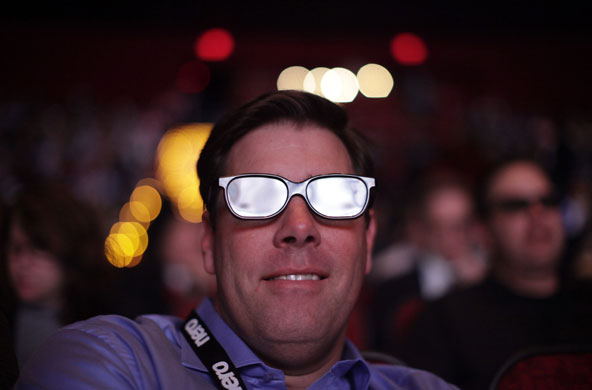
Cool, huh? This happy camper is watching a college football game in 3D in Las Vegas. Obviously the glasses have gotten a fashion upgrade. The photo suggests other changes as well. Now we see not the mass audience of 1950s popular culture, but instead a single individual relatively isolated from those in the soft focus background. Now the photographer zeros in on the individual’s experience, and his happiness clearly is his own and not related to those around him. He is illuminated, as if the spectacle is being produced just for him. Or at least for those like him–the niche audience able to afford the trip to Vegas and whatever else went into this show.

This inversion from the mass audience to the isolated spectator can be read as a shift from a culture of collective solidarity to one focused on individual autonomy. Conformity is not a problem, and as for the rest, well, let the market take care of that. As with better eyewear and improved projection, this is supposed to be progress: whereas the eyepieces in the first photo are dark, his lenses are shining with enlightenment.

And it may be progress. The audience in 1952 was watching “Bwana Devil,” which is all one need say about that. At the same time, one can’t help but think that this is a case of the same thing coming around again. What people need from their media today is not more “life-like” film and video projection but an upgrade in content.

And perhaps now more than ever, we don’t need glasses that make it easier to not see those around us.

Photographs by J. R. Eyerman/LIFE and Jae C Hong/AP.

 0 Comments

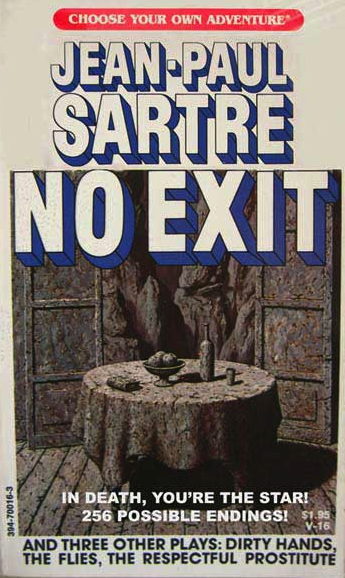
Sight Gag: No Exit

Credit: Something Awful.com

The “Sight Gag” is our weekly nod to the ironic and carnivalesque in a vibrant democratic public culture. We typically will not comment beyond offering an identifying label, leaving the images to “speak” for themselves as much as possible. Of course, we invite you to comment … and to send us images that you think capture the carnival of contemporary democratic public culture.

 0 Comments

Conference: Women in Photojournalism

WOMEN IN PHOTOJOURNALISM

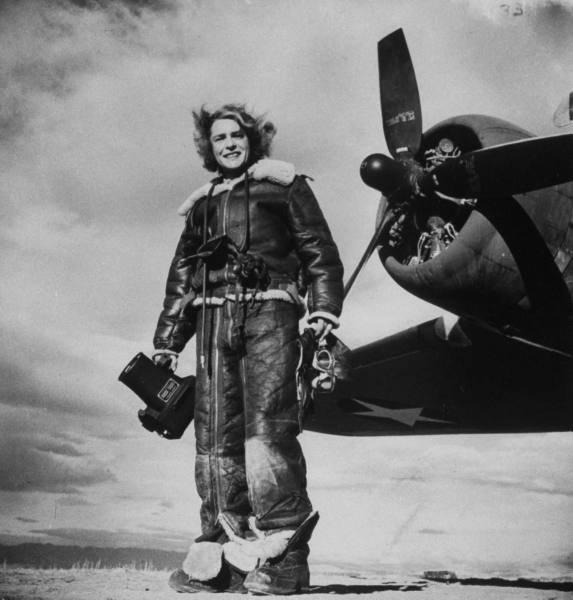
The National Press Photographers Association will hold the annual Women in Photojournalism Conference in Las Vegas, Nevada on June 10, 2009. The conference theme is Celebrating Our Past, Looking Forward Toward the Future. On the occasion of its twentieth meeting, the conference will feature the history of women in photojournalism and include a juried exhibition, workshops, and critiques. Additional information is available here.

Photograph of Margaret Bourke-White by Margaret Bourke-White, Life Magazine, 1943.

(Those readers who still hold their noses when confronted with Margaret Bourke-White’s photography (much less her self-promotion) would do well to read John Stomber’s essay, “A Genealogy of Orthodox Photography,” in Beautiful Suffering: Photography and the Traffic in Pain, ed. Mark Reinhardt, Holly Edwards, and Erina Dubanne. If nothing else, the smear job done by James Agee and Walker Evans was an exercise in hypocrisy on a grand scale, and there is reason to look at any image anew rather than through the lens they crafted.)

 0 Comments

The Great Unraveling

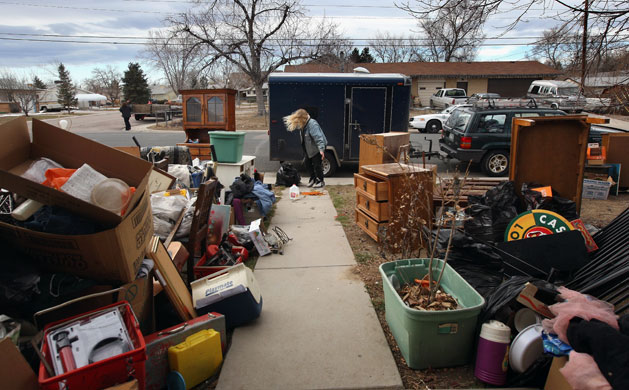
Descriptions of the current recession often feature terms of constriction: “cutting back,” “downsizing,” “retrenchment,” “shrinkage,” and so forth. Companies are reducing inventories as people are eating in instead of going out, all because bubbles, markets, and sectors have collapsed. With the Dow at a fraction of its former value and the global economy cooling like a dying star, it seems that drawing inward is a universal law of hard times. Until you look at photographs such as this one:

A woman is standing among her possessions after having been evicted from her house. She is seen at the back of the photograph, at the end of the bare concrete sidewalk leading to the street, on the line to the vanishing point. The wind blows her hair across her face, adding insult to injury. She stands as if at a loss. What to do? How can she gather this all up and put it somewhere safe, much less back where it belongs? How can she hold onto anything of value?

The garbage bag in front of her makes the question seem particularly futile: she could put something in it, except that it’s already full and likely to tear anyway when she tries to carry it, if she can carry it far at all. No wonder that she looks as if she is having an exasperated conversation with the bag. Who else can she talk to?

The rest of her stuff is strewn along the sidewalk and out into the street. It’s in no order save the haphazard mess made by the eviction team (they have jobs). Drawers are pulled open, a table overturned, the cabinet stands empty and precarious at the curb, boxes are piled helter skelter, a plant dies in the winter air. . . It would look much the same if it had been done by vandals, but then she would know whom to blame. In any case, she isn’t likely to see the people who helped her get into this mess.

This is a scene of personal desolation. It also is a sign of collective danger. The economic implosion does not lead only to the frugality and togetherness celebrated in nostalgic memories of bygone days. Economic disasters also release terrible centrifugal forces: winds of dispersion that tear lives apart and scatter people across places that will never be called home. Paul Krugman put it well when he spoke of The Great Unraveling. To see what that can mean, you don’t have to look too far.

Photograph by John Moore/Getty Images.

Update: Thanks to the cross post at BAGnewsNotes, you can read an extended caption to the photograph and additional comments by readers there.

 1 Comment

"R-e-s-p-e-c-t, Find Out What It Means to Me …"

In the classical tradition “decorum” called attention to the linguistic, aesthetic, and ethical standards of propriety designed to coordinate the relationship between thought and expression. The eloquent orator was decorous when he performed his civic persona in a manner that seamlessly and invisibly embodied a style of expression and a substance of thought that was appropriate to the audience and occasion being addressed.  More than just a set of rules for eloquent speaking, however, decorum was understood to be a normative habit of civic participation that would animate the balance or harmony “necessary for the comprehension and direction of life in the pluralistic space of public experience.”*  It was, in short, a control against unrestrained ego necessary to managing the tension between individual desires and collective responsibilities in civic life.

The photograph below depicts the fundamental  problem of the late governorship of Rod Blagojevich as a failure of decorum—a complete and utter lack of civic harmony.
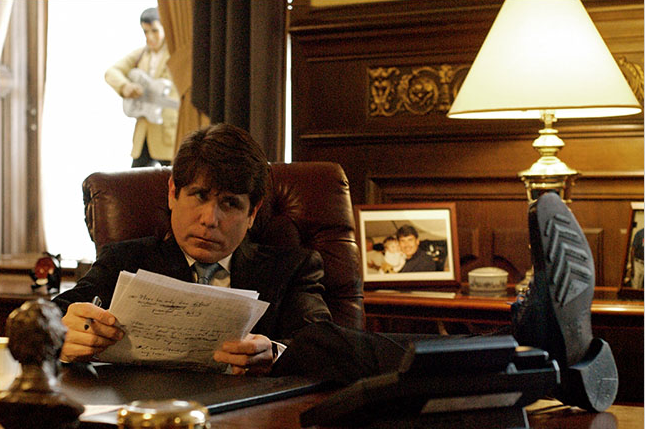
We like to think that the conduct of our leaders will call us to a higher standard of public responsibility as citizens, an entailment, perhaps, of the assumption that as elected servants of the public they are temporary stewards of an office that is larger than themselves.  We often accent this assumption by talking about how an elected official will “grow into the position,” underscoring both the sense in which the office transcends the mortal embodiment of any one person, as well as how the formal demands of the office shape and control any given occupant.  But in this photograph—which occupied the four middle columns, above the fold on the front page of the NYT on the day that Governor Blagojevich was unanimously convicted on an article of impeachment—none of these assumptions seem to abide.

A governor’s office is a public, symbolic space, its size and visual tableau functions as a marker of its long standing history and civic power, a reminder that the “office” is bigger than the current office holder.  Here, however, the photograph diminishes the effects of such magnificence by photographing the governor in a relatively tight, middle-distance close-up.  Indeed, the photograph contradicts the assumption that the office is bigger than the man by making it seems as if the physical space of the office can barely contain him, a point further accentuated by his slumping posture, as if the chair is too big for him and he never grew into it.

But there is more, for one might expect to see the governor’s office festooned with the emblems of the state—flags, the state seal, artifacts that mark the state’s history, and quite possibly photographs of the sitting governor as he conducts the business of his office.  And surely such things exist somewhere in the office.  But here, however, there is none of that.  Instead, the governor is triangulated by a small bust of Abraham Lincoln, a much larger, statuesque figurine of Elvis Presley (that recalls the ridiculous photograph of President Nixon posing with Elvis in the Oval Office of the White House), and a framed snapshot of Blagojevich, the private citizen, with his children. Decorating one’s workspace with personal effects is a habit of contemporary life, but even in the private sector the assumption is that such artifacts will operate moderately, in the background, visible and yet not seen—hence decorous.  One would anticipate even more such moderation in the governor’s office, but here the emblems of personal eccentricity and private life dominate the mis-en-scène almost to the point of impropriety.  

What gives the photograph its dramatic force, and in the end what pushes it fully beyond the bounds of propriety, is the shoe poised awkwardly and somewhat precariously on the edge of the desk.  Truth to tell, I will occasionally put my feet on my desk in my office when I am reading a manuscript or talking on the phone.  But I would never do it if someone else were in the room, and certainly not if there was a photographer within viewing distance (let alone a NYT photojournalist).  And the reason is quite simple:  doing so marks the space as private and proprietary. To do so in an otherwise public space is a sign of arrogance and disrespect; to do so as an officer of the state, literally posing for the a NYT photographer, marks the behavior as a gesture, as an intentional performance of utter contempt for the office and all who might see it.

More even than Blagojevich’s absurd claim to the NYT reporter that “[we] should have been more selfish, not selfless,” the photograph is a representative (visual) anecdote of the deep habits of his governorship and why he is deserving of public opprobrium whether he is guilty of the formal charges against him or not.  More, it is a reminder of why the standards of public decorum are valuable guides to the harmony and ministrations of civic life.

Photo Credit:  Amanda Rivkin/New York Times

*Michael Leff, “The Habitation of Rhetoric” in Contemporary Rhetorical Theory: A Reader, ed. John Louis Lucaites, et al. New York: Guilford Press, 1993, p. 62.


 2 Comments

Sight Gag: Shedding the Veil


Click here or on the cartoon above.

Credit: Ann Telnaes/Washington Post.

The “Sight Gag” is our weekly nod to the ironic and carnivalesque in a vibrant democratic public culture. We typically will not comment beyond offering an identifying label, leaving the images to “speak” for themselves as much as possible. Of course, we invite you to comment … and to send us images that you think capture the carnival of contemporary democratic public culture.

 2 Comments

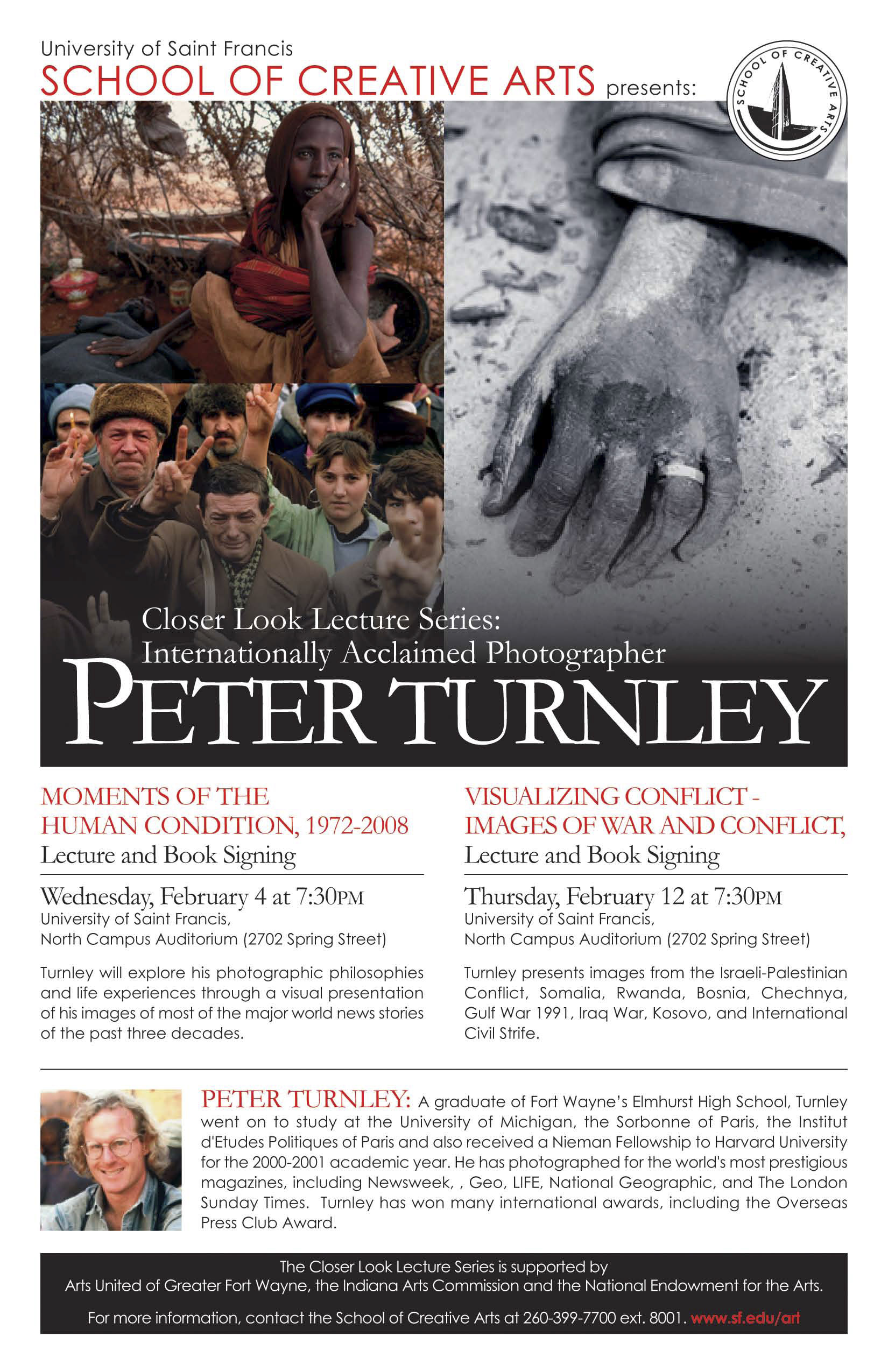
Announcement: Peter Turnley to Speak on Visualizing Conflict

Peter Turnley is one of our preeminent photojournalist.  His work has appeared regularly on the cover of Newsweek, as well as in places like Life, National Geographic, Harpers, and the London Sunday Times.  He covered both Iraq Wars (1991 and 2003) as an unembedded photojournalist.  We  are delighted to announce that in the next week or so we will be showcasing some of his recent work from the inauguration of President Obama. Today we want to call your attention to a series of lectures he will be presenting at the University of Saint Francis in Fort Wayne, Indiana,  as well as a series of workshops that he teaches regularly throughout the world.  

 0 Comments