Mar 10, 2010
Oct 04, 2013
Mar 04, 2011
Feb 06, 2012
Nov 03, 2013
Mar 15, 2013

The Dreaded Media Spectacle–Miniaturized!

The most insightful essays on photojournalism typically have included keen attention to the social and political implications of the photographic technology itself. The ideas and attitudes that become influential often persist despite technological change–sometimes rightly so, but not always. One item of conventional wisdom that needs to be either updated or shelved is the anxiety about media spectacles.
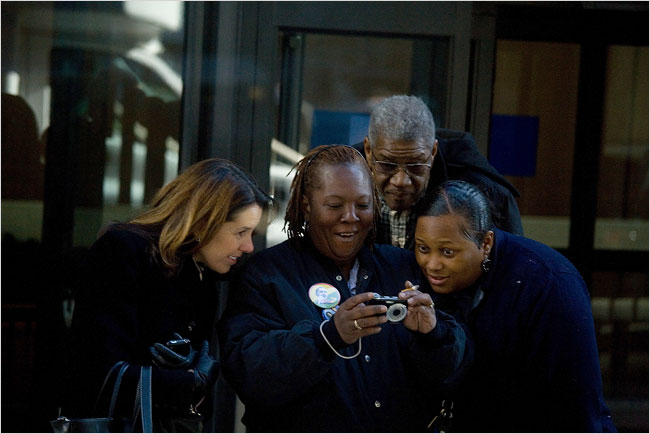
This image is a lovely vignette of the digital age. The caption stated that the woman in the center was showing “passers-by a photograph that she had taken of President-elect Barack Obama’s motorcade.”

We don’t see what they are seeing, but we do see how they are seeing it. Clustered together on a busy city street, focused as one on the small screen, blending their distinctive reactions, these strangers have become civic friends for a moment though an act of shared spectatorship. The remain individuals with distinctive modes of response–curiosity, pride, studiousness, and wonder, and with that four variations of a good feeling–but they obviously have been pulled together, however briefly, as if they they had other things in common as well. Though still strangers, they are also citizens defined by their comfort with each other while looking together at one sign of political representation.

It is significant that we see only her camera, not the picture taken. The content of the image does not matter as much as the fact that she can take it and share it. This everyday event thus reflects major social realities: it is understood that no guard is going to come along and confiscate the camera, that people can interact casually on the street as equals, and that the photograph typically is taken to be shared. It also is evident how digital technologies are inflecting the conventions for taking and interacting with images: cameras are everywhere and no longer tied to special occasions such as travel, the photograph is immediately available for review and other use, any place is a suitable place to view the image, and it could end up just about anywhere. The passers-by can look over her shoulder because they all have already done something like that many times before. Indeed, one consequence of affordable cameras and especially of the ubiquity of digital cameras may be that they prompt and normalize interactions among strangers. Whether asking someone to take your picture to holding up the camera phone image for all to see, one is crafting a public in miniature.

It also may be significant that the image is so small. Although the viewers’ reactions suggest an aura of political authority, the camera is also cutting it down to size. Likewise, the phantasm of Big Brother on the giant screen dominating all consciousness is seriously out of place here. There still are big screens, of course, and billions of dollars poured into major media productions, but digital technologies also are radically democratizing visual culture. In place of the mass media spectacle, there are small moments of shared seeing. To understand that well, we need to get beyond high anxiety about the media spectacle. Less attitude and smaller concepts doesn’t sound like a prescription for academic stardom, but it might be just what is needed to understand visual democracy.

Photograph by Ozier Muhammad/New York Times.
 3 Comments

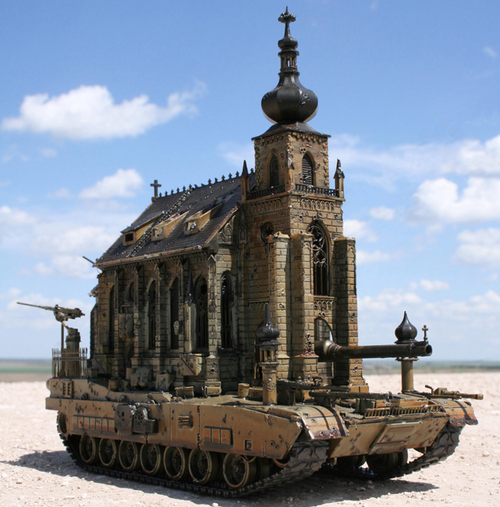
Sight Gag: The Church Militant

Credit: “Church Tank” by Kris Kuksi.

The “Sight Gag” is our weekly nod to the ironic and carnivalesque in a vibrant democratic public culture. We typically will not comment beyond offering an identifying label, leaving the images to “speak” for themselves as much as possible. Of course, we invite you to comment … and to send us images that you think capture the carnival of contemporary democratic public culture.

 1 Comment

Conference Paper Call: Humanising Photography

Humanising Photography

Durham Centre for Advanced Photography Studies (DCAPS)
Durham University, UK
25-27 September 2009

In the early twenty-first century, the still photographic image continues to be one of the central visual technologies of humanitarianism: from the all-too familiar images documenting successive waves of famine and disease, through those that bear witness to the action and destruction of war, to the photo ops staged in the arena of struggles for human rights. Disseminated across a range of media and spanning geographical distances and cultural divides, photographic images are presented for everyday consumption, produced by practitioners often working explicitly in the name of ‘humanity’ and testifying to acts of injustice and states of destitution and abjection.

And yet: this humanitarian deployment of photography has been vigorously attacked from a variety of angles. The contemporary moment is plagued by anxieties concerning an oversaturated visual sphere and attendant compassion fatigue, a state of anaesthesia said to blunt the photograph’s political and ethical efficacy. Humanitarian photography is predicated on humanist principles even after more than half a century spent interrogating and deconstructing the discourses of humanism. Within photography theory, not only have there been sustained attempts to dismantle ontological notions of photographic reference, but documentary has been pilloried as a practice that is profoundly implicated in the perpetuation of liberal capitalism. Despite all this, however, the fact that photographic images of human suffering, deprivation and also resilience continue to circulate and be deployed suggests an ongoing belief in their power to affect and ultimately to effect change.

‘Humanising photography’ is a single-track conference that aims to establish a creative forum in which to reflect on the political, ethical, historical, and aesthetic questions thrown up by the persistent presence of such images in the context of humanitarian discourses. It will bring practitioners into dialogue with scholars working in the academic fields of visual culture studies broadly construed and representatives from humanitarian organizations. Whilst we welcome papers exploring salient contemporary issues and case studies, we especially encourage those that examine other contexts and histories that have been occluded in the contemporary geopolitical moment, in addition to theoretically-oriented reflections.

Possible areas for consideration might include, but are not restricted to:

What modes of humanist photography might still be valid in the twenty-first century?
What are the histories of humanist photography?
What are the tropes, figures and other rhetorical devices at play in such photography and what are their effects?
What is the political and emotional work that is done by this mode of photographic display and does it work?
What are the modes of appeal of such images, whom do they address and on what terms?
How do the modes of circulation and display impact on modalities of affect and effectivity?

Instructions for submission of abstracts
Please send 500-word abstracts for 30-minute conference presentations and a brief biographical note (maximum 5 lines), together with affiliation and contact details to: photo.group@dur.ac.uk.

Deadline for abstract submission: 19 December 2008.

Notification: by 5 January 2009.

 1 Comment

Currently Under Construction: Gray World

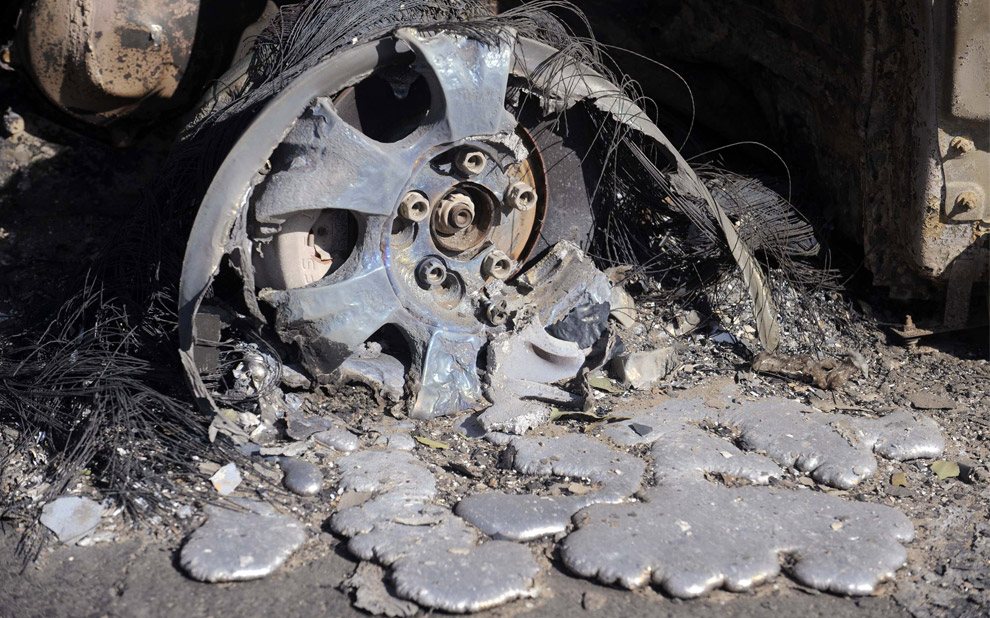
Several months ago in a post entitled Shades of Gray, I suggested that the use of gray tones in photojournalism could make a subject appear otherworldly. Thus, the photograph could alternately buffer the viewer from the those being depicted or reveal an inability to reach across the gulf between different cultures. Even if I got that right, there is more to be said about seeing gray. For one example, take a look at this photo:

The wildfires burning around Los Angeles this week were so hot that they could melt steel. Here a wheel rim has puddled into globs of dull metal. It’s as if the vehicle were being smelted back to its original elements, reversing the long process of civilization that turned iron ore into a truck. The fire might have been started by a match stick–or, more likely, a random lightening strike, one among thousands that happen in the area every year–yet it can become a raging inferno capable of devouring cities. In the aftermath, green shoots will appear amidst blackened devastation and the great cycle of life will continue. But nothing there will put that wheel rim back together. Nature, it seems, is no respecter of machines.

The image is a color photo, of course, and that makes the point all the more poignant. The gray metal isn’t an artifact of the photographic process. Instead, a color print reveals how gray has flowed into view. What had been hidden behind chrome has been released into the environment like lead or some other industrial toxin ready to leach further into the landscape. What had been crafted to help a society hum along now is neither artifact nor nature but that third thing: waste.

Like this:

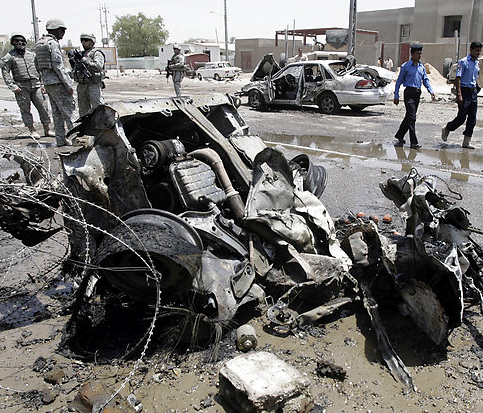
Again, a color photo reveals a world turning gray. It actually took a moment for the colored shirts on the Iraqi police officers to assert themselves into my focal vision, rather than merely providing a felt and uneasy sense of contrast. The wreckage from a car bomb dominates the foreground of the picture and is reinforced by the second smashed vehicle in the center rear. The scene as a whole is tonally consistent with these gray/white wrecks. But for one taillight and other minor reddish hints, this is a world of grays, greens, and other dull surfaces. Whether war zone or concrete yard, it’s a world being given over to gray. No wonder the police seem out of place: colorful, nonchalant, they imply domestic peace and all the life that can be a part of that. They are balanced and then some by the soldiers opposite them, who seem more of a permanent fixture. By contrast, the police are just passing through.

People like to think that wars, like fires, are accidents; and that fires, like wars, could not have been prevented. In reality, the California conflagrations are predictable outcomes of poorly regulated housing development. And the war in Iraq–well, we know that story, and it was no accident. The truth is that for all the art and energy that goes into building up modern societies, they also carry within themselves powerful forces that are continually turning people, places, and things into waste. Alongside familiar scenes of peace, prosperity, and color, another world is also under construction: Gray world, inert yet dangerous, making waste seem like second nature.

Photographs by Phil McCarten/Reuters (thanks to The Big Picture) and Karim Kadim/Associated Press. Note that because NCN doesn’t have a style sheet or a copy editor to keep my erratic spelling in check, I use both “gray” and “grey”; something I learned, somewhat to my embarrassment, when I searched for the Shades of Gray post and turned up more entries under “grey” than “gray.” Both terms are correct, but consistency would still be a virtue were it to be found here. For that, readers will have to look elsewhere.

 2 Comments

The Beauty of War Through a Child's Eye

This past week we honored America’s veterans, but except for a few conventional news stories and ritualistic photo ops the day passed with little notice or fanfare, eclipsed in the national consciousness by trying to figure out who President-elect Obama will appoint in his new administration and political wrangling over how to address the so-called “financial crisis.”  And what has been missed (or is it repressed?) in all of this has been the 150,000 U.S. troops who continue to occupy Iraq (and who are likely to continue to occupy Iraq until at least 2011); the 278 U.S. military deaths and 1,500 + U.S. military casualties that have occurred in Iraq since January of 2008; or the astonishing admission by the Veteran Administration that on average a staggering 18 veterans commit suicide everyday.

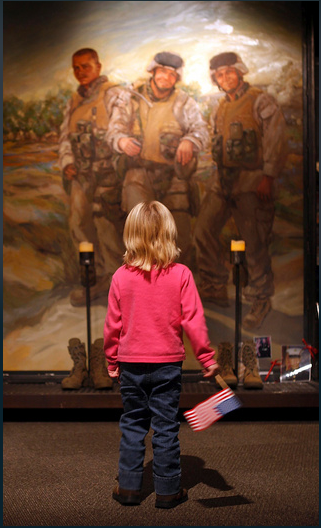
It is against this background that I was stuck by this AP  photograph that showed up in a number of on-line newspaper slide shows this past weekend.

The image is of a young girl as she “looks at a life-size painting of  men from the Columbus-based Lima Company, 3rd Battalion, 25th Marine Regiment, 4th Marine Division” that is part of the Lima Company Memorial at the Cincinnati Museum Center.  Lima Company suffered some of the heaviest casualties of any unit fought in Operation Iraqi Freedom, including the death of 22 brave marines in a very short period of time in 2005.  There is no question but that their service and sacrifice needs to be sanctified in public memory and yet there is something altogether unsettling about this photograph. Part of this (dis)ease is no doubt a recognition of how an innocent child—and a young girl at that—serves as the cipher for orienting the model citizen towards the nation-state as a gendered and infantilized spectator.

Children, we are told, “should be seen and not heard.”  Notice here how the young girl silently directs the national gaze upon the marines even as she holds their attention.  The colors of her hair, sweatshirt, and pants coordinate perfectly with the red, white, and blue of the flag that she holds and thus cast her as the metonymic (and fetishistic) embodiment of the nation-state.  Her shadow marks the corporeal distance of the passive spectator from the painting no less than the candles, boots, and photographs that frame it.  There can thus be no mistaking that the young girl is a passive spectator clearly separated from the scene in the painting—seeing and not speaking or acting.  And so, we must wonder, is she a child citizen or the citizen-as-child?

There is no final answer to this question, of course, but the smiling and approving gaze of the marines seems to suggest a paternal protectiveness of the child/citizen/flag that resonates with normative assumptions of the public as an innocent and passive child and all of that is troubling for those who might imagine a vibrant democratic public culture.  But what if the child was not in the photograph? How else then might we understand the painting as part of a public memorial?

This life size canvas, it turns out, is one of  eight panels portraying all 22 marines from Lima Company painted by Anita Miller, a liturgical artist motivated  “to paint images that open the viewer’s eyes to the beauty of the world.”  In each of these eight panels we have portraits of two or three of the deceased marines and in each instance we are presented with a smiling and caring countenance.  And there can be no doubt that the images offer comfort to those who knew and loved these men as friends and family members within the contours of private life. But when cast as a  war memorial the appeal to the spiritual beauty of the individuals doing the fighting diverts attention from the sheer ugliness that is combat regardless of the cause. War’s “beauty”—if that is the right word—is terrible, and that is a lesson that we forget at our peril.

And so, once again back to the photograph and the young child who gazes upon the scene with what we can only imagine is beatific awe and admiration.  And the question here must be, is this the best way to transport the civic virtues of sacrifice and service from one generation to the next?  I am not so Pollyanna as to believe that wars will never be needed—though hope springs eternal— but I never want my children to think of war as “part of the beauty of the world” or that those who do the fighting do so with a “smile” upon their face.  We owe the men of Lima Company more than that.

Photo Credit:  Ernest Coleman, AP Photo/The Enquirer


 5 Comments

Sight Gag: Would Twer That It Were True

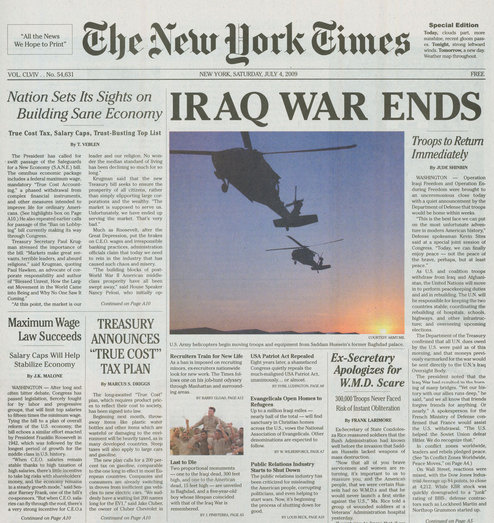
Credit: The Yes Men and Gawker

“Sight Gags” is our weekly nod to the ironic and carnivalesque in a vibrant democratic public culture. We typically will not comment beyond offering an identifying label, leaving the images to “speak” for themselves as much as possible. Of course, we invite you to comment … and to send us images that you think capture the carnival of contemporary democratic public culture.

 0 Comments

A New Aesthetic of Patriotism

Guest post by Marita Sturken

Of the many seismic changes signaled by this election, one is surely a change in the aesthetics of American political culture. Not only is Obama telegenic in a way that we have not seen in decades, but the aesthetics of his campaign and of the image economy that emerged around his candidacy signal a new kind of aesthetic, one that is embedded within a contemporary image culture of pastiche, play, and savvy image-making.

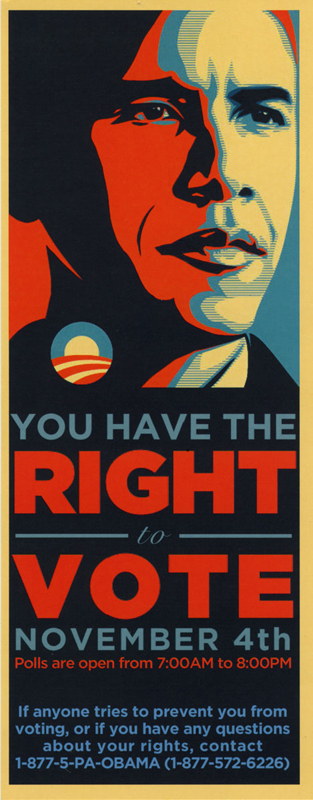
Let’s take, for instance, this flyer, which was handed out by volunteers in Pennsylvania in the last get-out-the-vote push (it was created by the Pennsylvania Democratic Party, not the Obama campaign). The flyer has a very specific informational intent (its reverse side gives information about voter rights and explicitly counters the misinformation campaigns intended to confuse voters), yet it is a strikingly visual document. It is derived from a poster that was made in support of Obama by Shepard Fairey, a street artist who became know for his Andre the Giant graffiti in cities such as New York, who has since made his name through a clothing line and his Obey Giant logo.

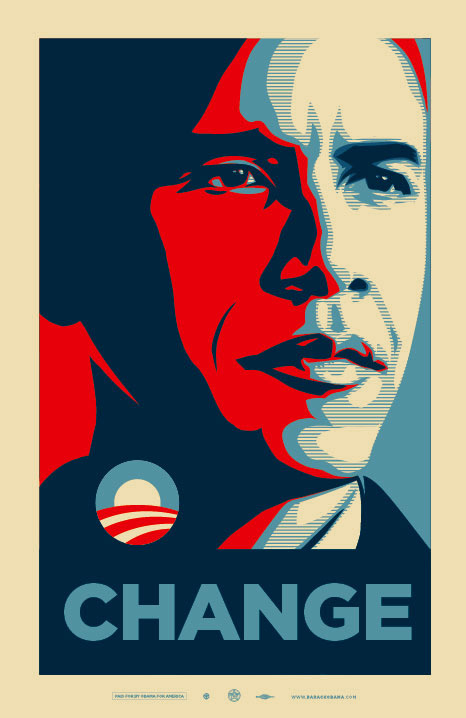
Fairey is emblematic of a new kind of cultural producer, at home with commerce and cultural politics simultaneously. In the new edition of our book Practices of Looking, Lisa Cartwright and I analyze the widely circulated Fairey-Obama posters (one features “Hope” and one “Change”) as both evocative of the historical image of JFK and as deploying the visual style of graphic poster design used by the Bolshevist agitprop artists of the 1920s. The graphic newsprint-like reproduction gives the work a sense of political urgency, playing with the idea of the image (and political figure) with mass appeal. The aesthetics of the image convey the spirit of progress and hope experienced both in the early Soviet context and in the Kennedy era. Contemporary viewers might be expected to read the poster’s graphic style as evoking a very modern kind of hope and optimism recoded within a savvy postmodern culture. The elegance of the poster is worth noting, with its deployment of a blue that is lighter than the stars and stripes blue, and a yellow warm tone—evoking yet not fully using the conventions of the red, white, and blue.

Of course the Obama logo (seen on the flyer) has already received significant attention (it’s been referred to as the “hardest working presidential candidate logo”) with its clever play on the “O” of Obama with the image of a sunrise evoking change, and its color scheme subtly signifying patriotism and the flag. Simple, evocative, smart. It was designed by Sol Sender of Sender LLC in Chicago in collaboration with mo/de, and was used in highly adaptable ways in the campaign. This week’s post-election coverage signals that the “O” will be played with throughout Obama’s tenure in office in headlines, political cartoons, and images (see, for instance, the cover of this week’s New Yorker).

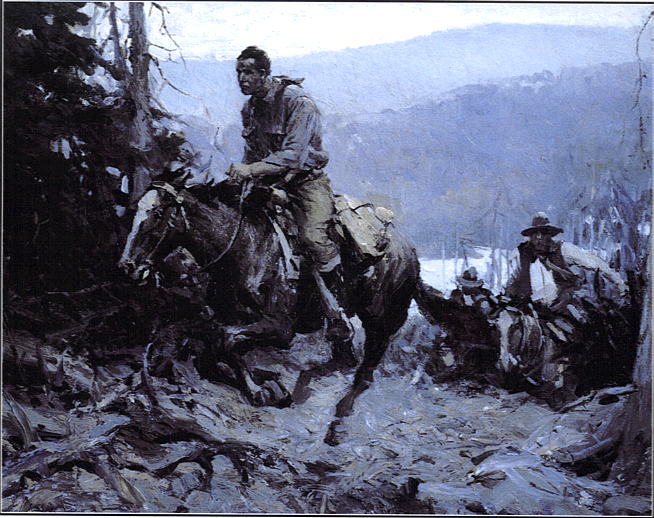
It was amusing to hear that when Bush showed Obama the Oval Office for the first time this week, he took him on his standard tour of the kitschy artifacts in his personal collection on display there (one can see this tour on the White House homepage). Presumably the tour included his painting A Charge to Keep, which depicts a lone cowboy riding his horse up a hill followed by a pack of riders, an image from a pulp cowboy story about a thief fleeing a posse that Bush had mythologized as the lone “determined horseman” who has a “difficult trail.”

One can only imagine the aesthetic disconnect the president-elect might have felt in that moment, and perhaps in quietly “measuring the curtains” he might have considered for a moment what kinds of images he would take with him to the White House.

Sidney Blumenthal has written on Salon.com about the “peculiar aesthetics propagated in the age of George W. Bush” with its “contradictory styles of softening nostalgia and hardening cruelty.” Blumenthal saw the Bush kitsch as a rejection of the Reagan-era kitsch of patriotic sentiment, stating that “under Bush, kitsch has been transformed from sentimentality to sadomasochism.” The kitschy (and brutal) cowboy aesthetic of the Bush Administration has finally run its course, and a new aesthetic, one that rejects kitsch for a nuanced play off the visual codes that evoke America, is emerging in its place.

 5 Comments

We the People, One by One

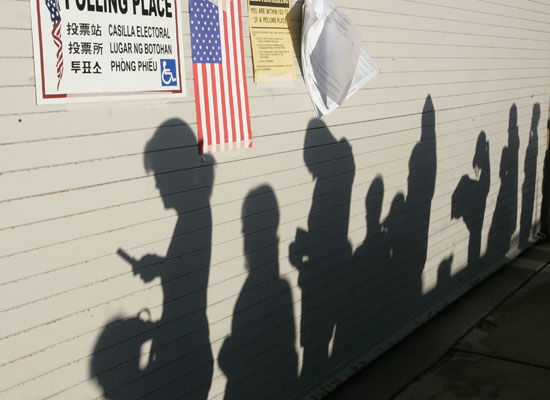
The worldwide celebration of Obama’s victory has made it clear that this election was about much more than turning out the vote. Nothing less than the nation’s soul was on the line. Individual voters need not have seen it that way, but this was one of those moments when the collective significance of the outcome went far beyond any individual interest or conventional political preference. The US was at a fork in the road, and only one candidate even knew that was so. Because he won, the election brought people together again on the best of terms: committed to equality, justice, freedom, and a better future for all. Democracy in American seems to have proved itself once again.

I think that the outcome is even more remarkable yet. Here’s one reason why:

This photo is a particularly good example of the hundreds of shots that were put up on November 4 and the day after. The slide shows featured long lines of ordinary people with their coffee cups and other paraphernalia of everyday life, all waiting together as if one community. But they weren’t a community pure and simple, and this image shows why. The silhouettes capture habits that might be overlooked when seen directly: each person is standing apart as a single individual. The sharp shadows also feature details of individual preoccupation that emphasize the point: a cellphone, book, or magazine are in each case technologies for avoiding interaction with the person next to you.

There are good reasons not to have to talk to a stranger for three hours, and I’m not going to knock any of the things people do to pass the time. But we ought to note that photographs such as this one record the social habits of a liberal democracy, that is, a democracy that has developed sufficiently to make individualism second nature. These people typically will be strangers to one another, gathered together for only a few minutes every several years. Otherwise they live their own lives and, as Tocqueville noted almost two centuries ago, sever themselves from the community and willingly leave society at large to itself (Democracy in America, vol 2, Bk 2, chapter 2). According to Tocqueville, modern democracy doesn’t drive people to become a multitude, but just the opposite: to individuate to an extent that first “saps the virtues of public life” and eventually “attacks and destroys all others and is at length absorbed in selfishness.”

Tocqueville’s claim can explain a lot of the habitual practices of American society, but not the election. The miracle of November 4 is that the majority of the voters affirmed a return to public virtues. They did so as individuals, as they is what they are, but they voted more than their individualism.

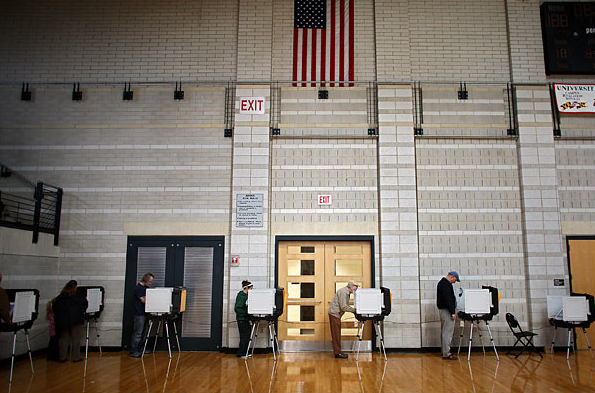
Our awareness that Americans are individuals rather than one people in shared solidarity leads to a second reason to appreciate what can be accomplished in a voting booth. Another of Tocqueville’s insights was that individual autonomy both elevates and dwarfs the individual. “When the inhabitant of a democratic society compares himself individually with all those about him, he feels with pride that he is the equal of any one of them; but when he comes to survey the totality of his fellows . . . he is instantly overwhelmed by the sense of his own insignificance and weakness” (2.1.2; and my apologies for the gender specific diction in the Reeve translation). In short, it is easy to recognize that your vote doesn’t count. A rational voter wouldn’t vote, and especially when one factors in not only the other voters but the enormous size, complexity, and power of the modern state.

I think this photo captures the paradox perfectly. Each of the voters is small, isolated, and surely incapable of matching the institutional power and inertia represented by the wall of the building behind them. That wall–complete with flag high above the rest, not to human scale–has all the features of governmental authority, impersonality, and indifference. And yet they vote as if they don’t know any better. Because they vote, democracy happens. It happens among strangers, among individuals devoted to living private lives, among people who have no power to speak of otherwise. It’s a miracle.

Photographs from huffingtonpost.com and Chang W. Lee/New York Times.

 0 Comments

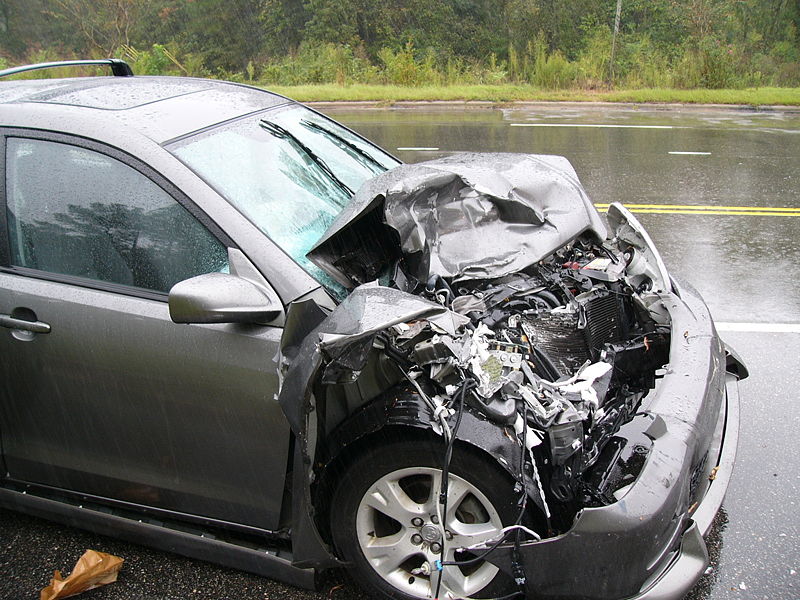
CRASH!

NCN was down from about Saturday noon until early Monday morning.

Need I add that John and I were clueless about what to do beyond emailing tech support? Thanks to David Huffaker at Northwestern for helping out and to the Dreamhost staff for the repair. Everything seems to be back to normal, but if you encounter problems, please let us know. We should be back to our regular posting schedule by Wednesday.

 0 Comments

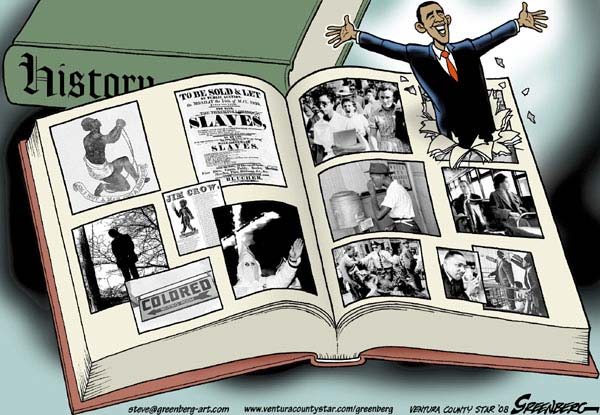
Sight Gag: A Visual History of the United States

Credit: Steve Greenberg

“Sight Gags” is our weekly nod to the ironic and carnivalesque in a vibrant democratic public culture. We typically will not comment beyond offering an identifying label, leaving the images to “speak” for themselves as much as possible. Of course, we invite you to comment … and to send us images that you think capture the carnival of contemporary democratic public culture.

 1 Comment