Mar 08, 2009
Feb 01, 2009
Feb 23, 2017
Jul 12, 2009
Oct 13, 2010
Aug 16, 2013

Obama, Aesthetics, and the Way Forward

Guest post by Aric Mayer.

Let me just come out and say it. Barack Obama’s landslide victory on Tuesday is the greatest moment in politics for my generation. This is the fifth presidential election that I have voted in, and it is the first where I feel as though the country is being moved by the collective will of its younger citizens. As an eyewitness to many of America’s great domestic tragedies over the past eight years, this election affects me deeply and I can’t write outside of the relief and hope that it brings.

With that said, all is not champagne corks and confetti.

I want to draw your attention to two images by Alan Chin taken in Chicago at the Grant Park celebration where Barack Obama gave his acceptance speech as president elect.
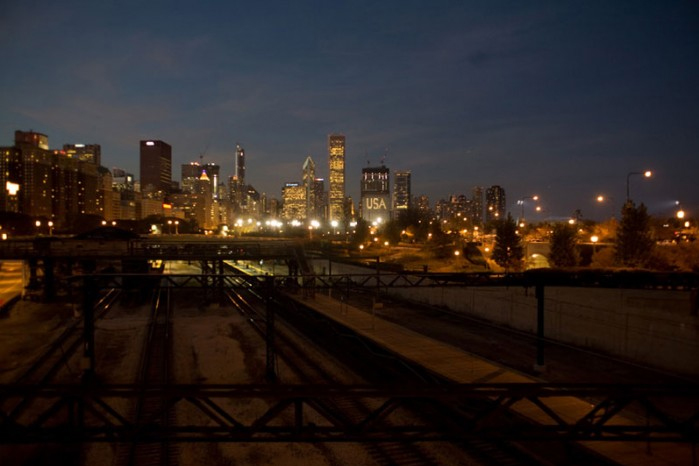
Here the viewer stands alone while looking out over empty railroad tracks at Grant Park with the Chicago skyline spreading across the horizon. In the distant center, the letters USA are shining off of one of its buildings. As a symbol, a city represents the best of human cooperation and achievement. There is promise ahead. And it is going to take real work to get there.

In his acceptance speech Obama looked tired and sometimes grim. He knows what is ahead. Obama has often quoted Reinhold Niebuhr, the moral philosopher who wrote about the destructive nature of power and how it is sometimes necessary to use it even as it corrupts you. Obama inherits two lengthy and costly wars, the near bankruptcy of our own domestic policies, an American economy in free fall and a world economy that appears to be teetering on the edge of the unknown. But as dark as this may seem, the alternative was even darker. John McCain’s last efforts at character assassination and fear mongering left him in the isolated position of having nothing to win but a completely fractured constituency.

The election on Tuesday was won in part through the unprecedented turnout of minority and young voters. It ultimately came down to a contest between the nuanced, hopeful and inclusive pluralism of Barack Obama and the entrenched fears of a segment of conservative white working and middle class voters that was the final platform of John McCain’s candidacy. In contrast to the fear being spread by the McCain campaign, Obama focused on statesmanship, policy and the choice of pragmatism over idealism in forming a new government in America. In a theatrical paradox, while drawing huge crowds Obama frequently played down the drama to the extent that newspaper editorials began to call him boring.

What was happening though was not boring at all, but was and is a ground shift towards pluralism, nuance and complexity with aesthetic consequences. As Obama’s campaign traced its arc from the Democratic Convention until Tuesday night, he clarified his message by moving away from the inflammatory and the incredible and towards the gritty and the pragmatic. To live in a multidimensional society we must recognize that while our own positions are uniquely ours, they do not make up the entire country. The post baby boomers who had such a powerful impact on this election have been accused of self absorption and narcissism, frequently by baby boomers themselves. But there are advantages to self absorption within context, for it reveals the limits of self. It helps to know oneself in order to make room for one who is unlike you. At the heart of this is an acceptance of the “other” and a grass roots rejection of fundamentalist divisions along ethnic and racial lines. What is emerging in America is a more truly plural constituency. At the same time, the depiction of the American Dream as a place and an experience where you can have it all is being replaced by pictures of collapsing markets and a very uncertain economic future. The Great Depression and the New Deal brought us documentary realism. It remains to be seen what will emerge for us out of the current growing crises.
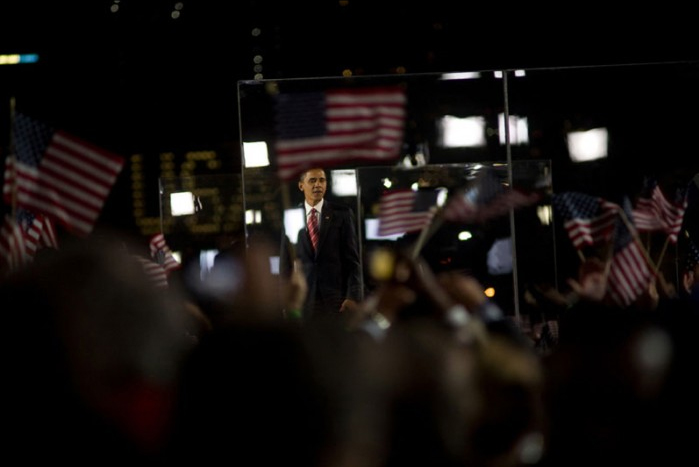
In the second image, Obama is surrounded by waving American flags. It is a triumphant moment, framed by reminders of danger. The bullet proof glass is already in place. In the back left the letters USA appear on an electronic ticker, the same lettering that streams up to the minute data of the market turmoil. There is a balance of hope and realism.

We need to cultivate this balance. Obama wrote it into his speech. While warning us of the difficulties ahead, he still took the time to remind us that there will be children and a new puppy in the White House. A new generation in American politics begins.

A complete slideshow of Alan Chin’s images from Grant Park on November 4 is available at BAGnewsNotes.
 3 Comments

American Democracy Prevails

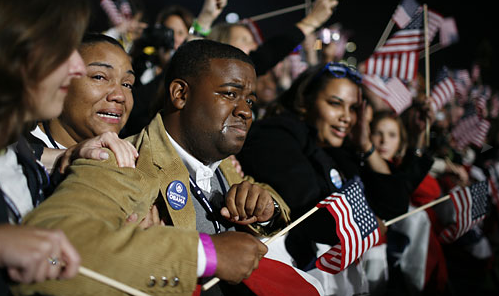
There are thousands of photos today of people throughout the US and around the world celebrating the Obama victory. These come on top of the hundreds put up yesterday of Americans standing patiently in long lines to vote. I finally stopped my search for the elusive photo that would capture it all. That photo doesn’t exist, but I kept coming back to this one:

The celebration is there, like the patriotism that was always there, but the joy of having finally overcome one great barrier should never erase the pain that lies within that story. This is a time for smiles and cheers and the renewal of hope that is so essential to democratic life–but it also is an occasion that can only be truly comprehended through tears. The sob welling up in this man’s face speaks volumes about how much he and so many others have suffered quietly, painfully, their grief and frustrations hidden away form public view lest they be made worse yet. Today, however, a great transmutation is taking place, and pain can finally be converted into joy.

This transformation in the individual heart can occur only because democracy worked as it is supposed to work. For all the flaws and demands and sheer theatrical excess of the electoral campaign, the election made official what are real changes in American society. Look at the others in the photo: not only the diversity but also the comfort level of those being crowded together. This new, good vibe has been evident in the Obama campaign all along, and the fact that it was able to prevail over proven tactics of fear-mongering, character assassination, and a vicious nativism is one of the great achievements of this election.

Forty years ago Martin Luther King, Jr. was assassinated, the cities went up in flames, and the democratic process itself seemed to break apart as Chicago police brutally clubbed hundreds of people gathered in Grant Park to protest the Vietnam War. Forty years later, Barack Obama was elected president as Grant Park filled with over 200,000 people celebrating real change within the cities and across the nation. What may be most remarkable about this victory is that it was achieved without revolutionary disruption. Look again at the photo above and at the thousands of other photographs of this election: They record nothing but the ordinary procedures and rituals of an American election, and they do so using nothing but the regular conventions of photojournalism. And that is enough. There is no need for revolutionary iconography or artistic innovation. Ordinary people standing in line, recording their vote, gathering for a speech, celebrating in the living room or bar or street or park–just like you’ve seen before. But with a difference–and it is that combination of historical change with ordinary democracy that provides real hope.

Photograph by Damon Winter/New York Times.

 6 Comments

The Visual Codes of Racism

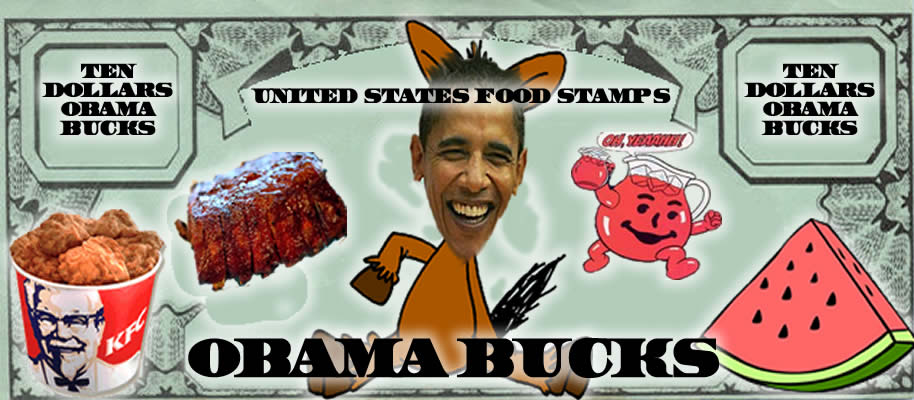
Racism is the American tragedy, and as the current political campaign reminds us, it comes in many shades and colors.  Sometimes it is explicit, as when a Georgia bar owner visually compared Senator Obama to a playful monkey, or more recently when a San Bernadino Republican group distributed Obama Bucks adorned with visual racist stereotypes linking African Americans with watermelon and fried chicken.  At other times it is a bit more subtly coded, as when a nationally syndicated political pundit emphasizes “blood equity” rather than “race or gender” as a sign of one’s fitness to be president, or when the current housing crisis is blamed on the efforts of ACORN, a “community organizing group,” to facilitate mortgages for “low income groups” and  “inner city” residents rather than, say, on those within the financial industry who targeted such communities for subprime loans in the first place.  All forms of racism are troubling, especially for a nation dedicated to social and political equality, but in some respects these more subtly coded versions are all the more pernicious because they operate under a thin veil of interpretive ambiguity that enables such advocates to absolve themselves of the responsibility to acknowledge (let alone to justify) the insidious implications of the views that they espouse.

Consider, for example, this photograph published in an online slide show at the Washington Post this past week:

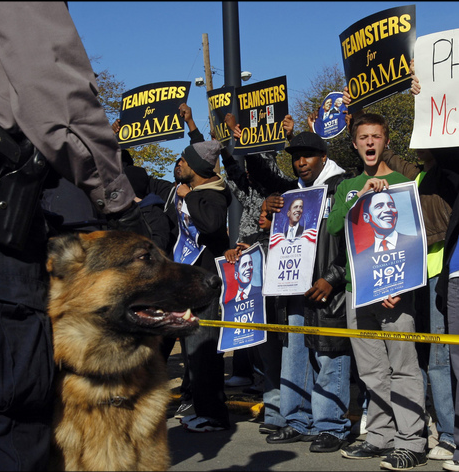
The caption reads: “Police officers accompanied by police dogs, stand guard near supporters of Democratic presidential candidate Barack Obama outside a campaign stop of U.S. Republican presidential candidate John McCain in Sandusky, Ohio.”  At first blush, everything seem reasonable enough.  After all, presidential candidates need security, and crowd control is a valid concern for local police departments, even when the purpose of a large event does not engender the high visibility of a hotly contested political campaign. The presence of the police at such an event is a legitimate usage of state authority to maintain public order that should not even raise our eyebrows.  But of course there is something disturbing about the scene captured by this photograph and it warrants our careful attention.

A defender of the scene might argue that the photograph clearly marks the tension between “security” and “liberty” that is symptomatic of political culture in a liberal-democratic polity. The pivot point, one might note, is the yellow police line that marks the often tenuous division between public order and chaos. Shot from an oblique angle, the image distantiates the viewer from easily aligning with either the police officer and dog (the signs of public order) or the Obama supporters (the signs of potential disorder); it thus invites and implies a degree of viewer objectivity that encourages us to treat such tensions as regular and ordinary: protest is legitimate within bounds, but so too is the exercise of state authority, and as long as the two operate in careful equipoise all is well.  But, of course, such an analysis begs the larger question:  Why the guard dogs?  What is about this particular event that warrants the presence of dogs trained to kill upon command to guard the public welfare against what appear to be peaceful and orderly Obama supporters? 

There are no doubt answers to this question that deny any racist implications to the image or the scene it records, but as with those who invoke specific racial stereotypes only to deny any racist implications to their comments, such responses willfully  ignore the history and symbols of American racism writ large.  And one prominent symbol of that racism has been the use of dogs to manage and control African American populations.  Dogs were regularly used to hunt down escaped slaves or to otherwise keep unruly slaves “in their place” in the 18th and 19th centuries, and in our own era they have been used by the police to intimidate and control nonviolent black marchers and protestors as during the civil rights movement of the 1950s and 1960s.  The presence of the dogs at this rally thus function, at least in part, as an altogether insensitive symbolic reference to the “unruly” slave and the “rabble” of  black protesters, particularly as the protestors/supporters are divided from the forces of order by a police line that implies that they stand on the other side of the law.  But lest I be accused of a too simple “political correctness,” there is more, for the presumed legitimacy of the very presence of guard dogs—and why else would the police use them but for the belief that they were necessary to maintain the peace—contributes to a culture of racial fear and anxiety that manifests itself in comments like those reported recently on NPR by concerned white citizens who worry that if Senator Obama loses the election there will be race riots across the nation.

Of course, the presence of a single symbol of racism at one political rally will not, by itself, animate or sustain a culture of racism and racial anxiety—or at least not for very long.  The problem is that at some point the accumulation and concatentation of such symbols, explicit and subtle alike, reinforce and eventually naturalize one another.  And when that happens it becomes increasingly difficult to resist the power and appeal of their “common sense” pretensions.  The only antidote is to develop the verbal and visual literacy necessary to understand and interpret such codes for what they are and to be guided, in the end, by what Martin Luther King referred to as the “true meaning” of our national creed that “all men are created equal.”  

Photo Credit:   Brian Snyder/Reuters

 2 Comments

Sight Gag: The Eyes of Alaska Are Upon You (Vote!)

Photo Credit: Pat Wellenbach/AP

“Sight Gags” is our weekly nod to the ironic and carnivalesque in a vibrant democratic public culture. We typically will not comment beyond offering an identifying label, leaving the images to “speak” for themselves as much as possible. Of course, we invite you to comment … and to send us images that you think capture the carnival of contemporary democratic public culture.

 0 Comments

Summer Institute: Photojournalism and Public Culture

Visual Rhetoric: Photojournalism and Public Culture

summer institute for graduate students and faculty

June 22-26, 2009

Pennsylvania State University

Directed by Robert Hariman (Northwestern University) and John Lucaites (Indiana University)

Using photojournalism as our leading example, this seminar will explore basic questions regarding the analysis of visual images as artifacts for experience, advocacy, deliberation, and reflection in democratic societies. Images will be drawn from historical and contemporary news media and trade publications as well as alternative media, cultural forums, and vernacular practices. The seminar also will address concerns regarding the objectives, methods, and rigor of scholarship regarding visual culture. Participation in the seminar will include writing for possible publication online at nocaptionneeded.com or other blogs.

The workshop is part of the biennial summer institute sponsored by the Rhetoric Society of America. The fee is $400 ($450 for nonmembers, which includes a one-year membership in RSA) and includes lodging and some meals.

For additional information, including scholarship opportunities, click here. The application form is here.

 2 Comments

For Sale: The Bush Years

With six days until the election, the hope is so strong that I can taste it. Soon the final, mad rush of campaigning and reporting will rise to its final crescendo, and then there will be the day of reckoning. After that, a party or two, but then the sober realization of just how much needs to be changed. Where to begin–with a long, dazed look backwards at what actually happened, or all around to assess just how bad the damage is? What will it mean to take a hard look at where we are and what habits are still in place?

Well, it might mean looking at how artists from around the world have depicted Bush’s America.

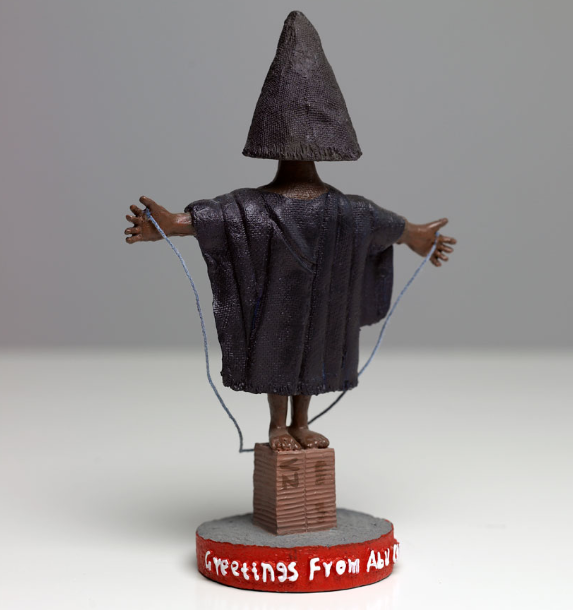
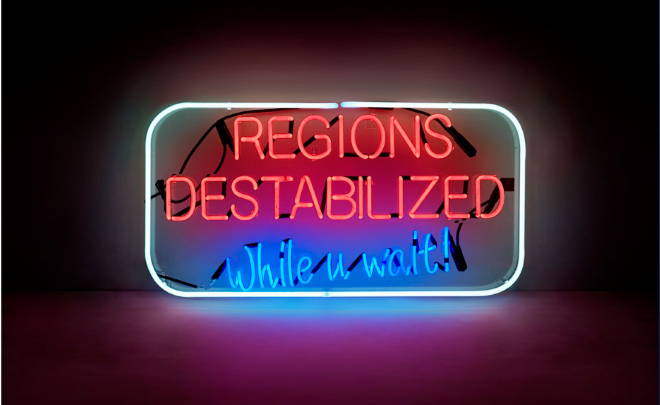
This bubble-head figure is from an exhibition by Phillip Toledano entitled “America – The Gift Shop.” Toledano asks, “If American foreign policy had a gift shop, what would it sell?” His answers involve an uncanny fusion of criminal government policies and commercial brick-a-brack. In a stroke, Toledano captures the enormous gap between day-to-day experience in the US and the terror perpetrated by the Bush administration in Iraq. Equally disturbing is his demonstration of how the crimes might be miniaturized or otherwise diminished by those whose lives are defined by retail consumption. I’ve seen many appropriations of the iconic image from Abu Ghraib, but this is the only one that really drained it of most of its moral force. What might be disregarded as merely clever artistry in fact does something much more difficult: it reminds us that human beings can get used to anything.

It is imperative that Americans not become accustomed even in part to the policies of the past seven years. The clock needs to be turned all the way back at the justice department, state department, treasury department–just to name the obvious–and elsewhere, even as the government and the society move forward to do better than that. Until that happens, the change that is needed will be too little, too late.

Bad habits die hard, and there always will be those at home and abroad trying to use them to their own interests. Too many people have made a lot of money or acquired a lot of power off of the War on Terror. All the more reason to turn to those artists and intellectuals who can reveal just how much went wrong and why one can’t assume that wrongs will be righted and habits changed as a matter of course.

America the Gift Shop is an exhibition at The Apartment, a design agency in New York City. Abu Ghraib Bubble-head; moulded resin, 7″, 2008. Regions destablized while-u-wait; neon, glass, 20″ x 30″, 2008. Thanks to Conscientious for finding this great work.

 1 Comment

The American Gulag

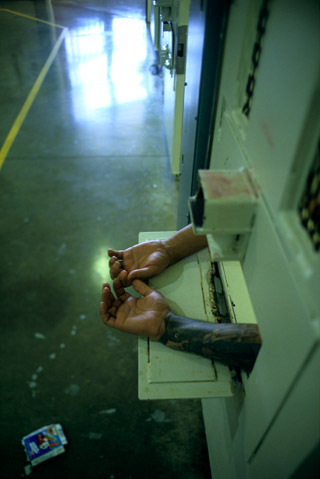
The prison system in the United States gives a hard meaning to the adage “out of sight, out of mind.” Just as the prison keeps its inmates out of public view, the buildings themselves are placed well off the main roads in what are often economic dead zones. Few ever go by the place, and no one ever needs to go inside unless you work there, are making a delivery, or want to visit with an inmate. And most of those people won’t be allowed to see anything like this:

This stunning photograph by Andrew Lichtenstein shows a prisoner’s hands being held out in order to be handcuffed before he is taken to a shower. I find the image deeply disturbing–as if it were something I would see because I was already insane, looking down the asylum hallway and still accosted by hideous visions distending reality. The hands lie there as if the body is a corpse, worse, as dismembered body parts. The sickly green color scheme, hard surfaces, and sharp, metallic fixtures are a nightmare of institutional authority gone horribly perverse. The red stains on the wall and the white stains on the linoleum floor look like traces of bodily fluids, and the yellow lines suggest a steady traffic in gurneys and terror always rationalized by official procedures.

The image doesn’t tell only one story, however. Those hands may be murderous. Tattoos are commonplace today, but in this tableau the heavily tattooed arm seems demonic, as if the outer sign of snakes writhing within. There seems to be no place for innocence in this world, which can only provide further justification for rough justice, inhumane conditions, and policies that do more to perpetuate violent crime than prevent it.

This marked, abject body waiting to be shackled is a fitting reminder of the cesspool at the end of America’s criminal justice system. (“Criminal justice system”–a phrase in which each term twists the others.) The US has the highest incarceration rate in the world; only Russia is even close, and the European states are far, far below. The causes include both excessive income inequality and the disintegration of the family. Given that both conservative and liberal arguments are proved correct, you might think that a strong bi-partisan effort could be made to keep millions of Americans out of prison. Think again, for why would anyone bother to fix something they never see?

This image and others like it can be seen in the exhibition “Behind Bars: Photographs by Andrew Lichtenstein” through January 4, 2009 at fovea in Beacon, New York. Lichtenstein’s portfolio includes the eloquent book Never Coming Home, which documents the funerals of eight soldiers killed in the Iraq war. You can see one of those heart-rending images in an earlier post at this blog on Shared Suffering in Iraq and America.

 10 Comments

Sight Gag: Breaking the Glass Ceiling


Credit: Anonymous (brought to our attention by Cara Finnegan)

“Sight Gag” is our weekly nod to the ironic and carnivalesque in a vibrant democratic public culture.  We typically will not comment beyond offering an identifying label, leaving the images to “speak” for themselves as much as possible.  Of course, we invite you to comment … and to send us images that you think capture the carnival of contemporary democratic public culture.

 3 Comments

What We See and What We Know

Guest post by Aric Mayer.

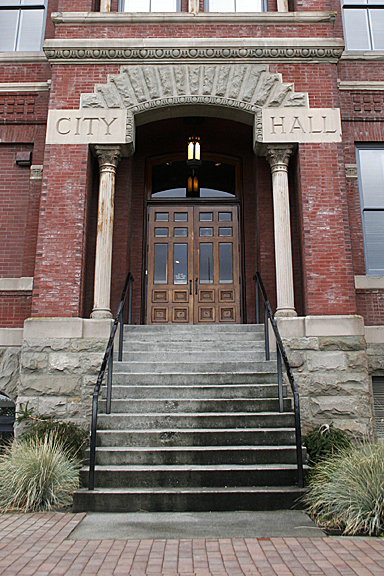
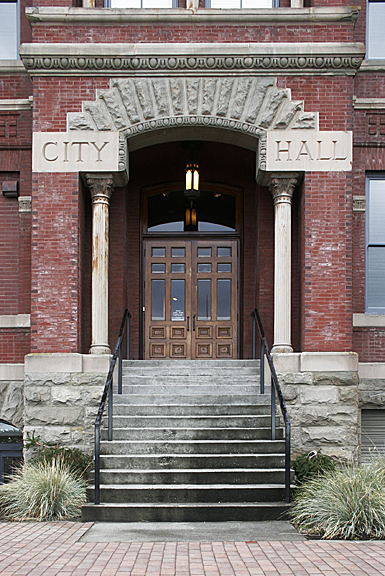
Consider for a moment these two mundane photographs taken this morning. In their differences lies a subtle insight into the Western mind.

In the first image, the columns and porch are recorded looking up with the vertical lines receding away from the viewer and converging somewhere in space off the top of your screen. For the second image I have corrected this so the vertical lines are parallel. In both the brick in the foreground creates receding lines that emphasize the horizontal space moving away from the viewer. For the purposes of this post I will skip the technical means by which this is done in camera and instead focus on what this means for how we see.

To understand this better, let us travel back in time to the early fifteenth century when there comes into painting the theory of two point perspective. This opens up the world for realistic depictions of a single point of view. For the first time space is rendered as though it is being seen through a single eye, rather than through the multiple viewpoints of the previous ages. It is architecture that makes this possible, for the theory of two point perspective relies on the understanding that the world, or at least the man made world, is made up of parallel lines that remain equidistant from each other in reality and in perception appear to converge as they recede away in space.

If you spend time with paintings from the Renaissance to Modernity, you will see that the sophistication of the way space is rendered as it moves horizontally away from the viewer grows. But almost universally the vertical axes remain vertical. This corresponds to how we know the world to be. Up is up and down is down. But this is not how we see. If you stand at the base of a tall building and look at its middle, you will not see it as a rectangle, but more as a cone where the top is much smaller than the base. The vertical axes are not
straight up and down. They conform more to the way space is rendered in the first image.

Optically speaking, vertical axes are possible only when our eye is pointed directly at the horizon, thereby creating a balance between earth and sky, with each occupying an equal amount of perception. In this case the viewer is visually located between the two. To experience this personally, stand near the base of a tall building and look through the building towards the horizon. You will perceive with your peripheral vision that the vertical lines of the building above you do not converge but go straight up as we know them to do. The ground will also occupy about the same amount of perception as the building does. Perceiving vertical axes seems to ground us with a sense of balance.

Consider again the above images. The first image seems to dominate the viewer, looming slightly while the second is arranged in the picture frame in balance as we know the building to likely exist. The feeling is subtle but distinct in its difference. As you look at photographs, pay attention to how these axes are recorded. They can be manipulated to create different senses of space and feeling within the image.

 0 Comments

Vernacular Photojournalism in the War Zone

For all the excitement of the US presidential election, Iraq and Afghanistan are still war zones where people are struggling to live in conditions that fall far short of the American Dream. You wouldn’t know it from the American media, however. Fortunately, there are other reminders of both the damage done and the people still there–in short of obligations that remain.

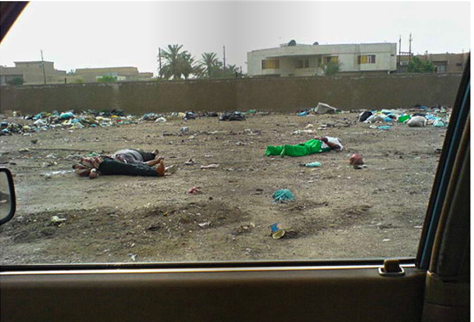
Baghdad Calling, by Geert van Kesteren, is a remarkable collection of images taken by ordinary citizens in Iraq and elsewhere in the Iraqi diaspora across the Middle East. The photo above has strong resonance with professional war photography. Coverage of the Iraq war has included many scenes framed by a car window, and of dead bodies on the ground which harken back to the famous photograph by Mathew Brady of “Federal Dead on the Field of Battle of First Day, Gettysburg, Pennsylvania.” But the photo above is hardly a study in artistic allusion. Knowing that this is a scene from daily life gives it a special fascination and horror. This is not “the war” but somebody’s neighborhood, a place where kids might be scrounging around looking for cool junk. Or worse, the car could be driving through the back lot because those inside are hoping they won’t find the body of a loved one.

That emotional response to the photograph is supported by a realism that makes it a worthy heir of Brady’s image. Brady showed the world that “the fallen” become corpses that bloat in the heat. Now look closely at the photo above. The man on the right has his arms tied behind his back. One of those on the right may have been dismembered. Despite our familiarity with photographs of destruction, this is not what one wants to see while riding in the car. Welcome to Baghdad.

And what would you do if you had to live amidst violence? Well, one solution is to get a hot car.

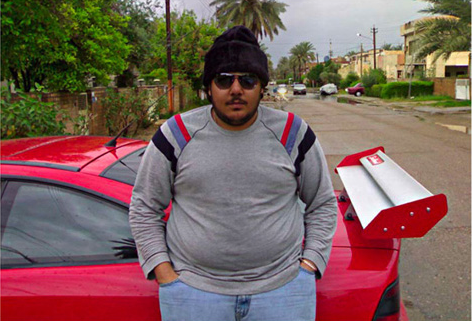
This photograph may be more jarring than the one above. It certainly is not what one expects to see coming out of coverage of the war. Nor would you see it at an automotive fair or a fashion show. This guy is not rich and not cool, neither sleek nor fast, yet he’s doing what he can to to make that small car into something beautiful, and his life into something of his own making.

The scene is perfectly still–perhaps even more so than the first, which carries the sense of the interrupted motion of the car and the transitoriness of human life. Yet the motionless pose contains a cascade of contrasts. This is a domestic scene, not men at war; his casual clothes are further diminished by the sheen of the car; the car is diminished by the ideals of automotive power and design it evokes; he appears clownish by comparison to the Hollywood fashions implied by the hat, sunglasses, and car. The result is a complex emotion of both the vicious derision within all social hierarchy and astonishment or even admiration at his being there at all. Isn’t he supposed to be dead, or killing someone, or at least staying out of sight behind the imperial guard?

This image documents reality just as deeply as the first does. Where one exposes how war terrorizes people while turning them into trash, the other documents the sheer persistence of the desire to live a normal life. The image captures a triumph of self-respect, and precisely because he can stand up even though everything he has is less than ideal. That is exactly how each one of us gets through the day.

The problem, of course, is that some people have to do so against much worse obstacles than others. And what is needed is not sentimentality, but political accountability.

Van Kesteren’s work is also part of an exhibition “On the Subject of War” at the Barbican Art Gallery through January 25, 2009. Note also the commentary by Geoff Dwyer at The Guardian. You can link to the book at Amazon.com here, or to his earlier book on the Iraq war, Why Mister, Why?

 4 Comments