Aug 24, 2011
May 14, 2012
Jan 28, 2013
Nov 06, 2009
Apr 14, 2013
Dec 09, 2009

In Search of the "Real Economy"

The recent economic “downturn” is being treated as a world historical event and that means that photo editors have been searching furiously to find the iconic image of the event, a problem made somewhat difficult by the fact that economic traumas are not nearly as easy to visualize as wars or natural disasters.  And the result is somewhat amusing as one after another the various newspapers emphasize an almost endless parade of images of stock brokers and fund managers from around the world depicted in various degrees of emotional distress, mute witnesses to a roller coaster of numbers scrolling across black and green screens and monitors. Elsewhere, and at the same time, news stories wonder when the effects of the most recent “bubble” to burst will be felt in the “real economy.”  To be sure, the effects of the current economic situation are palpable; many who don’t deserve it face serious financial hardships in the years ahead, and I don’t mean to diminish the significance of that in any way. And yet, two photographs that appeared in tandem as part of a slide show at The Seattle Times this past week (10/17/08) put it all in a perspective that it would be good for us to think about.
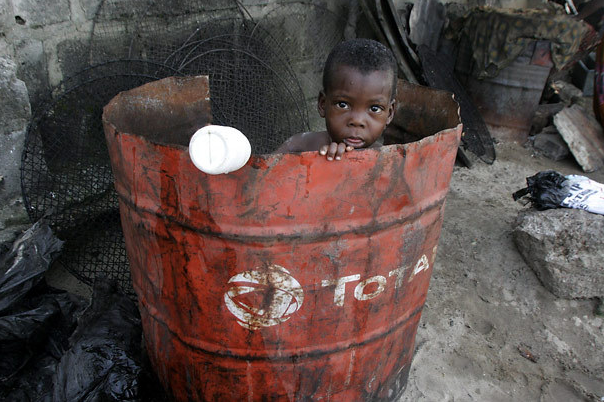
The first image is of a young child in Lagos, Nigeria playing in a dirty and rusted out oil drum in what appears to be a garbage dump of some sort.  The picture is used to promote World Poverty Day and it channels all of the pathos of images commonly used by NGOs to encourage charitable contributions—perhaps you can’t solve all of the poverty in the world, such ads typically intone, but surely you can save this child for only pennies a day.  The power of the appeal is simple and direct: the child is looking directly at the camera in the manner of a demand and all we have to do is substitute the image of our own child (real or imagined) to understand the pattern of identification that is being encouraged.  

The problem, of course, is that we encounter such images so frequently that it is easy to become inured to their appeal or simply to look past them as if they were not their at all.  And I might have done exactly that but for the photograph that followed it:
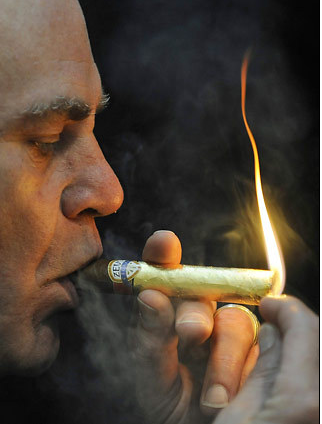
What we are looking at is a man smoking a “Golden Zeus,” a cigar that has been dipped in pure gold and is “on display” at the Millionaire’s Fair—a luxury goods and trade show “open to the public”—being held in Munich.  Unlike the photograph of the child in Lagos, there is no demand made here upon the viewer; the smoker is completely self-absorbed in his own private desires, a decadent pleasure offered up to the “public” (by some accounts over 40,000 people paid the $50 admission fee to attend the show and we can only assume that most were not millionaires) for its own perverse consumption.  It is, in a phrase, an exhibition of “class voyeurism.  Left on its own, the photograph would operate in a pornographic symbolic economy, but of course when placed in direct contrast to the earlier photograph it is hard to imagine it as anything but obscene.

We could go on at some length about the fundamental contradictions of global capitalism captured in the opposition between the two images, and there certainly would be some value in doing that.  But there is a slightly  different point to be made, for the juxtaposition of these photographs at this moment in time stands as a potent reminder of two key facts: (a) for all the bubbles that burst in the financial sectors, and for all of the claims that capitalism will be fundamentally transformed in the process (and it might well be), nevertheless, the desire that animates the underlying value system of a capitalist economy is far from diminished—and no amount of government regulation is likely to change that; and (b) while much has been lost by many as a result of the current crisis, and while more still is likely to be lost, the  measure of that loss is best calibrated against how much we actually had to lose.

As we search out the impact of our current economic woes on the “real economy” it is perhaps prudent to keep both facts in focus.

Photo Credit:  Sunday Alamba/AP; Christof Stache/AP


 1 Comment

Sight Gag:The Fall of Wall Street

Credit: J.D. Crowe, Alabama, Mobile Register

“Sight Gag” is our weekly nod to the ironic and carnivalesque in a vibrant democratic public culture.  We typically will not comment beyond offering an identifying label, leaving the images to “speak” for themselves as much as possible.  Of course, we invite you to comment … and to send us images that you think capture the carnival of contemporary democratic public culture.

 0 Comments

Downsizing the American Dream

This week we welcome Benjamin Sklar to NCN. A freelance photographer based in Austin, Texas, Ben’s portfolio includes highly regarded coverage of Hurricane Katrina, a Time cover, and regular work for The New York Times, Getty Images, and the Austin American Statesman, as well as his blog.

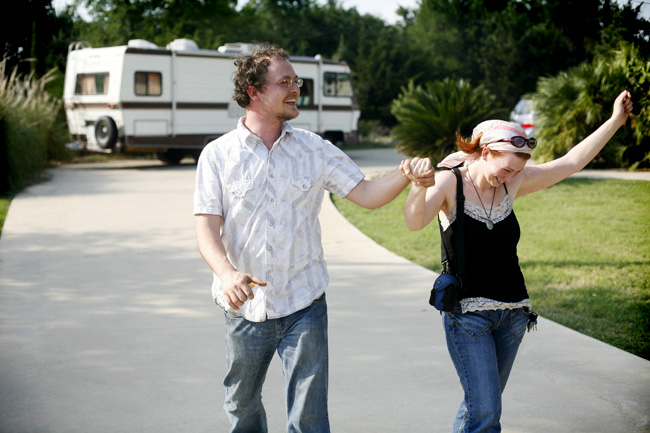
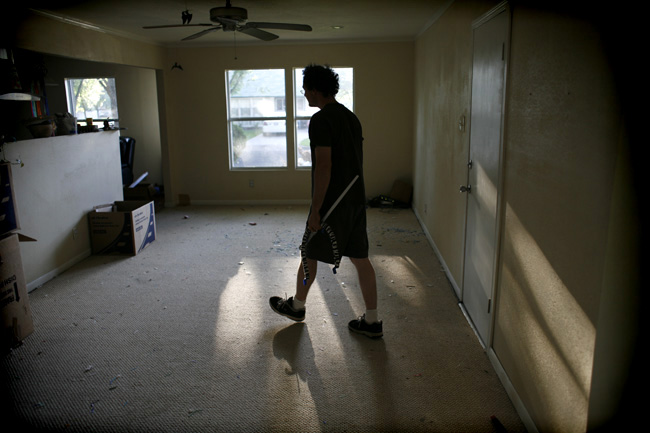
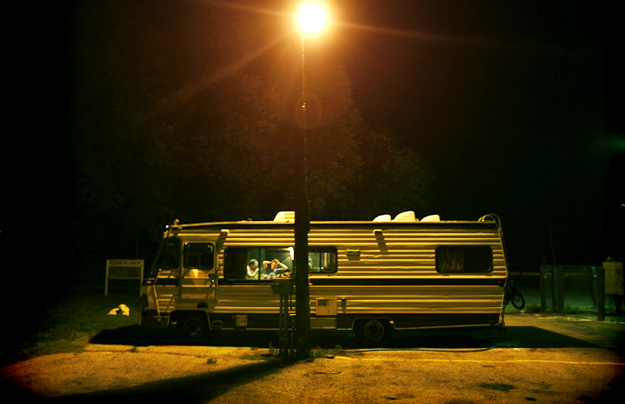
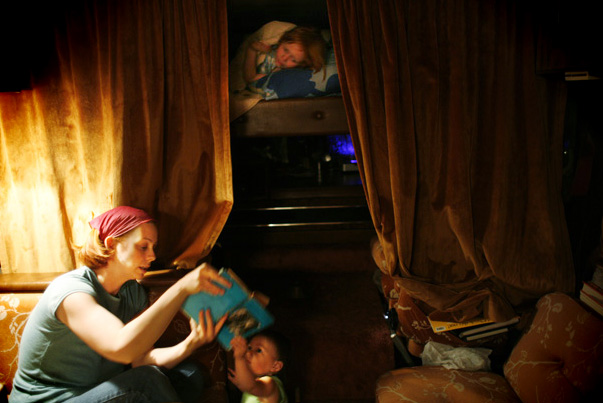
Amidst all the fears expressed in the last several weeks about losing money, homes, and the American Way of Life, it might seem astonishing to learn that some people are voluntarily deciding to live in radical simplicity–and not near the end of life but while raising young children. Aimee and Jeff Harris are one such couple. This photo essay is a continuation of a slide show that recently was featured at the New York Times. Titled “Voluntary Simplicity,” the Times chronicled the Harris’s preparations to discard most of their possessions in search of a low-impact, sustainable lifestyle. The photographs below pick up the story as they make the transition from their single family home to life in a RV. As Ben’s photographs make clear, no one should assume that this quest is going to be easy.

Jeff and Aimee Harris plan on moving on from their stable lifestyle and careers to pack up their children Quinn, 5 and a half, and Nichola, 1 and a half, to move to a simple life in Vermont. The family will donate all of their goods, even trade their wedding rings for what they see fit.

Jeff and Aimee celebrate after finding their new home.

Jeff Harris walks through their empty home in Austin, Texas

Dinner with the Harris family in the RV in West Texas.

Aimee Harris reading to Quinn and Nichola before bed in the RV.

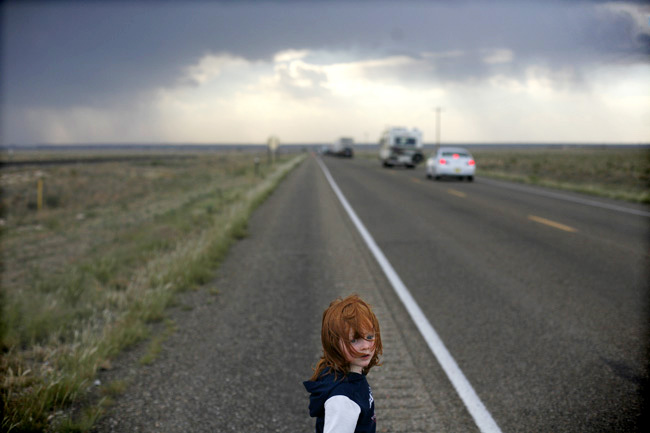
Quinn Harris on the road with his family during traffic in New Mexico.

 4 Comments

Arts Forum: "Torture and Representation"

Arts Forum: “Torture and Representation”
A panel discussion with Daniel Heyman, Julie Mertus, and Katherine Gallagher.

October 25, 2-4 pm

Katzan Art Center, Washington, D.C.

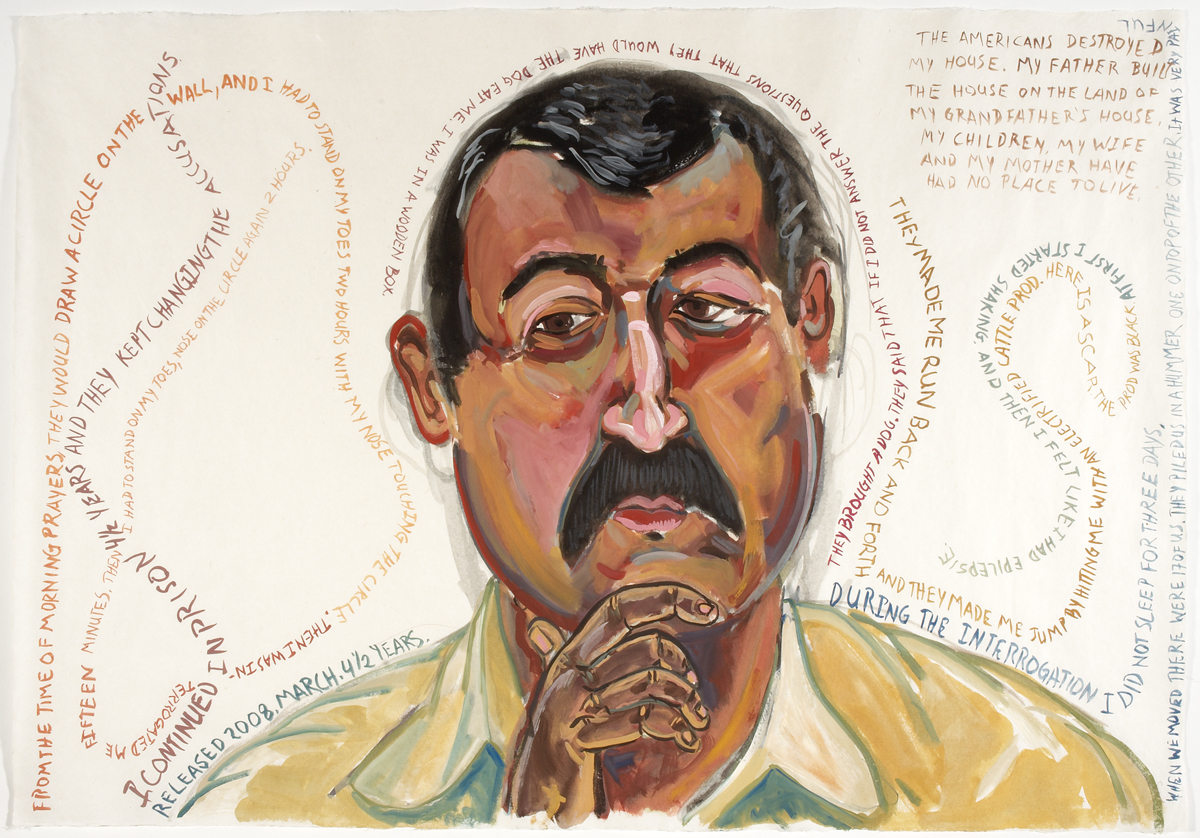
Daniel Heyman, in a recent interview with FPIF Co-Director John Feffer: “I’ve heard now 35 interviews. I’ve heard about people arrested in the middle of the night, so the shock has worn off a bit. But listening to someone telling me these things, the room still fills up with the thread of words coming out of the person’s mouth. The words become a physical thing and weigh people in the room down. So, I wanted the words to feel like an imprisonment, like a cage surrounding a person. At other times I wanted the words to feel like a stream pouring out of a person.”

Artist Daniel Heyman, Professor Julie Mertus, and attorney Katherine Gallagher will explore the issues of artistic and legal representations of victims of torture in a panel discussion moderated by Sarah Anderson. This event is sponsored by Foreign Policy In Focus and Provisions Library and is connected to an exhibit called “Close Encounters: Facing the Future,” also at the Katzen Center, which runs through October 26.

Daniel Heyman is a painter and printmaker from Philadelphia who has been capturing the images and words of Iraqi victims of torture from U.S. facilities like Abu Ghraib. More of his work may be viewed at his website. Julie Mertus is an Associate Professor and Co-Director of the MA program in Ethics, Peace and Global Affairs at American University. Katherine Gallagher is a Staff Attorney at the Center for Constitutional Rights. Moderator Sarah Anderson is Global Economy Project Director at the Institute for Policy Studies.

This event is free and open to the public.

The Katzen Arts Center is located on Ward Circle at the intersection of Massachusetts and Nebraska Avenues in NW Washington, D.C. A map is available here. For museum hours and driving directions, please visit their website.

The “Close Encounters” exhibit is part of BrushFire, a national arts initiative organized by Provisions Library and focusing on social activist art in the run-up to the November elections.

 0 Comments

California Wildfire, American Apocalypse

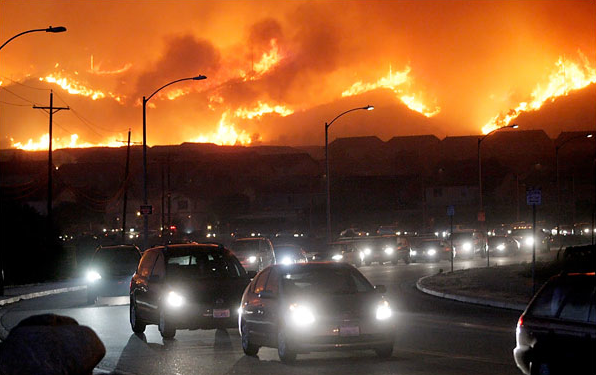
At least since Nathanael West, artists have turned to California for periodic images of an American apocalypse. This photograph fits nicely into that category.

Cars stream along a Southern California highway as wildfires rage across the mountains. The fires seem all-consuming, yet beneath that terrible horizon motorists can still creep along in semi-darkness. Indeed, lights have to be turned on in the valley despite the radiant holocaust above. This fusion of fire and darkness seems a premonition of hell, perhaps the level reserved for those who are complacent amidst pending disaster.

The New York Times caption said that the traffic included residents fleeing their homes in the hills. The photo contains a larger story as well. Intensive automotive use is not the direct cause of the wildfires’ destructiveness, but it is a key part of a larger pattern of land use, resource consumption, and social organization that is the reason the fires burn so extensively and cause so much damage. Likewise, the combination of business-as-usual behavior on the highway (a good thing in itself, of course) and the emotional tone of the twilight exodus captures an attitude of normalcy-by-denial while suggesting its larger cost. That attitude will result in insurance claims being filed, homes rebuilt, and another turn of the wheel.

Perhaps one of the symptoms of a catastrophic culture is that people take more pride in surviving disaster than in preventing it. Nothing to brag about, of course, but calm, resolute determination to carry on during the worst of it and then rebuild. If a bridge collapses as happened in Minneapolis, then build a new and bigger bridge rather than reassess the mixture of automotive and light rail transportation. If the levees break as in New Orleans, rebuild the city right where it was rather than move it inland while improving on past inequities. If the financial markets collapse, shore up the banks rather than jettison the ideology that destroys public goods to fuel private greed.

Bearing up and rebuilding makes sense during a war, but the major economic and environmental damage of the 21st century has been self-inflicted. Take another look at the photograph. The End Time may not be here, but you may be looking at the last days of twentieth-century America.

Photograph by Dan Steinberg/Associated Press.

 3 Comments

Political Theater on the Trading Floor

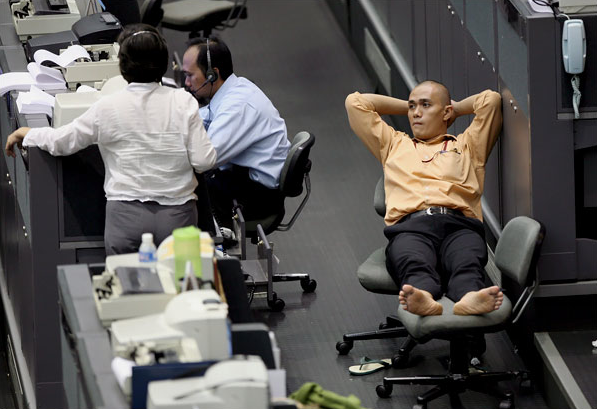
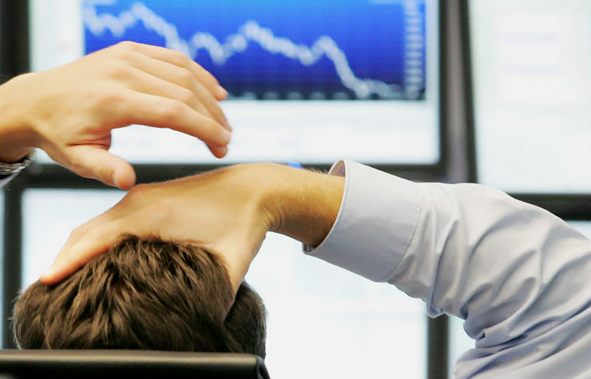
The collapse of the global financial markets is difficult to understand in part because it is difficult to visualize. That may be why there have been so many photographs of traders in various states of consternation or dismay. The shot is so conventional that photographers always are looking for a fresh angle, like this:

The trader on the right is literally laying down on the job. His more conventional associates don’t mind, however, because there is no longer a job to do. They might try to drone down into the disaster, but this guy knows better. That isn’t going to save him, however. He also looks like he’s laid out on a hospital gurney: the skin tone of his bare feet is picked up by the flesh colored shirt and bare head to suggest the vulnerability and dependency we experience when wearing a patient’s smock. He could be looking at his X-rays before they put him under. He’s cool but not in control; he’s just comfortable with not being in control.

The contrast between the the bare-footed patient and his environment pervades the image. Amidst the institutional decor, messy array of machines and printouts, and cyborg workers, he looks like a human being. The photo is unusual in featuring his composure, but still conventional in that it brings the global, systemic, structural collapse down to human scale. As does this:

From feet to hands, but to the same effect. Like the image above, this is both a conventional photo and an attempt to be distinctive. Just as there are many shots of trading floors littered with equipment and distracted traders, so are there many photos of people staring into screens that bear only bad news. And just as the first photo was keyed by those bare feet, here the trader’s hands define the picture. He, too, has stopped working–leaning back to hold his head as if it to keep in place while he watches the disaster unfold. Hands are symbols of work, and his have been taken off the task. They can’t stop the lethal dive depicted on the screen. Even so, they are young, strong, capable hands. The photo may be reassuring after all.

There is much to not like about the convention of reducing collective trauma to images of traders reacting to the news. The images are highly gendered, fragmentary depictions of isolated individuals. Anything like a social fabric or common good is left to the mise en scene of the market–what most of us would consider a seriously mistaken substitution. Worse, perhaps, the harm that will in fact be distributed across millions of lives for years to come is localized–as if only these guys are bearing the brunt of the crash.

The public often has to make do with less than optimal resources for understanding and judgment. These images have their problems, but they also may be an attempt to put a human face–and feet and hands–on the problem. Seeing the disaster as the operation of an alien system with its own harsh logic can only make the problem worse, destroying political will and accountability alike. These images are performances of the body politic–albeit the fragmented body politic of a liberal society–and they each offer a slightly different perspective and varied means for grasping and responding to the crisis.

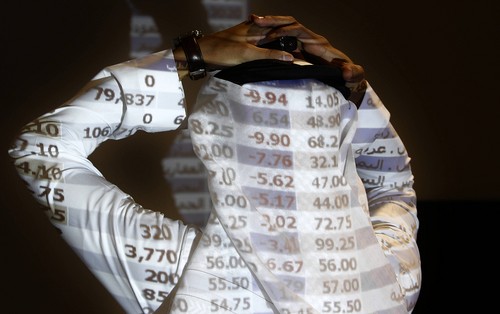
But good theater will not always be reassuring. So it is that I’ll close with this image.

The intention to capture a distinctive image may seem to be all there is to the photo, but there is more. The hands on head cue attitudes of dismay and capability just as in the image above. This time, however, the economic data are not set apart from the trader, not placed in a safe distance in the background (or off screen as in the first photo). While looking at a screen, he has become a screen. Although still caught up in his human choreography, he appears completely subsumed under the operation of an alien system with its own harsh logic. This is not so reassuring.

And so we need other resources for dealing with our fate. Humor, for example. In this case, an excellent post labeled Sad Guys on Trading Floors. Dozens of photos, each with a clever caption. Enjoy the show.

Update: See also Images of a Crisis? at Spiegel online; the link comes courtesy of Conscientious.  And here’s another variation on the theme: Traders with Hands on their Faces.

Photographs by Adi Weda/European Pressphoto Agency, Martin Oeser/Agence France-Presse-Getty Images, and Hassan Anmar/Associated Press.

 2 Comments

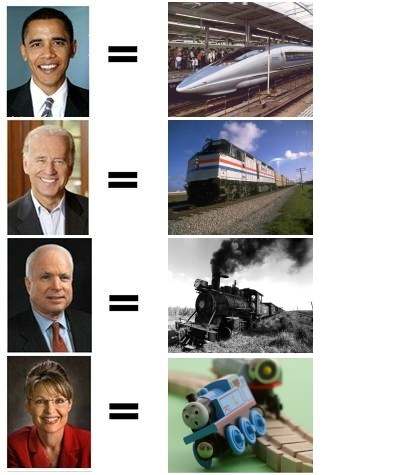
Sight Gag: If You Were A Train, What Would You Be?

Photo Credit: Anonymous E-Mail (With thanks to Maurice Charland who brought it to our attention).

“Sight Gags” is our weekly nod to the ironic and carnivalesque in a vibrant democratic public culture.  We typically will not comment beyond offering an identifying label, leaving the images to “speak” for themselves as much as possible.  Of course, we invite you to comment … and to send us images that you think capture the carnival of contemporary democratic public culture.

 6 Comments

Conference Paper Call: Imaging America

Imaging America

Papers and session proposals are invited for the conference “Imaging America,” a meeting of the Great Lakes American Studies Association (GLASA), which will be held at the University of Notre Dame, March 19-21, 2009. Deadline for submission has been extended to October 15, 2008.

Imaging America evokes themes that are both fundamental to the development of American Studies as a discipline, and representative of some of the most current research in the field. “Images” can refer both to visual or material representations and to the cultural impressions and expectations embodied in texts, oral traditions, or social performance. “America” is a contested term in American Studies, referring alternately to the United States and the Americas. As a theme for our conference, we hope that “Imaging America” will provide an opportunity for scholars and emerging scholars to enter a discussion about the boundaries, both literal and cultural, of America, as well as about the role of images in our analysis of America.

Proposed papers may consider any aspect and interpretation of the theme “Imaging America” including the following:

“America” conceived and defined as a place, land, nation, and people in terms of visual, cultural, and textual images and practices of mapping, naming, and/or cultural geography.

The transnational dimensions of “America” with expanded attention to the “Americas,” both north and south.

Stereotypes, competing cultural images of and from minority communities, including those defined by race, ethnicity, religion, class, gender, sexuality, ability, region.

The diversity of American religious iconography and images.

The production and cultural use of visual images, e.g. photography, art, advertising, and how new imaging technologies transform national, regional, and individual self-understanding and experience.

The ways in which America is “imaged” during political campaigns, especially the 2008 presidential election.

The roles that American images play in defining national subjectivity and determining who “counts” in the national imaginary.

The emotional and affective dimension of American images and icons, e.g. the flag, the soldier, the West.

Please send 200 word abstracts and c.v. by October 15, 2008 (electronic submission is preferred) to Erika Doss, Chair, Department of American Studies, University of Notre Dame, at: doss.2@nd.edu. Submissions may also be mailed to Sandra M. Gustafson, Department of English University of Notre Dame Notre Dame, IN 46556.

Participants will be notified of their acceptance by November 1. Graduate students are encouraged to apply; partial funding for conference travel may be available.

 0 Comments

Conference: Cold War Culture

Cold War Culture
Friday 21 & Saturday 22 November 2008
10.30-17.00 Lecture Theatre

Victoria and Albert Museum

London

International conference that brings together art, design, cultural and architectural historians of the post-1945 period. The Cold War was a period of high tensions and exceptional creativity, which touched every aspect of life from everyday goods to the highest arenas of human achievement in science and culture. This conference explores the major themes of Cold War Divisions, Americanisation, High Technology, and Last Utopias. The keynote speaker is Ariel Dorfman, and other speakers include Alice Friedman, Jean-Louis Cohen, Michell Provoost, David Crowley, Branislav Jakovljevic, Victor Misiano and Richard Barbrook.

£110 for 2 days, £55 for 1 day, concessions available
Supported by the Council of Europe
Book online or email bookings.office@vam.ac.uk

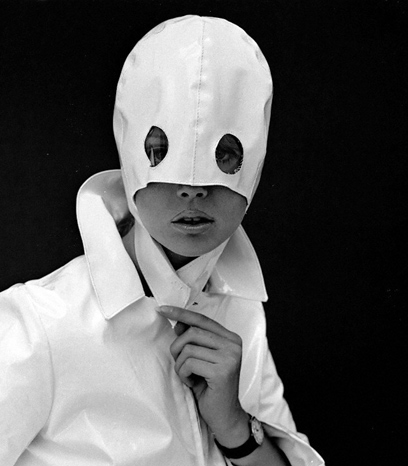
Photograph by John French (1960s)/Victoria & Albert Museum.

 0 Comments

Repose and Heartbreak Outside the Markets

The breakdowns and bailouts in the financial markets have created sky-high levels of fear, anger, more fear, and more anger. As the Dow drops, anxiety spikes. The situation is awful, dire, disastrous, catastrophic–a maelstrom of panic, collapse, more panic, and further collapse as investors act like crazed victims piling up against a door in a theater that has caught fire.

Don’t think that I had my money in CDs. I’ve been nailed badly and the prospects are not good for my family. But somehow, everyone needs to take a deep breath and exhale. For all the talk of pain, the term remains a metaphor for many of us. And the panic is a symptom not only of the obvious problems but also of what happens when a society becomes a market society instead of a society with a market economy.

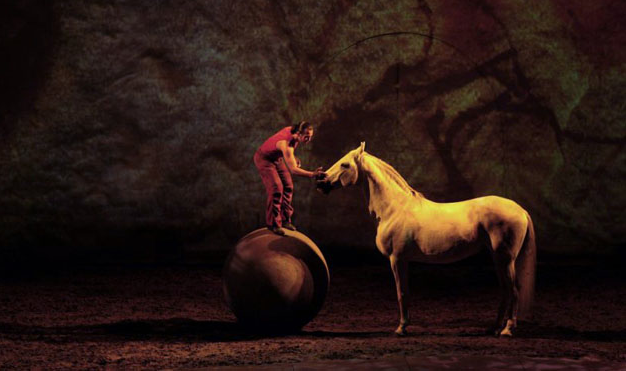
If a photograph can help us regain a sense of balance, it might be this one:

The caption at The Guardian tells us that we are looking at a man performing with a horse at the Cavalia equestrian show in Lisbon, Portugal. The horse will be exhibiting superb training, but the roles almost seem reversed. The man looks like the lesser animal, almost like a monkey who has been trained to do tricks on the big ball. By contrast, the horse seems the epitome of nobility, a superior being who only has to show up to dominate the scene. He is the standard by which the man will be judged.

Perhaps this seeming inversion of a natural order appealed to me because of the financial world being turned upside down, and because of my wish to regain a sense of balance. And the scene is about balance–more specifically, about repose, with balance one means to that end. Indeed, the man could be a metaphor for the markets, as he balances precariously (however skillfully) on a globe than is at once unified and capable of punishing any sudden shift in his stance. Above all, however, it is something different from the madness of the markets. Sure, they will have sold tickets to the show, but for a moment a man and a horse stand in perfect equipoise. The man is on top of a small world, but not to get rich. Communion with the horse is more important than that. The sense of ritual harmony runs deep; Confucius would say that this sense of things is essential to restoring balance in the individual and the state.

I could end there, but there is need to go a step further. Repose in a theater may be too easy. The real test is real pain. This is Childhood Cancer Awareness Month, and observance has included this beautiful portrait:

The caption at The Big Picture says, “Nathan Gentry, age 6, sits by a window overlooking New York City traffic on September 8, 2006.” Nathan died after months of painful treatments. Although trapped in a disease that most children, thankfully, do not experience, Nathan captures so much of the vulnerability of childhood and the profoundly precious quality of life itself.

This also is a picture of repose. He is experiencing, it seems, a moment free of pain, of quiet reflection on the scene outside the window. And the scene is outside: the glass walls him in as much as it lets him see, and the outer world has shrunk to that small portal. Outside we can see scaffolding, and so he is looking at a building that will be sustained, though he cannot be. His repose comes not for keeping everything in balance, but from putting himself in relationship with what remains. He asks–and takes–nothing but a moment of peace. It seems that he has already learned how to live with less. Obviously, that is something many of us have yet to learn.

Photographs by Nacho Doce/Reuters and, via The Big Picture, Susan Gentry (©), who asked for a link to the Children’s Neuroblastoma Cancer Foundation.

 0 Comments