Nov 17, 2013
Jun 18, 2008
Jul 08, 2009
Jan 23, 2011
May 06, 2013
Dec 07, 2014

Observing Nature's Way

The coverage of the flooding throughout the Midwest this month will have brought more than one reader to wonder why people just don’t move to where they can stay high and dry. Easy to say when you are high and dry, and before the mud slide or water shortage or hurricane or wildfire or other so-called natural disaster occurs closer to home. It’s not easy to move a city, of course, nor can home owners pack up the neighborhood en masse without losing their shirts. More important, people live where they do because it once was beneficial to put the city where it is, and because it often is beneficial to continue to live close to nature. Getting too close is one problem, but we should remember that becoming too insulated from our environment is equally dangerous, physically and spiritually.

Rather than feel superior or even fortunate for being above the floods, let’s take a minute to simply marvel at nature.

This photograph gives us both the awesome power of natural forces and the beauty of the earth, the incredible gift of new growth and the fury of destruction. That thunderhead can appear out of nowhere, gather together wind, water, and fire, and wreak havoc on the work of a year or a lifetime. Yet that crop can come up seemingly by magic, teased out of the ground by the sun and rain which feed it and without which none of us would live. No one wants to be battered by the storm, but why would anyone want to get too far away from this?

Or this:

This shot from the San Juan Islands near Seattle is a picture in serenity. But the islands were created by the same massive, impersonal forces that were visible over the wheat field. And that water is no safer than the Mississippi, colder, in fact, with deadly currents should you capsize. But we don’t worry about that when looking from such a privileged place as that provided by this photograph. And it is beautiful. We should ponder why it is so beautiful, for that is another gift: our human ability to see it as more than forage or shelter or simply what it is. Instead, we see the beauty of forms, whether undulating shapes or shimmering shades of luminescence. And form is the trace of prior activity, the natural forces molding the land and channeling the waters.

Photographs by Steve Hausler/Associated Press and Bruce Dike/The Daily Dozen at nationalgeographic.com

 2 Comments

High Noon in Sadr City

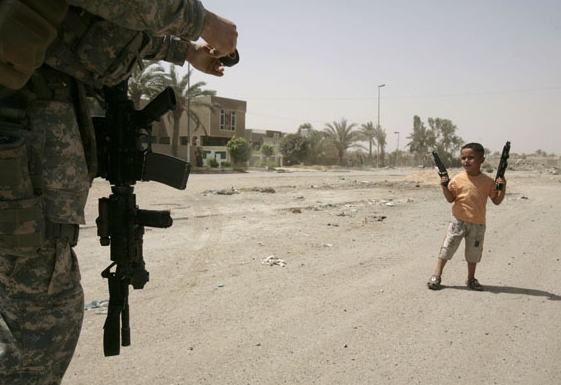
One of the earliest posts I did here at NCN was of a photograph of three Iraqi children staging a mock execution with toy guns.  The image, which literally stopped me in my tracks, bordered on the surreal, the expression on the boys faces marking a dialectical tension between the “pleasure” and “horror” of human violence.  I’ve thought of that photograph often over the past year, especially as I have encountered more than a few photographs of children with toy guns, not least this AP photograph which showed up this week on the Guardian website.

The caption reads “Baghdad, Iraq: A child armed with plastic toy weapons approaches a US soldier on patrol in Sadr City.”   As with the photograph of the mock execution, it is fraught with tensions that make it hard to distinguish between the real and the surreal.  At first blush, the scene invites comparison to a shootout between two gunslingers squaring off in a frontier town. But of course the opposition between a fully equipped US soldier carrying a high powered, automatic weapon and a young boy – he can’t be more than eight years old – with toy guns suggests that something more than a simple parody is taking place here, though what is not exactly clear:  on the one hand, we might view the scene with the same kind of  reflexive and approving  smile we use when we see children trying to act like their parents, cutely imitating what they take to be adult roles; on the other hand, we have a young Iraqi child “approaching” a US soldier in one of the most dangerous suburbs in one of the most dangerous countries in the world right now while appearing to point “toy weapons” at him.  And, of course, any hint of an approving smile has to fade to deep concern. Are they really toy guns?  Is this an innocent child or an insurgent?  And even if the child poses no immediate threat to the soldier, is this an insurgent in the making, someone he will have to worry about down the road?

One might argue that these last few questions reflect a typically western paranoia—and in large measure I would be inclined to agree—but it has to be tempered by the fact that in the past year we have seen more than a few photographs of Iraqi and Palestinian children wielding “toy guns” that they had received as presents and marking them as members of a culture that actively nurtures violence.  Of course, if you are a male who grew up in the 1950s and early 1960s as I did, there is a good chance that you too received toy guns as presents and did your part to help make the world “safe for democracy” while storming the shores of Iwo Jima in your own backyard.  And so where is the difference?  One answer is that anymore we rarely see images of US children playing with toy guns (go ahead … search “toy guns” and “kids” at Google Image and see what you come up with).  This is not to say that contemporary US children are not enchanted with guns and weaponry—as I was out for my afternoon jog today I came across a five year old playing with a set of toy golf clubs, except he wasn’t using his putter in imitation of Tiger Woods, but as a rifle trying to shoot me as I passed; and certainly the cottage industry of “shoot ’em up” video games would make the point as well—but it does suggest how the public visual economy functions to constitute a palpable cultural difference between the West and the Middle East.  If nothing else, it implies the sense in which “their present is our past,” and operates as a marker of our “cultural progress and superiority.”

But there is, I think, an additional and more important point to be made.  As I noted above, virtually all of the contemporary photographs of kids with guns that have circulated in recent years are of either Iraqi or Palestinian children, literally the future citizens of countries widely assumed to support state terrorism and thus a direct threat to the United States and its European allies. During World War II U.S. propaganda typically represented Allied children as they went to school or church, played baseball, did chores around the house, and in general represented an uncorrupted innocence, while Axis children were represented as being trained in the arts of war (see, for example, Frank Capra’s Prelude to War).  I do not want to suggest that photojournalists are complicit in some sort of concerted propaganda effort, but there can be little question that something like a visual trope is at work here as the visual representation of children—abroad and at home—become powerful signs of what purports to be a potent and pernicious cultural threat.

Return now to the photograph above and attend closely to its caption:  “A child armed with plastic toy weapons approaches a US soldier on patrol in Sadr City (emphasis added).”  The word “approaches” seems to domesticate the image some, as an “approach” is not necessarily a threatening move.  And indeed, the image itself reinforces this ambiguity as it is shot from behind the soldier and at waist height, thus making it impossible to see his face and eyes, and so difficult to interpret how he is reacting to the child’s behavior: Is he smiling in recognition of his own childhood “playing soldier” in the backyard?  Or is there the look of caution and concern?  And yet, for us the viewers, operating within the contemporary visual economy of representations of Middle Eastern children, it may well be that “armed” is the more important verb in the caption, for while the child carries “plastic toy weapons” there is nothing to suggest that he is “playing” at anything.  And while the “approach” might appear somewhat innocent, there are too many markers within the larger visual culture to suggest that “plastic toy weapons” are simply a precursor to the real thing.

Photo Credit:  Petros Giannakouris/AP


 10 Comments

Only Connect

The war in Iraq seems to be entering a surreal phase. The surge is working, we are told, and violence is down, and other things are improving, but, of course, the US death toll ticks right along this month at one per day and sectarian bombings continue and none of the avowed political objectives are remotely in sight. Likewise, the likely Democratic victory in November bodes well for a substantial draw-down of our forces, but in the current negotiations with the Iraqi government about our long-term military presence there, the US requested 58 bases, control of the airspace to 30,000 feet, continued immunity from prosecution under Iraqi law of all US personnel and private contractors, and other amenities such as protocols for offensive operations. Given that we currently have 30 bases in Iraq, 58 is an interesting number. And the exemption of roughly 132,000 troops and 154,000 contractors from prosecution for whatever crimes they might commit, well, that is business as usual. “’More than 90 percent of this will be a pretty standard status-of-forces agreement,’ said one senior official involved in drafting the American proposal.”

And that’s the problem: we could be drifting into the usual indifference of Empire. Something called “stability” will be restored while the rest of us will forget that lives were torn apart. So it is that we need to be reminded.

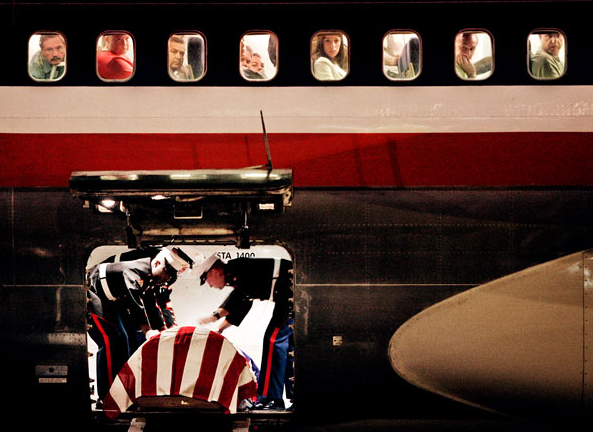
This now famous photo of a coffin being prepared for delivery captures all too well the terrible disconnect between US civilian experience and the costs of this war. The honor guard are doing everything they can to pay proper respect to their fellow Marine, but nothing can change the fact that the dead are consigned to the cargo hold while not far above them the living go about their business. It’s not that those peering out of the windows of the plane are uncaring, but how can they know what is happening in the hold? And unlike the carefully coordinated efforts of the uniformed guard, those above are isolated into individual reality compartments, each firmly separated from the others. The structure of the plane reflects the structure of ordinary life in a liberal society: those things held in common are like baggage, thrown together in the hold, while each of us pursue our separate destinations, free to choose and not likely to even know what is shared.

But, of course, the grief is not shared. The photograph came to my attention again when the New York Times used it to feature a review of the book Final Salute: A Story of Unfinished Lives, by Jim Sheeler, which is based on his Pulitzer Prize winning series in The Rocky Mountain News. The Times slide show accompanying the review documents just how isolated the families of the fallen are in their grief. The honor guards do what they can, but then they leave; after all, they have more work to do.

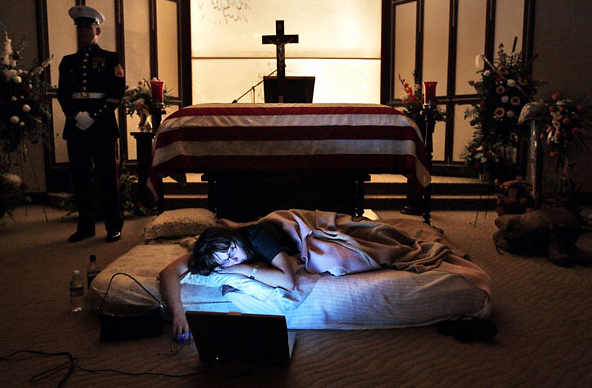
This photo is one that I find particularly poignant:

Katherine Cathey had asked if she could sleep next to the body of her husband for one last time. Illuminated by the glow of her laptop, she is listening to songs that reminded her of her beloved. She listens if to connect again, somehow, through the ether, through memory. She lies between the hard reality of the shrouded casket and the glow of a virtual world. These are all that remain. She at least knows that. The rest of us sit, like passengers on a plane, unaware of how close we might be to the terrible losses wrought by this war. Or we look into the media portal, like looking out of the window of the plane, staring blankly at the suffering unfolding elsewhere. Like Katherine Cathey, we, too, need to connect.

Photographs by Todd Heisler/Rocky Mountain News. Michael Shaw wrote a fine post on Heisler’s photographs when the Pulitzer was awarded. John and I have written a number of posts on mourning in the US and Iraq, too many to cite here. We’re rather not repeat ourselves, but the war is not over. For some it will never be over. How many are in that category depends on the rest of us.

 3 Comments

A Kodak Moment

Over the past few weeks Midwestern states including Iowa, Wisconsin, and my home state of Indiana have experienced monstrous storms and heavy flooding with homes being ripped off of their foundations and entire towns and cities being submerged for days on end.  If the damage and devastation is not quite at the level of Hurricane Katrina it is nonetheless tragic enough and it will take years for many of these communities to recover—if recover they can.

Local photojournalists have done an excellent job of documenting the storms and their effects, but as with any such “event” there is a fairly conventional litany of photographs that seem to recur: aerial views of the flood waters (which of course distance the viewer from the event in something like a God’s eye view); shots of the incredible damage effected by natural forces gone out of control—including both long shots that invite a sense of magnitude and then extreme close-ups (often of personal possessions) that encourage a sense of viewer identification;  forlorn victims (there but for the grace of God …); people—neighbors and/or strangers, it is often hard to know which, and the ambiguity itself is telling—helping and/or comforting one another; officials either surveying the damage or lending assistance; children easily and inventively adapting to the changed circumstances as they find ways to convert the damaged world into a new kind of playground; and so on. Taken as a whole, and repeated over and again in different newspapers, magazines, websites, and television broadcasts, such images constitute a visual narrative with strong normative implications for communal living.

In the days immediately following the floods in central Indiana much attention was dedicated to families who seemed to have lost everything—homes, vehicles, furniture, clothing, etc.  I was thus initially surprised to find a series of photographs in the Indianapolis Star that focused attention on people who had dedicated their attention to salvaging and preserving family photographs.  

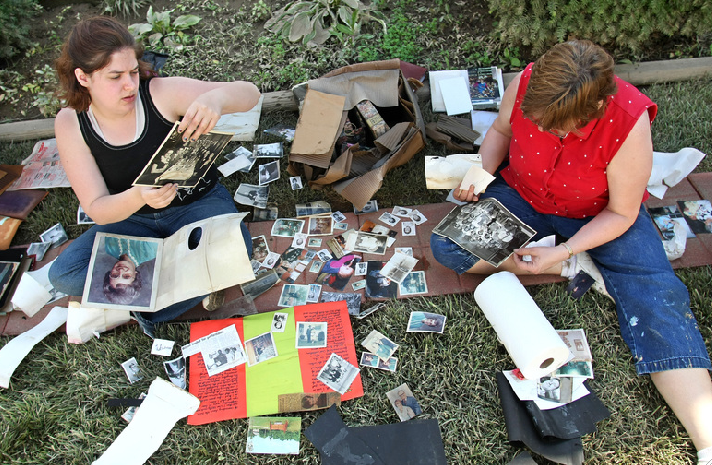
Here a granddaughter and grandmother “sort through family photographs to help clear off the mud and the preserve them” in Columbus, Indiana, one of the towns hardest hit in the southern-central part of the state.  As I studied this photograph and several others like it I recalled Nancy West’s wonderful book Kodak and the Lens of Nostalgia, a cultural history of the snapshot that examines the ways in which for generations Kodak has “taught” us how to take and display photographs—generally of children playing; special events that mark the passing of time such as holidays, anniversaries, graduations, etc.; prized possessions such as homes and cars; and, of course, family vacations—and in the process to produce a nostalgic sense of family history as representing something of a happy and ideal past.

That last point is something that students often resist until I require them to bring their family photo albums to class (and the “family photo album” is a social practice that seems to transcend class, race, and most other demographic categories), but it doesn’t take a great deal of reflection to realize that even if pictures of “unhappy” moments in the family history were taken they rarely if ever make it into the family archive of visual memory.  And that we value such memories is underscored by the photograph above.  Surely, one might imagine, given the magnitude of the destruction wreaked by the floods, that these women have more pressing tasks confronting them, but here they take precious time to “sort through” their past—two women crossing the divide of family generations working together to “preserve” a particular sense of family memory.

A second photograph from the same community—but not of the two women above—effects a shift from long view to close-up and in so doing accents the practice of snapshot preservation as cultural (and maybe even universal) rather than idiosyncratic. 

The disembodied hands make the point:  This could be anyone.   Of course, the hands are gendered, and so there is a sense in which such preservation is cast as “woman’s work”—a stereotype displayed in the longer shot above—but there is a different point to be made.  Notice how the hands work carefully and gently to wipe away traces of the flood, and in so doing it also erases part of the history of the image, seeking to preserve the millisecond captured by the camera in its original condition, unaffected by the passage of time. It only makes sense, of course, but it also should call our attention to how the photograph itself and its preservation in a frame or an album or an old shoe box is always already an erasure of the past in the interest of a nostalgic recollection of happier, less troublesome times.

And the reason for all of this, it seems, is clear, for the power of memory and the emotional connection to something larger than ourselves is palpable and no less essential to social sustenance than food and water is to the physical sustenance of the body. It is a point, you may recall, imaginatively developed in Ridley Scott’s Bladerunner, a movie of a not-too-distant society where androids otherwise indistinguishable from human beings nevertheless lack the experience ordinarily accumulated across the life cycle and necessary for the management of the rawest human emotions.  The solution, it turns out, was to implant a past that they could believe in, and for these androids the “reality” of their memory implants was manifest in the family photographs that they treasured and carried with them.   It didn’t matter that they were real or true; what mattered was that they were realistic and valued.

As the Kodak slogan used to say, “We capture your memories forever.”  

Photo Credit:  Matt Detrich/Indianapolis Star; In addition to Nancy West’s Kodak and the Lens of Nostalgia be sure to see also Marianne Hirsch’s Family Frames: Photography, Narrative, and Postmemory.


 3 Comments

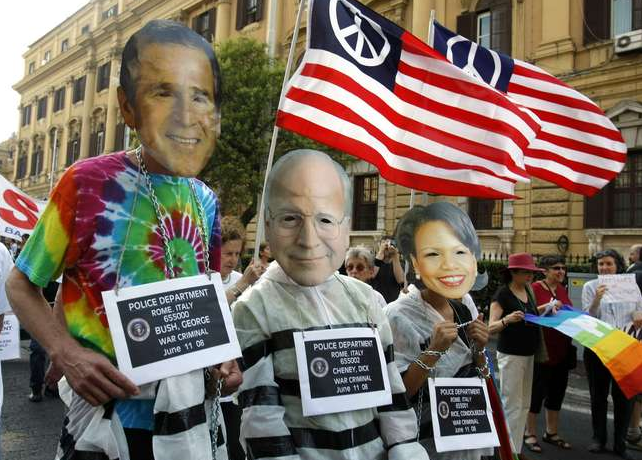
Sight Gag: Give Peace A Chance

Photo Credit: Helgren/Reuters

Our primary goal with this blog is to talk about the ways in which photojournalism contributes to a vital democratic public culture. Much of the time that means we are focusing on what purport to be more or less serious matters. But as Jon Stewart and Stephen Colbert often remind us, democracy needs irony, parody, and pure silliness as much as it needs serious contemplation. For our part, we will dedicate our Sunday posts to putting such moments on display in what we call “sight gags,” democracy’s nod to the ironic and/or the carnivalesque. Sometimes we will post pictures we’ve taken, or that have been contributed by others, or that we just happen to stumble across as we navigate our very visual public culture. Sometimes the images will be pure silliness, but sometimes they will point to ironies, poignant and otherwise. And we won’t just be limited to photography, as a robust democratic visual culture consists of much more. We typically will not comment beyond offering an identifying label, leaving the images to “speak” for themselves as much as possible. Of course we invite you to comment … and to send us images that you think capture the carnival of contemporary democratic public culture.

 1 Comment

Photographers Showcase: "Freedom's Cause"

Today we welcome MIchael David Murphy to NCN.  Michael is a writer and photographer based in Atlanta, GA.  We featured one of his photographs earlier in the year under our “Sight Gag” category, but here we ask you to consider one of his photo-textual studies called “Freedom’s Cause” inspired by Barack Obama’s stump speech.  The photographs below are a side project of Michael’s presidential campaign project “So Help Me …

* * * * * * * * * * * * * * * * * * 

Barack Obama’s candidacy for President contains a direct link to the successes of the Civil Rights movement. While campaigning, Obama often referred to the movement’s successes and struggles:

“That’s how women won the right to vote, how workers won the right to organize, how young people like you traveled down South to march, and sit-in, and go to jail, and some were beaten, and some died for freedom’s cause. That’s what hope is.” (02/12/2008, Madison, WI)

While photographing the primaries across the Southern states, I visited locations where the echoes of the Civil Rights struggle can still be heared — places that have nearly gone quiet during the more than forty years in between. History doesn’t just happen, it goes down, and as a photographer, witnessing what our country chooses to commemerate, and what we all collectively and selectively choose to forget, can be instructive. These three locations, each in Mississippi, may be views of America’s troubled past, but when seen through the lens of Obama’s candidacy, they telescope forward toward an optimistic future.
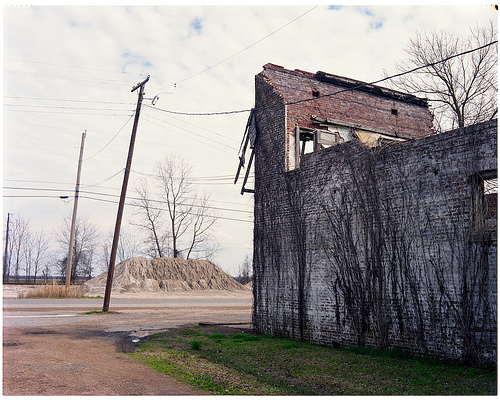
On August 27th, 1955, a few months after the murder of Rev. George Lee, fourteen year old Emmitt Till walked into Bryant’s Store in Money, Mississippi. 

There are conflicting stories about what happened when Till left the store, but he apparently said something (or whistled) at the store owner’s wife, Carolyn Bryant. Later that night, Till was kidnapped from his great uncle’s house, and taken to a shed where he was beaten, then shot, then dropped into the Tallahatchie River with a fan tied to his neck. 

When Till’s body was recovered, Till’s mother insisted on having an open casket funeral in Chicago, and encouraged photographs of Till’s disfigured body, which were published in Jet. Nearly 100,000 people saw Till’s body during a four-day public viewing. 

in 1957, Bryant’s Store closed due to lack of business. In August, 2007, a Mississippi historical marker showing the location of the killing was stolen. 
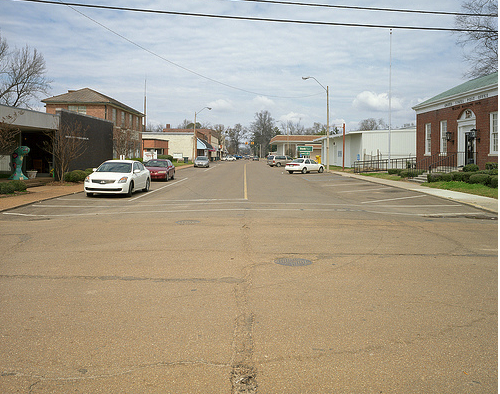
On May 7th, 1955, Rev. George Washington Lee, the first black person to register to vote since reconstruction in Humphreys County, Mississippi, was driving down Church St. in Belzoni, a small town in the Delta. Rev. Lee was well-known in the area for his voter initiatives, successfully registering blacks to vote. 

As he drove down Church St., Rev. Lee was tailed by men in a convertible. Someone shot out his right rear tire, at which point another car pulled alongside, and Rev. Lee was fatally shot, point-blank in the face. Rev. Lee’s Buick hopped a curb and slammed into a house, and the Reverend died on the way to Humphreys County Memorial Hospital. 

There were witnesses who saw the fatal shot, but couldn’t identify the killers. The FBI investigated, discovered enough evidence to take the case to trial, but the local prosecutor declined, saying a Humphreys County grand jury “probably would not bring an indictment.” There seemed to be consensus in Belzoni as to who the killers were, but they were never prosecuted. In death, Rev. Lee’s actions helped usher the passage of the Voting Rights Act ten years later, in 1965. 

Belzoni is a quiet town in the Mississippi delta. It’s catfish country, and they even have their own Catfish Museum and Catfish Festival. It’s the kind of place where you can stand in the middle of the road under a darkcloth to make a photograph and no one will pay you any mind. 

This is Country Road #515 in Mississippi. It was called “Rock Cut Road” back in 1964. 

On June 21st, 1964, three civil rights workers were booked into the Neshoba County Jail after being arrested for speeding through Philadelphia, Mississippi. The three (James Chaney, Michael Schwerner, and Andrew Goodman) had driven to Longdale earlier that day to see the remains of a church that had been firebombed by the KKK. The firebombing was apparently targeting Schwerner, who had plans to turn the church into a “Freedom School”. Freedom Schools where established during Freedom Summer in the South by a coalition of CORE, SNCC & the NAACP. 

The three were released at 10:30 that night and told to leave the county. Just before reaching the county line, their car was overtaken by a group of men that included law enforcement. Their station wagon was forced over to the side of the road. The three were pulled from their vehicle and taken to “Rock Cut Road”, where they were beaten and shot. 

The killings raised national attention to the Civil Rights struggle in the South. Robert Kennedy got the FBI involved (because Mississippi law enforcement was so slow to respond), and their remains were found a month later. No one has been convicted for their murder, but in 2005, Edgar Ray Killen was convicted for manslaughter for his role in recruiting the mob that was involved with the killings. 

Through the efforts of volunteer workers (often from out of state, Schwerner and Goodman, who were both from New York), over 100,000 new black voters were registered in Mississippi in two years, and the Voting Rights Act passed in 1965.


 5 Comments

On the Democratic Sublime

In democratic societies political leaders serve (and derive their legitimacy from) a collective master. In U.S. style liberal-democracies the collective, legitimizing sovereign force goes by the name of “We the people …” Of course, “the people” is a metaphor for the “body politic,” itself an abstraction which lacks any objective material reality. Lacking objective material reality however, does not mean that it lacks influence or force; following the terms of the metaphor, that influence is typically cast as “the voice of the people.” And so the problem for political leaders who want to retain their legitimacy to serve/rule is to be able to claim to be the material embodiment of “the people,” literally to speak for “the people.” I call this a problem, but of course it is as much an opportunity as anything, for since “the people” lack an objective material reality it is difficult to countermand a duly elected leader’s claim to speak for “the people” in any objectively verifiable or decisive way. Think, for example, of how difficult is was to contest President Nixon’s claim to speak for the “great silent majority.” Of course, being difficult and being impossible are two different things.

The photograph below made me think about this political dynamic:

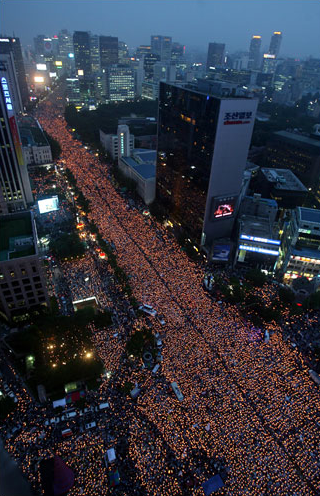
It appeared above the fold on the front page of the NYT as part of a story concerning popular protests against recently elected South Korean President Lee Myung-bak’s decision to “resume imports of American beef.” The image is an aerial view of “thousands of South Koreans” massed along a major avenue in Seoul. Shot at dusk and from both a long distance and an acute, high angle, no individual person is identifiable in any sense at all. What we see instead is a vibrant and speckled mass—later described in the accompanying article as “South Koreans with candles”—that appears almost to pulsate with its collective energy as it surges like flood waters between and among the buildings for as far as the eye can see. And indeed, what appears initially to be a beautiful expression of unity resonates as well as a sublime, natural force totally beyond control. 1 or 100 or even 1,000 protestors might be seen as malcontents or perhaps as a small minority whose concerns will be duly noted before being ignored. But hundreds of thousands of individuals (the estimates range from 100,000 to 700,000) collected in one place, appearing to be animated by a common cause, make it much harder—and far more dangerous—for a leader to discount or ignore. And so it should come as no surprise that Lee’s newly appointed cabinet members offered to resign in recognition of their failure to meet the needs and expectations of “the people” (or whatever the comparable moniker is for the collective sovereign source of political legitimacy in South Korea).

What is particularly interesting here is how the above photograph operates as an allegory for the democratic process. On one hand it helps to create the illusion that we can see “the people” as an objective material reality—a collective body with mass that is not easily reducible to the individual, even though the flickering candles call attention to the fact that the individual is in there somewhere. On the other hand, it serves as a reminder that however beautiful such a representation can be, nevertheless, “the people” can be a sublime democratic force and leaders who toy with its will or interests do so at their own peril.

Photo Credit: Dong-A Ilbo/AP

 7 Comments

When is a Flag Not a Prop?

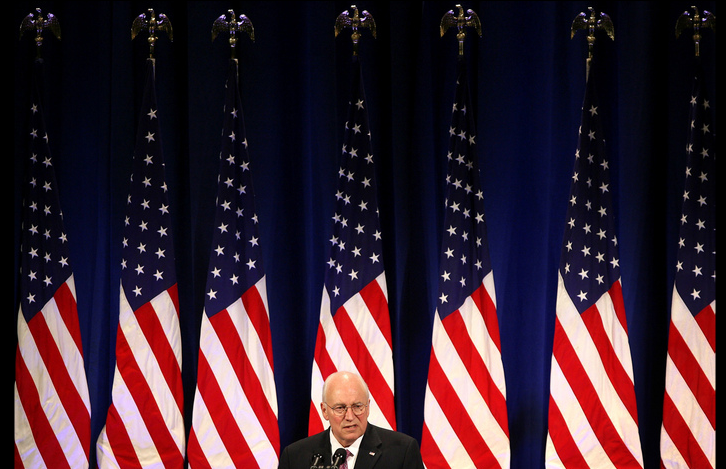
One of the more successful cases of symbol capture in my lifetime is the Republican Party’s wrapping itself in the flag. Of course, the Left gave it away and then had to seethe in frustration while watching it used to set records in hypocrisy. But what credibility did they have when it came to the flag itself? That monopoly is fading however, down to Fox News and MSNBC sputtering about whether Barack Obama is wearing a flag pin. (He is. Feel better?) This decline in faux patriotism may be another side-effect of the Bush years, not that they have caught on:

There are thousands of these shots, but this one seems particularly offensive. This is the guy who had “other priorities” than serving in the Vietnam War but no qualms about sending other young men to die in the sequel of his own making. The arrogant sneer seems just right, a moment of truth revealing this administration’s cynical use of the flag–and the troops–as props. They are props in two senses of the word: devices for staging a show, and supports for something that would collapse of its own bad weight otherwise.

The image caught my attention because it demonstrates a principle of symbolic action. The basic idea is that when you see excessive display, it often is compensating for some lack. When we raise our voice, it often is not because we have the better argument. Excessive make-up can be a response to a lack of skill in a preteen or a lack of self-esteem at any age. If we go on too long, it may be because we have so little to say. Getting back to the photograph, if the administration displays not one flag but seven (and counting), it may be not because they have a surplus of patriotism and demonstrated commitment to the common good, but because there is so little evidence of those civic virtues in their policies.

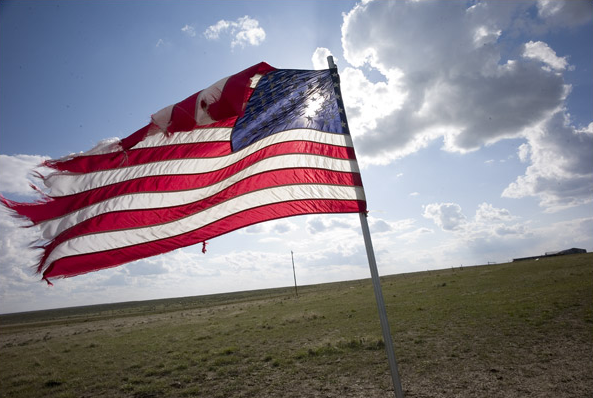
For a sense of contrast, consider this image:

This flag is flying near Belle Fourche, South Dakota. The town has the distinction of being the geographical center of the nation. We see one flag, not seven, and it is a worn flag, not the imperial banners behind Cheney. Most important, it wasn’t put up there to prop up anyone. Think of it more as an act of homage, something done because it felt right, not because it would play well. The frayed edges tell us that it’s been there awhile, taking a beating from the wind but still standing as someone’s testament to their love of country. And so the principle works in both directions: when an act of display shows signs of being ragged and worn, it can be a sign of some larger fullness. What looks like a simple gesture in an all but empty place may be something much bigger. Not just the center, but the heart of the nation.

FYI to our readers: I posted on Belle Fourche recently, and this second post is something of an atonement for a mistake made at that time. If you read to comments to that post, you’ll see what I mean. Thus, this second post is another demonstration of the relationship between excess and deficiency, a dynamic that endlessly fuels language and culture.

Photographs by Seth Wenig/Associated Press and Angel Franco/New York Times.

 3 Comments

Punctuated Equilibrium in the Photographic Record

Punctuated Equilibrium is a theory of evolutionary change that accounts for both the overall stability of large populations across time and the process–or periods–of significant change–e.g., in the species, if studying biology, or the social practice, if studying human organization. Generally, species maintain themselves as species by not changing, which happens because most local adaptations are diluted by more comprehensively functional features, but adaptations that develop at the margins of the population, where the species is less likely to match environmental conditions, can acquire selective advantages that subsequently can spread quickly across the population. So why am I telling you this?

The question came to mind of what image of the world is being maintained by photojournalism, and particularly coverage of world politics. Were we to examine the photographic record as if it were a fossil record, would we see a history of punctuated equilibrium? More to the point, when we look at the images in the news, do we see a world of general stability punctuated by moments of rapidly spreading change? Or do we see another model of collective behavior: for example, nearly uniform stability occasionally disturbed but always restored? Or relatively stable civilizations that once in a long while are destroyed or fundamentally transformed by some catastrophic upheaval? Or perhaps a continual improvement regrettably but inevitably accompanied by “creative destruction”? Or, if we do see a stable order that is occasionally subject to rapid change, what is the norm and what is developing in the margins? And might we see these larger patterns across images or inside of individual images?

Let’s look at two photographs to consider how this line of thinking might develop.

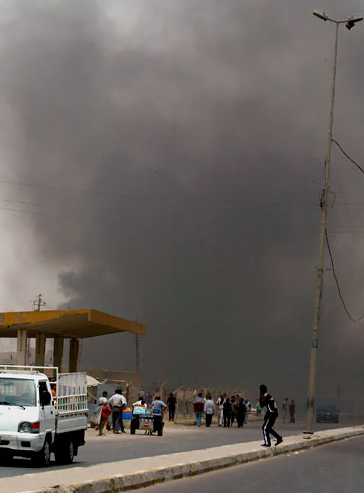
This photograph depicts the aftermath of a car bombing in Baghdad. It is one of hundreds of images that I could have grabbed from the last month’s slide shows: images of bombing, rioting, shooting, clubbing, and similar forms of violence. These are images of disruption. For example, we see the mise-en-scene of ordinary life–and the blast. Street with truck, curb with light pole, functional building and people going about their business–and looming up where there should be light and perspective, a dark cloud, miasmic, bearing bad news on an ill wind. But the cloud will disperse, the truck start up again, the people break away to get back to a semblance of routine, right?

One might see the bombing as a minor disruption of an otherwise stable social order, or as something more ominous, like the dark cloud of smoke in the photograph. Generally, the concrete street and steel structures, along with the smoke of the blast, imply that social order is the norm and violence the disruption, but one might not be too sure. Perhaps the frame is tipped one way rather than the other by images such as this one:

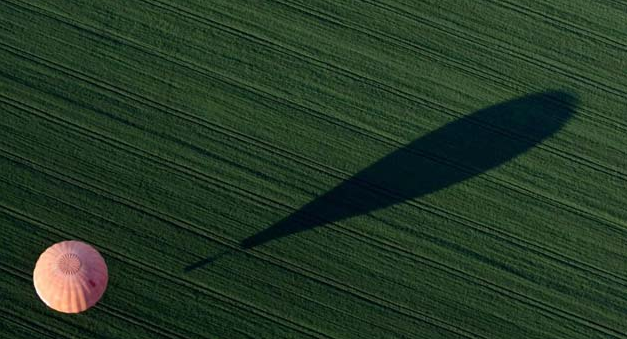
This photograph also features an ordinary scene–cultivated fields greening in the springtime–and a dark shape, but one that is not threatening. The balloon’s shadow is but an extension of the sunlight illuminating the balloon and feeding the crops below. Instead of being faced with a loss of control, the elongated shape can stand for the magnified sense of freedom and personal extension that one might feel while floating above the earth. Whether thinking of the special experience of being aloft in a hot air balloon or the collective good in verdant fields stretching to the horizon, life is good.

And so it goes. The newspapers, magazines, and slide shows feature a steady stream of both images. On the one hand, hard news images of continual disruption (whether political or natural disasters), and, on the other hand, soft news images of peace and harmony (both natural and political). It might be that journalism in a democratic society is inclined to present a dystopian world–by contrast to the obligatory good news of an authoritarian press–but that the need to hold on to readers also motivates the signs of reassurance provided by the soft news.

The question remains of which view is correct. Which tendency is more characteristic of the species, and which might be a marginal adaptation? Is civilization the norm, with violence a marginal adaptation, or is violence the general characteristic of the population, punctuated occasionally by selective adaptations toward peace? Look again at the photographs. Which is more indicative of what is breeding at the margins today? is it light technologies and sustainable cultivation that can bring some degree of prosperity and peace across a planet riven by conflict? Or is it anarchy and war that can spread contagiously in a global order built upon the competition for non-renewable resources?

Photographs by Ahmad Al-Rubaya?AFP-Getty Images and Viktkor Veres/AFP-Getty Images.

 1 Comment

Good Grief

We have written previously about the photojournalism coming out of China with regards to the recent earthquake, noting the powerful images of a government mobilized to help its people in times of need.  And as the imagery has demonstrated, those efforts have been a model of efficiency and effectiveness that put U.S. efforts to help the victims of Hurricane Katrina to shame. But, of course, what we should not forget is that Beijing continues to house a repressive governmental regime that refuses to endorse the most basic tenets of democracy such as freedom of speech and the right to protest.  And, of course, the western media is quick to call the tune and to remind us of China’s totalitarian tendencies.  The point was driven home more recently by state efforts to intimidate the parents of school children killed in the earthquake who were protesting “shoddy school construction.”

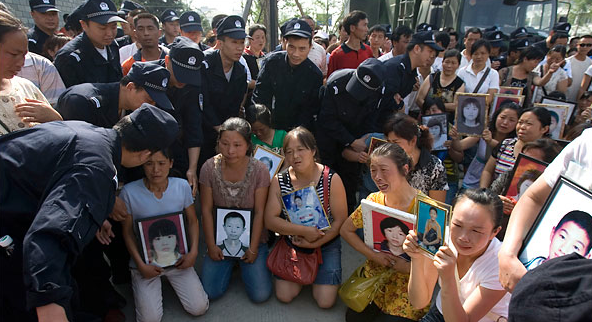
The above photograph, which anchored a story in the NYT, features the parents of school children killed in the earthquake in Dujiangyan (in the Sichuan province), as they are being confronted by the police (dressed in black).  And one can see why the western media would be attracted to it, for the image is an almost perfect representation of occidental perceptions of the  difference between totalitarianism and democracy as it portrays a black clad and masculine force quieting and controlling a feminized people (literally “brought to its knees”) clad in a wide array of colors that mark its pluralist and individualist identity.   But there is, I think, a more interesting point to be considered if we focus more directly on the parents themselves and the fact that they are all clutching photographs of their dead children.

The question, of course, is what are the parents doing? If one were to crop the parents’ faces it would be hard – at least to western eyes – to discern whether they are expressing mournful grief and sorrow or protesting a political or moral wrong.  But, of course, their faces are not cropped and they all embrace photographs of their dead children, a posture which frames the meaning of the image even as it complicates the relationship between mourning and protest, imbricating the two in a single mode of social and political action.  This relationship is accented by a set of photographs that appeared in the NYT and elsewhere of  parents posing with pictures of their dead children in more or less private and physically isolated settings and locations.

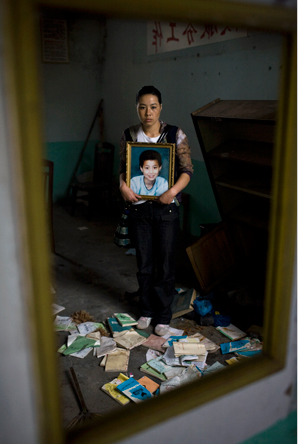
The tension in such images between the controlled but sorrowful gaze of the parent and the smiling faces of the children is palpable, producing a visual hybrid of more traditional photographic conventions that operates at the conjuncture of “offer” and “demand.”  As with most of these images, the setting records a private world turned upside down—notice the overturned bookcase in the above photograph—which, when combined over and again across a series of such shots, is emblematic of a larger public disorder. And indeed, it is the repetition of the form in photograph after photograph that animates the affective force of the image.  At some point in time the aesthetic might become a cliché, subjecting such photographic representations to theories of “compassion fatigue,” but here at least their inventional novelty seems to avoid this result.

Such photographs are interesting for what they tell us about how protest might operate in political regimes where voices cannot be spoken with impunity, for they acknowledge the threat and potency of repressive silence even as they assert the power of something like a “public screen” to challenge and subvert controls on free speech traditionally understood. The people in such images recognize that they have little status to “speak” out in protest, even if such efforts did not put them at personal risk, which they obviously do.  But, of course, being seen is a different matter. The point is especially pronounced in the above photograph of  Zhao Xiao Ying and her twelve year old son Ji Qing Zhen, which foregrounds and underscores the political performativity of posing for such images; notice, for example, how the subjects in this photograph are visually thrice removed from the political present, even as as their political presence is accented by the photographic frame: what we have is quite literally a visual representation (a photograph) of a visual representation (mirror image) of a visual performance (posing for a photojournalist) that is equal parts private and public, and thus simultaneously an expression of personal grief and collective, political protest.

The individuals in such images do not speak per se, and thus in one sense they are “seen and not heard,” but in a much larger sense their collective visual presence—as displayed in the photograph at the top of this page—demonstrates the capacity for the performance of visibility to “speak” truth to power by affecting what we might call a “visual public sphere.” 

Photo Credits:  Ng Han Guan/AP, Shiho Fuakada/NYT; For discussion of the concept of the “public screen” see Kevin DeLuca and Jennifer Pepples, “From Public Sphere to Public Screen: Democracy, Activism, and the ‘Violence’ of Seattle,” in Critical Studies in Media Communication 19 (2002): 121-51.

 2 Comments