Mar 24, 2008
Apr 10, 2009
Jul 31, 2011
Mar 17, 2013
Oct 03, 2012
Jun 08, 2009

Visual Culture Graduate Student Conference

Urban Cuts: Appropriation and Resistance in the American City

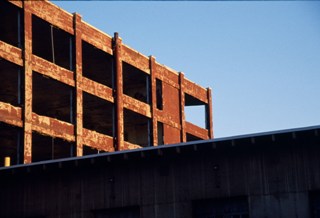
Sky cut-small

The Department of American Studies at Saint Louis University invites papers for its Second Visual Culture Graduate Student Conference, to be held April 16-18, 2010 in St. Louis, Missouri. This year’s conference theme, “Urban Cuts: Appropriation and Resistance in the American City,” coincides with the “Urban Alchemy/Gordon Matta-Clark” exhibition at the Pulitzer Foundation for the Arts, St. Louis.

Proposals are welcome from all disciplines exploring visual representations of conflicting uses and contested meanings of urban space. Taking a cue from Matta-Clark’s “cuts,” we seek contributions addressing the effects of changes in urban geography on people’s daily lives. We are particularly interested in projects that examine the role of photography, film, advertising, fine art, performance, architecture, design, and/or new media. We encourage submissions by graduate students working transnationally and comparatively on urban environments.

Topics may include, but are not limited to, the following themes:
– Representation & Iconography of Urban Space
– Demolition, Destruction & Displacement
– Fractured/Fragmented Space
– Contested Ownership
– Political Activism through Urban Space
– Memory & Subjectivity
– “Anarchitecture” as concept and practice
– Abandonment & Neglect
– Urban Renewal
– Urban Performance as Resistance

Please submit a 250-word abstract and a curriculum vitae by January 15, 2010 to vcc2010@slu.edu.
Additional information is available here. For questions, please contact Elizabeth Wolfson (vcc2010@slu.edu).

 0 Comments

Déjà Vu All Over Again

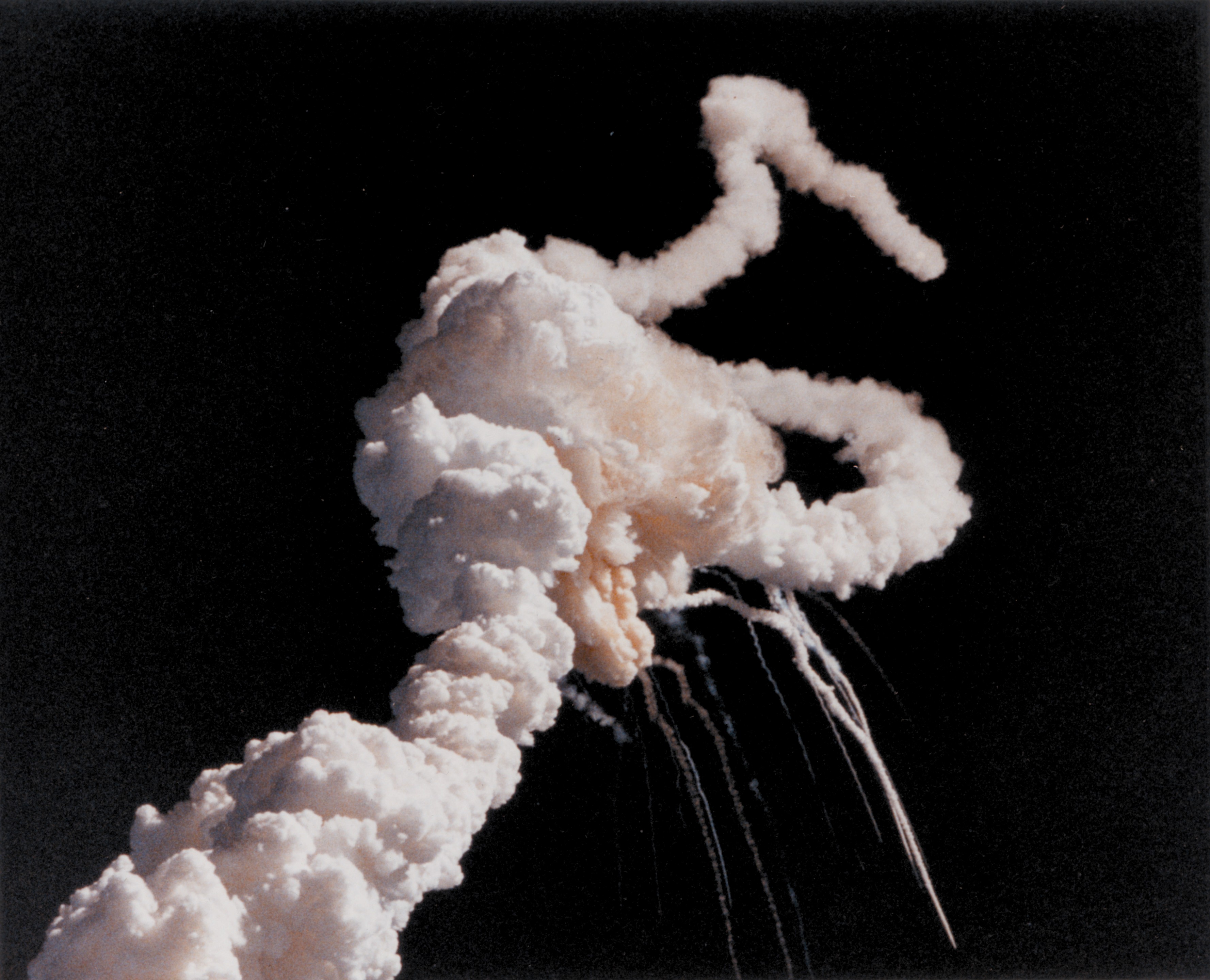
One of the primary anxieties of late modern life is modernity’s gamble, the wager that the long-term dangers of a technology-intensive society will be avoided by continued progress.  And, as with any wager, it is driven not only by calculations of probability but also by an unrelenting desire to beat the odds  There is perhaps no better representation of the anxiety that has attended modernity’s gamble than the dialectical tension animated by the iconic photographs of the tragic explosions of the Hindenburg and the Challenger: the first a dark, gothic, dystopian warning against the excesses of technological hubris, the second a bright and forward moving, utopian celebration of the heroic frontier spirit.

Enterprise 2

I was reminded of modernity’s gamble when I came across the above photograph of the recent public unveiling of the “VSS Enterprise,” named in honor of U.S. and British naval vessels, as well the “Starship Enterprise” of Star Trek fame.  The VSS Enterprise is the first commercial passenger spacecraft that will offer 300 paying customers a two and one half hour suborbital space ride—including five minutes of weightlessness—for the modest sum of $200,000 each.

The first thing to recall when considering the Hindenburg and Challenger explosions is that the events leading up to the tragic moment in each case were orchestrated as media spectacles.  And note that here too, the “unveiling,” which takes place in the Mojave dessert and in the dead of night, accompanied by “dreamlike purple lights” and “an ethereal soundtrack,”  is heavily attended by the media dutifully recording the event.  But the comparison does not stop here, for as with both the Hindenburg and the Challenger, the development of the VSS Enterprise has been beset with one technological delay after another, as well as with tragic injuries and three deaths following equipment failures and explosions.  We can only assume that more will follow.  And yet, the fetishistic desire to conquer the heavens never seems to die, a point driven home by the billionaire Richard Branson who noted, “Isn’t that the sexiest space ship ever?”

These similarities notwithstanding, it should be recalled as well that both the Hindenburg and Challenger were statist enterprises driven by a martial spirit and distinct militaristic goals—the Hindenburg underwritten by Hitler’s Nazi Germany and an interest in exploiting the advantages of air warfare, and the Challenger a manifestation of the U.S.’s involvement in the Cold War “space race”—while the VSS Enterprise is an entrepreneurial, free market enterprise.   This difference, it seems, is worth remarking upon, for while one might imagine militaristic functions as part of a “rational” public policy agenda, the current enterprise seems driven by the same hubris that led Icarus to fly too close to the sun, and one can only assume that the current “enterprise” will have a similar ending.  How else to account for such space tourists as Natasha Pavlovich, a native of Serbia who bought her ticket “on credit” because she wants to “bring pride to her native country.” In short, the fetishized,  ritualistic thrill of modernity’s gamble comes in many guises, and the desire to “beat the house” is an unyielding addiciton for indivduals and states alike, regardless of how tragically fated its failure it might be.

It is little wonder, then, that agencies like NASA stay in business and that the citizenry is willing to support them with public dollars. Or that the media is always there to play its part.   Yogi Berra had it right.

Photo Credit: Robyn Beck/AFP/Getty Images

 3 Comments

Bit Players in the Ritualization of Violence

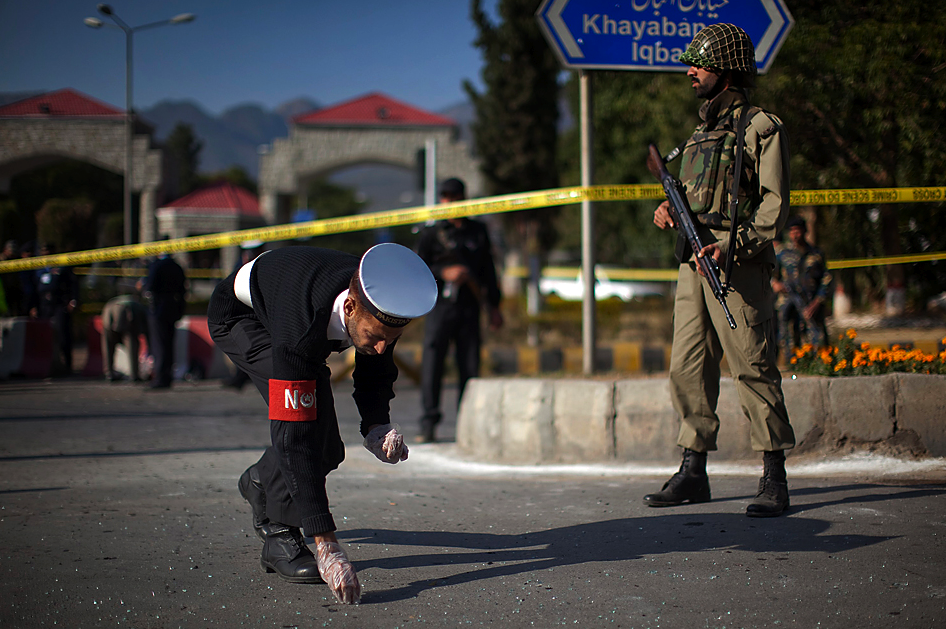
Lawrence Olivier once suggested that the key to acting was throwing yourself into your part, no matter that it might be as insignificant as the third spear carrier from the left.  The characters in this scene exemplify that advice.

body parts Pakistan

While the figure on the right stands guard, the figure the left picks up body parts in the aftermath of a suicide bombing in Islamabad, Pakistan.  Neither action is likely to be decisive in the war spreading across that country, and each seems incidental even within the small scale of this photograph: the tiny pieces of flesh being retrieved appear to be no bigger than a fingernail, while the soldier is armed and ready in a street that is once again stabilized, even static, and almost empty.  Yet they are playing their parts with complete concentration, as if the play really mattered.

This play does matter, of course, and yet the war there and in Afghanistan is haunted by the sense that a deadly serious game also is being played merely for show.  The full panoply of state action appears, albeit too late to save those who were attacked, and on behalf of the restoration of a normalcy that was already a facade.  Everything in the scene is meticulously modern: sharp uniforms, aluminum signage, yellow plastic crime scene tape (in English), even the flowers in the traffic median and the clear plastic gloves for the body-part detail.  And yet none of these investments in civic order could keep someone from detonating a bomb among innocent people.

Thus, the image is troubling because of how it captures several deep tensions within state responses to insurgencies across the globe: tensions between attentiveness and incapacity, between restoring civic order and refusing to change, between collecting the dead and ignoring the demands of the living.

Because they have played their silent roles so well, these two minor players allow the scene to speak.  The photograph depicts another instance of the normalization of violence in the 21st century.  Nor can that violence be attributed wholly to the absent suicide bomber, for every part of the mise en scene declares that such violent acts are not a primitive residue, but have become fully integrated into a ritualized modernism.  Unfortunately, it seems that too often the modern state is committed only to maintaining whatever imbalances feed its own display of power.  If so, then any show of strength really is a sham.

Photograph by Adrees Latif/Reuters.

 0 Comments

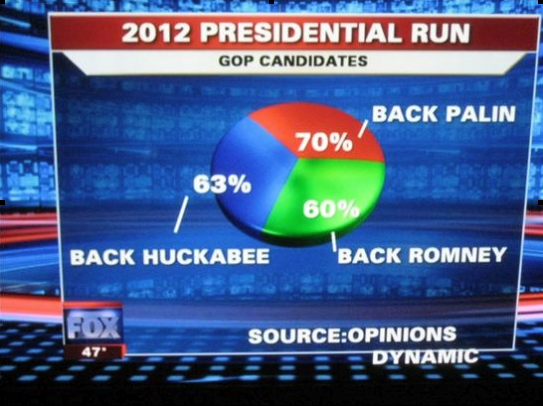
Sight Gag: Fox News, "Just do the Math!"


Fox News Graph

Credit:  Fox News, Chicago

“Sight Gags” is our weekly nod to the ironic and carnivalesque in a vibrant democratic public culture.  We typically will not comment beyond offering an identifying label, leaving the images to “speak” for themselves as much as possible.  Of course, we invite you to comment … and to send us images that you think capture the carnival of contemporary democratic public culture.

 1 Comment

Photographic Exhibition: Act of State

ACT OF STATE

Une histoire photographiée de l’occupation israélienne 1967 — 2007

(A Photographic History of the Israeli Occupation, 1967-2007)

Act of State

Curated by Ariella Azoulay

Centre de la photographie

Geneva, Switzerland

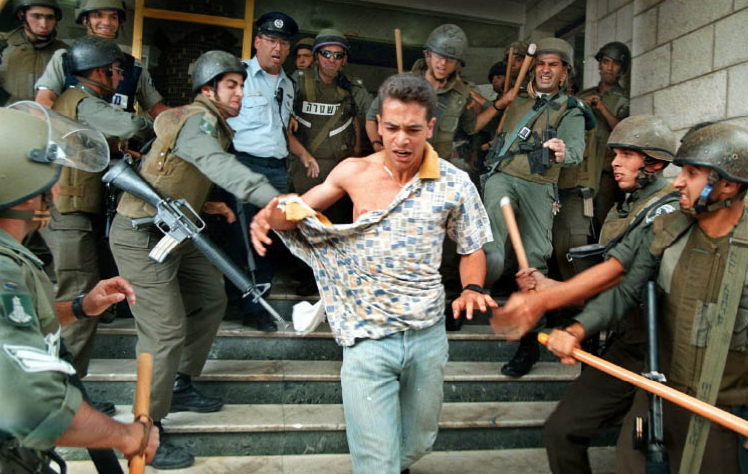
ACT OF STATE is the first photographic history of the occupation of the Palestinian territories. This exhibition documents both a history of facts and a history of representations.  The 700 photographs taken by 50 photographers are printed on A4 sheets from digital files.  The images also are available in an Italian catalogue published by Bruno Mondadori in 2008.

28, re des Bains, Ch-11205, Geneve

t +41 22 329 28 35/F +41 22 320 99 04

epg@centrephotogeneve.ch

www.centrephotogeneve.ch

December 3, 2009-January 17, 2010

Photograph by Rina Castelnuovo, 1997.  See also Ariella Azoulay, The Civil Contract of Photography.

 1 Comment

Learning What to See

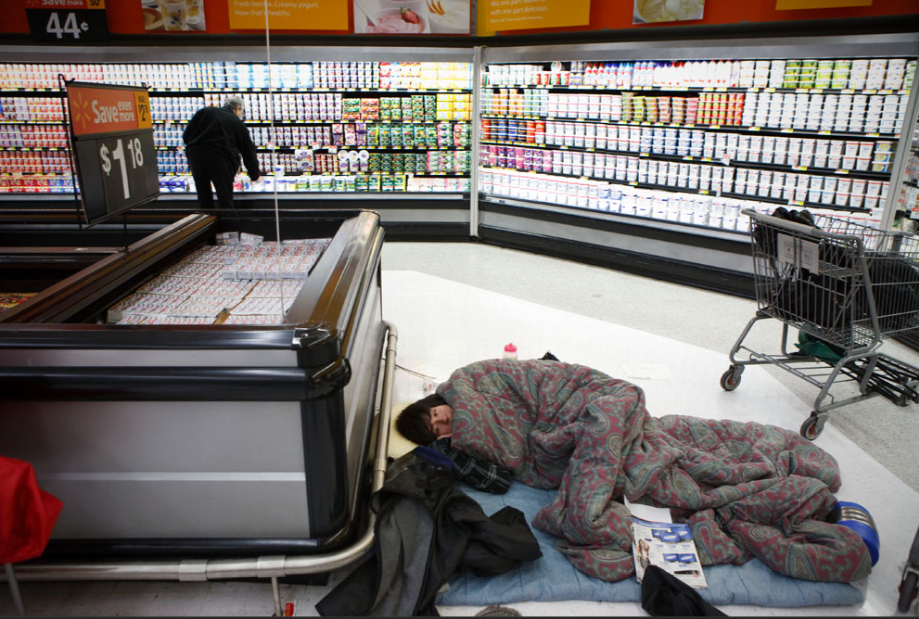
Homeless at Walmart

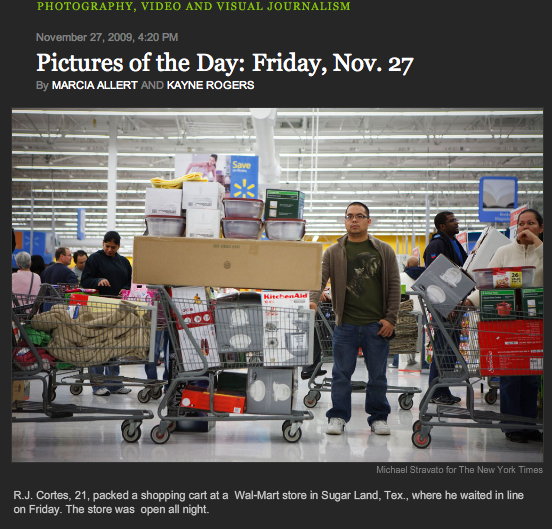
A few weeks ago I stumbled upon the movie At First Sight, a story about a man, blind from the age of three, who recovers his sight. Because he had spent most of his life sightless his brain never learned how to translate the chemical and electronic impulses transmitted to it from his eyes in a meaningful fashion.  Like a child initially learning how to read has to figure out how to translate squiggles on a page into meaningful words and then sentences, the movie’s protagonist literally has to learn how to see: colors, shapes, textures, shadows, reflections … all the of the visual aspects of the world that sighted people take for granted, he had to learn, one dimension and one image at a time.  The most pertinent moment in the film occurred for me during a scene in which the now sighted man is walking around the streets of New York City with his girl friend, reveling in the cornucopia of images  available to him.  They come across a homeless person sleeping on a door stoop and he doesn’t quite know what to make out of it; his bewilderment is compounded when his girl friend fails to even see the person laying there.  When he points the homeless person out to her she admonishes him as if he were a child, “you’re not supposed to look at that.”  The scene is a poignant allegory of the the myriad ways in which we must learn to see, including the complex  network of social norms and conventions concerning what can and cannot (or should and should not) be seen.

I was reminded of this moment from the movie when I came across the above photograph in a NYT slideshow on November 27th, the day after Thanksgiving  also known as “Black Friday.”  Cued by a number of symbolic markers, my first thought was that the camera was encouraging me to see seeming that was indecorous to look at: a homeless person—a barely recognizable individual sleeping in a public space, his face obscured and his body wrapped up in what appeared to be a grey and dirty blanket; surrounded by his few worldly goods, including the signature shopping cart, the only other person in the scene dutifully ignores him as if he isn’t there and shouldn’t be seen.  The awkwardness of the moment dissipated upon closer inspection, however, for there were things that didn’t make much sense, not least that we don’t typically see homeless people sleeping on the floor in grocery stores—after all, it’s not good for business.  And then I read the caption:  “Brian Garcia, 17, tried to nap on Friday at a Wal-Mart in Sugar Land, Tex., where he was first in line for a greatly discounted  plasma TV.”

It is possible that this photograph was intended as something of a visual irony, particularly when we consider that it was juxtaposed with other pictures in the same slideshow that implied something like an unrepentant, consumerist version of gluttony.  But there is a different and perhaps more important point to be made.  Stories and photographs about the frenzy of activity that took place in our stores and malls on Black Friday were ubiquitous across local and national media.  And for the most part what we were being invited to see was the world of commerce doing what it does.  Individual shoppers might be portrayed as going overboard in buying too much, or as being unduly cautious as they wait for “deep discounts” before they make their holiday purchases.  But in either case we were being encouraged to seeing consumers and businesses doing what they do.  What we didn’t see were those incapable of being consumer-citizens.  And most of all, we didn’t see the homeless.  To make the point take note of the fact that every year the week before Thanksgiving is National Hunger and Homeless Awareness Week.  This year that would have been November 15-21. If you rely on the major news outlets for your information—print or broadcast—you probably wouldn’t know that since, as far as I can tell, not a single national newspaper or network carried a story about it.  Not a one!  Apparently its not something we are supposed to see … or look at.

Photo Credit:  Michael Stravato/New York Times

 1 Comment

Accidental Truths in Images of the Afghan War

Much of the time, photographs provide the ideal pretext for those who would deny the obvious.  The gambit goes like this: someone, often a photographer with intimate knowledge of the setting, takes a photograph that  is circulated by the press and then used as evidence in political argument.  At that point, the defender of the policy being questioned responds by focusing exclusively on the photograph’s evidentiary problems: the image shows only a single event; things might have looked very different a moment before or after; expressions can’t be trusted; much is not being shown; given these problems, the use of the photo is proof of bias.  Such objections rightly carry weight as each is true of photography in general and can provide a reasonable basis for skepticism.  The problem is that they also are used to deflect deliberation about serious problems, including environmental damage, economic and social decline, and tragic mistakes in foreign policy.   Worse yet, these seemingly reasonable caveats can bring one to overlook the facts when they are staring you in the face.
US soldier training Afghan police

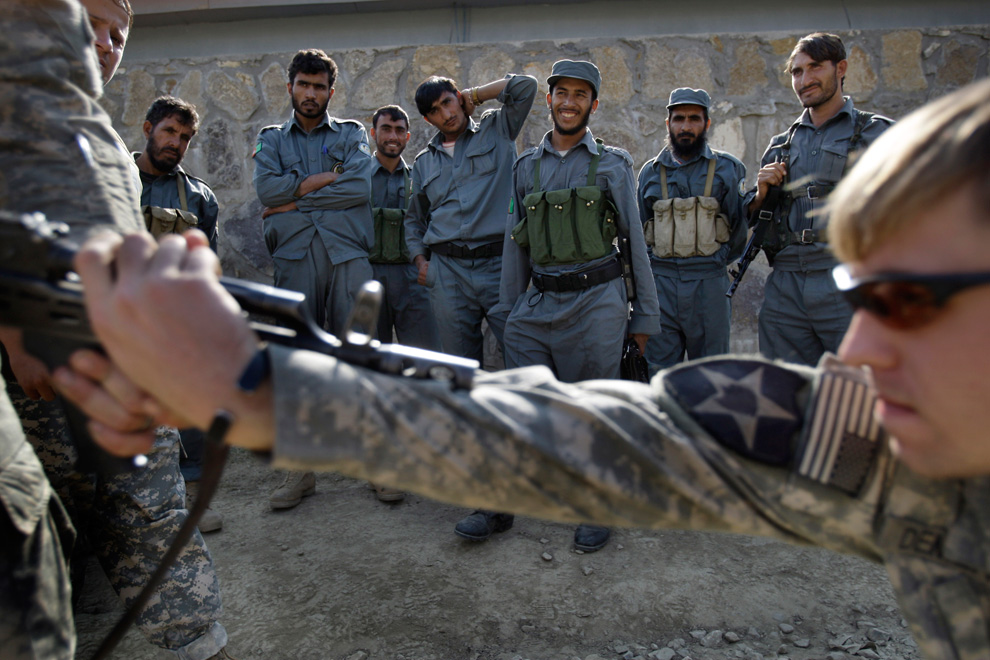
This recent photograph from Afghanistan is a good example of how images can simultaneously both reveal the truth and provide fodder for its denial.  The caption at The Big Picture said, “Afghan National policemen look on as U.S. soldier Cpl. Joseph Dement, right, from the 2nd Battalion, 12th Infantry Regiment, 4th Brigade Combat Team, 4th Infantry Division helps train the police on how to apprehend a gunman at an outpost in the Pech Valley of Afghanistan’s Kunar province Thursday, Nov. 5, 2009.”  The text is chock full of facts, and so we are cued to see the scene as evidence, but of what?

One obvious answer is that Americans are training Afghan security forces, and that the training reflects the same precision and intensity found in our own superbly prepared troops.  But note the verb: the policemen “look on.”  And so they do; they look on rather than study intently as if they were committed to the same mission as the US forces, or as if they really expected to be in a situation where they would enage in close combat rather than melt away.

In fact, the photograph is a troubling picture of contradictory extremes that can’t work together and aren’t likely to prevail on their own.  On the one hand, there is the American who is entirely focused on the technical precision of the military operation, and oblivious to the complex social scene in which he is embedded.  On the other hand, the Afghan policemen represent a social field of diverse personalities and attitudes, not one of which is likely to lead to a well-organized counter-insurgency.  It’s as if the photo was from a casting call for two very different B movies: one with American action figures and the other an Afghan sitcom on the order of Hogan’s Heros.

Thus, some can see the photo as revealing a fundamental problem in the American war in Afghanistan–indeed, a problem those of us of a certain age have seen in another war in a place called Vietnam, when we were subject to many years of denial of the obvious at all levels.  But you don’t have to take that analogy to see the problem now.  For example, Comment #79 at the Big Picture slide show says that this photo “shows pretty well the situation in Afghanistan. The Americans will fail because they can’t stay forever and the moment they leave everything will collapse.”

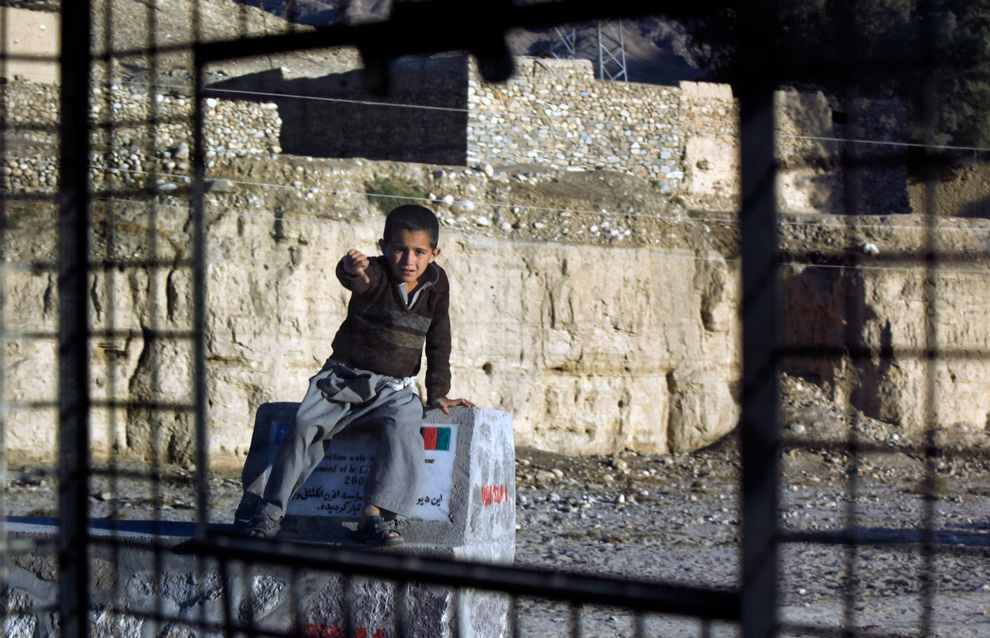
On the other side, of course, photographs depicting momentary facial expressions are tailor made for those who will seize on the single image to deny the broader picture.  Well, there are very few situations where anyone should be persuaded by a single image, and this isn’t one of them.  But it also is not a situation where political dissent should be disregarded because it turns to images to provide evidence (a term that comes from the Latin word for seeing).  When the “hearts and minds” of the people are a crucial factor in the mission, then photographs of ordinary people caught in accidental moments of time can reveal important truths.
Afghan boy thumbs down

“A young Afghan boy gives the thumbs down to a passing NATO French Foreign Legion convoy near Surobi some 50 kms east of Kabul, Afghanistan,Monday, Nov. 9, 2009” (The Big Picture).

Photographs by David Guttenfelder and Jerome Delay for the Associated Press.

 1 Comment

Giving Thanks or Giving Up?

As the Thanksgiving holiday in the US approaches, preachers, public officials, teachers, counselors, and even advertisers will be encouraging everyone to give thanks for what we might otherwise take for granted.  Because this was not likely to have been a bountiful year for most people, the ordinary, unsung features of daily life are being elevated to the status of blessings (which they are).  One might consider what would happen if similar advice were given regarding the way we look at things.  The sentiment need not even be one of gratitude so much as simple curiosity, if we would but look at what we otherwise take for granted.

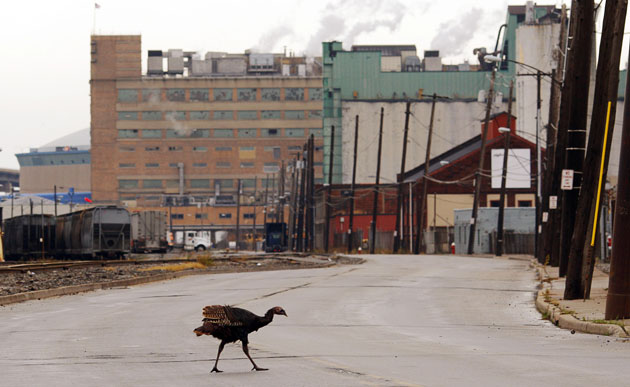
wild turkey Buffalo-New-York

This photograph provides one example of what I have in mind.  It is basically a novelty shot: a wild turkey on the street in Buffalo, New York.  Even at Thanksgiving, one doesn’t see many wild turkeys, and they are not expected to appear in an urban, industrial setting, and what could it be doing there but–I can’t resist–crossing the road to get to the other side.  No more serious response seems called for: the turkey is a small, awkward figure, yet it can dominate a scene that is both dismal and distant.  This is not the time of year for a turkey to be walking into the city, but it seems safe enough, somewhat like an ordinary commuter trudging through urban isolation.  The image might as well be comic, if it is to be noticed at all.

What strikes me about the image, however, is everything other than the turkey.  Almost every part of the photo is focused on some part of what we ordinarily overlook: the electrical poles, lines, guy wires, and signage; the cracks in the pavement, crumbling curbs, and weeds breaking them down; the rusted rail line, the road bed, and rail cars; the industrial back lot of utility buildings, ventilation ducts, smoke stacks, and air conditioners and other rooftop machines; and, increasingly, the emptiness haunting industrial sites that have been abandoned or neglected or put to too little use for too long.

Seeing the world is something that everyone in the US now does through a camera, whether they know it or not, but not the camera that shows all.  Instead, most of the time we see the beautiful vistas and happy people of what might be called the retail side of life.  We habitually edit out the power lines in the tourist photo of a busy street or the weeds lurking in the news coverage, and few stop to consider how they rarely are shown the gritty reality of de-industrialization or the sad dispersions of people, possessions, and opportunities that accompany a declining standard of living.

Were people to really look at what is around them, they would still see much to be thankful for.  But they might see reasons to become alarmed as well.  To be truly thankful involves not only a feeling of gratitude, but also a resolution to preserve the good thing and pass it along to others.  If one looks closely, it may appear that Americans are overlooking a great deal, and that their inattention and lack of care for their cities, factories, and other infrastructure is a sign not of gratitude but rather of giving up.

Photograph by Brian Snyder/Reuters.

 1 Comment

Sight Gag: Standing Up For Human Rights

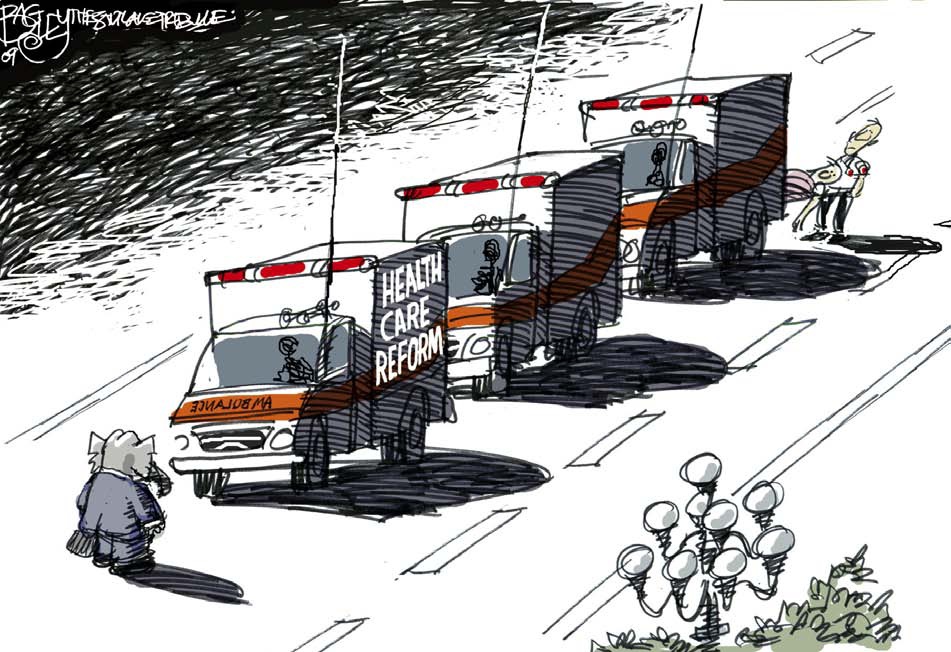
tiananmen Health Care

Credit:  Pat Bagley, Salt Lake Tribune (Note:  The cartoon is this week’s Cartoon for the Classroom “Caption Contest”  run by NIE and the Association of American Editorial Cartoonists).

“Sight Gags” is our weekly nod to the ironic and carnivalesque in a vibrant democratic public culture.  We typically will not comment beyond offering an identifying label, leaving the images to “speak” for themselves as much as possible.  Of course, we invite you to comment … and to send us images that you think capture the carnival of contemporary democratic public culture.

 2 Comments