Dec 05, 2007
May 29, 2011
May 11, 2012
Apr 28, 2014
Mar 21, 2016
May 22, 2009

北京背景 Bĕijīng Bèijĭng

Today we are pleased to welcome Alejandro Martinez to our Photographer’s Showcase at NCN.  Alejandro is an American- educated Mexican photographer.  He holds a B.A. in Studio Art and a minor in Japanese from Dartmouth College in New Hampshire.  He spent the past year in China, photographing and studying Chinese.  Currently he teaches photography at an international high school in Mexico City.

The first Beijing is the city, the second means background (as in historical or personal background or the background of an image) or backdrop .  The series is an exploration of the complexity and fragmentation of the city space as it continues to rapidly expand.  The images were taken in 2008-2009 in the aftermath of The Olympic Games.

beijing1_011

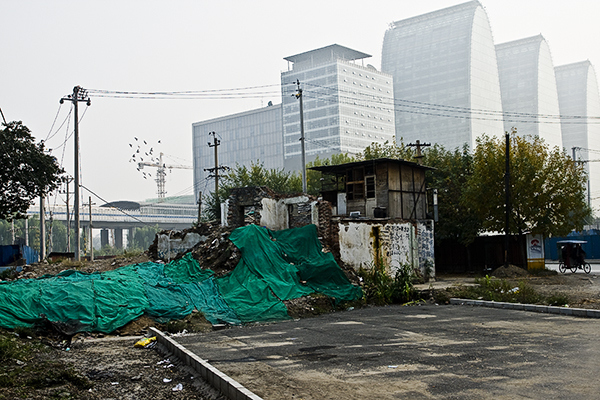
西直门 (Xizhimen):  Recently demolished structures to construct a new high rise next to a new subway station/mall/office complex.

beijing1_04

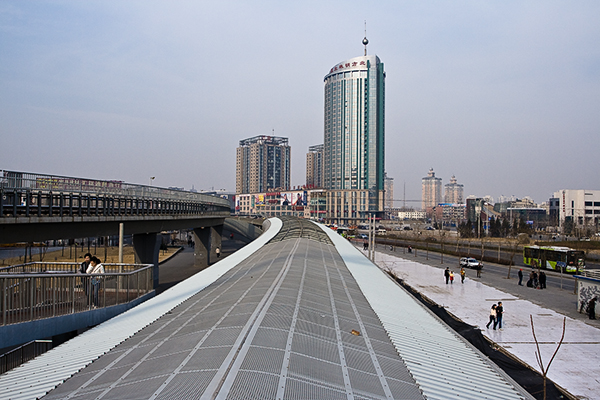
立水桥北 (Lishuiqiaobei): Looking at an upscale mall/office complex from the subway station in one of the most populated suburbs in the north part of Beijing.

beijing1_10

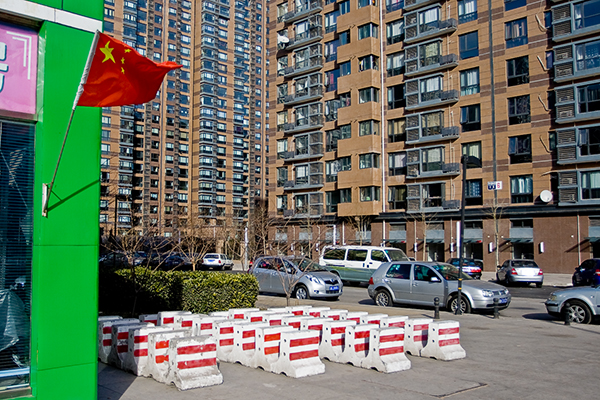
Near 国贸 (Guomao): Chinese flag flying outside a store, and traffic barriers by upscale apartment buildings close to the financial district.

beijing1_11

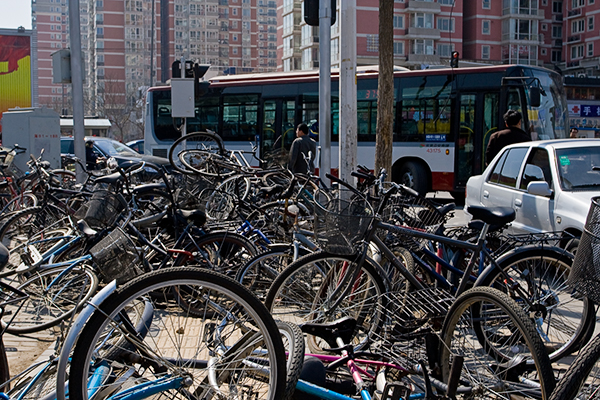
五道口 (Wudaokou): Bicycle parking by subway station in the university district.

beijing1_20

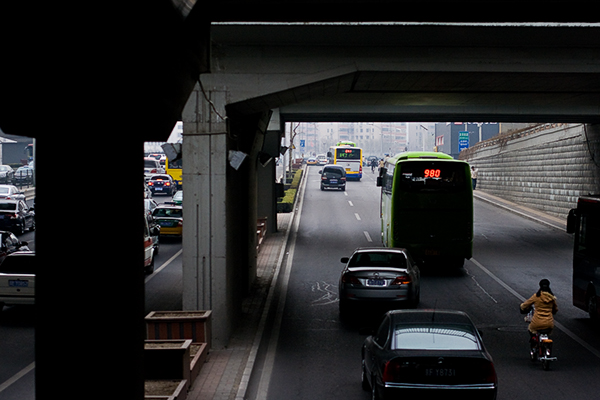
北三环 (Beisanhuan): Underpass on the 3rd Ring Road North.

These images belong a larger series exploring the city space and its people.  People can access this and other series from Alejandro’s time in China here.  They can contact him at alejandro@alexmatz.com.

 0 Comments

Art and Life at the Beach

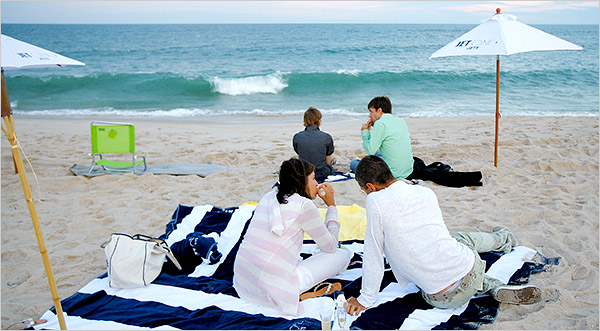
One of the attractions of the beach is that so many distinctions seem to melt away into the broad expanses of  sun, sea, and sand.  Nature offers the same three elements to whoever is there, and there seems to be room enough for everyone, and–for the day, anyway–what more does anyone really need?  But, of course, even when life’s a beach, it is a life lived one way rather than another.  This image from the Hamptons is one example of what I mean.

hamptons-beach-scene1

I had to stare at this image initially to make sure that it was a photograph.  The pictorial values are evocative of the seaside reveries that were a favorite subject for painters around 1900.  (For one example having a tone similar to this scene, see Calm Morning (1904) by Frank Weston Benson.)  But if life is following art at the Hamptons, the closer source might be a J. Crew catalog.  The causal wealth on display here reflects that narrow niche of class and ethnicity, starting with the gorgeous blue and white beach towels.  The rest of the scene is more subdued, but the pattern continues: her pink and white shirt, the white breaker of the emerald wave,  white umbrellas on orange or yellow poles, the green chair between sand and sea foam.  Somehow this world is both colorful and very white.

The blue and white towels create a space of privileged intimacy within the scene, one mirrored by the second couple as well.  One member of each pair is eating and listening, savoring, as if there is no hurry, no need to worry about running out of time or anything else.  We see them from behind, while standing at a respectful distance, as if servants waiting to be summoned.  The photo depicts a summer idyll and also the image of an ideal life, but only for the few.

It should not be surprising that people of wealth can seem so at home in an image that appears to be an oil painting.  The photographer’s achievement has been to capture a representative moment in a social stratum by evoking the appropriate pictorial tone from another art and time, albeit while also channeling the commercial iconography that defines that way of life the present.  There is more than one beach, however, and more than one way to use a camera.

orchard-beach-bronx-man-and-moat

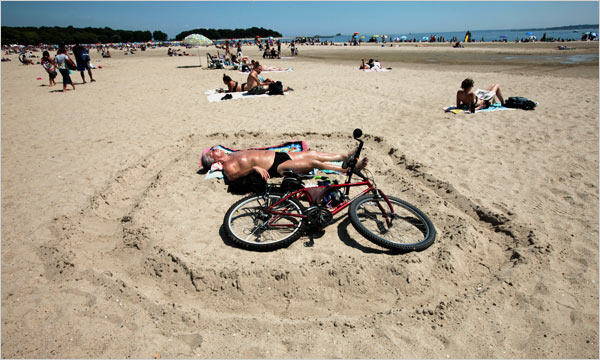
The caption in the Times (the source for both photos) read, “An early arrival at Orchard Beach in the Bronx staked out his territory on Saturday.  Estimates put the crowd at 59,000 by 5 p.m.”  I think this shot is hilarious.  It might as well be Rodney Dangerfield taking a break from Caddyshack.  The guy is a scandal according to the social and aesthetic values of the other photo: damn near naked, exposed to the world, but not before drawing a line in the sand that serves as a big “Keep Out” sign.  He looks like a beached whale with attitude, and instead of being huddled in luxury he’s stripped the day down to its essentials: bike, just enough clothing to be decent, a towel just big enough for his body, and a poor man’s moat to keep the 59,000 other people out of his face.

This slice of life on the other side of the cabana is presented courtesy of another photographic perspective. Instead of the faux intimacy of the painting, we have a documentary angle, seeing the subject from the side and set in context, as if a subject for sociological study.  And yet the distance is still respectful, allowing him the sovereignty of his temporary kingdom.  Unlike the Hamptons photograph, there is no implicit invitation via the fashion code to wish–or buy–our way into the scene.

One photo is from the beginning of summer and the other comes much closer to the end, but that is the least of their differences.  The question, however, is not which is the better way of life.  I’m not sure there even need be a question.  May you find your beach in what little summer remains.

Photographs by Jemal Countess/WireImage and Suzanne DeChillo/The New York Times.

 0 Comments

On The Difference Between Seeing Forests and Trees

The national health care debate has received an enormous amount of attention over the past few weeks, but for the most part the focus has had less to do with the state of health care and more with the incivility of protestors. As President Obama put it, “TV loves a ruckus.” Apparently so too does the print media where most of the photographic record has featured groups of protestors and reformers holding signs and/or shouting at one another, town hall meetings seemingly out of control, and the president addressing audiences in what appears to be stump speech fashion. What we have seen very little of has been any visual evidence that might help us to reflect on the actual problem of the health care system itself.

The difficulty is figuring out how to show a systemic crisis. We can display photographs of individuals in need of some, more, or better health care, but in the very process such images typically individuate the problem in ways that minimize its magnitude (we only see one person or family at a time) and mask its bureaucratic complexities (systems, by their nature, are abstract and multifaceted processes that are rarely evident in the individual case). The photograph below wrestles with these problems.

medical-care-la

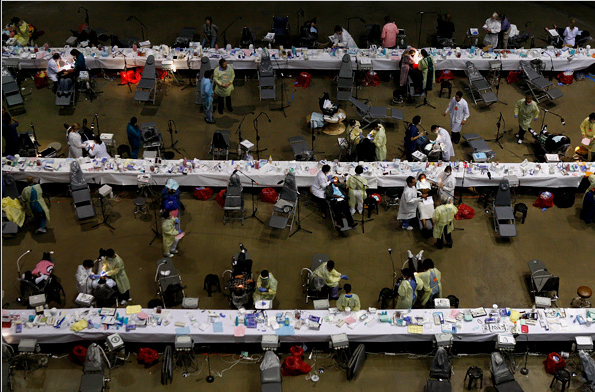
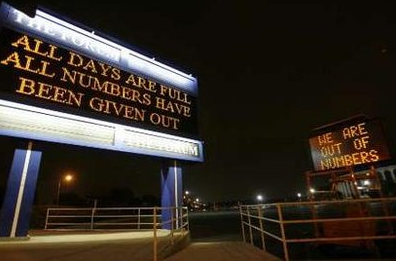
At first glance it might be hard to know what one is looking at. The photograph is shot from above and at some distance, rather like the way in which we often photograph scenes in which too close proximity to an event might put the photographer at risk of bodily harm. As we will see, the photographer’s well being is not at risk here, and so there must be some other function being served by the photographic aesthetic. The key point to note, however, is that the distance from the scene of action is accentuated by the fact that we get a fairly wide field of vision that frames the image as a landscape: it invites us to take in a wide vista, to see the whole rather than to focus on any individual part—to see the forest rather than the trees. And truth to tell, no individual is recognizable as such; indeed, in most instances it is difficult to identify even typical demographic markers as race and gender with any accuracy. There are individuals here, to be sure, but the significance of their individuality is visually minimized in the face of some larger communal or collective quality—whatever it is that they are doing or whatever it is that has brought them all together.

Here the photograph becomes harder to decipher. And so we need a caption to direct our attention: “Thousands Line Up for Free Health Care.” What we are looking at is not an overhead shot of a flea market or a trade show but a makeshift medical clinic set up inside of The Forum in Inglewood, California by Remote Area Medical, a nonprofit agency that provides free medical and dental care to people living in “remote” parts of the United States and throughout the world. One might not ordinarily think of Los Angeles County as “remote,” but therein lies at least one dimension of the systemic problem of health care in the U.S., for many—by some accounts the number is as high as 46 million citizens or 15% of the population—the issue of access is not a function of geographical proximity to medical care facilities but rather a function of the inability to pay for medical services. And in this instance thousands of people stood in line over night—many for more than one day—in order to “take a number” that would allow them access to medical services that their lack of health insurance would otherwise have made prohibitive. What the story fails to note is that when the numbers ran out many were simply turned away.

Much of the current debate over health care has emphasized the question of choice: will health care or health insurance reform effect the private, individual choice of medical services and practices. And no doubt this is a decisive issue for many people. But as this photograph suggests, if we step back to look at the entire health care system rather than the desires of private individuals, we might recognize that a considerable portion of the national community have no real choices at all.

Its all a matter of what we are able—or willing— to see.

Photo Credit: Ruth Fremson/New York Times

 1 Comment

Sight Gag: Diversity of Species in the Rainforest

oroverde-rainforest-foundation_thumb

For full size image click here.

Credit: Oro/Verde

“Sight Gags” is our weekly nod to the ironic and carnivalesque in a vibrant democratic public culture.  We typically will not comment beyond offering an identifying label, leaving the images to “speak” for themselves as much as possible.  Of course, we invite you to comment … and to send us images that you think capture the carnival of contemporary democratic public culture.

 1 Comment

Death and Mourning in Retail

By guest correspondent Troy Cooper

One of the consistent visual conventions of the current economic recession is the photograph of a store closing.  Any number of major retailers have announced their intent to shut the doors at many or all locations, and the conventional image often accompanies such news.  Record stores, due to a number of factors, not the least of which is the popularity and availability of digital music, have been phasing out over the past decade.  So the demise of another one might not be surprising, but the closing of a music megastore suggests that more can be involved than discounts and shuttered windows.

With the closing of the Virgin Megastore in New York City comes a ritual normally relegated to human loss.  In the store’s last days, we bear witness to death, loss, and mourning.

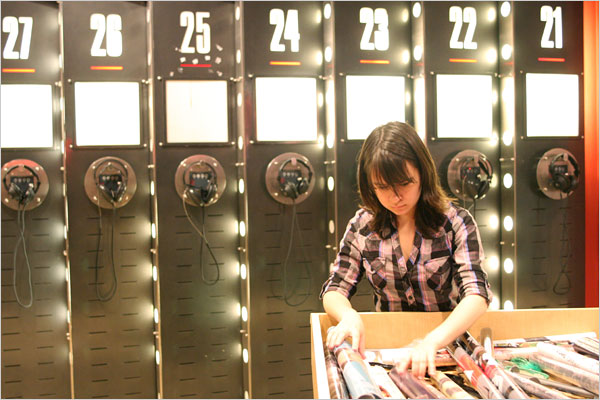
poster-bin

In a space where one would aurally browse the latest albums now resides a repetitive emptiness, as if each of these stations is an individually numbered victim of the downturn.  One might even envision the cold steel drawers of the morgue in this photo, numbered to identify the dead.  The young woman in the photograph stares dismally into the poster bin, as if in mourning of the loss behind her.  Perhaps she is there to identify a fallen loved one.  No longer do consumers share in the experience of new music side by side in the store; instead, scavengers pick through the detritus that remains.

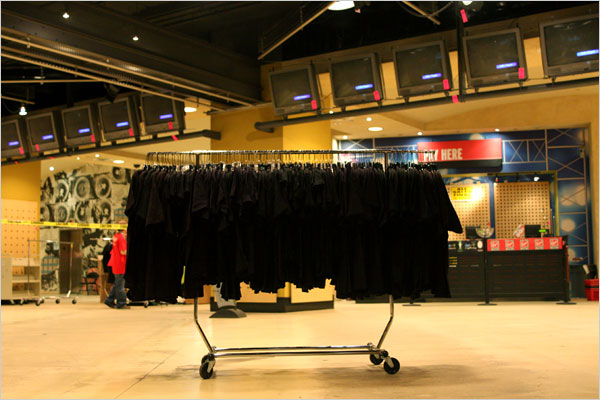
shirt-rack

Here, amid the vast emptiness of the retail floor, exists a lone rack of black Virgin-branded t-shirts, one of the last remnants of the megastore’s inventory.  The composition of this image is notable. The image of a gurney or a casket comes to mind, as the shape of the rack on wheels centers the image; the blackened televisions above suggest flatlined heart monitors.  The deceased is prepared for transport to the cemetery.  The recession has claimed a mega-victim.

Yet, what is it about the death of the megastore that gives us cause to mourn?  Our investment in consumerism is intimately tied with civic responsibility.  It is the consumer-citizen’s responsibility to tend to the dying industry, for without her attention, its lifeblood is drained.  Despite one’s best efforts to the contrary, we are all part of consumer culture.  Our roles in the culture may differ, but our commitment to capital remains constant.  While some may applaud the death of a megastore, others lament.  We all have our ways of mourning.

Interestingly, in this particular case of the store-closing photograph, we are provided a glimpse of the store’s last days.  We are allowed to witness the slow and steady death of the retail chain; perhaps we are also called to witness the death of an industry. More importantly, we are privy to the mourning process; we see human grief for the loss of commerce, exchange, goods often enjoyed in common.  The photographs ask us to consider the utility of the megastore in troubled economic times, our reactions to various effects of economic recession, and our personal relationships to consumerism.

Photograph by Jessica Ebelhar/The New York Times.

Troy Cooper is a Ph.D. Candidate in the Dept. of Communication at the University of Illinois, Urbana-Champaign.  His dissertation examines the visual rhetoric of consumer activism during the rise of modern advertising in the United States.  Troy can be contacted at tcooper2@illinois.edu.

 2 Comments

Photographs of Afghanistan: Orientalism or Critical Reflection?

Photographs can show us not only what was in front of the camera but also ways of seeing.  Two recent photos from Afghanistan each present a scene and at least two different perspectives on what is seen.  Although not representative of all the images being taken there, they can illustrate a dilemma confounding attempts to understand that distant country.

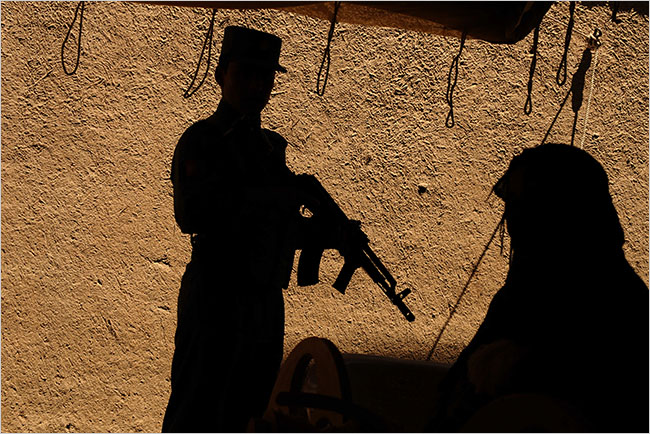
ahghan-police-silhouette

The caption at the New York Times stated that “An Afghan police officer stood guard Thursday in Kabul during a campaign stop by Ashraf Ghani, a presidential candidate.”  But is it the policeman or his silhouette?  Are we seeing his shadow cast on a wall, or is it him with everything but his outline obscured by the intense contrast between darkness and light?  One can’t be sure whether we are seeing reality or a mirage.

This illegibility that comes from casting the Afghanis in darkness can be taken in at least two ways.  We may be seeing the continuing projection, as if a movie on the wall, of a colonial world.  The local (client) militia are there in our stead, complete with colonial cap and weapons supplied by the West, but they remain shadows rather than people, much less a force to be reckoned with.  Dark, ephermeral, and mere cutouts of the Western military they are imitating, they represent only the outline of civilization against a barren backdrop close to the state of nature.  Their culture is likewise located in darkness, signified here only by the enigmatic figure in traditional garb on the right–is he being guarded or merely a spectator?  Mystery and danger are mingled together in the darkness that hides those who, for whatever reason, avoid the light–and enlightenment.

The darkness will be cooler than the sun-blasted street, however, and the photographer could be showing us not only what was there but also how little we can know about it at a glance.  (The image will have been selected for its visual distinctiveness, of course, but that doesn’t solve the interpretive problem.)  In fact, the silhouettes (whether actual or apparent) present a more accurate corollary to the caption: we are seeing exactly that–an officer standing guard–and nothing more.  For the rest, you have to not only see more but know more.  Stated otherwise, you know almost nothing about “Ashraf Ghani, a presidential candidate” from this photo, or about anything else of the event it depicts.  Thus, the photograph does the neat trick of not only documenting what is there–which may include traces of colonial relationships still present today–but also highlighting our ignorance about what we are seeing.

In sum, the photograph presents one scene but two mentalities: Someone can see it through the lens of orientalism, where the exotic other is not quite real and so a blend of fact and fiction, mystery and danger, an object of fear or desire but never an equal; or one can see it with an awareness of the ignorance that comes from not being there, not knowing the language, and having to depend on this small fragment of an image to add to what meager knowledge we might have.  Nor does one have to choose which interpretation is most real–that would be like trying to determine whether one is seeing a person or his silhouette.   And, of course, if you have to ask. . . .

With that tension in mind, take a look at this photograph:

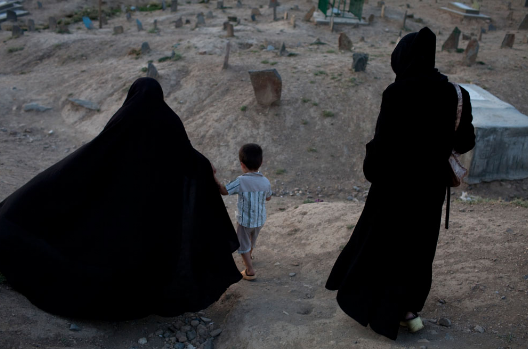
afghanis-in-kabul-cemetary

The Times caption identifies these figures as Afghans at a cemetary in Kabul.  And so they are.  And, as above, the adults (those wholly socialized into their culture) are black figures, unidentifiable save as types.  Like the seated figure above, they have their backs to the viewer.  Are they shrouded in their culture and still oriented toward the past, or are we being reminded of how little we know about this place and the people who love, grieve, live, and die there?

Photographs by Tyler Hicks/New York Times and Massoud Hossaini/Agence France-Presse—Getty Images.

 1 Comment

Between a Rock and a Hard Place

The recession has been bad for just about everyone, but it has been much worse for some than others.  And surely among those hurt the hardest have been the homeless who have become both the frequent target of hate crimes as well as the aim of criminalization laws in 273 cities nationwide making it making it illegal to eat, sit, or sleep in public places.  It is difficulty to fathom the fear that animates such violent reactions against those we might imagine are forlorn and hopeless—what is about such fellow citizens that evokes such animus?  what makes them appear to be so undeserving of our charity?— but since it comes from both vigilantes (the rock) and the state (the hard place) we can only assume that it is driven by deeply seeded anxieties.

A photograph featured by the New York Times in a story on efforts to enact hate crime statutes against those who perpetrate violence against the homeless perhaps offers the hint of an answer.

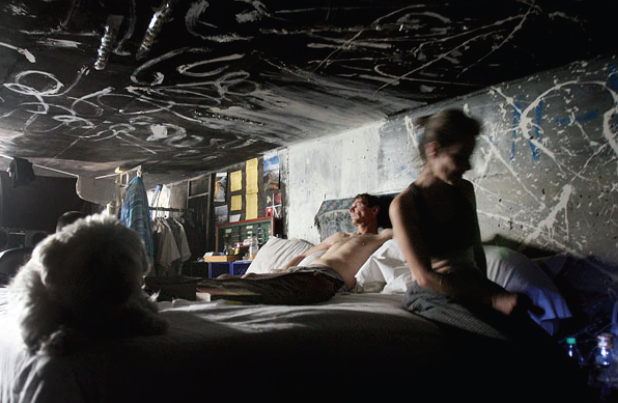
homeless-in-las-vegas

The photograph is of a couple who live in an underground flood channel beneath the Las Vegas strip. The image is shot at eye level, the vertical angle neither high nor low, and thus nullifying any sense of a power differential between the viewer and the subjects even as it suggests some degree of identification; at the same time, however, the horizontal angle is slightly oblique, detaching the viewer from the scene, perhaps even casting him or her as an outside observer. The image is thus framed formally by a tension between identification and dissociation.

The social tension that simultaneously separates and connects viewers and the viewed is marked in other respects as well.  The faces of the people are not recognizable, cast in shadows and blurred by movement, and yet they appear to be a normative heterosexual couple—perhaps even a family—as they share their neatly made bed with one another and their dog.  It is clearly not a normal house or apartment.  Distinguished by its low ceiling it has something of a cellar-like atmosphere, dark and damp.  The unrecognizable graffiti strewn across the wall and ceiling  makes even that an unlikely location however, suggesting something of a public space.  And yet for all of that it does appear to be organized as a private “room” that  bears many of the artifacts of modern living, including what looks to be a bulletin board that features colorful photographs—a reminder of or perhaps a hope for better times—and something like a desk.  And note too the book that sits next to the man’s leg as he apparently has tired of reading in bed.  Maybe he is listening to the boom box that sits behind the dog.

The most telling feature of the photograph is  surely the clothing neatly hanging on a rod in the background.  This sign of orderliness—here, a clear marker of civility—does not fit with our stereotype of the homeless as crazed, drunken or lazy vagabonds.  These are not social outcasts who tote their worldly goods bundled together in a trash bag or orphan grocery cart or who mumble to themselves while walking down the street.  They clearly know what it means to have a home. Indeed, these people could be us, the viewers, you and me.  And therein, no doubt, lies at least part of the answer to the cause of our intense fear and loathing of the homeless, for as much as scenes like this lead us to utter the mantra “there but for the grace of God,” so too do they heighten the need for dissociation.  And as history has shown, time and again, there is no more powerful mode of dissociation than casting about for scapegoats.  But that, of course, has not been history’s only lesson with respect to the practice of scapegoating.

Perhaps we too as viewers are caught between a rock and a hard place.

Photo Credit: Isaac Brekken/New York Times

 2 Comments

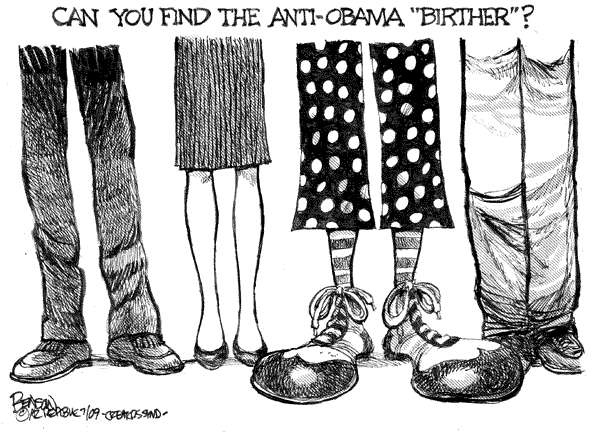
SIght Gag: Can You Find the Obama "Birther"?

benson

Credit: Benson/Arizona Republic

“Sight Gags” is our weekly nod to the ironic and carnivalesque in a vibrant democratic public culture.  We typically will not comment beyond offering an identifying label, leaving the images to “speak” for themselves as much as possible.  Of course, we invite you to comment … and to send us images that you think capture the carnival of contemporary democratic public culture.

 0 Comments

When the People Point and Shoot, What Do They See?

By guest correspondent Daniel Kim
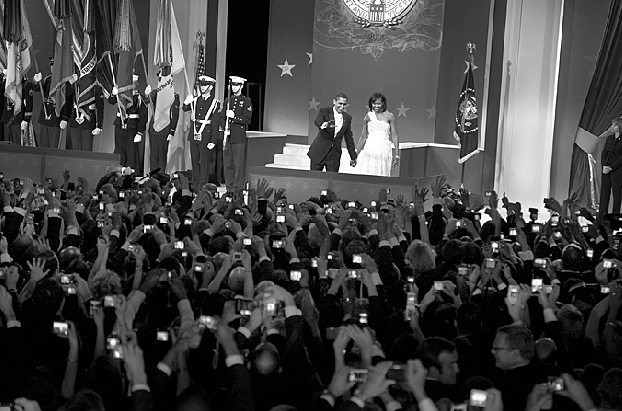
elliott_erwitt-_obamas_magnum

Peer into the small, circular opening of just about any camera’s viewfinder, and you’ll see the familiar, rectangular frame through which the photographer composes her image. There exists, however, within contemporary point-and-shoot cameras, another frame that is often relegated to the background—quite literally. This LCD frame is positioned behind the camera and it provides the photographer with an instant relay, or feedback, of what unfolds in front of her.

Photojournalists employ a pejorative term called ‘chimping,’ which denotes the act of admiring one’s own photo directly after each shot. The term is meant as a critique of the photographer who may otherwise miss an important shot within the course of his self-admiration. I do not share in this criticism, but I do want to discuss the chimping that is now ubiquitous in snapshot photography. My concern—or hope, rather—is that we can transform how we think about, and therefore, how we go about the process of looking at one another.

If we are to consider how photography can act as democratic speech—as a practice adding to the richness of citizenship—then the snapshot photographer should be capable of a degree of reflection, during the act of taking the photograph, that we have yet to witness with any regularity within the culture of everyday life.

The photo above can be read as part of a continuing critique on photography’s affair with the spectacle. But the predictability with which this phenomenon now occurs, be it at government inaugural or rock concert, reveals just how entrenched the habit of seeing through a screen becomes to those determined to capture rather than look. Taking a step back, Magnum photographer Elliott Erwitt contemplates the sight in front of him, and freezes the moment—on film. The image registers both the banality of capture and perhaps the attempt by a photographer to push the other way.

The LCD frame shares several features with the camera’s viewfinder, particularly the display of representation in real-time. But the rear-facing frame has an unmistakable resemblance to the familiar, rectangular borders enclosing what had counted as western art for centuries (i.e., that which was worthy of framing). The molded, raised plastic on the back of the camera forms a physical border, a tactile frame that cues us toward what it is that we should shoot. The framing convention of the past is now resurrected on the back of today’s common camera.

This repeated ‘shooting-and-looking’ at the ephemeral, frozen image is a two-step process that first addresses the photographic subject, and then immediately investigates the LCD frame for evidence of the photographer’s success. The photographer is now the viewer, and the viewer, the photographer. And because of the whiplash caused by chimping, the photographer now participates in a rash, malformed process—a process more interested in the ownership, or capture, of the camera’s subject than a meaningful study of another within his community.

Chimping, and the technology that enables this practice, strips away a photographer’s ritual of the past: an emerging likeness that magically appears under the red darkroom light bathed in chemically-diluted water (courtesy of Rochester). And this is not simply nostalgia. Nor is it a concession that the older craft is a better craft. Rather, the various technologies of photography can cause us to rethink, more thoughtfully, the ways in which the photographer participates in a measured exchange with not just friends and family, but also strangers we might get to know through the act of photographing.  We need not cover up our LCD screens with gaffer’s tape (as some have apparently done), but we can ask how technology leads us to look in certain ways, ways that resist contemplation and limit relationships. And we might consider how to use the same technology to see each other anew rather than as objects to be consumed.

Perhaps, we should celebrate a different kind of ubiquity–the prospect of affordable technology for the purposes of capturing loved ones, strangers, and the details of everyday life. And significantly, as argued here, we should celebrate that the shared viewing of a small LCD screen to show off images to others, enacts and instigates a sense of community. The larger point is this: accessibility need not be at odds with a reconsideration of our photographic practice.  Such rethinking can work toward the democratization of attentive, measured ways of photographing each other—looking at each other—for amateurs, enthusiasts, and professionals alike.

Photograph by Elliott Erwitt/Magnum

Daniel Kim is a former photojournalist and recently completed his first year of Ph.D. study in rhetoric in the Department of Communication, University of Colorado.  He can be reached at daniel.h.kim@colorado.edu.

 0 Comments

Monster Mash During the Dog Days

The news on a slow news day is not like slow food–it’s often more like junk food.  But there is better and worse in junk food, and the same holds for what the press serves up during the summer doldrums.  Time Magazine recently put up a slide show about the zombie walks and related zombie festivals in various cities around the globe.  (There have been several events this summer, along with auditions for the London Bridge Experience staged for tourists, while some of the photos document choice displays in previous years.)  But I’m getting ahead of the show, which started with this beauty:

zombie-frankfurt

And he is gorgeous, isn’t he?  As much as I like The Night of the Living Dead, there definitely has been a fashion upgrade in the ensuing decades.  Purists might point out that there is little in the way of genuine corruption evident in this dude: the hair, piercings, beard, and bone structure are stylish in any case, while the make-up only highlights those bedroom eyes.  Romance or Romanticism, he’s got it down.

But why look at a walking corpse, or act like one?  As with the movie, these zombies might be providing a ghastly simulacrum of the “normal” society seen walking about during the day.   The undead can display bodily cravings that otherwise are kept under wraps, and the reactions of those still not buried can reveal social norms that mutilate and kill.  If so, this guy really is a model, because he suggests that fashion dominates modern life and that art is not enough to overcome the distance between one soul and another.

Unless, of course, you have the good sense to not take any of this too seriously.  And so my admiration for the first image was topped by the good laugh I had when I saw this photograph:

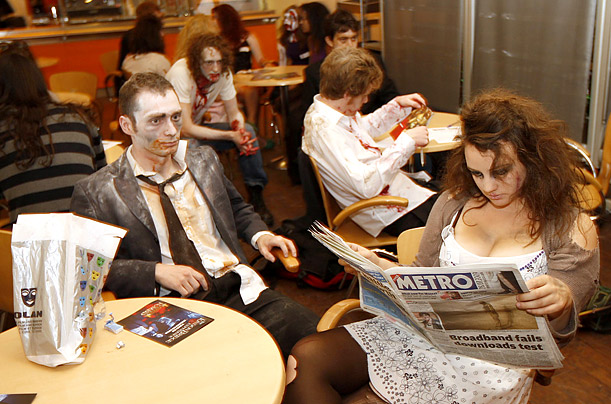
zombies-london

These zombies are waiting in a cafe before their auditions in London.  God, I love this tableau.  Even the zombie life can come to this, another day of deadening routine.  Worse, you have to believe they could be ordinary customers not in costume.  He’s shell shocked by another day in a job that is sucking the life out of him; she’s already so bored with the relationship that she could croak.  The living dead, indeed.

The moral of the second photo is that we shouldn’t be too quick to assume that ordinary activity is a sign of life, or that the living aren’t already succumbing to mindlessness.  The moral of the first might be that artistic attentiveness, which is the opposite of mindlessness, can both liberate and isolate.  Alive or undead, there are no easy answers in how to live your life.

Photographs by Johannes Eisele/Reuters and Stephen Hird/Reuters.their auditions.

 0 Comments