Aug 14, 2009
Jan 11, 2008
Nov 30, 2012
Nov 30, 2015
Nov 15, 2013
Aug 20, 2008

Environmental Transformation

Guest post by Aric Mayer
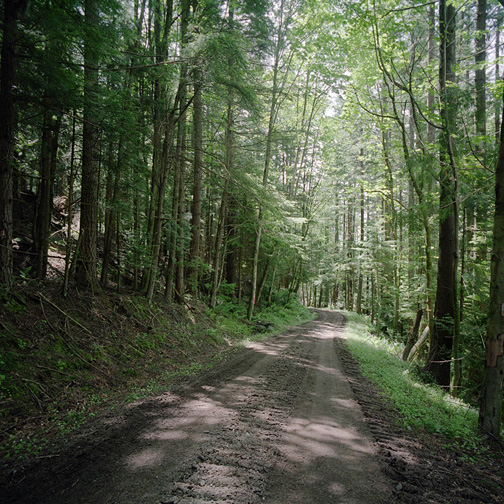
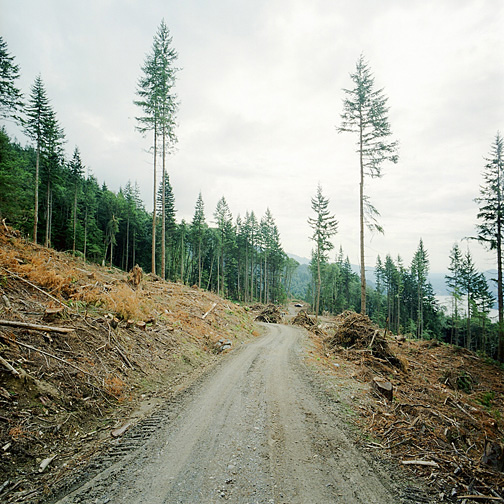
For the past few months I have been following a logging operation that is taking place within the watershed of Bellingham, Washington. High up on the hillsides above Lake Whatcom, the timber rights for public land are sold off and the trees are cut in commercial logging operations. There are many obvious problems with logging within one’s watershed. Erosion and habitat destruction are two.

There are also difficulties in visually communicating environmental transformation through photographs. Visual drama is easy to catch. It is the long, slow passage of time that pictures cannot easily touch. Cinema is a medium better suited to constructing a narrative. Photographs are fixed and therefore are unchanging. There is no passage of time within an image. Because of this, though, it is possible to see into two places in time simultaneously. The effects can be jarring, especially when it is the same place in two radically altered states.

The first picture above is a view of a healthy middle-aged forest. In another 20 years, the trees would have thinned out, with the stronger trees thickening and growing taller, pushing out the weaker in the quest for sunlight, and the weaker trees falling and contributing through their decay to the life of the forest floor. In the second image, taken some weeks after the first, the forest is completely destroyed in a commercial logging operation. For a decade this will be almost entirely uninhabitable land. With no trees to impede the sunlight, brush and weeds will rule. Then, slowly, birds and animals will return again to find habitat in the returning trees.

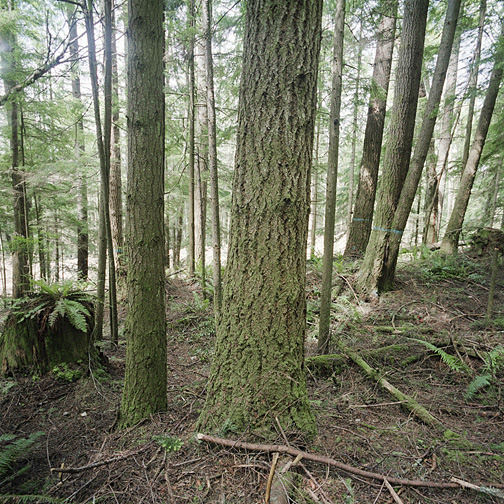
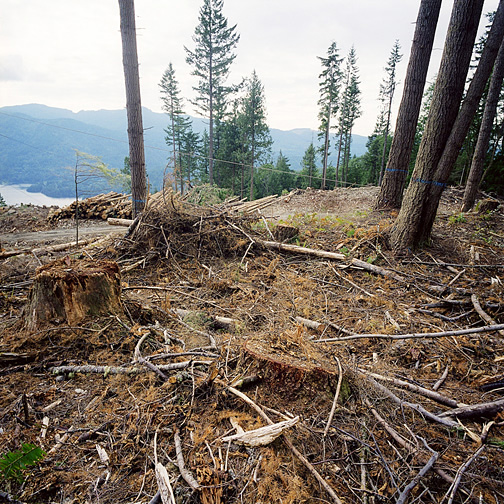
In this next pair of images, we first see trees in the foreground in a healthy forest. In the second image they are gone, cut down, dragged away, stripped and stacked on the pile of logs in the background waiting to be sent to the mill. The three less useful trees with blue painted bands in the upper right corner anchor both images. The green life has been stomped out of the foreground. Only broken branches and debris remain.

Not only are these images a record of the passing of a forest, but they are also competing visions of success. Progress in the first images takes decades to achieve. Progress in the second can be reached in just days. There is an obvious question of values here. Many of us may not be alive long enough to see this forest return. On a planet with looming environmental crises, how much cheap lumber do we need, and at what expense?

 1 Comment

Being Flooded, Letting Go

This is going to be a brief post as I’m not through cleaning up the basement that was flooded this weekend. Of course, the damage was not even close to what people are experiencing in the Gulf Coast, while many other people will not have had to worry about water at all. The question for all of us, regardless of circumstances, is what is there to learn from being flooded? When I looked through the photographs in the papers I realized that one lesson was hidden in plain sight. Somewhat like this, perhaps:

You are looking at a car under water on a Chicago highway. Nice car, isn’t it? It’s also a nice photo: The dirty water is everywhere, making the car appear all the more self-contained and beautifully machined. The car is both there and not there, seen yet only partially visible, as if already being transmuted into a ghostly counterpart of itself. The streamlined design and smooth surface implies power and mystery as if it were to emerge like some god out of the primal waters, except that you know that everything is going in the other direction. This vehicle will be written off as a complete loss.

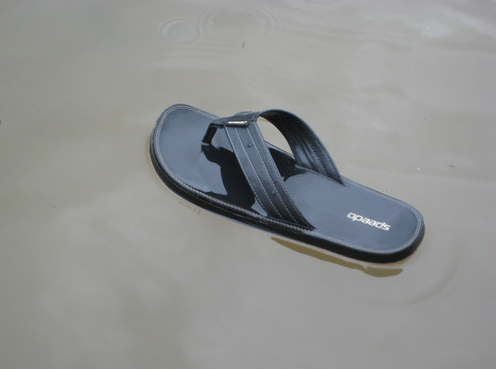
The hurricane and flood coverage has been all about loss. The loss of property, to get right down to it. Granted, there has been little loss of life and the deaths largely are unknown or kept private, but I doubt those are the only reasons that so much of the coverage features the destruction of property. The encounter with nature reveals any society’s preoccupations. A modern, capitalist society is one that is absorbed with the acquisition of material things. Nothing wrong with that, but it does shape our emotional response to what happens. Perhaps that is why I liked this photograph:

A single sandal floats, almost as if it had been made for floating. It is a small and inexpensive thing, yet it has the same sleek design and machined look of the car in the first photo. And this photo also is about being both present and absent. The sandal is there, ready for wear, just the thing for a wet day, and yet it is a study in subtraction. It’s mate is missing, and more to the point its owner is no longer there. Again, person and property have been separated. If the image is poignant it is because we realize that only the property remains. That sandal could last for centuries, but the naked foot that fits inside can only last a few years before being reabsorbed into the earth.

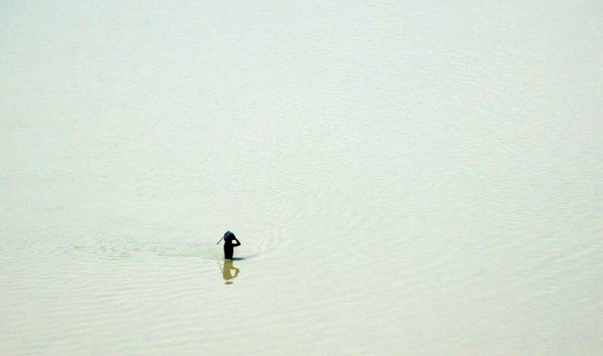
Which is why I’ll close with this photograph.

A villager is walking through floodwaters in Kumarkhad, India. The photograph reflects both the flood and a latent Orientalism, but let’s use that frame for the moment. The tone here is one of serenity–and that of the “perennial philosophy” of Eastern nonattachment. We see no property whatsoever, only a single human being half-immersed in oceanic stillness. This is not a study in loss but rather a depiction of eternal return: from nothing, through the small disruption of the waters that is human consciousness, to nothing.

I don’t think you will see many photographs like this in media coverage of the flooding in the US. People will be picking through their broken, sodden property and holding on to whatever they can. After all, what else can they do? This is no time to ask them for transcendence. Those who have not lost so much, however, might want to think about why we hold on so tightly to what are just things. Why we hold on to them because we are trying to hold on to something else that is sure to slip away.

A hard lesson, perhaps, but no reason to be mournful. Rilke knew as much:

And though you fade from earthly sight,
declare to the silent earth: I flow.
To the rushing water say: I am.

The Sonnets to Orpheus, by Rainer Maria Rilke; translation by Robert Hunter.

Photographs by Abel Uribe/Chicago Tribune, unknown/Chicago Tribune, and Diptendu Dutta/AFP.

 2 Comments

Public/Private Tears of Joy

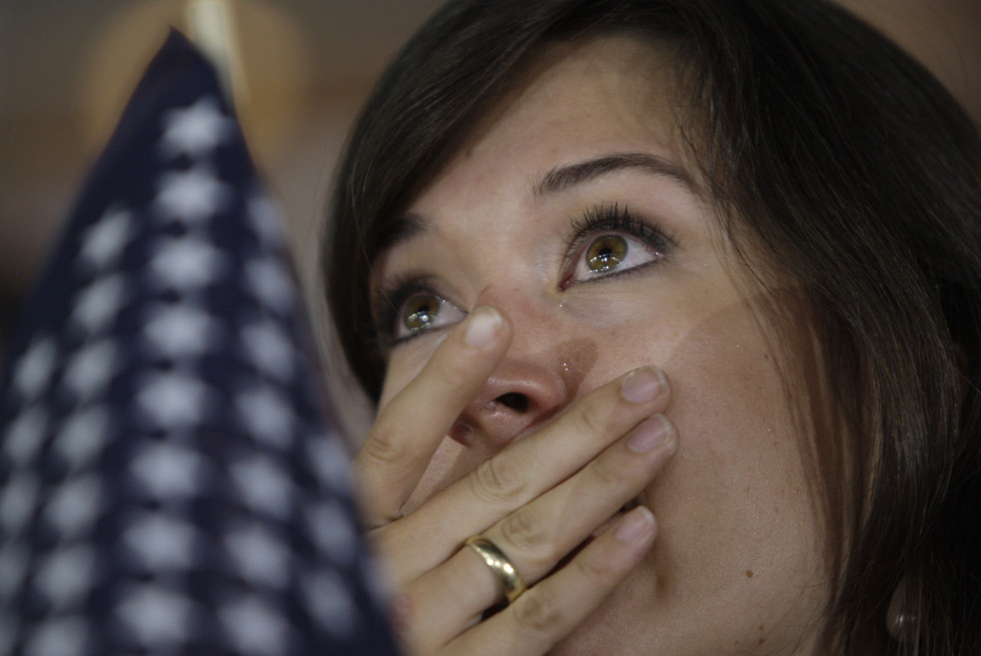
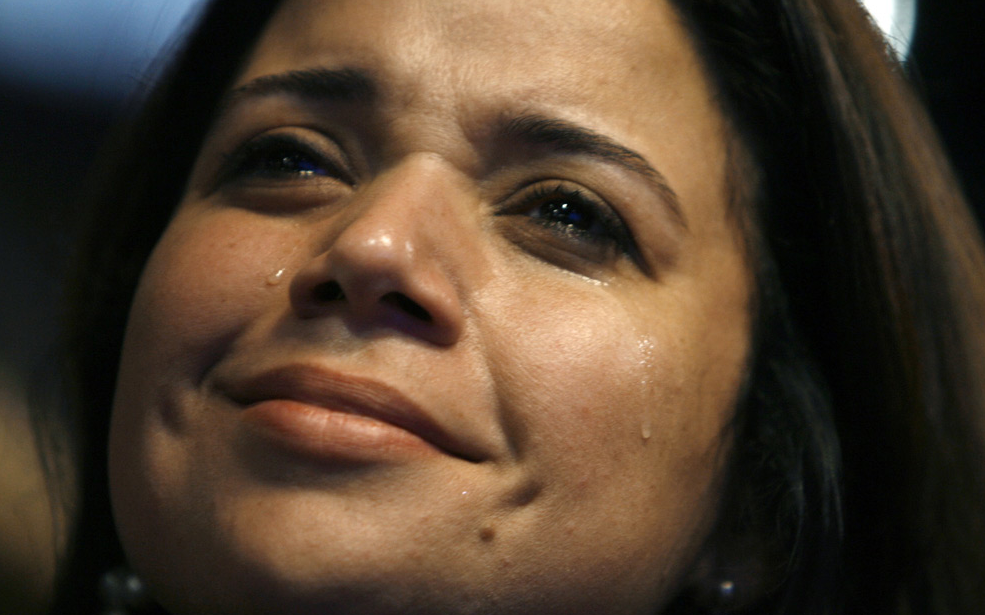
A recent slide show at The Big Picture on the 2008 Political Conventions consists of thirty-six photographs oscillating back and forth between the events that took place first in Denver and then in Minneapolis.  And what we see, quite clearly, are nearly identical, highly ritualized media events.  Most of the pictures are of crowds cheering on their respective candidates or of the candidates and their families themselves.  Two images call attention to protestors (interestingly enough both are from the Minneapolis Convention as if there were no protests in Denver) and, as has become the custom in recent years, several images reflexively call attention to the presence of the media itself.  What I found most interesting, however, were these two photographs:


Nearly identical images, their captions accent the relevant theme as each describes a woman/delegate “crying” in the presence of the acceptance speech of her chosen candidate.  Their passion in each case is palpable and intense, as each woman/delegate looks up to what we can only assume she sees as her political savior.  It is the expression of awe one might imagine in the presence of an overwhelming and sublime power, what Max Weber might have called “charisma.”  And regardless of what one might think of either candidate, the point here seems to be that the expression of such affect is an inherent part of the political process, an authentic component of the ritual of political identification.  Indeed, one would be hard pressed to say which is the Democrat and which is the Republican.*

The very way in which the photographs are framed seems to be telling in this regard. Shot from below and in extreme tight focus the images are cropped to exclude almost all signs or symbols that might distinguish and underscore party affiliation or opposition.  Even the two markers of institutional affiliation in the top image – the shield of the U.S. flag in soft focus and the gold wedding band on her hand – call attention to ambiguously normative and largely homogeneous identifications.  Republican or Democrat, the images seem to suggest, it doesn’t matter, the expression of emotion in public is inimical to our political being.  As such, these two women are something like visual synecdoches for the body politic. 

But there is more, for the expression of emotion that they privilege is not only clearly gendered feminine (we don’t see men crying for joy in the images of this slide show, nor do we tend to find them anywhere … and when we do find something comparable, as say with Howard Dean’s famous verbal “cry” for joy four years ago in Des Moines, Iowa, it is clearly vilified as inappropriate and “out of control”), but it is also portrayed in highly privatized terms.  Crying, in the western world at least, is typically an individual, not a communal, behavior, and it is generally seen as the expression of a deeply personal, individual psychic state that is more or less anathema to good public policy.  The implication here, then, is that such emotional responses are fine—perhaps even to be encouraged as a antidote to apathy and alienation— so long as they are socially disciplined and restrained. And here notice how the woman in the first image wipes away her tears, almost as if to hide them from the outside world, and the woman in the second image seems to be clenching her facial muscles as if to hold the tears back.

One can cry in public, it seems, but to do so is to isolate oneself  in some measure from the polity; it is to turn inwards in ways that divorces our “liberal” sensibilities from our “democratic” sensibilities, and in so doing nullifies the otherwise potent potentialities for a genuine “liberal-democracy.”  And it is precisely in this sense that the framing of the two photographs fully isolates these women as individuals from the thousands of delegates surrounding them, as well as the synesthesia of collective activity—the chanting and clapping and banner waving—that is the hallmark of such occasions.

What these photographs display then is the incredible ambivalence we have to the presence of public emotion.  Whereas in one sense these women seem to channel the body politic, in another, and at the same time, they stand as something of a caution to a too close psychic connection between the individual and the collective.  And the question for us is how to negotiate an authentic public emotionality that is not oppressively reduced to and restricted by the normative demands of a privatized, bourgeois sensibility.

* The first image is from Denver, the second from Minneapolis.

Photo Credits:  L.M. Otero/AP Photo; Damir Sagolj/Reuters 

 12 Comments

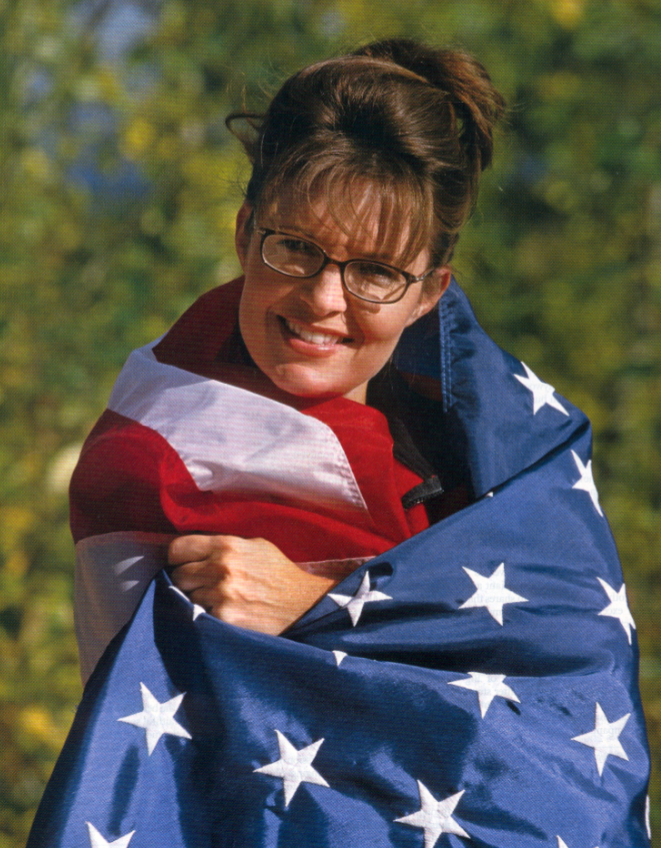
Sight Gag: Patriotic Porn

Photo Credit:  Judy Patrick/Alaska Stock in Newsweek, September 15, 2008.

“Sight Gags” is our weekly nod to the ironic and carnivalesque in a vibrant democratic public culture.  We typically will not comment beyond offering an identifying label, leaving the images to “speak” for themselves as much as possible.  Of course, we invite you to comment … and to send us images that you think capture the carnival of contemporary democratic public culture.

 8 Comments

Politics and Society in the Twentieth Century

If it seems too soon to really be in the 21st century, just take a look backwards.

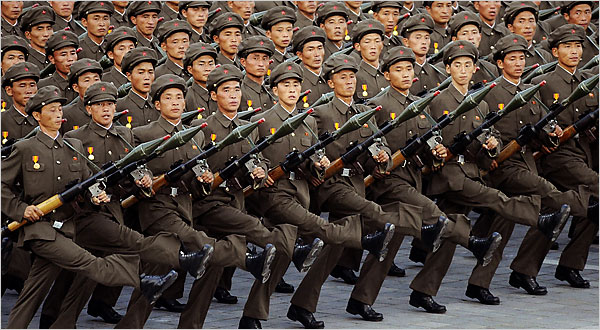
This photograph of North Korean troops on parade appeared on the front page of the New York Times earlier this week, but it’s really an example of time travel. North Korea is one of the last countries in the world that is trapped in the past century. A rigidly totalitarian state, command economy, and extreme isolation combine to keep the people miserable. For once, a stock photograph seems the appropriate documentary report.

The photo is nothing if not conventional. You can look through it to generations of Soviet May Day parades and before that the German Wehrmacht goose-stepping through Europe. Indeed, this is the most typical image of the totalitarian state: militaristic, uniformed, regimented, everyone marching in lock-step formation. Machine-like regimentation concentrates power in the state while making individuals interchangeable and expendable.

Curiously, on the same day (Wednesday, September 10) the Times featured a very different story on the same front page. I don’t have the exact photo that was used in the paper edition, but this is a variant from the online slide show:

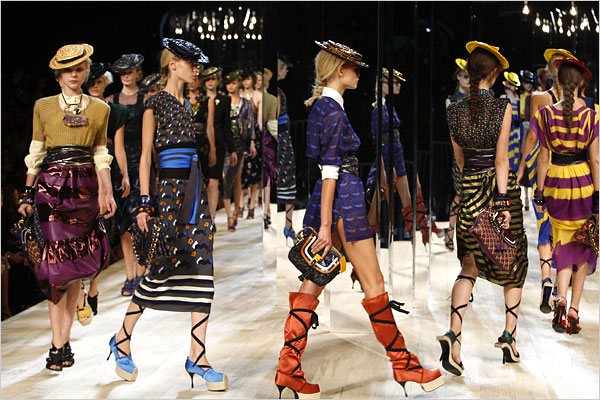
It’s Fashion Week in New York, and the show by Marc Jacobs was featured in part because he “used the early 20th century as the inspiration for his latest collection.” Compared to the photo of the North Korean soldiers, this scene would seem to be from another planet. But look again: Although each model is arrayed differently, they are marching in formation, the actual individuals are interchangeable parts in a production controlled completely by others, and the entire display has little bearing on what ordinary people actually do. The riot of color serves the same purpose as the drab uniforms of the soldiers: individuals are woven into a culture defined by a single orientation.  In one we see the massed power and collective discipline of the state, in the other the richness of the market; both are ideological displays.

The two images have something else in common: complete gender segregation. This bifurcation carries another: politics in one place, society in another. The first image reduces modern politics to the nation-state’s monopoly on violence. The second image reduces modern society to conspicuous consumption in a private sphere having no visible politics at all. Thus, both photos reproduce one of the stock assumptions of modern political thought: that politics and society are essentially separate spheres, each having its own autonomy and each disrupted by any intrusion from the other realm.

In the 21st century this fiction is becoming increasingly dated. From suicide bombers to Blackwater mercenaries, creationists to environmentalists, free trade to slow food, third world modernization to global warming, it is clear that society and politics are complexly interwoven. Of course, there still is need for distinctions that protect both individual and common interests. (I want to maintain the relative autonomy of church and state, for example.) That said, this is a time for moving beyond the old binaries. They are so twentieth century. More to the point, such stock images and conventional assumptions get in the way of creating a better world.

Photographs by Kyodo News via Associated Press and Richard Temine/New York Times.

 1 Comment

How to Party On in the Oval Office

As Jon Stewart, Stephen Colbert, and The Onion regularly demonstrate, sometimes you have to get silly to get to the truth of American politics. The guys writing their material are pros, but sometimes amateur cut-ups can do just as well.

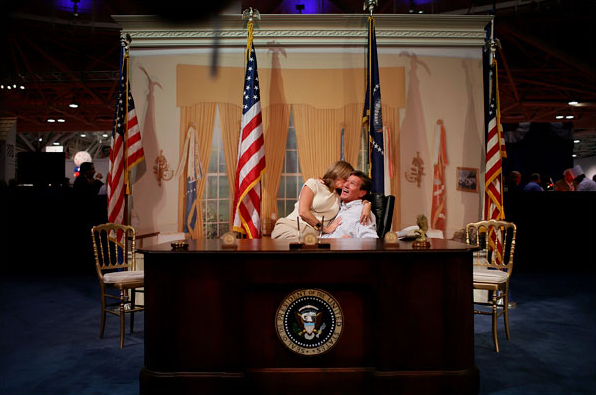
You are looking at a fun couple enjoying themselves in a replica of the Oval Office at CivicFest, “a vibrant civic festival celebrating Minnesota and American history, democracy, and the U.S. Presidency.” The event was held in Minneapolis during the Republican National Convention; in this case, it provided the locale for a delegate party. And these two do know how to party.

I’d kill to know what she’s whispering in his ear, but that’s beside the point. This photo inadvertently captures the history of the American presidency during the last ten years. Start with Bill Clinton and Monica Lewinsky. Might have been just like that. Now fast forward to John McCain and Sarah Palin. . . . Unfair? Sure, and yet there certainly is an erotic undercurrent to the current billing that leads directly to fantasy shots like this one. And in between: the frat boy, George Bush. Laura doesn’t even need to be in the picture for the rest to ring true. He’s been playing, and playing at being president, for seven years. In fact, Bush always looks most comfortable when he’s goofing around at some ceremonial gig. He probably can be a lot of fun; he just needs to be in another house.

This photo may also be prophetic. The basic idea of the CivicFest replica is that ordinary citizens can put themselves virtually into the center of the U.S. government. That, of course, is not too far from the idea of democratic representation: the people elect an official to represent their interests while providing for the general welfare. What has happened, however, is that this principle of representation has become entangled with a politics of personal identification. People are encouraged to vote for those who seem just like them: ordinary people, you know, the kind who work hard but don’t take politics too seriously. Frat boys and so-called “mavericks” seem to fit the bill, never mind that most of us are not rich and have not spent the last two decades in Congress. And don’t get me started on beauty queens.

The couple in the photo are just having a good time. More power to them. One of the secrets to the success of American politics is that political parties can make politics fun. God help us if it becomes nothing but solemn debates. But I keep coming back to this picture. It gets truer still: a stage set bedecked with the symbols of American government, yet in fact the party in power has been playing, not just with some aide, but with the integrity of our most basic institutions and the lives of our military personnel. And if American voters vote to put someone just like them into the picture, it will get worse yet.

One can’t help but feel wistful about what might have been. Even the dippy CivicFest has some sense of direction. Their blurb for the replica says, “Experience the White House Oval Office and sit behind the president’s desk, sign a bill into law and have a souvenir photo.” Ordinary people will be there for the photo, but they are given the benefit of the doubt regarding their fantasies of power. “Sign a bill into law”–what a thought. Maybe even a good bill, one that would serve the people. It could happen, you know, if only enough people would, for one day of the year, get serious.

Photograph by Todd Heisler/New York Times.

 1 Comment

John McCain and The Chocolate Factory

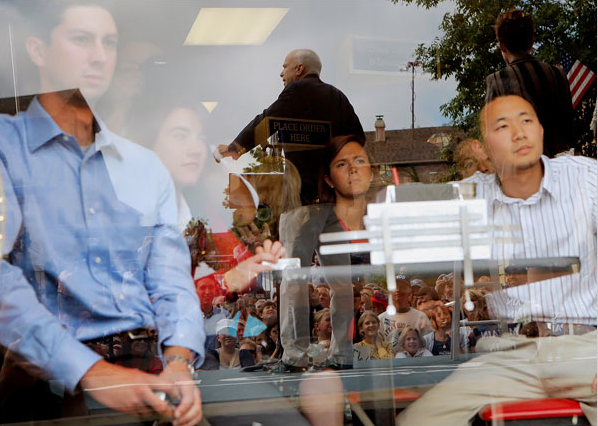
One can only wonder what the McCain campaign had in mind when they decided to hold a rally this weekend in Cedarburg, Wisconsin against the backdrop of a confectioner’s shop called “The Chocolate Factory,” but surely the allusion to “Willy Wonka” could not have escaped them.  Lest you forget, the world of Willy Wonka is a child’s utopia, a fantasyland where trees and grass are edible, ice cream doesn’t melt, the very finest of chocolate is abundant, and all of the labor is done by the Oompa-Loompa—a dark-haired, bronze-skinned, dwarfish tribe from Loompaland, a small island in the Pacific Ocean—who work for cacao beans.  And what child wouldn’t love such a world?  The problem for McCain, of course, is that children don’t vote and surely adults are smart enough to know that the promises for a comparable political utopia, say a world in which an accumulated national debt of $9,674,423,286,469.86 (and growing at the rage of $1.93 billion per day) can be managed with extensive tax cuts, is no less a fantasy than Willy Wonka’s Chocolate Factory.

But then again, maybe not. 

The photograph above is somewhat telling in this regard.  The photographer is standing at an oblique angle to the stage from which McCain speaks; the camera is aimed not at McCain, but at the storefront that is behind him and so what we see directly are the faces of customers sitting inside The Chocolate Factory; beyond that we see a reflection of what they see, including McCain’s back and the audience that he sees and addresses.  And the difference between the two audiences could not be more pronounced.  Those in the front appear to be on the same plane as McCain, neither looking up at him nor down upon him; they are thus positioned visually to judge him as equal citizens. The expressions on their faces are uniformly intense, seemingly unaffected by his appeals if not in fact somewhat skeptical of them. One could imagine them asking hard questions. But of course McCain has his back to this audience and thus doesn’t see them. In the world of fantasy, ignorance is bliss.  By contrast, the audience he does see—and indeed, the one he speaks down to—looks up at him with childlike adulation; and note here how the faces that are the most prominent in the reflection of the audience that stands in front of him are those of smiling children.  It is hard to imagine them asking pointed questions.

Two audiences, the photograph seems to suggest, both youthful and thus pointed to the future, but one mature and reflective, the other immature and animated by its sweet tooth; one seemingly ignored by the candidate and the other cast as children easily enticed by the fantasy of endless pleasures that exact no palpable costs.  And the question the photograph seems to ask is, which audience will the American people choose to be?

Photo Credit:  Bryan Snyder/Reuters

 3 Comments

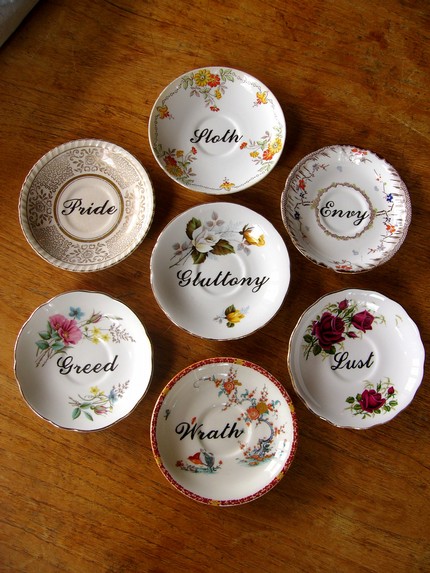
Sight Gag: The Seven Deadly Sins

“Sight Gags” is our weekly nod to the ironic and carnivalesque in a vibrant democratic public culture.  We typically will not comment beyond offering an identifying label, leaving the images to “speak” for themselves as much as possible.  Of course, we invite you to comment … and to send us images that you think capture the carnival of contemporary democratic public culture.

Photo Credit:  trixiedelicious

 1 Comment

The World in Miniature

Guest post by Aric Mayer

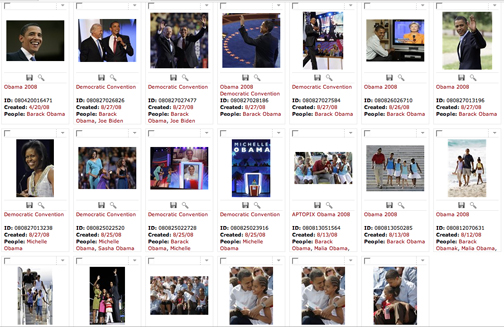
A page on the AP photo website, where a search for “Obama” yields 20,652 publishable images, or 1,033 pages just like this one.

A former colleague of mine is a photo editor at a weekly magazine. In the normal course of her job she edits a section that requires her to review up to 18,000 images a week to publish fewer than 20. Most of this editing takes place over the course of two days. As she goes through these images that are coming in off of the open wire, she knows that her competitors are looking at the same images as well. If she misses one great image that is picked up by another magazine, there is going to be some answering to do. Talk about pressure. There is a kind of marathon quality to the performance. I’m not even sure the human brain has evolved yet to handle this much volume in visual stimuli.

The technical way that almost all photo editing gets done these days is through editing programs that allow hundreds and thousands of images to be searched for by keywords and then browsed through as thumbnails. See something you like, double click on it and you get the full size preview. And here is the limiting factor. Almost any image going through this system must have some appeal as a thumbnail or it is almost sure to be overlooked. In other words, if your image doesn’t look good at one or two inches on a computer screen, it isn’t likely to make it through the editing process at all.

Due to the volume that editors are handling under tight deadlines, this is a necessary evolution. It also is a great limiting factor on the kind of work that gets published. Loud, colorful, graphically dramatic work tends to win the day. Quieter, more complex work has a tough time competing on this level because it doesn’t work at that size and in that format. We can look to another related medium, painting, to see more clearly how this works.

An early lesson that a beginning painter must learn is that scale and format really do matter. Before a painting begins, the shape and size of the surface have to be determined, and those decisions will influence the effect of the painting right through to its completion. The next lesson is that painting a larger painting is not at all like making a small painting. Increasing scale changes everything.

On the larger scale, detail at the surface level is the same only there is a lot more of it, and to make an integrated piece the detail must be related to the entire piece. Which is to say that making an 8 foot by 10 foot painting requires approximately 144 times the attention to detail than an 8 inch by 10 inch painting, since the larger painting has that much more surface area.

But, making the larger painting is not like making 144 of the smaller ones, because the entire surface must come together to make a whole. All the ingredients, including the scale, must be necessary for it to work.

What does this mean for photography? Making a bigger photograph is very different than making a smaller one. Scale matters, but the ingredients in the photograph must require that scale in order for it to be necessary. There must be sufficient detail, resolution, and interest in the photograph to hold up at scale. Since venues for larger images are shrinking while smaller images get into distribution easily on the web, the aesthetic of the thumbnail is winning the day.

Consider also the tonality of the image. Printing photographs on paper is a master craft, as is making color separations for CMYK printing in magazines. In each case, the final viewing experience is largely under the control of the printer. Not so on the web.

A few years ago I went to the opening of a gallery show exhibiting some recent photojournalism. Many of the images were familiar from their appearance in popular magazines. What was surprising to me was that the images, printed at 30×40 inches, in many cases appeared to have less impact at that size than they did at full page and double truck sizes in the magazines. On the wall they started to fall apart. The scale wasn’t necessary for the final object.

Years of working in 8.5×11 or 11×17 as maximum scale had made those photographers maximally effective in that format. With one notable exception–all work shot with a Leica on black and white negative. The grain just got sexier as it went up in size. The compositions were tight and the teeth of the film carried through. Digital images blown up past their prime need real help to make it. They tend to lose surface appeal.

The web is one of the easiest ways to distribute photography and it is one of most limiting ways to view it. Almost all of the problems I have detailed above play out over the web. Images have to be small to be viewed properly. There is significantly less detail in most computer monitors than there is in a finely made print. Each step of the way something is thrown out. By the time the image reaches you on the other end of this computer exchange, it is but a shadow of its real self– the final, beautiful, nearly perfect print.

 4 Comments

Virtual Leaders at the Republican National Convention

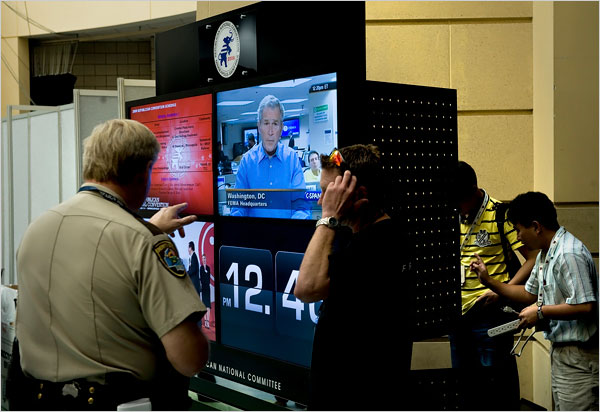
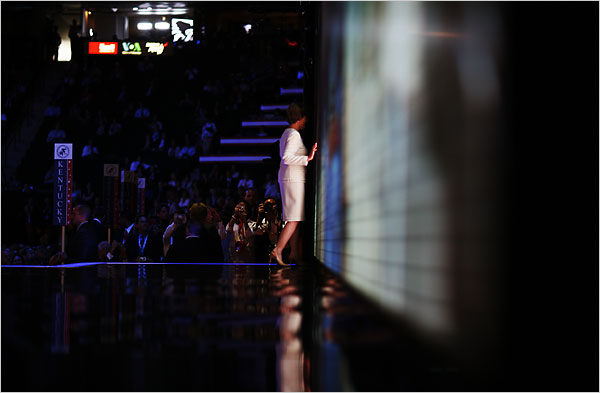
Something strange is going on at the Republican National Convention. It started a few weeks ago as the list of official no shows started to unfold and grow longer by the day. The list grew longer still as hurricane Gustav acquired force in the Gulf. As the winds roared toward New Orleans, the GOP went into full theatrical mobilization to show the world that, this time, they had leaders who were READY to LEAD. Of course, those same leaders had nothing to do and a lot of air time to fill. The result was to gear up for a virtual convention. A map of the Gulf Coast became a giant screen saver in the convention hall, and Bush and McCain appeared around the edges like pop-up videos.

Here workers in St. Paul are joined by President Bush from the FEMA center in Washington. His briefing on the hurricane preparations included the news that he would not be attending the convention. Too much to do, you know. Then a funny thing happened on the way to the coast. Hurricane Gustav missed New Orleans. Crisis over. Everything under control. Local authorities just need some time to tidy up the place before letting everyone back in.

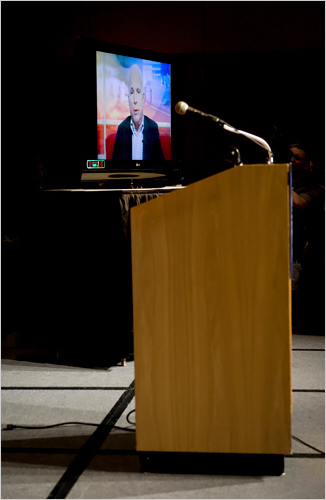
And so Bush would come to the convention after all, right? Wrong. As I’m writing this, he just gave his speech on the big screen, from the White House, in Washington. Huh? Maybe FEMA is still such a mess that the president has to help them calm down from the near miss, or maybe there is something to earlier rumors about the strategic value in having a little distance between Bush and McCain. I have no doubt that this question will be the subject of deep thought in media commentary this week. I’d like to take a different tack, however.

One of the characteristics of the digital age is that we are surrounded with screens. The multiple arrays and chance encounters with screens of all sizes create a distinctive aesthetic, one still in the making. Some of the time photojournalism is picking up on the digital environment and channeling that aesthetic. For example, there are many photographs from the primary campaign of candidates caught on screens of camcorders, cameras, cellphones, showroom TVs, airplane videos, you name it. What may be merely artistic innovation becomes particularly interesting when it captures something deeper: some current of change or unrecognized need or latent possibility. Or perhaps a hidden betrayal.

The truth captured by these vignettes of politics in a digital age is that the leadership of the Republican Party is there but not there, reporting for duty but actually somewhere else, ready to speak to their fellow citizens but only at a distance. They are virtual leaders, projecting concern while hiding behind whatever photo-op, publicity stunt, surprise announcement, or shopworn excuse they can use to avoid facing the people. Where a leader might have stood, ready to engage the American people on those issues that will test and define the nation, we see instead only an image. Indeed, today I heard a convention speaker extolling John McCain’s face. Really. The face that you see on your TV, for example. Right there, on the screen. The virtual leader.

Photographs by Brendan Smialowski/New York Times.

 1 Comment